




Abstract
Background:
A biobank is a central resource that supports basic and clinical research. RNA quality of fresh-frozen tissue specimens in the biobank is highly associated with the success of downstream applications. Therefore, it is very important to evaluate the impact of tissue processing and storage conditions on RNA quality.
Methods:
A total of 238 surgically removed tissue specimens, including esophagus, lung, liver, stomach, colon, and rectal cancer, were used to evaluate RNA quality. Two tissue homogenization methods, manual and TissueLyser, were compared and the impacts of temperature fluctuation, tissue types, storage period, and clinicopathological parameters on RNA quality were analyzed.
Results:
RNA integrity was not influenced by tissue homogenization methods and tissue types. However, RNA integrity number (RIN) values were significantly correlated with temperature fluctuation. When the power of a −80°C freezer was cut off, RNA integrity of frozen tissues was not significantly affected until the temperature increased to 0°C. When the temperature rose to room temperature and remained for 4 hours, RNA integrity was almost completely destroyed. In addition, various cancer tissues with short-term storage at −80°C (<5 years) or high tumor differentiation had higher RINs.
Conclusions:
Tissue processing and storage conditions affected RNA quality of fresh-frozen cancer tissues. It is necessary to keep storage temperature stable and keep specimens at ultralow temperatures during homogenization. Also, for a biobank containing multiple types of cancer tissue samples, it is better to store them in liquid nitrogen if the storage duration is more than 5 years.
Introduction
Human biobanks play an irreplaceable role in translational medicine and health management.1–3 A human specimen bank stores human tissues and body fluids as well as relevant clinical information and data, which can promote the study of disease mechanisms and drug discovery. 4 High quality specimens support the research of genomics, proteomics, and metabolomics and contribute to basic medicine and precision medicine. Therefore, standardized tissue processing and storage are particularly important for subsequent research.
Biobank surveys have shown that plasma, serum, fresh-frozen, and formalin-fixed paraffin-embedded tissues were the most commonly stored specimens.5,6 Among the solid tissue specimens, fresh-frozen tissue (FFT) is considered to be one of the most favored specimens because of its advantage in nucleic acids preservation and variant and gene level detection.7,8
As a simple and convenient molecular diagnostic tool, RNA reflects biological information and the characteristics of biospecimens. RNA quality has a powerful influence on molecular biology studies, such as quantitative real-time polymerase chain reaction (qRT-PCR), microarray analysis, and whole-genome sequencing.9–11 RNA is a thermodynamically stable molecule; however, it is considered to be a vulnerable molecular component of FFT and will be rapidly degraded by ubiquitous RNase enzymes in the natural environment.12,13 Thus, RNA quality is regarded as an important indicator for FFT preservation. The RNA degradation mechanisms include physiological mechanisms. A stress response in metabolism can be activated by physical trauma and warm ischemia, which can mediate RNA degradation. These perioperative variables cannot be controlled but can be inhibited. Also, freeze–thaw cycles can induce degradation, through RNA transcripts degradation, which is an autolytic mechanism, independent of cellular metabolism. 13
Purity and integrity of RNA are significant indicators of RNA quality. Previous studies have explored the relationship between RNA quality and relevant operations in biobanks, including specimen collection, processing, storage, and transportation procedures.14–17 The tumor location, surgical approach and the occurrence of anastomotic leakage are important parameters associated with RNA quality. 8 A number of studies have explored the impact of ex vivo ischemia time and storage periods on RNA quality.4,14,18–20 However, it still remains unclear whether the temperature rise caused by power failure or malfunction of the freezer influences the RNA quality of FFT specimens and then affects subsequent RNA analysis. Whether the degradation rate of RNA in various tumor tissues remains comparable is still unknown.
Thus, the aim of this study was to investigate the impact of sample processing and storage conditions, including tissue homogenization methods, temperature fluctuation, tissue types, storage duration, and clinicopathological parameters on RNA quality of FFT specimens.
Materials and Methods
Patients and specimens
A total of 238 surgically removed tissue specimens, including esophageal cancer (EC, n = 35), lung cancer (LC, n = 35), hepatocellular carcinoma (HCC, n = 35), gastric cancer (GC, n = 53), colon cancer (CC, n = 40), and rectal cancer (RC, n = 40) were collected from the Biological Resource Center of Taizhou Hospital of Zhejiang Province between January 2006 and December 2019. Among these specimens, 18 GC tissues were used to compare the impact of tissue homogenization method on RNA quality. Ten colorectal cancer (CRC) tissues were used to investigate the effect of temperature fluctuation on RNA quality.
A total of 210 cancer tissue specimens (including EC, LC, HCC, GC, CC, and RC, n = 35, respectively) were used to explore the impact of tissue types, storage period, and clinicopathological parameters on RNA quality. All samples were assessed via the mirror image method 21 and the samples with tumor cells comprising more than 65% were used for subsequent RNA quality analysis to ensure histological representativeness and to avoid areas of necrosis.
As soon as the surgical resection was completed, tissue specimens were immediately put into a prepared container and transported to the operation facility at room temperature (RT). Tissue specimens were professionally collected by the biobank personnel, and dissected into 0.5 × 0.5 × 0.5 cm3 pieces. Each piece of a specimen was placed in a labeled cryovial and stored in a cryogenic freezer after snap freezing in liquid nitrogen. All freezers were equipped with a visual real-time temperature monitoring system (Shanghai FeiRui, China).
All samples included in this study remained frozen and no thawing occurred during the entire storage period. The cold ischemia time was controlled within 30 minutes. Clinical information, including the patient characteristics, histopathological features, and pathological diagnosis, was collected from the hospital information system. This study was approved by the Tissue Bank Management Board and Ethics Committee of Taizhou Hospital of Zhejiang Province. All tissue donors signed the informed consent.
Effect of temperature fluctuation on RNA quality
The −80°C freezer is one of the most common devices for preserving specimens in the biobank. A constant temperature of the freezer is critical to sample quality. To evaluate the effect of temperature fluctuation on RNA quality of FFT specimens, 10 surgically removed tissues from CRC patients were randomly selected and sectioned into six aliquots, respectively. After snap freezing in liquid nitrogen, these specimens were stored in a normal-use empty −80°C freezer with a capacity of 816 L, and then the electrical power of the freezer was cut off.
The temperature of the freezer was determined by reading the visual real-time temperature monitoring system on a computer. When the temperature reaches a certain set value, the system will sound an alarm. As soon as the temperature of the freezer reached −80°C, −60°C, −40°C, −20°C, 0°C, and RT for 4 hours, a piece of the specimens was immediately transferred into another normal-use empty −80°C freezer, respectively. Finally, total RNA of all these specimens was extracted and RNA quality was assessed. The flowchart of this experiment's design is shown in Figure 1.

Flowchart of temperature fluctuation experiment design.
Effect of tissue homogenization methods on RNA quality
FFT specimens were weighed and homogenized using TissueLyser-32L (Shanghai JinXin, China) or homogenized in the traditional way using manual grinding. For TissueLyser homogenization, each specimen was removed from the −80°C freezer and immediately transferred to a 2 mL tube containing steel beads and 1 mL TRIzol reagent (Invitrogen), and then set in the precooled scaffold, and homogenized for 50 seconds with two cycles. For manual grinding, specimens were placed in a mortar with small amount of liquid nitrogen and immediately ground into a fine powder, then the tissue power was transferred into a 1.5 mL tube containing 1 mL TRIzol reagent and violently shaken by hand for 1 minute. During the whole process of tissue grinding, specimens were always kept in liquid nitrogen to avoid freezing and thawing.
RNA isolation and quality assessment
Total RNA was extracted by a phenol-based extraction method according to the operating instruction manual. The concentration of isolated RNA extracted from about 200 mg tissue samples was determined by NANODROP ONE (Thermo Fisher Scientific) and diluted into about 250 ng/μL to keep RNA concentration similar before RNA integrity was analyzed using the RNA 6000 Nano Kit on an Agilent Bioanalyzer 2100 (Agilent Technologies, Belgium). RNA integrity numbers (RINs) were calculated by Agilent software, and RNA integrity was detected by an entire electrophoretic trace of the RNA sample.
Statistical analysis
All statistical analyses were performed with SPSS 21.0 programs (SPSS, Inc., Chicago, IL). Measurement data are presented as mean ± standard deviation, and an independent-sample t test was used to validate the difference between two groups. One-way analysis of variance (ANOVA) or the Kruskal-Wallis test was used for intergroup comparisons. Categorical variables were presented as n (%), and the Pearson's chi-square test was used to analyze the relationship between RIN and clinical parameters. All statistical tests were two tailed. Statistical significance was set at p-value <0.05.
Results
Effect of tissue homogenization methods on RNA quality
Previously, our group analyzed the effect of the storage time and ex vivo ischemia time on RNA quality of human colon tissues and gastric cancer tissues, with all tissues being ground to a fine powder under liquid nitrogen (manual operation). In this study, for the sake of convenience, we ground tissues using the TissueLyser. To investigate the effect of tissue homogenization methods on RNA quality, 18 gastric cancer FFT specimens were randomly selected and divided into two parts and homogenized by manual grinding or by the TissueLyser, respectively. RNA quality was evaluated via RIN, 28S/18S rRNA ratio, and A260/280 ratio. The results showed that there was no significant difference in RNA quality between the manual and TissueLyser homogenization methods (RIN: 8.14 ± 0.68 vs. 8.16 ± 1.08, p = 0.962; 28S/18S ratio: 1.50 ± 0.16 vs. 1.68 ± 0.34, p = 0.058; A260/280:2.01 ± 0.06 vs. 2.04 ± 0.03, p = 0.061) (Fig. 2). Therefore, the TissueLyser homogenization method was used in the following experiments.

Effects of manual and TissueLyser homogenization methods on RNA quality of fresh-frozen cancer tissue specimens.
Effect of tissue type, storage period, and clinical parameters on RNA quality
We assessed the RNA quality of 210 tissue specimens from six types of cancer, including RC, CC, GC, EC, HCC, and LC. Every specimen type included 35 specimens. As shown in Table 1, the mean RIN values of the six tissue types were all >7.5, and the purity of RNA was acceptable. The RIN value of 79.52% (167/210) tissue specimens was 7 or higher. No significant difference was found among RINs in different tissue types (p = 0.928) (Fig. 3A).
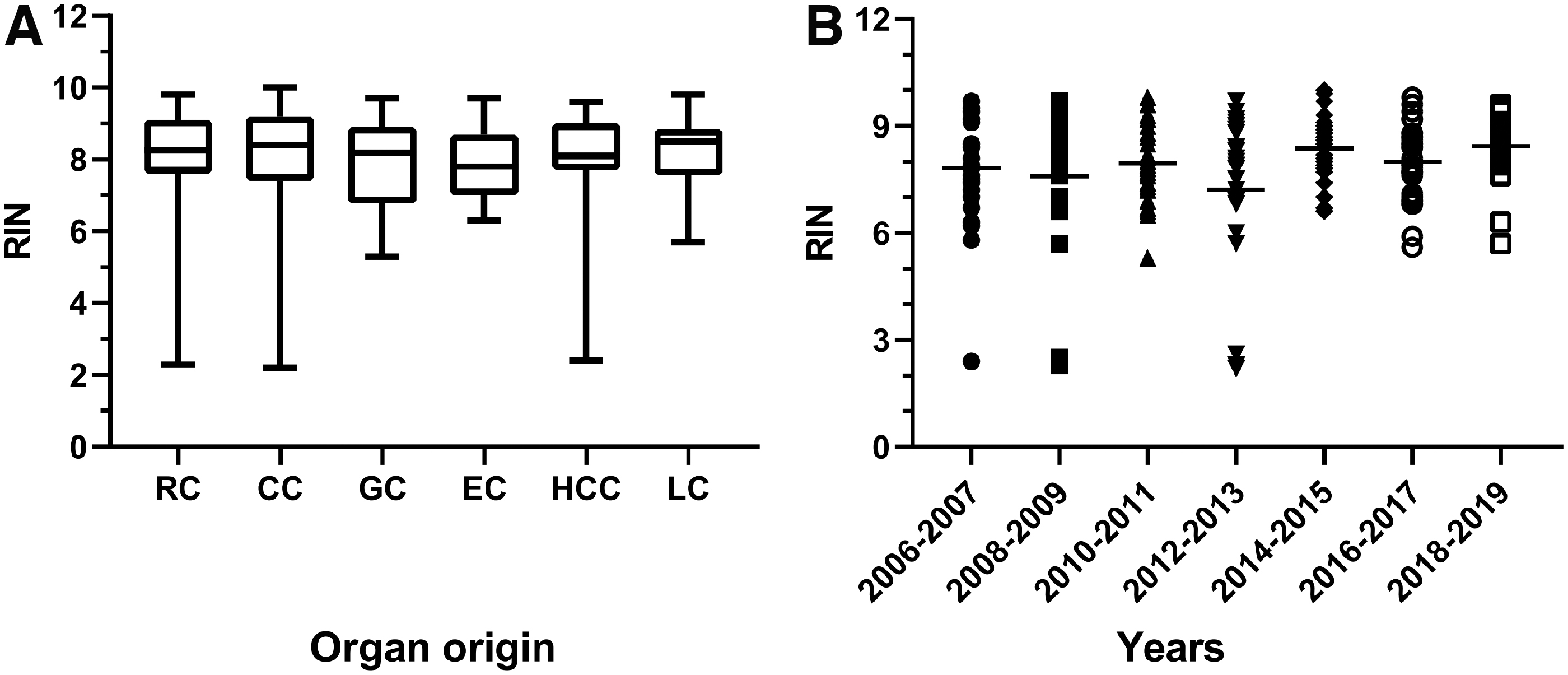
RNA integrity in various types of cancer tissue specimens during 2006–2019.
Description of RNA Quality Assessment
CC, colon cancer; EC, esophagus cancer; GC, gastric cancer; HCC, hepatocellular carcinoma; LC, lung cancer; RC, rectal cancer; RIN, RNA integrity number.
The storage time of 210 tissue specimens varied from 2 to 166 months (79.12 ± 47.36 months). RIN values had no obvious difference among different storage period groups (p = 0.203) (Fig. 3B). In addition, RIN values of only 6.67% (14/210) of specimens were lower than 3, and the average storage time of these specimens was 96.57 ± 46.23 months (Supplementary Table S1). It seems that RNA integrity was independent on the storage duration, as during 2006–2007, the RINs of RC, LC, and CC specimens were all greater than 8, while between 2012 and 2013, the average RINs of RC and HCC were lower than 7 (Supplementary Fig. S1).
To further investigate the association of the storage period and RNA integrity, specimens were divided into two groups, RIN ≥7 and RIN <7. The storage duration of 76.7% of tissue specimens in RIN <7 group was longer than 5 years, while only 60.5% of those in RIN ≥7 group was longer than 5 years. A significant difference was found between the two groups (p = 0.048) (Table 2). The results showed that the RIN was significantly correlated with the preservation time of FFT samples, including various cancer tissue types.
Storage Period Associated with RNA Integrity of Fresh-Frozen Cancer Tissues
Independent-sample t test.
Pearson's chi-square test.
SD, standard deviation.
In addition, we analyzed the relationship of clinicopathological variables and RNA integrity. The results showed that tissue specimens with higher tumor differentiation tended to show higher RIN values (50.0% vs. 70.1%, p = 0.027) (Table 3).
Clinicopathological Variables Associated with RNA Integrity in Fresh-Frozen Cancer Tissues
Pearson's chi-square test.
Temperature fluctuation influences RNA quality
Despite strict management, temperature fluctuation may still occur due to power failure or malfunction of the freezer in the biobank, which may seriously affect the quality of specimens. To evaluate the effect of temperature fluctuation on RNA quality, 10 surgically removed tissues from CRC patients were divided into 6 aliquots and stored in a normal-use empty −80°C freezer after snap freezing in liquid nitrogen. At the same time, the temperature was determined by reading the visual real-time temperature monitoring system on a computer. Then we cut off the power supply of the freezer. When the temperature of the freezer reached −80°C, −60°C, −40°C, −20°C, 0°C, and RT for 4 hours, one of the six aliquots was transferred into another normal-use empty −80°C freezer. Finally, the RNA integrity of all specimens was detected.
The results suggested that RNA integrity was not affected compared to that of specimens stored in −80°C, until temperature rose to 0°C (RIN: 8.38 ± 0.58 vs. 6.91 ± 0.87, p = 0.000; 28S/18S: 1.76 ± 0.20 vs. 1.62 ± 0.339, p = 0.273). RNA integrity was almost destroyed when temperature rose to RT and stayed for 4 hours (RIN: 1.84 ± 1.49; 28S/18S: 0.51 ± 1.58) (Fig. 4).

Effect of temperature fluctuations on RNA quality of fresh-frozen cancer tissue specimens.
Discussion
Nucleic-acid-based techniques have been widely applied to disease diagnosis, precision medicine, and molecular pathology. Compared with DNA biomarkers, RNA biomarkers have advantages in providing insights into the cellular state and regulatory processes, 22 however, RNA is more susceptible and much more easily degraded than DNA.4,23
In this study, the RNA quality of 210 tissue specimens from six types of cancer was evaluated. The results showed that the RIN value of 79.52% of tissue specimens was 7 or higher. Among them, 71.43% (25/35) of GC specimens had RINs ≥7 (7.87 ± 1.28), while in our previous research, RINs were relatively lower (6.58 ± 1.71). 21 There are two differences between the studies. For one thing, the way of tissue grinding was different. The TissueLyser was used to homogenate tissue specimens in this study, but in previous experiments, tissue specimens were ground by hand. Our results showed that tissue homogenization methods by manual or TissueLyser have little effect on RNA quality.
For another, in this study, more attention was paid to keeping the specimens in a cryogenic environment, ensuring that tissue specimens were always kept frozen and covered with liquid nitrogen during weighing and grinding. As the temperature rises, FFT will undergo a freeze–thaw cycle. The impact of repeated freeze–thaw cycles on RNA integrity has been widely confirmed. For example, Ji et al indicated that freeze–thaw cycles affected the RNA integrity of liver and muscle tissues. 24 Hu et al found that RIN values in gastrointestinal tumor tissues correlated with freeze–thaw cycles and showed a decreasing trend. 25 Kellman et al demonstrated that multiple freeze–thaw cycles led to a loss of consistency in poly (A)-enriched RNA sequencing. 26
Furthermore, the impact of temperature fluctuation on RNA quality was evaluated in this study. With the increasing cold storage temperature, the A260/280 ratios were almost all greater than 1.8, indicating that the purity of extracted RNA was not affected by temperature fluctuation. However, the 28S/18S ratio and RNA integrity of FFT specimens were gradually degraded during specimen thawing. RIN values between 1 and 4 are suitable for PCR detection with short amplification regions, while RIN values >7.0 are suitable for gene array detection with more stringent requirements. 27 The results of this study showed that the temperature fluctuation (−80°C to −20°C) of the freezer did not significantly affect RNA quality. However, RNA integrity was seriously affected when the temperature reached 0°C and was almost fully destroyed when the temperature rose up to RT and stayed for 4 hours.
The reason might be that during the temperature rising from −20°C to RT, these samples thawed and RNA was degraded, while the temperature fluctuation from −80°C to −20°C did not change the frozen state of these samples. The aim of this experiment was to mimic what happened to RNA integrity of frozen samples during the temperature increase caused by the power failure or malfunction of the freezer. Therefore, different from normal temperature fluctuations, in these cases the temperature increased relatively soon, especially in an almost empty freezer. It only took about 30 hours for temperature to reach 0°C from −80°C, and about 45 hours for temperature to reach RT. However, whether samples stored for a long time in −20°C, −40°C, or −60°C would affect RNA integrity or how long-term storage in those temperatures would affect RNA integrity was still unknown.
Anyway, it is absolutely necessary to keep temperatures stable and monitor the temperature of specimen storage devices in real time. In our center, all freezers are equipped with a visual real-time temperature monitoring system. When the temperature reaches a certain set value, the system will instantly sound an alarm and send the information to the staff. We determined the temperature by reading the visual real-time temperature monitoring system on the computer for more accurately measuring the temperature in this study.
As we know, the effect of storage period on RNA quality of FFT specimens still remains controversial. In this context, we found that there was a significant negative correlation between RIN value and storage period. After various types of FFT specimens were stored at −80°C for more than 5 years, RIN values significantly decreased. The result is consistent with Wang's report. 20 Therefore, for long-term storage of FFT samples, liquid nitrogen may be a better choice than cryogenic freezers for a biobank containing various types of cancer tissue samples, because liquid nitrogen can maintain a much lower temperature and has less temperature fluctuation than other freezers. Also, liquid nitrogen is relatively little influenced from external factors, such as power outages or other malfunctions.
However, some studies found that long-term storage at −80°C had no adverse impact on the RNA quality of FFT specimens.8,15,18 We suggest that this difference may be due to the tumor heterogeneity and the distribution and activity of enzymes associated with RNA degradation. Furthermore, sample size, grouping and cancer types may also be important factors affecting the statistical results.
Finally, we examined the correlation between RNA quality and tissue types of tumor, as well as clinicopathologic features. Although previous studies indicated the effect of tissue sites on RNA integrity due to enzymatic activity, cellular activities, and specific microenvironment,20,28,29 no significant difference was found among RINs of various types of tumor tissues (including EC, LC, HCC, GC, CC, and RC) in this study. In the analysis of the correlation between RNA quality and clinicopathological features of patients, we observed that RNA integrity was associated with tumor differentiation. We believe that this may be due to the decreased endogenous RNase activity and intratumoral cellular activity in highly differentiated tumors, but the specific mechanism remains to be elucidated.
In summary, our results revealed that two tissue homogenization methods, manual and TissueLyser, did not affect RNA quality, however, it is critical to always keep tissues in liquid nitrogen during homogenization. Temperature fluctuation caused by power failure or malfunction of the freezer, storage period, and tumor differentiation influenced RNA integrity of frozen samples containing various types of cancer tissues. Moreover, one important limitation to this study is that we are not attempting to define biological relevance and the data are not at the level of detection to specifically determine whether the RNA from these examples were altered or misleading, since detailed RNA transcriptome analysis was not performed.
Footnotes
Authors' Contributions
Y.-Y.C.: writing-original draft (lead) and formal analysis (lead). Q.-Y.H.: methodology (lead). Q.-Y.C.: methodology (lead). W.-J.Z.: resources (lead). J.-G.Z.: acquisition of data (lead) and methodology (equal). X.Z.: resources (lead) and conceptualization (supporting). A.L.: conceptualization (lead), writing-original draft (equal), and review and editing (lead).
Author Disclosure Statement
No conflicting financial interests exist.
Funding Information
This work was supported by grants from Science and technology Bureau of Taizhou (21ywb06) and the Medical Science and Technology Project of Zhejiang Province (2023RC300).

References
Supplementary Material
Please find the following supplemental material available below.
For Open Access articles published under a Creative Commons License, all supplemental material carries the same license as the article it is associated with.
For non-Open Access articles published, all supplemental material carries a non-exclusive license, and permission requests for re-use of supplemental material or any part of supplemental material shall be sent directly to the copyright owner as specified in the copyright notice associated with the article.
