




Abstract
Rapid and uniform rewarming has been proved to be beneficial, and sometimes indispensable for the survival of cryopreserved biomaterials, inhibiting ice-recrystallization-devitrification and thermal stress-induced fracture (especially in large samples). To date, the convective water bath remains the gold standard rewarming method for small samples in the clinical settings, but it failed in the large samples (e.g., cryopreserved tissues and organs) due to damage caused by the slow and nonuniform heating. A single-mode electromagnetic resonance (SMER) system was developed to achieve ultrafast and uniform rewarming for large samples. In this study, we investigated the heating effects of the SMER system and compared the heating performance with water bath and air warming. A numerical model was established to further analyze the temperature change and distribution at different time points during the rewarming process. Overall, the SMER system achieved rapid heating at 331.63 ± 8.59°C min−1 while limiting the maximum thermal gradient to <9°C min−1, significantly better than the other two warming methods. The experimental results were highly consistent, indicating SMER is a promising rewarming technology for the successful cryopreservation of large biosamples.
Introduction
Cryopreservation of large biosamples has numerous applications in fundamental research and clinical settings, including bulk volume of cell suspensions for cellular therapy and vaccine development,1–3 hundreds of milliliters of blood for transfusion,4–6 and tissue and organ preservation for transplantation.7–9 Research breakthroughs in the vitrification technology, forming an amorphous glassy state by fast cooling and adding cryoprotective agents (CPAs) with a much higher concentration, reduced the cryoinjuries caused by ice formation during the cooling process.10–12
However, successful cryopreservation is still limited to a small volumes due to the remaining challenges in the rewarming process. First, a rapid rewarming rate is needed to avoid fatal ice-recrystallization or devitrification. Second, the temperature needs to be homogeneously distributed within the entire sample to prevent thermal-stress-induced fracture, especially for tissues and organs. Neither of these two goals is easy to achieve for biological samples because of their high thermal capacity and low thermal conductivity.
The current gold standard rewarming method for small samples (<3 mL) is immersing samples in a warm water bath. 13 But it fails in large samples due to the slow and nonuniform rewarming. As the sample volume increases, this convection-based heating technology inevitably experiences faster warming at the surface compared with the inner parts, causing physical damage to the samples from the increasing thermal gradient. Alternatively, air warming has been used to reduce the thermal gradient in samples, however, at the cost of an even slower warming rate than the water bath, which may lead to damage to the samples caused by recrystallization/devitrification.
The lack of a rapid and uniform warming method has hindered the large sample cryopreservation for a long time. Laser heating achieved ultrafast rewarming, but it is limited to samples with volumes in the order of microliters.14,15 It is challenging to scale up to large models and maintain the same level of energy density and penetrate the heat to the center of samples. A radiofrequency induction heating study reported successful preservation of large samples (tens of milliliters). However the heating performance relied on the high dosage of magnetic nanoparticles, which raised concerns about the cytotoxicity and potential long-term effects of the metal-based nanoparticles.16,17
Moreover, for a complex model, for example, tissues and organs, it is also challenging for nanoparticles to be uniformly distributed throughout the samples before cooling and completely removed after rewarming. The electromagnetic (EM) cavity warming system provided a promising solution by utilizing the energy through vibration of dipolar molecules,18,19 generating volumetric dielectric heating, and suppressing the dilemma of low thermal conductivities and large heat capacities of biological materials. However, the previous multimode EM cavity approaches lacked an accurate feeding frequency control system and failed in large sample rewarming due to the “thermal runaway” problem.19–22
To achieve an ultrafast and uniform rewarming for the cryopreservation of large samples, we developed a single-mode electromagnetic resonance (SMER) rewarming system.23,24 In this study, the heating performance of the proposed SMER technology was investigated experimentally and numerically, and compared with both the convective water bath rewarming and air rewarming methods. A numerical model was also established to simulate the heating process for each warming method. Temperature distribution and thermal gradient within the samples were measured experimentally and investigated numerically to evaluate the heating performance quantitatively.
Materials and Methods
Vitrification solution
Twenty-five milliliters DPVP vitrification solution in a cylindrical glass bottle was selected as the sample. 24 The DPVP solution 25 contains 41% (v/v) dimethyl sulfoxide (Sigma-Aldrich, St. Louis, MO) and 6% (w/v) polyvinylpyrrolidone (Sigma-Aldrich) in phosphate buffered saline solution (Sigma-Aldrich). Solutions were prepared on the day of the experiments.
Cooling and vitrification process
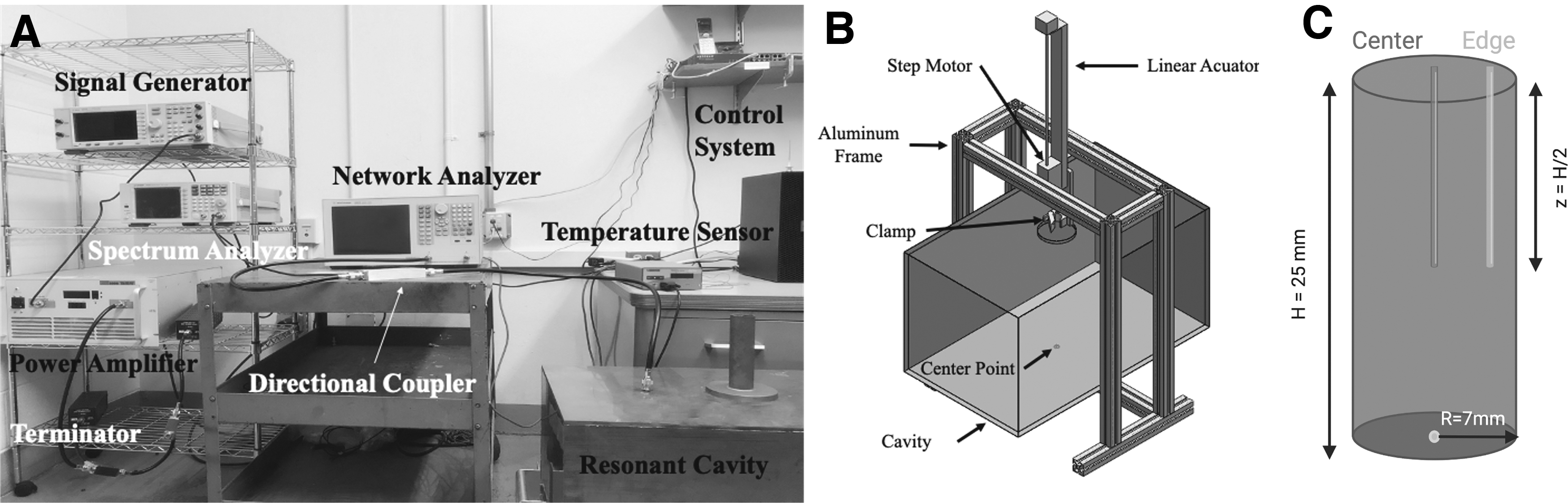
The experimental setup of the cooling device is shown in Figure 1A. The DPVP-loaded cylindrical glass container was placed in a three-dimensional (3D) printed rack and transferred to the liquid nitrogen dewar. A nylon string was used to hold the rack and adjust the height to ensure the sample holder was above the liquid level, and cooled by vapor phase nitrogen. Two fiber-optic temperature sensors (Micronor LLC, Camarillo, CA) were inserted in the center and edge of the sample to monitor the profile of temperatures.

The vitrification status was verified by visual inspection once the sample temperature reached −150°C (Fig. 1B). The vitrified samples were stored in the liquid nitrogen storage dewar for at least 24 hours before the rewarming process.
Rewarming process
Three rewarming methods were applied for comparison: (1) natural air convection: the vitrified samples were put on the laboratory bench at room temperature (21°C–23°C); (2) convective water bath: the samples were quickly transferred to a 37°C water bath with shaking at 60 revolution per minute in an orbital motion; and (3) SMER system: samples were quickly transferred to the EM resonant cavity with a maximum input power of 400 W. The heating process was recorded by temperature sensors and terminated when the sample temperature reached 0°C. The average rewarming rate for each method was calculated between −150°C and 0°C.
In the SMER rewarming method, the EM energy was created by a signal generator (Keysight Technologies, Santa Rosa, CA) and amplified (OPHIR RF, Los Angeles, CA) into a resonant cavity with previously defined dimensions at 680 × 400 × 350 mm. 26 During rewarming, the resonant state within the cavity was excited with an initial feeding frequency of ∼430 MHz. The schematic of the system setup is shown in Figure 2A, with a detailed 3D drawing of the resonant cavity in Figure 2B. The resonant frequency in the cavity was measured by the system along the heating process and the input EM frequency was adjusted accordingly to keep the cavity in a resonant state.
Numerical simulation
Applying the finite element method, the numerical modeling of the air warming, convective water bath, and SMER technology were accomplished with COMSOL Multiphysics (COMSOL Inc., Burlington, MA). The parameters of the numerical model and measurements of the physical properties (thermal conductivity, heat capacity, dielectric constant, and dielectric loss) of DPVP solution were consistent with our previous study. 24 The sample was set as a cylinder (diameter at 14 mm and height at 50 mm) in the shape and glass in the material.
In the modeling of SMER rewarming process, the electric field distribution in the sample was obtained by solving the Maxwell equations on the frequency domain, and the EM-heat transfer model was adopted with the following equation:
where ρ (
Statistical analysis
The statistical analysis was carried out using GraphPad Prism (GraphPad Software Inc., San Diego, CA). The data were presented as the mean value ± standard deviation. Differences of p < 0.05 were considered to be of statistical significance.
Results
Temperature profile during the cooling process
The recorded temperature profiles at the sample center and edge locations are shown in Figure 3A. The average cooling rate was 5.69 ± 1.41°C min−1 (n = 6), beyond the critical cooling rate (CCR), the lowest cooling rate to avoid ice formation, of the DPVP solution. 25 The thermal nonuniformity is calculated as the temperature difference between the sample center and the surface (Fig. 3B). The largest temperature difference during cooling was 9.27 ± 1.49°C (n = 6).
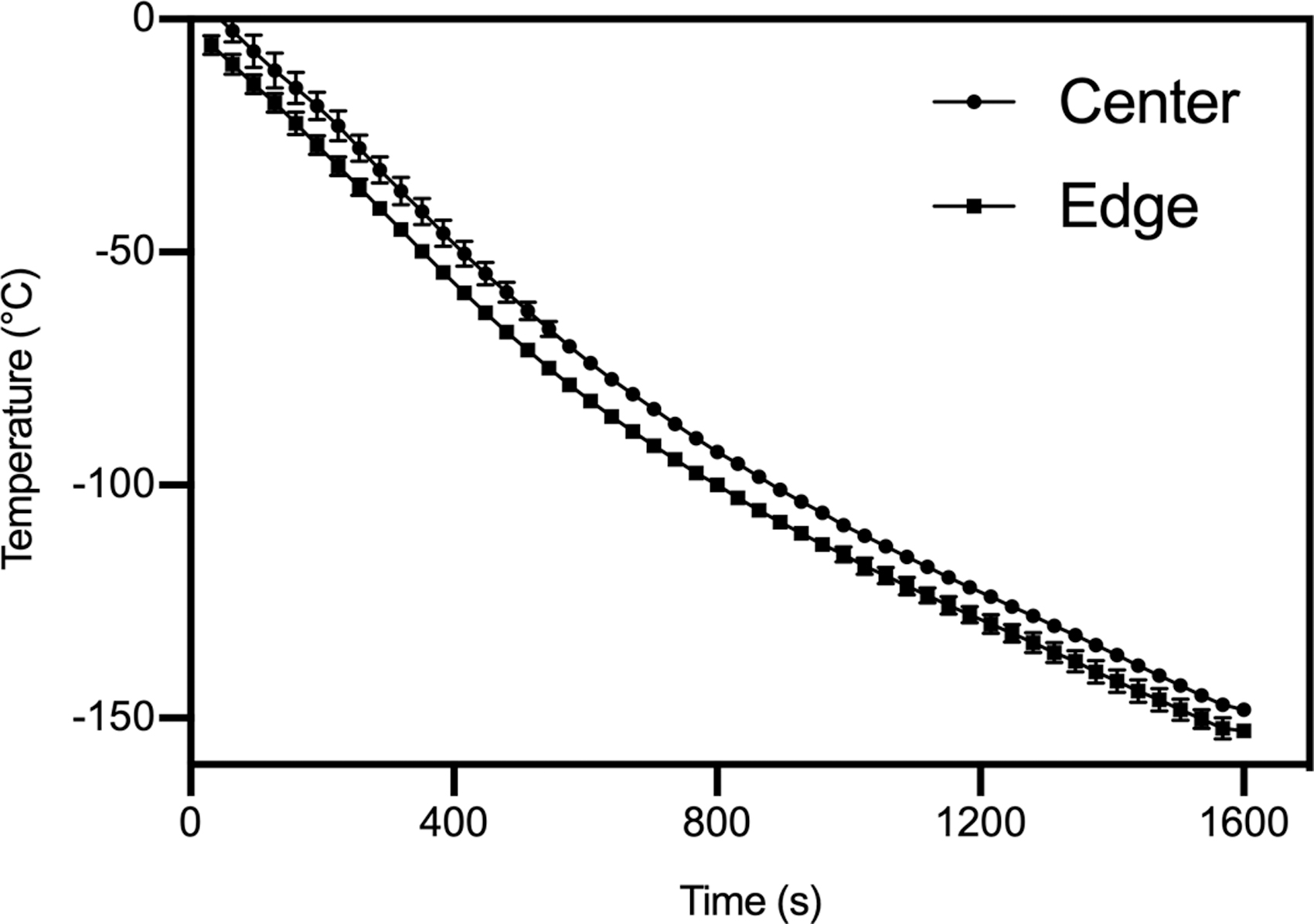
Temperature profile of the 25 mL DPVP solution during the cooling process.
Rewarming temperature profile in different rewarming methods
The numerical and experimental heating results are shown in Figure 4. The natural air convection had the slowest rewarming rate at 4.61 ± 0.19°C min−1 and a relatively uniform temperature distribution with the maximum temperature difference within 10°C (Fig. 4A). The convective water bath achieved faster heating at 48.2 ± 6.24°C min−1 but with a large temperature difference (>100°C), especially at the beginning of the warming process (Fig. 4B). The SMER technology accomplished a uniform rewarming with a temperature difference <10°C while surging the heating rate to 331.63 ± 8.59°C min−1 (Fig. 3C, n = 6.).

Temperature profiles and temperature differences in the 25 mL DPVP solution during the rewarming process.
To further demonstrate the thermal uniformity during rewarming, the simulated temperature distributions at different rewarming time points in the samples on the plane at the same position of half of the cylinder height are shown in Figure 5. The maximum thermal gradients of three rewarming methods were calculated as the maximum temperature difference divided by the distance between the sample center and the edge. The water bath method experienced a huge temperature gradient at the early rewarming and gradually reduced over time, with the maximum temperature gradient at 8.69°C min−1. The air warming and SMER system achieved uniform heating throughout the entire rewarming process, with the maximum temperature gradient of 0.81°C min−1 and 0.94°C min−1, respectively.
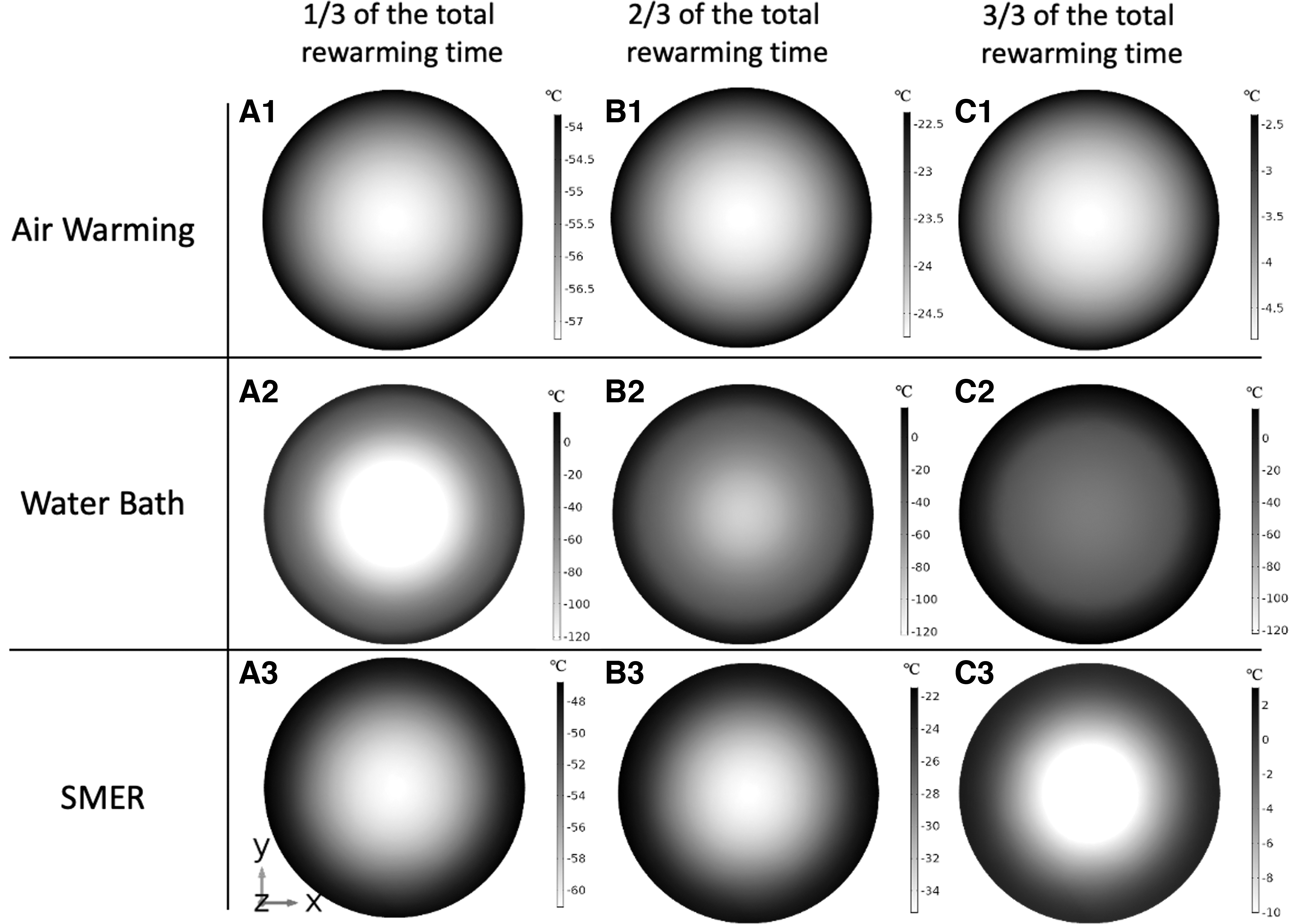
Temperature distribution on the plane in the sample at the position of half height of the cylinder for three rewarming methods at different time points.
Discussion
The promise of SMER technology for the long-term preservation of large biological samples rests on the ability to vitrify the samples, rapidly and uniformly rewarm the samples to room temperature. To achieve successful vitrification of a large-volume sample, besides the fast cooling with cooling rate above the CCR, the cooling process also needs to be homogenous within the sample to avoid fractures caused by thermomechanical stress. Instead of directly putting the samples into liquid nitrogen, we demonstrated a slow cooling procedure by the designed cooling device (Fig. 1A) could achieve sample vitrification better.
A transparent glassy state of DPVP solution was formed at −150°C by cooling with vapor-phase nitrogen. In contrast, a cracked sample in the experiments indicated the holder was too close to the liquid level and caused a severe temperature gradient in the samples during cooling. An opaque solid-state sample represented the holder was too far away from the liquid nitrogen, resulting in crystallization due to the slow cooling rate below the CCR.
It has been proved that fast heating can effectively hinder crystallization during the rewarming phase and benefit the viability of the cryopreserved biosamples. 27 For large samples, uniform heating is also needed to avoid mechanical damage from thermal stress. The gold standard convective water bath warming failed in both heating speed and uniformity in the test of 25 mL DPVP solution. The average heating rate was lower than the critical warming rate (CWR), the minimum rate to avoid recrystallization of DVDP (50°C min−1),10,25 resulting in devitrification within the sample.
Furthermore, the vast temperature difference (>100°C at the beginning of rewarming) led to high-level thermal stress that could damage the biomaterials. Natural air convection method reduced the thermal gradient by limiting the temperature difference to 10°C throughout the rewarming process. However, as a cost, the warming rate was significantly slower at only 4.61 ± 0.19°C min−1. At such a low rewarming rate, devitrification would happen during heating, rupture the biosample's structure, and cause the failure of preservation.
In contrast, the SMER technology successfully converted EM energy into rapid and uniform volumetric heating. As shown in Figure 6, the SMER's rewarming rate was five times more than the required CWR, whereas the maximum thermal gradient was significantly improved from the water bath's 8.69°C min−1 to only 0.94°C min−1. Moreover, the experimental results indicated the temperature nonuniformity was decreasing toward the end of the rewarming process, suggesting the “thermal runaway” phenomenon was inhibited, presumably due to the specific correlation between the dielectric loss properties of the DPVP solution and temperatures. 24

Heating performance of the different rewarming methods.
The temperature profile is critical to the quantitative evaluation of the heating performance of different rewarming methods. However, experimental temperature measurements heavily rely on the number of temperature sensors and the sensor locations in the sample. In addition, it would be extremely hard to place the temperature sensors into the large complex tissues and organs. Thus, the utilization of an accurate and effective numerical model could support us in evaluating different rewarming methods, screening for the optimal CPA/vitrification solution, and improving the heating protocols. In this study, the simulated warming process for all three rewarming methods demonstrated the same trend as the experimental results. The consistency between the numerical simulation and experimental results confirmed the reliability of the numerical models.
Conclusions
To summarize, this study investigated the rewarming effects of the SMER technology on the large-volume cryopreserved materials through numerical simulation and experimental studies. The SMER system achieved superior heating performance in providing rapid rewarming rate and uniform temperature distribution, significantly improved from the convective water bath and natural air convection methods. The numerical model results were highly consistent with the experimental results, suggesting the simulation tool would benefit us in the future for the development and optimization of the rewarming methods.
Footnotes
Author Disclosure Statement
No conflicting financial interests exist.
Funding Information
This study was supported by the University of Washington Royalty Research Fund (A172920), the UW CoMotion Strategic Technology Enhancement Portfolio (STEP) program, and the UW Tacoma Internal Pilot Fund.