




Abstract
In recent years, cells provided by cell banks and medical facilities have been used for cell therapy, regenerative therapy, and fundamental research. Cryopreservation is an effective means of maintaining stable cell quality over a long period of time. The slow freezing method is most suitable for processing many human cells isolated simultaneously from organs and tissues, but it is necessary to develop a freezing solution for this method. In this study, we report the successful development of a dimethyl sulfoxide (DMSO)-free freezing medium for differentiated neuronal cells. Neuronal differentiation results in the differentiation of undifferentiated SK-N-SH cells into neuronal cells. A basic freezing medium (BFM) was prepared using Dulbecco's modified Eagle's medium, 1 M maltose, and 1% sericin as the essential ingredients, supplemented with 5%–40% propylene glycol (PG). Each BFM supplemented with 5%–40% PG was evaluated in undifferentiated cells. After thawing, BFM supplemented with 10% and 20% PG were 83% and 88% viable, respectively. There was no significant difference between the 10% and 20% PG groups. However, a significant difference was observed when the concentration of PG in the BFM decreased by 5% (5% PG vs. 10% PG; p = 0.0026). Each DMSO-free BFM was evaluated using differentiated neuronal cells. There was no significant difference between the 10% PG BFM and stem-CB-free groups. Viability was significantly different in the 10% glycerol BFM (4.8%) and 10% PG BFM (45%) (p = 0.028). The differentiated cells with 10% PG BFM showed higher adherence to culture dishes than those with 10% glycerol BFM. These results show that BFM containing PG was effective in differentiating neuronal cells. DMSO affects the central nervous system at low concentrations. This report indicates that DMSO is unsuitable for neuronal cells with multipotent differentiation potential. Therefore, it is essential for cell banking and transplantation medicine services to select appropriate cell freezing media.
Introduction
In recent years, cells provided by cell banks and medical facilities have been used for cell therapy, regenerative therapy, and fundamental research. Cryopreservation is an effective means of maintaining stable cell quality over a long period of time. The slow freezing method is most suitable for processing many human cells isolated simultaneously from organs and tissues, but it is necessary to develop a freezing solution for this method.
Sericin is a macromolecular protein derived from silkworm cocoons that is used in various biomaterials and cosmetics. In various animal cell lines, sericin has been reported to promote proliferation, protect against freezing stress, and be effective as a freezing medium containing dimethyl sulfoxide (DMSO). 1 Recently, sericin has also attracted attention as a serum substitute 1 and has been reported to be adequate for freezing human hepatic parenchymal cells (primary hepatocytes), 2 human adipose tissue-derived stem cells, 3 and human mesenchymal stromal cells. 4 However, DMSO causes cytotoxicity, differentiation, growth inhibition, and cell dysfunction in some cell types. For example, low concentrations of DMSO induce widespread apoptosis in the central nervous system (CNS). 5
In this study, slow freezing was performed on neuronal cells differentiated from undifferentiated cells (SK-N-SH cells, human neuroblastoma cells) using a freezing medium supplemented with 10% glycerol and 10% DMSO. 6 However, cryopreservation of cells was less efficient with glycerol than with DMSO. 6 Therefore, we focused on propylene glycol (PG), which has long been used as a freezing solution in the vitrification method.7,8 PG is widely used in the food, cosmetic, and pharmaceutical industries because of its low toxicity and high safety. In this study, we report the successful development of a DMSO-free freezing medium containing maltose, sericin, and PG for differentiated neuronal cells.
Materials and Methods
All procedures were replicated according to our previous study.
6
All materials and chemicals were of the highest available grade. SK-N-SH cells were purchased from the Riken BRC Cell Bank (Tsukuba, Japan). Undifferentiated cells were seeded and cultured at 37°C in a humidified 5% CO2 atmosphere at ∼80%–90% confluence. A maintenance medium for undifferentiated cells was prepared using Dulbecco's modified Eagle's medium (DMEM) with high glucose,
Differentiated neuronal cells (1 × 10⁶ cells) suspended in each freezing solution were transferred into cryotubes and frozen in a BICELL freezing treatment container at −80°C for 24 hours. After 1 day, each frozen differentiated neuronal cell was transferred to liquid nitrogen and stored for 2 weeks. A basic freezing medium (BFM) was prepared using DMEM, 1 M maltose, and 1% sericin as the essential ingredients, supplemented with 5%–40% PG. Stem-Cellbanker® DMSO-free GMP grade (stem-CB free) was used as the commercial freezing medium. Each stored sample was thawed in a warm water bath at 37°C, and cell viability and live cell recovery rate before freezing and after thawing were calculated using a TC20 Automated Cell Counter. Cell viability was determined using the trypan blue dye exclusion test (final concentration, 0.2%). The live cell recovery rate before freezing was set to 100%.
After thawing, live cells were seeded at a density of 1 × 10⁵ cells in new dishes and cultured at 37°C in a humidified atmosphere containing 5% CO2. The morphology of cultured cells after 24 hours of incubation was observed using a phase-contrast microscope. Data are presented as the mean ± standard error. Each experiment was performed in triplicate (n ≥ 3). Statistical significance was determined using Welch's t-test. Statistical significance was set at p < 0.05.
Results and Discussion
Neuronal differentiation results in the differentiation of undifferentiated cells into neuronal cells, which continue to further differentiate and exhibit mature neuronal cells (Fig. 1A). NeuN protein (a specific neuronal marker) was expressed in neuronal and mature neuronal cells. 6 Each BFM supplemented with 5%–40% PG was evaluated in undifferentiated cells (Fig. 1B). After thawing, the viability of undifferentiated cells stored in the BFM supplemented with 10% and 20% PG were 83% and 88% viable, respectively. There was no significant difference between the 10% and 20% PG groups. However, a significant difference was observed when the concentration of PG in the BFM decreased by 5% (12% viability of 5% PG vs. 83% viability of 10% PG; p = 0.0026).
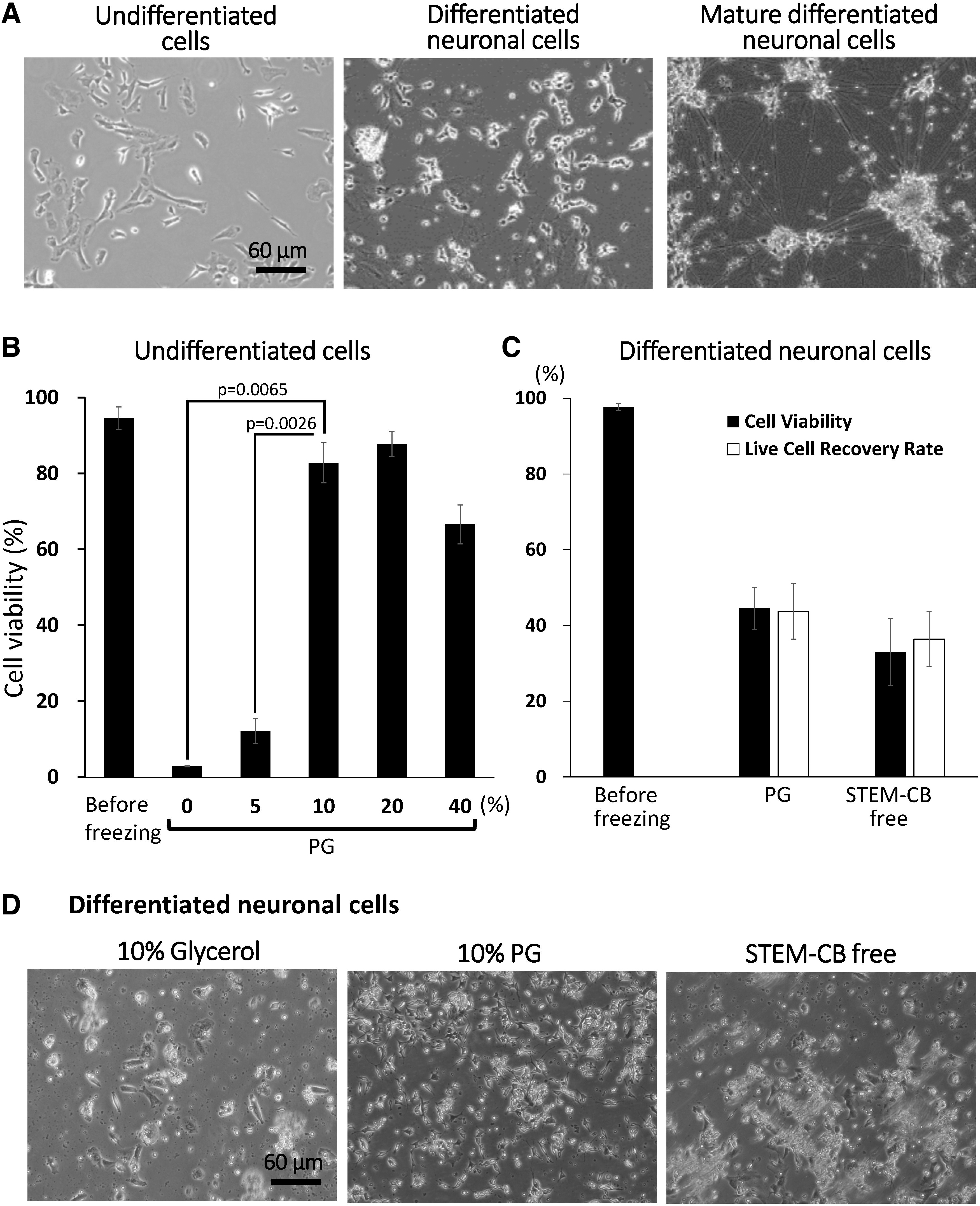
Each DMSO-free BFM was evaluated using differentiated neuronal cells (Fig. 1C). After thawing, the viability and recovery rate of differentiated neuronal cells in the 10% PG BFM were 45% and 44%, respectively. There was no significant difference between the 10% PG BFM and stem-CB-free groups.
Viability was significantly different in the 10% glycerol BFM (4.8%), 6 10% DMSO BFM (36%), 6 and 10% PG BFM (45%) (10% glycerol vs. 10% PG, p = 0.028; 10% DMSO vs. 10% PG, p = 0.37). Cell morphology after thawing for 24 hours (Fig. 1D) was similar to that before freezing (Fig. 1A), and was not affected by the freezing medium. As shown in Figure 1D, differentiated neuronal cells with 10% PG BFM showed higher adherence to culture dishes than those with 10% glycerol BFM. These results show that BFM containing PG was effective in differentiating neuronal cells. In previous studies, differentiated neuronal cells were defined as damage-sensitive cells such as neuronal cells 6 and primary hepatocytes. 2
Intracellular cryoprotectants, such as DMSO, glycerol, and PG, can protect cells from freezing, thawing, dehydration, and rehydration. 9 The protective effect of DMSO allows frozen hepatocytes to maintain liver function. 2 In contrast, DMSO affects the CNS at low concentrations. 5 At 1%, the differentiation of neural stem and progenitor cells is inhibited by oligodendrogenesis and induced by astrogenesis. 10 This report indicates that DMSO is unsuitable for neuronal cells with multipotent differentiation potential. Therefore, it is essential for cell banking and transplantation medicine services to select appropriate cell freezing media.
Footnotes
Acknowledgments
We greatly appreciate the support of the students at the Tokyo University of Science for supporting our experiments.
Authors' Contributions
Conceptualization and visualization by K.Y., Y.N., and Y.M. Methodology and investigation by K.Y., Y.N., N.T., W.K., K.M., K.N., T.Y., and Y.M. Resources, writing—review and editing, and funding acquisition by K.Y. and Y.M. Data curation, writing—original draft preparation, supervision, and project administration by Y.M. All authors have read and agreed to the published version of the article.
Author Disclosure Statement
No conflicting financial interests exist.
Funding Information
This study was supported in part by JSPS KAKENHI Grant Numbers JP18H03556, JP15H03039, JP16K11121, and JP20K09608.