




Abstract
Background:
Cryopreservation causes harmful effects on sperm quality due to reactive oxygen species (ROS) overproduction and physical–chemical modifications, resulting in reduced sperm fertility potential. Recently, many studies have shown that adding antioxidants to the cryopreservation medium can markedly reduce these damages. The present study aimed to evaluate the effects of pre-treatment with curcumin at 0, 20, 50, and 100 μM concentrations on frozen-thawed human sperm parameters.
Methods:
Semen samples from 25 normozoospermic men were collected. Then, each sample was divided into five equal parts: fresh group and frozen-thawed groups, including 0, 20, 50, and 100 μM of curcumin. Pre-cryopreservation and post-thaw sperm motility, morphology, vitality, DNA fragmentation, and ROS levels were investigated.
Results:
Cryopreservation significantly reduced sperm quality. A known value of 50 μM curcumin significantly improved sperm progressive motility (18.67 ± 1.12 vs. 11.2 ± 1.24, p < 0.01), vitality (35.50 ± 1.63 vs. 21.83 ± 2.64, p < 0.05), and decreased ROS levels (p < 0.05), 50 μM curcumin also efficiently preserved sperm morphology after thawing (13.55 ± 0.33 vs. 6.56 ± 0.16, p < 0.001). Furthermore, the application of 50 μM curcumin resulted in a reduction in DNA fragmentation, though it did not reach statistical significance (p = 0.08). In contrast, 20 μM curcumin only had a significant impact on progressive motility (15.85 ± 0.7 vs. 11.2 ± 1.24, p < 0.05), whereas, in the 100 μM group, there were no significant differences in any of the measured parameters compared with the control group.
Conclusion:
It seems that curcumin ameliorates cryopreservation-induced injury to sperm.
Introduction
Sperm cryopreservation has become a routine procedure in many infertility clinics worldwide. It is now widely used to preserve spermatozoa obtained from patients undergoing toxic radiation therapy or certain surgery that may result in testicular dysfunction and can also be used for the management of assisted reproductive technology cycles for couples who are physically distant. Furthermore, cryopreservation facilitates sperm storage in donor banks.1–3
Despite great benefits for fertility preservation, cryopreservation causes harmful effects on sperm such as the loss of sperm motility and viability, ultrastructural modifications, plasma membrane permeability alteration, mitochondrial dysfunction, altered DNA integrity, DNA fragmentation, and acrosome damage.4–7 During cryopreservation, overproduction of reactive oxygen species (ROS) caused by cold shock and osmotic stress may result in lipid peroxidation, membrane and DNA damage, and cell death, which eventually compromise sperm quality and fertilization capacity.2,8 Sperm cells are more susceptible to oxidative stress due to the structure of plasma membranes that are rich in unsaturated fatty acids. In addition, sperms also have little cytoplasm and therefore a small amount of antioxidants. 9 Many studies have shown that adding exogenous antioxidants to the cryopreservation medium may inhibit or reduce cryopreservation-induced oxidative stress by scavenging released free radicals.10,11
Curcumin, a natural polyphenolic compound found in turmeric (Curcuma longa), has gained considerable attention in recent years for its potent antioxidant properties. 12 Curcumin is known for being safe and well-tolerated for long-term use, in sharp contrast to some synthetic antioxidants that can cause harm. 13 Curcumin exerts its antioxidant effects through various mechanisms, including direct scavenging of free radicals including superoxide and hydroxyl radicals as well as nitrogen dioxide and upregulation of endogenous antioxidant enzymes like superoxide dismutase (SOD), catalase, and glutathione peroxidase (GPx).14–16 Curcumin can chelate transition metal ions, which play a role in the generation of harmful free radicals. 17 Moreover, curcumin has been shown to modulate the expression of genes involved in inflammation and apoptosis, thereby reducing inflammation-induced damage and promoting cell survival.
It has been shown that curcumin improves semen parameters, oxidative stress, inflammatory biomarkers, sperm capacitation, and fertilization in infertile men. 18 This antioxidant could improve bull spermatozoa parameters exposed to induced oxidative stress 16 or could mitigate cryopreservation-induced injury to boar, 19 human, 20 rat, 21 and dog sperm cells 22 in a dose-dependent manner.
In rams, curcumin exhibited protective effects on frozen-thawed sperm parameters at various doses. This antioxidant led to a notable increase in sperm acrosome integrity and offered robust protection for sperm mitochondrial activity compared with the control group. 23 A previous study illustrated that a low concentration of curcumin (20 μm) had the capacity to enhance human sperm parameters and reduce sperm DNA damage in the presence of induced oxidative stress during cryopreservation. 20 Based on these findings, this study was undertaken to examine the effects of higher concentrations of curcumin on human sperm quality after the freeze‐thaw process.
Materials and Methods
Chemicals
In this study, all reagents were purchased from Sigma (Sigma–Aldrich) unless otherwise noted. Curcumin was prepared using 96% ethanol as a solvent.
Semen collection
Semen samples were obtained from 25 normozoospermic men (aged 20–40 years) referred to the IVF unit of Shahid Mohammadi Hospital. All the participants were required to be abstinent for 3–5 days before the collection of semen specimens. Alcoholics and smokers were excluded from this study, as well as men with a chronic illness or endocrine disorder, genital infection, or varicocele. The study was approved by the Ethics Committee of the Varamin-Pishva Branch of Islamic Azad University (IR.IAU.VARAMIN.REC.1400.054).
All samples were analyzed by 2010 World Health Organization (WHO) guidelines (defined as sperm concentration of 15 million/mL, total motility of 40%, and normal morphology of 4%). Participants in the research have signed the informed consent.
Semen cryopreservation and thawing
The liquefied semen sample of each patient was divided into five equal aliquots: (1) fresh group, (2) frozen-thawed group without curcumin, (3) frozen-thawed group containing 20 μM curcumin, (4) frozen-thawed group containing 50 μM curcumin, and (5) frozen-thawed group containing 100 μM curcumin. The sperm samples were cryopreserved by the liquid nitrogen vapor method. Briefly, each aliquot was gently diluted with an equal volume (0.5 mL) of sperm freezing medium (Quinn’s Advantage Sperm Freeze cryoprotectant, SAGE-In Vitro Fertilization, Coopersurgical Inc.) containing the various concentrations of curcumin. Then, the cryovials (cryogenic vial 1.5 mL, Sorfa) were placed 10 cm above liquid nitrogen at −80°C in nitrogen vapor for 15 minutes and then immersed in liquid nitrogen. 10 After 2 weeks of storage, the thawing process was carried out by transferring the cryovials to room temperature for 15 minutes. 11 Then, an equal amount of prewarmed medium (37°C; Ham’s F10 medium supplemented with 10% human serum albumin [Life Global]) was added to samples. After 5 minutes of centrifugation at 300 g, the pellet was resuspended in 2 mL of Ham’s F10 medium. 10
Assessment of sperm motility and vitality
Sperm motility was assessed by using a phase contrast microscope with 400× magnification and was categorized into three grades according to the WHO criteria (WHO 2010): progressive, non-progressive, and immotile. Viability was evaluated by eosin–nigrosin staining. At least 200 cells were counted in each slide at 400× magnification, and the percentages of unstained (live) sperm and pink-colored (dead) sperm were calculated.
Assessment of morphology
Strict criteria were used to evaluate sperm morphology. A total of 10 μL of the sample was smeared onto glass slides and air-dried for 20 minutes. Diff-quick rapid sperm staining (Avicenna) was used to stain the smears. The morphology assessment was carried out according to 2010 WHO guidelines. 24 To assess sperm morphology, at least 200 sperms were counted (Optika).
Assessment of DNA fragmentation
The integrity of sperm DNA was determined using a sperm DNA fragmentation assay kit (SDFA; Ravan Sazeh; Fig. 1). The patterns were classified into two groups based on sperm chromatin dispersion: sperm with intact DNA (medium or large size halos) and sperm with fragmented DNA (small or no halo size). 25 For each sample, at least 200 sperms were counted, and the amount of DNA damage was reported by dividing the abnormal sperms by the total number of sperms.

Representative images of sperm chromatin dispersion staining to evaluate the DNA fragmentation
Measurement of intracellular ROS production
A known value of 100 μL of semen sample was mixed with 1000 μL of potassium chloride solution and 100 μL of dichlorofluorescein reagent (Sigma-Aldrich). It was stirred slowly and incubated for 30 minutes at 37°C in complete darkness. After incubation, the sample was centrifuged for 2 minutes at a speed of 10,000 rpm (12298 g) and a temperature of 4°C. Then, the DCF fluorescence intensity of 100 μl of the supernatant solution was recorded using a FLUOstar Omega® multifunctional microplate reader (BMG LABTECH; λ excitation = 485 nm and λ emission = 525 nm). Next, 100 μL of the same supernatant solution was slowly mixed with 100 μL of Bradford’s solution for 15 minutes and then measured the absorbance at 596 nm wavelength.26–29 Finally, the data were standardized using the respective protein concentration, with normalization conducted using Graphpad Prism 8 software.
Statistical analysis
To determine the significance of the variables, SPSS version 22 software was used. The results were presented as mean ± standard deviation. Graphs created with the Prism Graphpad version 8 software. Parameters were compared between different groups using one–way analysis of variance followed by the Tukey and Kruskal–Wallis tests. Also, the comparison between the two groups was performed by paired t test. A value of p < 0.05 was considered statistically significant.
Results
Sperm motility and vitality
As shown in Table 1, the percentage of sperm progressive motility and sperm total motility significantly decreased after freezing in the control group compared with the fresh group (****p < 0.0001).
Effect of Different Concentrations of Curcumin on Sperm Parameters After Thawing
Note: Data are presented as mean ± standard deviation; similar letters have significant difference.
Progressive motility: a, ****p < 0.0001; b, **p < 0.01; c, *p < 0.05.
Total motility: a, ****p < 0.0001.
Vitality: a, ***p < 0.001; b, *p < 0.05.
Normal morphology: a, ***p < 0.001; b, ***p < 0.001.
Supplementation with 20 and 50 μM of curcumin improved the progressive motility compared with the control (*p < 0.05, **p < 0.01, respectively), whereas curcumin at a concentration of 100 μM presented no significant improvement at this parameter compared with the control group (p = 0.23). Cryopreservation also reduced sperm vitality in all cryopreserved samples compared with the fresh group (***p < 0.001). However, only the 50 μM of curcumin-treated samples significantly increased sperm vitality compared with the frozen control (*p < 0.05).
Sperm morphology
Normal morphology significantly decreased in the control group due to cryopreservation compared with the fresh group (***p < 0.001). Supplementation with 50 μM of curcumin notably preserved the morphology of the spermatozoa after the freezing process (***p < 0.001; Table 1).
DNA fragmentation
Based on the results, cryopreservation increased the percentage of sperm cells with DNA fragmentation compared with the fresh group (**p < 0.01). Only 50 μM of curcumin marginally decreased the level of DNA fragmentation after the freezing process (p = 0.08; Fig. 2).
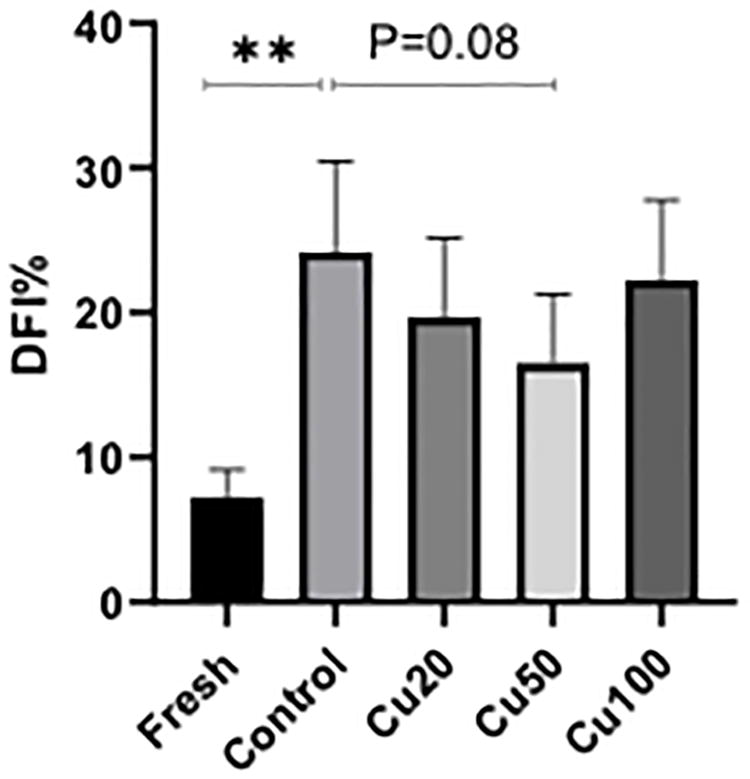
Effect of different concentrations of curcumin on DNA fragmentation of normal sperm after cryopreservation. Fresh group (Fresh); freezing group without antioxidant (Control); freezing group containing curcumin 20 μM (Cu20); freezing group containing curcumin 50 μM (Cu50); and freezing group containing curcumin100 μM (Cu100). **p < 0.01 versus the fresh group.
Intracellular ROS levels
The results demonstrated that the levels of intracellular ROS in the control group were notably higher compared with the fresh group (***p < 0.001). A total of 50 μM of curcumin significantly decreased the ROS levels after the freezing process (*p < 0.05), whereas analyses in the 20 and 100 μM of curcumin-supplemented groups showed that the amount of intracellular ROS was approximately similar to those of the control group (Fig. 3).
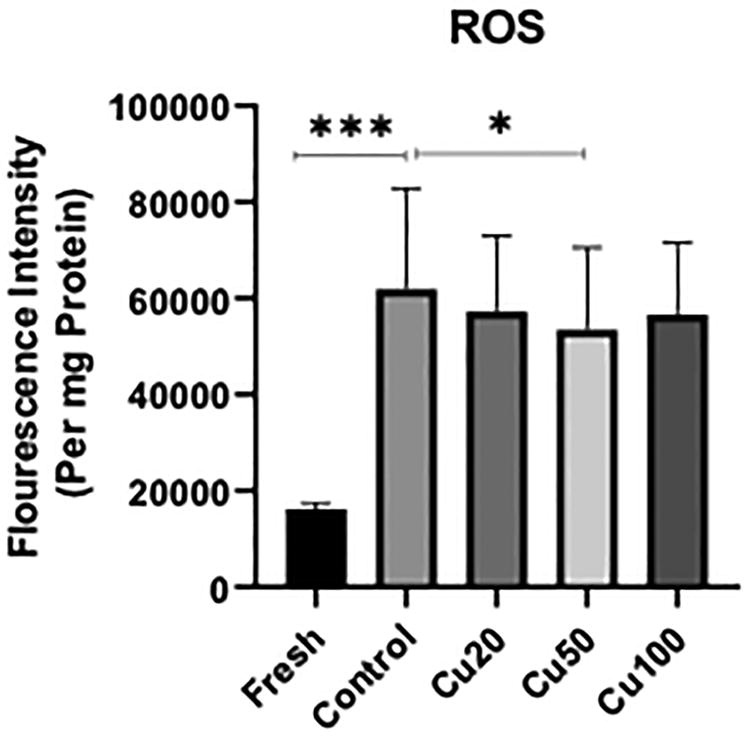
Effect of different concentrations of curcumin on ROS levels of normal semen samples after cryopreservation. Fresh group (Fresh); freezing group without antioxidant (Control); freezing group containing curcumin 20 μM (Cu20); freezing group containing curcumin 50 μM (Cu50); freezing group containing curcumin 100 μM (Cu100). ***p < 0.001 versus the fresh group. *p < 0.05 versus the control group.
Discussion
In this study, we examined the effects of pre-treatment with various concentrations of curcumin supplementation on post-thawed human sperm quality. The main findings of the study indicate that the post-thawed sperm quality significantly deteriorated compared with pre-freezing values, which is consistent with what is generally observed after cryopreservation. However, the application of 50 μM curcumin had notable beneficial effects on several sperm parameters, including progressive motility, vitality, ROS levels, and sperm morphology, while also showing a trend toward reducing DNA fragmentation. Our findings also demonstrated that curcumin at a concentration of 20 μM only improved sperm progressive motility, whereas 100 μM curcumin showed no beneficial effects on sperm quality after thawing.
Despite increasing demand for sperm freezing to preserve male infertility, cryopreservation causes negative effects on sperm health through physical–chemical modifications and ROS overproduction. Free radical attacks induce a series of events that can lead to reduced intra-cellular ATP levels through lipid peroxidation and oxidative damage of electron transport chain proteins, release various apoptotic agents via the damaged mitochondria membrane into the cytosol, and damage to DNA integrity through DNA oxidation and deactivation of DNA repair enzymes.1,2,8 Moreover, oxidative stress may change the membrane structure, consequently altering sperm morphology. 2 In the present study, sperm progressive motility, viability, and morphology were significantly decreased in the control group compared with the fresh group. As well, cryopreservation increased DNA fragmentation and ROS levels consistent with previous studies. 11 It appears that the antioxidant activity of the sperm cell is inadequate to quench excessive levels of ROS generated during the freezing‐thawing process. Numerous studies have recently shown that the addition of antioxidants to a freezing medium can neutralize ROS and mitigate ROS-induced damage to sperm cells.11,30,31 Curcumin, a potent antioxidant derived from turmeric, 32 has been shown to exert its protective effects on sperm during the freezing process through various mechanisms. First, curcumin has been found to enhance the activity of antioxidant enzymes, such as SOD and GPx, leading to the scavenging of ROS and a reduction in oxidative stress.14,15 This antioxidant activity helps to preserve the structural integrity of sperm membranes and prevent lipid peroxidation. Additionally, curcumin activates the nuclear factor erythroid 2-related factor 2 (Nrf2) pathway, which induces the expression of antioxidant genes and increases the production of endogenous antioxidants. This further enhances the cell’s antioxidant defense system. Furthermore, curcumin has been reported to influence the expression of heat shock proteins, which play a crucial role in protecting cells against stress conditions. We hypothesized that curcumin, as a supplement in freezing media, could be effective in mitigating oxidative damage caused by cryopreservation. We found that adding 20 and 50 μM of curcumin to freezing media had a beneficial effect on sperm progressive motility, while no significant impact was observed on the total motility parameter. Probably, by reducing the levels of ROS and improving mitochondrial function, curcumin could improve sperm motility. Similarly, the addition of 1, 2, and 4 mM of curcumin to ram sperm cryopreservation medium increased the percentage of sperm motility and sperm acrosome integrity and provided strong protection in terms of sperm mitochondrial activity relative to the control group. 23 Another recent study showed that supplementation of the cryopreservation medium with 20 μM of curcumin significantly improved post-thawed sperm progressive and non-progressive motility. 20 In vitro incubation of sperm with curcumin also improved sperm motility by 63.6% in leukocytospermic patients. 33 Curcumin may affect sperm motility, function, and fertility by inhibiting tyrosine phosphorylation of sperm surface proteins and Ca2+ channels, acidifying the intracellular pH of sperm, hyperpolarizing the sperm cell membrane, and preserving mitochondrial function.32,34
Our data also showed that, among the concentrations tested, 50 μM curcumin significantly decreased intra-cellular ROS production, proving that curcumin can protect sperm cells from oxidative damage induced by cryopreservation and improve semen quality after thawing. In agreement, previous studies have demonstrated that curcumin can decrease the intra-cellular ROS levels in frozen-thawed sperm cells.20,22 It is related to the fact that curcumin has carbon–carbon double bonds, phenolic, β-diketone, and methoxy functional groups, which play important roles in ROS scavenging and free radical neutralizing. 35 Moreover, curcumin can suppress ROS production and reduce DNA fragmentation by upregulation of GPX4 and Nrf2 and enhancing the intrinsic defenses of the cells.20,32 In the present study, 50 μM of curcumin exhibited a tendency to decrease DNA fragmentation, preserved sperm morphology, and improved vitality compared with the control, whereas 20 μM of curcumin did not show any notable improvement in sperm vitality or a significant decline in DNA fragmentation. In contrast, Santonastaso et al. indicated that 20 μM of curcumin improved sperm vitality and significantly decreased DNA fragmentation. 20 However, this discrepancy may be related to factors such as differences in the concentration of the freezing media that was used, the preparation of sperm before freezing, and the methods used for sperm parameter evaluation. They used the TUNEL assay for DNA fragmentation assessment and added 0.7 mL of freezing medium to the samples, while in our study DNA fragmentation was measured by the SDFA test and each sample was diluted with an equal volume of sperm freezing medium. However, it is worth noting that a larger sample size was recruited in their study. Therefore, more studies are needed to determine the exact effects of curcumin at 20 μM concentration on sperm parameters following cryopreservation. Interestingly, we also found a high concentration of curcumin (100 μM) did not yield any positive impacts on sperm parameters compared with the control. Zhou et al. reported that using high concentrations of curcumin (1 mM and 1 M) can induce toxicity to sperm motility. 32 Another study demonstrated that the treatment of semen with high levels of naringenin and crocin before cryopreservation had no beneficial effects on rooster sperm parameters. 36 It seems that antioxidants at high levels may have adverse consequences due to the excessive removal of free radicals, potentially through altering their physiological amounts. 36
Conclusion
This study provides valuable insights into the potential protective effects of curcumin on sperm quality after thawing, following cryopreservation. The results suggest that 50 μM of curcumin may be a promising candidate for improving post-thawed sperm parameters, including motility, vitality, ROS levels, and morphology. These beneficial effects are probably mediated by decreasing ROS production and clearing free radicals. However, further research is needed to confirm these findings, investigate the underlying mechanisms, and determine the most effective curcumin concentration for sperm cryopreservation. In addition, the potential impact of curcumin on DNA fragmentation warrants further investigation to assess its significance in fertility outcomes. Additionally, it is important to acknowledge several limitations of the present study that should be taken into account in future research endeavors. These limitations encompass a small sample size, the absence of a CASA system being utilized, and an incomplete understanding of the precise mechanisms through which curcumin reduces ROS production—whether by upregulating endogenous antioxidant enzymes, suppressing the activity of enzymes involved in ROS generation, or through other pathways.
Footnotes
Acknowledgment
The authors of this article wish to express their appreciation to Hormozgan University of Medical Sciences, Bandar Abbas, Iran.
Authors’ Contributions
B.M.-B.: Investigation, data curation, original draft preparation, and formal analysis. M.H.N.: Supervision, visualization, validation, and software. M.A.K.: Validation, resources, and project administration. E.S.: Conceptualization, methodology, and review and editing.
Confirmation Statement
All authors of this article confirm that this research was supported by an institution primarily involved in education and research.
Author Disclosure Statement
The authors declare no conflict of interest.
Funding Information
There were no funding resources.