




Abstract
Biobanks can consume a lot of financial resources and some biobanks have a poor record of utilization. This suggests the need for better planning by these biobanks around what new biospecimens to collect and store and more deliberate approaches to determine the value of existing biospecimen collections to make operational decisions. Existing biospecimen collections may comprise part of the biobank inventory (where decisions are needed around availability or continued storage) or external collections (where decisions are needed to consider their addition to the inventory). However, there has been limited discussion about how to value these collections. This paper proposes a guideline for the valuation of existing collections based on a two-stage process that involves consideration of features under two broad categories: “ELSI” factors and “Biospecimen and Data” factors. The first “initial-valuation” stage is based on the consideration of five key questions related to each of the main factors and will, in many instances, suffice. This approach can identify salient features of a collection that may have a dominant impact on the value. However, in other instances, a second “extended-valuation” stage may be needed to make a more in-depth assessment of the features of a collection. The overall value can then be summarized and/or assigned a score and compared with valuations of comparable collections. The latter might include another collection occupying a similar storage volume within the biobank, a collection from a similar group of donors, or a similar collection stored by another affiliated biobank. In summary, we hope that these guidelines and discussion serve to highlight key factors and an approach to valuing existing collections to improve biobanking efficiency and sustainability.
Introduction
Biobanks are important research infrastructures that can support significant research impacts, but this process often takes many years. 1 At the same time biobanks often require significant investments, and many can have a poor record of utilization. 2 Similar challenges with high costs of data storage, 3 and with maximizing the value of utilization in the face of data quality uncertainty, 4 are echoed elsewhere in the health and medical research landscape with open data repositories. 5 Biobank utilization rates depend on many factors, including the operational model of the biobank. 6 However, the tendency to accumulate unused biospecimens has led to an increasing oversupply relative to demand. 7 This imbalance between supply and demand arises in part from the natural drive of some biobankers to hoard biospecimens for future use. 8 Here, some biobankers are inclined towards an inclusive storage approach that endeavors to safeguard against lost opportunities to provide researchers with required biospecimens. When this approach is not associated with adequate strategies to ensure utilization, and at the same time there is an avoidance of the decision making that is needed to potentially cull low-value biospecimens, it can result in an excess of unused biospecimens being stored for long periods of time (i.e., “biohoarding” 8 ). The continued storage of unused biospecimens is also an issue from the climate perspective, where excessive mechanical freezer usage contributes to unnecessary energy usage. 9
For many biobanks that are designed to support multiple users and diverse research questions and allow open access to qualified researchers (i.e., poly-user academic biobanks 10 ) many important strategic and operational decisions on human biospecimen collection and distribution rest with components of the governance structure. In this type of biobank, biospecimen collections are openly available to multiple researchers via a formal application process. Decisions within the biobank governance structure include biospecimen collection priorities (steering committees), determination of which researchers can access biospecimens (access committees), and inventory and storage approaches (biobank operations committees). Therefore, most decisions are not biobank director- and staff-autonomous, but rather involve a broader group of researchers and other stakeholders. However, the leadership of the biobank is often best placed to assist with the valuation of existing and new biospecimen collections in order to support committee decisions around priorities, access, and storage.
Broadly, value can be defined as an entity’s worth, utility, or importance. 11 In the case of human tissue biobanking, we have previously proposed that the approach to biobank valuation and specific parameters to be assessed should be relevant to the goal of those biobanks in supporting health and medical research. 12 The same concept applies to other types of biobanking, such as environmental and biological biobanking, where the goal is to support other areas of scientific endeavor.
External to the biobank, host institutions may conduct valuations to support decision-making on financial support. The scope of the valuation may include the biobank inventory and utilization, operational costs, and research impact.13,14 Some of the metrics and approaches to the assessment of impact have been previously discussed.12,14 Similarly, research funders and their peer reviewers may also ask for an evaluation of sets of biospecimens as a favorable indicator of high-quality biobank management. Also, researchers will undertake valuations when seeking biospecimens. Here the focus is on the quality of specific biospecimens and characterization (including the annotating data available), as well as user fees, delivery times, indicators of overall operational quality, and extent of post-supply support.15,16
Internally, biobank leadership and stakeholders involved in governance may rely on valuations to support decision-making on access, user fees, and/or operational priorities. User fees are often determined by a cost valuation to estimate and justify ethically appropriate fees that will achieve partial or full cost recovery from research users.17,18 The focus of this valuation is on financial costs and approaches to assessment of user fees have been previously discussed.17,18 Valuation is also necessary to support internal decision-making on researcher access to some collections, maintenance, and storage of existing biospecimen inventory, and the consideration of external biospecimen collections. 19
While example scenarios differ, the focus and intended outcome are the same: to estimate the research usefulness of sets of biospecimens. This type of valuation of collections should be distinguished from the valuation of entire biobanks.14,20 While the valuation of collections has been proposed, 21 and discussed 22 previously at meetings of the International Society of Biological and Environmental Repositories, it has had relatively little discussion in the literature.19,23 Valuation of collections is therefore the focus of this paper.
Valuation Scenarios for Internal Decisions Concerning Biospecimen Collections
Biospecimen collection valuation to support internal decisions is necessary in several scenarios. First, valuation is important to inform decision-making on researcher access to existing biobank collections. When considering researcher access to collections of biospecimens, open-access biobanks strive to support all qualified researchers and studies. However, in some situations, consideration of the value of the requested biospecimens becomes important for the biobank’s access decision. For example, when the biospecimens requested are very small, rare, and/or are in high demand, the collection may be regarded as of “higher value.” In turn, research studies may need to meet a higher scientific threshold (e.g., stronger rationale and evidence of capability to conduct the proposed analysis) to gain access.
Second, valuation can support biobanks in selecting suitable storage locations for biospecimens. When considering storage locations for biospecimens, assignment to specific storage locations is a standard part of biobank operations. The types of biospecimen and many practical considerations can affect the types of storage units and their locations. For example, frozen biospecimens with a higher perceived value may be assigned to liquid nitrogen (LN2) rather than −80°C frozen storage, and more accessible onsite rather than offsite storage. Location is also important for disaster planning. Events can range from relatively small scale (a freezer breakdown24,25) to a larger scale disaster that necessitates prioritization of biospecimen rescue. While freezers can be replaced, short-term relocation of biospecimens to offsite temporary locations will often be necessary. 26 Where this occurs, the biobank will usually choose to relocate biospecimens with lower perceived value (and less likelihood of utilization). Similarly, identification of “cold data” (that is, data that is infrequently accessed) may support archiving to lower cost but less accessible data storage locations. 27 Maintaining existing storage space and resourcing new storage space as inventories expand is a frequent challenge for biobanks. Therefore consideration of culling all, or a portion, of a low-value collection can sometimes become desirable, in order to make space for collecting new biospecimens,6,28 and to achieve a better balance between biobank supply and researcher demand for biospecimens.
Finally, in addition to considering existing biospecimens in its own inventory, a biobank may be asked to accept external legacy collections. Biospecimen collections can attain “legacy” status when researchers retire and a laboratory is closed down, when grant resources to maintain the collection become limited, or when there are insufficient resources and expertise necessary to make the collection accessible at the end of a project. 19 Here, valuation may be useful when considering whether or not to accept such collections.
Valuation of external collections is likely to pertain to large biobanks supported by institutions with demonstrated sustainability, and/or biobanks with a remit to house collections on behalf of third-party investigators. 29 For example, a single health and medical research institution may support many different biospecimen collections, each with a single researcher as custodian, in addition to one large poly-user biobank. Where a researcher custodian is no longer able to sustain their collection, the institution may request that the large biobank consider accepting the collection into its inventory. However, the biobank may not immediately have the resources to support this request. Here, the biobank will need to rationalize the value of the legacy collection, alongside that of their existing collection/s. In these circumstances, there may be relocation costs to consider, and either existing freezer space or space for new freezers may be limiting factors. Therefore, it may be important for the biobank to place a value on the external collection relative to components of its existing inventory, in order to decide whether to reject the new collection or to make space to absorb it by culling existing inventory.
It is important to note that while at least one study has shown that transfer of legacy biospecimens to an academic institutional biobank is viewed as the most acceptable option for biospecimen donors in North America, 30 this may create Ethical, Legal, and Social Issues (ELSI) and operational challenges. For example, changes in the scope of consent and clarity on preferences for the return of incidental findings, 31 may have changed over time. Such changes may influence the biobank’s decision to accept the collection, based on the biobank resources required to resolve these issues.
Valuation of Biobank Collections for Research Worth
In order to value biospecimen collections, biobank leaders and their relevant governance committees (e.g., scientific advisory committees) must apply their collective expertise. This may necessitate soliciting further external peer opinion. The main factors that are relevant to collection valuation can be grouped into two broad categories: ELSI and “Biospecimen and Data” considerations. However, as the objectives of the valuation of a collection can vary and assessment of all possible factors may be time consuming and costly for the biobank, we propose a two-phase approach to valuation.
In the first phase an “initial-valuation” should be conducted. When an “initial-valuation” does not result in highlighting a major strength or weakness for a collection that can be expected to dominate any decision process, biobanks should continue to conduct an “extended-valuation.” In this second phase, valuation is based on a more comprehensive consideration of factors and sub-factors within each category.
“Initial-valuation”
An “initial-valuation” of a collection should consider a set of five key questions in the order listed in Table 1. These questions include three questions that will often dominate the assessment of value, concerning “ELSI” considerations and “Biospecimen and Data” considerations related to prospects for future use and visual integrity of the collection (see “defining questions”, Table 1). Two other questions are also listed (see “important questions”, Table 1) that concern the quality and scarcity of the biospecimens and data that comprise the collection. These considerations are explained in more depth in Tables 2 and 3 and the “extended-valuation” section below.
Key Questions to Ask About a Biospecimen Collection for an “Initial-Valuation” Approach
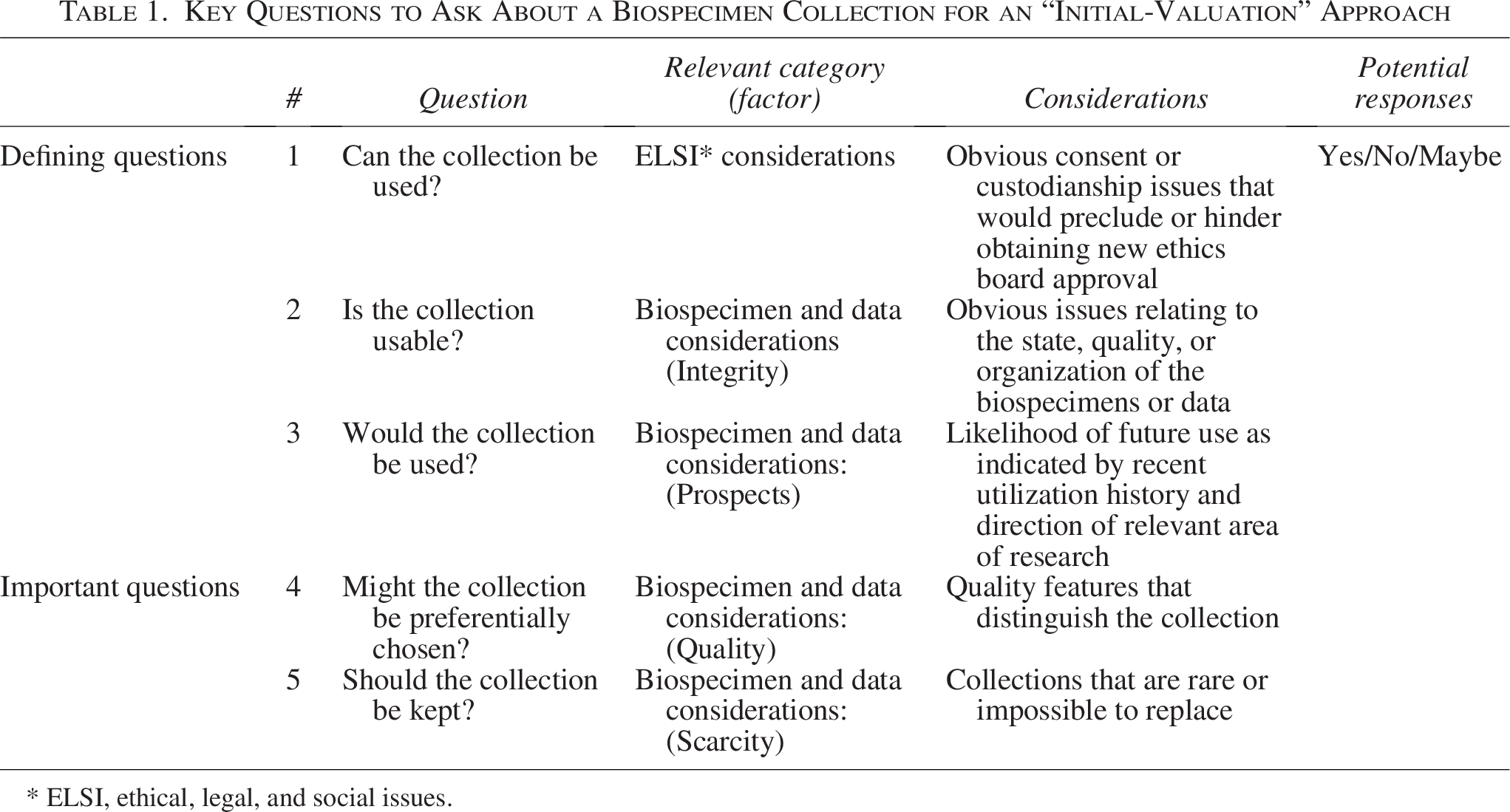
* ELSI, ethical, legal, and social issues.
Summary of the Main Ethical, Legal, and Social (ELSI) Factors that Influence Valuation of Biospecimen Collections and Status

ERB, ethics review boards; IRB, institutional review board.
Summary of the Main Biospecimen and Data Factors and Sub-Factors that Influence Valuation of Biospecimen Collections

High-level responses to these five questions (i.e., responses of Yes/No/Maybe) should be relatively easy to determine. A “Yes” response to all of the three defining questions will indicate a high value, that might be modified by the additional important questions. A “No” response to any of the three defining questions will indicate a very low value and make subsequent questions irrelevant. A “Maybe” response to any of the defining questions will be important to evaluate further if all other questions have “Yes” responses. Responses to the two additional important questions will be hardest to determine, and responses could often be “Maybe.” However, a “Yes” or “No” response here would act as a useful modifier indicating a higher or lower overall value.
“Extended-valuation”
Where an “initial-valuation” of a collection does not identify any major strengths or weaknesses that would dominate decision making, then it may be necessary to proceed to an “extended-valuation.” For example, an “extended-valuation” may be necessary if there is a major change to the biobank’s existing storage capacity/locations, or when the focus is on external collections that have different provenance and the impact of multiple parameters (outlined below) may need to be assessed to determine value.
Factors Involved in the Valuation of Biobank Collections
ELSI factors
ELSI factors can often dominate valuation assessments, particularly when assessing collections where the provenance is independent of the biobank. However ELSI considerations may also be important in instances where biobanks have operated for many years, and laws and guidelines have changed over time. This assessment will involve the review of participant information sheet/s and consent form/s, study protocol/s, and prior approval/s. Assessment may also require consultation with a range of stakeholders (e.g., institutional department heads, ethics review boards [ERB], funding bodies, patient advocates, and third-party contractors). An initial ELSI review can be performed by relevant experts in the biobank. However, in most jurisdictions, the ERB will ultimately decide on the feasibility of a change of governance, the options, and any limitations associated with future research use. It is important to note that ethics oversight and ERB approaches may vary according to country. As the ERB will be directly involved in reviewing consent forms and documentation to determine applicability, they must be provided with all relevant information. Following review, the ERB will (or will not) provide final approval for the transfer of custody of a biospecimen collection.
A list of specific factors posed as questions that may need to be addressed by the existing custodian or through biobank/ERB review of available documentation is outlined in Table 2. These questions pertain to the ethical basis for compiling the original collection, the status and potential ongoing role of the original custodian/s, and the terms of the original approved plan for biospecimen and data access, distribution for research, and data sharing by researchers.
Where paper or electronic copies of participant information sheet/s and consent form/s are available, they must be reviewed for details relating to the information provided to the participant. A review of the consent form and study protocol must confirm that the named custodian is the current custodian proposing the transfer (e.g., for old study collections that are housed in research laboratories, this custody may have changed over time without appropriate review and documentation). The duration and location of storage of biospecimens and data described in the consent form also need to be considered. Special statements and limitations around intellectual property and future research use (e.g., the consent form may contain details about what areas of research can or cannot be supported) should also be checked. When participant enrollment has occurred over an extended period of time with the associated evolution of ERB requirements, there may be more than one version of the participant-facing material. Therefore, all versions must be reviewed, and their relation to different parts of the collection considered.
For external legacy collections, if the original or current custodian is still available and wishes to participate in decision-making about the collection on an ongoing basis, inclusion on the access committee should be considered. Where this custodian is still active in research, their ongoing involvement can positively influence the decision to accept an external collection as they can act as a champion to stimulate future utilization. By contrast, the continued involvement of a past custodian who is not still active in research could hinder objective decisions about future retention of a collection.
The identification of significant ELSI issues by the biobank is likely to complicate obtaining approval from the ERB for transfer of custody. Therefore ELSI assessment should usually precede detailed efforts to assess other factors. Issues can range from lack of adequate documentation of original informed consent for research use (or granting of a waiver of consent), to narrow restrictions within the original consent around the length of storage or specific research uses.32,33 In some instances, the ERB may require a reconsent of participants. This process can be very costly and time consuming, therefore the potential yield and work involved in the reconsent process should be carefully considered in the context of likely research demand. Alternatively, there may simply be insufficient funds or appropriate staffing available to conduct such a process. In other instances, an ERB may only approve absorbing the collection with a minimal and anonymized data set. For some collections, this approach may be worthwhile but for other collections, this can significantly reduce the value. Even if transfer is deemed feasible by the ERB, some limitations associated with original consent may reduce the value of biospecimens for future research use, and therefore the enthusiasm to accept an external collection.
Biospecimen and data factors
If no significant ELSI issues arise (or issues identified can be adequately addressed), a number of “Biospecimen and Data” related factors will need to be considered to complete the valuation of a collection. The starting point, the effort applied, and the emphasis on the assessment of specific “Biospecimen and Data” factors and subfactors (summarized in Table 3) will all be determined by the outcome of the “initial-valuation” assessment (Table 1). The approach used to summarize the status of “Biospecimen and Data” factors may in some cases be a qualitative description, but in other cases, these many factors may be best summarized by a quantitative score (Table 3).
The visual integrity of the collection will be the starting point in many instances (Table 3) because it is readily assessed. During the assessment of the visual integrity of frozen biospecimens (where any physical changes to the biospecimen and/or its container and label are assessed visually), efforts should be made to minimize inspection time outside of the freezer or LN tank. If possible, this task should be performed and recorded in concert with other, necessary times of freezer access. Similar visual features such as labelling integrity can also be assessed for other types of stored biospecimens. However, this may involve significant effort for large collections. Where visual inspection finds a significant number or proportion of biospecimens or containers with defects, compromised labeling, or that cannot be confidently linked to accompanying data, then the overall value of the collection is clearly compromised. In this case, assessment of other factors may not be worthwhile, unless the scarcity of the collection is very compelling. 14 Where only a proportion of biospecimens are damaged, any valuation should discount these.
Prospect factors revolve around an assessment of the likely demand for the collection (Table 3). These factors may be relatively more difficult to ascertain than the other valuation factors, due to a need to predict future usage and the subjective nature of the assessment. However, there are a number of approaches to ensure that the assessment meaningfully predicts future research use. This includes reviewing the relevance to a current clinical issue (e.g., improvement to a current therapy) or key research questions that might be addressed using special features of the collection (e.g., association with a clinical trial), recent upward or downward trends in collection utilization, and/or identification of alternative similar cohorts. The availability of accessible analytical data and/or publications from the cohort may also influence prospects. Predicting future research use for research collections may pose challenges for biobank decision makers, but it is integral to business planning for the creation and sustaining of any classical model biobank. 6 Therefore, developing a “best guess” for the likelihood of future research use of biospecimen collections is an essential part of operating a biobank. Assessing prospects sub-factors may require consultation with and input from scientific advisory committees and/or other individuals knowledgeable in the relevant research area. These experts should be consulted if and when biobank committees judge that their opinion would support biobank decision-making.
Quality factors are diverse, and it may only be feasible to consider a limited selection of metrics on the basis of the most likely future research use of the collection (Table 3). Quality metrics (beyond the simple visual assessment for integrity) can be assessed quantitatively or semi-quantitatively. These include indicators of biospecimen quality (e.g., RNA Integrity Number [RIN] score), data quality (e.g., completeness of data fields), and the extent of data on biospecimens (e.g., pre-analytical factors, 34 ), and the donor (e.g., outcomes data), as well as the history of management (e.g., details on previous handling of the biospecimens, adherence to standard operating procedures, biobank certification or accreditation).
Scarcity is a well-developed concept in other fields, such as in determining the pricing of museums or other artifacts,35,36 but quantitation can be challenging. Scarcity factors relate to rarity and include the feasibility of replacing, the original cost to collect, and estimates of future opportunity costs to replace and store (Table 3).
Summarizing Valuations
In some instances there may be some salient features of a collection that are easy to identify, are straightforward to assess, and have a dominant impact on the value of a collection. Examples of salient features that might “fail” a collection on “initial-valuation” are biospecimens that are not associated with adequate informed consent, biospecimens that have lost reliable labels, or data fields that are limited in number or substantially incomplete. Examples of important features that might “fail” a collection and yet only emerge on “extended-valuation” are biospecimens with very low RNA quality when analyzed or a new expert opinion on a shift in potential for research use related to changing clinical issues.
In circumstances where assessing most/all of the factors and sub-factors discussed above is necessary to arrive at a decision on overall collection value, it may be useful to summarize all issues in the ELSI category and to determine a value score for the “Biospecimen and Data” considerations. These summaries/scores can then be used to make comparisons with one or more other collections. While what is comparable may be determined by individual situations, examples may include another collection occupying a similar storage volume within the biobank, or a collection from a similar group of donors (internal comparison), or a similar collection stored by another biobank (external comparison).
It is hard to assign quantitative scores to ELSI factors, but these may be summarized using responses to the list provided in Table 2. “Biospecimen and Data” factors listed under “Integrity,” “Prospects,” “Quality,” and “Scarcity” factors in Table 3 can be summarized by assigning scores for each factor to arrive at an overall score. For example, each subfactor could be assigned 10 points, allowing each main factor to be reflected in subtotal scores up to 30 and the overall collection value in a total score ranging from 0 to 120. A quantitative value score should be regarded as an indicator of relative rather than absolute value, but a score can be an effective way to summarize multiple parameters. Scoring underpins the well-established peer review model for the valuation of research proposals in academic research, where a summary score is used to reflect the assessment of multiple different parameters.37–39 In the biobanking context a scoring approach has also recently been proposed to support prioritization and selection of samples within microbial biobanks. 23
Conclusions
Valuation of biospecimen collections is a necessary part of routine biobank operations, including determining researcher access to sought-after biospecimens and decision making on accepting or rejecting all or portions of external legacy collections that are under consideration by the biobank. However valuation of collections is often avoided because it can be challenging, but also because many biobankers can be “hoarders” by nature. 8 When valuation of biospecimen collections is undertaken, it is likely to occur through a variety of non-standardized approaches. This paper seeks to delineate a standard approach to valuation and to highlight the main factors and subfactors that should be considered when valuing collections. Valuing sets of biospecimens with the option to cull existing and/or not accept legacy collections seeks to address biohoarding in a systematic manner, providing a framework for biobank decision-making. It also provides opportunities to improve the balance of biobank supply and demand in the face of limited research resources. As a secondary benefit, creating efficiencies in biobank storage may also have favorable climate impacts where mechanical freezer energy usage is reduced.
The act of valuation remains partly objective, partly subjective, and partly predictive, relying on the evidence at hand to predict future needs. Despite these challenges, more consistent approaches to collection valuation will inform better decisions by biobanks on what to collect, what to continue to store, and what to discard.
Authors’ Contributions
A.R. and J.A.B.: Writing—review and editing. P.H.W.: Conceptualization, writing—original draft. Writing-review and editing.
Footnotes
Acknowledgments
P.H.W. acknowledges valuable past discussions on this topic with Jodi Leblanc, Lise Matzke, Helen Moore, and Abhi Rao. P.H.W. also gratefully acknowledges support for this work by the Biobanking and Biospecimen Research Services Program at BC Cancer (supported by the Provincial Health Services Authority), the Canadian Tissue Repository Network (funded by a grant from the Terry Fox Research Institute). J.A.B. gratefully acknowledges support for the NSW Health Statewide Biobank from the NSW Office of Health and Medical Research, NSW Health Pathology, and the Sydney Local Health District. A.R. gratefully acknowledges the support of the Leeder Centre for Health Policy, Economics, and Data at the University of Sydney.
Funding Information
This work has been supported in part by grants from the
Author Disclosure
There are no disclosures.