




Abstract
Biobanking is crucial for advancing medical research and personalized medicine, offering high-quality biospecimens for studies on biomarkers, drug development, and diagnostics. Despite its global potential, challenges such as fragmented governance and varying standards hinder biorepository collaboration, particularly in South Africa (SA). A unified national biobank network could enhance research and healthcare by improving biospecimen access, ethical governance, and collaboration. Global biobank networks offer models for standardization, data sharing, and international cooperation. SA can benefit from these models by creating a centralized biobank platform, promoting capacity building, and fostering regional and global partnerships. To address the challenges SA faces regarding biobanking, the Medical Biobanks Cluster established a network named Medical Biorepositories of SA (MBirSA), which seeks to build a cohesive network of medical biorepositories in SA. Through this network, it plans to foster an inclusive culture of biospecimen and data protocol harmonization, while encouraging adherence to legal, ethical, and quality best practices and standards. The network aims to bring stakeholders together, increasing visibility and transparency, and encouraging sector-wide collaboration. MBirSA also aims to offer training to build capacity in global best practices, aid in the development of dependable biorepository infrastructure, and promote research partnerships to enhance healthcare advancements.
Introduction
Biobanking has become a key element in advancing medical research and personalized medicine.1,2 Recognized globally for its healthcare potential, Time magazine named biobanking 1 of the “10 Ideas Changing the World Right Now” in 2009. 3 With advances in technology and bioinformatics, the need for high-quality biospecimens and data continues to grow, facilitating the development of personalized treatments and better understanding of diseases.4–6 Biorepositories, which collect and store biospecimens, are essential for reproducible research in fields like biomarker discovery, drug development, and diagnostic validation.7–9 These collections, when well-annotated, also serve future studies employing new technologies. 10 Biobanks encourage global and interdisciplinary collaborations across fields such as health, life sciences, and social sciences.11,12 However, standardizing processes across different biorepositories is a significant challenge due to varying governance structures and economic disparities.13–17 In South Africa (SA), harmonizing biobank governance could benefit the diverse public, academic, and industrial biorepositories.18–21
Benefits of a biobanking network
As demand for biospecimens grows, so does the strain on biobanks to meet the needs of large-scale, complex research. Biorepositories in specific settings, such as diagnostics and clinical trials, offer access to rare disease specimens and specialized techniques. Networking biorepositories enable wider access to high-quality biospecimens and metadata, supporting global healthcare advancements. 22 A collaborative network dismantles research silos, promotes shared resources, fosters a culture of cooperation, and enhances the impact of biobanks. 23 Such networks also improve efficiency by providing reciprocal biospecimen exchange, ethical governance, and sustainability. 24 As biorepositories join national and international networks, their capacity for impactful research increases. 25 Furthermore, biorepository networks improve the availability, visibility, and utilization of biospecimens, increasing sustainability through funding and collaboration. 26 Educational initiatives within these networks enhance knowledge transfer and capacitate the next generation of biobankers. 26 Collaboration between high-income (HICs) and low- to middle-income countries (LMICs) is vital for equitable access to biobanks and mutual capacity building. 27
The SA biobanking landscape
SA’s biobanking landscape is diverse, consisting of institutional, public, and private biorepositories addressing various research and public health needs. Institutional biorepositories are housed within universities and focus on genomics, disease-specific studies, and epidemiological research. The National Biobank of the National Health Laboratory Service serves as the country’s first population-based biorepository. 21 Private biorepositories focus on niche research areas, but their accessibility is often limited to stakeholders.18,28,29 SA also faces challenges such as limited resources, fragmented governance, and the lack of a dedicated Biobank Act, which affects operational consistency and quality.28,30,31 A national biobanking act in SA would significantly enhance research capabilities,1,21 as well as the ethical and regulatory framework, 32 and would address current challenges by ensuring the availability of relevant biospecimens. 1 The demand for diverse biospecimens, especially for genomic research, is growing as SA remains underrepresented in global genomic studies.33,34 A unified biorepository network in SA would enhance local and international research, support capacity building, and address healthcare disparities by ensuring ethical governance and equitable access to resources.
Overview of global biobanking networks and lessons for SA
Biorepositories across various settings have significantly advanced human health research, particularly in HICs. 35 Collaborative global initiatives such as the Human Heredity and Health in Africa (H3Africa), the Economic Community of West African States, Africa Centres for Disease Control and Prevention, Bridging Biobanking and Biomedical Research across Europe and Africa, LMIC Biobank and Cohort Network, Global Emerging Pathogens Treatment Consortium, along with AIDS and Cancer Specimen Resource/AIDS Malignancy Consortium through its sub-Saharan Africa Regional Biospecimen Repository, all had a common goal—to improve, capacitate, and promote biobanking capabilities within Africa.1,18,20,35–39
These efforts have led to the establishment and growth of biorepositories in countries such as Ivory Coast, Uganda, Nigeria, Kenya, and SA, increasing awareness and expertise in biobanking and “-omics” across the continent.1,14,18,40 Through these initiatives and others, African researchers are delivering innovative, world-class scientific research and competing for more resources as they map a pathway to health ownership on the continent while remaining cognizant of the ethical implications of biospecimen and data custodianship.1,41 However, they additionally highlight challenges associated with the highly fragmented landscape such as researchers working in isolation, and disjointed governance and ethical frameworks. From the author’s experience, SA medical biorepositories still function as disparate entities, reliant on their own operating procedures, with little to no collaborative partnerships.
SA can gain valuable insights from international biobank networks outside of Africa (see Table 1. for a summary). The Marble Arch International Working Group on Biobanking (MAIWG) focused on developing collaborative frameworks for biobank networks, particularly for translational research. The group emphasized the importance of ethical governance, transparency, and data sharing in biobank operations. It highlighted the need for clear guidelines on the use of human samples for research purposes and establishing trust with participants. Key features included community engagement and participant-centric practices that promote ethical considerations in biobanking. 42 The emphasis on community engagement and ethical governance by MAIWG is highly relevant for SA, where cultural and ethical considerations are paramount. A SA biobank network should prioritize transparency, informed consent, and ensuring public trust in the handling of biospecimens.
The United Kingdom (U.K.) Biobank, one of the largest biobanks globally, provides access to a diverse array of health data and biological samples for large-scale research. Its success is attributed to its centralized data-sharing platform, extensive participant consent process, and long-term storage capacity. The model emphasizes integration across biobanks and high data quality, as well as ethical standards in participant consent. 43 The U.K. Biobank model demonstrates the importance of centralized infrastructure and a uniform approach to data sharing. SA can learn from this model by creating a centralized platform for biospecimen access and ensuring that biobank data is high-quality and well-maintained. The focus on long-term storage and maintaining comprehensive metadata is especially pertinent for SA’s research needs in genomic studies and public health.
The European Biobank and Biomolecular Resources Research Infrastructure (BBMRI-ERIC) is a European initiative that aims to connect biobanks across Europe and establish common standards for biobank operations. It focuses on harmonizing biobanking practices, ensuring compliance with legal and ethical standards, and promoting interoperability among biobanks. The network enables seamless integration of biobank data and specimens, supporting large-scale, and multinational research efforts. 44 BBMRI-ERIC’s focus on standardization, governance, and international collaboration provides a valuable framework for SA. Harmonizing biobanking practices across South African institutions, while maintaining autonomy, would enhance the consistency and quality of biospecimen collections. Collaboration with international partners would also boost SA’s visibility in global health research.
The Asian Network of Research Resource Centers (ANRRC) facilitates the sharing of biospecimens and research resources across various countries in the Asian region. The network emphasizes the integration of regional biobanks and the creation of standardized protocols for sample handling and data management. The key to ANRRC’s success is its focus on overcoming geographic and logistical barriers to create a seamless, accessible biobank network. 45 For SA, an emphasis on overcoming logistical and geographical barriers to biospecimen sharing could improve the accessibility and usability of its biobank resources. The ANRRC model could inspire SA to develop regional collaborations, ensuring that biobanks from across the country are well-connected and accessible to researchers nationwide.
The Polish Biobanking Network (BBMRI.pl) is a national initiative that aims to integrate Poland’s biobanks into a single network. The initiative focuses on standardizing biobank operations and ensuring compliance with European Union regulations, including data protection laws. The Polish model includes capacity-building efforts and training programs for biobank staff and researchers, fostering a collaborative environment. 46 The BBMRI.pl model demonstrates the importance of capacity building and staff training in biobank sustainability. SA could adopt similar strategies, especially in low-resource settings, to strengthen local expertise and ensure that biobanks operate efficiently and in accordance with best practices.
Overview of the National Scientific Research Collections Platform
Scientific collections represent research infrastructures with the potential to significantly address global challenges such as One Health and emerging diseases. However, it has been noted that scientific collections in SA (and globally) are generally scattered and poorly organized to provide optimal access for research purposes. 47 In 2011, the National Research Foundation of SA commissioned a study to investigate the state of the national scientific research collections. The report indicated the following challenges: (1) fragmentation and isolation of collection institutions; (2) inaccessibility; (3) lack of proper physical infrastructure for preservation and storage; (4) poor understanding of best practices and a lack of common standards; (5) scarcity of workforce development and training; (6) narrow and individualized approaches to collections-based research; and (7) ideology of personal ownership of the collections and consequently a lack of research collaboration.
The South African Research Infrastructure Roadmap and the National Scientific Research Collections Platform (NSRCP), approved by the Department of Science and Innovation (DSI), aim to support the development of national biorepository infrastructures. 48
The NSRCP (Fig. 1) consists of five clusters, namely (1) biodiversity biobanks, (2) living collections, (3) Medical Biobanks Cluster (MBC), (4) natural scientific collections, and (5) anthropology collections. Each cluster is managed by a champion nominated by the scientific collection’s community.

Visual presentation of the National Scientific Research Collections Platform (NSRCP) and the placement of the Medical Biobanks Cluster(MBirSA) within the platform. MBirSA, Medical Biorepositories of South Africa.
The specific objectives of the NSRCP are to: (1) ensure the long-term security and accessibility of collections and data by developing common policies, standards, human capacity, and research infrastructure; (2) catalyze interdisciplinary research addressing questions relevant to South African society; (3) explore opportunities to enhance the economic potential of knowledge and products; and (4) accelerate innovation in healthcare-related products using biobank samples and data.
Each of the five clusters has been mandated by the SA-DSI (now known as the Department of Science, Technology, and Innovation) to develop a detailed business plan and to establish a steering committee to drive the activities of the cluster. The next section will introduce the MBC and highlight some of its activities to date.
Overview of the MBC
The MBC was tasked with creating a cohesive network of medical biorepositories in SA, which has been named Medical Biorepositories of SA (MBirSA). As the establishment of this network progresses, the MBC and MBirSA are considered one and the same entity, with all future references aligning under the name MBirSA.
The primary role of MBirSA is to develop a unified and collaborative network by implementing standardized protocols for the collection, storage, and sharing of biomedical specimens and their associated metadata. These protocols will adhere to ethical and quality standards to ensure the reliability and integrity of the resources. A key focus is increasing awareness of the network’s benefits to encourage the collaborative use of biomedical resources across the research community. The initiative aims to integrate all medical biobanks into a single cohesive network to harmonize biobanking practices, standardize operations, enhance biospecimen quality, and build biorepository capacity. MBirSA seeks to address fragmentation in the biobanking landscape and align SA’s infrastructure with international standards.
The network will adopt a hybrid model, combining a centralized “hub,” hosted by a designated institution, with independent biobanks operating under their own governance while adhering to MBirSA’s frameworks. This model ensures biobank autonomy while providing access to standardized practices, shared resources, and network support.
A core focus of MBirSA is raising awareness of the benefits of joining a harmonized network. Member biobanks gain enhanced visibility, access to training and capacity-building programs, guidance on standardization, shared resources, opportunities for collaboration, and support for ethical and quality compliance.
To achieve its goals, MBirSA will implement standardized protocols for the collection, storage, and sharing of biospecimens and metadata, ensuring compliance with ethical, legal, and quality standards. Comprehensive training programs will also be developed to build a skilled biorepository workforce and foster excellence in the sector.
MBirSA’s establishment is supported by seed funding from the DSI, with allocations of R1,192,500.00 for 2023/2024, R2,307,111.20.00 for 2024/2025, and R2,704,441.60 approved for 2025/2026. This funding underpins the development of infrastructure, training, and essential guidance documents.
In addition to operational goals, MBirSA will play a key role in fostering collaborations between researchers and biorepositories by facilitating partnerships, knowledge exchange, and resource sharing. These efforts are expected to drive innovation in healthcare and biomedical research, with MBirSA also hosting events to connect local and international stakeholders.
The governance of MBirSA is overseen by a steering committee of national experts and international advisors. This leadership ensures alignment with local priorities and global trends. The network’s objectives and 10-year implementation strategy are detailed in Figures 2 and 3, respectively.
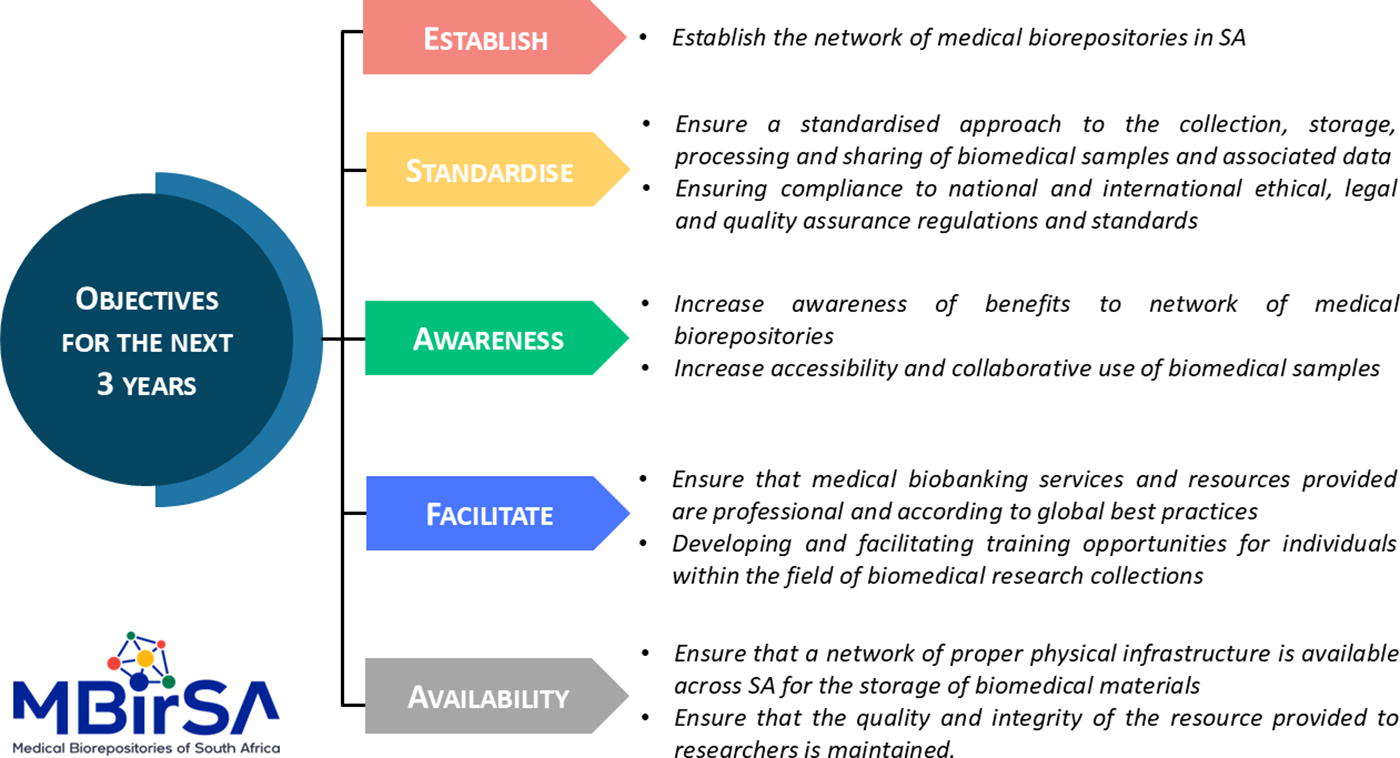
Objectives of the MBirSA for the next 3 years with the official MBirSA logo.

Timeline illustrating the proposed milestones and deliverables of the MBirSA over the next 10 years.
Progress to date
Marketing and communications
The implementation strategy of the MBC and the established MBirSA network emphasizes marketing and communication to increase awareness and engagement through the following initiatives:
The Key Features of Global Biobank Networks and What Distinct Features Can Be Applied to South Africa’s Biobank Network
LMICs, low- to middle-income countries; H3Africa, Human Heredity and Health in Africa; MAIWG, Marble Arch International Working Group on Biobanking; SA, South Africa.
Education and awareness
A webinar series has been launched to educate the biomedical research community about the benefits of the MBirSA network of medical biorepositories in SA. Four seminars were delivered over 4 months from November 2023, with an attendance of 149 participants/average of 37 individuals. The series was well received, with recordings available on the website (https://mbirsa.org.za/resources/#webinars).
Future directions and implications
Capacity development and training materials
Capacity for the MBirSA network will be established, both in terms of knowledge and infrastructure. A needs assessment will be conducted during Phase 1 (years 1 and 2) of the implementation plan. Targeted sites during the first round of assessments will include those associated with the working group of the MBC. The cluster champion will conduct the needs assessment in the form of site visits with a suitable checklist (based on the International Society for Biological and Environmental Repositories [ISBER] best practices document and the international standards, ISO 20387). The cluster will also aim to work together with the international accreditation body currently responsible for assessments of ISO 20387 (A2LA) in conjunction with the South African National Accreditation system in adopting the ISO 20387 standard and performing accreditation assessments of biorepositories within SA. The site visits will mimic a vertical assessment. The outcome of the site assessments will be reported back to the NSRCP steering committee after its completion. Capacity development in terms of knowledge, will be linked to education and awareness training activities. As the network grows and additional sites are added to the network, these will also be subject to site assessments.
To date, the newly released ISBER Best Practices 5th edition, 47 (published end of 2023) has been downloaded by the core working group and will be used as the basis for the development of an evaluation checklist. Capacity development has begun in the form of the webinar series, and a workshop on the fundamentals of biobanking scheduled for October 2024. Site visits will commence in 2025.
The development of training materials for medical biobanking in SA is progressing well, with the first version on track for completion. The training material was utilized during the workshop on the fundamentals of biobanking in October 2024. This workshop served as an initial platform for disseminating knowledge and best practices, ensuring that participants were well-equipped with the necessary skills and information to enhance medical biobanking efforts across the region. Refinements will be made to the material after the workshop.
Policy recommendations: Development of standardized documents and protocols
The establishment of standardized documentation and protocols is a crucial step toward creating a cohesive and efficient biorepository network. The working group, having procured the necessary documents and best practices guidelines, is now positioned to begin a thorough evaluation and development process. Although the key performance indicators are set for completion by 2025, the current progress suggests that these foundational documents will be finalized ahead of schedule. This proactive approach not only demonstrates the commitment of the working group but also underscores the importance of timely implementation in achieving the network’s broader goals. Moving forward, it will be essential for policymakers to support this momentum by ensuring that the developed protocols are integrated into national health frameworks and are adaptable to evolving technological and ethical standards. In addition, the early completion of these documents provides an opportunity to pilot these protocols in select biorepositories, allowing for iterative refinement and setting a precedent for other initiatives across the continent.
Expansion of the network
The MBirSA network will be developed in three phases.
During Phase 1, a limited number of medical biorepositories will be approached for inclusion in the network, based on the preexisting working relationship and established knowledge of the national initiative. Phase 1 will pave the way for the establishment of a formalized medical biorepositories network, with national reach and expanded geographical coverage in Phase 2. During Phase 2, the aim is to expand the network to provinces not yet covered by the initial phase, by building relationships with individuals at academic or medical institutions and entities that have (or are in the process of) established biorepositories. The structure of the network is still to be determined and may take on a variety of forms, but with a central goal that all collaborators share data and information in accordance with established protocols and policies. It is envisioned that Phase 2 will rapidly upscale access and capacity within the network to enable the participating entities to operate independently while sharing the required data and biospecimens with the network. In Phase 3, the MBirSA steering committee will actively search for multidisciplinary research projects that may utilize the resources within the network, to provide the scientific evidence to the research community on what the potential benefits of this initiative might entail.
One of the primary challenges we have encountered in establishing a national biobanking network is the prevailing preference among many scientists to work independently. This inclination necessitates significant efforts in awareness education and training to highlight the benefits of a collaborative approach. Our team is dedicated to demonstrating how participation in a national network can enhance research capabilities, provide access to a wider range of biological materials, and foster innovative, multidisciplinary projects. By emphasizing these advantages and actively engaging with the scientific community, we aim to shift perspectives and encourage broader involvement in the national biobanking network.
Innovation and technology advancements through multidisciplinary research projects
As SA’s medical biorepository network develops, integrating cutting-edge technologies will be crucial for maximizing the value of collected biomaterials. Successful multidisciplinary projects using network resources demonstrate the innovation potential within this framework. Key to this advancement is ensuring that data are findable, accessible, interoperable, and reusable, especially for genetic and “-omics” data. The initiative will leverage artificial intelligence and machine learning to improve data analysis and personalized health interventions. As the network expands, digital biobanking and remote biospecimen collection will enhance research efficiency and facilitate cross-disciplinary collaboration. These technological innovations will support global health research and are planned for the network’s third phase, ensuring sustainable and strategic integration of technology with health research.
Conclusion
Biorepositories are crucial for advancing health research. SA’s biobanking landscape includes institutional, public, and private biorepositories that support genomics, disease-specific, and epidemiological research. However, challenges such as limited resources, fragmented governance, and a lack of a dedicated Biobank Act hinder operational consistency, and a unified biorepository network would improve research, capacity building, and equitable access to biospecimens.
SA can draw valuable lessons from international biobank networks, particularly in the areas of standardization, ethical governance, and international collaboration. However, SA’s biobank network should be designed with a focus on local health priorities, capacity building, and ensuring the active involvement of local communities. Adopting elements from successful international models, such as BBMRI-ERIC’s standardization, the U.K. Biobank’s centralized platform, and H3Africa’s community-centered approach, can help SA create a biobank network that supports both national health needs and global scientific collaborations.
By focusing on these distinct priorities and leveraging international best practices, SA can build a biobank network that not only meets the challenges of today but also contributes significantly to global health research in the future.
MBirSA is an initiative aimed at creating a unified network of medical biorepositories across the country. The goal is to standardize the collection, storage, and sharing of biomedical specimens while ensuring ethical and quality compliance. MBirSA focuses on increasing awareness and fostering collaboration among biobanks, encouraging the use of shared resources and best practices. The network adopts a hybrid model, with a central “hub” institution and independent biobanks operating under a shared framework. This approach promotes biobank autonomy while ensuring standardization and support for compliance, training, and capacity building. Supported by substantial funding from the DSI, MBirSA is set to drive innovation and collaboration in biomedical research and healthcare. The initiative is governed by a steering committee of national and international experts, with a clear 10-year strategy to align SA’s biorepository infrastructure with international standards.
MBirSA has already made strides in marketing, education, and awareness, with future activities geared toward developing training materials, policy recommendations, expanding the network, and supporting multidisciplinary research to advance healthcare innovation and technology. A comprehensive, interdisciplinary approach is vital for addressing SA’s diverse health challenges and achieving sustainable improvements in healthcare delivery.
Footnotes
Authors’ Contributions
E.H.C.: Conceptualization (equal), funding acquisition (lead), writing—original draft (equal), writing—review and editing (equal), and final approval. D.E.A., C.S., F.F., M.S., B.M.D., M.R.M., and S.S.: Writing—original draft (equal), writing—review and editing (equal), and final approval. W.O.F. and M.S.T.: Writing—original draft (supporting), writing—review and editing (equal), and final approval. A.C.S.: Writing—original draft (supporting), writing—review and editing (equal), final approval, preparing article, and supporting documentation for submission to journal (lead). C.C.-A.S.: Conceptualization (equal), writing—original draft (equal), writing—review and editing (equal), and final approval.
Disclaimer: Use of Artificial Intelligence
Chatgpt (4o mini) was used to shorten sections that authors originally wrote in their own words (initial word count was over 7500), the revised sections were compared to the original document to maintain integrity and the initial meaning of each section.
Author Disclosure Statement
No conflicts of interest to declare.
Funding Information
This study received funding from the South African Department of Science and Innovation for providing seed to establish MBirSA and to publish this article open access.