




Abstract

The importance of quality parameters in biobanking of biological materials like human tissues has been emphasized in the past.1,2 Biobanking best practices, guidelines, and policies like International Society for Biological and Environmental Repositories (ISBER) Best Practices 5th ed. and those by the Organization for Economic Co-operation and Development (OECD) and Canadian Tissue Repository Network (CTRNet) 3 were developed to address these challenges. 4 In the new biobanking standard, International Standard Organization (ISO) 20387, training of biobank employees is specifically required. 5
There is no doubt that such education is needed. 6 Many organizations are offering a wide range of education in biobanking. 7 However, they are either specific in-house on-the-job training or more formal education for young professionals or even students.7,8 While these procedures are proving invaluable to biobanks to ensure that their processes for accessing, processing, and distributing biobanked materials ensure reproducibility and quality performance,2,4,9,10 they do not address the quality performance of the biobanking professionals themselves.
Highly trained and skilled staff are essential to ensure high-quality biospecimens for reproducible results in precision medicine, biomarker development, and biomedical research. 11
For this reason, ISBER and the American Society for Clinical Pathology Board of Certification (ASCP BOC), as the two leading organizations in their fields, joined forces to develop the Qualification in BioRepository Science (QBRS) examination in order to further establish and solidify the future for reproducible and sustainable quality biobanking.
In April 2020, the QBRS examination went online as a new and unique qualification examination for biobanking professionals. This initiative was an important advance in ISBER’s overall effort to constantly enhance and improve quality in biobanking in all its various facets. While there are now several initiatives in place to assess the quality of biobanks as a whole,3,4,10 there were no benchmark examinations in place prior to that time for biobanking professionals working within the biobanks. The QBRS online examination was created to fill this void. The QBRS exam takes advantage of ISBER members’ content knowledge of biobanking combined with ASCP BOC’s extensive experience in creating and scoring examinations for research and clinical laboratory workers. The online examination is unique; Japan has an online examination that is similar, but in Japanese (ISBER poster, 2021, Pj-07, J. Ikeda et al., Newly developed qualification system to assess personnel competency in biobank activities in Japan). Background work prior to releasing the examination online included creating an agreement between ISBER and ASCP BOC, recruiting an examination committee of knowledgeable ISBER members to create and mark the examination, and establishing the technical details that underlie the examination process. A marketing campaign was initiated as well and has continued to promote the examination.
The exam process is straightforward; after an application is received with the applicants’ background training verified, an examination window is provided for the exam to be completed within 60 days of approval. The exam is marked and graded promptly after the online examination is completed. If unsuccessful at the first attempt, the applicant has several repeat chances if required to complete the examination successfully. QBRS credential holders are required to renew their credential every three years, primarily by documenting continuing education during that time. To date, 26 biobankers have been renewed for a renewal rate of 68%.
Full details about the application process can be found at ISBER, https://www.isber.org/page/qualification and “Frequently Asked Questions” (FAQs) regarding all aspects of the QBRS exam can be accessed at the same URL.
As of March 31, 2025, 95 individuals in Australia, Canada, Egypt, Hong Kong, Madagascar, Nigeria, Pakistan, Poland, Puerto Rico, Saudi Arabia, Singapore, the United Arab Emirates, Uganda, the UK, and the USA have taken and passed the exam (Fig. 1). While the majority of QBRS recipients are located in the United States, biobankers in 15 countries have now taken the exam and qualified for the QBRS designation.
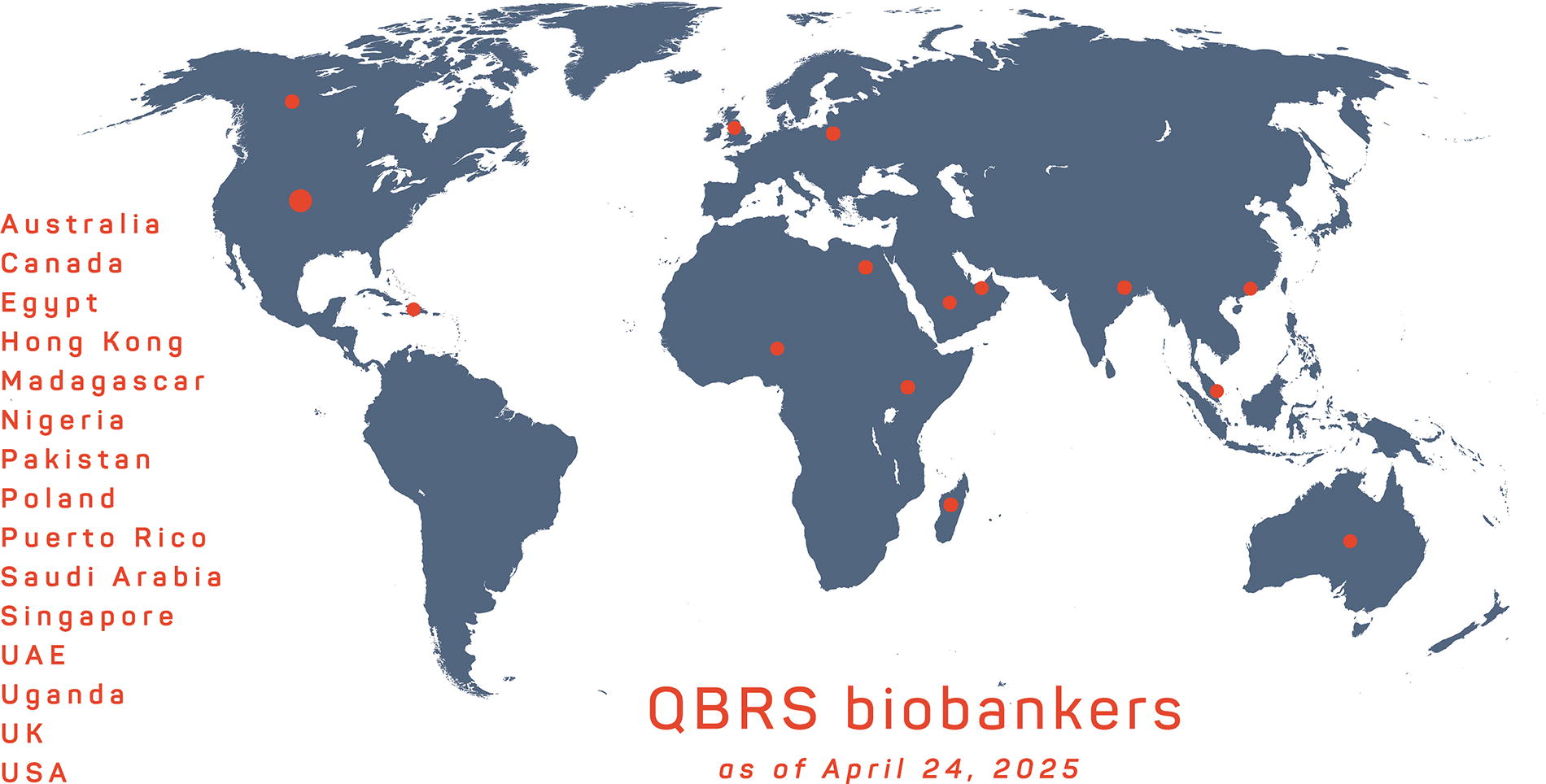
A world map illustrating the location of QBRS qualified biobanking professionals in Australia, Canada, Egypt, Hong Kong, Madagascar, Nigeria, Pakistan, Poland, Puerto Rico, Saudi Arabia, Singapore, United Arab Emirates, Uganda, UK, and USA.
Initially there were six routes delineated as requirements as a prerequisite to application, requiring some combination of previous ASCP BOC certification, a baccalaureate degree or equivalent, higher degrees, and years of biobanking experience. Route 6, which was a “grandparent” clause which relied on years of experience rather than degrees taken, has been retired. Route 7, which refines the criteria for individuals’ acceptability following Masters in Biorepository Science/Biotechnology training, has been added. The variety of routes provides maximum flexibility on the basis of their prior training and experience to prospective applicants. Full details of the routes can be found at ASCP-BOC, https://www.ascp.org/content/board-of-certification/get-credentialed/#qbrs.
ISBER has adopted the CTRNet Essentials of Biobanking online course review (ISBER, https://www.isber.org/page/EssentialsBiobanking) as a valuable adjunct to prepare biobanking professionals for their roles in biobanking. It is currently being updated to conform with changes to the ISBER Best Practices Ed. 5 that was recently published. When released, it will be utilized as an important study guide for the QBRS Examination.
For the past 3 years (2022–25), ISBER has sponsored a Bursary program for LMIC/UMIC (World Bank definition) biobanking professionals to provide funds to enable them to apply to take the QBRS exam. The Bursary covers the cost of registering for the exam itself as well as the cost of verifying the applicant’s academic credentials. Over that time, 15 individuals in Asia, Africa, and South America have been awarded bursaries, and 9 have written the exam and obtained the QBRS credential. Four have not yet taken the exam. This is an important initiative because it ultimately will help qualified biobankers and their staff in those underserved regions to expand our knowledge of the human genome on the Indo-Pacific Rim and in Africa. This may result in the development of new and effective approaches to disease management.
The QBRS will become the standard that defines the required level of quality in biobanking professionals and will assure sustained quality in biobanking laboratories. Successful applicants have acknowledged that attaining the QBRS makes them more desirable in hiring competitions and enhances their careers. Conversely, biobanks that hire a QBRS-qualified biobanker are striving for quality in their biobanking operation. In addition, they have indicated that employing QBRS-qualified biobanking professionals adds a further level of implied quality to their organization. Biobank directors have also indicated that the QBRS exam provides further impetus for professional training for their staff.
Footnotes
Author Disclosure Statement
No competing financial interests exist.
Funding Information
No funding sources were utilized in writing this article.