




Abstract
Background:
Positively charged drug carriers are rapidly emerging as a viable solution for long-standing challenges in delivery to dense, avascular, negatively charged tissues. These cationic carriers have demonstrated especially strong promise in targeting drugs to articular cartilage for osteoarthritis (OA) treatment. It is critical to evaluate the dose-dependent effects of their high intratissue uptake levels on charge-shielding of anionic matrix constituents, and the resulting changes in tissue osmotic swelling and mechanical integrity.
Materials and Methods:
We use the ideal Donnan osmotic theory to derive a model for predicting intracartilage swelling pressures as a function of net charge (z) and equilibrium uptake of short-length, arginine-rich, multivalent, cationic peptide carriers (cationic peptide carriers [CPCs], z varied from +8 to +20) in cartilage samples with varying arthritic severities and fixed charge density (FCD). We use this model to determine the dose-dependent influence of CPCs on both physiological osmotic swelling pressures and compressive electrostatic moduli of cartilage in healthy and arthritic states.
Results:
Under physiological conditions, the Donnan model predicted carrier-induced reductions in free swelling pressure between 8 and 29 kPa, and diminished compressive modulus by 20–68 kPa, both dependent on the net charge and uptake of CPCs. The magnitudes of deswelling and stiffness reduction increased monotonically with carrier uptake and net charge. Furthermore, predicted levels of deswelling by CPC charge shielding were amplified in tissues with reduced FCD (which model OA). Finally, the Donnan model predicted markedly higher reductions in tissue compressive modulus in hypotonic bathing salinity compared with physiological and hypertonic conditions.
Conclusion:
This analysis demonstrates the importance of considering charge shielding as a likely adverse effect associated with uptake of cationic drug carriers into negatively charged tissues, especially in the case of damaged tissue. The simple modeling approach and principles described herein can inform the design of cationic drug delivery carriers and their clinical treatment regimens.
Introduction
Many tissues in the human body that are sites of common diseases are composed of negatively charged matrix entities, which renders drug delivery to cellular targets deep within these tissues extremely challenging. 1 Examples include musculoskeletal tissues in joints, the intervertebral disc of the spine, and the vitreous humor of the eye, which are all sites of painful, debilitating degenerative diseases that affect millions of people worldwide. As a promising solution, recent advancements have harnessed the intrinsic bioelectrical activity of these tissues for drug delivery by using rationally designed cationic drug carriers, which can passively target the negatively charged matrix barrier.2,3 These carriers rely on Coulombic attractions with matrix constituents, which drive high upward Donnan partitioning at the tissue interface, setting up a steep inward concentration gradient that enhances intratissue transport. 4 Carriers designed with optimal charge can facilitate the weak, reversible, electrostatic binding interactions necessary to enable rapid, full-thickness penetration through the tissue to reach deep zone cellular targets, with retention times on the order of days to weeks.5–7 A multitude of positively charged delivery systems have proven successful in targeting a variety of charged tissues such as cartilage,3,8–10 gastrointestinal mucus,1,11,12 the intervertebral disc, 7 the tumor microenvironment, 13 and the eye,14,15 and there is significant interest in their preclinical development and clinical translation.1–3 As the application of cationic macromolecules gains traction, it is also important to evaluate the effects of their net charge and dosing on the target tissue's electromechanochemical and biological properties, 2 which can have strong implications for the design of future modalities.
Recent efforts have addressed the long-standing challenge of delivering drugs into cartilage tissue in articulating joints by designing cationic delivery systems for osteoarthritis (OA) treatments.3,4,16 Promising disease-modifying therapies for OA such as glucocorticoids, 17 small-molecule glycation inhibitors, 18 and proanabolic growth factors 19 have been successful in preclinical trials. However, their clinical translation has been limited because of the difficulty for drugs to diffuse through the full thickness of cartilage and reach cellular targets following an intra-articular (IA) injection. Cartilage comprises a low density of chondrocytes surrounded by a dense, avascular, and aneural meshwork of collagen II and aggrecan proteoglycans, which contain negatively charged glycosaminoglycan (GAG) side chains.1,20 Cartilage GAGs have an abundance of ionizable chondroitin sulfate and keratan sulfate groups that are deprotonated at physiological pH, which impart the tissue with a high negative fixed charge density (FCD). Importantly, not only do the small (∼10 nm) effective pore size and negative FCD of the extracellular matrix (ECM) present significant steric and Coulombic resistance to drug or drug carrier diffusion, but therapeutics are also susceptible to rapid clearance from the joint space by the synovial fluid following IA injection. 4
In light of these challenges, the highly anionic FCD of cartilage is becoming increasingly recognized as an opportunity for drug delivery rather than a barrier, which has been leveraged by rationally designing cationic drug carriers that electrostatically target matrix GAGs. A variety of cartilage-targeting cationic carriers have been proposed including protein-,8,21,22 peptide-,5,23 polymer-,9,24 and antibody- 25 based modalities, which have exhibited excellent ability to penetrate the full thickness of cartilage in vitro and in vivo. 26 Such delivery systems have enabled intratissue uptake concentrations up to two orders of magnitude higher than the surrounding fluid.5,6
Although studies in cartilage have given attention to off-target27,28 and cytotoxic 29 side effects of cationic carriers, the effect of high intratissue concentrations of polyvalent cationic molecules on tissue mechanical properties has received little consideration. 30 A core function of cartilage in joints is to withstand compressive loads as a shock absorber between bones, and a significant component of the tissue's compressive strength derives directly from its negative FCD. 31 In fact, experimental evidence suggests that 62% of the tissue's compressive modulus arises from like-charge repulsions between neighboring GAGs. 32 Moreover, the fluid-withdrawing properties of proteoglycans generate a high Donnan osmotic swelling pressure within the tissue; even at rest, the tissue is prestressed as proteoglycan swelling forces exist in equilibrium with tensile resistance from collagen fibers. 33 Intracartilage charge shielding is a well-studied phenomenon by which high interstitial concentrations of small counterions (Na+) mask the negative FCD of the tissue when immersed in a hypertonic environment, which can cause significant deswelling. 34 We hypothesize that a similar effect may occur in cartilage (and other negatively charged tissues) treated with high concentrations of cationic drug carriers, which could affect the tissue's ability to withstand physiological loads. 30 This effect could be particularly severe in mid- to late-stage arthritic cartilage, in which the mechanical integrity of the tissue is already diminished due to proteoglycan loss. 35
The goal of this study was to apply Donnan osmotic theory to predict the effects of charge shielding by multivalent cationic macromolecules on the equilibrium swelling properties and mechanical stiffness of cartilage tissue. Using previously published uptake data on short-length, arginine-rich cationic peptide carriers (CPCs) of varying net charges (as an example multivalent, macromolecular drug carrier), 5 we describe a modeling approach that incorporates the cationic charge of CPCs into the electroneutrality of the tissue FCD and mobile counterions. We implement this classical ideal Donnan model to predict CPC-induced deswelling, and report estimates for the magnitudes of swelling pressure expected from empirically observed levels of CPC uptake into cartilage. Furthermore, we use this model to investigate the dependence of osmotic swelling on intratissue CPC concentration and net charge, and to predict swelling and stiffness following CPC uptake into GAG-depleted cartilage mimicking mid- and late-stage OA. Finally, we apply the model to estimate the change in the electrostatic contribution to the tissue's compressive bulk modulus expected to result from CPC charge shielding. The results demonstrate the necessity for considering potential adverse effects to tissue electromechanochemical homeostasis when designing cationic drug carriers. We expect that this simple modeling approach may be used by future investigators in conjunction with empirical mechanical measurements to inform design and clinical recommendations for cationic drug carriers targeting a variety of anionic tissues.
Materials and Methods
Defining carrier-induced charge shielding in cartilage
Charge shielding by counterions within cartilage is a well-characterized phenomenon that underlies the dependence of the tissue's osmotic swelling pressure on its ionic environment.34,36 At the nanoscale under the Poisson–Boltzmann (PB) framework, swelling pressure results from like-charge repulsions between neighboring GAG chains: since the inter-GAG distance is on the order of the estimated Debye length (∼0.8 nm) of the polyelectrolyte chain, there is a steep drop in electric potential between neighboring molecules, causing coulombic repulsive forces.37,38 As an alternative view at the macroscale, an imbalance in mobile ion (i.e., NaCl) concentrations arises between the tissue and the surrounding bath due to Donnan partitioning, in which Na+ counterions enter the tissue to maintain electroneutrality against the negative FCD; a higher ionic concentration within the tissue compared with the surrounding bath induces fluid absorption and tissue swelling. With higher surrounding ionic strengths, an increased concentration of counterions within the tissue masks Coulombic repulsive forces between GAG chains, causing lower swelling pressure. This effect of charge shielding has been extensively observed in articular cartilage in hypertonic salt environments.34,39–41 All research presented herein was conducted in accordance with the Declaration of Helsinki as revised in 2013.
We hypothesize that a similar charge shielding effect may occur in cartilage and other negative tissues following absorption of cationic drug carriers. Intuitively, the phenomenon modeled herein can be best described using the concept of concentration-dependent chemical stress,
34
first defined by Eisenberg and Grodzinsky as follows. When a tissue sample is equilibrated in a hypertonic bath with sufficient ionic strength to entirely shield the FCD, the Donnan osmotic pressure within the tissue reduces to zero, and the sample deswells to a zero-strain reference thickness supported only by the solid matrix (Fig. 1A). Subsequently, if this tissue were then equilibrated in a more hypotonic solution (e.g., physiological salinity), it would freely swell to a new thickness by purely charged-based osmotic forces (Fig. 1B). The physiological chemical stress is then defined as the compressive stress required to return the tissue back to the hypertonic reference thickness of zero solid matrix strain. This stress thus represents the free osmotic swelling pressure within the tissue under physiological salinity, which we refer to herein as the baseline swelling stress
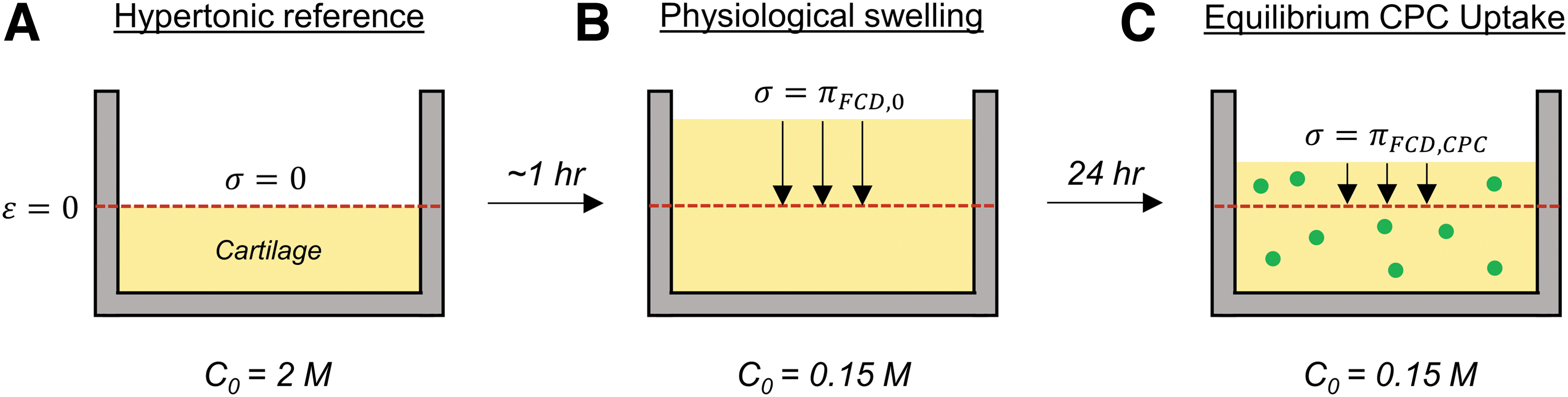
Illustration of charge shielding by multivalent CPCs, defined as a reduction in the physiological chemical stress of the tissue.
Modeling assumptions
Here we modeled deswelling induced by CPCs as a representative class of multivalent, cationic drug carrier molecules, which consist of a 3 kDa, ∼20 amino acid sequence of arginine and alanine residues. 5 The uptake and transport properties of CPCs in bovine cartilage have been studied previously by our group, and we have chosen these macromolecules for this study because of their high intracartilage uptake and suitability for independently investigating effects of net charge. As shown in Table 1, CPC variants have been designed to be similar in size with positively charged groups distributed symmetrically along the peptide length, such that effects of net charge can be studied separately from other confounding variables such as size and spatial charge distribution. As such, this study exclusively considered the effects of the cationic carrier's charge on cartilage mechanics. Polypeptides and other carriers with polyvalent cationic charge distributed along their length are expected to interact extensively with macromolecular constituents of the solid matrix of cartilage. 42 In the case of arginine-rich CPCs, long-range Coulombic interactions as well as short-range hydrogen bonding by guanidinium groups and hydrophobic attractions (due to the presence of alanine spacers) all are likely to facilitate binding to the solid matrix, 5 which could alter matrix mechanical properties and interstitial fluid dynamics. In light of these complicating effects, we sought to independently model charge shielding by disregarding the spatial charge distribution and polyelectrolyte character of CPC molecules, the effects of which were assumed to be equal for each CPC variant. Thus, this study only considered the amount of counter-charge introduced into the tissue by different CPCs.
Cationic Peptide Carrier Net Charge, Sequence, and Size
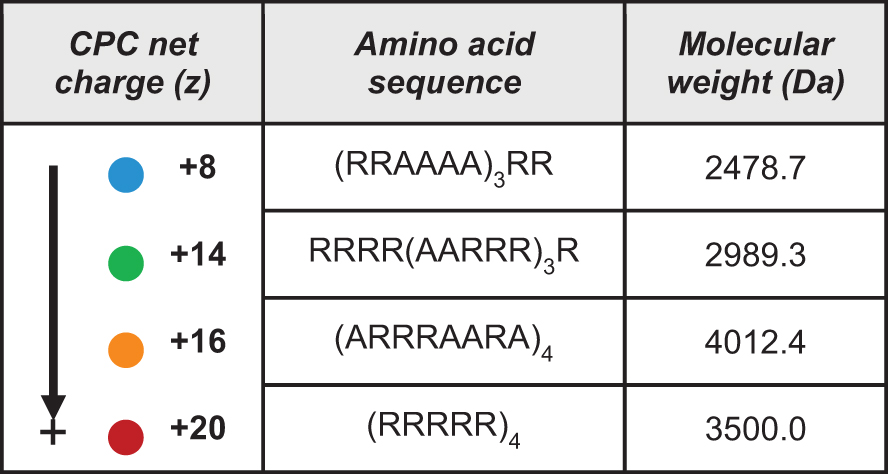
CPC, cationic peptide carrier.
Given the lack of experimental data characterizing the microscale interactions of CPC macromolecules with GAGs and their spatial orientation in the brush network, we chose to use a macroscale Donnan model under the fundamental assumption of a uniformly charged polyelectrolyte phase with no molecular-level variation in electrostatic potential. 37 The cartilage tissue was assumed to be an isotropic, triphasic mixture comprising a charged solid matrix, a neutral fluid, and monovalent mobile Na+ and Cl− ions. 43 Importantly, CPC peptides were assumed to be homogenously distributed throughout the tissue GAG network, such that there is no spatial inhomogeneity in the amount of charge shielding each CPC molecule induces. Only equilibrium uptake conditions (for both CPC and Na+/Cl− ions) were considered; transient solute diffusivities and fluid flow dynamics were omitted. Furthermore, once bound at equilibrium, CPC was considered static, and transient, intratissue CPC mobility was neglected (i.e., the intratissue concentration was assumed to be constant regardless of the surrounding [NaCl]). Thus, we have effectively modeled direct charge shielding of the proteoglycan FCD as resulting from an equivalent amount of moles-charge introduced by the valency of the intratissue CPCs.
Derivation of the Donnan osmotic model
In applying the macroscale Donnan osmotic theory,
37
we first define the intratissue electroneutrality condition, incorporating the cationic charge of CPC:
where
where C0 is the concentration of NaCl in the bulk external fluid. In this system,
where R is the universal gas constant, T is absolute temperature (310.15 K), and
Estimating the electrostatic contribution to bulk compressive modulus
The compressive modulus of cartilage can be expressed as the sum of the contributions arising from (1) electrostatic repulsive forces between GAG chains (
Here,
The swelling pressure can then be evaluated at multiple strain levels (here, 0.1 and 0.2) using Equation (3), and the relationship between incremental stress and strain yields the electrostatic modulus component:
Experimental model parameters
The FCD of the modeled cartilage tissue was calculated from previous measurements of sulfated GAG in the bovine cartilage explants used in CPC uptake experiments.
45
An average value of 280.5 μg of sulfated GAG was observed for 3-mm-diameter, full-thickness cartilage plugs from young bovine femoral grooves, as measured by dimethylmethylene blue (DMMB) biochemical assay.5,46 This was used as a representative value to estimate the FCD of healthy cartilage, using the following relation
31
:
where
Previously reported equilibrium uptake ratios (RU) for CPC variants into healthy and GAG-depleted tissues were used to calculate intratissue CPC concentrations using the following relation:
where C0 is the initial bath CPC concentration (30 μM for these experiments), 0.8 is the fluid volume fraction of the tissue, and RV is the volume ratio between the bath and the tissue, which was set to ∼45 in accordance with the experimental uptake setup (300 μL bath). Equation (8) is derived from the definition
Results
The goal of this study was to model the effect of charge shielding by a representative cationic drug carrier, CPCs, on the swelling properties and stiffness of articular cartilage. By applying the macroscale Donnan osmotic theory and incorporating the intratissue cationic charge introduced by CPCs into the electroneutrality condition, we derived a simple expression relating physiological swelling pressure
The ideal Donnan model predicts CPC-induced reductions in free swelling pressure that depend on carrier net charge and uptake concentration
Shown in Figure 2A are the magnitudes of free swelling pressure (

Magnitudes of articular cartilage swelling following CPC uptake, predicted by the ideal Donnan model.
Empirical Uptake Ratios (RU) of Cationic Peptide Carriers in Tissue Explants of Varying Fixed Charge Density
Data from Vedadghavami et al., 5 presented as mean ± standard deviation.
FCD, fixed charge density; GAG, glycosaminoglycan; OA, osteoarthritis.
In general, the ideal model predicted swelling pressures on the order of ∼100 kPa, which is in agreement with previously reported calculations with an ideal Donnan model for biomolecular FCD osmotic swelling pressures.
47
Notably, these results suggest observable deswelling induced by CPCs:
Next, we used the Donnan model to investigate how cartilage swelling pressure varies in relation to CPC net charge and intratissue concentration. Figure 2B depicts
The relative effect of deswelling induced by CPC charge shielding is amplified in tissues with reduced FCD
We next considered differences in swelling between cartilage samples with varying levels of FCD. Previous studies have demonstrated that despite severely diminished electrostatic driving forces, CPCs can still penetrate tissues with depleted FCD and bind within due to the synergistic effects of short-range H-bonding (from guanidinium cations of arginine) and hydrophobic interactions (due to the presence of alanine in the sequence).
5
For instance, in tissues modeling mid- and late-stage OA (enzymatically GAG-depleted by 50% and 90%, respectively), uptake ratios of CPC +14 were only reduced by half (Table 2). Therefore, we investigated relative

Relative effects of charge shielding by CPCs in healthy and GAG-depleted (OA model) cartilage.
To directly compare relative deswelling induced by each CPC in tissues of different FCD, we calculated deswelling over a range of intratissue CPC concentrations for each variant (Fig. 3C), in which swelling pressures were normalized using predictions calculated with
Reductions in the predicted bulk compressive modulus of cartilage caused by CPC charge shielding are magnified at hypotonic salinity
Repulsive forces between neighboring GAG chains increase as they are forced into close proximity due to compressive loads, and thus, electrostatic repulsion contributes to the compressive stiffness of cartilage in addition to affecting the free swelling stress. 37 We examined how charge shielding in healthy cartilage might attenuate the tissue's compressive modulus.
Figure 4 shows estimates for the electrostatic component of the compressive bulk modulus,

Predicted effect of CPCs on the bulk compressive modulus of cartilage tissue and its dependence on bath salinity.
The dependence of free osmotic swelling and electrostatic modulus on the tissue's surrounding salinity has been studied and characterized extensively.34,44 Given that the response of a tissue's mechanical properties to perturbations in external salinity depends directly on its FCD, we next considered whether cartilage equilibrated with CPCs may exhibit mechanical properties with a different salinity dependence than native tissues. Using constant values for
Discussion
Charge-based delivery is a promising strategy to enable clinical translation of disease-modifying treatments for degenerative conditions of connective tissues, such as OA in articular cartilage.1,4 However, the effect of high-molecular-weight cationic nanocarriers5,8,21,22,25,48 on the electromechanochemical homeostasis of cartilage has received little attention in the development of cationic drug delivery systems. 30 In vivo, perturbations to this balance could compromise the tissue's ability to withstand physiological loads, which is crucial to the natural function of cartilage as a shock absorber at joint surfaces. Thus, mechanistic knowledge of the mechanical changes associated with cationic carrier treatment is valuable to inform the design of future carriers.
Here we have performed a theoretical evaluation of the effect of charge shielding by multivalent cationic drug carriers on the mechanical properties of articular cartilage tissue. Using the classical ideal Donnan osmotic theory,
37
we have derived a simple expression for estimating the tissue's swelling pressure (
The results of this study predict that experimentally observed concentrations of CPC are capable of inducing reductions in the free swelling pressure of healthy cartilage on the order of 10–30 kPa (Fig. 2). Direct precise measurements of free swelling pressures in cartilage have remained elusive due to the presence of restraining collagen fibers in situ; as such, previous studies have relied on proteoglycan solutions or the ideal Donnan theory for estimating swelling pressure magnitudes. 49 However, a recent study previously reported directly measured physiological swelling pressures of healthy bovine articular cartilage of ∼70 kPa, 40 about half the pressure estimated by the Donnan model here (Fig. 2A; an observation consistent with previous studies 40 ). Using this point of comparison for physiological swelling in cartilage, the results presented here suggest that cationic carriers may induce observable deswelling in comparison with physiological values that could potentially hinder mechanophysiological functionality or disturb chondrocyte physiology.50,51 In addition, a key finding from this study was the increased relative magnitude of deswelling in GAG-depleted cartilage tissues mimicking OA (Fig. 3C). Given that CPCs and other drug delivery modalities are intended for administration to OA patients for which mechanical side effects may be amplified, the results herein strongly indicate that full experimental characterization of charge shielding effects by future cationic carriers of interest is a necessary consideration in their development.
This model can be useful for drug carrier design as a tool to define constraints on carrier uptake properties and net charge on the basis of induced deswelling. By rearranging the Donnan model [Eq. (3)] and inputting tolerable limits for deswelling or modulus reduction, it can be implemented to assess safe uptake limits for cationic carriers of a given net charge. As an example, we performed such a sensitivity analysis for the case of CPCs. To induce a 36.7% reduction in compressive modulus (
Other effects of cationic carriers on tissue mechanical properties besides charge shielding may arise that have not been considered here, such as changes in modulus due to physical interactions between carrier molecules and the solid matrix. For instance, intratissue macromolecular cationic carriers may be expected to exhibit an ionic crosslinking effect, since their macrosize allows them to span and simultaneously interact with multiple GAG chains.* In designing cationic drug carriers, it is important to characterize changes in tissue mechanical properties that arise from such interactions, since the downstream mechanical changes likely depend on tunable parameters such as net charge and spatial charge distribution, which can be integral design considerations. We envision that the Donnan model presented herein can be leveraged to investigate these nonelectrostatic effects in conjunction with experimental bulk modulus measurements. Since the modulus of cartilage tissue can be expressed as the linear sum of electrostatic and nonelectrostatic components [e.g., Eq. (4)], the Donnan model described here can be used to deconvolute measurements into components arising from charge shielding (predicted by the model) and interactions between a carrier and the solid matrix [extrapolated with Eq. (4)].
Importantly, the relative changes of modulus components resulting from treatment with a cationic drug carrier can provide mechanistic insight into how the structural features of the carrier influence mechanical and swelling properties. For instance, the magnitude of nonelectrostatic changes may depend on the external salinity, since binding interactions between carriers and matrix proteins are likely facilitated by electrostatic attractive forces. 5 Therefore, the relationship between the nonelectrostatic modulus component and external salinity (if any) following carrier uptake could provide insight into the dependence of carrier/matrix interactions on electrostatic attractions. Here, we have demonstrated the utility of the Donnan model in characterizing these interactions, as our results predict that electrostatic charge shielding effects may dominate modulus measurements when performed at low salinity (Fig. 4C).
There are multiple notable limitations inherent in the use of an ideal Donnan model for estimating swelling pressures in cartilage tissue. First, it was recently shown that swelling pressures in cartilage exhibit considerable nonideality when measured at hypotonic salinity, 40 which was corrected by modifying the Donnan model to include a constitutive parameter based on counterion condensation theory. 53 Such a model more accurately predicted absolute magnitudes of swelling pressures compared with overestimated pressures from the ideal Donnan model and thus represents a possible extension to the modeling approach presented herein. This method of incorporating nonideality was omitted from the analysis here because it relies on fitting the constitutive Manning parameter to experimental mechanical data. Future studies measuring mechanical changes following CPC uptake should be conducted to allow for implementation of the nonideal Donnan model in this context for more accurate estimations of absolute swelling pressures and electrostatic compressive moduli.
Second, models based on the Donnan osmotic theory are generally inferior to swelling pressure models that incorporate microscale variations in electrostatic potential within the tissue, such as the PB cell. 37 As such, the magnitudes of swelling pressure and electrostatic modulus obtained by the macroscale Donnan model used here are likely higher than what would be predicted by the PB cell model. Importantly, a macroscale model was chosen here because the use of PB cell and other microscale models requires knowledge of the spatial orientation of the drug carrier in relation to single GAG chains in the brush network. Furthermore, the sizes of CPC polypeptides are on the order of the Debye length of GAGs in the PB cell model (∼1 nm) and may be large enough to span multiple GAGs (PB cells). Therefore, experimental characterization of physical interactions between CPCs and GAG chains in the ECM network is necessary before microscale models can be reliably used to obtain more accurate swelling pressure predictions when cationic carriers are present in the system. Finally, since the ideal Donnan model is applied at the macroscale, spatial variations in CPC uptake and FCD are ignored. Since CPCs exhibit variable penetrations through the tissue based on their net charge (some being hindered in the superficial zone), 5 CPC-induced deswelling may exhibit significant local variations between the superficial and deep zones of cartilage following physiological uptake.
Conclusion
In summary, we have implemented the ideal Donnan osmotic theory to evaluate the charge shielding effects of cationic drug delivery systems in articular cartilage. While this study has focused on delivery systems for articular cartilage, the predicted effects of cationic carriers described here may be extended to a variety of anionic tissues for which cationic delivery systems are being evaluated, such as the vitreous humor of the eye 1 and the intervertebral disc. 7 The modeling approach described here may therefore be an integral tool in the design and evaluation of future cationic delivery systems for treatment of a variety of diseases.
Footnotes
Acknowledgments
We would like to thank Armin Vedadghavami and Dr. Shikhar Mehta for their expertise, guidance, and advice pertaining to polyarginine CPCs.
Authors' Contributions
M.R.W. and A.G.B. designed the study, developed the model, performed data analysis, created figures, and wrote and edited the article. A.G.B. conceived the study and obtained funding. All coauthors have reviewed and approved the article before submission. This article has been submitted solely to Bioelectricity: Science, Engineering and Medicine and is not published, in press, or submitted elsewhere.
Author Disclosure Statement
No competing financial interests exist.
Funding Information
This study was supported by the National Institute of Health (NIH) Trailblazer R21 Grant EB028385 and NIH R01 Grant AR075121.