




Abstract

A
On June 13, 2013, the U.S. Supreme Court rendered its decision on the issue of whether human genes are patentable.6 Many commentators had suggested that the decision would not greatly impact the biotechnology industry because of how late in the gene patent game it was coming, suggesting the future of biotechnology was elsewhere.7 Contrastingly, I suggest that because the Supreme Court adopted the “product of nature” doctrine and used broad language in its opinion, the decision may have very real consequences in the biotechnology industry.
First, I will discuss the background facts of the Association for Molecular Pathology v. Myriad Genetics case. Next, I will look at the patentability of isolated DNA using the Myriad case history, including Judge Sweet's district court decision, Judge Lourie's Federal Circuit court opinion, Judge Moore's Federal Circuit court concurrence, and Judge Bryson's Federal Circuit court dissent. Further, I will discuss the patentability of complementary DNA (cDNA) using the same case history. I will then compare and critique the analytical and logical methodology used by the Myriad lower court judges in coming to the determinations of patentability, including the evolution and application of the “product of nature” doctrine, deference to Congress and the PTO and judicial involvement in subject matter decisions, and how to factor in patent law's effects on market incentives. Next, I will compare the Supreme Court opinion with the legal history and the Supreme Court Oral Argument. I will then discuss how the Court's decision, in the inclusion of specific language and use of particular rationales, may impact the future of the biotechnology industry. Lastly, I will summarize the discussion.
Facts of Myriad
The human genome is made up of nearly 22,000 genes,8 sequences of nucleotide bases on DNA.9 There are two types of nucleotide sequences in DNA: exons, which encode particular sequences of amino acids that aggregate into proteins, and introns, which do not code for proteins.10 Nucleotide sequences are covalently bonded to the sugar–phosphate backbone of each strand of DNA, and to their respective complementary base through hydrogen bonds, creating the double-helix structure.11 In the human body, DNA is compressed and wrapped around histone proteins to form the 23 pairs of chromosomes.12
An anomalous nucleotide in a sequence, or mutation, is often associated with a particular disease.13 For example, certain BRCA1 and BRCA2 mutations correlate with a higher incidence of breast and ovarian cancer.14 Thus, “DNA sequencing is used in clinical diagnostic testing to determine whether a gene contains mutations associated with a particular disease or disease risk.”15 DNA can be isolated by extracting it from the body's cells using routine and well-established methods.16
Complementary DNA lacks introns.17 It is synthesized from mRNA “using complementary base pairing in a manner analogous to RNA transcription.”18 This process of creating exon-only sequences is well known to genetic researchers.19
Myriad Genetics filed a patent application covering isolated BRCA1 DNA, cDNA, and relevant diagnostic methods20 in August of 1994.21 The patent issued almost three and a half years later.22 In December of 1995,23 Myriad filed the patent for isolated BRCA2 DNA, cDNA, and relevant diagnostic methods.24 That patent issued nearly three years later.25 Thus, by the winter of 1998, Myriad held patents to isolated BRCA1 and BRCA2 sequences and their respective diagnostic methods.26
Other entities that began providing BRCA clinical testing services, including the University of Pennsylvania's Genetic Diagnostic Laboratory, were sent cease-and-desist letters on behalf of Myriad.27 The original plaintiffs, “an assortment of medical organizations, researchers, genetic counselors, and patients,”28 filed suit against Myriad to challenge the patentability of its composition claims (over the isolated DNA and cDNA) and method claims (over the diagnostic testing).29 I will discuss only the composition claims in this paper, as that was the only type of claim at issue before the Supreme Court.30
The U.S. District Court for the Southern District of New York held that all of Myriad's composition claims at issue were invalid as unpatentable subject matter.31 The Federal Circuit decided the case originally on July 29, 2011, but reheard it in light of Mayo under the Supreme Court's remand instruction, following the granting of a petition for certiorari and a decision to vacate the Federal Circuit's decision.32 The Federal Circuit rendered a splintered decision consisting of an opinion, a concurrence, and a dissent.33 Ultimately, all judges upheld the validity of the cDNA patents; Judge Lourie, writing for the court, and Judge Moore, in her concurrence, upheld the validity of patents on isolated DNA. Judge Bryson dissented, finding isolated DNA an unpatentable “product of nature.”
Case History In Determining the Patentability of Isolated DNA
District Court Decision
The major issue in Myriad was whether isolated DNA qualifies as patent-eligible subject matter. Congress has defined patentable subject matter as the “invent[ion] or discover[y]” of “any new and useful process, machine, manufacture, or composition of matter, or any new and useful improvement thereof.”34 Although this definition should be interpreted broadly,35 “laws of nature, physical phenomena, and abstract ideas” are excluded from patentable subject matter.36 The court in Chakrabarty also deemed “products of nature” unpatentable.37
Judge Sweet of the U.S. District Court for the Southern District of New York found Myriad's isolated DNA claims unpatentable by framing the patentability inquiry as in Chakrabarty: whether the isolated DNA claims had “markedly different characteristics” from DNA found in nature.38 One must consider “the claimed invention as a whole” to determine whether “it is sufficiently distinct in its fundamental characteristics from natural phenomena to possess the required ‘distinctive name, character, [and] use.’”39
Judge Sweet dismissed Myriad's arguments that isolated DNA's structural and functional differences make it “markedly different” from native DNA40 and instead focused on the unique shared characteristic of isolated and native DNA as an information carrier.41 DNA's information-carrying capacity is not limited to information about its own structure like other chemical compounds' respective information; DNA also contains information about other molecules in the body.42
Judge Sweet further found that any structural and chemical differences between isolated and native DNA are superseded by isolated DNA's retention of native DNA's special information-carrying capacity.43 There is an “overriding importance of DNA's nucleotide sequence to both its natural biological function as well as the utility associated with DNA in its isolated form.”44 Even though Myriad argued that isolated DNA has a “markedly different” function in its ability to be used in gene therapy and as probes and primers for molecular tests,45 this utility is attributable to the isolated DNA's “nucleotide sequence identity” with DNA found in the body.46 As the isolated DNA's utility is attributable to its identical nucleotide sequence with native DNA, “the use of isolated DNA for the various purposes cited by Myriad does not establish the existence of differences ‘in kind’ between native and isolated DNA that would establish the subject matter patentability of what is otherwise a product of nature.”47
Judge Lourie's Federal Circuit Court Opinion
The Federal Circuit reversed the district court's determination that the isolated DNA molecules were unpatentable, holding that “each of the claimed molecules represents a nonnaturally occurring composition of matter.”48 Judge Lourie applied the “product of nature” doctrine as an inquiry into whether the claimed composition's identity changed relative to what already existed in nature.49 Lourie disentangled the concepts of being made from nature and being a product of nature. “[Isolated DNA molecules] are obtained in the laboratory and are man-made, the product of human ingenuity. While they are prepared from products of nature, so is every other composition of matter.”50 Thus, although isolated DNA is derived from natural materials, they are different from the materials from which they are derived.51
In his opinion, Judge Lourie lays out the arguments of Myriad, the plaintiffs, and the government as an amicus. With regard to the “product of nature” doctrine, Myriad argues that the district court misread “Supreme Court precedent as excluding from patent eligibility all ‘products of nature’ unless ‘markedly different’ from naturally occurring ones” and incorrectly focused on one similarity instead of the differences between isolated and native DNA.52 The plaintiffs, according to the Court, contend that the “product of nature” doctrine requires the claimed composition not only to undergo a “highly useful change from its natural form,” but also to have “a distinctive name, character, and use, making it ‘markedly different’ from the natural product.”53 Because the isolated DNA retains parts of the same nucleotide sequence, there are no “markedly different” characteristics.54 The government agreed, stating that isolated DNA is a product of nature, as its “nucleotide sequence[] exist[s] because of evolution, not man.”55 Myriad argued that the isolated DNA does not exist in nature and has a different use from native DNA as primers and probes and thus has a “distinctive name, character, and use.”56
Judge Lourie's analysis began by comparing and reconciling the governing case law of Chakrabarty and Funk Brothers.57 Chakrabarty differentiated its facts from those in Funk Brothers, stating that the subject had “markedly different characteristics from any [bacterium] found in nature,” whereas in Funk Brothers, no bacterial species “acquired a different property or use” from being mixed together with other bacteria and the “bacteria's cooperative qualities…[were] the ‘work of nature.’”58 Lourie then analyzed this case under the “product of nature” doctrine, using Chakrabarty's “markedly different” test, where “markedly different” means distinctive.59
According to Judge Lourie, the “product of nature” doctrine involves an inquiry into the differences, not similarities, of the structure, not function, between the natural composition and the composition in question.
Judge Lourie found isolated DNA “markedly different” from native DNA because it has a “distinctive chemical structure and identity.”60 Whereas natural DNA is condensed in a chromosome structure, with various proteins intertwined, isolated DNA is freestanding and represents a smaller portion of the DNA molecule.61 Covalent bonds have been broken by human intervention.62 Isolated DNA has not merely been removed from the body; it has been “manipulated chemically so as to produce a molecule that is markedly different from that which exists in the body.”63
Judge Lourie further contended that the “markedly different” inquiry should focus on the differences and not the similarities between the claimed composition and the natural product. Thus, by basing an argument of not being “markedly different” on isolated DNA retaining the same nucleotide sequence, Lourie suggested the Plaintiffs were focusing on the wrong thing.64 Although the information content similarity is a key similarity, it is nonetheless “irrelevant” to the fact that “claimed isolated DNA molecules are distinct from their natural existence as portions of larger entities” and will not “negate” its patent eligibility.65
The inquiry, Judge Lourie stated, also commands focus on the chemical structure rather than the biological function of the DNA.66 It is the “distinctive nature of DNA molecules as isolated compositions of matter that determines their patent eligibility rather than their physiological use or benefit.”67 Use may be relevant, instead, to the “nonobviousness of these substances or to method claims embodying those uses.”68 This seems to contradict Chakrabarty's description of a patentable composition as having a “distinctive name, character [and] use.”69 Although Lourie wrote off an analysis of differences in utility as an inappropriate exercise in the “product of nature” doctrine inquiry, he nevertheless suggested the differentiated use of isolated DNA when he stated “the ability to visualize a DNA molecule…when it is bonded to other genetic material [] is worlds apart from possessing an isolated DNA molecule that is in hand and usable.”70
Although Mayo is not applicable to the composition claim, even under Mayo, isolated DNA would not be preempted as a law of nature, according to Judge Lourie's opinion. A composition itself is not a law of nature.71 While “[e]verything and everyone comes from nature” and “follow[s] its laws,” the “compositions here” are “products of man.”72
Judge Lourie went on to make Congressional and PTO deference-based arguments. He explained that it is Congress's job, not the court's, to determine policy questions related to patenting biological molecules.73 He also suggested deference to the PTO's longstanding practice of issuing human gene-related patents,74 including patents for isolated DNA.75
Judge Moore's Concurrence in the Federal Circuit Court Case
In her concurrence, Judge Moore constructed a “product of nature” framework where “manifestations of nature are not patentable” and “composition[s] of matter with ‘markedly different characteristics' from that found in nature with the potential for significant utility [are] directed to patentable subject matter.”76 Unlike the majority, Judge Moore did not think that chemical differences alone are sufficient to make isolated DNA subject matter.77 She added the additional test of “potential for significant utility,” meaning an “‘enlargement of the range of…utility’ as compared to nature.”78 Although Moore acknowledged the chemical and structural differences between the claims of the long isolated DNA segments and native DNA, she recognized these longer strands cannot be used as primers or probes and thus, do not “clearly lead to an ‘enlargement of the range of…utility’ as compared to nature.”79 Nonetheless, Judge Moore found these longer isolated DNA strands patentable because of the precedent set by the PTO.80
Short-sequence isolated DNA's ability to be used as probes or primers in diagnostic testing “enlarge[s] the range of [DNA's] utility.”81 This new utility is attributable to “markedly different” properties in the short sequences of isolated DNA.82 Thus, diverging from Judge Lourie's opinion, Judge Moore stated, “It is not the chemical change alone, but that change combined with the different and beneficial utility that leads me to conclude that small isolated DNA fragments are patentable subject matter.”83 Because of short-sequence isolated DNA's different physical properties and expanded utility, it is patentable subject matter.
Judge Bryson's Dissent in the Federal Circuit Court Case
Although Judge Bryson would find applications of the BRCA gene sequence patentable, he held that the sequence itself is unpatentable subject matter because Myriad provided no inventive contribution to the discovery of the nucleotide sequences.84 Bryson framed the “product of nature” doctrine as having a dual focus. The test looks at the similarities in both (1) structure and (2) utility between the claimed composition and its natural counterpart.85
Judge Bryson stated the genetic coding material “is the same, structurally and functionally, in both the native gene and the isolated form of the gene.”86 The structural differences between isolated DNA and native DNA are irrelevant to “the claim limitations, to the functioning of the genes, and to their utility in their isolated form.”87 Instead, it is the sameness that is the key to the isolated DNA's functional value.88 Thus, isolating the DNA has not transformed the genetic material structurally or functionally in a valuable and significant way.89
The extraction of DNA, according to Judge Bryson, does not make the DNA patentable. The extraction process itself may lead to physical and chemical alterations to the DNA, but these changes attendant to extraction do not necessarily lead to patentability.90 Cleaving chemical bonds, for example, to isolate DNA, does not make isolated DNA “different materials.”91 Although the covalent bonds are broken during the isolation process, “the genetic coding sequence that is the subject of each of the BRCA gene claims remains the same whether the gene is in the body or isolated.”92
Thus, looking at the two-part test of similarity in function and similarity in structure, Bryson found isolated DNA unpatentable. Isolated DNA's function is dictated by the same nucleotide sequence found in naturally occurring DNA;93 its utility owed its retained identity to naturally occurring DNA.94 “[The structural similarity of the nucleotide sequences] dwarfs the significance of the structural differences between isolated DNA and naturally occurring DNA, especially where the structural differences are merely ancillary to the breaking of covalent bonds, a process that is itself not inventive.”95
While Judge Bryson acknowledged that Mayo does not control the case, he suggested it is instructive. As applied to this case, Mayo suggests that “a patent involving a product of nature should have an inventive concept that involves more than merely incidental changes. …”96 Extracting the DNA is not enough to distinguish isolated from native DNA, as the nucleotide sequence, as the functional part, does not change.97 Judge Bryson discussed the claim over short DNA sequences separately. He held these claims unpatentable for being too broad.98
Judge Bryson also reviewed the costs and effects of patents on the biotechnology industry, including the “patent thicket.” Holding broad claims to genes and gene fragments as patent eligible would result in a “significant obstacle to the next generation of innovation in genetic medicine—multiplex tests and whole-genome sequencing.”99 In order to develop a technology that involves sequencing an entire genome, “a firm would have to license thousands of patents from many different licensors,” thus encountering a “patent thicket.”100 Product-developing biotechnology firms do consider these costs.101 It is also possible for a patent-holding company to preempt the ability to sequence its section of the genome by not licensing its patent.102
Case History in Determining the Patentability of cDNA
Complementary DNA is synthesized in the laboratory by humans.103 It is different from ordinary DNA in that it contains only exon sequences, as introns are not present in the mRNA from which cDNA is synthesized.104
Judge Sweet did not spend much time differentiating Myriad's claims of cDNA from its claims of isolated DNA. He dismissed the argument that cDNA is “markedly different” structurally from native DNA for lacking introns, because the coding sequences are identical despite the introns in native DNA.105 Further, the “particular arrangement of those coding sequences [of cDNA] is the result of the natural phenomena [sic] of RNA splicing” of pre-mRNA into mature mRNA.”106 Thus, cDNA is not “markedly different” from the native DNA (product of nature) because its function is due to its coding sequence, and that sequence is the same as that of native DNA, regardless of native DNA's exons. Further, Sweet explains that with regard to BRCA1, “cDNA sequences are actually found in the human genome” as a naturally occurring pseudogene.”107
Judge Lourie highlighted cDNA as “especially distinctive” because it “lack[s] the non-coding introns present in naturally occurring chromosomal DNA.”108 As cDNA is “even more the result of human intervention into nature,” Lourie found cDNA eligible for patenting under §101.109 The Government's amicus argument for the patent eligibility of cDNA is that cDNA is engineered by man and rarely occurs in nature.110
Judge Moore, in her concurrence, found cDNA patentable because the “cDNA sequences do not exist in nature.”111 Complementary DNA is “markedly different” from native DNA: A lack of introns gives cDNA “markedly different chemical characteristics” from naturally occurring DNA and RNA, and the ability to “express a protein in a cell which does not normally produce it” gives it a “distinctive character and use.”112
Judge Bryson also agreed that cDNA is patentable because of its distinct structure and utility, and the human intervention needed to prepare it.113 Complementary DNA must be created in a laboratory; it has a distinct structure because its introns have been removed, and a distinct utility of being attached to a promoter and inserted to drive protein expression.114 However, Judge Bryson suggested that Myriad's claim on short cDNA sequences is invalid because some permutations of the broad claim would cover naturally occurring exon sequences.115
Reasoning and Methodology in Case History Prior to Supreme Court Decision
One district and three Federal Circuit court judges decided the outcome of the patentability of human genes differently on the basis of individualized reasoning. Looking at how the lower courts arrived at their decisions can illuminate key distinctions that the Supreme Court may have picked up on and incorporated into its decision.
There are three basic categories of reasoning the judges used in deciding this case: (1) defining the scope of the “product of nature” doctrine, either broadly or narrowly, and applying it to the case; (2) deciding how big a role the judiciary should take in the context of deference to Congress and the PTO; and (3) factoring in how the patent system and the outcome of this case impact the market economics in the biotechnology industry.
Product of Nature Doctrine
The “product of nature” doctrine has been molded in multiple directions during the course of the Myriad case, differing in scope with each judge's opinion. The test gets at whether the claimed composition is different enough from what exists in nature that it counts not as a mere discovery of a product of nature116 but as an invention of something new.
The Supreme Court in Chakrabarty applied the “markedly different” test to determine whether the patentee had produced something with “markedly different characteristics from any found in nature and one having the potential for significant utility.”117 The Court also found that the bacterial strain in Chakrabarty was a “product of human ingenuity ‘having a distinctive name, character [and] use.’”118 While applying the Court's “markedly different” test for products of nature and subsequent rationale from the Chakrabarty and Funk Brothers cases, the district and circuit court judges in the Myriad case have adjusted the boundaries and implications of the doctrine.
The Myriad lower court judges differed in their application of the “product of nature” doctrine in two main ways: (1) in deciding whether to assess the claimed composition's function in addition to its structure; and (2) in determining what weight to give similarities between the product of nature and the claimed composition versus their differences. See Figure 1 for a summary of the judges' positions regarding the court's application of the “product of nature” doctrine.
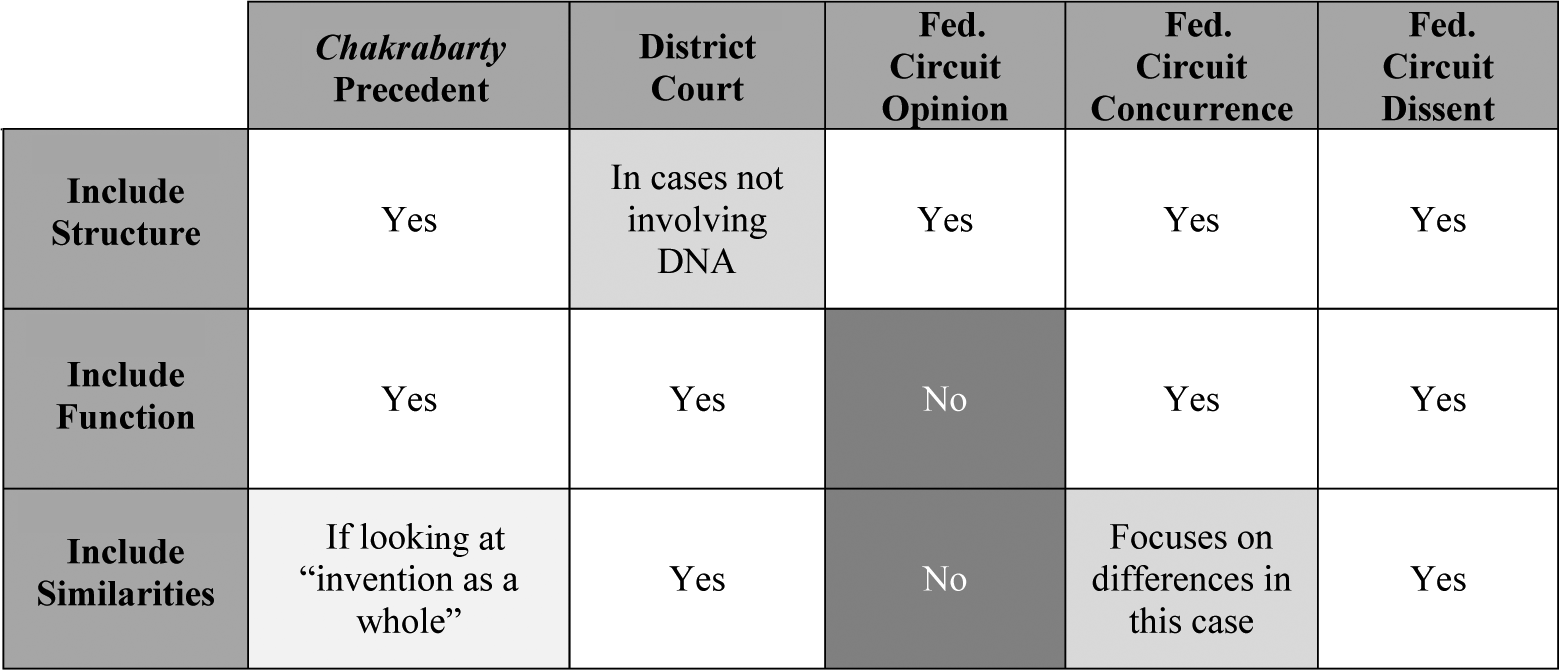
The first question is whether “markedly different” characteristics refer only to the assessment of the claimed composition's structure, or also to its function, compared with those of the natural product. Judge Sweet determined that one should look particularly at functional differences (and similarities) in this case because DNA is a special molecule, although one should also consider structural and chemical differences.119 Judge Lourie suggested that the inquiry should focus on the differences in structure, not of function.120 He stated that an assessment of a composition's utility should be relegated instead to the nonobviousness inquiry.121 Judge Moore, in her concurring opinion, stated that comparing chemical or structural differences is not enough; the Chakrabarty precedent suggests that “enlargement of the range of…utility” is key to the question, and thus, utility must not only be compared, but a difference in utility resulting in an “enlargement of the range of…utility” must be found.122 Judge Bryson framed the “product of nature” doctrine as looking at both structure and utility between the claimed composition and the natural product.123
In dissecting the precedent the Supreme Court set in Chakrabarty, consider these two oft-quoted phrases from the decision. “[T]he patentee has produced a new bacterium with markedly different characteristics from any found in nature and one having the potential for significant utility.”124 The Court found that the bacterium was a “product of human ingenuity ‘having a distinctive name, character [and] use.’”125 Taken together, the language of Chakrabarty indicates that function and utility should be compared between the claimed composition and its native form. The more interesting question is whether one needs to find both significantly different utility and structure to hold the claimed composition to be “markedly different.” The Chakrabarty language indicates so, and Judge Moore based her concurrence on the reasoning that utility is needed in addition to structural or chemical differences.126
Given that the claimed invention is to be evaluated “as a whole,”127 it seems appropriate to look at both structure and function when evaluating whether the claimed composition as “markedly different characteristics” from its native counterpart. If one can categorize differences in both structure and of function as “characteristics,” then in evaluating the claim as a whole, the magnitude and quality of differences may make a holding of needing differences in structure and function redundant. Both structural and functional differences should be assessed in their nature, quality, and magnitude, and as long as there seems to be a distinctive difference in the claimed composition's “characteristics” through this evaluation, the claimed composition should be patentable. This seems to be the best way to administer a flexible standard that can respond accurately to the particular facts of a case.
There are functional differences between isolated and native DNA. Shorter sequences of isolated DNA can be used as primers and probes for diagnostic tests, in medical treatments, and in biotechnological processes.128 There also are structural differences; the covalent bonds are broken, and the genetic material is not wrapped between protein complexes.129 Beyond this, there is the obvious difference that the one form of DNA is isolated, so it is no longer in the body.
The next question is whether similarities between the claimed composition and product of nature are factored in, and if so, how they are weighed against the differences. The additional question of what counts as “markedly different” compounds the complexity of this inquiry. The district court factors in similarities in its holding that isolated DNA is unpatentable. Judge Sweet focused on the identical information-carrying characteristics of isolated DNA and native DNA.130 The judges on the Federal Circuit court were split. Judge Lourie advocated that the doctrine involve an inquiry into the differences, but not similarities, of the structure of the natural composition and composition in question.131 Judge Moore focused her concurrence on inquiring into the differences between the claimed and natural compositions.132 Lastly, Judge Bryson used both similarities and differences in his reasoning, and ultimately found isolated DNA unpatentable because of the structural similarity between isolated DNA and native DNA.133 The point of the “product of nature” doctrine is to determine whether the differences are enough, in light of countervailing similarities, to amount to something “markedly different,” but the judges' analyses do not lend much insight into what this balance entails.
The Supreme Court in Chakrabarty discusses the inquiry as determining whether the claimed composition has “markedly different characteristics” from compositions found in nature.134 The term “markedly different” could suggest that a quest solely for differences is appropriate, or it could mean that one should undertake an investigation into both the similarities and the differences. This latter definition is more in line with the notion that claims should be analyzed “as a whole,” as it suggests comparing the claimed composition and the composition found in nature fully to understand how distinct the two are in light of their shared qualities.
In this case, isolated and native DNA molecules are similar in that they share the same nucleotide sequences. This structural similarity is key for isolated DNA to function in its further capacity as a primer, probe and other acquired functions.135
Congressional Deference and Deference to PTO
Cabining the expansiveness of the judicial role in determining patentability in light of Congressional and administrative deference is another type of reasoning used in the Myriad lower court opinions. It is the role of Congress to legislate, or create laws, while it is the role of the judiciary to interpret such laws. However, the lines often blur between interpreting and creating laws, as interpretation of vague or broad Congressional language can lead to judge-made law. In fact, much of patent law's details and nuances are judge-made doctrine.136
Congressional deference promotes the view that it is Congress's role to determine the policy question of whether DNA deserves special treatment in its information-carrying capacity, or should otherwise be treated like other molecules. Deference is further used to caution the court against holding claims of isolated genetic material unpatentable, advocating that the creation of categorical limitations should be left to Congress. Judges are split on how much deference to award Congress. Judge Sweet and Judge Bryson support limited Congressional deference, whereas Judges Lourie and Moore advocate strongly for Congressional deference.
Some judges, including Judge Lourie, considered categorically excluding isolated DNA from patentability as changing, rather than interpreting, the law.137 In using Congressional deference to advocate against judge-made categorical limitations, Lourie suggested these policy questions are best left to Congress.138 He justified this deference as Supreme Court precedent.139 Judge Moore justified Congressional deference by explaining why it is more appropriate for Congress, and not the court, to make such a decision: Congress has the “constitutional authority” and “institutional ability to accommodate fully the varied permutations of competing interests.”140 In contrast to Lourie and Moore, Judge Bryson considered the court's determination of gene patentability not as creating new law, but as an interpretation of the Congressional definition of patentable subject matter.141
In Judge Lourie's rejection of the district court's categorical finding of isolated DNA as unpatentable and his appeal to Congressional deference, he focused on the combination of Congress's awareness of the problem with its decision not to act to change the law.142 Judge Moore saw Congress's lack of action, of not changing the law to exclude isolated DNA from patentability, as evidence that such claims are patentable subject matter.143 In fact, Moore based her finding that longer sequences of isolated DNA are patentable on the actions of Congress and the PTO.144 Contrastingly, Judge Sweet suggested that a lack of Congressional action does not preclude the courts from finding differently.145
Judge Lourie suggested that the question of whether DNA “warrants singular treatment” in its dual nature of chemical entity and information carrier is also best left to Congress, which has a better institutional capacity to answer it.146 In this determination, Lourie's opinion quoted Sebelius in holding that the judiciary “possess[es] neither the expertise nor the prerogative to make policy judgments. Those decisions are entrusted to our Nation's elected leaders, who can be thrown out of office if the people disagree with them.”147 But a critical look at the current legislature may warrant hesitancy in applying this type of deference to Congress.
It is not clear that Congressional inaction in changing the patent law means that Congress is fulfilling the will of its constituency and thus, carrying out the legislative function of a working democracy. This works only when Congressional members can be held democratically accountable, being voted out of office by constituents whose needs are not served. Because of the technical and esoteric nature of patent law, legal reform is not transparent or accessible enough for voters to understand its implications and thereby hold their respective Congresspersons accountable. Limited accountability by constituents allows Congress to submit to biotechnology company lobbyists' demands without consequence. Biotechnology lobbyists are very politically involved. In 2010, when the District Court decision came out, the Biotechnology Industry Organization spent nearly $8.5 million on lobbying-related expenses.148 The Organization spent nearly $6 million dollars in 2013.149 Thus, when supporting Congressional deference, one should look critically at Congress's actions to ensure we do not conflate the will of the democratic majority with the will of the lobbyists for the biotechnology industry.
The Myriad judges also had differing views on how much deference is appropriate to give the PTO. In a pattern similar to their stances on Congressional deference, Judges Sweet and Bryson felt no deference should be afforded to the PTO in this case, whereas Judges Lourie and Moore advocated such deference. Judge Lourie stated in his majority opinion that the PTO's practices are due deference, not least because the patent system works because of reliance and settled expectations.150 The PTO has a long history of issuing patents related to DNA molecules, and the Office reaffirmed its position on the patentability of isolated DNA in 2001 when it issued its Utility Examination Guidelines.151 Judge Moore found deference to the PTO's past practice crucial, and used deference in determining that longer sequences of isolated DNA are patentable despite their lacking of a clearly new utility.152
The length of time the PTO has been issuing patents with claims on isolated DNA, along with the vast number of these patents issued,153 creates certain expectations of patent eligibility in the biotechnology industry. Judge Moore argued that we should be “particularly wary of expanding the judicial exception to patentable subject matter where both settled expectations and extensive property rights are involved.”154 Judge Bryson put weight in the fact that “the PTO lacks substantive rulemaking authority as to issues such as patentability,”155 and that regardless of the industry's settled expectations, it would still “give the PTO lawmaking authority” that it did not have.156 Judge Moore understood that the PTO lacks “substantive rule making authority” but still acknowledged the PTO's expertise.157 She suggested that the PTO's position of granting patents on isolated DNA reflects “a longstanding and consistent policy of allowing patents for isolated natural products.”158
Judge Sweet swiftly dismissed deference as not something precedent commanded and is thus not necessary to carry out.159 Judge Bryson, on the other hand, spent more time enumerating reasons deference should not be given to the PTO here.160 In addition to the rationale that the PTO generally lacked rulemaking authority, Judge Bryson gave case-specific limitations for deferring to the PTO. He believed the deference owed was proportional to the “thoroughness…and validity of [the PTO's] reasoning.”161 Judge Bryson suggested that the PTO comments on this issue were perfunctory, and as such, should not be afforded much weight.162 Further, the Government's position in this particular case, by suggesting that the isolated DNA claims are not patentable, undermines the PTO's past views.163 Lastly, the Supreme Court went against the PTO's determination of microorganisms as unpatentable in Chakrabarty, so the PTO has not always been afforded deference in these types of cases.164
Thus, although the PTO's longstanding practice and the industry's accompanying expectations suggest giving some deference to the PTO, the fact is that the PTO does not have rulemaking authority, which suggests it should not be dispositive in these cases, particularly when the Government takes a position in the case antithetical to the PTO's comments.
Market Incentives
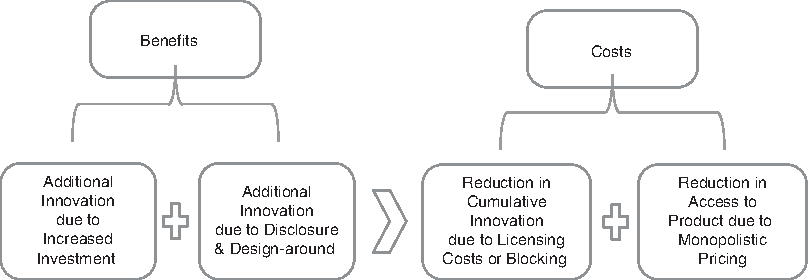
The third type of reasoning the Myriad judges enlisted is the possible economic impact on the biotechnology industry that holdings on the patentability of isolated DNA may cause. The goal of the patent system is to incentivize invention (through investment in the potential patentable design and in design-around research), disclosure, and commercialization.165 Because the patent system affects various markets differently, the magnitude and relevance of particular costs and benefits is industry specific. From a greater policy perspective, patenting is good for an industry when the following equation holds true: when additional innovation attributable to increased investment, disclosure, and design-around is greater than the reduction in cumulative innovation attributable to licensing costs (including transaction costs) or absence of licensing opportunities, and reduction in access to the patented product because of monopolistic pricing (“deadweight loss”)(Fig. 2).
Myriad suggests the “invalidation of the patents-in-suit will result in the decimation of the biotechnology industry,” but the district court quickly dismissed Myriad's predictions as “unfounded,” because its opinion was based on “unique properties of DNA that distinguish it from all other chemicals and biological molecules found in nature.”166 Through this terse treatment of the question of how the opinion could affect industry incentives, Judge Sweet suggested that although there may be an effect on the incentives to innovate for DNA-based products, the decision will not affect the majority of the industry.167 But this may not be true.168 This response seems to give short shrift to acknowledging the potential costs of denying patents on isolated DNA, and cDNA, for the biotechnology industry.
Judge Bryson focused on the idiosyncratic costs to the biotechnology industry of allowing patents. He recognizes the industry-specific phenomenon of the “patent thicket,” where in order to develop a certain technology covering different parts of the genome, “a firm would have to license [up to] thousands of patents from many different licensors.”169 Bryson also suggested that biotechnology firms are dissuaded from development by the costs of these licenses,170 as well as by the additional transaction costs associated with finding which patents are necessary and transacting with thousands of parties. Companies can also withhold licensing of their patents, as Myriad did in this case, thus potentially “preempting methods for whole-genome sequencing.”171
This potential to stifle innovation for 20 years is even more costly in a constantly innovating industry, particularly when there is no alternative “design-around” to the claimed genetic material.172 Upholding the patentability of broad claims to genes and gene fragments would result in a “significant obstacle to the next generation of innovation in genetic medicine—multiplex tests and whole-genome sequencing.”173
Judge Lourie and Judge Moore focused instead on the costs to industry innovation of finding isolated DNA unpatentable. “The dissent mentions possible ‘adverse effects' that may occur if isolated DNAs are held to be patent eligible. But, respectfully, it is the adverse effects on innovation that a holding of ineligibility might cause. Patents encourage innovation and even encourage inventing around; we must be careful not to rope off far-reaching areas of patent eligibility.”174 Judge Lourie focused on the need to encourage investment in an industry that involves a risky and costly research and development process;175 Judge Moore echoed this sentiment in suggesting patent protection is the reason for the flourishing industry.176
Because the patent system is about affecting incentives, having a clear set of rules and a commitment to following them matters. Thus, sensitivity to concerns about disrupting the quarter-century old practice of granting gene patents seems appropriate. If a whole segment of the biotechnology industry relies on these patents, there is a good chance the industry will react. Judge Moore recognized this in her concurrence. “The type of fundamental alteration in the scope of patentable subject matter argued in this case ‘risk[s] destroying the legitimate expectations of investors in their property.’”177
In the biotechnology industry, there are additional costs associated with granting composition patents on human genes. Composition patents are particularly broad, as the patent covers the product itself, so a company would be liable for infringement regardless of how it made the product or for what reason the product was used.178 In this case, it would mean that if a company “want[ed] to do anything with the BRCA1 gene in isolation from the body, [it would] need Myriad's permission.”179 This is problematic when new gene therapies or diagnostic testing cannot be developed because of underlying patents on a gene. “The real value and potential for innovation, experts say, comes after genes or gene mutations are identified, and that genetic insight is then applied to a new process, method or algorithm.”180 Further, it is not clear that gene patents are necessary for investment in developing genetic tests.181 On the other side, though, patenting creates an incentive to disclose, which eventually leads to a greater amount of information available to the public in the public domain.182
Reasoning and Methodology in Supreme Court Decision
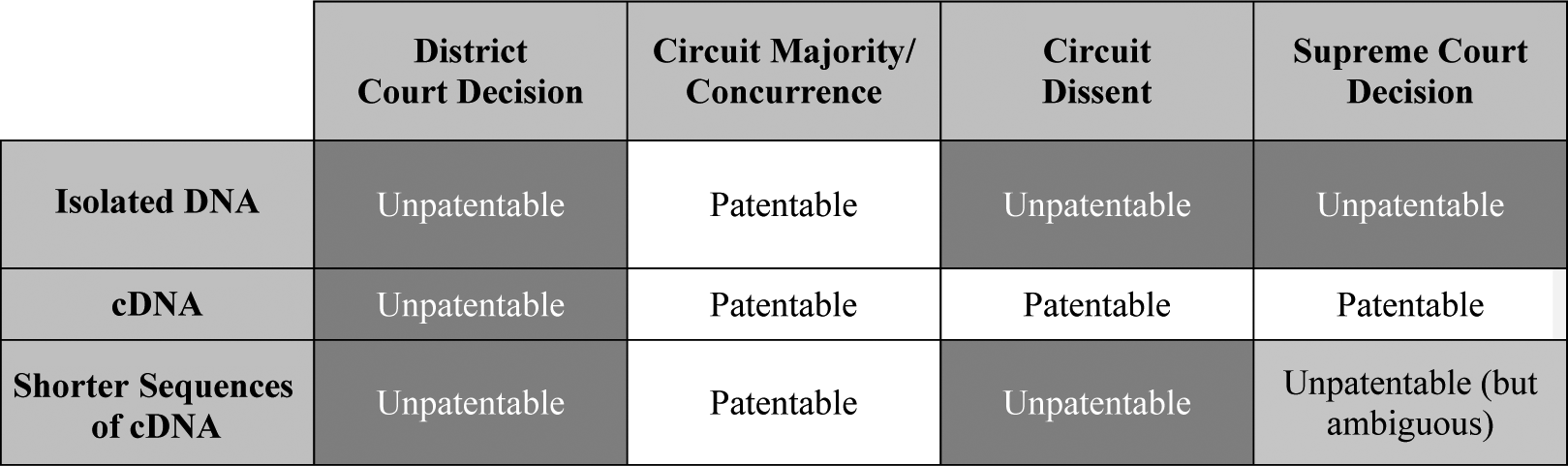
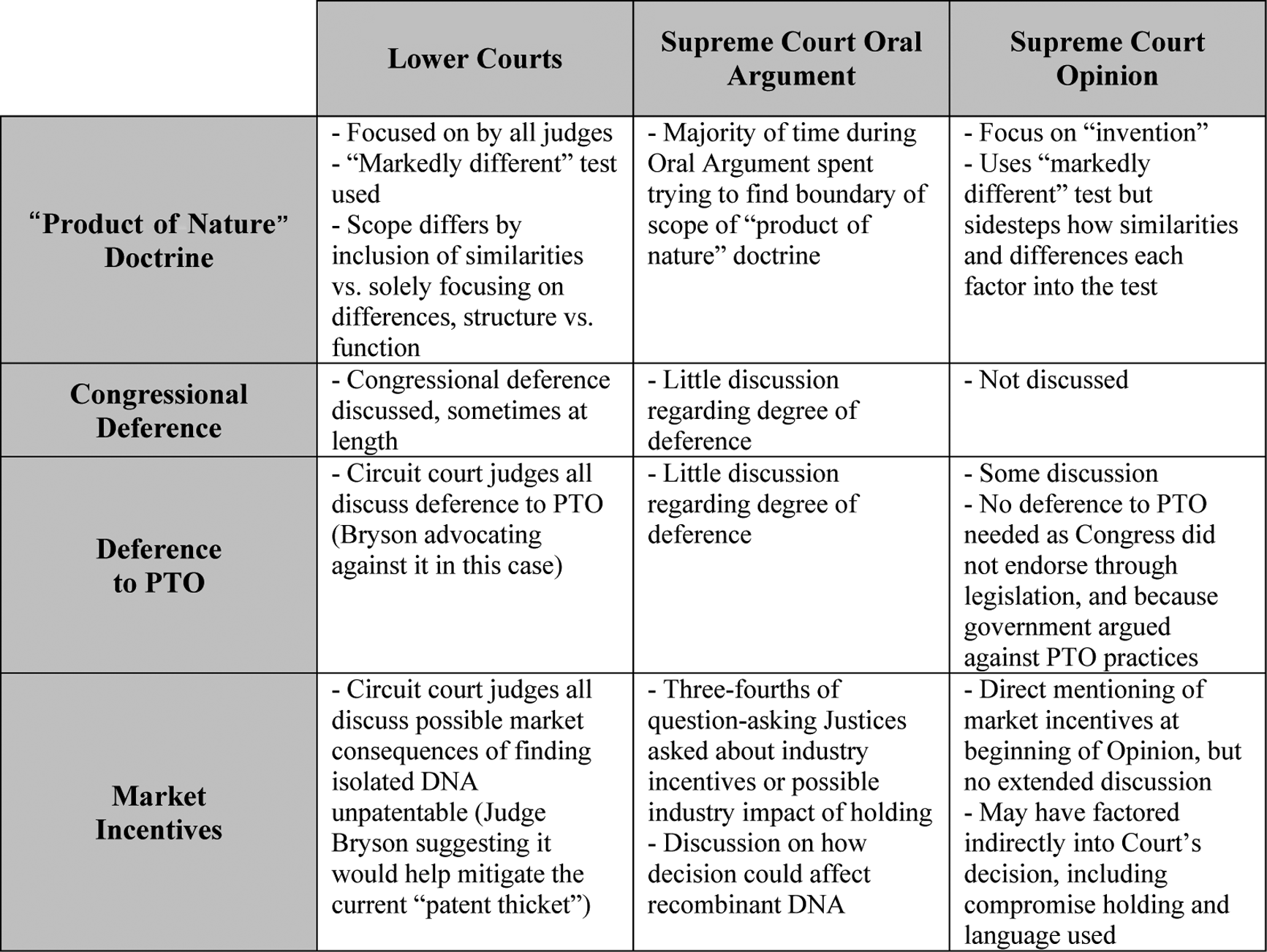
The impact that the case could have depends on the language and rationale that the Supreme Court included in its opinion.183 The fact that the decision was unanimous184 should not detract from the significance of the opinion's nuances. Unanimity may imply that the decision was uncontroversial among the Justices, but the nuances of the opinion are what make it interesting. Thus, I will explore how the opinion's reasoning was laid out, including how various rationales were utilized, how the language used defined the scope of the various doctrines, and how the Supreme Court's treatment of the doctrine compares to the lower court decisions and the Supreme Court's own Oral Argument, which was held on April 15, 2013.185 See Figures 3 and 4 for a summary of the Myriad case history.
Structure of the Supreme Court Decision
Before launching into the details of how each rationale was incorporated into the opinion, it is valuable to look at how the decision was structured. Justice Thomas delivered the opinion for the Court and was joined by all Justices except Scalia, who concurred in part.186 Justice Thomas first laid out, clearly and directly, the issues before the court.187 He then stated the holding.188
The opinion is divided into three sections. The first section provides background facts. Part one of the first section details the basic science of DNA and genetics, including the methods of isolating DNA and synthesizing cDNA.189 Part two of the first section provides a background on Myriad's patents, detailing the various claims and discussing the relevance of such patents on the sequence of BRCA genes.190 The last part of the first section discusses the legal history of the case.191 Thomas summarized the view of each of the Federal Circuit judges on whether isolating DNA was an inventive act and thus meets patent-eligibility requirements, and whether cDNA is patent eligible.192
The bulk of the decision and its accompanying rationale lies in the second section of the opinion. The first part of this section introduces the general standards to be used in the case, including an interpretation of §101 of the Patent Act, the “product of nature” exception to patentable subject matter, and the limits of that exception.193 The second part invalidates the patentability of isolated human genes, including dismissing deference to the PTO and reliance interests, whereas the third part explains why cDNA is patentable subject matter.194 In this third part, the Court illustrates how cDNA differs from isolated DNA.195 This part is relatively brief in comparison with the part explaining why isolated DNA is unpatentable. This is understandable, given that the patentability of cDNA was a less contentious issue than that of isolated DNA; upholding the status quo probably requires less explanation than overturning the practice of the PTO and expectations of the biotechnology industry; and much of the doctrine supporting the patentability of DNA was already set up and explained when discussing isolated DNA. However, interestingly, the Court also gave a brief treatment of its finding that short sequences of cDNA are unpatentable, relegating the entire topic to two sentences at the end of this section.196
The last section of the opinion is a disclaimer; it clearly addresses the limitations of the opinion, ensuring that the industry is clear that the opinion does not cover: (1) method claims; (2) claims on the application of knowledge; and (3) claims on human-made alterations of the genetic code.197 This may be an effort, conscious or otherwise, on the part of the Justices to indirectly address the market incentives theory of patent law, or to mitigate the backlash created by the Court's deciding against the PTO. The Court is cabining its limitations on patentability, making very clear that the holding of the unpatentability of isolated DNA should not be applied to anything but composition patents on isolated DNA.
Supreme Court's Analysis of “Product of Nature” Doctrine for Isolated DNA
In the Supreme Court Oral Argument, the majority of the time was spent trying to find the boundaries of the scope of the “product of nature” doctrine. The Justices and counsel for both sides used a number of amusing analogies198 to try to define how exactly isolated DNA should be viewed within the “product of nature” framework. Although Oral Argument questions may not correlate directly with high interest in the topic, as certain topics may not need further clarification but are still important to the respective Justice, questions certainly correlate with some level of interest or the Justice would not bother to ask the question. From the questions the Justices focused on, we get an understanding of how the Court would shape its opinion.
Specifically, the Justices suggested in Oral Argument that isolation is not enough to warrant finding isolated DNA “markedly different” from native DNA. They focused on isolation as “snipping” the DNA from the body, rather than adding something new.199 Figuring out where to cut is not innovation.200 Justices Breyer and Sotomayor further implied that there are line-drawing issues with holding an isolated composition patentable merely because of its extraction from the body.201
The Supreme Court Opinion mirrored the Justices' discussion of the “product of nature” doctrine in Oral Argument. First, the “product of nature” doctrine was central to the Court's decision holding that cDNA, but not isolated DNA, is patentable subject matter.202 Second, many of the arguments that Justice Thomas set forth echoed the Justices' sentiments in Oral Argument. Specifically, in invalidating the patentability of isolated DNA, the Court relied on the argument that isolation is not enough, and that there must be something new added—some act of innovation—for a material to be considered patent eligible.
The Opinion's discussion of the “product of nature” doctrine opens by quoting §101 of the Patent Act for determining what is generally considered patentable subject matter.203 It then goes on to give the exceptions to §101 as listed in Mayo—“[l]aws of nature, natural phenomena, and abstract ideas.”204 In the subsequent paragraph, the Court suggests limits to the exceptions to patentable subject matter.205 The Court poses the issue of isolated DNA's patentability as “whether Myriad's patents claim any ‘new and useful…composition of matter,’ §101, or instead claim naturally occurring phenomena.”206
In analyzing the eligibility of the Myriad patents, the Court clarified what Myriad accomplished in its patent. The Court stated that Myriad did not “create” or “alter” either the genetic information in the BRCA genes or the DNA's genetic structure.207 Instead, the Court wrote, Myriad's “principal contribution was uncovering the precise location and genetic sequence” of the BRCA genes.208 This is important because it sets up the rest of the discourse on the patentability of isolated DNA with the characterization of Myriad's patents as discoveries (of genetic locations and sequences) rather than of invention by stating that Myriad “uncovered” locations and sequences, but did not “create” or “alter” DNA.209 In this same vein, the Court restated the Chakrabarty rationale: patent-eligible subject matter must be “a product of human ingenuity ‘having a distinctive name, character [and] use.’”210 In contrasting Myriad's patent claims with those in Chakrabarty, the Court gives the reader a good sense of its definition of “product of nature.” “In this case…Myriad did not create anything. To be sure, it found an important and useful gene, but separating that gene from its surrounding genetic material is not an act of invention.”211
Justice Thomas dedicated a paragraph to addressing why the chemical and structural changes—DNA's severed bonds from extraction—are not enough to “save” Myriad's claim.212 There are two noteworthy points about this discussion, one regarding the way in which it is framed and the other regarding its focus. The Court explained, “Myriad's claims [are not] saved by the fact that isolating DNA from the human genome severs chemical bonds ….”213 Although one may write it off as a stylistic idiosyncrasy, the framing of the subject suggests that instead of looking at all similarities and differences, structural and functional, between the composition in question and its natural counterpart, the Court focused first on the similarity, and then suggested possible redemption through additional discrepancies.
The other interesting fact about this discussion is the Court's rationale for why the chemical and structural changes were not enough to save Myriad's claims. The chemical and structural changes from isolation could not save Myriad's claims on isolated DNA because its claims were not “expressed in terms of chemical composition” and did not rely on the chemical changes from isolation, but instead focused on genetic information.214 Thus, the Court pushed aside the tough question of how to weigh structural and functional similarities versus differences. It opted to avoid this balancing altogether by finding the chemical and structural changes irrelevant.
Supreme Court's Analysis of the “Product of Nature” Doctrine for cDNA
The Court's upholding of cDNA's patentability is unsurprising for several reasons. First, a broader application of the “product of nature” doctrine would lead to a greater sphere of exclusion under §101. Such broad exclusion seems unlikely to happen, given the district and circuit court judges' acknowledgement and cautioning that §101 eligibility is broad, and the fact that the Justices in the Supreme Court Oral Argument seemed hesitant to use §101 to narrow the categories of patent-eligible claims when the doctrine is meant to be expansive.215 Second, during Oral Argument, the Justices suggested they would accept Solicitor General Verrilli's “compromise” of holding cDNA patentable while invalidating isolated DNA patents.216 Lastly, although the Justices spent some time reflecting on the natural existence of cDNA sequences in the human genome as a “naturally occurring pseudogene,” it seemed unlikely the Court would invalidate the patentablity of cDNA as a result.
The Opinion upholds cDNA as patentable subject matter succinctly. It states that “creation” of cDNA results in an “exons-only molecule that is not naturally occurring.”217 Justice Thomas does not go into detail about the creation of cDNA involving human invention. Instead, he uses the word “creation” to signal that this part of the test is satisfied. He also includes a discussion, in a footnote, regarding why pseudogenes do not invalidate cDNA's patentability. “The possibility that an unusual and rare phenomenon might randomly create a molecule similar to one created synthetically through human ingenuity does not render a composition of matter nonpatentable.”218 This statement is significant because its impact goes beyond isolated DNA and cDNA. The Court implied that the possibility of a rare natural phenomenon occurring is not enough to render an otherwise patent-eligible composition ineligible. This view results in a broader scope of eligible subject matter under §101.
In its last couple of sentences discussing cDNA, the Court ambiguously suggested that “short” strands of cDNA are unpatentable.219 The Opinion states, “As a result, cDNA is not a ‘product of nature’ and is patent eligible under §101, except insofar as very short series of DNA may have no intervening introns to remove when creating cDNA. In that situation, a short strand of cDNA may be indistinguishable from natural DNA.”220 The Court relegates an important distinction to one and a half sentences. The Opinion does not define “short,” so it is left unclear whether “short” refers to cDNA segments 15 nucleotides or less,221 or whether it is a subjective test to be applied on a case-by-case basis.
The Court's declaring “short” cDNA sequences invalid was not out of left field. During Oral Argument, Justice Sotomayor acknowledged that claims to sequences consisting of 15 nucleotides or less present a separate question from the general patentability of cDNA.222 However, the Court's terse and ambiguous treatment of the subject may lead to future attempts at line-drawing in determining how short a sequence is too short to be eligible for patenting.
Supreme Court's Analysis of Deference to Congress and the PTO
During the Supreme Court Oral Argument for the Myriad case, there was little discussion regarding the degree of deference owed to the PTO or Congress. One could extrapolate from Justices' comments advocating a broad interpretation of §101 that the Court believed in some level of Congressional deference, but certainly not to a degree where the Court would uphold the patentability of isolated DNA as a result.
As predicted on the basis of the Court's treatment of Congressional deference in Oral Argument, Congressional deference was not a main factor in the Myriad decision. In fact, the Court does not include Congressional deference in its reasoning, and mentions Congress's role only in relation to endorsement of PTO practices223 and concerns about reliance interests.224
Based on the Oral Argument, it was clear the Court would not find isolated DNA valid because of deference to the PTO either. During Oral Argument, Justice Ginsburg asked the sole question regarding such deference. She suggested that given the Government's position in this case, disavowing the PTO's practice of granting patents on isolated DNA, “the strength of the presumption [of deference] would be diluted.”225 This echoes Judge Bryson's sentiment in his dissent.226
Such rationale resonated with the Court, as its Opinion found that the Government's position in the case weighed “against deferring to the PTO's determination.”227 The Court further implied that the PTO's practices are not automatically entitled to deference, and that deference would be called for in a case where Congress has “endorsed the views of the PTO in subsequent legislation,” something the Court asserted has not been done with regards to isolated DNA.228
Supreme Court's Analysis of Market Consequences of Decision
In the Supreme Court Oral Argument, what questions the Justices present, how such questions are phrased, and on which lines of reasoning the Justices decide to focus are all possible indicators of the language and posture of an upcoming decision. The amount of attention Supreme Court Justices gave to industry incentives at Oral Argument signaled that the Justices are cognizant of, and concerned about, the potential consequences of the decision for the biotechnology industry.
During Oral Argument, six of the eight question-asking Justices inquired about the industry incentives or effects the holding could have on the market. Some Justices had a proclivity for focusing on the negative effects of eliminating patents for claims on isolated DNA. Justice Scalia, for example, asked what incentive a company would have to “incur massive investment” if it could not patent the isolated gene229 and wondered what advantage a company would have for undertaking isolation of the gene, even if the company could get a patent on the gene's use.230 Justice Alito also seemed worried about how a broad holding invalidating the patentability of isolated DNA could reduce investment.231 Justice Kennedy echoed this concern, commenting, “I just don't think we can decide the case on the ground, oh, don't worry about investment, it'll come. I…just don't think we can do that.”232
Justices Kagan and Breyer, on the other hand, acknowledged possible increased investment that a nonarbitrary reduction in the granting of patents could achieve. Although Justice Kagan pushed Christopher Hansen, counsel for Petitioners, on why we should not be concerned that Myriad and other companies will stop investing,233 she also indicated in her follow-up to Mr. Hansen's answer to Justice Scalia's question that she was not as concerned with the holding causing a decline in investment, as companies could still patent the use of the genes.234 Justice Breyer acknowledged the balance of optimizing innovation that the Court is trying attain,235 and implied that a compromise, such as patenting the use of the gene and not the isolated gene itself, is key to achieving this.236
The Supreme Court Opinion in Myriad directly expresses the Justices' understanding of the patent system's effect on market consequences when it introduces the “product of nature” doctrine. First, in quoting Mayo's natural phenomena exception to §101, the Court reiterated the Mayo rationale: “[W]ithout this exception [for natural phenomena], there would be considerable danger that the grant of patents would ‘tie up’ the use of such tools and thereby ‘inhibit future innovation premised upon them.’”237 In continuing to introduce the bounds of the “product of nature” test, the Court further explained, “[P]atent protection strikes a delicate balance between creating ‘incentives that lead to creation, invention, and discovery’ and ‘imped[ing] the flow of information that might permit…invention.’”238 The Court stated next that it “must apply this well-established standard” in determining the patent eligibility of Myriad's claims,239 though the language of market incentives is sparse in the remainder of the Opinion. Thus, the Court assured the reader from the beginning that it had an understanding of the market effects of the Court's possible decision on the industry and would decide the Myriad case with this impact in mind.
Although Justice Thomas did not use explicit language throughout the Opinion to suggest that this balance was on the Court's mind, he nonetheless obliquely signaled the Court's cognizance of market incentives. The Justices' demonstrated sensitivity to the possible consequences of their holding in Oral Argument is reflected in the way the decision was written in several ways. First, the Justices' sensitivity may have secured the holding that cDNA is patent eligible under §101 to accompany the Court's invalidating of isolated DNA as patentable subject matter. Second, the Court spent the last section of the Opinion on dicta that reiterated the limitations of the application of the Court's decision. Third, in not addressing how similarities and differences should be weighed to determine whether a composition is “markedly different” from its natural counterpart, the Court might have hoped to avoid narrowing the category of patentable subject matter. In these ways, the Opinion implicitly expresses the Justices' underlying goal of incentivizing investment in innovation while not granting excessively broad rights that would stifle future innovation.
Although there is a discussion in the Oral Argument regarding how the decision may affect recombinant DNA, the Opinion does not address recombinant DNA. Recombinant DNA is the current technological focus of the biotechnology industry.240 Recombinant DNA is “DNA where the scientist decides the sequence.”241 During Oral Argument, Mr. Hansen suggested that a holding by the Court that isolated DNA and cDNA are unpatentable would not prevent recombinant DNA from being patented, and that “if [DNA and cDNA] patents are upheld, recombinant DNA is frustrated.”242 Companies would thus not be able to use the pieces of the BRCA gene to recombine them to “find new treatments and find new diagnoses and find new things that will advance medicine. …”243
In Oral Argument, Justices Sotomayor and Kennedy both inquired about whether recombinant DNA technology relies on both cDNA and isolated DNA, or just on isolated DNA.244 Hansen suggested that recombinant DNA technology relies on both isolated DNA and cDNA.245 Solicitor General Verrilli, counsel for the Government as amicus curiae, countered that cDNA is not necessary for creating recombinant DNA.246 He agreed that granting patents on isolated DNA would result in the inability to use the gene itself for recombinant DNA, because nobody could extract the gene without isolating it, and this isolation would violate the patent.247
Because isolated DNA was invalidated as unpatentable subject matter, recombinant DNA will not be “locked up” as to the isolation of particular sequences of human genes. However, to the extent that a company may rely on patented long cDNA sequences for its recombinant DNA, the company would be limited in its ability to produce recombinant DNA. Thus, the magnitude of the result depends on the extent to which recombinant DNA technology relies solely on isolating DNA, or whether cDNA is a necessary part of the process.
Supreme Court Decision's Impact on the Biotechnology Industry
Many people248 predicted that the Supreme Court would uphold cDNA patent eligibility under §101 and invalidate all claims related to isolated DNA as unpatentable subject matter. Some commentators further suggested that the Supreme Court's decision invalidating isolated DNA patents will have little impact on the industry,249 as Myriad's patents will expire soon anyway,250 “single-gene patents [will] be hard to get regardless of this decision because of a stricter obviousness standard,”251 and “newer sequencing technologies may be able to avoid using patented single genes in isolation, which would avoid Myriad-style patents entirely.”252 The biotechnology industry is moving toward “synthetic gene and RNA sequences, proteins and other indisputable contrivances of human ingenuity,”253 including recombinant DNA.
On June 13, 2013, the Supreme Court invalidated patents on isolated DNA and upheld the validity of (most) cDNA claims as patent-eligible subject matter.254 The direct impact of the Supreme Court's decision invalidating patents on isolated human genes is that “[c]ompanies using isolated genomic DNA to screen patients at multiple gene loci will no longer have to worry about whether the genes they are testing are patented ….”255 This means that without having to pay licensing fees or worry about infringing on a composition patent, companies can use isolated DNA to test for, diagnose, and counsel patients on possible risks for certain diseases, like breast and ovarian cancer. The result of these lower costs is greater patient access to these tests.
The decision may additionally impact the biotechnology industry through (1) the language of the Court's opinion and the doctrine that thus develops; and (2) in the message sent by the Court finding prior PTO-approved patent subject matter invalid, thus disturbing settled expectations established by PTO's long-standing practice.
Impact of Supreme Court's Opinion Language
The Opinion's language will likely impact future patent law cases. The Court chose to define a “product of nature” as something more akin to a discovery, where there is no “act of invention” or “product of human ingenuity,” and that is not sufficiently “distinctive” or “markedly different.”256 Whereas the lower court judges focused on whether isolated DNA was sufficiently “markedly different” from naturally occurring DNA, they did not emphasize a requirement of invention. The language the Supreme Court used in its decision may be used later by lower courts to interpret “product of nature” broadly, invalidating the eligibility of subject matter that may not have a discrete “act of invention” involved, even if the composition is “markedly different” than its natural counterpart. In punting the question of how to balance structural and functional similarities versus differences in determining subject-matter eligibility, the Court suggests it does not want to state a rule. The lower court judges, on the other hand, all had their own individual takes on how to achieve the balance in determining whether the composition is “markedly different” from that of nature. Thus, with the Supreme Court side-stepping the question, it remains to be settled. Such remaining ambiguity leads to industry uncertainty.
The Court's suggestion that Myriad's claims were not “saved” by isolated DNA's chemical and structural changes because of Myriad's claim language highlights the importance of how patents are written. It incentivizes future patent seekers who may have a §101 “product of nature” problem to include additional information about any possible differences between the composition and its natural counterpart, including structural and chemical changes.
The Court's language discussing cDNA has two consequences. First, the Court reaffirmed the broad scope of patent-eligible subject matter under §101 by stating that the possible existence of rare pseudogenes does not invalidate cDNA's patentability. It implies that the possibility of a rare natural phenomenon occurring is not enough to render an otherwise patent-eligible composition ineligible. Second, through its ambiguous discussion of short-strand cDNA as unpatentable, the Court leaves open the question of how short a nucleotide sequence is patent ineligible. Because the Court's opinion does not define “short,” it is left to lower courts to interpret. This unanswered question adds to the uncertainty this Opinion causes for the biotechnology industry.
Impact of Unsettled Reliance and Expectations
The Court's suggestion that the PTO's past practices are not entitled deference without Congress's clear endorsement will likely affect the biotechnology industry. Companies may question their reliance on the stability and predictability of the patent system and the PTO.257
The Supreme Court's decision is at odds with a longstanding practice of the PTO to grant patents on human DNA. The Court relegates its discussion of reliance interests to two sentences in a footnote and suggests that such interests “arising from PTO determinations, insofar as they are relevant, are better directed to Congress.”258
In this brief treatment of reliance interests, the Court sent a two-part message. First, through the Court's terse treatment of the issue, the explanation's position in a passing footnote, and the addition of the clause “insofar as they are relevant,” the Court seems to minimize the possible consequences arising from its decision to invalidate patents that the PTO has traditionally granted. Second, the footnote's language suggests that the industry should bring its concerns to Congress, hinting that Congress could amend or otherwise add detail to the Patent Act. It is unclear whether the Court is trying to pass the ball to Congress in this particular case, or if it is hinting more broadly that Congress has not provided the courts with sufficient guidance on how to apply the Patent Act, and that as a result, patent law is a piecemeal compilation of judge-made doctrine.
The Court suggested that the industry request legislative changes to address reliance interests, but the uncertainty that results from the Supreme Court overturning a longstanding practice of the PTO remains a very real consequence of the decision. “Uncertainty in the biotechnology sector may have a negative impact on investments in research and development.”259 It sends a signal that longstanding practices can be changed; however, “[i]f patents on genetic sequences are held unpatentable, investors in biotechnology and medical diagnostics may worry that other types of biomedical patents will be excluded from the patent bargain in the future.”260 This consideration factors ex ante into companies' decisions to invest, because the uncertainty adds an additional risk to the investment. Whether this additional risk will dissuade companies from making the investment depends on the individual cost–benefit analysis of each company, a complicated and multi-factored equation.
Conclusion
The case, while causing much emotionally charged debate around “ownership” of human genes,261 is actually very much about judicial interpretation of 35 U.S.C. §101 and the accompanying interpretation of the judge-made “product of nature” doctrine, the appropriate level of deference to be accorded Congress and the PTO, and how the determination of patentability of human genes affects the incentives of the biotechnology industry.
In the case history, the judges took different positions in their understanding of the breadth and shape of the “product of nature” doctrine: whether the courts should look at the composition's function, structure, or both: whether the courts should focus on similarities or differences between the claimed composition and the composition found in nature, or both, and what weight to give to differences in light of potential underlying similarities. Understanding the lower courts' reasoning and analyzing the Supreme Court's Oral Argument can provide valuable insight into the nuances of the case. The further reconciliation of the case history with the Supreme Court's ultimate decision can provide additional understanding of the real issues in the controversy over the patentability of human genes. Breaking down the Court's language and rationale can also help illuminate how the decision may affect the biotechnology industry.
Last summer, the Supreme Court rendered its decision on whether human genes should be considered eligible for patentability under the subject matter requirement of 35 U.S.C. §101. Although it is not clear that holding that isolated human DNA is unpatentable subject matter whereas synthetically created cDNA is patent eligible will directly impact much of the future of the biotechnology industry, the language the Court uses and the way it shapes the “product of nature” doctrine will likely impact the industry. The Court's holding further signals to the biotechnology industry that reliance on PTO practices is not fail-safe, and the subsequent uncertainty may result in decreased investment. However, companies creating recombinant DNA and related medical technology will be free to use gene segments while not having to worry about licensing upwards of thousands of patents. This increased innovation will be a victory for the patent system in the biotechnology industry.