




Abstract

Introduction
2014
Overview of the South African biotech ecosystem
In this overview, I will highlight elements of the South African biotech ecosystem that are germane to the subject of biotech innovative activity, including national strategies, sources of funding, and legislation pertaining to intellectual property.
In 2001, the South African government adopted its first biotech-focused strategy, the National Biotechnology Strategy (the “2001 Strategy”). 1 The 2001 Strategy proposed that public funds should be allocated to kick-start a vibrant biotech sector. In pursuance of the 2001 Strategy, various public biotech funding agencies were established that commenced funding activity in 2003 and 2004; by 2009, these agencies had invested over R1 billion ($67 million at the most recent exchange rate of ± $1:R15) in biotech projects. 2
In an attempt to centralize all the various public funding agencies administered by it, the Department of Science and Technology established a new statutory body, the Technology Innovation Agency (TIA). By 2010, the public biotech funding agencies that were established in pursuance of the 2001 Strategy were all merged into TIA. It should be noted that the public funding agencies and programs that are administered by government departments other than the Department of Science and Technology continued to be independent of TIA. As such, while there are currently no public funding agencies dedicated to biotech, various public funding agencies can fund biotech.
Private funding for biotech in South Africa is virtually non-existent. 3 In 2001, South Africa's first and only biotech venture capital (VC) firm, BioVentures, was established. 4 By 2004, it was fully invested and was unable to raise a second fund.
In 2013, the South African government adopted a replacement for the 2001 Strategy, namely, the Bio-Economy Strategy (“2013 Strategy”). 5 The pertinent difference between the 2013 Strategy and its predecessor is that the 2013 Strategy identifies focus areas within the country's bio-economy on which to concentrate efforts.
Both the 2001 and 2013 Strategies proposed that foreign direct investment should be attracted to fast-track the bio-economy. However, the main issue that has in the past hindered foreign direct investment in South African biotech—namely, exchange control regulations—remains in force. 6 These regulations entail, amongst others, that the South African Reserve Bank (the country's central bank) must pre-approve all international transactions in terms of which patents that are owned by a South African entity are to be a) assigned to a foreign entity, or b) licensed out on an exclusive basis to a foreign entity. This obviously complicates possible exit strategies for a foreign investor.
Further, on the subject of patents, the South African biotech ecosystem changed significantly in 2008, with the enactment of the Intellectual Property Rights from Publicly Financed Research and Development Act (“IPR Act”). The purpose of this legislation was to promote patenting and commercialization of state-funded science. However, the IPR Act is controversial for multiple reasons.
7
Lee-Ann Tong of the University of Cape Town highlights the following practical issues:
8
In every case where there is use of public finance, for example in the form of professors' wages, office space, use of facilities, or use of existing IP, the Act will kick in. Potential donors and collaborators need to be alert to the fact that even if they are contributing significant resources to a research project with a local university or institution, anything less than funding on a full cost model, will result in a severe curtailment of the ability of the funder to decide on the status of the resultant IP. The Act not only alters the general position that the IP creator is entitled to first ownership of the IP, it imposes enormous administrative burdens on recipients of public funds who have to meet the reporting, disclosure, and commercialization conditions.
This new IPR regime is therefore relevant to anyone contemplating making use of any form of government support for biotech R&D or contemplating private-public cooperation. It especially impacts the nascent local biotech private sector that often relies on the research capabilities of the country's universities and public research institutes. 9 South Africa's biotech private sector still lacks critical mass: 10 according to the latest available statistics (dating from 2006), South Africa had 38 dedicated biotech firms—firms whose predominant activity involves the application of biotech techniques to produce goods or services and/or to perform biotechnology R&D. 11 The average annual R&D spent per firm was $0.5 million, and the vast majority of these firms (89%) had fewer than 50 employees. 12
Taking Stock: Biotech Innovation in South Africa
In the following, I first present the core finding on South African biotech innovation over the past twenty years. I then analyze South African biotech innovation relative to comparative countries, and in terms of its internal structural composition. This analysis will be done using patenting data, in the form of Patent Cooperation Treaty (PCT) applications, as proxy for innovative activity. To show general trends rather than year-to-year fluctuations, I present my findings in four consecutive five-year periods. I refer to these periods as follows:
• Period I: 1994–1998 • Period II: 1999–2003 • Period III: 2004–2008 • Period IV: 2009–2013
Core finding
Over the past twenty years, South African biotech innovative activity has steadily increased from a very small base. During Period I, South Africa's biotech PCT application output was but slightly less than two per year on average; by Period IV, South Africa's biotech PCT application output has increased to 14 per year on average—a sevenfold increase.
Comparative analysis
However, to contextualize the core finding, it must be seen relative to the performance of comparative countries. In its 2013 Strategy, the South African government compared certain aspects of the South African biotech sector with the biotech sectors of Australia, Brazil, Cuba, India, Malaysia, and Singapore. For comparative purposes, I use the same countries, with the exception of Cuba and Australia. In the present context, I suggest that these two countries are outliers: the embargo against Cuba by the world's number one biotech nation, the United States, taints any comparison between South Africa and Cuba. In the case of Australia, it is a developed country that already boasted an annual average of 51 biotech PCT applications in Period I.
Figure 1 represents the number of PCT applications per comparative country for each five-year period. In Period I, all five countries start from the same small base: Malaysia, 2; South Africa, 8; Brazil, 9; India, 11; and Singapore, 13 biotech PCT applications during the entire five-year period. In Period II, biotech innovation in India and Singapore took flight, with 24 and 15 biotech PCT applications per year on average, respectively. In comparison, South Africa and Brazil only managed to raise their biotech PCT application output to six each per year on average. Malaysia essentially stagnated, with negligible biotech PCT application output. Period III saw Brazil breaking away from South Africa: while South Africa raised its PCT application output from six to nine per year on average, Brazil pushed its output up to 16 per year on average—roughly similar to Singapore in the previous five-year period. During Period III, India and Singapore continued their strong growth, rising to 60 and 40 biotech PCT applications per year on average, respectively. Malaysia showed a slight improvement, with 2.6 biotech PCT applications per year on average, but stayed at the bottom of the pack. Period IV provided an interesting turn of events: while South Africa raises its PCT application output from nine to 14 biotech PCT applications per year on average, Malaysia started its biotech innovation engine and jumped ahead of South Africa with 20 biotech PCT applications per year on average. The existing gaps between South Africa and the other comparative countries continued to widen: biotech innovative activity in India now outstrips that of South Africa more than fivefold; even Brazil, whose level of biotech innovation mirrored that of South Africa in Periods I and II, increased its biotech innovation in Period IV to more than double that of South Africa.
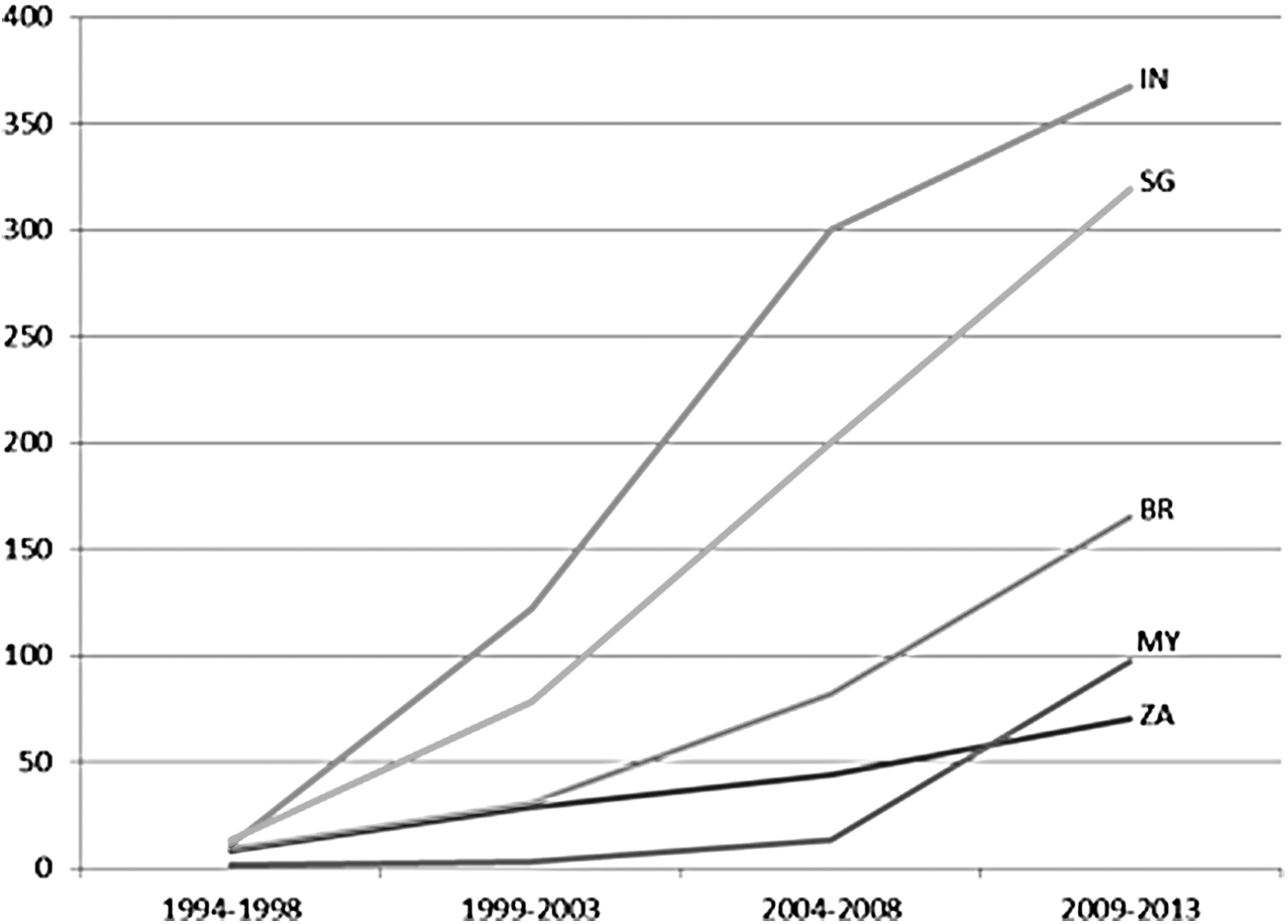
Number of biotech Patent Cooperation Treaty (PCT) applications per comparative country for each five-year period. IN, India; SG, Singapore; BR, Brazil; MY, Malaysia; ZA, South Africa.
Internal structural analysis
The respective contributions to South African biotech innovation over the past twenty years by universities, public research institutions, private firms, and industry organizations stand in the relationship 10:5:4:1. However, behind this twenty-year average, drastic structural shifts transpired during these two decades.
Figure 2 illustrates the relative contribution of the three top contributing sectors in each five-year period. Most remarkable is the inverse correlation between private firms and universities: while private firms contributed to about 60% of South African biotech innovation in Period I, their relative contribution fell to about 5% in Period IV. In absolute numbers of biotech PCT applications, private firms' contribution has essentially stagnated when Periods I and IV are compared—this despite South Africa's sevenfold increase in biotech PCT application output when the same periods are compared. Universities' contribution started in Period I at about 15% and increased to beyond 60% in Period IV. Public research institutes' contribution began at zero in Period I, then followed the same positive trajectory as universities in Periods II and III, before yielding to the advance of universities in Period IV, signified by a drop to a relative contribution level of about 20%.

Relative contribution of the three top contributing sectors in each five-year period.
Methodology
I identified biotech PCT applications using the following International Patent Classification (IPC) codes on Patentscope, the World Intellectual Property Organization's (WIPO's) online search engine for PCT applications: 13 A01H1/00, A01H4/00, A61K38/00, A61K39/00, A61K48/00, C02F3/34, C07G (11/00, 13/00, 15/00), C07K (4/00, 14/00, 16/00, 17/00, 19/00), C12M, C12N, C12P, C12Q, C12S, G01N27/327, G01N33/ (53*, 54*, 55*, 57*, 68, 74, 76, 78, 88, 92). I further used the publication date of PCT applications, ensuring that the data can be obtained for the full twenty-year period in review up until December 31, 2013, without having to provide for the lag between application and publication. As country indicator, I used the applicant's country, given the international mobility of researchers (inventors).
In the internal structural analysis of South African biotech PCT applications, I studied each application to ascertain the nature of the applicant(s). Given that United States intellectual property law (prior to the Leahy–Smith America Invents Act, the relevant provisions of which came into effect on September 16, 2012) required that the inventor(s) must be the applicants, many applications would list the inventor(s) as applicants with the qualification that it is for the United States only, and simultaneously list a legal entity as the applicant for the rest of the world outside the United States. Applications where the legal entity that is listed as the applicant for the rest of the world outside the United States did not have a South African address—in other words, where the South African link was based only on an inventor with a South African address and who was listed as an applicant only for the United States—were not included for purposes of the internal structural analysis.
Discussion
Relative to the comparative countries, South Africa's growth in biotech innovation has clearly been modest. Various factors could have stymied South Africa's potential, such as the dearth of VC funding and the complications with foreign direct investment in biotech pointed out in the overview above. Also, the size of South Africa's $100 million public investment in biotech pales in comparison with the public investments in biotechnology by some of the comparative countries:
• Malaysia invested $750 million in its biotech industry between 2005–2009.
14
• Commencing in 2007, Brazil plans to invest $4.77 billion in biotechnology over ten years.
15
• Singapore, a developing country with a population a tenth of that of South Africa, spent $10 billion on biotech during 2006–2010, and budgeted to spend 20% more during 2011–2015.
16
Moreover, several shortcomings in the operation of South Africa's public biotech funding agencies have been highlighted in the literature, including, amongst others, a lack of biotech business acumen amongst agency decision makers; 17 the imposition of onerous conditions; 18 heavy bureaucracy and slow turnaround times; 19 an overly controlling approach; 20 and funding that is provided in suboptimal amounts. 21
However, with reference to the results of the analysis above, I suggest a structural reason for the failure of South African biotech innovative activity to take flight, namely, that—figuratively speaking—it is attempting to fly with only one wing: the growth of South African biotech innovation was almost exclusively public sector-driven, with the private sector's relative contribution in continuous and dramatic decline. I suggest that a vibrant private sector is an essential driver of growth in biotech innovation—innovative SMEs in particular are key to the growth and dynamism of biotech. 22 A well-known example of this reality—of the important role played by innovative SMEs—in the public policy context is the support via various European policies of Young Innovative Companies, which are companies that are less than six years old, have fewer than 250 employees, and are highly R&D intensive, having an R&D intensity greater than 15%, as measured by R&D spending relative to total operating expenses. 23
The reason for the private sector's declining relative contribution by the private sector to South African biotech innovation deserves more analysis. The South African public funding agencies were reported to have concentrated on funding university-based R&D, rather than supporting R&D projects by small and medium enterprises (SMEs).
24
The problem, however, is not limited to the public funding instruments, but is systemic, as stated in the 2007 OECD report on innovation in South Africa:
25
A major gap in current innovation policy is indeed the lack of comprehensive support to innovation in SMEs. … too much focus on the role of public R&D-performing institutions. This may have obscured important issues, in particular … the central role of business enterprises in generating and implementing innovation …
The obvious solution has already been suggested in the OECD's report: “Bring business enterprises much more centrally into the map of the innovation system both as generators and implementers of innovation and as creators of human resources for innovation.” 26
The process of revision of the 2001 Strategy provided an ideal opportunity to change course and adopt this solution. However, the opportunity was not only missed, but the existing public policy exclusion of the private sector as potential driver of innovative biotech activity was solidified: the conceptual framework of the 2013 Strategy makes it explicit that innovation is the domain of universities and public research institutes, while the private sector is consigned to post-R&D activities, such as pilot scale-up, production, and commercialization.
Given the dearth of VC funding and foreign direct investment in biotech in South Africa, biotech firms are largely dependent on public support. As such, public policy has a significant impact on the still-nascent biotech private sector. I suggest, therefore, that the public policy exclusion of the private sector as potential driver of innovative biotech activity—throughout the innovation value chain—is an acute cause of the stasis of the biotech private sector in terms of innovative activity over the past twenty years, as well as its inability to attain any semblance of critical mass. This, in turn, as suggested above, has stymied South Africa's growth in terms of biotech innovation.
Conclusion
The analysis of patenting data as proxy for biotech innovative activity over the past twenty years indicates that although South Africa's biotech innovation has grown, such growth has been modest relative to the growth attained by comparative countries. There are certainly multiple, interlinked factors that have impacted and continue to impact on South Africa's suppressed growth in biotech innovation. I have highlighted some of these factors, such as the scarcity of funding and the problems experienced with the public biotech funding agencies that were established in terms of the 2001 Strategy. TIA, the public funding super-agency into which these agencies merged, also had a bumpy journey. An external investigation into TIA, commissioned by the Minister of Science and Technology in 2012, reported confusion about TIA's purpose, “toxic relationships” between TIA and the Department of Science and Technology, and jockeying for influence within TIA as reasons for it “not meeting the expectations of stakeholders.” 27 In April 2014, the Minister of Science and Technology announced that he had fired the Chief Executive Officer (CEO) of TIA based on a damning audit report, which included allegations of nepotism and irregular investment transactions. 28 In fact, the Directorate for Priority Crimes Investigation has been tasked to further investigate TIA. 29
However, I suggest that the nosedive by the private sector's relative contribution to South Africa's biotech innovation over the past twenty years points to a significant underlying factor of South Africa's suppressed growth in biotech innovation: the exclusion—in public policy on the level of national strategy—of the private sector as potential driver of innovative biotech activity throughout the innovation value chain.
With reference to South African biotech, Heather Sherwin, CEO of the VC BioVentures, remarked in 2006: 30 “we're in danger of having started something that is just going to fizzle.” I suggest that absent a rapid and complete change in mindset amongst South African public policymakers, Sherwin's comment may be prophetic.