




Abstract
Abstract
Teva Pharms. USA, Inc. v. Sandoz, Inc., 789 F.3d 1335 (Fed. Cir. 2015), indicates that “molecular weight” may be an indefinite claim term for polymer-related claims if the specification fails to provide the definition of “molecular weight.” Since Teva Pharms. USA, Inc., whether “molecular weight” is an indefinite claim term has become an issue in litigation concerning polymer-related patents. This article reports Reckitt Benckiser Pharm. Inc. v. Watson Labs., Inc., No. CV 13-1674-RGA, 2016 WL 3186659 (D. Del. June 3, 2016), where the court relied on a footnote of one table in the specification to hold the disputed term “molecular weight” definite. Such footnote merely disclosed the name of the company that manufactured the claimed polymer related to the dispute term. This article argues that while a small detail in the specification may save “molecular weight” from being held indefinite, it is better to disclose the molecular weight definition provided by the manufacturer.
I. Introduction
35
In 2015, the Federal Circuit in Teva Pharms. USA, Inc. v. Sandoz, Inc. 5 (hereinafter Teva IV) held that “molecular weight” was an indefinite claim term for describing copolymer-1. 6 There, the disputed term was “a molecular weight of about 5 to 9 kilodaltons.” 7 The Federal Circuit found that the claim language and specification failed to tell whether “molecular weight” means a number-average molecular weight (Mn), weight-average molecular weight (Mw), or peak-average molecular weight (Mp). 8 Instead, the Federal Circuit found that the prosecution history of two family patents showed that “molecular weight” means an Mw or Mp. 9 Thus, the Federal Circuit found the disputed term indefinite. 10
The Teva IV decision indicates that “molecular weight” as a claim term in polymer-related patents may mean a number-average molecular weight, weight-average molecular weight, or peak-average molecular weight, if the specification fails to describe which definition is followed. 11 The Teva IV decision also indicates that expert testimony may prove “molecular weight” to be definite, as long as the prosecution history of the disputed patent and its family patents does not show a different conclusion. 12
Teva IV acknowledges the complexity of “molecular weight” in polymer technology. The concept of “molecular weight” for polymers is “average.” 13 Because polymer molecules of the same kind have different lengths, it is impossible to characterize a polymer sample by a single molecular weight. 14 Rather, the molecular weight of a polymer sample is presented by an average of molecular weights of all polymer molecules in the sample. 15 As shown in Table 1, 16 there are several ways to define “average.” 17
Description: Mi means the single molecular weight of polymer molecules of the same length i. Ni means the total number of moles of the molecules with a molecular weight Mi.
Since Teva IV, whether “molecular weight” is an indefinite claim term has become an issue in litigation concerning polymer-related patents. 18 Reckitt Benckiser Pharm. Inc. v. Watson Labs., Inc. 19 (hereinafter, “Reckitt”) is one decision where the United States District Court for the District of Delaware disagreed with the defendants' indefiniteness challenge concerning “molecular weight” as a claim term describing polyethylene oxide. 20 The lawsuit arose from two separate abbreviated new drug applications (ANDAs) for a generic version of Suboxone® sublingual film that is used for treating opioid dependence. 21 Suboxone® sublingual film was sold by Reckitt Benckiser Pharmaceuticals Inc., which was also an exclusive licensee of three asserted patents. 22 Two ANDA applicants were Watson Laboratories, Inc. and Par Pharmaceutical, Inc. which were the defendants in this case. 23
The Reckitt court relied on a short sentence in the specification which describes the source of polyethylene oxide and found the term “molecular weight” definite. 24 This article is intended to explore the Reckitt decision and argue that a small detail in the specification regarding the meaning of “molecular weight” may save claim term “molecular weight” from being held indefinite. Next, Part II analyzes the Reckitt decision and includes discussion of relevant legal doctrines. Part III discusses what can be learned from the Reckitt decision to improve the patent drafting practice.
II. Analysis of Reckitt Benckiser Pharm. Inc. v. Watson Labs., Inc.
A. Disputed claim language
The disputed patent concerning the indefiniteness issue of “molecular weight” was U.S. Patent No. 8,017,150 (the '150 patent). 25 The '150 patent was titled “polyethylene oxide-based films and drug delivery systems made therefrom.” 26 The plaintiffs alleged that four claims of the '150 patent were infringed by the defendants. 27 Two disputed claims were independent claims that recite “a mucosally-adhesive water-soluble film product.” 28 These two independent claims were used as representative claims for analysis in the Reckitt decision. 29 The disputed claim term recited:
the polyethylene oxide comprises one or more low molecular weight polyethylene oxides and one or more higher molecular weight polyethylene oxides, the molecular weight of the low molecular weight polyethylene oxide being in the range 100,000 to 300,000 and the molecular weight of the higher molecular weight polyethylene oxide being in the range 600,000 to 900,000. 30
B. Governing law
The Reckitt court followed Nautilus Inc., under which “a patent is invalid for indefiniteness if its claims, read in light of the specification delineating the patent, and the prosecution history, fail to inform, with reasonable certainty, those skilled in the art about the scope of the invention.” 31 The Reckitt court also held that indefiniteness is a question of law 32 and must be proved by clear and convincing evidence. 33
But the Reckitt court did not recognize that claim construction is part of the indefiniteness issue, nor did it mention any legal doctrines regarding claim construction. 34 In fact, the same judge had construed “molecular weight.” 35 In 2014, the district court issued a decision to construe the disputed term “molecular weight” as “average molecular weight.” 36
C. District court's reasoning
Regarding the indefiniteness issue, the Reckitt court held that the defendants “failed to prove by clear and convincing evidence that a person skilled in the art would not know with reasonable certainty the meaning of ‘molecular weight’ in the context of the '150 patent.” 37 Instead, the Reckitt court concluded:
In the absence of a specified method to measure molecular weight and in light of the patent's references to molecular weight as reported by Dow, I find that the weight of the evidence demonstrates that one of skill in the art would understand that the patent relies on the molecular weight of Polyox N80 reported by Dow as the measure of “molecular weight.” 38
The Reckitt court reached its conclusion by considering the specification, the expert testimony, and the information of the infringing products. 39 When construing a claim, courts rely on intrinsic evidence and extrinsic evidence. 40 The intrinsic evidence covers claims, specification, and prosecution history, 41 while the extrinsic evidence includes “expert and inventor testimony, dictionaries, and learned treatises.” 42 Thus, the Reckitt court relied on both intrinsic and extrinsic evidence to resolve the indefiniteness issue.
The Reckitt court's reasoning can be divided into two categories. One category focuses on the specification, while the other focuses on the expert testimony.
When examining the specification, the Reckitt court found that “[t]he '150 patent does not explicitly describe a method to use to calculate molecular weight.” 43 But the Reckitt court noticed that the specification states the source of polyethylene oxide is Dow Chemical Company. 44 The Reckitt court further considered values listed in one table of the '150 patent (shown in Figure 1) as the approximate viscosity-average molecular weights assigned to different grades of polyethylene oxide, because it found that the accused ANDA drugs also used polyethylene oxide provided by Dow Chemical Company and that Dow Chemical Company assigned an approximate viscosity-average molecular weight to each polyethylene oxide product. 45 Therefore, the Reckitt court held that “[a] person of ordinary skill in the art would understand the term ‘molecular weight’ in the patent to refer to viscosity average molecular weight as reported by the manufacturers of commercial [polyethylene oxide].” 46

Table 22 of the ’150 patent.
Regarding the expert testimony, the Reckitt court considered the opinions from both parties' experts. 47 The defendants' experts showed that the molecular weight of a polyethylene oxide sample may have different definitions. 48 The defendants' experts also testified that there are two different methods for measuring the average molecular weight of a polyethylene oxide sample and each method gives different numerical values for the molecular weight of the same sample. 49 On the other hand, the plaintiff asserted that “molecular weight” means viscosity-average molecular weight. 50 Finally, the Reckitt court disagreed with the defendants' experts, 51 because “[t]he claims are not indefinite merely because multiple methods of measuring molecular weight exist.” 52
III. Patent Drafting
The Reckitt decision suggests that a small detail in the specification may save the term “molecular weight” in a polymer-related claim from being held indefinite. The specification of the '150 patent mentions the source of polyethylene oxide. But, the relevant statement is not in the main text. Rather, the source of polyethylene oxide is disclosed as a footnote of one table (shown in Figure 2), while such table is used for describing the compositions of the test samples. 53
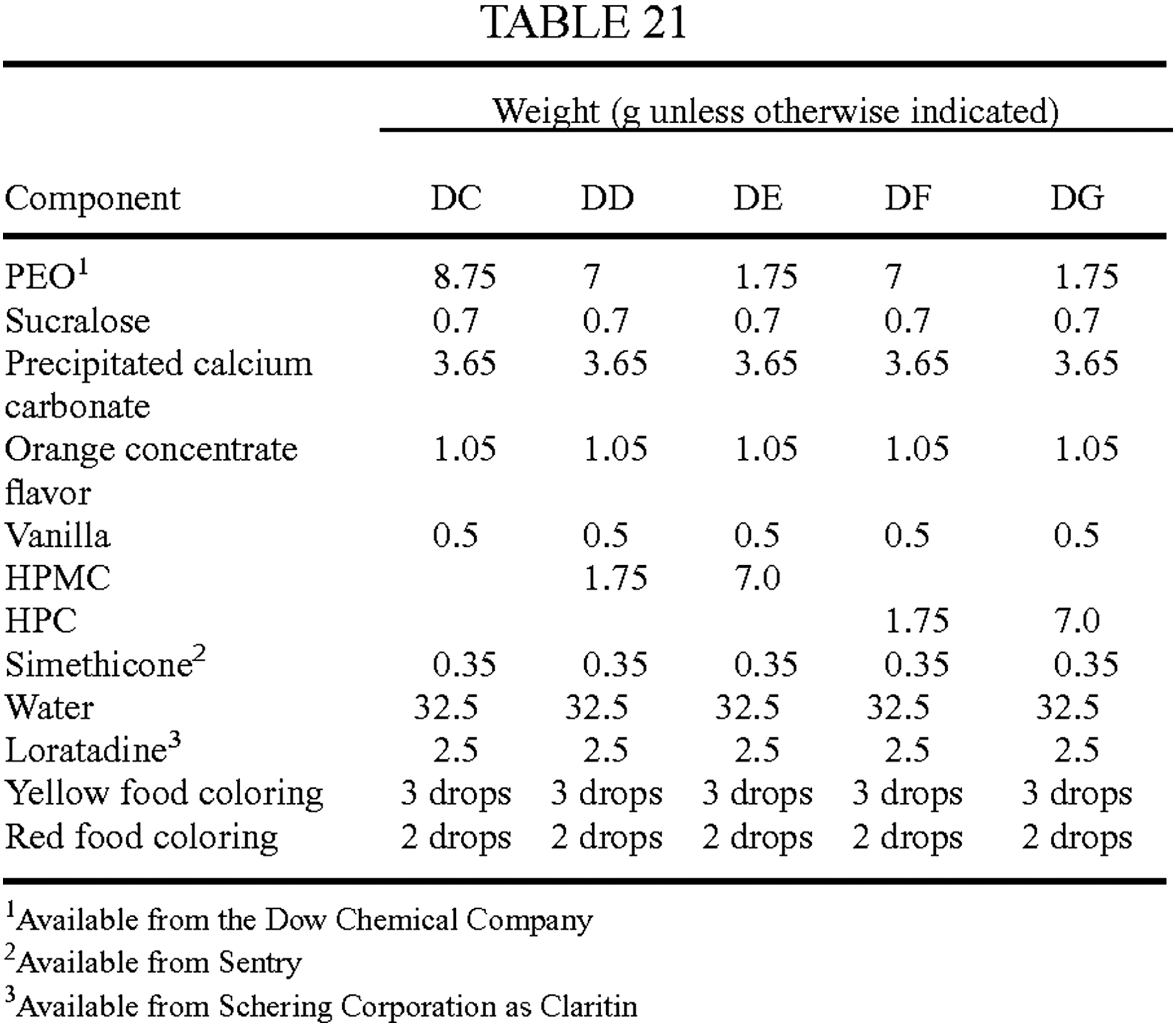
Table 21 of the ’150 patent.
The exact information in the '150 patent regarding the source of polyethylene oxide is only the phrase “Available from Dow Chemical Company,” which is not even a full sentence. 54 The phrase does not explain which “molecular weight” the '150 patent refers to. During the Markman hearing, the plaintiff actually argued that “molecular weight” meant “actual molecular weight” (or “the sum of the atomic weights of all the atoms in a molecule”). 55 That argument clearly contradicted the plaintiff's later argument for the definiteness of “molecular weight.” Eventually, the district court adopted the defendants' approach and construed “molecular weight” as “average molecular weight.” 56 The district court further left the question of whether “molecular weight” means “viscosity-average molecular weight” to a later proceeding regarding the indefiniteness issue. 57
Although “molecular weight” in the claims of the '150 patent is not indefinite, the patent drafting of the '150 patent is risky. The Reckitt court did not directly hold “molecular weight” definite. 58 Instead, the Reckitt court had to rely on extrinsic evidence. 59 That is, whether “molecular weight” is indefinite depends on extrinsic evidence developed during litigation. Expert testimony is helpful, but it does not work out well in every case. The Reckitt court did not rely on the plaintiff's expert testimony to conclude that “molecular weight” means “viscosity-average molecular weight.” 60 Instead, the Reckitt court quoted the defendants' expert testimony to support its holding. 61
Another example similar to the '150 Patent is U.S Patent No. 6,348,469 (the '469 patent) with the title “solid compositions containing glipizide and polyethylene oxide.” Claim 2 of the '469 patent recites “[t]he composition according to claim 1, in which the polyethylene oxide has a molecular weight which varies from 50,000 to 8,000,000.” 62 The specification states: “Polyethylene oxide referred to as PEO below is moreover known as a component of medicaments in tablet form designed to be administered by oral route. This compound is marketed by the Union Carbide Corporation under the commercial name Polyox®.” 63
But the specification does not identify whether “molecular weight” means “average molecular weight” or which average molecular weight the term refers to. 64 So, when an indefiniteness issue is raised, the patentee may have to present extrinsic evidence, such as product documents from Union Carbide Corporation, to explain that “molecular weight” means a certain class of average molecular weight.
The risk of indefiniteness can be avoided if the drafter of the '150 patent would have taken another approach. According a product document of polyethylene oxide from Dow Chemical Company, the approximate molecular weight of each polyethylene oxide grade is “[b]ased on rheological measurements.” 65 The document further states that “[m]olecular weights obtained by other methods, including light scattering and gel permeation chromatography, may not be directly comparable.” 66 By using “rheological measurements” to define the molecular weight of polyethylene oxide, the term “molecular weight” clearly means “viscosity-average molecular weight.” 67 The concern of the indefiniteness of “molecular weight” will be eliminated.
V. Conclusion
After Teva IV, “molecular weight” has become a disputable term in a polymer-related claim. When the specification does not define the meaning of “molecular weight,” the patentee has to rely on expert testimony to resolve the indefiniteness issue of “molecular weight.” The Reckitt decision suggests that a small detail in the specification may save “molecular weight” from being held indefinite. Such small detail may just be a footnote indicating the source of the polymer material related to the disputed term “molecular weight.” But the question is that the patentee has to depend on the court's view on expert testimony. Therefore, the best way is to not only provide the source but also state the specific average molecular weight assigned to the polymer material.