




Abstract

1. Introduction
It is going to be interesting to see how society deals with artificial intelligence, but it will definitely be cool.
Colin Angle, Chairman, CEO, and Founder of iRobot. 1
A
While there are a good number of AI-based applications being developed, some being approved for commercialization and use by United States Food and Drug Administration (FDA) in the health care sector, the regulatory framework is yet to be developed. The development of regulation for AI in the health care sector will bring certainty in its growing use.
The present study provides an analysis of the areas where AI has successfully been used in different domains of health care. Further, it also discusses some of the AI-based applications approved by FDA. Based on the analysis of the existing policies and regulations relevant to the health care sector in different countries, the study suggests factors that need to be considered for the development of responsive regulation.
2. Evidence of the Use of AI-Based Tools in the Drug Discovery and Health Care Sector
2.1. Drug discovery
The area of machine learning has brought about an essential change in the research and development sectors of the pharmaceutical industry. It can be used to develop prediction tools which can learn properties related to different structures. Ineffective drug targets are a significant reason for the failure of late-stage clinical trials, due to which few drugs make it to the drug approval process finally. However, AI is becoming a powerful tool to expand the drug discovery process and pathway. As a result, the development of AI platforms and processes has fuelled AI-based drug development.
BioXcel Therapeutics uses novel AI technology to identify and develop new medicines in the field of immune-oncology and neuroscience. 3 Berg, a clinical-stage biotechnology company, uses AI to map diseases to accelerate the discovery and development of breakthrough medicines. 4 XtalPi is increasingly utilizing the AI-based Intelligent Digital Drug Discovery and Development (ID4) Platform for reinventing drugs. The ID4 platform provides accurate predictions on the physicochemical and pharmaceutical properties of small-molecule candidates for drug design, solid-form selection, and other critical aspects of drug development. 5 Based on convolutional neural networks, the AI technology of Atomwise makes it convenient for the researchers to pursue hit discovery, lead optimization, and toxicity predictions with unparalleled precision and accuracy. 6 Deep Genomics uses AI technology to find drug candidates with desirable properties. Through the use of the Project Saturn platform, Deep Genomics evaluates, in silico, several billion molecules against one million targets. 7 With the help of biomedical data, BenevolentAI provides an end-to-end drug discovery process which covers early discovery to late-stage clinical development. 8 These examples are representative of how companies and start-ups are focusing AI solutions on the drug discovery and development pathway. In addition to the growing use of AI in drug discovery, there has also been a remarkable growth in AI's other health care applications.
Artificial intelligence in medicine was introduced during the early 1960s. Expert systems such as the MYCIN (developed by Stanford University), INTERNIST (developed by University of Pittsburgh), CASNET (by Rutgers Research Resource), MUNIN, Pathology Expert Interpretative Reporting System, and many others represent the development of AI systems for medical-related work (Table 1). Medical AI technologies have been growing over the years. With an increase in the growth as AI as a discipline, newer systems are being created with the help of fuzzy logic, neural networks, expert systems with integrated intelligent decision support systems (DSS) to machine learning (ML), deep learning, and computer vision.
Artificial Intelligence (AI) Systems Used in Medicine
Although the area of medicine was well established, the use of AI technology in the earlier days was considered unconventional. Clancey and Shortliffe defined its use in medicine:
Medical artificial intelligence are primarily concerned with the construction of AI programs that perform diagnosis and make therapy recommendations. Unlike medical applications based on other programming methods, such as purely statistical and probabilistic methods, medical AI programs are based on symbolic models of disease entities and their relationship to patient factors and clinical manifestations.”
9
Various subsets of AI have brought notable achievements to the health care sector in the last few years. Its efficiency has gone far beyond mere bioactivity predictions, as it is now also being used provide solutions to problems related to drug development and discovery process. The flexibility of the neural networks enables deep learning technology to distinguish itself from other machine learning methods. Companies such as IBM, TwoXAR, Insilico Medicine, Atomwise, Berg, GE, Google, and many others are using deep learning and machine learning technologies to achieve various objectives in the health care sector. The current use of artificial intelligence can be seen in various use in the health care sector, like telemedicine, diagnostics, and AI-assisted surgeries (Fig. 1).
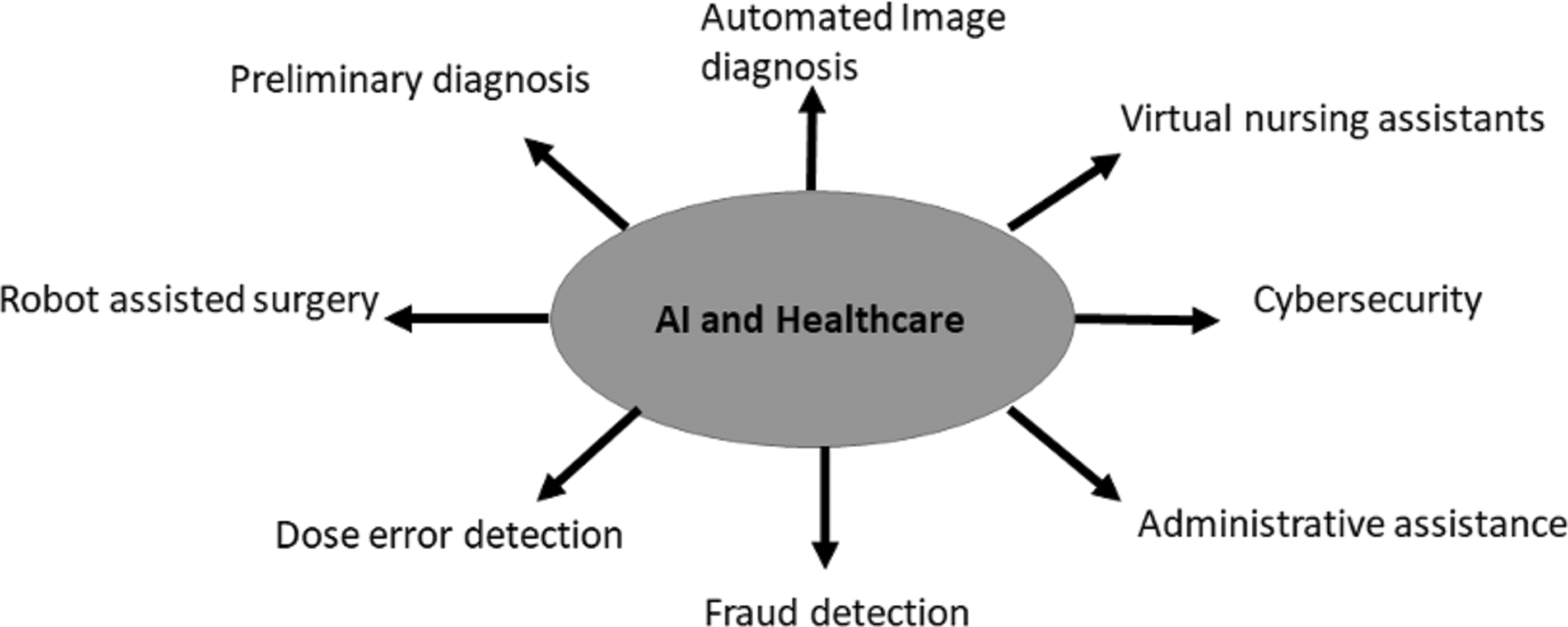
Application areas of AI in health care.
2.2. Diagnostics
The predominant use of AI in diagnostics has been with radiology. Capitol Health Limited, an Australian radiology service company, and Enlitic, a medical start-up, announced their first collaboration on the end-to-end transformation of medical diagnostics using deep learning technologies for radiologists and health care providers in 2015. 10 In 2017, a team at Karolinska Institutet launched Stockholm3 test, a blood-based prostate cancer diagnostic test which is currently being used in clinical practice in Sweden, Norway, Finland, and Denmark. In early January 2020, a team of researchers in Sweden discovered that an AI platform could be used to diagnose prostate cancer in tissue samples. 11 PathAI and Bristol-Myers Squibb are together working on the predictive promise of AI for a reliable and reproducible AI-powered pathology interpretation in immuno-oncology. Assessing PD-L1 expression on immune cells by traditional approaches can be challenging, and it is expected that the AI application would be useful. 12 AI genomics company Freenome uses molecular biology and machine learning to detect early-stage cancer and precision oncology with the use of its multiomics platform. 13 Researchers at Beth Israel Deaconess Medical Center (BIDMC) utilize artificial intelligence-enhanced microscopes for scanning for harmful bacteria (such as E.coli and Staphylococcus) in blood samples at a faster rate than is possible using manual scanning. 14
While global solutions are being developed, the use of AI in health care specifically in India is also growing. Microsoft India has several initiatives in health care, including the Microsoft Intelligent Network for Eyecare (MINE) project working with the government of Telangana and its Rashtriya Bal Swasthya Karyakram. This AI platform has been adopted to reduce avoidable blindness. 15
Artelus, a start-up, uses deep learning algorithms for detecting diabetic retinopathy (DR). Niramai, a Bangalore-based start-up, began in 2016 and focused on providing ML-based software to detect breast cancer at a much earlier stage. Qure.ai uses deep learning algorithms for radiology, CT scans, and MRIs. Sigtuple, a Bangalore-based start-up founded in 2015, uses AI, deep learning, and image processing tools for various uses, such as analysis of peripheral blood smears, urine microscopy, semen and fundus screening, OCT scans, and chest X-rays. 16 Google Health has developed a deep learning–based model diagnosing anaemia based on noninvasive retinal screening, rather than a traditional blood test. 17
2.3. Precision medicine
It is interesting to note several health care AI collaborative frameworks in recent times. The ability to determine outcomes accurately in the health care area is mainly dependent on expert evaluation. Due to the extensive data that needs to be evaluated, not only is it tedious, but timely health care also cannot be ensured. Several products have been developed for several diseases, including those of the lifestyle disease segment to increase speed of delivery.
Both Phytel and Explorys (since 2015) have added IBM Watson for Genomics and Oncology respectively to the supercomputer's portfolio. Microsoft in 2017 collaborated with University of Pittsburgh Medical Center to advance AI and released new products including HealthVault Insights, Microsoft Genomics, a chatbot, and Project InnerEye for radiotherapy. Google AI has released DeepVariant, a deep-learning technology for improving the accuracy of genome sequencing, as an open-source product in 2017. The open-source DeepVariant is more accurate than its original version for single nucleotide polymorphisms (SNPs) prediction. 18 Healthi, a Bangalore-based digital health and wellness start-up, uses machine learning, personalization algorithms, and predictive analytics for personalized health suggestions. 19 Oncostem Diagnostics, a start-up founded in 2011, aims to provide personalized treatment for cancer based on machine learning algorithms. 20 These are some of the representative precision medicine applications of AI.
2.4. Electronic health records
Documentation and information retrieval through an electronic health record (EHR) has made health care data available for use in different settings. However, there have been concerns about the extended time which physicians must dedicate to record keeping. AI applications have been developed to expedite and enhance clinical documentation and the retrieval of EHR data. Health institutions, as well as companies, are working together to develop AI applications in this area. EarlySign collaborated with Geisinger's Steele Institute for Health Innovation to develop and deploy machine learning-based digital technologies to identify patients at risk of high-burden diseases. 21 Researchers at Kaiser Permanente developed a machine-learning algorithm that could help prevent HIV transmission using electronic health records. 22 Cleveland Clinic researchers developed an artificial neural network that analyzes lung cancer patients' EHRs and medical scans to determine the most effective radiation dosage for therapy. 23 In order to address physician fatigue concerning EHRs, Google Cloud has partnered with an AI assistant, Suki, for efficient use of time as well as enhance value related to EHR information.
3. Regulation of the Use of Artificial Intelligence Tools in the Health Care Sector
As national digital health strategies continue to be announced, it is evident that digital interventions for patient diagnosis, care, and comfort would eventually play an essential role in the overall health care system. Many countries have included digitalization as one of the pillars to be achieved in digital health care. Digital health care includes maintaining electronic health records, as well as using AI-based drugs and devices. Many countries, including the United States of America, United Kingdom, Israel, European Union, Singapore, Australia, China, Saudi Arabia, and some African countries, have implemented digital health care to different extents. 24 In the post-digital era, the concept of DARQ (which includes distributed ledger (blockchain), artificial intelligence, extended reality, and quantum computing) is gaining much importance. In what can be termed as high-performance medicine, digital patient records will accentuate the ability to correct errors, improve workflow, and allow accurate predictability of clinical trial information. 25 Health care awards in relation to four areas—clinical decision support, diagnosis, screening, and system efficiency—have been recognized first by the UK. 26
An AI system includes both hardware and software components and so may refer to a robot, a program running on a single computer, a program run on networked computers, or any other set of components that hosts an AI. The foreseeability, autonomous nature, and assisted decision-making aspects of AI can integrate various areas. 27 However, the use of AI in various fields, which is different from standard computer software, comes with various liabilities. As there is no specific law to govern the liability of AI software, which is self-learning and makes decisions on experience, regulation of it becomes more complex and vital. Self-driving vehicles are one example which illustrates the risks inherent in autonomous systems and when supervision is effectively taken out of human hands. As computer intelligence, to a certain extent outgrows human intelligence, the extensive implementation of AI could have undesirable effects; therefore, there is an urgent need to regulate it. The “RoboLaw Project” by the European Commission, which investigated the legal implications of robotics, led to the development of Guidelines on Regulating Robotics. As an emerging technology which cannot be limited to a particular jurisdiction, AI needs to be regulated worldwide. 28 Technology regulation has a broader meaning than just creating and applying technical standards. Technological regulation mostly depends on how the regulators perceive the new technology. 29 Even companies like Google 30 and Philips 31 came up with their own AI guidelines within the company to regulate their development and use of AI.
3.1. Evolution of AI regulation
The basic proposition is that we should develop only “Beneficial AI,” which is created safely and for the benefit of the society. Two types of measures to build Beneficial AI have been suggested. Extrinsic measures necessitate AI designers to adopt beneficial designs. Such designs may be in the form of bringing in certain constraints, incentives, and compliances. Intrinsic measures include the cultivation of social norms and the framing of communications. The effect of intrinsic measures may impact extrinsic measures. 32 Developers of AI algorithms face the risks, including dataset shift, casual fitting of confounders, and unintended discriminatory bias. Further, challenges including generalization to new populations and the potential unintended negative consequences of new algorithms on health outcomes are other aspects which need thoughtful consideration and regulation. 33
Another vital area in the regulatory pathway is understanding AI, or more accurately, AI-related, liability. The possible grounds for liability can be conceptualized in several ways. First is respondeat superior liability where the master is liable on behalf of his/her/its servants—and in this context, the AI would be the servant. Second is vicarious liability, where liability for an AI's behavior will be vicariously imposed on a person on whose behalf the AI acts. The third is a strict liability, which absent a statute cannot be imposed except in relation to ultrahazardous activities. 34 Responsible development involves ensuring that AI systems are safe, secure, and socially beneficial. To reduce the potential harm from an AI system, it needs to be constructed responsibly. Regulatory compliance can also increase cost considerations for companies.
Market forces alone may not always incentivize companies to invest the appropriate amount into ensuring their products are safe. In real-world scenarios in which markets may not function correctly and information asymmetries exist, incentives for companies to invest sufficiently in product safety typically come from three sources: market forces, liability law, and the industry or government regulation. 35 In case of the role of AI in health care, there is a need for effective regulation. AI technologies rely on various algorithms—programs which are created with the help of health care data, which assist in making recommendations and predictions. However, the algorithms themselves are often too complicated for their reasoning to be understood or even stated explicitly.” 36 Algorithms in precision medicine guide care by predicting patient risks, making accurate diagnoses, selecting drugs, and even prioritizing patients to preserve or assign limited health resources. Patients may recover compensatory and punitive damages from physicians, health care organizations, pharmaceutical companies, and medical device manufacturers if they are injured as a result of the party's failure to meet judicially accepted standards. 37 It is quite settled now that physicians (and their employers: e.g., hospitals or clinics) may be held liable for any harm caused by faulty diagnosis. Machine learning software-based products and processes will need to be closely scrutinized to identify the scope of regulatory compliance. In a product liability scenario, the claimant goes uncompensated unless it can be shown that the defendant was at fault: that is, they acted unreasonably. 38
3.2. Comparative perspectives on the regulation of AI
According to Article 12 of the United Nations Convention on the Use of Electronic Communications in International Contracts, a person (natural or an entity) on behalf of whom a program was created must, ultimately, be liable for any action generated by the machine. This reasoning is based on the notion that a tool has no will of its own. 39 Hence, the AI tool cannot be held legally liable for the damage it has caused. In the U.S., the privacy of patient information is mandated under the Health Insurance Portability and Accountability Act's (HIPAA's) Privacy Rule. HIPAA creates a relatively complex set of permitted and restricted uses of protected health information. FDA requires manufacturers to report only a limited number of risks their devices present and actions taken to minimize the vulnerability. The autonomous behavior of AI technology complicates the issue of accountability. When AI devices decide, their decision is based on the collected data, the algorithms they are based on, and what they have learned since their creation. The 21st Century Cures Act clarified the scope of FDA regulatory jurisdiction over software used in health care, specifying that a medical device is an instrument or other tool intended for use in the diagnosis of disease or other conditions, or in the cure, mitigation, treatment, or prevention of disease, in man or other animals, or intended to affect the structure or any function of the body of man or other animals. FDA categorizes medical devices into three classes, according to their uses and risks, and regulates them accordingly. The higher the risk, the stricter the control. Class III is the category which includes the devices involving the highest risk.
Compared to computer-aided detection systems, FDA clearance is even harder to obtain for an AI system that does not need a radiologist's supervision and which cannot be compared to previous medical devices used as replacements for radiologists. FDA has categorically differentiated the algorithms designed to automate the performance of clinical tasks as medical devices, by either being embodied in traditional medical devices or under Software as a Medical Device (SaMD). FDA has already approved some machine vision imaging applications. 40 The U.S. report Preparing for the Future of Artificial Intelligence, released by the White House Office of Science and Technology Policy (OSTP) in 2016, focused on innovation and research on AI. Later, the FUTURE of AI Act of 2017 established the Federal Advisory Committee on Development and Implementation of AI. In 2019, the U.S. joined the Organisation for Economic Co-operation and Development (OECD) AI Recommendation, the first intergovernmental standards for AI, which list five complementary value-based principles and recommendations. 41
In the case of the EU, the General Data Protection Regulation (GDPR) will be applicable in each member state and will also apply to organizations outside the European Union that process data about EU citizens. This recognizes four areas of compliance:
Checklist interpretation: automating a compliance checklist and offering guidance on critical sections. Risk analysis: identifying activities that are high-risk, medium-risk, or low-risk according to the GDPR's criteria and taking compliance measures accordingly. Giving adequate replies to requests for information about automatic profiling. Identification and risk analysis of potential or actual data breaches.
42
The EU countries signed a Declaration of Cooperation on AI in 2018, even though some of the countries have their own AI policy. The European Commission established a High-Level Expert Group to gather expert input and develop guidelines for AI ethics, which will build upon a statement by the European Group on Ethics in Science and New Technologies. The Group published ethical guidelines for trustworthy AI in April 2019. The Joint Declaration on the EU's legislative priorities for 2018–2019 additionally named data protection, digital rights, and ethical standards in artificial intelligence and robotics as a priority. 43
The term “medical device” is applied to any instrument or other tool, including any software, intended by the manufacturer to be used on human beings for the purpose, among others, of diagnosis, prevention, monitoring, treatment, or alleviation of disease (as per Article 1(2) of Directive 93/42/EEC). The regulatory framework has been reformed by the new Medical Devices Regulation (MDR) and the new In Vitro Diagnostic Medical Device Regulation (IVDR). Both came into force on May 25, 2017; however, the MDR will apply beginning May 26, 2020 while the IVDR will apply beginning May 26, 2022. Unlike the directives, these regulations take effect immediately in member states. 44 The Massachusetts Institute of Technology (MIT) Media Lab and FDA signed a memorandum of understanding, “Health 0.0,” to foster AI and ML research for computational medicine and clinical development as well as to develop an accompanying regulatory framework to improve health outcomes for patients. Life sciences, biotechnology, foundations, universities, and patient advocacy groups are parts of this effort. 45
In the case of the UK, the UK House of Commons Science and Technology Committee released a report on AI in 2016. The report provides details of the capabilities, areas of focus, problems and consequences of AI. 46 In 2018, five principles relating to ethical aspects of AI were enunciated:
Artificial intelligence should be developed for the common good and benefit of humanity.
Artificial intelligence should operate on principles of intelligibility and fairness.
Artificial intelligence should not be used to diminish the data rights or privacy of individuals, families, or communities.
All citizens should have the right to be educated to enable them to flourish mentally, emotionally, and economically alongside artificial intelligence.
The autonomous power to hurt, destroy, or deceive human beings should never be vested in artificial intelligence.
The Committee has suggested building checks so that there are approaches developed to audit AI data. 47
In the case of India, a task force on AI for India's Economic Transformation was constituted in 2017. An interministerial National AI Mission has been recommended to act as a nodal agency for coordination of all AI-related developments. Four committees have been identified by the Ministry of Electronics and Information Technology (MeitY) for creating a policy framework for AI. These committees are the Committee on Platforms and Data for AI; Committee on Leveraging AI for identifying National Missions in Key Sectors; Committee on Mapping Technological Capabilities, Key Policy Enablers, Skilling, Re-skilling, R&D; and the Committee on Cybersecurity, Safety, Legal, and Ethical Issues. 48 Several ministries and governmental agencies are working on the use of AI in various applications. For instance, the Department of Agriculture Cooperation and Farmer's Welfare is working with private sectors for monitoring crops, identifying pests, and systematic management of the weather-based crop. The Department of Revenue is using AI and data analytics for the administration of taxes. 49 NITI Aayog, a governmental think tank, in its 2018 report emphasized on the use of AI in health care. 50 The state of Kerala, through the “e-Health Project” has collected and stored electronic health records of its population, enabling access to patient information and access to health care at government hospitals. Several domestic, as well as international, health care players are working on AI solutions for patient care. 51 In 2018, Wadhwani AI, India's first research institute for development of artificial intelligence solutions for the social good, was set up with the focus in health care, education, agriculture, and infrastructure in order to accelerate social development. 52
3.3. Regulatory approval of AI-based tools—current perspectives
The growth of AI can be seen mostly in diagnostic prediction such as radiology, ophthalmology, pathology, etc. One of the first FDA clearances for such AI was related to ophthalmology. 53 A device called IDx-DR, which is produced by IDx LLC, was first of its kind to get approval from FDA in 2018. It provides a screening decision without the need for a clinician also to interpret the image or results. IDx-DR will be used to detect diabetic retinopathy. This device was reviewed under new FDA regulations designed to fast-track some devices, which are considered as low-to-moderate risk. 54 Since then, there have been many approvals by FDA (Table 2).
AI-Based Medical Devices/SaMDs Approved by the Food and Drug Administration (FDA)
Recently, in January 2020, a drug created with the help of AI for treating obsessive-compulsive disorder is in the clinical trials phase. This was developed by UK-based AI start-up Exscientia, in partnership with Japanese pharmaceutical company, Sumitomo Dainippon Pharma, within one year. 55
All the approvals by FDA are under the Digital Healthcare Innovation Action Plan, which consists of an innovative Software Precertification (Pre-Cert) Pilot Program under which many AI-based digital health projects are already completed. For AI-based tools, a manufacturer application has to go through Section 510(k) clearance and Premarket Approval (PMA) (under the Food, Drug, and Cosmetics Act) or De Novo classification. As yet there is no directory to find out the time it takes for approval of AI algorithms as a medical device.
4. The Way Forward for AI Regulation in Health Care
Technology development outpaces law. This is true in case of several emerging technologies and AI is no exception. AI as a discipline has grown steadily, and its application is now closely impacting health and lifestyle. Improving outcomes in drug discovery and development and health care using AI does, however, pose several challenges. Understanding the risks and challenges involved in its use and deployment are paramount for development of responsive regulation in this area. 56 There are several aspects that need to be considered for the development of regulation. Prior to AI, genetic engineering, gene-based therapies, and stem cell development (among other developments) were the transformative technologies that had a tremendous impact necessitating changes to regulation.
Regulatory approaches are generally either principle-based or rule-based approaches. Principle-based approaches have obvious benefits resulting from the use of broadly stated principles, such as providing flexibility to adapt to developments in the area and market. There is less scope for legal issues, as this approach is not prescriptive in nature but rather inclusive in approach. This was the case with the regulatory developments in relation to the initial years of development and commercialization of recombinant drugs. Understanding comparative developments provides an insight into challenges companies face in relation to cross-border drug regulation. 57 In a principle-based approach, examining outcomes to define regulatory approval requirements provides greater flexibility but lacks clarity in terms of determining the exact requirements. The practical implementation of AI in health care and clinical development would provide key challenges in relation to understanding the of AI. Norm development is subject to the specific system where the implementation is done (i.e., tailored to specific segments/situations). Several guidelines can be made for implementation of such a system. In this approach, the need for separate regulation is not envisaged.
On the other hand, a rule-based approach is prescriptive in nature and provides a certain regulatory framework. Rules are stricter in nature and provide fewer trade-offs; implementation and enforcement are based on a well-defined regulatory system. It lacks, however, the advantage of looking at regulation from a broad perspective. Most regulatory systems initially are principle-based. For new technologies, to conceptualize the regulatory system, it is necessary to first decide whether a principle-based or rule-based approach should be followed.
Technical standards adopted by an industry for its products and processes are limited to specific industry practices. However, developing regulatory standards requires a broader perspective or understanding of the scope of application(s), stakeholder(s) perspective(s), and potential impact(s). Regulatory standards needed for newer technologies may not fit into traditional regulatory approaches. Further, from an evidentiary standpoint, all of scientific evidence, regulatory evidence, and real-world evidence need to be well understood. In general, there are two types of companies involved in AI development: one that develops and sells AI as a core product; and another that uses AI to complement the value chain. The application of AI for development of processes and products in the pharmaceutical industry and health care can be manifold. With 40% annual growth in the AI-based health care market and global applications, there is a need for development of an appropriate regulatory framework. As discussed in the aforementioned sections of this article, drug regulatory systems are at different stages of development in relation to the pathway for approval of AI-based products.
A preliminary analysis of the challenges, for example, of Indian companies working on AI solutions in the health care sector indicates that there are many challenges. First, compliance in relation to bioethical clearance needs to be done to ensure safe and ethical access to data. Similarly, ethical data capture is another requirement. Hospital ethics committees are increasingly receiving AI-based applications in relation to diagnostics. Second, there are challenges in multi-point analysis of data with variables as opposed to single-point data analysis with variables. The lack of interlinking of hospital systems is a hindrance in the analysis of data. Lack of electronic health record system limits information retrieval and analytics.
Drug regulatory agencies are only considering general compliance as a requirement, but that may not be enough. Some companies working with insurance-derived health information are complying with Insurance Regulatory and Development Authority regulations. There has been an interest in commercializing AI-based health care solutions in the U.S. and other countries. In this regard, few companies are working on developing compliance in relation to HIPAA in the U.S. The development of an AI consortium will provide a host of AI-based applications which could not only make patient care more efficient but also help health care professionals improve outcomes.