




Abstract
ABSTRACT
This article analyzes Life Spine, Inc. v. Aegis Spine, Inc., 8 F.4th 531 (7th Cir. 2021), an important decision providing trade secret protection on a publicly sold, patented spinal implant device. For an implant comprised of multiple components and subcomponents, the precise measurements of the implant's components and subcomponents can be protectable as trade secret information, even though a patent has disclosed the implant's structure. Life Spine teaches that a patent covering such an implant reveals nothing about how to measure precise dimensions of those components or subcomponents, that public displays of an implant product must be done with limiting a visitor's ability to observe the product, that an implant product is sold through non-public channels directly to surgeons or hospitals, and that delivery and surgical use of an implant product must be done with forbidding others who have no confidentiality duties from examining the implant product.
I. INTRODUCTION
In 2016
For example, to successfully allege trade secret misappropriation, a plaintiff must prove that the misappropriated information constitutes a “trade secret.” 3 Since the Uniform Trade Secrets Act (UTSA) was approved by the National Conference of Commissioners on Uniform State Laws in 1979, it has been adopted by many states. 4 The UTSA defines “trade secret” as “information, including a formula, pattern, compilation, program, device, method, technique, or process, that: (i) derives independent economic value, actual or potential, from not being generally known to, and not being readily ascertainable by proper means by, other persons who can obtain economic value from its disclosure or use, and (ii) is the subject of efforts that are reasonable under the circumstances to maintain its secrecy.” 5 However, the definition or requirements of “trade secret” may vary in different states. 6 Some states follow the same language of the UTSA, 7 while others do not. 8
The DTSA aligned with the UTSA but offered a broader definition of “trade secret.” 9 18 U.S.C. § 1839(3) was modified to define “trade secret” as “all forms and types of financial, business, scientific, technical, economic, or engineering information, including patterns, plans, compilations, program devices, formulas, designs, prototypes, methods, techniques, processes, procedures, programs, or codes, whether tangible or intangible, and whether or how stored, compiled, or memorialized physically, electronically, graphically, photographically, or in writing if—
(A) the owner thereof has taken reasonable measures to keep such information secret; and
(B) the information derives independent economic value, actual or potential, from not being generally known to, and not being readily ascertainable through proper means by, another person who can obtain economic value from the disclosure or use of the information[.]” 10
Recently, the Seventh Circuit in Life Spine, Inc. v. Aegis Spine, Inc. recognized that a publicly-sold, patented spinal implant is protectable as a trade secret under 18 U.S.C. § 1839(3). 11 There, Life Spine, Inc. (Life Spine) sued its distributor, Aegis Spine, Inc. (Aegis), for trade secret misappropriation of its spinal implant device called the ProLift Expandable Spacer System (ProLift). 12 Later, Life Spine successfully won a preliminary injunction barring Aegis and its business partners from marketing AccelFix-XT, a product directly competing with ProLift. 13 The preliminary injunction was upheld by the Seventh Circuit. 14
Life Spine is an Illinois-based company that designs, develops, and sells medical devices for treating spine disorders through surgical implantation. 15 ProLift is the best-selling device of Life Spine. 16 On the other hand, Aegis is a Colorado-based company that sells medical devices for treating spinal conditions. 17 Aegis does not manufacture devices, but its parent company, L&K Biomed, Inc. (L&K), does. 18 L&K is a South Korea-based medical device company. 19 From 2017 to 2019, Aegis acquired Life Spine's confidential information and gave it to L&K to develop and produce AccelFix-XT. 20 Hence, this case is a type of trade secret misappropriation committed by a distributor that corporates with its affiliated company to develop competing technology. 21
The Life Spine decision is remarkable because it acknowledges that “the precise dimensions and measurements of the ProLift components and subcomponents and their interconnectivity” are protectable trade secrets while those components and subcomponents have been disclosed in a patent. 22 It took Life Spine more than three years to design and develop ProLift and to eventually receive FDA's marketing approval of ProLift. 23 The fruits of the ProLift technology include an expandable cage capable of maintaining its “strength and integrity over the course of potentially decades of intense spinal pressure.” 24 Because a ProLift cage is comprised of multiple components and subcomponents, it requires precise engineering to ensure its strength and integrity. 25 Thus, the Life Spine decision secures the fruits of Life Spine's innovation.
Although the case is pending and the parties are debating the trade secret issue, 26 the Life Spine decision is worth our attention with respect to the scope of trade secret protection. Next, Part II introduces the factual background of Life Spine, including technical features of ProLift, Aegis's misappropriation of Life Spine's trade secrets, and the alleged trade secrets. Part III analyzes the Seventh Circuit's reasoning on the validity of the alleged trade secrets. Finally, Part IV provides two practical concerns related to trade secret protection on publicly-sold, patented implant products.
II. FACTUAL BACKGROUND OF LIFE SPINE, INC. V. AEGIS SPINE, INC.
A. ProLift
ProLift includes a cage (used as an implant) and an installer. 27 The cage can be inserted into the spine of patients with degenerative disc disease, while the installer can be attached to the cage to install the cage into the spine. 28 After the cage is in the spine, the installer can expand the cage to restore spinal disc height. 29 Expandability of the ProLift cage makes ProLift more advanced than static cages that provide a fixed height. 30 The advantages include less tissue injuries, reduced surgery duration, and quicker recovery. 31
Figure 1 shows five main components of the cage: an upper endplate (
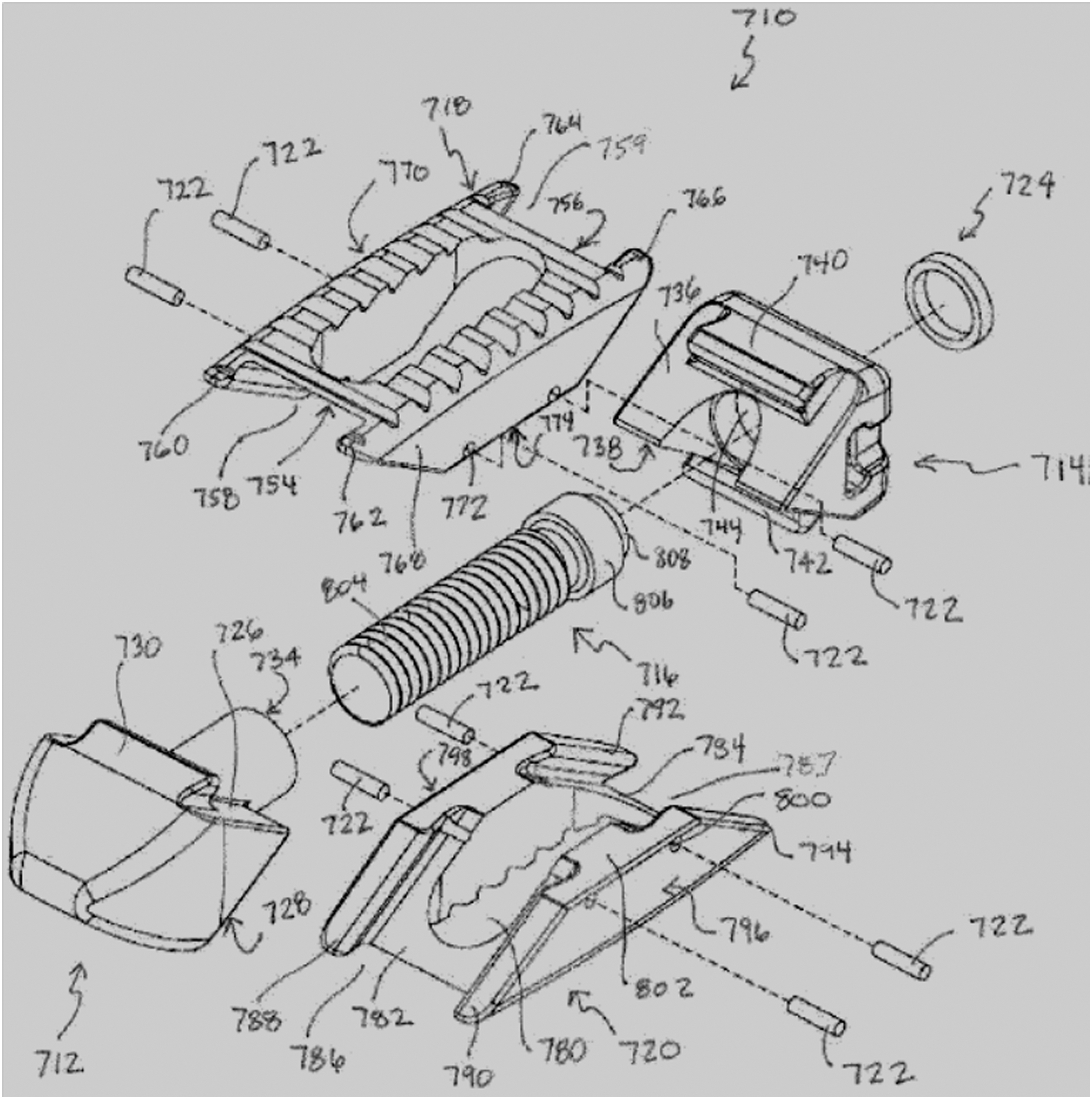
Figure 87 of U.S. Patent No. 9,801,733
Life Spine started to develop ProLift in late 2012. 34 Initially, Life Spine's engineers studied publicly-available information about expandable cages, such as online information, patents. 35 Several patents revealed that common features of those expandable cages include an upper endplate, lower endplate, base ramp, nose ramp, and cage-expanding screw. 36 As a result, Life Spine designed ProLift utilizing the same common features. 37
After learning the existing knowledge about expandable cages, Life Spine's engineers began a trial-and-error process of creating a device to meet performance standards required by the U.S. Food and Drug Administration (FDA). 38 When one design of the device failed in testing, they conducted a redesign to adjust the device's components and subcomponents. 39 Sometimes, the adjustment was mere fractions of millimeters. 40 The ultimate goal was to make those components interacting with one another well enough to enhance the quality of the device, such that FDA testing requirements would be met. 41
In November 2015, Life Spine filed with FDA an application for 510(k) approval for ProLift and listed two predicate devices designed by other companies. 42 In March 2016, FDA approved the 510(k) application of ProLift. 43
B. Aegis's misappropriation of Life Spine's trade secrets
In 2016, Aegis persuaded L&K to develop expandable cages to replace L&K's static cages that Aegis sold. 44 On October 16, 2017, L&K's chairman came to Aegis's Colorado office to discuss with Aegis's CEO about plans to develop an expandable cage. 45 Immediately, on October 17, Aegis's then Marketing Director, Alex Kang, contacted Mariusz Knap, Life Spine's Vice President of Marketing and Business Development, and requested an in-person meeting. 46 They met each other at a conference hosted by the North American Spine Society (NASS), where Alex Kang expressed Aegis's proposal of entering into a long-term relationship with Life Spine as a ProLift distributor. 47
After the meeting, Alex Kang requested Mariusz Knap to send him a ProLift device, so that Aegis's surgeon customers may examine the device. 48 Mariusz Knap responded that Aegis would have to sign Confidentiality and Loaner Agreements first before Life Spine would provide detailed information about ProLift. 49 The Confidentiality Agreement limited Aegis's use of Life Spine's confidential information to assisting a business relationship or transaction between two parties and barred Aegis from sharing the confidential information with third parties. 50 The Loaner Agreement forbade Aegis from disclosing ProLift to people who intend to reverse-engineer or replicate ProLift to create a competing product against Life Spine. 51
Alex Kang signed two agreements on behalf of Aegis, so Life Spine then provided Aegis with a ProLift set containing an expandable cage and an installer. 52 When Aegis was about to demonstrate ProLift to a surgeon, suspiciously Alex Kang asked Mariusz Knap not to participate in the demonstration. 53 Alex Kang further disregarded the obligations under those two agreements by inviting that surgeon to assist Aegis and L&K to develop an expandable cage, while the surgeon agreed to do so. 54
Formation of a distribution relationship with Life Spine
On January 25, 2018, Life Spine and Aegis signed a Distribution and Billing Agreement (DBA) permitting Aegis to sell ProLift to several surgeons including those surgeons who agreed to help Aegis and L&K to develop an expandable cage. 55 However, Aegis hid from Life Spine its plan to work with L&K to develop a competing expandable cage through assistance of some surgeons on the customer list. 56
The DBA contained provisions protecting Life Spine's proprietary interests in ProLift. 57 For instance, when ProLift products stayed in Aegis's inventory, Aegis would serve in a fiduciary capacity as a trustee of Life Spine's property rights in those products and maintain custody or control of each product. 58 Second, Aegis agreed to protect ProLift from being explored by itself or its employees or contractors through: (1) undercovering the ideas or design elements of ProLift, (2) creating derivative works based on ProLift, or (3) copying the design, knowledge, functionality, or otherwise of ProLift in any way. 59 Third, the DBA provided the definition of Life Spine's confidential information and the guidance of how Aegis would use the received confidential information to fulfill the obligations under the DBA. 60 Particularly, Aegis was required to acquire Life Spine's written consent before sharing the confidential information with any third party. 61
Shortly after the DBA became effective, Jack Lee, L&K's then R&D Director, left South Korea and took a position at Aegis's Colorado office as a R&D Director. 62 L&K promoted Sang-Soo Lee, a former co-worker of Jack Lee, to new R&D Director. 63 Jack Lee and Sang-Soo Lee started to prepare Aegis's kickoff meeting together. 64
Development of Aegis's expandable cages and installers
On March 17, 2018, Aegis held an “Expandable Cage Kickoff Meeting” focusing on how Aegis would develop expandable cages to compete against Life Spine. 65 The meeting lasted two days, while the participants included Aegis's employees and those surgeons recruited to assist development of expandable cages. 66 During the meeting, a ProLift set was presented to the surgeons who then examined it. 67 The surgeons also signed agreements under which they would consult with Aegis and L&K during the process of designing expandable cages. 68
Since Aegis and L&K began to design expandable cages, they had constantly received user feedback and suggestions from those surgeon contractors who performed surgical implantation of ProLift. 69 In fact, Jack Lee once asked L&K to modify the insertion shape and teeth angle of one previously designed expandable cage to incorporate features suggested by one surgeon contractor. 70 Ultimately, those surgeon contractors had contributed to the cage, instrumental set, and installer of L&K's AccelFix-XT. 71 Some surgeon contractors even earned their titles in the inventor list of Aegis's design patent applications. 72
In May and June of 2018, unbeknownst to Life Spine, Aegis sent two ProLift cages and one ProLift installer to L&K upon a request from Sang-Soo Lee, who wanted to see the real ProLift product. 73 Later, Sang-Soo Lee informed Jack Lee that L&K was copying the basic design of the ProLift installer to create an installer for L&K's expandable cages as well as ProLift cages. 74
In addition, Aegis tried to learn how Life Spine designed an installer. 75 Aegis asked Life Spine to customize an installer for Aegis's customers. 76 In response, Life Spine sent Alex Kang an email including a picture of and details about the customized installer. 77 While the information in the email was acknowledged by Alex Kang as Life Spine's confidential information, Alex Kang shared the information with Sang-Soo Lee. 78 Later, Alex Kang was transferred to L&K, but he continued to use his Aegis email to communicate with Life Spine and collect information concerning ProLift. 79 When emailing to Life Spine about ProLift, Alex Kang blind-copied Sang-Soo Lee. 80
Unauthorized acquisition of ProLift testing data
FDA requires an expandable cage submitted for clearance to go through two compression tests. 81 The first test, “[a] static shear compression test measures how much load the device can withstand on a one-time basis before breaking or deforming,” while the second one, “a dynamic shear compression test determines whether the device can withstand five million cycles of multiple load forces in repetition without breaking.” 82
To pass FDA testing requirements, Life Spine conducted compression tests on different ProLift specimens. 83 Although the test results were submitted to FDA, Life Spine considered the testing data as confidential information because neither it nor FDA had disclosed the data to the public. 84 As the district court identified, the economic value of the compression test data is that “[i]f a competitor were to access Life Spine's shear compression testing data, it would allow the competitor to short-cut the trial-and-error testing process by giving it a starting load number that it knows will satisfy the FDA.” 85
Although Life Spine had never disclosed ProLift's testing data to Aegis or L&K, Aegis and L&K somehow acquired the data. 86 On October 4, 2018, Aegis and L&K had a meeting, where the meeting materials for L&K's AccelFix-XT prototypes included a reference to the testing data for ProLift. 87 L&K also stored its “ProLift Data” on its computer system. 88
Red flag of the alleged misappropriation
Aegis's misappropriation started being revealed through some incidents. 89 In August 2019, Aegis informed Life Spine's manager, Jenn Jesse, that they received a box containing no ProLift cage, so they could not return that cage. 90 When Jenn Jesse asked Aegis to take a picture of the empty box, the returned photo showed a second anti-tamper sticker was affixed over the box's original anti-tamper sticker. 91 The photo indicated to Jenn Jesse that someone tried to hide the fact that the box had been opened. 92 Aegis also failed to return several ProLift installers that it possessed. 93
In September 2019, Life Spine attended the 2019 NASS convention and learned that Aegis was about to launch AccelFix-XT that directly competes with ProLift. 94 Finally, in the same month, Aegis brought AccelFix-XT to the market and stopped selling ProLift products. 95 Later, in October 2019, Life Spine filed this lawsuit against Aegis. 96
C. Alleged trade secrets
When the district court granted Life Spine's motion for a preliminary injunction, it acknowledged three distinct trade secrets as having been misappropriated: “(1) the combination, dimensions, and interconnectivity of the ProLift's components and subcomponents; (2) static shear compression testing data; and (3) information about how Life Spine prices the ProLift.” 97 On appeal, Life Spine focused its trade secrets on “the precise dimensions and measurements of the ProLift components and subcomponents and their interconnectivity.” 98
III. ANALYSIS OF LIFE SPINE, INC. V. AEGIS SPINE, INC.
A. Governing law
Under the Seventh Circuit's case law, “[t]o obtain a preliminary injunction, a plaintiff must show that it is likely to succeed on the merits, and that traditional legal remedies would be inadequate, such that it would suffer irreparable harm without the injunction.” 99 If the plaintiff satisfies these factors, a court will perform a balancing test that “weighs the harm of denying an injunction to the plaintiff against the harm to the defendant of granting one.” 100 However, the “balancing test is done on a sliding scale: ‘If the plaintiff is likely to win on the merits, the balance of harms need not weigh as heavily in his favor.’” 101 The test also requires courts to consider the public interest. 102
In addition, the Seventh Circuit reviews “a district court's decision to grant or deny a preliminary injunction for abuse of discretion[,] the court's legal conclusions de novo[,] and its factual findings for clear error.” 103 If legal or factual errors are found absent, the Seventh Circuit “afford[s] ‘great deference’ to the court's decision.” 104
On appeal, Aegis primarily questioned Life Spine's likelihood of success on the merits. 105 The Seventh Circuit's case law provides that “a plaintiff must demonstrate that its claim has some likelihood of success on the merits, not merely a better than negligible chance.” 106 While “a mere possibility of success is not enough[,]” 107 “[t]he precise showing necessary ‘depends on the facts of the case at hand because of [the] sliding scale approach.’” 108
B. Key issue
The key issue relevant to Life Spine's likelihood of success on the merits was “whether third parties can access those precise specifications without first signing confidentiality agreements.” 109 To resolve the issue, the Seventh Circuit in Life Spine pointed out several rules. 110
The Seventh Circuit started with a notion that “[i]nformation that is public knowledge or that is generally known in an industry cannot be a trade secret.” 111 Two examples were presented. 112 First, the Seventh Circuit opined that “a company may not publicly disclose information in a patent and then claim that the information is a trade secret[,]” as it previously held that “[p]ublication in a patent destroys the trade secret.” 113 Second, the Seventh Circuit stated that “a company may not publicly sell or display a product and then claim trade secret protection in information that is ‘readily ascertainable’ upon examination of the product.” 114
However, the Seventh Circuit clarified that “a limited disclosure does not destroy all trade secret protection in a product.” 115 Rather, the Seventh Circuit emphasized that “a company can maintain trade secret protection in the undisclosed aspects of a product, even if it has publicly disclosed other aspects of the same product.” 116 The Seventh Circuit noted that “[a] trade secret can even exist ‘in a combination of characteristics and components, each of which, by itself, is in the public domain,’ so long as their ‘unique combination’ has competitive value.” 117 Therefore, the Seventh Circuit reminded that “a company does not forfeit trade secret protection by publicly displaying or selling a product unless the trade secret is ‘readily ascertainable’ upon examination of the product.” 118
On appeal, Aegis argued that “the district court legally erred in concluding that information about the ProLift could remain a protected trade secret after Life Spine patented, displayed, and sold the device to hospitals and surgeons.” 119 In response, the Seventh Circuit reframed the issue as a factual question: “Did Life Spine publicly disclose its alleged trade secrets by patenting, displaying, and selling the ProLift?” 120 The Seventh Circuit held that Aegis failed to show that the district court clearly erred in concluding that the answer was no. 121
C. Holding I: patenting of ProLift
In determining whether the ’733 Patent destroyed the alleged trade secrets, the Seventh Circuit primarily relied on testimonies of Life Spine's engineers. 122 They explained that deriving the precise specifications from the ’733 Patent was difficult and that the ’733 Patent did not show detailed dimensions of ProLift's components or ways to connect or assemble those components. 123 They also expressed that the measurements of ProLift's dovetails required extreme precision of fractions of a millimeter and that the precise measurements could be learned only by first-hand observation and sophisticated measurement technology. 124
The Seventh Circuit also responded to Aegis's challenge to the testimonies of Life Spine's engineers. 125 Aegis focused on another Life Spine's expert testimony conceding that “some measurements of the ProLift are standard in the industry” and that “an engineer reading Life Spine's patent would have a good ‘starting point’ for ascertaining some of the other measurements.” 126 However, the Seventh Circuit found nothing in the expert testimony indicating that “Life Spine's patent materials disclose the exact dimensions and measurements of every ProLift component.” 127 The Seventh Circuit interpreted the expert testimony as at most supporting an undisputed fact that “the ProLift patent would be helpful to a company developing a competing product[.]” 128 Hence, the Seventh Circuit upheld “the district court's finding that Life Spine's patent did not disclose the precise specifications of the ProLift.” 129
D. Holding II: displays and sales of ProLift
In holding that Aegis could not “show that the district court clearly erred in finding that Life Spine's displays and sales did not disclose the precise specifications of the ProLift[,]” the Seventh Circuit started with two undisputed facts: (1) “those who attend ProLift displays do not have unfettered access to the device;” and (2) “Life Spine supervises them as they handle the device, much like a jeweler supervises someone trying on a watch.” 130
Secondly, the Seventh Circuit acknowledged that “the only purchasers of the ProLift are hospitals and surgeons, who purchase the device for use in scheduled surgeries[,]” so it focused on the testimony of one Life Spine's sales representative explaining how a ProLift product was handled by Life Spine and its distributors from shipment to use in surgery. 131
The Seventh Circuit agreed that “[t]he evidence showed that Life Spine takes many precautions to safeguard the device prior to surgery.” 132 For instance, a ProLift product was put in a sealed box affixed with anti-tamper stickers during shipment, and the box remained sealed until surgery. 133 In addition, Life Spine's distributors were required to act as fiduciaries for Life Spine's property when they stored and delivered ProLift products. 134 That is, these distributors would oversee a ProLift product until its arrival at a hospital and inspect the product before and during surgery. 135 They even had to stay in an operation room for surgeons or their assistants when the latter needed consultations regarding use of a ProLift product. 136 Finally, they documented surgery and checked whether the surgery went as planned. 137
To counter the district court's finding that the precise specifications of ProLift were not disclosed publicly, Aegis argued that surgeons or patients were not bound to confidentiality agreements as the distributors did and might reverse-engineer ProLift. 138 But, the Seventh Circuit held that the argument was speculative and unacceptable. 139
The Seventh Circuit doubted that “hospitals or surgeons purchasing [ProLift] for use in planned surgeries would secretly unpackage the device, measure all its components with specialized measurement technology, reassemble the device, and then use the device in the surgery.” 140 The Seventh Circuit also opined that “[i]t seems even more unlikely that a device would be removed from a patient's body and then reverse engineered.” 141 Most importantly, the Seventh Circuit criticized that “Aegis has not identified any evidence that supports these unfounded scenarios.” 142 Thus, the Seventh Circuit concluded that “[t]he district court was not obligated to credit Aegis's speculative and factually unsupported hypotheses.” 143
Furthermore, in affirming that “the owner of a trade secret need only take ‘reasonable measures' to preserve secrecy[,]” the Seventh Circuit clarified that although the owner “does not take every conceivable measure[,] it is not required to do so.” 144 Therefore, the Seventh Circuit concluded that “[t]he district court's factual finding that the precise specifications of the ProLift are trade secrets has substantial evidentiary support and does not approach clear error.” 145
IV. TRADE SECRET PROTECTION ON PUBLICLY-SOLD, PATENTED PRODUCTS
A. Product patenting concern
Notably in Life Spine, ProLift's precise specifications were found not revealed in “marketing materials, which include only ‘rounded approximations' of the components[,]” and “patent materials, which disclose the components and their interaction but not their precise measurements or dimensions.” 146 Therefore, to gain trade secret protection on precise dimensions and measurements of an implant's components and subcomponents and their interconnectivity, a patent covering that implant must not show or imply those precise dimensions and measurements. 147
In addition, Life Spine reaffirms a notion that patented technology may enjoy trade secret protection. 148 For instance, the Fifth Circuit in Tewari De-Ox Sys., Inc. v. Mountain States/Rosen, L.L.C. has indicated that a published patent application disclosing an oxygen scavenger may not foreclose trade secret protection on the information of using the oxygen scavenger in combination with other publicly-disclosed components. 149
In Tewari, the alleged trade secrets involved a meat-packing method that provides a storage atmosphere of zero parts-per-million (ppm) oxygen. 150 The plaintiff specified five trade secrets: “(1) a tri-gas mixture in combination with the [plaintiff's] zero-oxygen process published in 2004; (2) an oxygen scavenger disclosed in a 2006 patent application with the ability to quickly operate in certain environmental conditions; (3) the combination of trade secrets 1 and 2; (4) the knowledge of how to adopt the previously disclosed [the plaintiff's] process to an open-nozzle system, including knowledge of ideal initial-oxygen levels (and how to achieve them) and best practices for monitoring oxygen levels; and (5) knowledge of the importance of the foam tray on which the meat is placed in retail packaging for oxygen levels.” 151 The district court granted the defendant's motion for summary judgment on trade secret misappropriation because the elements of the plaintiff's trade secrets were either disclosed in its patent applications or known in the industry. 152
In disagreeing with the district court, the Fifth Circuit characterized the alleged trade secrets as “unique combinations of disclosed technologies or processes.” 153 The Fifth Circuit noted that it has “specifically rejected the contention that a combination of disclosed technologies cannot itself constitute a trade secret.” 154 In addition, the Fifth Circuit opined that “[i]n many cases, the question of whether certain information constitutes a trade secret ordinarily is best ‘resolved by a fact finder after full presentation of evidence from each side.’” 155 Thus, the Fifth Circuit set aside the district court's summary judgment. 156
In Life Spine, as the district court found, “to receive clearance from the FDA to sell an expandable cage, the applicant company must meet the FDA's rigorous testing requirements for both static shear and dynamic shear compression.” 157 Through multiple redesigns by mere fractions of millimeters, ProLift's components and subcomponents would be well interacted with one another, so as to satisfy FDA's testing requirements. 158 The perfect interconnectivity of ProLift's components or subcomponents means that these components or subcomponents can be well combined together.
Thus, “the precise dimensions and measurements of the ProLift components and subcomponents and their interconnectivity” in Life Spine are similar to “unique combinations of disclosed technologies or processes” in Tewari. In offering trade secret protection on “the precise dimensions and measurements of the ProLift components and subcomponents and their interconnectivity,” the Seventh Circuit in fact sides with the Fifth Circuit to acknowledge that an undisclosed combination of patented or publicly-disclosed elements may enjoy trade secret protection.
B. Customer service concern
Life Spine is important to medical implant companies because the decision recognizes several reasonable measures to protect information related to precise dimensions and measurements of an implant's components and subcomponents and their interconnectivity. The protective measures involve customer services before and after purchase of an implant.
Where a customer considers whether to order an implant product or places an order to purchase it, based on both the Seventh Circuit's and district court's decisions in Life Spine, practical guidance for protecting product specification as a trade secret includes:
The product specification can be discovered only through “unfettered access to both the [implant product] and specialized measurement equipment.”
159
Before any customer is allowed “to have prolonged or unsupervised access to the [implant product]” and provided “with detailed information about the [implant product],” that customer is required “to sign a confidentiality agreement.”
160
When the implant product is displayed at industry conventions, a customer is allowed “to hold or interact with the [implant product] only while being supervised by [the company's] employee.”
161
Marketing materials cannot reveal the precise dimensions of the implant product's components and subcomponents to any customer.
162
A member of the public cannot buy the implant product at a store or pharmacy; rather the implant product is sold to hospitals or surgeons through the company's distributors.
163
A customer must intend to use the implant product in scheduled surgery.
164
Distributors “are subject to confidentiality restrictions and that maintain oversight responsibilities for the [implant product] prior to its use in surgery.”
165
Distribution of implant products is done through a sealed box affixed with anti-tamper stickers.
166
Use in surgery ends up with the implant product being implanted inside a human body by surgeons.
167
V. CONCLUSION
Life Spine reaffirms a notion that patented technology can enjoy trade secret protection. Under Life Spine, while a medical implant comprised of multiple components and subcomponents has been disclosed in a patent through an exploded-view drawing, the precise dimensions and measurements of the components and subcomponents and their interconnectivity can be protectable as trade secrets.
Life Spine teaches reasonable measures to protect the precise dimensions and measurements of an implant's components and subcomponents as trade secrets. First, a patent covering such an implant must not reveal what can help measure precise dimensions of those components or subcomponents. Second, public displays of an implant product must be done by limiting a visitor's ability to observe the product. Third, an implant product is distributed through non-public channels and sold directly to surgeons or hospitals. Lastly, delivery and surgical use of an implant product must be monitored without giving others who have no confidentiality duties a chance to examine the implant product.