




Abstract
Biotech innovations’ patenting procedure in India encounters substantial procedural obstacles. This article provides a wide spectrum analysis of critical factors affecting the patent application process, specifically addressing subject matter eligibility, innovative steps, adequacy of disclosure, and delays in examination and backlog. These problems significantly impact the biotechnology business and startups, resulting in commercialization market delays, reduced competitiveness, and restricted research and development (R&D) efforts. This research highlights the need for action from stakeholders, policymakers, legislators, and the biotechnology community while offering solutions via case studies and analytical insights. Legislative amendments, adopting global best practices, improvements to the examination procedure, backlog reduction strategies, and more stakeholder involvement are among the suggestions. These procedural hindrances must be resolved in order to develop a vibrant and competitive biotechnology industry in India, promote more R&D activity, boost economic development, and successfully tackle global problems.
I. INTRODUCTION
Biotechnology vinnovations are expanding various sectors like healthcare, agriculture, and environmental sustainability. They address important global challenges and can contribute to human welfare and sustainable development. 1 In biotechnology, patents are key factors enabling inventors to protect their efforts, attract investment, and facilitate commercialization. 2 Patents provide safeguards for biotechnological innovations, ranging from genetically modified organisms (GMOs) and novel genes to bioprocessing techniques and diagnostic instruments. Due to patent protection, investors who may otherwise be hesitant to invest will do so, which helps institutions that uphold trust thrive economically. Benefits of this development include economic growth, job creation, and further scientific advancement. 3
Effective patent databases strengthen research knowledge sharing and collaboration, facilitating systematic biotechnological innovation. 4 One of the fundamental needs for turning potential scientific discoveries into marketable products is patent protection, as it gives inventors and firms legal surety that they will profit from their inventions, thus encouraging investment in developing commercially valuable biotechnology products. 5 Besides speeding up economic development, this also aligns innovation processes with societal needs, raising the overall quality of life. 6
Patent rights also contribute significantly to technology transfer, encouraging interactions between academia, research institutions, and industry, thus accelerating the deployment of new inventions in the market. 7 Patent protection drives the competitive landscape of biotechnology, rewarding inventors and organizations for commercial success through new discoveries. 8 Patents also assist in creating an exclusive space for biotechnological discovery and inventions, further catalyzing development and innovation. 9 Additionally, patent enforcement mechanisms protect against unauthorized use of inventions, fostering innovation and competition in biotechnology. 10
II. PATENT SYSTEM FOR ATTRACTING RESEARCH AND DEVELOPMENT IN THE BIOTECHNOLOGICAL SECTOR
An effective patent system is crucial for the biotechnology sector. The essential component for attracting both local and foreign investors, it guarantees strong protection for intellectual property. It provides legal protection by exclusive rights to inventors, which boosts trust and confidence in supporting innovation processes. 11 This protection encourages both researchers and firms to invest resources, expertise, and efforts into developing new technologies, as their intellectual property will be legally recognized and protected from unauthorized use. 12
Patents incentivize innovators by securing exclusive rights, hence providing a competitive edge in the innovation environment. Patents’ exclusivity provides innovators with an optimal return on investment, making them confident to take risks and explore discoveries. As a result, patents foster an environment conducive to ongoing technological innovation and scientific progress, benefitting society as a whole. 13
An effective patent system promotes increased investment by offering concrete, monetizable assets. Patents provide market exclusivity, enhancing the appeal of research and development (R&D) endeavors to both local and foreign investors, ensuring improved returns. Investors often support initiatives with legally protected inventions and maximize profit. This infusion of capital fosters economic expansion, employment generation, and more R&D initiatives.
Patents help universities, research organizations, and companies collaborate on research and transfer knowledge. A formal legal framework for licensing contracts on patents facilitates the sharing of information, expertise, and inventions between organizations. This collaboration accelerates the development of new products and services, fostering creativity and innovation-driven business transformation. 14 This supportive environment provides strength to the R&D ecosystem and drives sustained growth in biotechnology.
Economic development and improving a nation’s competitiveness are highly dependent on a strong patent system. Patents provide legal safeguards for novel ideas by conferring exclusive rights, enabling corporations to achieve market dominance and draw consumers. This conducive climate for innovation promotes more R&D initiatives, attracts proficient people, and stimulates new investments. Consequently, the biotechnology industry continues in its expansion and enhances its worldwide competitiveness.
III. OVERVIEW OF THE INDIAN PATENT SYSTEM AND ITS RELEVANCE TO BIOTECHNOLOGICAL INVENTIONS
The Indian patent system is instrumental in fostering an environment conducive to innovation and safeguarding intellectual property within the biotech sector. Being among the rapidly developing economies and a major player in biotechnology, India recognizes that stringent protection of patents is important to inspire R&D, stimulate investment, and further technological advancement. 15 The Indian Patent Office (IPO) is responsible for administering the country’s patent system, which is governed by the Patents Act of 1970. It is a “first-to-file” scheme, meaning that the first applicant would have all exclusive rights. In India, patent protection lasts for 20 years beyond the date of filing, giving innovators enough time to use and profit from their biotechnological innovations. The system covers inventiveness in various biotechnological inventions, comprising GMOs, gene sequences, bioprocesses, diagnostics, and pharmaceuticals. 16
To secure patent protection in India, biotechnological innovations must adhere to a few well-defined criteria: novelty, utility, nonobviousness, and industrial applicability. 17 For an invention to be considered novel, it needs to be original and not already in the public domain, which is determined through a thorough search of prior work or “prior art.” 18 The utility criterion demands that the invention offers practical benefits, such as therapeutic, diagnostic, or industrial applications. 19 When evaluating nonobviousness, the focus is on whether the innovation demonstrates a significant creative leap, rather than an expected development for experts in the field. 20 Last, the requirement of industrial applicability implies that the invention must be capable of being produced or used effectively in sectors like agriculture, healthcare, or manufacturing. 21
However, as stated in Section 3 of the Patents Act, some restrictions limit patent protection for biotechnological advances even with wide eligibility. This section excludes inventions that conflict with public order or morality, those derived from traditional knowledge, discoveries of natural principles, agricultural processes, and therapeutic methods intended for humans or animals. 22 The principle of compulsory licensing permits others to manufacture or market a patented product without the original patentee’s approval if the product is not easily accessible to the public or does not satisfy demand. This provision ensures a balance between protecting intellectual property and making crucial biotechnological innovations accessible. 23
IV. MAJOR PROCEDURAL ISSUES IN PATENTING BIOTECHNOLOGICAL INVENTIONS IN INDIA
The biotechnology sector in India has experienced notable growth; however, the patenting environment for biotechnological innovations continues to encounter various procedural hurdles. The challenges encompass issues related to subject matter eligibility, inventive step requirements, sufficiency of disclosure, examination delays, and backlogs.
Subject matter eligibility (SME) is crucial in assessing whether a biotechnological discovery is eligible for patent protection. Innovations including genes, proteins, GMOs, and bioprocesses often encounter challenges in fulfilling these requirements. The interpretation of Section 3(b) of the Indian Patents Act, which limits patentability to exclude simple discoveries, scientific concepts, and biological processes, often results in problems. In biotechnology, the line between a mere discovery and a creative application is especially blurred, as the discovery of new genetic sequences or biological phenomena can be fundamental to further innovation. 24 This restrictive approach can deter investment in high-risk R&D ventures, potentially slowing down the development of cutting-edge technologies 25 (Fig. 1).
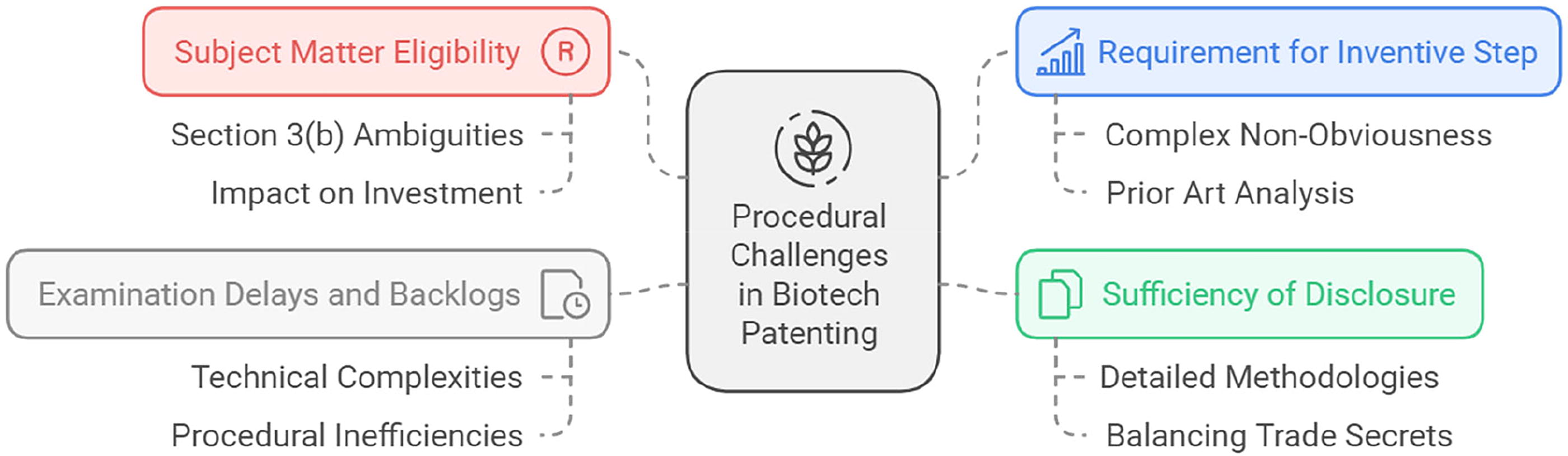
Major procedural issues in patenting biotechnological inventions in India.
The requirement for an inventive step guarantees that patents are awarded only for breakthroughs that provide substantial improvements or creative resolutions to technical issues. In the swiftly advancing and interdisciplinary domain of biotechnology, assessing nonobviousness becomes notably intricate. Assessing whether a biotechnological innovation involves an inventive step requires an in-depth analysis of prior art, the knowledge level of skilled professionals, and the specific technical problem the invention seeks to address. 26 Due to biotechnology’s dynamic nature, what constitutes a nonobvious improvement can be difficult to ascertain, especially with the continual emergence of scientific breakthroughs. 27
The sufficiency of disclosure criteria is essential for ensuring that patent papers include sufficient information for a trained expert to copy the invention without excessive experimentation. Biotechnological patents, often including intricate procedures, genetic sequences, and bioprocesses, need explicit elucidations, well-delineated techniques, and thorough experimental data. Inadequate disclosure may result in objections, limited protection scopes, or potential patent invalidation. Balancing detailed disclosure with the protection of trade secrets is essential for enabling reproducibility while safeguarding intellectual property. 28 Inadequate disclosure can affect the validity of patents, the extent of protection, and enforcement efforts, thereby posing significant challenges for patentees. 29
Delays and backlogs in examinations remain significant obstacles in India’s patent system, impeding the prompt protection and commercialization of biotechnological innovations. The delays stem from the intrinsic technological complexity of biotechnology applications, administrative inefficiencies, and constrained resources within patent offices. Since complex biotech patents often require specialized expertise, the examination process can be lengthy. 30 The existing backlog of pending applications further compounds these delays, affecting the competitiveness of firms, their market exclusivity, and their ability to attract investors. 31
V. IMPACT OF DELAY IN ASSESSMENT AND BACKLOG ON THE BIOTECHNOLOGY INDUSTRY
The procedural obstacles in patenting biotechnological innovations in India affect not just individual applications but also the whole biotech sector. These constraints induce delays, limit market access, deter investments, and impede knowledge transfer, eventually obstructing the sector’s development and competitiveness. Addressing these procedural challenges is essential for the establishment of a strong biotechnology sector in India (Fig. 2).

Impact of delay in assessment and backlog on the biotechnology industry.
An important problem arises from the backlog of outstanding patent applications, which might impede the commercialization and competitiveness of biotechnological inventions. Prolonged evaluation periods hinder the commercial launch of biotech goods, reducing the opportunity for inventors and corporations to monetize their ideas. During this time, competitors might launch similar products, reducing the market share and diminishing the competitive advantage of the original invention. 32 Long-term delays in patent applications may also deter partners and investors, who often assess the strength and enforceability of patents before allocating funds.
The existence of patent backlogs further influences the dynamics of market exclusivity. Patents grant inventors and companies limited exclusivity, enabling them to recoup R&D expenditures while securing a competitive edge in the marketplace. However, delayed examinations shorten this period of exclusivity, limiting the potential for commercial gains. 33 Without timely and enforceable patents, biotechnological innovations become susceptible to infringement, as competitors can exploit these ideas without legal repercussions, potentially deterring further investments in development and commercialization. 34 Furthermore, slow patent processing hurts global competitiveness: nations with quicker patent processes may get market access sooner, which gives their inventions a competitive advantage in worldwide marketplaces. In contrast, Indian innovators facing delays may struggle to maintain their competitive position globally. 35
The patenting process is made more difficult by stringent requirements for SME and adequate disclosure, which raise doubts among investors and inventors alike. Limited patent protection may cause inventors and companies to be hesitant about investing in or commercializing new technologies, thereby restraining the sector’s overall growth. 36 Extended patent evaluations may deter R&D, since inventors may hesitate to reveal their innovations without immediate certainty of protection. This reduction in R&D efforts can hinder the progress of significant discoveries and limit the sector’s potential for growth. 37
These procedural impediments impact the sector’s appeal to both local and foreign investors, who desire robust intellectual property protection to guarantee their investments. Delays, uncertainties, and limited protection can discourage investors from committing funds, which reduces the financial resources available for R&D and slows the development of new products and therapies. 38 Furthermore, technological transfer and partnerships between academic institutions, research centers, and businesses are impeded by procedural issues. Patent protection ambiguities may hinder knowledge transfer and licensing, two processes essential to converting scientific discoveries into commercially viable goods. A lack of cooperation and limited intellectual property utilization can restrict the growth of the biotech sector. 39
In a competitive global environment, prompt and efficient patent protection is essential for Indian biotechnology companies. Delays, strict eligibility criteria, and disclosure requirements may restrict the international competitiveness of innovations originating from India. Factors like delayed market entry, reduced market exclusivity, and higher risks of infringement can negatively affect market share, export potential, and the ability to establish international collaborations. 40 Enhancing the efficiency of the patent system is crucial for advancing the global standing of Indian biotechnology.
VI. CASE STUDIES HIGHLIGHTING INSTANCES WHERE PATENTING CHALLENGES AFFECTED INNOVATION AND INVESTMENTS
Several prominent case studies show that innovation and investments have been hit hard by the difficulties of biotechnology patenting in India. Both innovation and public health outcomes have been impacted by the biotechnology industry, which has been shaped by stringent patent rules, access obstacles, and legal disputes, as these incidents demonstrate.
A. Myriad genetics and the BRCA gene patents
The difficulties of strict patent protection are shown by the example of Myriad Genetics, which had patents on the BRCA1 and BRCA2 genes associated with an increased risk of ovarian and breast cancers. Access for vital genetic tests was restricted by a patent that granted exclusive authority over diagnostic testing for certain genes to Myriad. This limitation focuses on concerns about treatment accessibility, excessive expenses, and obstacles to further development and research in the area. The monopolistic characteristics of gene patents diminished competition, hindered innovation, and curtailed cooperation, hence impeding the development of alternative testing methodologies and prospective therapies. A pivotal U.S. Supreme Court decision deemed naturally occurring DNA sequences unpatentable. This case highlights the risks of excessively restrictive patents, which can negatively affect innovation, patient access, and investments in a field like biotechnology. 41
B. Bayer’s Nexavar patent controversy
The interaction between patent protection and public health is best shown by Bayer’s patent on Nexavar (Sorafenib), a medicine used for the treatment of liver and kidney cancer. Bayer’s patent application was refused by the IPO, which based its ruling on the drug’s excessive price and restricted availability. This rejection made it possible for generic producers to create and market less expensive Nexavar drug, expanding access and availability for a larger patient population. The ruling ignited much discourse over the equilibrium between patent rights and public health, highlighting the possible consequences of elevated drug costs on patient access to vital medicines. While Bayer faced financial setbacks due to lost exclusivity, the ruling fostered competition, reduced drug prices, and improved access to life-saving treatments, demonstrating how patent standard regulations can influence both healthcare outcomes and investment dynamics. 42
C. The BT cotton patent dispute in India
Another example from the field of agriculture of the difficulties in patenting GMOs is the patenting of Monsanto’s genetically engineered BT cotton. A gene from Bacillus thuringiensis was used to modify BT cotton, which synthesizes a toxin that deters pests and increases crop yield production. At first, Monsanto’s BT cotton patent raised questions over Indian farmers’ access to and the price of seeds. Subsequent legal disputes, public dissent, and governmental interventions occurred, culminating in license agreements that permitted Indian seed corporations to manufacture and distribute BT cotton seeds. This heightened adoption among farmers markedly enhanced agricultural yield. The case demonstrates how patenting issues can influence innovation, farmers’ livelihoods, and access to biotechnology in agriculture, highlighting the need for a balanced approach that promotes innovation while considering socioeconomic factors. 43
VII. COMPARATIVE ANALYSIS OF INDIAN PATENT PROCEDURES WITH OTHER JURISDICTIONS
Comparing India’s biotechnological innovation patenting procedures to those in other countries provides important information on how to improve procedural efficiency. Potential improvements to increase the efficacy of the Indian patent system may be found by studying how other nations address patenting issues.
Analyzing and understanding patent examination durations of the different nations might elucidate elements that facilitate expedited processing. Countries with abbreviated testing periods often use optimized resource allocation, specialized examination units, or simplified processes to improve efficiency. Sector-specific examiners who focus on biotechnology and other related fields make sure that professionals evaluate and scrutinize complicated patent applications. Adopting such practices could help nations like India reduce examination delays, leading to more timely legal protection and commercialization of biotech innovations. 44
Various countries employ different strategies to tackle patent backlogs, which may provide comprehensive insights and understanding for addressing India’s backlog issues and challenges. Many jurisdictions employ accelerated examination procedures and prioritization systems or allocate additional resources to accelerate processing for particular categories of innovations. In other countries, fast-tracking applications pertaining to vital sectors like healthcare or agriculture have worked well. Evaluating the effectiveness, feasibility, and adaptation of such strategies within the Indian context can provide practical measures to expedite the patenting process for biotechnological innovations. 45
Delays in India’s patent system could be reduced by adapting international norms. Harmonization requires understanding and precisely determining how India differs from other countries in terms of patentability standards, examination protocols, and disclosure obligations. India upholds strict standards under Section 3(b) of the Patents Act, whereas other nations might take a more flexible approach, particularly in relation to biotechnology and naturally occurring substances. Harmonization with global standards could lead to a smoother patent process, simplify requirements and compliance for applicants, and encourage international collaboration, ultimately boosting overall efficiency. 46
Patent processing has become more efficient in many jurisdictions because of the use of technology and automation. Improved speed and accuracy of prior art searches, automated document management, and decision assistance are all benefits of using artificial intelligence (AI), machine learning (ML), and big data analytics in patent inspections. The implementation of AI-driven tools in India has the potential to enhance both speed and accuracy by streamlining examination workflows and reducing manual errors. For example, AI-powered systems could help examiners quickly identify relevant prior art, allowing more time for thorough evaluation of biotechnological innovations. 47
The quality and efficacy of patent examinations are significantly influenced by the expertise of patent examiners. In order to improve the capabilities of examiners, particularly in specialized disciplines such as biotechnology, other nations have implemented capacity-building initiatives. Analyzing these activities may help direct comparable projects in India. Partnerships with World Intellectual Property Organization (WIPO), international patent offices, or other groups may promote training and information sharing, enhancing the quality of examinations. Enhancing examiner expertise in biotechnology through continuous training and exposure to international best practices can make the examination process more rigorous and efficient. 48
VIII. RECOMMENDATIONS FOR IMPROVEMENT
India can learn from international best practices and implement strategies that improve the efficacy of its patent system to effectively address procedural issues and challenges in patenting biotechnological innovations. This approach would be beneficial in managing backlogs, aligning with global standards, leveraging technology, enhancing capacity-building, and encouraging stakeholder engagement, thereby promoting innovation and facilitating the timely protection and commercialization of biotech inventions.
The following are important recommendations for enhancing the procedures involved in patenting biotechnological innovations in India:
Clarity and guidance: Develop precise and comprehensive guidelines specific to the field of biotechnological inventions, which must address essential criteria, including SME, adequacy of disclosure, and inventive steps. This will reduce uncertainties, improve candidates’ comprehension, and enable a more efficient examination procedure by giving clear instructions. Specialized patent examiners: Create a body of knowledgeable patent examiners who are dedicated to the field of biotechnology. Examiners must possess a thorough understanding and expertise in regard to the intricate scientific and technical aspects of biotech innovations to enable precise and comprehensive evaluations of novelty, inventive steps, and industrial applicability. Collaboration and training: Promote collaboration and cooperation between scientific biotechnology subject specialists and patent examiners. This will facilitate the exchange of knowledge and ensure that examiners are informed about the most recent developments by conducting workshops, training programs, and seminars. These endeavors will enhance the quality of examinations and foster consistency in decision-making. Streamlined patent prosecution: Implement an effective methodological framework to speed up patent processing, decreasing delays and backlogs. Use the latest and most advanced technology, such as electronic file systems and digital databases, to enhance communication between applicants and examiners. Establish time-sensitive examination objectives and reduce administrative obstacles to speed up the patent-granting process. Enhanced patent awareness: Educate and spread awareness among biotech companies, entrepreneurs, and researchers on the patent system. Educate people about the advantages of patent protection, the application procedure, and effective application writing techniques. Through equipping inventors with this knowledge, protection of innovations will be promoted, and R&D activities will be stimulated. International cooperation: Encourage the exchange of information and collaboration with global patent offices among related stakeholders in order to standardize patent criteria and harmonize examination procedures. This collaboration and information exchange may facilitate the identification of effective methods, mitigate discrepancies, and assure adherence to international standards. Periodic review of patent laws: Consistently review, assess, and revise patent laws to tackle the distinct challenges created by advancements in biotechnology. Regular updates will ensure that the legal framework stays in accordance with dynamic technical advancements and global changes. Stakeholder engagement: Keep in touch and interact with associated parties, such as patient advocacy organizations, biotech businesses, research institutes, and legal professionals. Their practical experience and comments will provide insights into the patenting process and possible enhancements, guaranteeing that many viewpoints are taken into account in the formulation of patent policy.
IX. POLICY SUGGESTIONS TO ADDRESS PROCEDURAL ISSUES AND ACHIEVE INTERNATIONAL HARMONIZATION IN BIOTECHNOLOGICAL PATENTING IN INDIA
The following policy suggestions are ways forward in an effort to address the procedural difficulties associated with patenting biotechnological innovations:
Public–private partnerships: Encourage and support public–private partnerships to improve collaboration, research, and innovation in the field of biotechnology. Thereby promoting sector development, improving patenting capacities, and easing information interchange. Patent awareness and support: Implement awareness programs to increase knowledge about patent protection among SMEs, startups, and biotech researchers. Provide specialized modules to support systems to aid inventors in directing the patenting process, such as assistance programs or patent clinics. This assistance should encompass the writing of patent applications, prior art searches, and guidance throughout the examination process. Clarify SME: Establish systematic and precise criteria for identifying SME pertaining to biotechnological inventions. Offer clear interpretations of Section 3(b) of the Indian Patents Act to resolve ambiguity. Ensure clarity in these standards will make them easier to understand and increase applicants’ and examiners’ confidence in the patentability of biotech ideas. Expedite the examination process: Speed up the patent application review process by implementing potential strategies to expedite biotechnology patents. Establish achievable timelines and objectives for examinations, emphasizing the enhancement of processing efficiency in biotechnology applications. Increase the number of effective examiners, using advanced technology to expedite examinations, and streamlining administrative processes are all good strategies. Training and skill development: Focus and invest in capacity-building programs to improve the capabilities and knowledge of patent examiners in the field of biotechnology. Facilitate specialized training sessions with industry experts and promote a culture of constant learning, ensuring examiners are up to date with the newest innovations. Leverage technology and automation: Employ advanced state-of-the-art technologies to enhance examination processes. Integrate artificial intelligence and machine learning to improve the efficiency of prior art searches, automate document management, and enhance data analysis capabilities. Utilizing technology will expedite the testing process and enhance the quality of evaluations and evidence-based fast and effective decision-making. Prioritization of critical applications: Create dedicated prioritization plans to expedite the evaluation of patents pertaining to important technologies or start-up businesses. Establish specialized examination units for evolving technological fields such as biotechnology to facilitate specialized, targeted, and efficient evaluations by experts. Collaborative examination: Study cooperative examination programs with both domestic and foreign patent offices. This strategy minimizes effort duplication, leverages cross-office experience, and permits job sharing. Collaborative examination efforts will speed up the patent-granting process and contribute to decreasing backlogs. Streamlined administrative procedures: Make the patent office’s internal administrative processes simpler, uniform, and effective. Recognize and rectify obstacles in the administrative and examination process to prevent superfluous delays and obstacles. Enhancing processes will enhance overall efficiency and reduce backlogs. Enhanced stakeholder engagement: Encourage effective cooperation between the patent office and interested parties, such as universities, research centers, business associations, and innovators. Incorporate systematic mechanisms for regular interval interaction, feedback, and consultation to resolve concerns, clarify requirements, and guarantee a transparent application process. Performance monitoring and evaluation: Create a strong data-driven management and monitoring system to evaluate the effectiveness and productivity of patent office employees. Consistent monitoring of key performance metrics, including processing durations and backlog mitigation, will facilitate the identification of improvement opportunities and assure accountability. Standardization of patent regulations: India’s patent regulations are consistent and uniform with internationally recognized standards, including those established by the European Patent Office (EPO) and the United States Patent and Trademark Office (USPTO). Harmonizing patentability criteria such as SME, inventive step, and adequacy of disclosure will further enhance uniformity and openness in evaluations, making India’s patent system more attractive to international stakeholders. Implementation of International Patent Classification (IPC): To standardize the classification of biotechnological innovations, use the IPC methodology and framework. IPC offers a homogeneous structure for classifying innovations, making searches and assessments more effective and efficient. Thus, India’s integration with global patenting systems will be improved by the increased accessibility of patent applications for examination and the improvement of international collaboration through the use of IPC. Integration of examination results from major patent offices: Review and logically consider the findings of examinations from reputable patent offices, such as the USPTO and EPO, in the patent examination procedure in India. This approach to work sharing utilizes the expertise and findings from various offices, minimizing duplication, expediting the examination process, and ensuring uniform assessments.
X. CONCLUSION
In conclusion, the patenting of biotechnological inventions in India encounters substantial procedural obstacles that hinder innovation, investment, and development in the biotechnology field industry. SME, an inventive step, adequate disclosure, examination delays, and a persistent backlog of applications are some of the main issues and challenges. These problems lead to declined competitiveness both nationally and globally, decreased enthusiasm for R&D efforts, and delays in the market entrance of technologies.
Legislators, stakeholders, and the biotech industry must take the initiative to resolve these problems. For the patentability requirements to be consistently and openly interpreted, there must be legislative improvements and clearer standards. Alignment of India’s patent system with global standards and practices, which can be achieved by holistic standardizing regulations and adopting best practices, can enhance its efficacy and effectiveness.
Patent examination process enhancements like resource allocation, specialized training modules for examiners, state-of-the-art technological integration, and collaborative examination activities may mitigate backlogs and enhance the efficiency and quality of patent evaluations. An effective patent framework will be strengthened by administrative processes, actively involving stakeholders, and strong performance assessment mechanisms, which will encourage innovation and support R&D initiatives.
Symbiotic collaboration and knowledge sharing among domestic and international patent offices, along with active participation in policy discussions, are crucial for the development of a patent system that addresses the specific needs of Indian biotechnological innovations. Implementing these methods and practices will result in optimizing the patenting process, allowing faster and wider market access for biotech advances, attracting investment, and increasing the sector’s global competitiveness.
To encourage R&D in the biotech field, a robust and holistic patent system is required. Intellectual property is protected legally, which encourages the creation of innovative solutions, discovery, and technology. This in turn promotes technology interchange, draws in investment, and boosts economic expansion and worldwide competitiveness. Countries may guarantee long-term economic growth, social advantages, and continued technical advancement by fostering an innovative patent system.
Footnotes
Acknowledgments
The authors are thankful to the Faculty of Science, Marwadi University, for providing the necessary encouragement and support to carry out this review. The authors are also thankful to Dr. Sandrine Ammann from Patentscope (WIPO) for providing the necessary training on Patentscope.
AUTHORS’ CONTRIBUTIONS
R.M.: Writing—original draft. V.B.M.: Review and editing and final draft. At the last, both authors have reviewed and approved the draft.
AUTHOR DISCLOSURE STATEMENT
The authors declare that they do not have any conflicts of interest or nonfinancial interests to disclose.
FUNDING INFORMATION
No funding was received for this article.
1
P.S. Menell, Intellectual Property: General Theories, in Encyclopedia of Law and Economics 129 (1999).

3
I.P. Hartwell, Patent Portfolio Structure for Single Technology Companies, SSRN (2004).
4
5
6
7
8
K. Maskus, Differentiated Intellectual Property Regimes for Environmental and Climate Technologies, SSRN (2010)
9
M. Feldman & I. Stewart, Knowledge Transfer and Innovation: A Review of the Policy-Relevant Literature, Ont. Ministry of Research & Innovation (2006)
10
J.C. Lang, Management of Intellectual Property Rights: Strategic Patenting, 2
11
12
13
S.J. Graham, R.P. Merges, P. Samuelson & T. Sichelman, High Technology Entrepreneurs and the Patent System: Results of the 2008 Berkeley Patent Survey,
14
15
16
17
18
19
20
21
22
S. Jayaswal, Patent System in India: An Overview, 44 Pragyaan J. Mass Commc’n (2010).
23
V. Konde, Recent Developments in Compulsory Licensing of Pharmaceutical Patents in India, 22 J.
24
A. Ghanghas, S. Gahlawat, N. Gahlawat & A. Poonia, Global Rules, Regulations and Intellectual Property Rights on Diagnostic Methods, in Advances in Animal Disease Diagnosis 299 (CRC Press 2021).
25
26
27
28
29
J. Farrell & R.P. Merges, Incentives to Challenge and Defend Patents: Why Litigation Won’t Reliably Fix Patent Office Errors and Why Administrative Patent Review Might Help, 19
30
31
32
33
B.N. Roin, The Case for Tailoring Patent Awards Based on Time-to-Market, 61
34
35
36
D.E. Adelman & K.L. DeAngelis, Patent Metrics: The Mismeasure of Innovation in the Biotech Patent Debate, 85
37
K.K. Singh, Biotechnology and Intellectual Property Rights: Legal and Social Implications, Springer (2014).
39
40
41
J. Paradise, European Opposition to Exclusive Control Over Predictive Breast Cancer Testing and the Inherent Implications for US Patent Law and Public Policy: A Case Study of the Myriad Genetics’ BRCA Patent Controversy, 59
42
C. Mathur, Compulsory Licensing: A Study with Reference to India’s First Pharmaceutical Compulsory License Case of Natco vs. Bayer, Bayer (2012).
43
N.T. Yaduraju, The Saga of Genetically-Modified (GM) and Herbicide-Tolerant (HT) Crops in India, 3
44
D. Foray, Technology Transfer in the TRIPS Age, Int’l Ctr. for Trade & Sustainable Dev. (ICTSD) (2009).
45
46
J.H. Reichman & R.C. Dreyfuss, Harmonization Without Consensus: Critical Reflections on Drafting a Substantive Patent Law Treaty, 57
47
T.Y. Ebrahim, Automation & Predictive Analytics in Patent Prosecution: USPTO Implications & Policy, 35
48
S. Suchi, Transforming India’s Intellectual Property Landscape with Modern Technology and Artificial Intelligence, 2