




Abstract
Previous studies showed that functional connectivity (FC) within resting state (RS) networks is modulated by previous experience. In this study the effects of sustained cognitive performance on subsequent RS FC were investigated in healthy young (25–30 years; n=15) and middle-aged (50–60 years; n=14) male schoolteachers. Participants were scanned (functional magnetic resonance imaging [MRI]) after a cognitively demanding and a control intervention (randomized tester-blind within-subject design). Independent component analysis (ICA) was used to decompose the data into spatially independent networks. This study focused on the executive control (ExN), the left and right frontoparietal (FPN), and the default mode network (DMN). The effects of cognitive performance and age were calculated with a full-factorial analysis of variance (ANOVA). A main effect of age was found in the left inferior frontal gyrus for the ExN and in the middle frontal gyrus for the DMN with middle-aged teachers having reduced RS FC. Sustained cognitive performance increased subsequent RS FC between the ExN and a lingual/parahippocampal cluster, and between the left FPN and a right calcarine/precuneus cluster. In these clusters, FC strength correlated positively with the perceived amount of effort during the intervention. Further, sustained cognitive performance affected subsequent RS FC between the ExN and the right temporal superior gyrus differently in young and middle-aged men. The results suggest that effects of age on RS FC are already present at middle age. Sustained cognitive performance increased RS FC between task-positive networks and other brain regions, although a change in RS FC within the networks was not found.
Introduction
O
One of the networks than can be studied during RS is the default mode network (DMN). The DMN consists of regions that exhibit decreased activity during cognitive task performance (a so-called task-negative network) and is thought to mediate processes that are important for the RS, such as attending to internally driven cognitive processes (Damoiseaux et al., 2006; Fox et al., 2005; Greicius et al., 2003; Raichle and Snyder, 2007). The functioning of the DMN has been associated with the amount of task-related activation (Greicius and Menon, 2004) and behavioral performance (Boly et al., 2007; Hampson et al., 2006). For example, attention lapses have been associated with reduced task-related deactivation of the DMN (Weissman et al., 2006). In addition to the DMN, RS studies have found patterns of FC between brain regions known to be involved in cognitive task performance, so-called task-positive networks (e.g., Damoiseaux et al., 2006; Smith et al., 2009). Examples of task-positive networks are the executive control (ExN), the sensorimotor, and the auditory network (Smith et al., 2009). Also, RS FC within task-positive networks has been associated with the amount of stimulus-induced activity (Fox et al., 2006) and behavior (Fox et al., 2007).
RS FC is considered a relatively stable baseline activity of the brain based on structural connectivity (Damoiseaux and Greicius, 2009). In line with findings of reduced white matter integrity in old age (Madden et al., 2009; Sullivan and Pfefferbaum, 2009), it has been shown that RS FC is compromised in old age. Previous studies have shown decreased RS FC within the DMN (Andrews-Hanna et al., 2007; Damoiseaux et al., 2008; Grady et al., 2010; Koch et al., 2010; Sambataro et al., 2010), reductions in the extent of the DMN, and reduced task-induced deactivation of the DMN (e.g., Andrews-Hanna et al., 2007; Sambataro et al., 2010) in older compared with young adults. In addition, previous studies found reduced FC within the dorsal attention system in elderly (Andrews-Hanna et al., 2007; Tomasi and Volkow, 2011). Although Grady and colleagues (2010) did not find reduced FC within the task-positive network in older subjects, they did show an increase in the extent of the task-positive network and changes in FC between task-positive network regions and other parts of the brain.
Although RSNs have been shown to be consistent across individuals and measurements (Damoiseaux et al., 2006), previous studies have reported that task performance can shape subsequent RS FC in both the default mode and task-positive networks (Albert et al., 2009; Hasson et al., 2009; Lewis et al., 2009; Northoff et al., 2010; Stevens et al., 2010; Tambini et al., 2010; Waites et al., 2005). For example, Waites et al. (2005) investigated the effect of performing a language task on subsequent RS FC within four language-related brain networks. They showed that RS FC between the left and right middle frontal cortex and between the posterior cingulate and medial frontal cortex was increased. In the present study, the effects of sustained cognitive performance on subsequent RS FC were investigated.
A factor that is likely to interact with the effects of sustained cognitive performance is age (Avlund et al., 2007). Previous studies have shown that cognitive performance has already started to decline during middle age (Park et al., 2002; Van der Elst et al., 2005). Reduced cognitive abilities may change the effects of cognitive performance on subsequent RS FC. Adding a group of middle-aged participants to the present study enabled us to investigate whether (1) effects of aging on RS FC are already present at middle age and (2) whether sustained cognitive task performance affects RS FC differently in middle-aged and young participants.
In the present study, the effects of performing highly cognitively demanding tasks for 1 h and a half on RS FC were investigated in healthy young and middle-aged schoolteachers. Participants performed tasks that required working memory (N-back task), cognitive control (Stroop Task), and solved brainteasers and arithmetic during the experimental intervention and read a book or watched a DVD during the control intervention (within-subject design). Smith and colleagues (2009) described what cognitive domains load on what brain networks. This information, combined with the nature of the cognitively demanding tasks participants performed, was used to select the task-positive RSNs the present study focused on: the ExN, and the left and right frontoparietal network (FPN). The DMN was added because of its importance for cognition and because effects of aging have been found on FC within the DMN. Previous studies have shown that FC strength is moderately to highly reliable when measured across sessions on separate days (Damoiseaux et al., 2006; van Dijk et al., 2010; Zuo et al., 2010). Considering the exploratory nature of the present study and the suggestion that independent component analysis (ICA) might be a better method than the seed-based approach to detect subtle changes in FC (Koch et al., 2010), ICA was used to identify the selected RSNs.
Based on previous studies that examined the effects of cognitive performance on subsequent RS FC (Albert et al., 2009; Jolles et al., 2011; Waites et al., 2005), it was hypothesized that sustained cognitive task performance increases FC within task-positive networks that have been recruited during the cognitive intervention. Further, reduced RS FC was expected in middle-aged compared with young participants. Finally, based on the finding that white matter integrity has already decreased in middle age (Salat et al., 2005), it was hypothesized that in brain regions sensitive to effects of aging, sustained cognitive performance increases FC less in middle-aged than in young participants.
Materials and Methods
Participants
Healthy right-handed male schoolteachers aged 25–35 (young; n=15) and 50–60 years (middle-aged; n=19) were tested. It was decided to test young and middle-aged male schoolteachers for the following reasons. First, schoolteachers experience the same amount and type of mental workload in their daytime jobs, resulting in a homogeneous research population. Second, schoolteachers might benefit from more insight into their response to high mental workload because the incidence of burnout is large among schoolteachers (Farber, 1991). Third, only men were tested to avoid confounding effects of differences in estrogen levels on brain functioning (e.g., Dietrich et al., 2001). Researchers involved in this project recruited participants by placing advertisements in school bulletins, and by giving short presentations and distributing flyers at schools to make teachers enthusiastic about participating in this study.
Men who suffered from significant past or present physical or psychiatric illnesses (epilepsy, stroke, Parkinson's disease, multiple sclerosis, brain surgery, brain trauma, electroshock therapy, kidney dialysis, treatment by a neurologist or psychiatrist, diabetes, heart disease, migraine, Meniere's disease, hypertension, and brain infections), who received medication at the moment of inclusion, or who had magnetic resonance imaging (MRI) contraindications (brain surgery, pacemaker, metal objects/part in body, claustrophobia, and large parts of the body tattooed) were not included in this study.
This study was approved by the Dutch local Medical Ethical Committee of the Maastricht University Medical Center and Maastricht University, and was carried out in accordance with the declaration of Helsinki (Seoul 2008). Participants were informed in advance about the goal of the study and the nature of the experimental procedures, and gave informed consent before the start of the study. They were compensated for their voluntary participation.
Procedures
Participants were tested twice: after a highly cognitively demanding (high load) and after a less-demanding control intervention (control). The test sessions took place during weekends, starting at 9.00 a.m., 11.00 a.m., or 01.00 p.m. Before the test sessions, participants received a training session in which the cognitive tasks that were performed in the scanner and some additional neuropsychological tests were carried out (not reported in this article). The order of the test sessions, high load or control first, was randomized and between the test sessions there was at least a week (maximum 9 weeks). The researcher, who operated the MRI system and gave instructions to participants during scanning, was blind to the condition they were in.
During the high load intervention participants performed the following cognitive tasks: 2- and 3-N-back tasks (in total for 30 min), Stroop task with incongruent trials only (in total for 20 min), mental arithmetic (in total for 20 min), and brain teasers/puzzles (in total for 20 min). The N-back and Stroop tasks were programmed in E-prime (Version 1.2; Psychology Software Tools) and presented on a laptop computer; arithmetic and brain teasers/puzzles were paper-and-pencil versions. Participants were engaged in these tasks for 1 h and a half without a break. During the control intervention participants watched a documentary style DVD or read a magazine (e.g., the National Geographic) for 1 h and a half.
After the intervention the participants were placed in the MRI scanner. First, localizer scans; second, the RS scan; and third, a T1 scan were made. These scans were followed by functional scans during which participants performed a working memory and a word-learning task (results will be presented elsewhere).
Questionnaires
To assess the subjective effects of the intervention, participants completed the NASA Task Load Index (NASA TLX; Hart and Staveland, 1988) after both interventions. The NASA TLX targets the subjective experience of workload and provides an indication of the costs of maintaining task performance. The following subscales were analyzed: Mental Demand (“How mentally demanding was the task?”), Temporal Demand/Time Pressure (“How hurried or rushed was the pace of the task?”), Own Performance (“How successful were you in accomplishing what you were asked to do?”), Effort (“How hard did you have to work to accomplish your level of performance?”), and Frustration (“How insecure, discouraged, irritated, stressed, and annoyed were you?”). In addition, participants completed a short visual analogue version of the Profile of Mood State (POMS) questionnaire (McNair et al., 1971) after both interventions, of which the subscale “Fatigue” was analyzed for this study. This subscale examines the “mood of fatigue” described as “feelings of having a reduced capacity to complete mental or physical activities” (O'Connor, 2004).
Analysis of variance (OpenStat Jan. 31, 2012;
MRI data acquisition
RS scans were acquired with a 3 Tesla whole-body MRI system (Philips Achieva; Philips Medical Systems). The body coil was used for RF transmission and an eight-element SENSE head coil (SENSE-factor 2) for signal detection. In total, 250 whole-brain echo planar imaging (EPI) images were acquired (TR=2.0 sec; TE=35 ms; field of view=224×112×256 mm; oblique orientation; interleaved slice acquisition; 32 slices; 3.5-mm slice thickness; 0.0-mm slice gap; 64×64 matrix; 4×4×3.5-mm voxels). During RS scanning, participants were asked to keep their eyes open, not to fall asleep, and to lie as still as possible. Van Dijk and colleagues (2010) showed that when subjects rested with their eyes open (whether fixating or not) correlations in the default mode and attentional network were stronger than when participants rested with their eyes closed or performed a cognitive task. We chose for the “eyes open not fixation” condition because this is in practice the easiest option and less likely to be confounded by differences in the ability to attend to a fixation cross that might exist between conditions and age groups. Further, a three-dimensional T1-weighted anatomical scan was acquired (256×256 matrix, 150 slices, 1×1×1 mm voxels).
MRI data analysis
Preprocessing
SPM5 (Statistical Parametric Mapping, Wellcome Trust Centre for Neuroimaging, Institute of Neurology, University College London) was used to preprocess the RS images. The following preprocessing steps were applied: slice-time correction (corrected to the middle slice with SPM5's Fourier phase shift interpolation), motion correction (registered to the first image with second degree B-spline interpolation), unwarping (to correct for susceptibility-distortion-by-movement interactions), and spatial normalization (the mean EPI image of each session was matched to SPM5's EPI template in Montreal Neurological Institute [MNI] space) where after the parameters were applied to all images of that session. During normalization voxel size was rescaled to 2×2×2 mm. Finally, the data were smoothed with a full width at half maximum 6-mm Gaussian kernel. The RS time series data were detrend (removal of linear trend) and low band pass filtered (between 0.01 and 0.08 Hz) with the RESTing-state fMRI data analysis toolkit (REST version 1.3, by Song Xiaowei;
Independent component analysis
The Matlab toolbox, group ICA of functional MRI Toolbox (GIFT v1.3h;
For all analysis we controlled for multiple comparisons by applying a family-wise error rate (FWER) correction on the group statistics. In SPM5 this correction is carried out with the use of random field theory (RFT). In this approach both the volume of search and the smoothness of the data are taken into account. FWER correction combined with a p-value<0.05 yielded a 95% confidence level; that is, there are no false positives in our results (Bennett et al., 2009). Effects of age, load, and their interaction were considered significant when PFWER corrected of the peak voxel(s) is <0.05 and the cluster size is larger than five voxels. Coordinates were labeled with MRIcron's (Rorden et al., 2007;
Total grey matter volume
To be able to control for differences in grey matter volume, total grey matter volume (TGMV) was calculated. Structural T1 images were segmented (segmentation tool SPM5) into white matter, grey matter, and cerebrospinal fluid images. Grey matter images were normalized to MNI space (SPM5; template: the average T1 image of 152 MNI brains) and TGMV was computed, following a procedure described in Pernet et al. (2009). A one-way ANOVA (F=21.6; p=0.00) showed that TGMV was lower in middle-aged (mean=102,462 voxels [819.7 cm3]; standard deviation [SD]=3,619 voxels) than in young participants (mean=110,378 voxels [883.0 cm3]; SD=5,316 voxels). TGMV was added as a covariate to the full-factorial ANOVA, to statistically correct for the difference in TGMV.
Results
Participants
Data were complete for 15 young and 17 middle-aged participants. To access data quality, raw MRI images were visually inspected. In six datasets, artefacts were seen. To check whether these artefacts affected the quality of the RSNs, we calculated the spatial correlation between the DMN found in these datasets (the result of ICA with all 64 datasets) and a spatial DMN template provided by the GIFT (DMN_ICA_REST.nii). Datasets were included into the analysis, when the spatial correlation was less than two SDs from the mean (mean spatial correlation=0.36; SD=0.07) and the DMN looked good when inspected visually. Based on these criteria, data of three middle-aged participants were excluded. So data of 15 young (mean age=30.7; SD=3.0) and 14 middle-aged men (mean age=54.9; SD=3.7) were used for analysis. A chi-squared test indicated that the number of participants in each group was statistically balanced (χ 2=0.03; p=0.85). Seven young participants started with the control and eight started with the high load intervention. Six middle-aged participants started with the control and eight started with the high load intervention. A chi-squared test indicated that the order of the interventions was statistically balanced (χ 2=0.04; p=0.84). A one-way ANOVA (F=2.0; p=0.17) showed no difference in the number of years of education following after primary school between the groups. Young teachers followed on average 12.4 (SD=1.4) and middle-aged teachers on average 13.6 years (SD=3.1) of education after primary school.
Questionnaires
Figure 1 shows the average scores on the questionnaire subscales (continuous variables). For the Frustration subscale, no main effect of load or age (categorical variables), and no interaction between load and age was found. A main effect of load was found for the NASA TLX Temporal Demands [F(1,27)=20.6; p=0.000], Own Performance [F(1,26)=8.8; p=0.006], and Effort [F(1,27)=28.8; p=0.000] subscales, indicating that the high load intervention was perceived as temporally more demanding, more effortful, and leading to a lower judgment of own performance than the control intervention. For these three subscales no main effect of age and no interaction between load and age were found. For the NASA TLX Mental Demand subscale, a main effect of load [F(1,27)=108.9; p=0.000] and an interaction between load and age [F(1,27)=6.4; p=0.018] were found. A one-way ANOVA with load as factor showed that both the middle-aged [F(1,26)=21.0; p=0.00] and young participants [F(1,28)=91.8; p=0.00] experienced the high load intervention as more mentally demanding than the control. Further, a one-way ANOVA with age as factor showed that the young participants experienced the high load intervention as more mentally demanding than the middle-aged participants [F(1,27)=6.5; p=0.02]. No difference between age groups was found after the control intervention. For the POMS subscale Fatigue, a significant effect of load [F(1,27)=7.3; p=0.012] was found. Participants were more fatigued after the high load than after the control intervention. No main effect of age and no interaction between load and age were found.
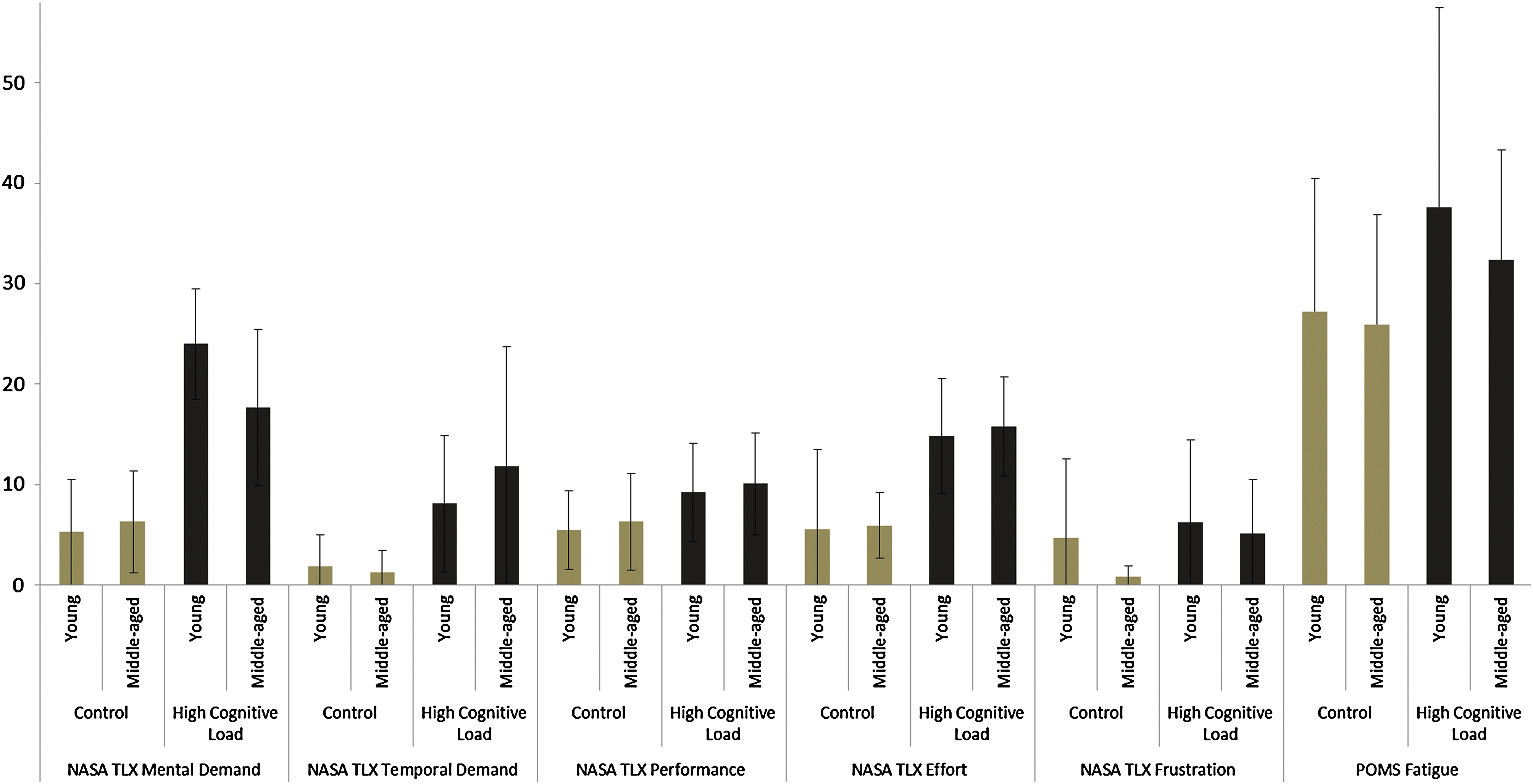
Average scores with standard deviations on the NASA TLX and POMS subscales. A higher score on the NASA TLX Mental Demand, Temporal Demand, Effort, Frustration, and POMS Fatigue subscales indicates that more mental demand, temporal demand, effort, frustration, and fatigue were experienced. For the subscale Own Performance, a higher score indicates that participants experienced their own performance as worse. NASA TLX, NASA Task Load Index; POMS, Profile of Mood Statement.
Imaging results
The ExN, the left and right FPN, and the DMN could be clearly identified and the overall average networks were very similar to networks reported in previous studies (Damoiseaux et al., 2006, 2008; Smith et al., 2009). The four RSNs are shown in Figure 2.
RS networks: the ExN
Effects of age
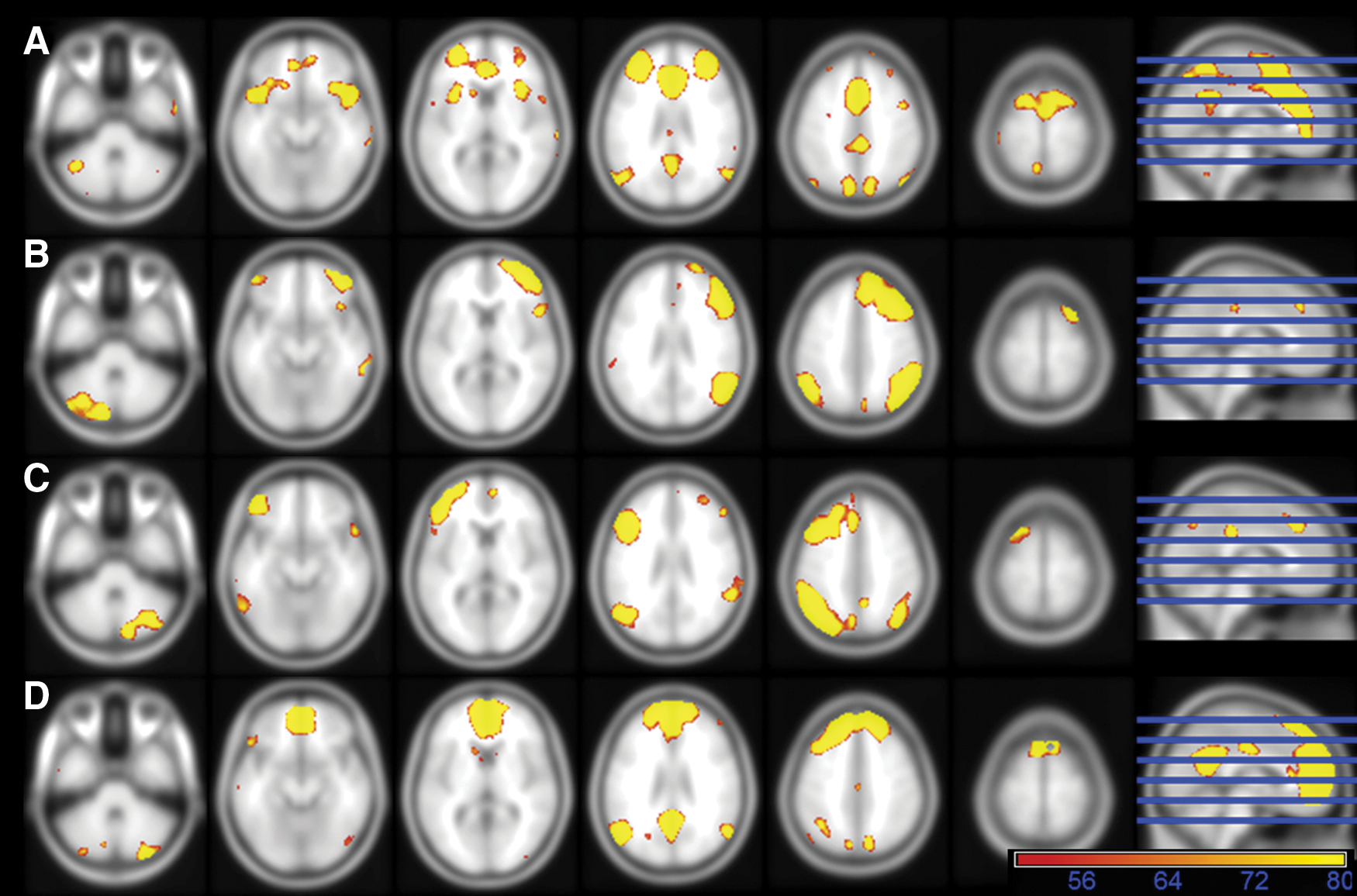
Table 1 shows the effects of age (categorical variable) on RS FC (continuous variable). For the ExN, a main effect of age was found in a left inferior frontal cluster (WB and SVC analyses: cluster falls within the ExN) with middle-aged teachers having reduced FC (see Fig. 3A). At the peak voxel of this cluster, the mean Z-value=0.90 (SD=0.61) for young and 0.04 (SD=0.67) for middle-aged participants. For the DMN, a main effect of age was found in a middle frontal cluster (SVC analysis: cluster falls within the DMN) with middle-aged teachers having reduced FC: mean Z-value=1.83 (SD=0.98) for young and 0.99 (SD=0.85) for middle-aged participants (see Fig. 3B). No main effects of age were found in the left and right FPN.

Effects of age on RS FC. Brain regions are superimposed on an MNI 152 standard space T1 template. Network regions are shown in white (F-values>30). Age effects are shown in red/yellow (F-values>10).
The effects of sustained cognitive performance (LOAD) and age (AGE) on RS FC are shown.
BA, Brodmann area; PFWER, P-value family-wise error rate; MNI, Montreal Neurological Institute; WB, whole-brain analysis; FC, functional activity; SVC, small volume correction; RS, resting state.
Effects of load
Table 1 shows the effects of load (categorical variable) on RS FC (continuous variable). For the ExN, load increased FC in a right lingual/parahippocampal cluster (WB analysis only: cluster falls outside the ExN): mean Z-value control condition=−0.31, SD=0.55; mean Z-value high load condition=0.51, SD=0.57 (see Fig. 4A). In a post hoc analysis the individual Z-scores for the peak voxel of the right lingual/parahippocampal cluster were correlated with the individual scores on the NASA TLX Effort and Mental Demand subscales and the POMS Fatigue subscale (both groups, both conditions). Individual scores on the Mental Demand [r(56)=0.49; T=4.2; p=0.00] and Effort [r(56)=0.39; T=3.1; p=0.00] subscales correlated positively with the individual Z-values. No correlations were found for the POMS Fatigue subscale [r(56)=−0.03; T=0.2; p=0.85].
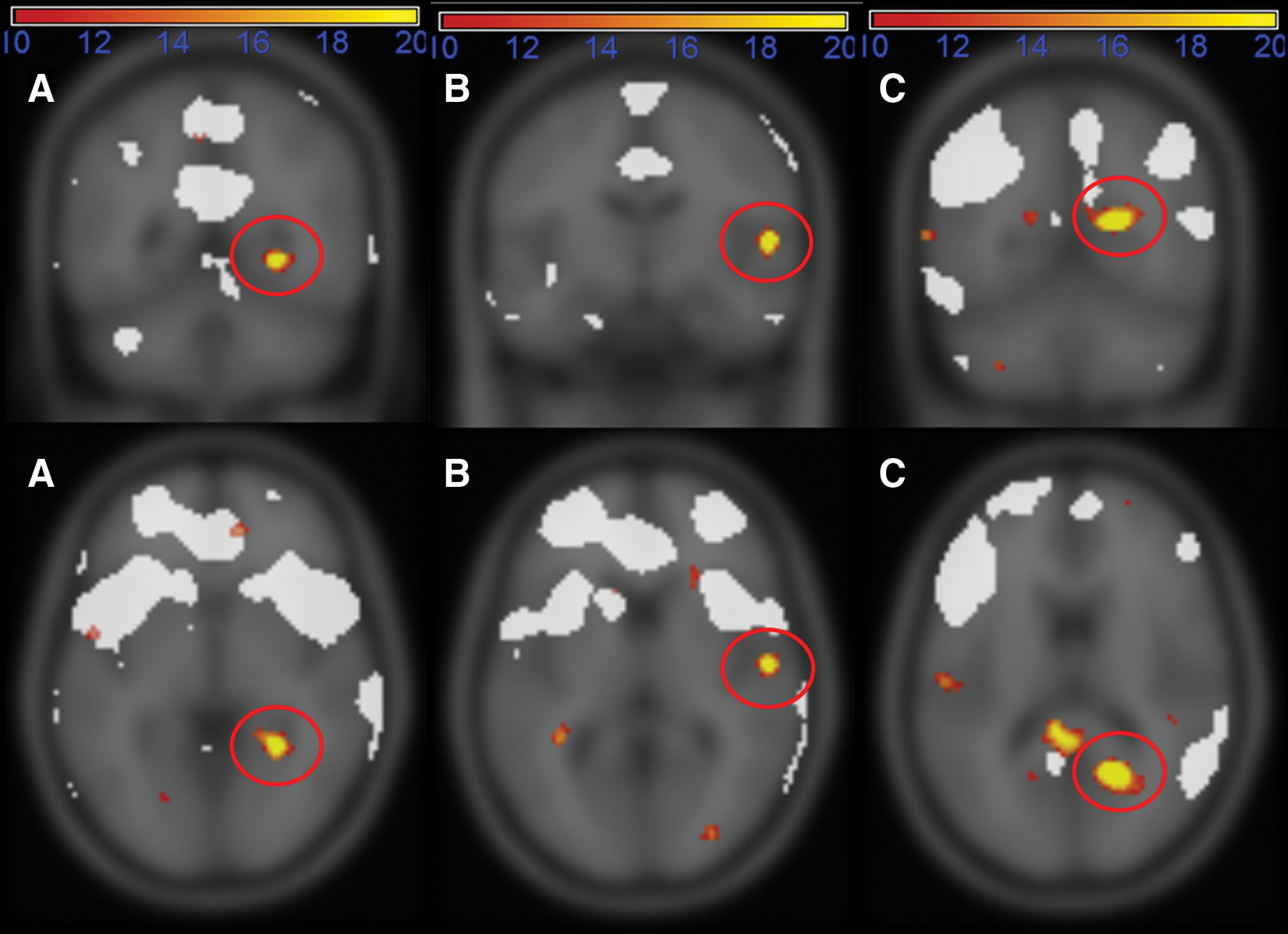
Effects of sustained cognitive performance on RS FC. Brain regions are superimposed on an MNI 152 standard space T1 template. Network regions are shown in white (F-values>30). Effects of sustained cognitive performance (load) are shown in red/yellow (F-values>10).
An interaction between load and age was found in a right superior temporal cluster (WB analysis only: cluster falls outside the ExN); load increased FC in young participants (mean Z-value control=−0.41; SD=0.75, and mean Z-value high load=0.52; SD=0.84), but decreased FC in middle-aged participants (mean Z-value control=0.31; SD=0.75, and mean Z-value high load=−0.56; SD=0.84; see Fig. 4B). For young participants, the individual Z-values of the peak voxel of the right superior temporal cluster correlated positively [r(56)=0.63; T=4.3; p=0.00] with the individual scores on NASA TLX Effort subscale. No correlation with the scores on the NASA TLX Mental Demand subscale [r(56)=0.28; T=1.5; p=0.14] and with the POMS Fatigue subscale [r(56)=0.21; T=1.1; p=0.27] was found. For middle-aged participants, the individual Z-values of the peak voxel of the right superior temporal cluster correlated negatively with the individual scores on the NASA TLX Effort subscale [r(56)=−0.50; T=2.9; p=0.01] and positively [r(56)=0.40; T=2.2; p=0.037] with the individual scores on the POMS Fatigue subscale. No correlation [r(56)=−0.28; T=1.5; p=0.15] with the scores on the NASA TLX Mental Demand subscale was found.
For the left FPN, load increased FC in a right calcarine/precuneus cluster (WB analysis only: outside the left FPN): Z=−0.53 (SD=0.63) after the control and Z=0.09 (SD=0.51) after the high load condition (see Fig. 4C). Individual scores on NASA TLX Effort subscale [r(56)=0.29; T=2.3; p=0.03] correlated with the individual Z-values of the peak voxel of the left inferior frontal cluster. No correlation with the scores on the NASA TLX Mental Demand subscale [r(56)=0.25; T=1.9; p=0.06] and with the POMS Fatigue subscale [r(56)=0.06; T=0.4; p=0.68] was found. No effects of load were found for the default mode and right FPN.
Discussion
Age effects
In the present study, the effects of sustained cognitive task performance on subsequent RS FC were investigated in healthy young and middle-aged male schoolteachers.
Tomasi and Volkow (2011), who evaluated datasets from 913 healthy subjects, showed that age reduced long-range FC in the default mode (most strongly in the precuneus) and dorsal attention network. Allen et al. (2011), who investigated datasets from 603 healthy adolescents and adults, showed age-related decreases in FC across all networks (except the basal ganglia). The results of the present study show reduced FC in the left inferior (part of ExN) and middle frontal gyrus (part of DMN). Although Tomasi and Volkow (2011) reported the strongest effects of aging in the precuneus and posterior cingulate, they also reported reduced short-range FC in the inferior frontal gyrus, and reduced short- and long-range FC in the middle frontal gyrus.
Both the inferior and the middle frontal gyrus are part of the prefrontal cortex, which is one of the regions most affected by aging (Fjell and Walhovd, 2010; Juraska and Lowry, 2012). Previous studies have shown substantial grey matter loss (Kalpouzos et al., 2009; Raz et al., 1997) and white matter degradation (Pfefferbaum et al., 2005; Salat et al., 2005; Yoon et al., 2008) in especially the prefrontal cortex in healthy aging. Reduced white matter integrity has been related to decreased cognition in older age (Charlton et al., 2010; Schiavone et al., 2009; Vernooij et al., 2009).
The results of the present study suggest that some effects of aging on RS FC are already present at middle age, which is in line with studies that have shown that white matter integrity (Salat et al., 2005) and cognitive performance (Bopp and Verhaeghen, 2005; Park et al., 2002; Van der Elst et al., 2005) are already reduced at middle age.
Effect of sustained cognitive performance
Sustained cognitive performance modulated FC for two task-positive networks: it increased FC between a right lingual/parahippocampal cluster and the ExN, and between a calcarine/precuneus cluster and the left FPN. In contrast with the effects of age, effects of sustained cognitive performance were found outside the examined RSNs.
In line with the findings of Lewis et al. (2009), it is possible that the negative correlation between task-positive networks (i.e., the ExN and left FPN) and the DMN [the parahippocampal gyrus and precuneus have been reported as DMN regions (for review see Buckner et al., 2008)] has been reduced due to sustained cognitive performance. In the present study, the lingual/parahippocampal and calcarine/precuneus clusters were, however, not part of the identified DMN. Two post hoc analyses were carried out to investigate whether sustained cognitive performance changed the relationship between RSNs. First, it was investigated whether sustained cognitive performance changed the average correlation between the individual time courses of any other cognitive RSN (out of the 20 components revealed by ICA) that contained or bordered the lingual/parahippocampal and calcarine/precuneus clusters, and the individual time courses of the ExN and left FPN [functional network connectivity (see Jafri et al., 2008)]. Two RSNs were identified. The first RSN, which could be described as a posterior DMN, consists of a large bilateral precuneus cluster; bilateral mid-occipital, cuneus, and cerebellar clusters; bilateral inferior and middle frontal clusters; and a bilateral fusiform/parahippocampal cluster. The second RSN, which could be described as primary visual areas, consists of one large occipital cluster extending into the lingual gyrus and the calcarine. No changes in the average correlation between the individual time courses of these networks and those of the ExN and left FPN were found. The second post hoc analysis showed that the average correlation between the individual time courses of every possible pair formed from the four examined networks did not change after sustained cognitive task performance. These post hoc analyses suggest that sustained cognitive performance did not change the relationship between the examined task-positive networks and the DMN.
Another possible explanation for the increased FC in regions outside the ExN and left FPN is that participants who had to put in more effort recruited additional brain regions during task performance. Since increased FC might represent a memory of repeated coactivation (Fox and Raichle, 2007), the recruitment of additional brain regions could have resulted in increased FC between these regions and the relevant task-positive RSN. The hypothesis that effortful processing was associated with increased lingual/parahippocampal and calcarine/precuneus activation cannot be tested by the present study. The tasks performed during the high load intervention were not performed in the MRI scanner.
Previous research has shown that the lingual gyrus is important for word recognition (Borowsky et al., 2007) and the parahippocampal gyrus for object recognition (Borowsky et al., 2007; Murray et al., 2000). Further, the calcarine, in which most of the calcarine/precuneus cluster is located, is part of the primary visual cortex. Based on the functions of these regions it could be speculated that participants who had to put in more effort recruited more brain regions associated with stimulus recognition to perform the cognitively demanding tasks.
For the ExN, an interaction between load and age was found in the right superior temporal gyrus: sustained cognitive performance increased FC in young, but decreased FC in middle-aged participants. The increased FC in young participants is in line with the effects of sustained cognitive performance discussed in the previous paragraph. The right superior temporal cortex is involved in spatial awareness (Karnath, 2001), speech perception (Price, 2010), and visual search (Gharabaghi et al., 2006). Increased effort might be associated with increased recruitment of these functions. However, the effect in middle-aged participants showed the opposite pattern: decreased FC that correlated negatively with effort. The superior temporal gyrus has been shown to be susceptible to age-related changes (e.g., Fjell and Walhovd, 2010; Ohnishi et al., 2001). If increased FC in young participants is the result of coactivation of this region with the ExN, then a decrease in FC in middle-aged participants might be the result of reduced coactivation due to impaired functionality of this region.
Previous studies have shown that learning can increase RS FC within the trained network (Albert et al., 2009; Jolles et al., 2011; Waites et al., 2005). In the present study, in contrast to our hypothesis, no effects of sustained cognitive performance were found on RS FC within task-positive RSNs. In contrast to other studies into the effect of cognitive performance or training on subsequent RS FC, participants performed a variety of tasks for 1 h and a half. The tasks performed during the intervention required cognitive control, working memory, problem solving, and making calculations. This intervention did not train one cognitive network, but has induced sustained effortful cognitive performance that is likely to have recruited a number of networks. The effects found in the present study correlated positively with the amount of effort participants required during task performance. The results of this study suggest that sustained cognitive performance does not change FC within the recruited task-positive networks but increases FC between task-positive networks and brain regions that might have been recruited when more mental effort is required.
Limitations
First, the number of participants in each group was low, which reduced the statistical power to detect effects of sustained cognitive performance and age. Second, only a limited number of RSNs was examined. However, the investigated networks were the most relevant for the cognitive intervention used in this study. Further, increasing the number of examined RSNs would have required a correction for multiple testing, which might have further reduced the detection power. Third, the statistical threshold used for the functional MRI analysis might be considered conservative. However, we consider it necessary to correct for the number of tests and thereby properly limit the number of false positives (as argued by Bennett et al., 2009). Fourth, between the end of the high load intervention and the start of the RS scan, participants had a short break. It would have been too expensive if they had performed the cognitive tasks in the MRI scanner. Participants therefore performed the cognitive tasks in a room next to the scanner room. After the end of the intervention they were placed in the MRI scanner as quickly as possible. This took about 10 min; they were given the possibility to use the restroom, they were put into the scanner, and two short localizer scans were made. Although short, this break might have given participants the opportunity to recovery to certain extends from the cognitive intervention. Finally, since in the present study a very specific subpopulation was tested—male schoolteachers—the results of this study cannot be generalized to the general population. Schoolteachers might be more used to cognitively demanding and stressful situations but on the other hand have an increased risk at burnout (e.g., Farber, 1991). They might therefore respond differently to sustained cognitive task performance than nonteachers. However, the results might be generalizable to other people who have jobs that require a high level of education and are mentally demanding, such as medical doctors.
Footnotes
Acknowledgment
S.A.R. is supported by a grant from The Netherlands Organisation for Scientific Research (NWO).
Author Disclosure Statement
No competing financial interests exist.