




Abstract
It is common to find that individuals with attention-deficit/hyperactivity disorder (ADHD) produce more variable responses when performing cognitive tasks. The neural mechanism associated with heightened response time variability (RTV) is not well understood in ADHD nor in typically developing individuals. One potential mechanism that might be associated with increased RTV is functional connectivity of the brain, and specifically inefficient connections. This study examined the relationships among functional connectivity of the brain, RTV, and levels of ADHD symptoms, using a cross-sectional developmental design. Twenty children aged 9–12 years and 49 adolescents aged 15–18 years completed the Sustained Attention to Response Task with flanker interference while electroencephalography (EEG) was recorded. The Conners 3 questionnaire was used to measure the participants' levels of ADHD symptoms. Parameters reflecting different aspects of RTV were computed using ex-Gaussian and fast Fourier transform techniques. Functional connectivity between 64 electrodes was computed for the task period, and global efficiency reflecting functional integration and modularity reflecting strength of functional segregation were computed. Greater global efficiency in the theta band was associated with decreased RTV. Increased integration during the task may help to combine information more efficiently and produce stable responses. When congruent flankers were present, children with greater modularity in the beta band showed greater tau, which is thought to reflect attentional lapses. This association was not observed when incongruent flankers were present. Brains with increased strength of segregated activity might be more prone to attentional lapses, especially during simpler tasks.
Introduction
The ability to suppress irrelevant information in everyday life is one of three key forms of inhibitory control, according to Friedman and Miyake's model (Friedman and Miyake, 2004). This “resistance to distractor interference,” also known as “interference control,” sits alongside the inhibition of a prepotent response, also known as response inhibition, and resistance to proactive interference. Presenting distractors alongside the target stimuli, such as in the Eriksen Flanker task (Eriksen and Eriksen, 1974), is one method to measure resistance to distractor interference. Individuals' responses tend to be slower, and more error prone when the target stimulus is flanked by incongruent relative to congruent distractors. This delay in response time (RT), computed by taking the mean RT of congruent stimuli from the mean RT of incongruent stimuli, is referred to as the flanker effect (Sanders and Lamers, 2002). By examining this flanker effect, the ability to suppress distractor interference can be assessed.
On average, people with attention-deficit/hyperactivity disorder (ADHD) have difficulties with resisting distractor interference, but task design may modify this effect. The systematic review by Mullane et al. (2009) found that children with ADHD were affected to a significantly larger degree than children without ADHD by incongruent distractors, leading to a greater number of errors and slower responses relative to congruent distractors. Newer studies support these results; children generally slowed in response during incongruent trials relative to congruent trials, but this slowing was greater in children with ADHD than those without ADHD (Forster et al., 2014; Iannaccone et al., 2015; Mullane et al., 2011). This difficulty in suppressing distractors reported in individuals with ADHD may be dependent on how engaging the task is and the underlying arousal levels of the participant. Performance can be improved significantly by increasing the salience of the distractors within a perceptual discrimination task (Friedman-Hill et al., 2010) and by introducing task-irrelevant sound distractors into a visual two choice task in children and young adults with ADHD (Merkt et al., 2013; van Mourik et al., 2007).
These findings are aligned with the Optimal Stimulation theory, suggesting that children with ADHD suffer from a state of under-arousal (Zentall and Zentall, 1983). They also accord with the Cognitive Energetic theory, suggesting that people with ADHD raise inadequate levels of activation/energy toward the task, leading to detrimental performance (Sergeant, 2005). Greater distractor interference and more complex task designs may serve to stimulate individuals with ADHD and enhance their arousal levels, leading them to perform similarly to those without ADHD or even better in some situations (Tegelbeckers et al., 2015; van Mourik et al., 2007).
A key measure that may further clarify the relation between interference control and ADHD symptoms is to examine response time variability (RTV). Increased RTV, measured using the standard deviation of response time (SDRT), is associated with higher symptoms of ADHD. This assertion is supported by the meta-analysis of Kofler et al. (2013), by studies using ADHD as a categorical construct (Albrecht et al., 2013; Epstein et al., 2011; Klein et al., 2006; Ryan et al., 2017; Scheres et al., 2001), and by studies measuring the symptoms of ADHD along a dimensional construct (Albaugh et al., 2017; Gomez-Guerrero et al., 2011; Mairena et al., 2012). The effect of flankers is often examined using speed and accuracy of response, but the flanker effect's influence on RTV has not been widely investigated.
There are several ways to measure RTV, including the SDRT based on the Gaussian curve, and three measures from the ex-Gaussian model (Luce, 1986). Mu and sigma are estimates of the mean and standard deviation (SD) of the Gaussian curve, and tau is an estimate from the exponential distribution (Luce, 1986). Using this approach, it has been suggested that tau is significantly greater in individuals with ADHD compared with controls, quite possibly indicating more occurrences of lapses in attention (Hervey et al., 2006; Keith et al., 2017; Leth-Steensen et al., 2000; Wolfers et al., 2015), although what tau actually represents is a matter of debate (Matzke and Wagenmakers, 2009).
In typically developing people, defined as those with no diagnosis of a disorder or disease that may affect the behavior of interest in a study, only a few studies have used the ex-Gaussian model to understand how the RT distribution is affected by the flanker effect. Spieler et al. (2000) found increases in mu (slowing in speed of responses) and sigma (increase in variability in the normal distribution) but a decrease in tau in the incongruent relative to the congruent condition. Another study also found that the flanker effect resulted in a greater increase in mu and sigma, but no effect on tau (Lamers and Roelofs, 2011). Contrary to those studies, Calabria et al. (2011) showed that tau was increased during the incongruent compared with the congruent condition only in a monolingual group but not in a bilingual group. The authors suggested that bilinguals may be well practiced at interference control, due to the need to always be selecting one language from the other and hence gaining more experience inhibiting interference from the other language. This finding implies that tau, rather than mu, is sensitive to the ability to handle distractors. In general, these findings indicate that the presence of distractors is not limited to influencing the speed of response. It appears that RTV is also influenced by the presence of distractors, emphasizing the importance of studying the relationship between ADHD symptoms, RTV, and the flanker effect together.
One other set of measures of RTV is based on the fast Fourier transform (FFT) algorithm, and it computes frequency-specific RTV. It has been proposed that the slower frequency range reflects arousal, and the fast frequency range reflects sustained attention performance (Johnson et al., 2007, 2008). Individuals with clinically diagnosed ADHD exhibit greater RTV across the frequency bands compared with a control group, suggesting deficits in both sustained attention and arousal (Adamo et al., 2014; Johnson et al., 2007; Karalunas et al., 2013). People with higher levels of ADHD symptoms also exhibit greater RTV compared with those with lower levels of symptoms (Mairena et al., 2012).
The influence of flankers on the FFT measures is currently unknown. Previous studies have used the FFT-based frequency analysis to examine the relationship between RTV and ADHD symptoms with the arrow version of the Eriksen Flanker task (Adamo et al., 2014; Castellanos et al., 2005; Di Martino et al., 2008), but these studies regressed out the effect of the different trials (neutral, congruent, and incongruent). Fluctuations in RT could have been reflecting the presentation of the different trial types within the same block during the experiment. The current study aimed to compare the difference in RTV, measured by the FFT, for congruent and incongruent trials separately using a block design.
It is important to understand how distractors may alter brain activity during the task. Individuals with and without ADHD may exhibit similar levels of behavioral performance with distractors but differences in brain activity. Schulz et al. (2005) reported that adolescents with ADHD showed more diffuse activation in the left ventral prefrontal cortex during the process of interference control than matched controls using functional magnetic resonance imaging (fMRI). The authors suggested that this diffuse activation reflects more cognitive effort to suppress irrelevant information; however, there was no difference in behavioral performance between the two groups. In an electroencephalography (EEG) study, Wild-Wall et al. (2009) found dissociation between the ADHD and control groups in an event-related potential component—the P3, measuring executive processes involved in response inhibition, but similar behavioral performance between the groups. This dissociation between behavioral performance and brain activity has also been reported in other studies (Konrad et al., 2006; Vaidya et al., 2005). These reported differences in brain activity might work as a compensatory process, enabling the ADHD group to perform like their typically developing peers when distractors are presented. This emphasizes the importance of investigating brain activity when examining ADHD symptoms and the effects of distractors on RTV.
By measuring the level of functional integration and segregation of the brain, the effects of distractors on brain activity and RTV may be examined. Past studies have shown a link between increased RTV and brain functioning, including underactivation of the frontal lobes—implying the influence of top-down control of attention (Bellgrove et al., 2004), intrinsic activity of the motor cortex associated with response speed (Fox et al., 2007), greater variability of brain signals being linked with more stable responses (McIntosh et al., 2008), higher white matter integrity of the brain being linked with less variable responses (Jones et al., 2018), and failure to suppress default mode network activity of the brain leading to greater RTV (Sonuga-Barke and Castellanos, 2007). RTV can be observed during any cognitive task measuring the participant's behavioral response. Correlated brain areas change in a similar way within a task (MacDonald et al., 2009). It is therefore likely that coordination between different brain regions may play a key role in the stability of response.
Brain connectivity and graph theoretical analysis help to examine how different parts of the brain connect and work together as a whole (Rubinov and Sporns, 2010). Functional integration indicates how closely different parts of the brain work together to process information, and functional segregation indicates locally segregated processing of information (Sporns, 2013). Functional integration of the brain increases with the involvement of cognitive processes to improve the efficiency of information flow through the brain (Bola and Sabel, 2015; Bullmore and Sporns, 2012). It has also been suggested that theta phase synchronization plays a role in combining information within the brain before responses are formulated and executed, reflecting the importance of greater integration of the brain (Sauseng et al., 2007, 2010). Functional integration could be negatively affected by distractors, leading to a decrease in integration. For example, a previous study reported that decreased functional integration in older adults was associated with poorer performance in suppressing interference from distractors (Knyazev et al., 2015). This decreased integration due to distractors may also be observed in younger individuals, including children and adolescents. Distractors might trigger additional processes in the brain, requiring the need to handle the distractors, and they may thereby hinder the efficient integration of information from different regions of the brain. This may alter brain connectivity during the performance of the task, which might have varying degrees of impact on RTV.
The balance of integration and segregation of the brain might be disrupted in individuals with ADHD, leading to increased RTV. By measuring resting-state functional connectivity, researchers have shown that integration of the brain, measured by global efficiency, was smaller in adults and children with ADHD compared with typically developed individuals (Lin et al., 2014; Wang et al., 2009, 2015). Additionally, strength of segregation, measured by modularity, was found to be higher in individuals with ADHD relative to those without ADHD (Lin et al., 2014; Wang et al., 2015). Cao et al. (2014) proposed that the behavioral symptoms of ADHD are due to a disrupted balance of integration and segregation of the brain. These findings imply that increased RTV, along with higher levels of ADHD symptoms, might be associated with integration and segregation of the brain.
Investigating brain activity in the theta and beta bands may be important in understanding ADHD symptoms. Increased theta and decreased beta band activity during resting state has been reported in individuals with ADHD compared with those without ADHD, which has led to speculation that increased theta/beta ratio in ADHD is a potential biomarker of the disorder (Arns et al., 2013; Marcano et al., 2017; Saad et al., 2018). Using EEG, Liu et al. (2015) examined functional integration and segregation in children with and without ADHD during the Multi-Source Interference Task, measuring interference control. They found decreased integration of the brain in children with ADHD relative to children without ADHD but only in the theta and beta bands—there were no significant group differences in the delta and alpha bands. They further showed that greater segregation in the beta band was associated with slower responses in the task. The theta and beta bands may be important frequency bands for understanding ADHD symptoms. The current study specifically focused on levels of functional integration and strength of segregation in the theta and beta bands.
To understand better the nature of ADHD symptoms, this study takes a dimensional approach toward the symptoms of ADHD instead of a categorical approach. Symptoms of ADHD are thought to be distributed across the general population, with those receiving a clinical diagnosis of ADHD sitting at the extreme high end of the symptom scale (Frazier et al., 2007). Even within a group of people with clinically diagnosed ADHD, levels of ADHD symptoms range from 65 to 90 based on the Conners Rating Scale (Conners, 2008). The dimensional approach in ADHD research uses the level of ADHD symptoms in the general population, rather than clinically diagnosed participants, to understand how the underlying cognitive processes in ADHD influence behavior and brain activity (Broyd et al., 2011; Gomez-Guerrero et al., 2011; Mairena et al., 2012). Examining each individual's level of ADHD symptoms and relating this to task performance and brain activity may more clearly reveal how ADHD symptoms and task performance are tied. Forster et al. (2014) have reported a positive correlation between the severity of ADHD symptoms and the amount of distractor interference, implying that individuals with higher levels of ADHD symptoms are more susceptible to interference from incongruent flankers. This suggests that susceptibility to distractors may be modulated by the level of ADHD symptoms.
The current study examined how ADHD symptoms and the effects of distractors may impact on RTV in children and adolescents. This study utilized a modified version of the Sustained Attention to Response Task (SART), adding flankers to the target digit presented in the task. This task allowed an investigation into how distractor interference influenced task performance by comparing congruent and incongruent distractors. This study explored how this congruency of flankers influenced different measures of RTV, computed by ex-Gaussian and FFT analyses. It was hypothesized that RTV would increase in response to incongruent compared with congruent flanker trials. It was also hypothesized that participants with higher levels of ADHD symptoms would perform the task with increased RTV, especially in incongruent trials, compared with participants with lower levels of ADHD symptoms. Functional integration and strength of segregation in the theta and beta bands during the performance of the Flanker SART were computed, and their associations with the levels of ADHD symptoms, RTV, and susceptibility to distractors were explored. It was hypothesized that greater functional integration of the brain during the task would be associated with reduced RTV and lower levels of ADHD symptoms. It was also hypothesized that all participants would show decreased functional integration levels during the incongruent, compared with congruent, trials.
Methods
Participants
Twenty-eight children aged 9–12 years (M = 10.95 years, SD = 1.06 years; 9 females) and 49 adolescents aged 15–18 years (M = 17.57 years, SD = 0.76 years; 33 females) participated. The children were recruited from local primary schools and six adolescents were recruited from local secondary schools. Forty-three adolescents were recruited from the university's first-year psychology course, who participated for course credit. Regarding school recruitment, letters of invitation to parents and their children were provided to school classes that met our target age ranges. Exclusion criteria for participation in the study included known neurological conditions, pervasive developmental disorders, and history of a serious head injury. No participants in this study reported the above conditions, and no participants were excluded based on the criteria.
Ethical approval for the study was obtained from the University of Melbourne, the Catholic Education Office Melbourne, the Victorian Government Department of Education and Training ethics committees. Parents/guardians consented for their children to take part in the study and were asked to complete a demographic information sheet providing information regarding current medications and any diagnoses that may affect their child's attentional or cognitive abilities. Participants currently using medications related to their ADHD symptoms were asked to withhold medication usage 72 h before participation. No participants reported the use of related medication, and no participants were asked to withhold the medication before the study.
Materials
Flanker SART
The Flanker SART was programmed using MATLAB (MathWorks, Inc.) and Psychtoolbox (Kleiner et al., 2007). The SART paradigm used by Johnson et al. (2007) was modified to include flanker stimuli without changing the timing of stimulus presentation. In the Flanker SART, five digits were presented in a single row and the middle digit was the target. Participants were asked to respond to each middle target digit with a button press unless the middle target digit was “3.” The flanker digits on either side of the middle target, the distractors, were separated into two conditions. In the congruent condition, the flanker digits were the same as the middle digit (e.g., 11111). In the incongruent condition, the flanker digits were different from the middle digit (e.g., 22122). In addition to these two conditions, fixed and random conditions were introduced, with the middle digit being presented in a sequential order in the fixed conditions and the order being randomized in the random conditions. In total, there were four conditions for the Flanker SART, combining two Flanker conditions (congruent and incongruent) and two SART Task (fixed and random): fixed-congruent, fixed-incongruent, random-congruent, and random-incongruent.
Conners 3 ADHD Index
The Conners 3 questionnaire was used as a measure of ADHD symptoms. The parent form was assigned to parents of all the children recruited from the primary and secondary schools. The self-report form was assigned to participants who were recruited from the university's first-year psychology course. The ADHD Index did not significantly differ between the age groups, t(49.11) = −1.65, p = 0.10, and was slightly smaller in adolescents (M = 51.00, SD = 12.90, range 41–90) compared with children (M = 56.61, SD = 15.08, range 43–90). Eight children (29%) and nine adolescents (18%) had ADHD Index scores at 65 and above, which is indicative of elevated levels of ADHD symptoms. The correlation between the parent and self-report forms is 0.57 for the ADHD Index (Conners, 2008).
Wechsler Abbreviated Scale of Intelligence
To ensure that participants understood the task instructions, participants with a full-scale IQ below 70, as measured by the Wechsler Abbreviated Scale of Intelligence (WASI) (Wechsler, 2011), were excluded. Participants recruited from the university were assumed to have an IQ higher than 70 and to have understood the task instructions, and so they did not complete the WASI. No participants were excluded due to having an IQ assessment of below 70.
Procedure
The WASI was administered to participants from the primary and secondary schools before performing the Flanker SART. Parents were asked to complete the parent form questionnaires, and the undergraduate participants completed the self-report questionnaires. EEG signals were recorded using the Biosemi system with 64 electrodes during the performance of the Flanker SART.
Analysis
Behavioral analysis
For each participant, variables were computed separately for each of the four subsets of the Flanker SART. An omission error is a failure to respond to a Go trial and a commission error is a failure to withhold a response during a No-Go trial. Trials containing omission or commission errors, and RTs <100 msec were removed from all the analyses. Participants with more than 30 omission errors were to be removed from the analysis, but no participants made more than 30 omission errors in this study. The mean RT and SDRT were then computed. The ex-Gaussian model was applied using the same method employed by Lacouture and Cousineau (2008), and three parameters, mu, sigma, and tau, were extracted.
The FFT analysis of RT was based on an approach used by Johnson et al. (2007) to compute the fast frequency area under the spectra (FFAUS) and the slow frequency area under the spectra (SFAUS), with modifications (see below). Removed trials, including No-Go trials, errors, and trials with <100 msec RTs, were linearly interpolated. The RT data were then analyzed using an FFT analysis based on Welch's method. The 225 trials were divided into 7 segments of 75 data points, with 50 data points overlapping between each segment. Each segment was detrended, Hamming-windowed, and zero-padded to 450 data points, and then, the FFT was applied to each segment. Any segment containing five or more consecutive interpolated data points was removed. If the number of segments removed exceeded three of the seven, then the FFAUS and SFAUS were not computed for that participant and were instead treated as missing values. FFAUS and SFAUS were not computed for one adolescent in the fixed-incongruent condition and one adolescent in the random-incongruent condition as the number of segments removed exceeded three. Those participants were still included in the statistical analysis, and thus, the analysis contained missing FFAUS and SFAUS values in these conditions.
One cycle of the 1–9 digit presentation in the Fixed SART is equivalent to 0.0772 Hz. At this frequency, there is a narrow peak, representing a pattern in the RT data. This pattern is a result of participants slowing when pressing to digit “1” in anticipation of the upcoming no-go digit “3” (Johnson et al., 2007). This peak at 0.0772 Hz was used to divide the frequency range into fast and slow bands. The FFAUS is a measure of all sources of variability faster than one SART cycle (0.0772 Hz), the area under the curve to the right of 0.0772 Hz. The FFAUS represents trial-to-trial variability. The SFAUS is a measure of all sources of variability slower than once per SART cycle, the area under the curve to the left of 0.0772 Hz. The SFAUS represents any gradual changes in variability in responding. The FFAUS and SFAUS were computed by obtaining averages of the fast and slow frequency ranges.
EEG analysis
The EEG signals were recorded via the 64-electrode Biosemi system with a sampling rate of 512 Hz. A common mode sense active electrode in the Biosemi system was placed on the surface of the head, and this electrode was used as a reference during the recording of EEG signals.
The EEG data were imported and preprocessed in MATLAB using FieldTrip (Oostenveld et al., 2011). In MATLAB, the EEG data were first referenced to an average of the two electrodes located behind the ears, and a band pass filter from 0.5 to 40 Hz was applied. Subsequently, the EEG data were divided into segments of 225 trials each, based on the length of a single trial of the Flanker SART, which ranged from −200 to 1200 msec, where 0 signified when the target digit was presented. Trials with severe artifacts, such as extraordinarily large amplitudes and flat signals, were visually inspected and removed. Electrodes containing too much noise were manually identified and temporally separated from the data. Using independent component analysis (ICA), artifacts such as eye blinks, eye movements, and heartbeats were also removed. Temporally separated electrodes before ICA were interpolated using the spherical spline method, and further visual inspections were conducted to remove noisy trials with amplitudes above 100 and below −100 μV. The data were then referenced to an average of all 64 electrodes and detrended. The data associated with the trials removed in the behavioral analysis were not included in the EEG analysis. If the number of remaining trials was <50, the EEG analysis was not performed for that participant. All participants satisfied this condition, and all were included in the analysis.
The analysis of the EEG data followed the event-related networks approach described by Valencia et al. (2008) and Vourkas et al. (2011). By applying the complex Morlet wavelet (Cohen, 2014), signals could be represented in both time and frequency domains, ranging from 1 to 40 Hz in steps of 1 Hz, and from −200 to 1200 msec in steps of 10 msec. For each step of frequency and time, phase synchronization between each pair of electrodes was computed using the Phase Lag Index (PLI), which, by removing the zero phase lag, is insensitive to the volume conduction effect (Stam et al., 2007). Using PLI values, a weighted and undirected network was formed without thresholding. This network was constructed for each step of time and frequency. Each electrode represented a node of the network, and the PLI value was treated as the strength of the connections between these nodes. Two network measures, global efficiency and modularity, were computed using Brain Connectivity Toolbox (Rubinov and Sporns, 2010). Global efficiency is the inverse of the average shortest path length in the network and a measure of functional integration, indicating how closely each node is connected. Modularity is measuring a strength of functional segregation and reflects how well a network can be divided into smaller subcommunities.
The Flanker SART is composed of four short tasks, and multiple independent variables were examined in this study. A few graph theoretical measures are available, but only global efficiency and modularity were computed to avoid increasing the number of variables to be handled in this study.
The network measures were averaged over the theta (4–8 Hz) and beta (13–30 Hz) bands, which are commonly studied in ADHD (Arns et al., 2013). A priori, the computed network measures were averaged for both the baseline and task periods for each participant. The baseline period was defined to be from −200 to 0 msec before the digit presentation. Both global efficiency and modularity for each of the two frequency bands were averaged during this baseline. Baseline correction was applied to global efficiency and modularity based on the averaged baseline values, and baseline-corrected global efficiency and modularity were averaged during the period between 400 and 600 msec after the digit presentation. This period was implied to be associated with cognitive processes of distractor interference centered around 500 msec after the target presentation (Nigbur et al., 2012; Zavala et al., 2013). This analysis resulted in measures of global efficiency and modularity in the two frequencies (theta and beta), and at the two time periods (baseline and task), for the four subsets of the Flanker SART separately. Only the task period was examined in this study period (see Supplementary Table S1 for statistical results of the baseline period).
Statistical analysis
The statistical analysis was performed with R, using linear mixed-effect models (LMEMs) with random intercepts. LMEMs allow us to analyze data with missing values (Gelman and Hill, 2007). The behavioral measures employed in this study were the number of omission and commission errors, mean RT, SDRT, mu, sigma, tau, FFAUS, and SFAUS. The network measures employed were global efficiency and modularity in the two frequency bands (theta and beta) and the task. There were three categorical variables: SART Task (fixed and random), Flanker (congruent and incongruent), and Age (adolescent and child groups). Additionally, there was one continuous variable: ADHD Index.
To examine the relationships among behavioral measures, ADHD Index, and network measures, three different types of models were examined. Three categorical variables (Age, SART Task, and Flanker) were inserted into the models as predictors. The first type of model aimed to examine the association between the behavioral measures and the ADHD Index. Each behavioral measure was treated as an outcome variable, and the ADHD Index and the three categorical variables were the predictors. A single model was fitted for each behavioral measure. In the second type of model, the association between the behavioral measures and the network measures was examined. Each behavioral measure was treated as an outcome variable, and each single network measure was inserted as a predictor, along with the three categorical variables. A single model was fitted for each behavioral measure and network measure. In the third type of model, the association between the network measures and the ADHD Index was examined. Each network measure was treated as an outcome variable, and the ADHD Index was inserted as a predictor, along with the three categorical variables. A single model was fitted for each network measure.
The coefficient of each predictor in LMEM was tested by the 95% bootstrap confidence interval (CI) with 2000 resamples. Predictors were considered to be significant if the CI did not contain the value 0. When the interaction terms in the models were shown to be significant, a pairwise comparison was conducted using the lsmeans package in R (Lenth, 2016). The p-values were adjusted using the false discovery rate (FDR) method devised by Benjamini and Hochberg (1995). The FDR method increases the power of statistical tests compared with the Bonferroni method (Glickman et al., 2014). Since this study is of an exploratory nature, as opposed to being confirmatory, the increased power of statistical tests using the FDR was preferred, rather than the more conservative method usually employed to control the family-wise error rate.
Results
Behavioral measures—ADHD Index, Age, SART Task, and Flanker
The first type of model was used to understand how the behavioral measures were associated with Age, SART Task, and Flanker categories and the ADHD Index. As omission and commission errors were count data, generalized LMEMs were used with the Poisson distribution. LMEMs were applied to the other behavioral measures including the mean RT, SDRT, mu, sigma, tau, FFAUS, and SFAUS. Behavioral measures were treated as outcome variables, and four predictors were inserted into the models—Age, SART Task, Flanker, and ADHD Index. Categorical variables, Age, SART Task, and Flanker, were coded based on the sum coding. Children, Random, and Incongruent were coded as −1, whereas adolescents, Fixed, and Congruent were coded as 1. ADHD Index was centered to reduce collinearity. Statistical results are summarized and reported in Table 1.
Analysis for Behavioral Measures
ADHD represents the ADHD Index and it is continuous data. For Age, −1 = children or Child, 1 = adolescents or Adol. SART represents the SART Task, and −1 = Random, 1 = Fixed. For Flanker, −1 = Incongruent or Inc., 1 = Congruent or Con. β represents the coefficient of a predictor variable.
p < 0.05 or CI does not contain 0.
ADHD, attention-deficit/hyperactivity disorder; CI, confidence interval; FFAUS, fast frequency area under the spectra; RT, response time; SART, sustained attention to response task; SDRT, standard deviation of response time; SFAUS, slow frequency area under the spectra.
Main effect of age on behavioral measures
Adolescents and children showed significant differences in task performance. Compared with children, adolescents performed the Flanker SARTs with faster mean RT, smaller SDRT, smaller sigma, smaller tau, smaller FFAUS, smaller SFAUS, less omission errors, and less commission errors. There were no other significant main effects of Age.
Main effect of SART Task on behavioral measures
Participants made significantly more omission errors during the fixed than the random versions of the Flanker SART. There were no other significant main effects of SART Task.
Main effect of Flanker on behavioral measures
In the conditions with incongruent distractors, compared with congruent distractors, participants performed the tasks with slower mean RT, increased SDRT, increased FFAUS, and increased SFAUS. There were no other significant main effects of Flanker.
ADHD Index on behavioral measures
Higher scores on the ADHD Index were associated with increased SDRT, increased tau, increased FFAUS, and a greater number of omission errors. There were no other significant main effects associated with the ADHD Index.
Interactions on behavioral measures
There were significant interactions between Age and Flanker for a number of the behavioral measures, in which children, but not adolescents, performed significantly more poorly in the presence of the incongruent compared with congruent flankers. There were significant two-way interactions between Age and Flanker on the mean RT, FFAUS, and SFAUS, (Fig. 1). The pairwise comparisons revealed that children performed the tasks with slower mean RT, greater FFAUS, and greater SFAUS in the incongruent compared with the congruent condition. For the adolescents, there was no significant difference in the mean RT, FFAUS, or SFAUS between the conditions with congruent and incongruent distractors.

Bar graph reflecting SFAUS for each age group in the congruent and incongruent conditions. Error bars indicate standard error. Similar relationships were found for the mean RT and FFAUS. FFAUS, fast frequency area under the spectra; RT, response time; SFAUS, slow frequency area under the spectra.
There was a four-way interaction between ADHD Index, Age, SART Task, and Flanker for sigma (Fig. 2). The pairwise comparison revealed that the strength of the negative association in children in the random condition was greater in the incongruent condition compared with the congruent condition. Other comparisons did not differ significantly. In the random version of Flanker SART, children showed a greater decline in sigma as the ADHD Index increased when the incongruent distractors were present. There were no other significant interactions.
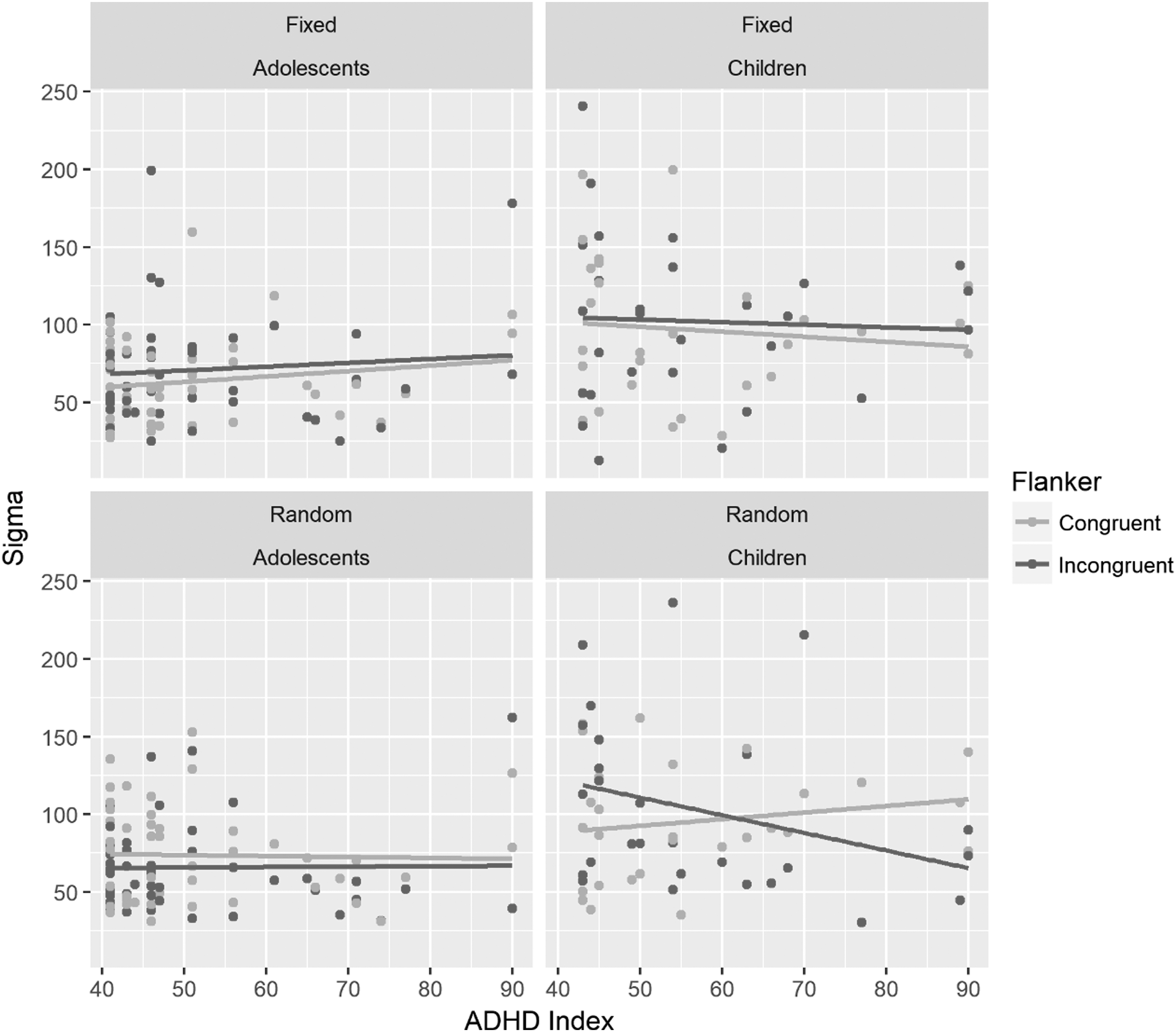
Associations between sigma and ADHD Index are shown. In this figure, the four panels were separated by the two age groups and the fixed and random conditions. ADHD, attention-deficit/hyperactivity disorder.
Behavioral measures with network measures
In this second type of model, LMEMs were used to examine the relationship between the RT measures and task period network measures as well as interactions between the network measures and the three other categorical variables. The behavioral measures included the mean RT, SDRT, mu, sigma, tau, FFAUS, and SFAUS. These were all treated as outcome variables in the models. Associations between omission/commission errors and network measures were not examined, as trials with errors were removed when computing the network measures. Network measures, Age, SART Task, and Flanker were treated as predictors in the models. Age, SART Task, and Flanker were coded in the same manner as described above. Network measures were centered to reduce collinearity. The main effects of network measures on behavioral measures and how network measures interacted with Age, SART Task, and Flanker were specifically examined. Statistical results are summarized and reported in Table 2.
Behavioral Measures with Network Measures
ADHD represents the ADHD Index and it is continuous data. For age, −1 = children or Child, 1 = adolescents or Adol. SART represents the SART Task, and −1 = Random, 1 = Fixed. For Flanker, −1 = Incongruent or Inc., 1 = Congruent or Con. β represents the coefficient of a predictor variable. Mod represents Modularity, (theta) represents the theta band, (beta) represents the beta band.
p < 0.05 or CI does not contain 0.
GE, global efficiency.
Speed of response and global efficiency
There was a significant two-way interaction between Flanker and global efficiency in the beta band for the mean RT and mu (Fig. 3). In conditions with congruent distractors, global efficiency in the beta band was positively associated with the mean RT and mu. The strength of these positive associations was significantly greater than the associations in conditions with incongruent distractors for the mean RT and mu. When the congruent distractors were present, a greater increase in global efficiency in the beta band was observed relative to the conditions with incongruent distractors, with slower mean RT and mu. There were no other significant effects and interactions.
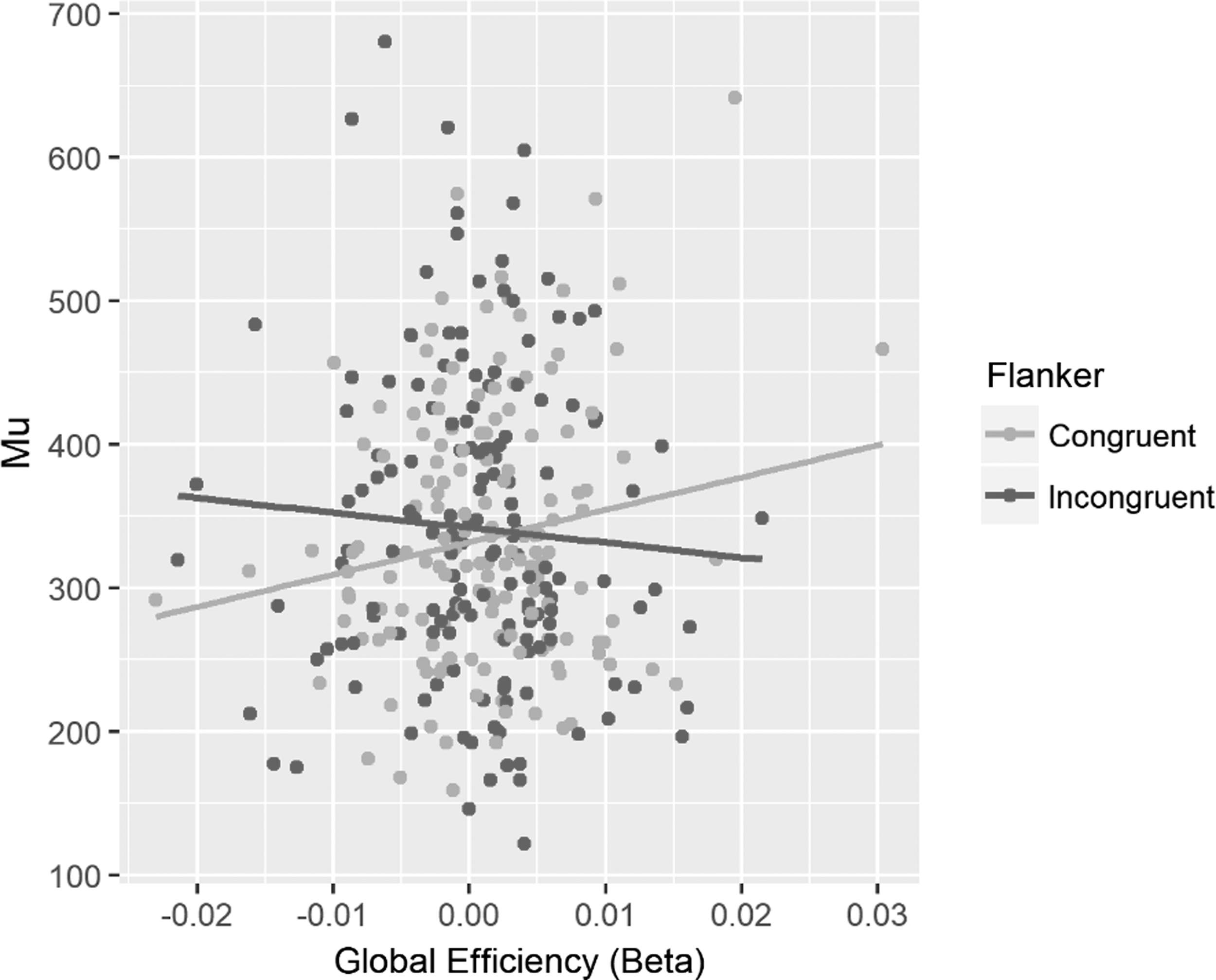
Associations between mu and global efficiency in the beta band in the congruent and incongruent conditions. In this figure, data from both children and adolescents in the fixed and random conditions have been aggregated.
RTV measures and global efficiency
Global efficiency in the theta band was found to be negatively associated with SDRT, tau, FFAUS, and SFAUS, irrespective of the SART or Flanker types.
Interactions between global efficiency in the theta band and Age on those behavioral measures further revealed that children mainly contributed to the significant associations. There were significant two-way interactions between global efficiency in the theta band and Age on SDRT (Fig. 4), tau, FFAUS, and SFAUS. In children, global efficiency in the theta band was negatively associated with SDRT, tau, FFAUS, and SFAUS. The strength of the negative associations was greater for children than for adolescents in SDRT, tau, FFAUS, and SFAUS. Children showed a steeper decline of SDRT, tau, FFAUS, and SFAUS as an increase in global efficiency in the theta band compared with adolescents.
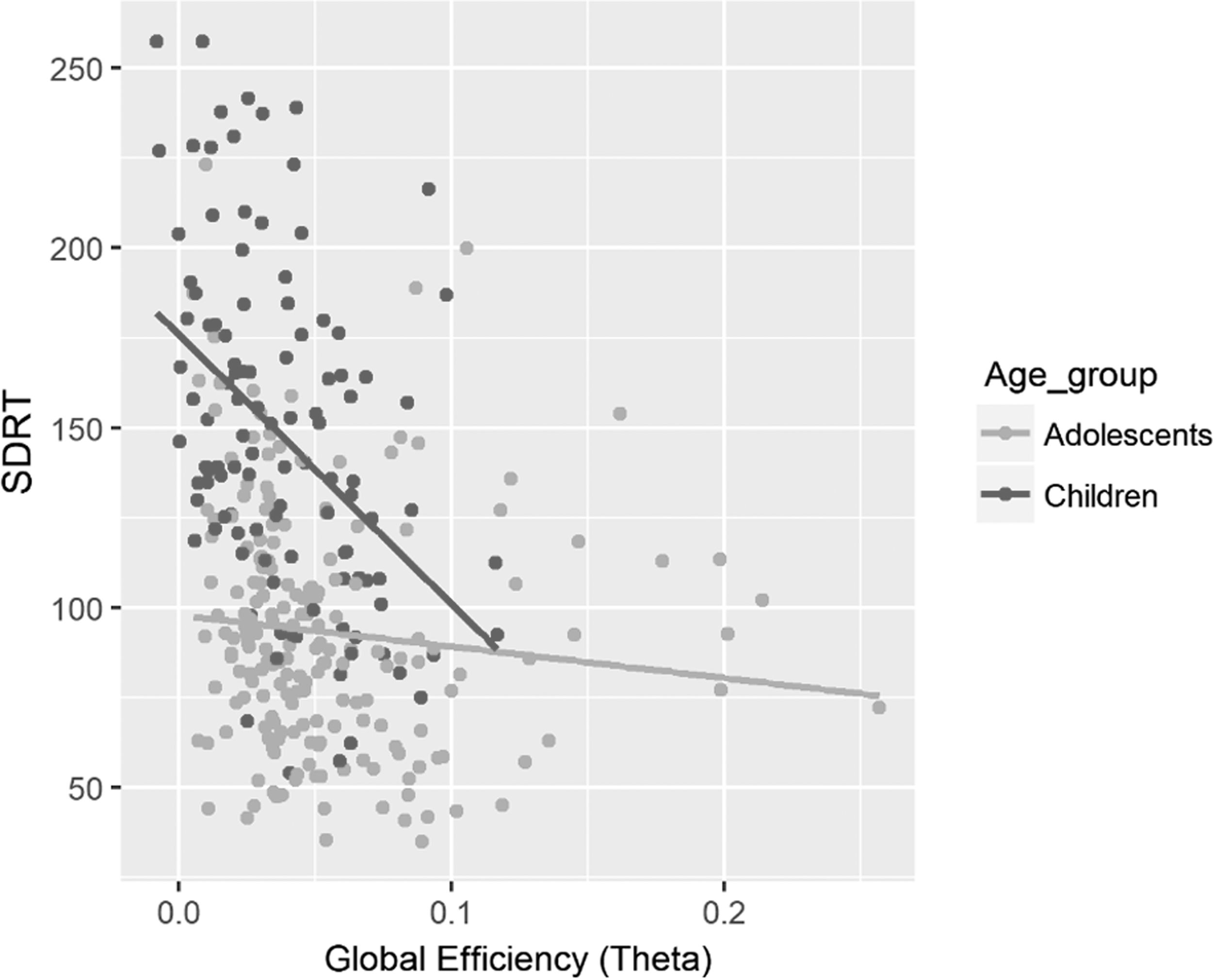
Associations between SDRT and global efficiency in the theta band in both children and adolescents. In this figure, data from all the four conditions of the Flanker SART have been aggregated for each age group. Similar relationships were found for tau, FFAUS, and SFAUS. SART, sustained attention to response task; SDRT, standard deviation of response time.
A similar relationship between FFAUS and global efficiency was found in the beta band. A significant two-way interaction between global efficiency in the beta band and Age was found on FFAUS. There was a negative association between global efficiency in the beta band and FFAUS in children. The strength of this negative association was greater in children compared with the association in adolescents. Children showed a greater increase in FFAUS global efficiency in the beta band decreased. There were no other significant effects and interactions.
Speed of response and modularity
There was a significant four-way interaction between modularity in the theta band, Age, SART Task, and Flanker on the mean RT (Fig. 5). Modularity in the theta band was positively associated with the mean RT only in adolescents in the random and incongruent condition. The pairwise comparison revealed that the strength of this association was only significantly greater compared with the association found in adolescents in the random and congruent condition, p = 0.008. Other comparisons did not differ significantly. In the random version of Flanker SART, adolescents showed a greater increase in the mean RT as an increase in modularity in the theta band when the incongruent distractors were present relative to congruent distractors.

Associations between the mean RT and modularity in the theta band. The four panels were split by the two age groups and the fixed and random conditions.
There was a significant three-way interaction between modularity in the beta band, Flanker, and Age for mu (Fig. 6). There was a positive association between modularity in the beta band and mu for children in the incongruent conditions. The strength of this positive association was significantly greater than for children in the congruent conditions. Other comparisons did not differ significantly. When incongruent distractors were present, children showed a greater increase in mu as modularity in the beta band increased compared with adolescents. There were no other significant effects and interactions.
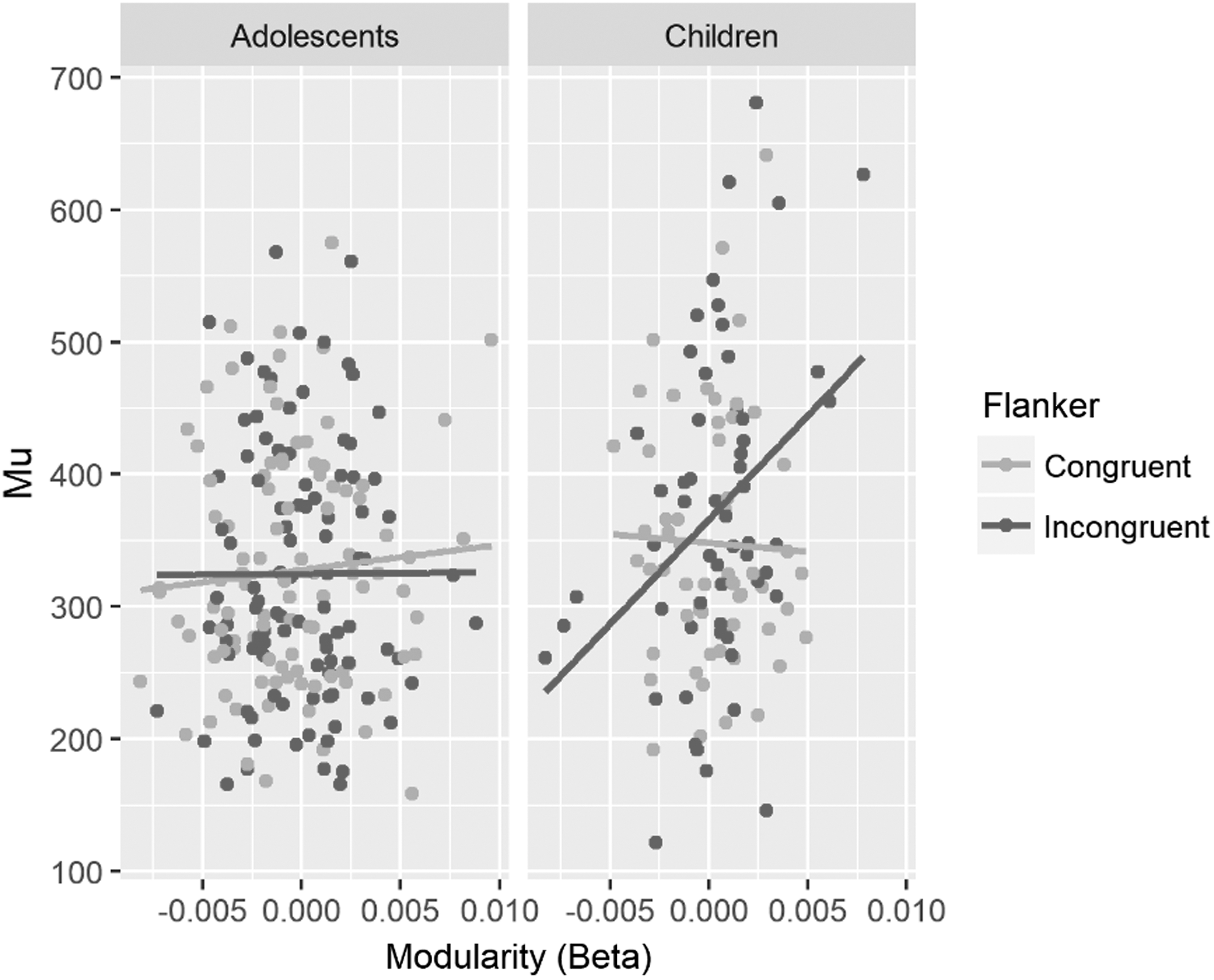
Associations between mu and modularity in the beta band. The two panels were split by the two age groups. In this figure, the random and fixed conditions have been aggregated.
RTV measures and modularity
There was a significant two-way interaction between modularity in the beta band and Age on FFAUS (Fig. 7). There was a positive association between modularity in the beta band and FFAUS in children. The strength of this positive association was greater compared with the association in adolescents. Children showed a greater increase of FFAUS as modularity in the beta band increased.

Associations between FFAUS and modularity in the beta band in both children and adolescents. In this figure, data from all the four conditions of the Flanker SART have been aggregated for each age groups.
There was a significant three-way interaction between modularity in the beta band, Flanker, and Age on tau (Fig. 8). There was a positive association between modularity in the beta band and tau only in children in the congruent conditions. The strength of this positive association between modularity in the beta band and tau was greater than the associations for children in the incongruent conditions, adolescents in the congruent conditions, p = 0.005, and adolescents in the incongruent conditions. When congruent distractors were present, children showed a greater increase in tau as modularity in the beta band increased. There were no other significant effects and interactions.
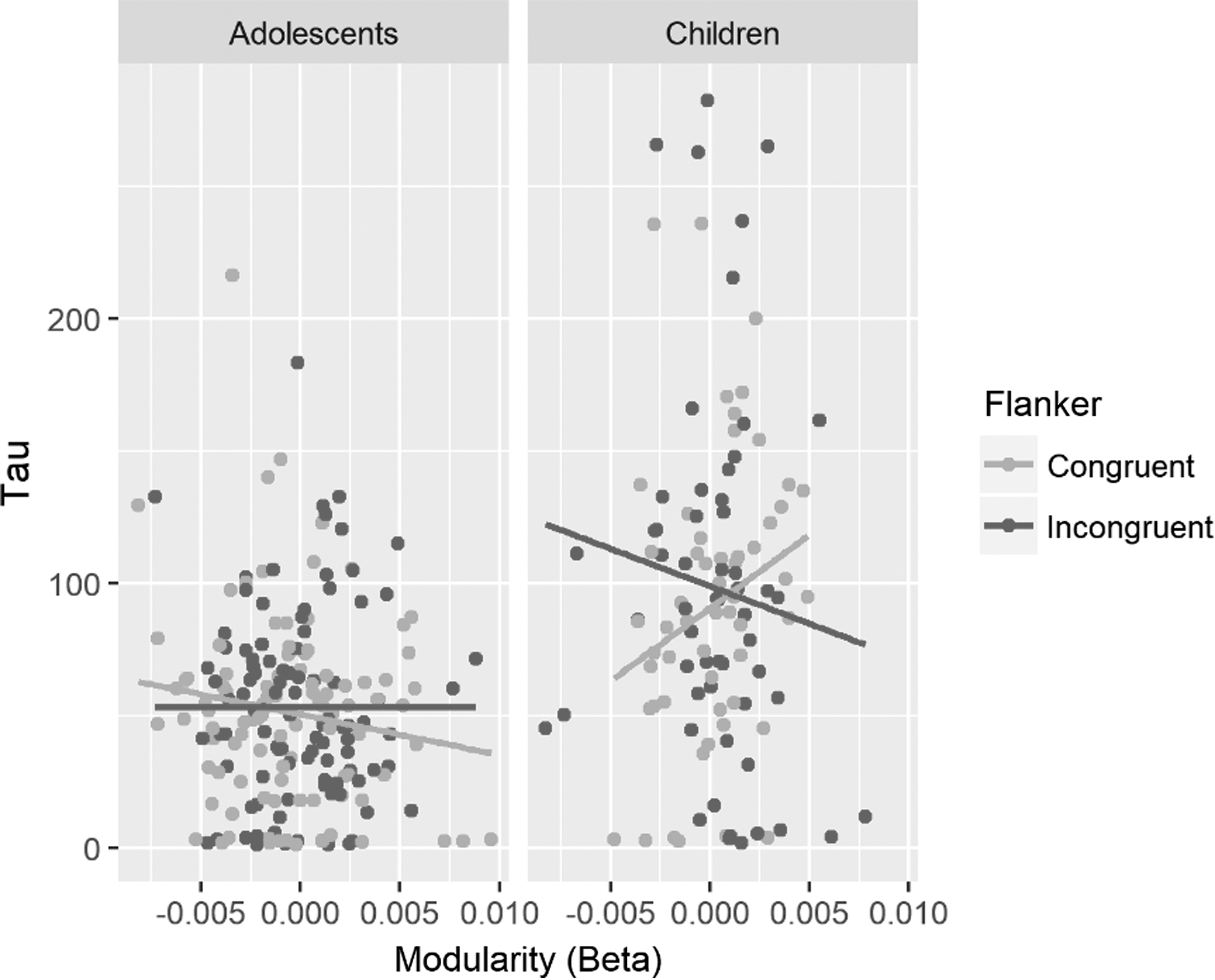
Associations between tau and modularity in the beta band. The two panels were split by the two age groups. In this figure, the random and fixed conditions have been aggregated.
Network measures—ADHD Index, Age, SART Task, and Flanker
The third type of model was used to understand how the task period network measures were associated with ADHD Index and influenced by Age, SART Task, and Flanker categories. Network measures during the task period were inserted as outcome variables including the two frequency bands (theta and beta). Four predictors were inserted in the models—ADHD Index, Age, SART Task, and Flanker. ADHD Index was centered to reduce collinearity. Age, SART Task, and Flanker were coded in the same manner as described above. Statistical results are summarized and reported in Table 3.
Outcomes of Analysis for Network Measures During the Task Period
ADHD represents the ADHD Index and it is continuous data. For Age, −1 = children or Child, 1 = adolescents or Adol. SART represents the SART Task, and −1 = Random, 1 = Fixed. For Flanker, −1 = Incongruent or Inc., 1 = Congruent or Con. β represents the coefficient of a predictor variable. Mod represents Modularity, (theta) represents the theta band, (beta) represents the beta band.
p < 0.05 or CI does not contain 0.
Main effect of Age on network measures
There were significant differences between children and adolescents. Adolescents performed the tasks with smaller modularity in the theta band. There were no other significant effects of Age.
Main effect of SART Task on network measures
Participants performed the fixed conditions with greater global efficiency in the theta band during the task compared with the random conditions. There were no other significant effects of SART Task.
Main effect of Flanker on network measures
Participants performed the congruent conditions with greater global efficiency in the theta band and with smaller modularity in the theta band during the task compared with the incongruent conditions.
Main effect of ADHD Index on network measures
There were no significant main effects of ADHD Index.
Interactions on network measures
There was a significant two-way interaction between ADHD Index and Flanker on modularity in the beta band during the task (Fig. 9). There was a negative association only in the congruent conditions. The strength of this negative association was significantly greater than the association in the
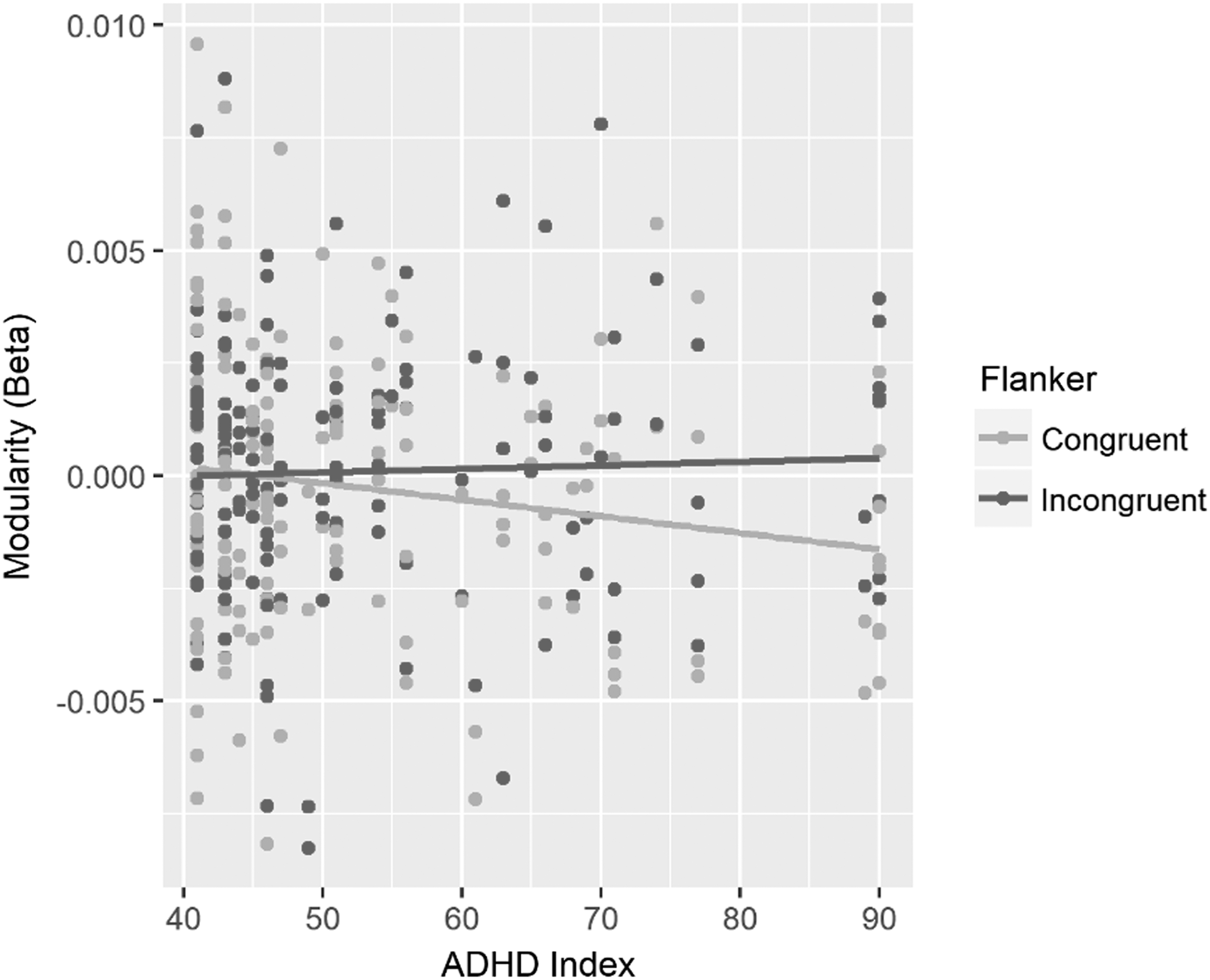
Associations between modularity in the beta band during the task period and ADHD Index for congruent and incongruent conditions. In this figure, the two age groups and fixed and random conditions have been aggregated.
Discussion
Using the Flanker SART, this study sought to examine the effects of distractors on ADHD symptoms, RTV, and network measures computed from EEG data. The results showed that differences in the mean RT, FFAUS, and SFAUS between congruent and incongruent distractors were more pronounced in children than they were in adolescents, indicating that adolescents were better able to suppress distractor interference. In the random-incongruent condition, children with more acute ADHD symptoms were observed to exhibit lower sigma, but not in the other conditions. This finding may indicate the beneficial effect of increasing task difficulty for children with higher levels of ADHD symptoms, where greater difficulty might help to maintain their arousal levels and produce more stable responses. This finding was only found in sigma, and the congruency of distractors did not have any impact on associations between the ADHD Index and other behavioral measures, implying that individuals handle distractor interference in a similar manner irrespective of ADHD symptom levels except for sigma. By examining the associations between network measures and behavioral measures, greater global efficiency in the theta band was shown to be associated with smaller SDRT, tau, FFAUS, and SFAUS. Increased integration may be an important characteristic of the brain to be able to produce stable responses by combining information through the brain more efficiently. This global efficiency in the theta band was reduced when incongruent distractors were employed relative to congruent distractors, and when the target digit was presented in the fixed sequential order relative to the random order. Incongruent distractors might disturb brain integration processes and expectation of the next stimuli might help to increase this integration level during the task. Modularity in the beta band was associated with both speed and variability of responses differently depending on the congruency of distractors. When the congruent distractors were present, increased modularity in the beta band was associated with increased tau in children, but not in adolescents. When incongruent distractors were present, greater modularity in the beta band was observed to be associated with slower mu, and this interaction was more evident in children than it was in adolescents. Decreased strength of segregation may enable the delivery of faster responses only when there is greater distractor interference and the task is more difficult, and having greater strength of segregated brain activity may increase the risk of experiencing attentional lapses when the congruent stimuli is present and the task is simpler. When congruent distractors were present, the ADHD Index was found to be associated with modularity in the beta band, suggesting that individuals with more acute ADHD symptoms showed less strength of segregation during the task. This decreased strength of segregation might suggest greater task difficulty and more cognitive effort required when the congruent distractors are present for individuals with higher levels of ADHD symptoms. Greater distractor interference may benefit individuals with higher levels of ADHD symptoms possibly by reducing cognitive effort required to complete the task.
Behavioral measures
Children were significantly more affected by the congruency of distractors than adolescents, suggesting an improvement from childhood to adolescence in the ability to filter out distractor interference. Children, but not adolescents, showed a distractor effect in the mean RT, FFAUS, and SFAUS measures. This result suggests that both mean RT and RTV were affected by the congruency of distractors, even though it is common to study the effects of distractors on the speed (mean RT) and accuracy of responses (Eriksen and Eriksen, 1974; Sanders and Lamers, 2002). This finding also indicates that adolescents are better equipped to suppress distractor interference and are less affected by the congruency of distractors. Our results imply that this ability is improving from late childhood to late adolescence. This is consistent with a number of other studies that have all reported an improvement from childhood to adulthood in the ability to inhibit distractors (Abundis-Gutierrez et al., 2014; Li et al., 2009; Waszak et al., 2010). As these previous studies tended to just focus on the speed of RT, and not its variability, some areas of improvement undergone during the period from childhood to adulthood might have been overlooked. Future studies might consider focusing on the variability of responses and not just the speed and accuracy of responses when examining the effects of distractors. Our results suggest that there is an improvement from late childhood to late adolescence in the ability to filter out distractors, as is evident from our examination of the fluctuations in RT over the course of the task (measured by FFT analysis). This analysis might be helpful in identifying the effects of distractors over a wide range of ages.
The beneficial effect of greater distractor interference and task difficulty for children with more pronounced levels of ADHD symptoms was observed with sigma, suggesting that their responses may become more stable with greater task difficulty. In children, an association between sigma and ADHD symptoms was observed in the random-incongruent condition of the Flanker SART. When the target digit was presented in a random order and incongruent distractors were present, children with higher levels of ADHD symptoms produced more stable responses, as measured by sigma. Friedman-Hill et al. (2010) suggested that individuals with and without ADHD perform the task equivalently with greater distractor interference when the task is more difficult, but individuals with ADHD would have more difficulty in suppressing distractor interference when the task is simple. Distractors of sound were also implied to be beneficial in ADHD possibly by increasing arousal levels (van Mourik et al., 2007). This result supports the Optimal Stimulation theory, suggesting that children with ADHD suffer from under arousal and that greater stimulation enhances their performance (Zentall and Zentall, 1983). A random presentation of digits with incongruent distractors in Flanker SART might have helped to maintain an adequate arousal level in children with higher levels of ADHD resulting in a smaller sigma. Compared with sigma, other behavioral measures showed no interaction between the flanker effect and levels of ADHD, indicating that all participants were affected by distractors to a similar degree, irrespective of ADHD symptoms. This finding is consistent with studies that showed distractor interference influences the performance of individuals with and without ADHD equally (Samyn et al., 2017; Schulz et al., 2005; Suzuki et al., 2017; Tegelbeckers et al., 2015; van Mourik et al., 2009). According to the results of this study, the flanker effect on behavior seems not to vary with levels of ADHD symptoms, except for sigma. As the finding regarding sigma is from a four-way interaction and it was not found in any other measure of RTV, it might contain a higher risk of being a false finding. Further studies are needed to replicate the same finding to confirm the negative association between sigma and levels of ADHD symptoms in the random and incongruent condition.
Network measures—global efficiency
Functional integration during performance of the task was observed to be affected by the congruency of distractors. Global efficiency in the theta band during the task was greater when congruent, as opposed to incongruent, distractors were present. Increased distractor interference when incongruent distractors were present may have had the effect of weakening the integration of the brain during performance of the task. The connections in the theta band of the brain are thought to coordinate information from the various parts of the brain and help to integrate information (Berthouze et al., 2010; Mizuhara et al., 2004; Sauseng et al., 2007, 2010). The presence of incongruent distractors might necessitate additional information processing in the brain and interfere with the process of reconfiguring the brain's activity during the task. This could make it more difficult to achieve adequate integration of the brain.
Knowing the next target digit may help to integrate the brain. There was a significant difference in global efficiency in the theta band during the task between the Fixed and Random conditions of the Flanker SART. Global efficiency in the theta band was greater when the target digit was presented in the sequential compared with the random order. By comparing fixed and random versions of the SART, O'Connell et al. (2009) showed a slow potential in the fixed version and suggested that individuals are expecting the next stimuli to appear. The expectancy effect in the fixed version of the Flanker SART might have facilitated the smooth reconfiguration of brain connections and helped in achieving an adequate level of brain integration during performance of the task.
Greater integration of the brain, as measured by global efficiency, was shown to play a significant role in RTV. There was a significant effect of global efficiency in the theta band on smaller SDRT, tau, FFAUS, and SFAUS, indicating that a less integrated brain is likely to produce more variable performance. The interaction further revealed that children exhibited greater associations between functional integration and RTV compared with the association in adolescents, implying that having a highly integrated brain is more beneficial to children than to adolescents in producing stable responses. It has been suggested that theta band connectivity plays a role in the integration of information in the brain (Sauseng et al., 2010). Functional integration was shown to increase from the rest to task period as well as from the easier to more difficult task (Bola and Sabel, 2015; Cohen and D'Esposito, 2016; Cruzat et al., 2018; Toth et al., 2012). Completing the more difficult task may demand more complex processing, requiring the involvement of wider areas of the brain, and increased levels of integration. It may be the case that children find tasks more difficult than adolescents and thus need greater levels of integration to efficiently process the task and produce stable responses. Children with less integrated brains might not be able to achieve an adequate level of integration for the successful completion of the task, which might have led to more variable responses. Adolescents, finding the same task to be less challenging, may not need to achieve such a high level of integration, and therefore, in our study, adolescents with lower integration might be less impacted than children to produce stable responses.
Network measures—modularity
The congruency of distractors was found to alter the relationship between strength of segregation and behavioral performance reflected by the speed of response. When incongruent distractors were employed, a positive association was observed between greater modularity in the beta band during the task and slower mu, especially in children. Greater strength of segregation was found to be associated with slower responses when greater distractor interference was introduced. Using fMRI, Cohen and D'Esposito (2016) showed that modularity declined from the rest to task state in an N-back task, but modularity did not differ from the rest to task state in a sequential tapping task. As the N-back task is more demanding relative to the sequential tapping task, the brain shows decreased strength of segregation for greater task demand. Yue et al. (2017) examined the relationship between modularity and task performance based on the mean RT using fMRI, and they showed that task complexity served to alter the relationship. When the task was simpler, higher modularity of the brain was found to be associated with superior performance. When the task was more complex, lower modularity was found to be associated with better performance. This indicated that greater strength of segregation of the brain is more efficient in simpler tasks, and lower strength of segregation is more efficient when the task demands more complex processing. This implies that the level of segregation reacts differently depending on the difficulty of the task, and the brain might be more strongly segregated when the task difficulty is low. According to our results, it seems that, compared with adolescents, children might have felt the task to be more complex and demanding when incongruent distractors were employed due to the greater difficulty in suppressing the distractors. Children with more segregated brains processed information from incongruent distractors less efficiently and their responses were thus slower in this study.
The task complexity may modulate the relationship between strength of segregation of the brain and task performance differently for different measure of RTV. Yue et al. (2017) suggested that greater strength of segregation is associated with better performance when the task is simpler, whereas during the more complex task reduced strength of segregation is associated with better performance. This explanation might be specific to general speed of responses and it might work differently for different types of RTV measures. In children, greater FFAUS was found to be associated with greater modularity in the beta band during the task. Decreased strength of segregated brain functioning in children was associated with reduced fast fluctuations of RT. FFAUS is thought to reflect sustaining attention and the top-down control of attention (Johnson et al., 2007). As beta band connectivity is suggested to be associated with allocation of cognitive resources (Hogan et al., 2013), reduced modularity in the beta band in this study may imply more efficient allocation of cognitive resources. Children with more strength of segregation in the beta band might have inefficient allocation of cognitive resources, and this might have led to greater difficulty in sustaining attention. Breckel et al. (2013) examined how network measures changed during a visual vigilance task using fMRI. Reduced segregation was observed in earlier blocks of the task relative to later blocks. The authors suggested that slowing of responses over the course of the task was accompanied by increasing segregation. Individuals who performed the task with less segregated brain functioning may have been more resilient to vigilance decrement over the course of the task. This finding is aligned with our study suggesting that children with more segregated brains have more difficulty in sustaining attention. Additionally, when children were performing a task in which congruent distractors were present, greater tau was observed to be associated with greater modularity in the beta band. One possible interpretation for this increase in tau is a higher occurrence of attentional lapses (Leth-Steensen et al., 2000). Children with more strength of segregation may be experiencing difficulty in sustaining their attention on the task, and they are therefore more prone to experiencing attentional lapses when engaged in simpler tasks. Even though Yue et al. (2017) suggested that greater modularity of the brain is associated with better performance (i.e., producing faster responses in simpler tasks), this increased strength of segregation might have a negative impact on the stability of responses for relatively simpler tasks. Further studies should also examine the relationship between levels of integration and segregation, task complexity and task performance, using not just the speed of response, but also RTV measures.
Decreased strength of functional segregation may be enabling individuals with higher levels of ADHD symptoms to carry out the task with a similar proficiency to individuals with lower levels of ADHD symptoms. Modularity in the beta band was negatively associated with the ADHD Index when congruent distractors were present. This suggests that participants with higher levels of ADHD symptoms showed less strength of segregated brain functioning during the performance on the congruent task. In EEG studies, coherence in the beta band may be related to the allocation of cognitive resources for performing the task, where greater connectivity might allow smoother allocation (Hogan et al., 2013). It has been reported that modularity decreased when task difficulty increased (Kitzbichler et al., 2011). These findings suggest that decreasing strength of segregation in the beta band might allow for accessing greater cognitive resources when the complex task demands greater cognitive effort. It might be the case that individuals with elevated levels of ADHD symptoms may find simpler, less arousing, tasks to be more difficult to complete. Less arousing tasks may be more demanding for those with elevated levels of ADHD symptoms. Those with elevated levels of ADHD symptoms might therefore be reducing the strength of segregation to compensate for the increased cognitive effort associated with the simpler task. Increasing task complexity by greater distractor interference may benefit those with higher levels of ADHD symptoms by increasing their arousal levels (Sergeant, 2005; van Mourik et al., 2007). Even though it was not clearly apparent from the observation of behavior, our results indicate that greater distractor interference may be beneficial for individuals with higher levels of ADHD symptoms.
A potential limitation of this study is that participants were recruited from the general population and levels of ADHD symptoms were gauged by questionnaire rather than recruiting children or adolescents clinically diagnosed with ADHD. The results obtained might have been different, therefore, if a clinically diagnosed population had been used. Another limitation of this study was the utilization of both the self-report and parent forms of Conners 3. The ADHD Index obtained from both the parents' and self-report forms was treated as a single variable reflecting levels of ADHD symptoms, as they were assumed to measure the same construct (Conners, 2008). Findings related to the ADHD Index may have varied if the same type of administration was used for all participants.
Conclusions
In conclusion, this study found that incongruent distractors had the effect of slowing mean RT and increasing RTV, as measured by SDRT, FFAUS, and SFAUS. This suggests that greater distractor interferences can lead to more variable responses, not just slower responses. Children, in particular, were affected by the congruency of distractors, indicating that the ability to filter out distractor interferences improves from late childhood to late adolescence. Global efficiency in theta was found to be associated with SDRT, tau, FFAUS, and SFAUS. Global efficiency in the theta band might be involved in integrative processing of information in the brain, and more efficient integration of information might lead to more stable performance. Global efficiency in the theta band decreased when incongruent, as opposed to congruent, digits were employed, which may imply that incongruent distractors require additional information processing and interfere with the integration of information in the brain. In children, greater global efficiency and reduced modularity in the beta band were associated with smaller FFAUS, reflecting more stable moment-to-moment responding. More integrated and less strength of segregated brain activity in children might be beneficial for sustaining attention during the task. Decreased strength of segregation of the brain in people with higher levels of ADHD symptoms when congruent distractors were employed suggests that distractor interference may benefit individuals with higher levels of ADHD symptoms by possibly reducing cognitive effort to stay on task. This suggests that those with more pronounced ADHD symptoms are finding simpler tasks to be more difficult and distractors may alleviate this difficulty.
Footnotes
Author Disclosure Statement
No competing financial interests exist.
Funding Information
No funding was received for this article.
Supplementary Material
Supplementary Table S1
References
Supplementary Material
Please find the following supplemental material available below.
For Open Access articles published under a Creative Commons License, all supplemental material carries the same license as the article it is associated with.
For non-Open Access articles published, all supplemental material carries a non-exclusive license, and permission requests for re-use of supplemental material or any part of supplemental material shall be sent directly to the copyright owner as specified in the copyright notice associated with the article.
