




Abstract
Background:
Air pollution exposure has been associated with adverse cognitive and mental health outcomes in children, adolescents, and adults, although youth may be particularly susceptible given ongoing brain development. However, the neurodevelopmental mechanisms underlying the associations among air pollution, cognition, and mental health remain unclear. We examined the impact of particulate matter (PM2.5) on resting-state functional connectivity (rsFC) of the default mode network (DMN) and three key attention networks: dorsal attention, ventral attention, and cingulo-opercular.
Methods:
Longitudinal changes in rsFC within/between networks were assessed from baseline (9–10 years) to the 2-year follow-up (11–12 years) in 10,072 youth (M ± SD = 9.93 + 0.63 years; 49% female) from the Adolescent Brain Cognitive Development (ABCD®) study. Annual ambient PM2.5 concentrations from the 2016 calendar year were estimated using hybrid ensemble spatiotemporal models. RsFC was estimated using functional neuroimaging. Linear mixed models were used to test associations between PM2.5 and change in rsFC over time while adjusting for relevant covariates (e.g., age, sex, race/ethnicity, parental education, and family income) and other air pollutants (O3, NO2).
Results:
A PM2.5 × time interaction was significant for within-network rsFC of the DMN such that higher PM2.5 concentrations were associated with a smaller increase in rsFC over time. Further, significant PM2.5 × time interactions were observed for between-network rsFC of the DMN and all three attention networks, with varied directionality.
Conclusion:
PM2.5 exposure was associated with alterations in the development and equilibrium of the DMN—a network implicated in self-referential processing—and anticorrelated attention networks, which may impact trajectories of cognitive and mental health symptoms across adolescence.
Impact Statement
Recent epidemiological studies link air pollution exposure to elevated risk of psychiatric disorders. Further, particulate matter air pollution can impact the central nervous system, and children and adolescents may be more vulnerable than adults because of ongoing brain development. However, the neurodevelopmental mechanisms have yet to be identified. Results of this study indicate that resting-state functional connectivity within and between the default mode network (DMN) and anticorrelated attention networks is impacted by particulate matter exposure during childhood. The DMN is implicated in various neuropsychiatric disorders and may, therefore, be a promising target to mitigate the adverse mental health effects of air pollution.
Introduction
Exposure to air pollution is associated with negative neurocognitive (e.g., poorer working memory, attention, and processing speed) and mental health outcomes (e.g., increased psychiatric emergency department visits) in children and adolescents (Brokamp et al., 2019; Lopuszanska and Samardakiewicz, 2020), as well as increased risk of developing psychiatric disorders (Roberts et al., 2019). However, the underlying neurodevelopmental mechanisms behind these associations remain unclear.
Preclinical and human neuroimaging studies demonstrate that air pollutants, specifically particulate matter (PM), impact central nervous system function and structure, likely through immune and inflammatory processes (Zundel et al., 2022). PM2.5, or particulate matter with a diameter smaller than 2.5 microns, is of particular interest because of its small size, which allows it to penetrate the lungs, induce systemic inflammation, and increase the permeability of the blood–brain barrier, which may lead to altered brain functioning (Costa et al., 2020). Children and adolescents may be more sensitive to the adverse effects of air pollution than adults because of ongoing development and refinement of large-scale neurocognitive networks throughout the first two decades of life (Gogtay et al., 2004).
Emerging research links air pollution exposure to altered brain structure (e.g., gray matter volume and microstructure) and function (e.g., functional connectivity) in youth (for a review, see Herting et al., 2019). Within the Adolescent Brain Cognitive Development (ABCD®) study, a large nationwide multisite study following over 11,000 youth across adolescence, childhood air pollution exposure has been associated with lower white matter microstructural integrity (Burnor et al., 2021), lower subcortical gray matter microarchitecture integrity (Sukumaran et al., 2023), and variable differences in brain volumes (i.e., smaller cuneus and larger right orbitofrontal cortical surface) (Cserbik et al., 2020).
Childhood and adolescence are characterized by dynamic age-related changes within- and between-core neurocognitive functional brain networks. These networks—including the salience network (SN), frontoparietal network (FPN), dorsal attention network (DAN), ventral attention network (VAN), cingulo-opercular network (CON), and the default mode network (DMN)—are involved in higher-level cognitive and emotional processes (Uddin et al., 2011). The SN is involved in attentional orienting to relevant emotional and sensory stimuli (Menon, 2011). The FPN subserves goal-directed behavior, decision making, and the active maintenance and manipulation of information in working memory (Menon, 2011). The DAN and VAN are involved in attentional control (Vossel et al., 2014) and the CON monitors and adjusts attentional resources over the course of a task (Dosenbach et al., 2008). The SN, FPN, DAN, VAN, and CON collectively represent task-positive networks, as they are typically activated during directed behavior and are characteristically anticorrelated with the DMN (Hampson et al., 2010). The DMN, also known as the task-negative network, is activated during internal mental processes, such as self-referential thinking (Andrews-Hanna et al., 2014). The DMN typically deactivates in response to attention-demanding tasks, and disruptions in DMN functioning have been reported in various neuropsychiatric disorders (e.g., depression and attention-deficit/hyperactivity disorder (ADHD)) (Hamilton et al., 2015; van Rooij et al., 2015).
Prior research has shown that the connections between the DMN and anticorrelated neurocognitive networks (i.e., SN, FPN, DAN, VAN, and CON) continue to refine across adolescence; specifically, within-network resting-state functional connectivity (rsFC) of the DMN increases over time, whereas between-network rsFC of the DMN and anticorrelated networks decreases with increasing chronological age (Fair et al., 2009; Uddin et al., 2011). However, recent research that has used newer processing techniques to remove motion artifact, a notable problem in developmental magnetic resonance imaging (MRI) studies (Barkovich et al., 2019), has revealed that these developmental changes observed in rsFC are significantly attenuated (see Grayson and Fair, 2017 for a review). For example, in a cross-sectional study of 10–26-year-old participants, Marek et al. (2015) found that with increasing age from childhood to early adolescence, there was a global decrease in both within- and between-network rsFC of the DMN, CON/SN, and FPN. However, across adolescence, within-network rsFC of these networks remained stable, whereas between-network rsFC increased with increasing age. Thus, because of the changes that rsFC networks undergo from childhood through adolescence, these core brain networks may be particularly sensitive to environmental exposures during this period. In particular, rsFC networks are prime targets to begin elucidating the neurodevelopmental mechanisms underlying the link between air pollution exposure and adverse mental health outcomes.
Recent cross-sectional research from the Generation R Study has shown that postnatal exposure to PM (from birth to 5 years of age) is associated with altered rsFC of brain regions in core neurocognitive networks during late childhood and preadolescence (ages 9–12 years) (Guxens et al., 2022; Perez-Crespo et al., 2022). Although PM2.5 overall was not associated with rsFC, PM2.5 absorbance, a marker of black carbon, and PMcoarse, particles that are larger than PM2.5 but smaller than PM10, were associated with increased within-network rsFC of brain regions primarily in task-positive and task-negative networks (Guxens et al., 2022; Perez-Crespo et al., 2022). Although these cross-sectional studies highlight that exposure to PM is associated with altered rsFC of neurocognitive networks in childhood and preadolescence, longitudinal studies are needed to further explore the trajectories of these alterations over time.
The first study to use a longitudinal sample, to our knowledge, examined the effects of PM2.5 as well as other pollutants (O3, NO2), at age 9–10 years, on rsFC of three core networks, commonly referred to as the triple-network model (DMN, SN, and FPN), in the ABCD® study. Findings from that study showed higher exposure to PM2.5 was associated with increased between-network rsFC of SN-DMN and FPN-DMN with increasing chronological age over the follow-up period (Cotter et al., 2023). This important study reaffirms the findings reported in the above cross-sectional studies and shows that the age-specific changes within these networks, as well as their interactions, are impacted by PM exposure during early adolescence.
The current study examines the effects of PM2.5 exposure on the neurodevelopmental trajectories (e.g., from late childhood to early adolescence) of within- and between-network rsFC of three core attention networks (i.e., DAN, VAN, and CON) as well as the DMN. This will allow for a full characterization of how PM exposure impacts functional brain networks beyond the triple-network model (DMN, SN, and FPN)—as previously characterized (Cotter et al., 2023)—by investigating major attention networks (DAN, VAN, and CON) and their interplay with the DMN. Given that alterations in attention and executive functioning are common in psychiatric disorders (Millan et al., 2012), understanding the impact of PM on these additional neurocognitive networks may allow for better intervention targets, such as cognitive behavioral therapy, to bolster top-down control of attention (Hirsch et al., 2019).
We chose to focus a priori on PM2.5 exposure as it accounts for most air pollution-related health impacts in the United States (Fann et al., 2012). PM2.5 impacts the brain directly through the nasal olfactory mucosa and indirectly through systemic inflammation and immune responses (see Costa et al., 2020 for a review). Furthermore, studies have projected small but important increases in PM2.5 across North America, from 2000 to 2050, because of climate change (Shen et al., 2017; Tai et al., 2012). Therefore, the present study underscores the importance and timeliness of investigating the ongoing health impacts of PM2.5, particularly among vulnerable populations. Therefore, we hypothesized that higher PM2.5 exposure would be associated with decreased within-network rsFC of the DMN and increased between-network rsFC of the DMN and attention networks from late childhood to early adolescence.
Methods
Preregistration
This current study was preregistered on Open Science Framework (https://osf.io/rvjsx/).
Participants
We obtained baseline and year two follow-up data from the NDA 4.0 release of the ABCD® study, which includes youth recruited from 21 study sites across the United States (Garavan et al., 2018). Briefly, 9–10-year-old children (n = 11,876) and caregivers participated in baseline assessments (between October 2016 and 2018), with yearly follow-ups thereafter. The study was approved by a centralized Institutional Review Board (IRB) and IRBs at individual study sites. Written informed consent and assent were provided by each caregiver and child, respectively. A total of 10,072 participants were included in the present study following image quality control (see Supplementary Fig. S1 for details).
Externally linked environmental data
As described previously (Fan et al., 2021), annual ambient PM2.5 concentration estimates from the 2016 calendar year were assigned to primary residential addresses of each participant. The 2016 calendar year was chosen to correspond with the onset of enrollment in the ABCD® study. The annual concentrations of PM2.5 (μg/m3), NO2 (ppb), and O3 (ppb) were estimated at a 1-km2 resolution using a hybrid ensemble spatiotemporal model (Di et al., 2019), which incorporates satellite, land-use, weather, and chemical transport models. Nationwide, the annual PM2.5, NO2, and O3 concentration estimates are highly accurate, with a cross-validated R 2 of 0.89, 0.84, and 0.90, respectively (Di et al., 2020; Di et al., 2019; Requia et al., 2020).
Demographic variables and covariates
Potential confounders were selected based on the prior literature (Cotter et al., 2023) and analyses were adjusted for baseline age, sex at birth (male or female), race and ethnicity (Non-Hispanic White, Non-Hispanic Black, Hispanic, Non-Hispanic Asian, or Multi-Racial/Other), highest household education (Postgraduate, Bachelor, Some College, High School Diploma/General Educational Development (GED), or <High School Diploma), total combined family income (high income: ≥$100K, middle income: ≥$50K<$100K, and low income: <$50K), child handedness (right, left, or mixed), years between visits, MRI manufacturer (Siemens, Philips, GE), and average framewise displacement (FD) during the rsFC scans (mm). Further, annual averages of both O3 and NO2 were entered as covariates to assess the specific effects of PM2.5 on rsFC.
Neuroimaging data acquisition, preprocessing, quality control, and rsFC analysis
MRI data acquisition, processing, and harmonization for the nationwide ABCD® study have been extensively described elsewhere (Casey et al., 2018; Hagler et al., 2019). Briefly, four 5-minute resting-state scans were acquired during the imaging session, which included a high spatial and temporal resolution simultaneous multislice (SMS)/multiband Echo Planar Imaging (EPI) sequence (Casey et al., 2018). Functional magnetic resonance imaging (fMRI) data were preprocessed using the ABCD® Data Analysis and Informatics Core’s standardized pipeline (Hagler et al., 2019), and time courses were calculated for cortical surface-based regions of interest (ROIs) using Freesurfer’s functionally defined parcellation based on rsFC patterns. Correlation values for each pair of ROIs within- or between-neurocognitive networks, calculated on the basis of the Gordon parcellation scheme (Gordon et al., 2016), were then Fisher z-transformed and averaged (Hagler et al., 2019). Within-network rsFC reflects the average of the correlation over all pairs of ROIs within a network, and between-network rsFC reflects the average correlation value between all ROIs of two separate networks. Our analyses focused on both the within- and between-network functional connectivity of the following four networks: (1) DMN, (2) VAN, (3) DAN, and (4) CON.
Statistical analyses
Linear mixed-effect models were used to test associations between PM2.5 concentrations and within-subject change in rsFC over time. Our main regressor of interest was the continuous estimates of PM2.5. The annual PM2.5 concentrations were scaled such that beta estimates from the models reflect a change in 10 μg/m3 of PM2.5. Time was modeled as a within-subject factor (1 = baseline, 2 = year 2 follow-up), and PM2.5 × time interaction terms were included. Site and family ID were added as random effects to the models, with family nested within the site. The following model equation was used:
The current study focused on the main effects of PM2.5, time, and the effects of PM2.5 over time (PM2.5 × time interactions). Analyses were performed using R software (version 4.3.0; R [2022]) and the lme4 package (version 1.1.34; Bates et al. [2015]). Models were conducted in three steps: unadjusted, adjusted for covariates of interest (baseline age, sex, combined income, parent education, race/ethnicity, handedness, MRI manufacturer, years between visits, and FD), and adjusted for multiple pollutants (O3 and NO2). All model results can be found in the Supplementary Data (Supplementary Tables S1-S10). An alpha of 0.05 was chosen, a priori, before any models were fit or analyzed as a threshold for significance. False discovery rate (FDR) was used to correct for multiple comparisons for the coefficients of interest (PM2.5, time, PM2.5 × time) across the 10 tests (10 tests, 3 coefficients = 30 tests; pFDR < 0.05). All reported p values are two sided. For ease of interpretation and graphical presentation, annual PM2.5 concentrations were dichotomized into high and low groups based on a median split (7.70 μg/m3). Figures depict predicted outcomes from the linear mixed-effect models, using the effects package (version 4.2-2; Fox and Weisberg, 2018).
Results
Demographics
The mean annual PM2.5 concentration from the 2016 calendar year for our study sample was 7.65 ± 1.55 μg/m3. The mean age of the sample at baseline was 9.93 ± 0.63 years and at year 2 follow-up was 11.95 ± 0.65 years. The sample was 53.6% White and 51.2% male. Our study sample (n = 10,072) differed from the full ABCD® cohort in year 2 follow-up in age (with our sample being slightly older), race (with our sample having slightly more non-Hispanic White youth and less non-Hispanic Black youth), average FD (with our study sample having less motion in scans because of imaging quality control protocol), and in MRI manufacturer (with our sample having less subjects collected on a Phillips system at baseline, and more subjects collected on GE and Siemens systems at the year 2 follow-up; p’s < 0.05). Importantly, our study sample’s air pollutant concentrations did not differ from the full ABCD® cohort (PM2.5 , p = 0.635). Other key demographics and covariate information can be found in Table 1.
Demographics
“Other” race/ethnicity category includes participants identified by their caregiver as American Indian/Native American, Alaska Native, Native Hawaiian, Guamanian, Samoan, Other Pacific Islander, Asian Indian, Chinese, Filipino, Japanese, Korean, Vietnamese, Other Asian not listed, or Other Race not listed. For sample comparison, independent two sample t-test or proportions test were used and p-values < 0.05 were considered significant.
PM2.5 and within-network rsFC the core neurocognitive networks
Results reported are from the fully adjusted models, including both covariates and other pollutants. A significant PM2.5 × time interaction was observed for within-network rsFC of the DMN (β = −0.0123), such that higher annual concentrations of PM2.5 were associated with a smaller increase in rsFC over time (see Fig. 1A). No significant PM2.5 × time interactions were observed for within-network rsFC of the DAN, VAN, or CON (pFDR’s > 0.05).
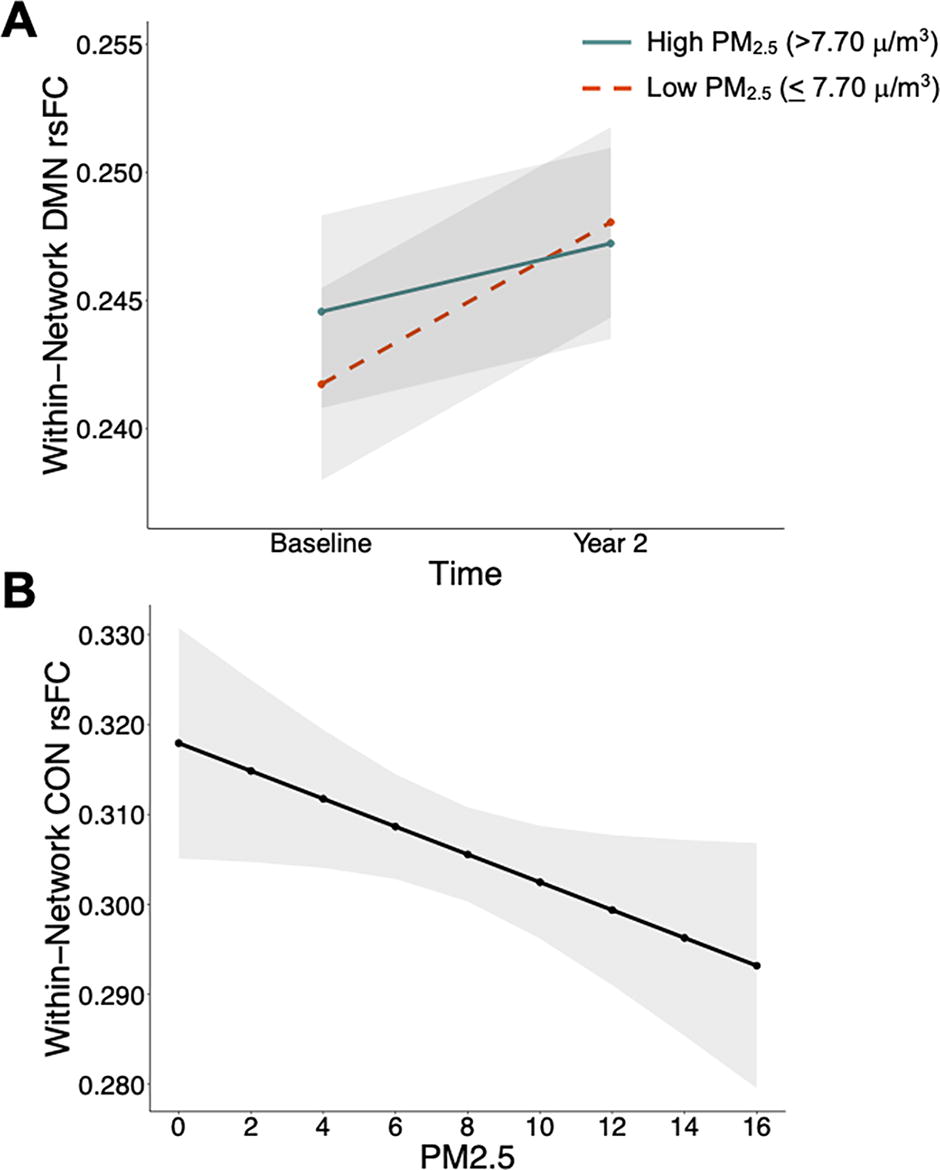
A significant main effect of PM2.5 was observed for within-network rsFC of CON (β = −0.0221), such that higher concentrations of PM2.5 were associated with lower within-network rsFC (see Fig. 1B). No significant main effects of PM2.5 were observed for within-network rsFC of the DMN, DAN, or VAN (pFDR’s > 0.05).
Significant main effects of time were observed on within-network rsFC of three of the four core neurocognitive networks. Within-network rsFC increased over time in the DMN (β = 0.0138). In contrast, within-network rsFC decreased over time in the VAN (β = −0.0091) and CON (β = −0.0103). No significant main effect of time was observed for within-network rsFC of DAN (pFDR > 0.05).
PM2.5 and between-network rsFC of the DMN with attention networks
Significant PM2.5 × time interactions were observed for DMN rsFC with the three attention networks (i.e., DMN-DAN, DMN-VAN, and DMN-CON). For DMN-DAN, higher annual concentrations of PM2.5 were associated with an increase in rsFC from baseline to year 2. In comparison, lower PM2.5 concentrations were associated with a decrease in rsFC (see Fig. 2A, β = 0.0214). For DMN-VAN and DMN-CON rsFC, higher annual concentrations of PM2.5 were associated with a smaller decrease in rsFC from baseline to year 2 (see Fig. 2B and C, respectively; β = 0.0118, and β = 0.0287, respectively). A significant main effect of PM2.5 was observed for DMN-CON rsFC (β = −0.0165), such that higher concentrations of PM2.5 were associated with lower between-network rsFC overall. No main effects of PM2.5 were observed for the between-network rsFC of the DMN and other attention networks (pFDRs > 0.05). Significant main effects of time were observed for between-network rsFC of the DMN and all three anticorrelated networks, such that between-network rsFC decreased over time (pFDRs < 0.05).
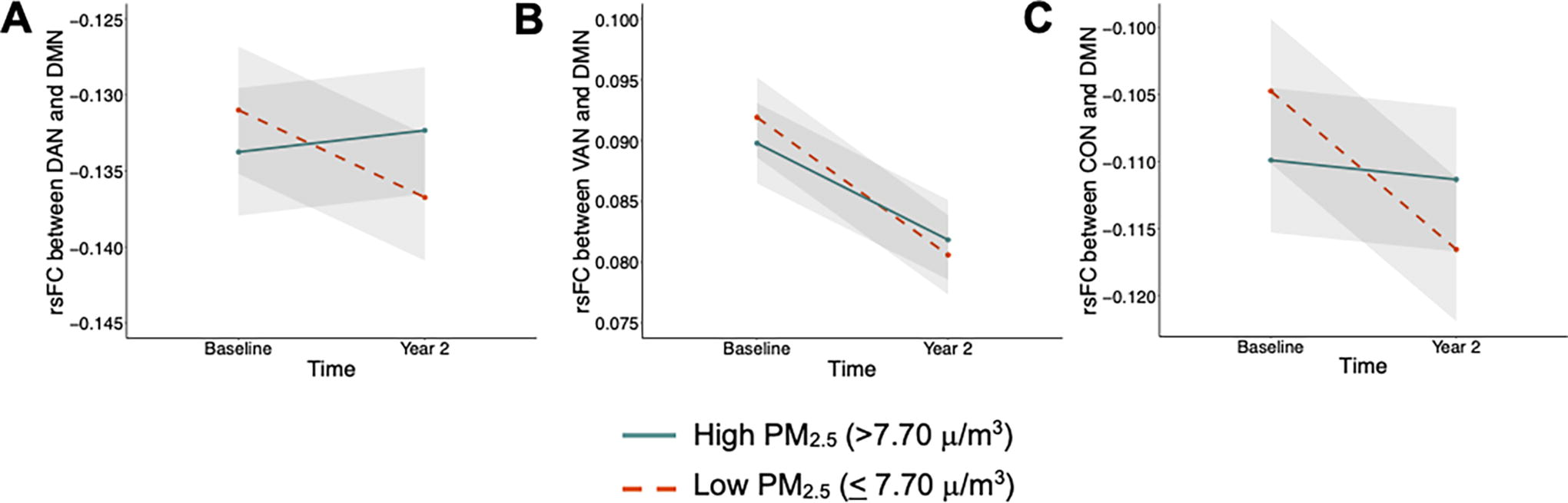
Significant PM2.5 × time interactions on between-network resting-state functional connectivity (rsFC) of the default mode network (DMN) with the three attention networks.
PM2.5 and between-network rsFC among the attention networks
Results reported are from the fully adjusted models, including both covariates and other pollutants. A significant PM2.5 × time interaction was observed for between-network rsFC of CON-VAN, (β = 0.0137), such that higher annual concentrations of PM2.5 were associated with a smaller decrease in rsFC over time (see Fig. 3A). No significant PM2.5 × time interactions were observed for the other network connections (pFDRs > 0.05).
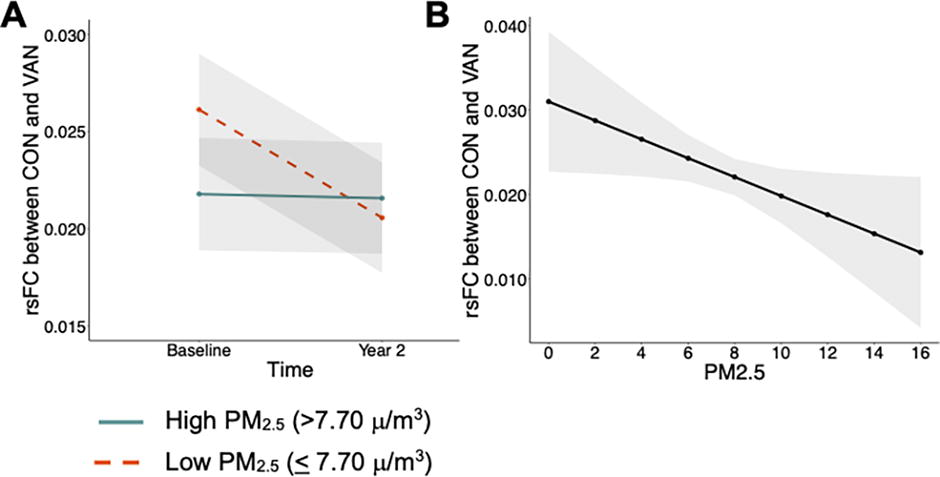
A significant main effect of PM2.5 was observed for between-network rsFC of CON-VAN (β = −0.0185), such that higher concentrations of PM2.5 were associated with lower between-network rsFC overall (See Fig. 3B). No significant main effects of PM2.5 were observed for the other network connections (pFDRs > 0.05).
Significant main effects of time were observed for between-network rsFC of CON-VAN (β = −0.0133), such that between-network rsFC decreased over time, and between-network rsFC of CON-DAN (β = 0.0112), such that rsFC increased over time. No significant main effects of time were observed for DAN-VAN (pFDR > 0.05).
Discussion
This study examined the impact of PM2.5 exposure on developmental trajectories of the DMN and three core attention networks over a 2-year period. We found that youth exposed to higher PM2.5 concentrations had attenuated increases in within-network DMN rsFC over time and lower within-network CON rsFC at baseline and the 2-year follow-up. In addition, we found significant PM2.5 × time interactions on rsFC between the DMN and all three attention networks (i.e., DAN, VAN, and CON), suggesting that higher exposure to PM2.5 alters the equilibrium between the DMN and attention networks. Further, youth exposed to higher PM2.5 concentrations had attenuated decreases in between-network CON-VAN rsFC over time—networks critical for attentional control (Dosenbach et al., 2008; Menon, 2011; Vossel et al., 2014). Our findings confirm prior cross-sectional studies reporting alterations in rsFC between task-positive networks in those exposed to higher concentrations of PM2.5 (Guxens et al., 2022; Perez-Crespo et al., 2022; Pujol et al., 2016). Further, our findings extend an earlier longitudinal study in the ABCD® cohort that focused on the triple-network model (DMN, SN, and FPN) (Cotter et al., 2023) by investigating the effects of PM2.5 on three additional major neurocognitive networks (i.e., DAN, VAN, and CON). These networks are critical for attentional control and undergo substantial changes across childhood and adolescence (Dosenbach et al., 2008; Vossel et al., 2014).
Across childhood and adolescence, within-network rsFC of the DMN generally increases and then stabilizes, suggesting increasing network integration (Marek et al., 2015). In the current study, within-network DMN rsFC increased over time; however, higher PM2.5 concentration exposure attenuated these increases, raising the possibility of a disruption in neuromaturation of the DMN. Interestingly, disrupted DMN maturation has been observed in neuropsychiatric disorders characterized by inattention, impulsivity, and social deficits (e.g., ADHD and autism) (Harikumar et al., 2021). In fact, PM exposure is related to attentional impairment in several epidemiological studies (see Donzelli et al., 2019 for a review), and DMN dysfunction is observed transdiagnostically in anxiety, depression, and schizophrenia (Broyd et al., 2009). Our recent systematic review found that 73% of all animal and human studies reported increased internalizing symptoms and behaviors in those experiencing higher levels of air pollution exposure (Zundel et al., 2022). Thus, the previously observed changes in psychiatric symptoms related to air pollution may relate to the air pollution-related DMN changes reported herein. Further, reduced within-network DMN rsFC has been associated with other environmental adversities and their psychological impact, such as childhood poverty, trauma, and posttraumatic stress symptoms (Sripada et al., 2014b). Therefore, PM2.5 may be an additional unseen and understudied environmental stressor to the developing brain.
We also found a main effect of PM2.5 on within-network rsFC of the CON, such that youth exposed to higher PM2.5 concentrations had overall lower rsFC. The CON is involved in maintaining attentional resources during tasks and goal-directed behaviors (Dosenbach et al., 2008). Reduced connectivity within the CON may reflect reduced network integration and efficiency, observed in children with neurodevelopmental disorders (Freedman et al., 2020).
Next, we found that childhood exposure to PM2.5 was associated with altered trajectories of between-network rsFC of the DMN and all three major attention networks (DAN, VAN, and CON). Throughout childhood and early adolescence, between-network rsFC of core neurocognitive networks generally decreases, suggesting developmental network segregation, and generally increases in late adolescence to adulthood, reflecting the support of cross-network information processing necessary for cognitive control (Marek et al., 2015). Further, the DMN is typically anticorrelated with attention and executive function brain networks, as the DMN “turns off” during active tasks (i.e., task-negative network). Interestingly, the between-network rsFC of DMN-DAN in youth exposed to higher concentrations of PM2.5 increased over time—an opposing effect to youth exposed to lower concentrations—which may indicate more network integration and less segregation. Increased integration of the DMN to these anticorrelated networks in youth with ADHD has been posited to reflect difficulty disengaging from internal, self-generated thoughts to direct attention to a task (Duffy et al., 2021; Sripada et al., 2014a). For the between-network rsFC of DMN-VAN, DMN-CON, and CON-VAN, all youth demonstrated a decrease in rsFC over time; however, youth exposed to higher concentrations of PM2.5 demonstrated a smaller decrease over the two-year follow-up period. These between-network findings may reflect disrupted maturation in the separation and segregation of core neurocognitive networks.
Interestingly, within the ABCD® cohort, lower DMN-CON rsFC has been associated with increased internalizing psychopathology (e.g., anxiety and depressive symptoms) at ages 9–10 (Lees et al., 2021). Together with the present findings, these earlier reports raise the possibility that air pollution may impact core neural circuitry that leads to previously evidenced attention/externalizing pathology risk (e.g., ADHD) (Siddique et al., 2011) and more recently recognized internalizing symptoms (e.g., anxiety and depression). Further, these findings suggest that some air pollution effects on the adolescent brain may only be detectable when assessing change over time. This highlights the importance of examining the longitudinal impact of environmental pollutants on the developing brain, which may further elucidate periods of vulnerability or resilience.
Lastly, we found a significant PM2.5 × time interaction on between-network rsFC of CON-VAN, such that youth exposed to lower concentrations of PM2.5 exhibited a decrease in rsFC over time; however, youth exposed to higher concentrations of PM2.5 demonstrated no significant change over the 2-year follow-up period. The VAN and the CON play an integral role in attentional orienting. In particular, these networks are involved in maintaining attentional control during cognitive tasks (Dosenbach et al., 2008; Vossel et al., 2014). Disruption in integrating these attentional networks may lead to impaired learning and attention (Sheffield et al., 2021). In children and adolescents with anxiety disorders, dysfunction within the VAN is associated with enhanced attentional bias toward threatening stimuli (Perino et al., 2021). Further, altered connectivity within VAN is thought to represent a specific risk factor for the development of anxiety disorders in youth (Sylvester et al., 2013). Thus, early dysfunction of core attention networks, which are foundational for higher-order functioning in a variety of domains (e.g., learning, memory, and emotion regulation) (Dosenbach et al., 2008; Vossel et al., 2014), may indicate a risk factor for various neuropsychiatric pathologies (e.g., ADHD, anxiety, depression). Early dysfunction of attention networks may also represent a novel target to mitigate the effects of air pollution on the emergence of neuropsychiatric symptoms.
Our recent systematic review of the literature investigating air pollution exposure and internalizing symptoms (i.e., anxiety and depression) identified that 73% of studies across the lifespan reported increased symptomology following exposure (Zundel et al., 2022). However, recent studies within the ABCD® and European developmental study cohorts failed to replicate these associations (Campbell et al., 2023; Jorcano et al., 2019). Specifically, in the ABCD® cohort, Campbell et al. (2023) examined internalizing and externalizing problems longitudinally from ages 9 to 12 and found no associations between PM2.5 or NO2 exposure and mental health symptoms. In a study pooling together eight European cohorts of youth aged 7–11 years, exposure to a variety of air pollutants (i.e., NO2, NOx, PM, PM10, PM2.5, PMcoarse, PM2.5 absorbance, and Polycyclic Aromatic Hydrocarbons(PAHs)), either prenatally or postnatally, was not associated with mental health symptoms (Jorcano et al., 2019). Interestingly, both studies used parent-reported measures of child mental health (i.e., Child Behavioral Checklist (CBCL), Strengths, and Difficulties Questionnaire), which generally use broad sampling frames (i.e., 6 months for CBCL). These approaches may not capture fluctuation in symptoms over shorter periods, and these longer sampling frames may be subject to recall bias. Further, earlier research has shown significant discrepancies in parent–child reporting of psychiatric symptoms (Achenbach et al., 1987). In addition, while these measures broadly assess psychopathology, they may not reflect the dimensionality necessary to probe specific internalizing disorders or symptoms (e.g., depressive disorders and subtypes of anxiety disorders). In fact, for anxiety symptoms, which have been consistently linked with several of these environmental exposures, the CBCL includes only several questions related to each of the four primary Diagnostic and Statistical Manual of Mental Disorders, Fifth Edition (DSM-5), anxiety disorders. Future studies should investigate whether any associations emerge using child-reported mental health measures in addition to parent reported and should more deeply probe internalizing symptoms and disorders. Moreover, both studies are focused on childhood and preadolescence; therefore, psychiatric symptoms associated with air pollution exposure might not have emerged yet. In particular, depressive disorders and some anxiety disorders (e.g., generalized and social anxiety disorders and panic disorders) do not emerge until pubarche and mid-adolescence (Beesdo et al., 2010; Warner et al., 2023; Warner and Strawn, 2023). This emphasizes the importance of ongoing longitudinal follow-up to monitor how neurodevelopment and psychiatric trajectories evolve following the exposure to air pollution. The ABCD® study, which has entered its 4th year follow-up wave, will be poised to explore these predictions further.
The current study is not without limitations. Although one major strength of the study was the utilization of a nationwide cohort, there is inherent variability associated with using different magnetic resonance (MR) scanners across sites. Although the ABCD® study has implemented harmonization strategies to minimize this variability, we additionally included MR manufacturer as a covariate in our analyses, and we cannot rule out the possibility that scanner or site differences contributed to results. Next, a single measure (one annual average) of PM2.5 concentrations at the baseline survey was used as our exposure variable of interest. The ABCD® study data release 4.0 is limited to air pollution estimates from the 2016 calendar year only. We recognize that adolescents’ exposure to PM2.5 could have changed between follow-ups, and future studies should incorporate lifetime cumulative estimates of exposure to further elucidate the impact during this sensitive period of brain development. Future studies should also incorporate daily estimates of PM2.5 concentrations, which would allow for the identification of specific windows of susceptibility and the short-term impact (e.g., prior week exposure) on immediate brain functioning and behavior. In addition, the current study’s analyses focused on static measurements of rsFC, where measurements are averaged across the entire time series of functional data. Although static rsFC of known networks is reliable [Intraclass Correlation Coefficient (ICC): 0.63–0.73; Tozzi et al. (2020)], future studies should incorporate dynamic measures of rsFC, which may provide complementary information regarding the effects of PM exposure on large-scale networks (Marusak et al., 2017). Further, while large nationwide cohorts, like the ABCD® study, have increased statistical power to detect small effects, these effects may not be clinically relevant (e.g., βs ranging from −0.0240 to 0.0290) (Owens et al., 2021). However, relatively small shifts in rsFC of core neurocognitive brain networks can indicate a large shift in functional brain organization and associated behavioral changes (e.g., ADHD, internalizing psychopathology) when scaled up to an entire population (Carey et al., 2023). In addition, although the ABCD® study is a nationwide study with 21 different sites, the study population was predominately White (53.6%) and of high-income status (47.7% ≥ $100K). Future studies should incorporate more racial and economically diverse cohorts to investigate health disparities attributable to air pollution exposure, given that minority and lower socioeconomic status populations experience disproportionately high levels of air pollution exposure (Cheeseman et al., 2022). Furthermore, there is a growing concern, particularly regarding publicly available datasets, about dependencies created in the literature that indicate an illusion of independence between the samples in each article (see Mroczek et al., 2022 for commentary). As mentioned, an earlier publication investigated resting-state trajectories and air pollution exposure in this cohort (see Cotter et al., 2023). Adhering to best practices, our current study was pre-registered and focuses on attention networks not previously examined. We also encourage future users of the ABCD® study to pre-register their investigations.
It should be noted that the current study’s finding of a significant PM2.5 × time interaction for within-network rsFC of the DMN was not reported in the prior ABCD® longitudinal resting state study (Cotter et al., 2023). Although conceptually both papers investigated the impact of air pollutants on developmental trajectories of resting state networks, our study differs in sample size and analytical methods. For example, we chose to maximize study power by including familial siblings and participants assessed during the COVID-19 pandemic in our study sample. Further, we limited the scope of this study to focus a priori on PM2.5 and not on other air pollutants, as PM2.5 has been shown in preclinical studies to directly impact the central nervous system (Costa et al., 2020). While we controlled for other air pollutants in our model to assess the independent effect of PM2.5, Cotter et al. included all pollutant interaction terms (PM2.5 × age, O3 × age, NO2 × age) in their models, which may have contributed to our differing results. Cotter et al. also used age as their indicator of time within their models to assess age-specific effects (e.g., the 2-year change for a 9–11-year-old may be different than the change for a 10–12 year old). We chose to model time as a dummy-coded variable (baseline or follow-up). We included baseline age as a covariate to estimate the 2-year change for youth of all ages, given the average outcome at that age. In doing so, our analyses focused more on within-subject changes over time rather than the effects of chronological age.
In conclusion, the present study demonstrated a link between elevated PM2.5 concentrations and disruptions in developing core neurocognitive networks during early adolescence. The implications for mental health are becoming increasingly apparent, as small, but important increases in PM2.5 concentrations are projected across North America over the next 25 years because of climate change (Shen et al., 2017; Tai et al., 2012). Notably, despite the current study sample’s average annual concentration of PM2.5 (7.65 µg/m3) being below the newly adopted current EPA guideline (9.0 µg/m3), our findings indicate that even exposure to concentrations below this standard is associated with neurofunctional alterations in youth, which may have implications for population-level health (Matthay et al., 2021). These findings support the revision of PM2.5 guidelines and underscore the urgent need to comprehensively assess the neurodevelopmental and health sequelae of lower-level PM exposures. Further investigations are required to elucidate the underlying neurobiological mechanisms (e.g., inflammation and immune reactions) responsible for these air pollution-associated effects to develop primary and secondary prevention methods.
Moreover, it is crucial to acknowledge the emerging field of environmental psychiatry (Gauld and Micoulaud-Franchi, 2022) and to emphasize the need for expanded research into environmentally based drivers of neurodevelopment and psychiatric risk. In addition, there is a need to explore the interplay between neurotoxicant exposures and other well-established risk factors for psychopathology (e.g., trauma exposure, genetic risk, and family environment) (Warner and Strawn, 2023) to delineate separate and interactive effects of individual exposures on the brain and behavior.
Footnotes
Acknowledgments
Data used in the preparation of this article were obtained from the Adolescent Brain Cognitive DevelopmentSM (ABCD®) Study (https://abcdstudy.org), held in the National Institute of Mental Health (NIMH) Data Archive (NDA). This is a multisite, longitudinal study designed to recruit over 10,000 children aged 9–10 years and follow them over 10 years into early adulthood. The ABCD Study® is supported by the National Institutes of Health and additional federal partners under award numbers U01DA041048, U01DA050989, U01DA051016, U01DA041022, U01DA051018, U01DA051037, U01DA050987, U01DA041174, U01DA041106, U01DA041117, U01DA041028, U01DA041134, U01DA050988, U01DA051039, U01DA041156, U01DA041025, U01DA041120, U01DA051038, U01DA041148, U01DA041093, U01DA041089, U24DA041123, and U24DA041147. A complete list of supporters is available at https://abcdstudy.org/federal-partners.html. A listing of participating sites and a complete listing of the study investigators can be found at  . ABCD® consortium investigators designed and implemented the study and/or provided data but did not necessarily participate in the analysis or writing of this report. This article reflects the views of the authors and may not reflect the opinions or views of the NIH or ABCD® consortium investigators. Additional support for the ABCD® consortium was made possible from NIEHS R01-ES032295 and R01-ES031074.
Authors’ Contributions
Conceptualization—C.Z. and H.M.; methodology—C.Z. and H.M.; formal analysis—C.Z.; data curation—C.Z.; writing, original draft—C.Z.; writing, review and editing—C.Z., S.E., T.J., H.M., C.B., P.R., and J.R.S.; visualization—C.Z.
Author Disclosure Statement
While not relevant to the current work, the following are provided in the spirit of full disclosure: J.R.S. has received research support from the National Institutes of Health (NICHD, NIMH, NIEHS, NCATS), the Yung Family Foundation, and PCORI. He has received material support from Myriad and royalties from UpToDate, Springer, and Cambridge University Press. He has consulted with Cerevel, Intracellular Therapeutics, and Otsuka and plans to serve on an advisory board to Boehringer-Ingelheim and Genomind. The other co-authors have no conflicts to disclose.
Funding Information
C.Z. is supported by National Institute of Mental Health grant F32MH133274. S.E. is supported by the National Institute of General Medical Sciences (award T32 GM139807) and through a Graduate Research Assistantship from School of Medicine, Wayne State University. H.M. is supported by National Institute of Mental Health grants K01MH119241 and R01MH132830 and Eunice Kennedy Shriver National Institute of Child Health and Human Development grant R21HD105882.
Supplementary Material
Supplementary Data
Supplementary Figure S1
Supplementary Tables S1
Supplementary Tables S2
Supplementary Tables S3
Supplementary Tables S4
Supplementary Tables S5
Supplementary Tables S6
Supplementary Tables S7
Supplementary Tables S8
Supplementary Tables S9
Supplementary Tables S10
References
Supplementary Material
Please find the following supplemental material available below.
For Open Access articles published under a Creative Commons License, all supplemental material carries the same license as the article it is associated with.
For non-Open Access articles published, all supplemental material carries a non-exclusive license, and permission requests for re-use of supplemental material or any part of supplemental material shall be sent directly to the copyright owner as specified in the copyright notice associated with the article.
