




Abstract
Background:
The multilayer network framework has emerged as an innovative approach for analyzing electrophysiological networks, providing insights into complex neuronal interactions by integrating connectivity across different frequency bands in electroencephalography (EEG) and magnetoencephalography (MEG) data.
Current Limitations:
Traditionally, multilayer networks have treated canonical frequency bands (e.g., delta, theta, alpha, beta, gamma) as distinct layers. Recent findings could raise potential concerns regarding this approach, emphasizing the need to incorporate the distinction between periodic (oscillatory) and aperiodic (broadband) signal components.
Conceptual Advance:
Aperiodic signals may reflect excitation–inhibition balance and scale-free dynamics, while periodic signals capture oscillatory rhythms, both contributing uniquely to brain network interactions. A multilayer network framework in the current context could be applicable in the case of genuine coupling between these components, termed “aperiodic-to-periodic coupling.” This necessitates novel connectivity metrics and analytical methods that can handle broadband data. Furthermore, challenges remain in decomposing these components in the time domain and developing robust metrics for broadband connectivity that account for signal leakage.
Outlook:
Addressing these issues will enhance multilayer frameworks, enabling better insights into brain network integrity, cognitive dysfunction, and neurological conditions.
Introduction
Over the past decade, the field of electrophysiology has undergone a remarkable transformation, driven by the development of new analytical frameworks. One key innovation in network neuroscience has been the application of multilayer network concepts, which have opened up new opportunities for understanding complex interactions between neuronal populations (De Domenico, 2017). This transition is based on the important recognition that networks defined by specific frequency bands have often been analyzed in isolation despite the significant interrelationships among these bands (Jensen and Colgin, 2007). Multilayer brain network frameworks for electroencephalography (EEG) and magnetoencephalography (MEG) offer a robust and comprehensive depiction of the interactions across multiple frequency bands (Brookes et al., 2016; Tewarie et al., 2016). Multilayer networks can be regarded as a complex system defined as a network of networks, where these networks are considered layers, and relationships exist between these layers, that is, interlayer connectivity. In the context of EEG/MEG, each layer within this framework distinctly represents a functional network specific to a frequency band (e.g., delta, theta, alpha, beta, or gamma band). The interlayer connectivity in this context could correspond to the empirical notion of cross-frequency coupling between frequency bands, which can either be phase–phase, phase–amplitude, or amplitude–amplitude coupling.
Formal Mathematical Description
Formally, a multilayer network with
Inter-layer matrices
Given the interest in higher-order networks, it is important to distinguish hypergraphs from multilayer networks. In the context of neurophysiology, hypergraphs would model higher-order interactions within a single frequency or condition, using hyperedges that link multiple brain regions. In contrast, multilayer networks organize interactions across frequencies into layered structures. This layered structure is usually pairwise but can be extended to higher-order interactions (Boccaletti et al., 2014).
What Has It Brought Us?
One of the primary contributions of multilayer networks is their ability to capture the interdependencies between various brain regions and their connectivities across multiple frequency bands. One of their key advantages lies in their ability to capture nuanced relationships that single-layer models may overlook, providing a more holistic picture of neural communication. For example, studies demonstrate that a multilayer network framework can better identify community structures, especially when treating information across frequencies (Karaaslanli et al., 2023; Puxeddu et al., 2021). The cognitive relevance of the multilayer network approach was highlighted by Breedt et al. (2023), who utilized MEG and magnetic resonance imaging–derived multilayer centrality to relate network properties with executive function. Multilayer metrics significantly outperformed single-layer models in predicting executive function.
Multilayer networks have also proven valuable in identifying vulnerabilities in brain regions associated with neurological conditions such as epilepsy, Alzheimer’s disease, glioma, and depression (Guillon et al., 2017; Nugent et al., 2020a; Nugent et al., 2020b; van Lingen et al., 2023; Yu et al., 2017). Research indicates that these multilayer approaches can uncover connectivity patterns that are not detectable through conventional single-layer methods, thereby enhancing our understanding of the relationship between brain network integrity and cognitive dysfunction (Breedt et al., 2023; van Lingen et al., 2023). For example, studies have demonstrated that patients with Alzheimer’s disease exhibit abnormal patterns in their multilayer networks, which are more pronounced than using single-layer analysis (Cai et al., 2020; Echegoyen et al., 2021; Guillon et al., 2017; Yu et al., 2017). In addition, a study found that abnormalities in multilayer networks were significantly more pronounced in patients with Alzheimer’s disease, highlighting their potential as diagnostic markers (Echegoyen et al., 2021). Longitudinal analysis of executive functioning in patients with glioma has shown that baseline functional network properties can inform targeted cognitive treatments, emphasizing the clinical relevance of multilayer network analyses (van Lingen et al., 2023). Nonetheless, other studies showed that multilayer networks can identify vulnerable brain regions in epilepsy, revealing connectivity patterns not detected with simpler models (Dang et al., 2021). Taken together, these results have underscored the importance of multilayer networks in revealing the intricate dynamics of brain connectivity and their implications for cognitive health and disease.
Aperiodic and Periodic Activities
Given recent developments and insight into the very nature of electrophysiological signals, there may be a need to revisit the multilayer network paradigm. A growing body of literature and evidence shows that it is more natural to treat electrophysiological signals in terms of the decomposition of aperiodic and periodic signals (Brake et al., 2024; Donoghue et al., 2020; Freeman, 2006; Pourdavood and Jacob, 2024). Hence, composing layers based on canonical frequency bands may be arbitrary and ignore the natural structure of the underlying data, especially in resting-state and nontask conditions where there are no induced or evoked responses. In light of these findings, the more rational way to reconstruct a multilayer network from electrophysiological data would be to respect the distinction between aperiodic and periodic signals and to reconstruct a multilayer network for electrophysiological networks where one layer represents connectivity from the aperiodic component and the second layer represents connectivity from the periodic component (see Fig. 1). The key questions that need to be explored to justify the use of multilayer networks, given the current electrophysiological evidence, are (1) whether there is actual interaction between aperiodic and periodic signals, both in resting-state data and during cognitive task paradigms; (2) whether there are connectivity metrics that can adequately handle broadband data from the aperiodic part of the spectrum; (3) how to separate the periodic and aperiodic parts of the signal, not only in the spectra but also in the time-domain signals, to enable meaningful connectivity analyses. This third challenge is critical for further advancing the application of multilayer networks, as effective decomposition methods would ensure that aperiodic and periodic connectivities are properly delineated.
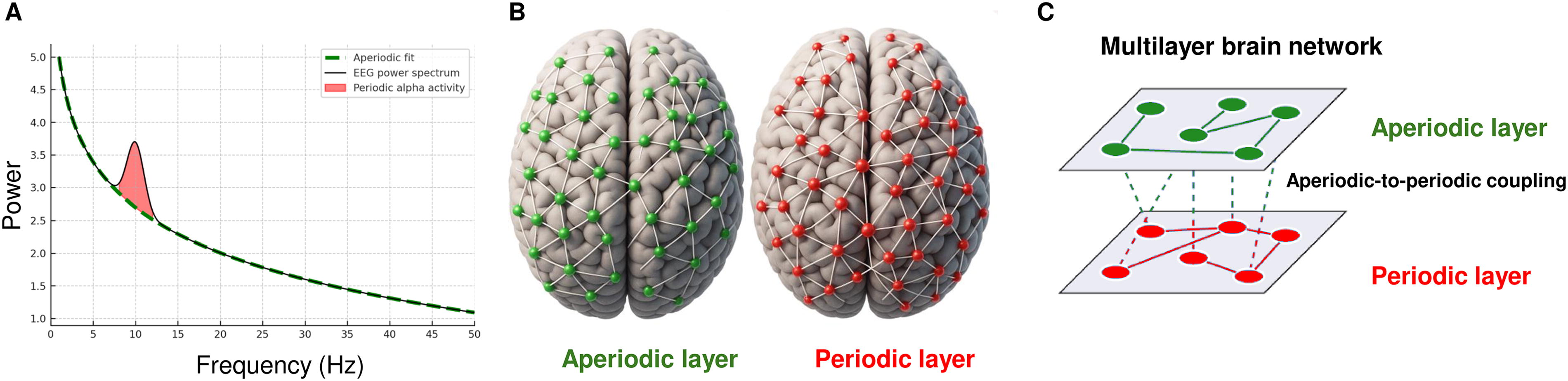
Multilayer network framework for electrophysiological networks.
The First Challenge: Aperiodic-to-Period Coupling?
There is increasing literature on the distinct characteristics of aperiodic and periodic electrophysiological signals. The aperiodic component is believed to relate to fluctuations in excitation–inhibition balance, which lack specific frequencies or scales, contributing to diverse, scale-free phenomena observed across different species and brain imaging modalities (Nanda et al., 2023). A recent article explored the origins of aperiodic, or broadband, EEG signals and their impact on traditional EEG interpretation. Using modeling, the authors show that aperiodic signals, which form a 1/f trend in EEG spectra, stem from neural activity that contributes to the overall broadband structure without disrupting the measurement of periodic rhythms (Brake et al., 2024). This was demonstrated experimentally by examining EEG changes under propofol, an anesthetic and GABA receptor agonist, which induced broadband spectral changes in line with known GABAergic effects, revealing a direct link between synaptic properties and aperiodic EEG components. Importantly, the model allowed the researchers to correct for these aperiodic influences, isolating delta-band power increases that correlated with loss of consciousness under anesthesia. This study highlights how aperiodic components in EEG reflect synaptic dynamics and how they interact with, yet are distinct from, oscillatory brain rhythms, offering a refined understanding of EEG background trends. A study utilizing MEG and advanced analytical methods revealed that aperiodic brain activity generates distinct and stable correlation patterns in the cortical regions, particularly in the anterior areas (Chaoul and Siegel, 2021). This finding suggests that both aperiodic and oscillatory signals contribute complementary to large-scale brain network interactions, likely reflecting different underlying neuronal mechanisms.
However, some recent studies suggest that the aperiodic and periodic signals may be influenced by common neuronal generators and, hence, be related. In a study, the authors explore how aperiodic power-law behavior in neural activity, observed in both resting and drug-modulated states, can be understood as the result of multiple damped oscillatory processes with various relaxation rates (Muthukumaraswamy and Liley, 2018). By separating periodic and aperiodic components in EEG, MEG, and ECoG data using irregularly resampled auto-spectral analysis (IRASA), the authors show that periodic alpha power correlates with high-frequency aperiodic activity. While not establishing a clear relationship, in another study, the authors investigated how respiration modulates both periodic (oscillatory) and aperiodic (nonoscillatory) brain activities (Kluger et al., 2023). The results reveal that while periodic oscillations are rhythmically synchronized with respiration, aperiodic activity also shows modulation linked to respiration, highlighting that common but overlapping mechanisms may influence both periodic and aperiodic activities.
Solution
The multilayer network framework may still be useful for studying the complex interactions in electrophysiological brain networks if there is indeed genuine cross-frequency coupling between periodic and aperiodic signals. However, “cross-frequency coupling” may not be the most appropriate descriptor for these interactions. A more accurate term is “aperiodic-to-periodic coupling,” which emphasizes the relationship between these components. It denotes the connectivity between aperiodic and periodic elements without implying directionality.
Aperiodic-to-periodic coupling can be assessed using direct measures for cross-frequency coupling or by using more abstract measures. Metrics for cross-frequency coupling are typically designed for narrowband signals; however, such an approach may not naturally capture the unique dynamics of interactions between aperiodic broadband and periodic signals. Examples of more abstract measures are estimated interlayer connectivity parameters using biophysical models. Previous work has used a multilayer Kuramoto model for this context (Tewarie et al., 2021). However, as Kuramoto models may be less suitable for aperiodic signals, alternative modeling approaches, such as residual analysis of multivariate autoregressive models (MVAR) (Dupré la Tour et al., 2017), to better characterize these aperiodic-to-periodic interactions. Additionally, temporal asymmetry metrics provide another lens for assessing interaction (Deco et al., 2022; Tewarie et al., 2023). When applied to aperiodic and periodic time series separately or in joint form, they can reveal subtle asymmetries in their dynamics that might indicate directional modulation (Hindriks et al., 2024b). Alternatively, information-theoretical approaches such as transfer entropy or mutual information can be employed to capture nonlinear dependencies between components.
The Second Challenge: Connectivity for Broadband Data
As mentioned in the previous paragraph, another challenge is the limitation of current functional connectivity metrics to handle broadband data or aperiodic signals effectively. This would apply to both periodic-to-periodic coupling and aperiodic-to-periodic coupling. Most conventional metrics, such as imaginary coherency (Nolte et al., 2004) and the phase-lag index (Stam et al., 2007), are developed for frequency-domain signals. Although these metrics could be combined across frequency bands to yield connectivity metrics for aperiodic signals, this is not a natural approach. There is, therefore, a need for new measures that naturally handle broadband data while being insensitive to signal leakage or volume conduction. Aperiodic signals are more naturally analyzed in the time domain, where connectivity metrics can be defined in terms of cross-correlation functions. An example is the Pearson correlation. However, the Pearson correlation is sensitive to signal leakage, which precludes its use for EEG and MEG data. Connectivity metrics that are insensitive to signal leakage can be obtained by exploiting the temporal irreversibility (if present) of the signals. For instance, the lagged correlation can be used (Mitra et al., 2015) or, more generally, any metric that quantifies the asymmetry of the cross-correlation function (Hindriks, 2021).
Third Challenge: Separate the Periodic and Aperiodic Components in Time Domain
The challenge of separating periodic and aperiodic components of neural signals in the spectral and time domains is critical for advancing multilayer network analyses in neuroscience. Current methodologies, such as fitting oscillations and one-over-F (FOOOF) and IRASA, provide robust frameworks for decomposing these signals in the frequency domain (Donoghue et al., 2020; Wen and Liu, 2016), but their application in the time domain remains less explored.
An approach to achieve this using FOOOF could involve first modeling the power spectrum as a combination of a 1/f aperiodic background and superimposed oscillatory peaks. The original signal could be transformed using the Fourier transform to retain both magnitude and phase. Now, the magnitude of the Fourier representation can be reconstructed by the modeled 1/f component and the phase extracted from the Fourier transform of the original signal. Applying the inverse Fourier transform would yield the aperiodic time-domain signal. The periodic component could be approximated by subtracting the aperiodic signal from the original time series. Likewise, for IRASA, one can apply an inverse Fourier transform to the frequency representation of the aperiodic and periodic components. Recent studies suggest that employing time-domain decomposition methods, such as the variational mode decomposition (VMD) or the empirical mode decomposition (EMD), could effectively separate the two components without the pitfalls associated with frequency-domain aliasing and end-point effects (Dou et al., 2024). For instance, the VMD method has been shown to adaptively decompose complex signals into intrinsic mode functions, which can then be analyzed separately for periodic and aperiodic characteristics (Dou et al., 2025). Additionally, the use of inverse Fourier transforms post-decomposition could facilitate the reconstruction of time-domain signals, allowing for a clearer delineation of connectivity patterns (Gerster et al., 2022). Future work will need to determine the suitability, accuracy, and robustness of these methods for reliably separating periodic and aperiodic components in the time domain.
Fourth Challenge: Integration with Higher-Order Networks
There is also growing literature that connectivity in the brain may be characterized by higher-order interactions, that is, interactions between more than two regions that cannot be reduced to pairwise or bivariate connectivity (Hindriks et al., 2024a). Though there is literature from physics and complex networks, incorporating higher-order and multilayer network information into a generalized higher-order multilayer network framework (Pal et al., 2024), it remains an open question whether such an integrated higher-order and multilayer network framework would not overcomplicate the handling of electrophysiological data and obscure the interpretability of results. To address this, surrogate data methods could be used to test whether observed interlayer connectivity (e.g., aperiodic-to-periodic) or higher-order interactions are statistically meaningful. This approach could help determine the appropriate level of model complexity based on empirical evidence, thereby avoiding unnecessary overfitting. When it is justified to increase complexity, it should be done incrementally and modularly. Network features, such as interlayer edges or higher-order structures, should only be added if they enhance explanatory power. This enhancement can be evaluated using model selection criteria or cross-validation.
Conclusion
Recent advancements in electrophysiology have highlighted the potential of multilayer network frameworks in analyzing EEG and MEG data, especially by capturing interactions across frequency bands and understanding the general properties of electrophysiological networks across frequency bands. However, recent research suggests that distinguishing aperiodic from periodic signals could yield a more natural and informative way to interpret these data, as aperiodic signals may reflect dynamics distinct from oscillatory and periodic rhythms. This shift prompts the need for more versatile connectivity metrics that can handle broadband and aperiodic data. Refining multilayer networks to incorporate these nuances without compromising simplicity and interpretability is crucial to advancing our understanding of complex brain networks.
Footnotes
Authors’ Contributions
All authors contributed to the conception and design of the article. Initial draft was written by P.K.B.T. Specific sections were written by R.H. and S.L. All authors edited the article.
Author Disclosure Statement
None of the authors reports any conflicts of interest.
Funding Information
No funding was received for this article.