




Abstract
The New World alphaviruses Venezuelan equine encephalitis virus (VEEV), eastern equine encephalitis virus (EEEV), and western equine encephalitis virus (WEEV) pose a significant threat to human health as the etiological agents of serious viral encephalitis through natural infection as well as through their potential use as a biological weapon. At present, there is no FDA-approved medical treatment for infection with these viruses. The Defense Threat Reduction Agency, Joint Science and Technology Office for Chemical and Biological Defense (DTRA/JSTO), is currently funding research aimed at developing antiviral drugs and vaccines against VEEV, EEEV, and WEEV. A review of antiviral drug discovery efforts for these viruses revealed significant gaps in the data, assays, and models required for successful drug development. This review provides a description of these gaps and highlights specific critical research areas for the development of a target-based drug discovery program for the VEEV, EEEV, and WEEV nonstructural proteins. These efforts will increase the probability of the successful development of a pharmaceutical intervention against these viral threat agents.
T
Despite this focus on development of countermeasures for VEEV, EEEV, and WEEV, much of the alphavirus research has been conducted using the prototype Old World alphaviruses, Sindbis virus (SINV) and Semliki Forest virus (SFV). This is due to their ease of culture, ability to be worked on under BSL-2 conditions, and relatively low level of virulence. While these studies have yielded valuable information regarding the biology and pathogenesis of these viruses, few of these observations have been experimentally validated in VEEV, EEEV, or WEEV. As a result, very little is understood regarding the pathogenesis of New World encephalitic alphavirus infection. In order to characterize VEEV, EEEV, or WEEV antiviral targets, much of the current knowledge derived from studies with SINV or SFV needs to be confirmed.
Viral-Directed Therapeutic Targets
The alphavirus nonstructural proteins (nsPs) are the primary mediators of viral replication and perform a variety of intracellular functions, making them attractive targets for antiviral-directed therapies. Nearly all the characterization of the nsPs has been conducted using SINV and SFV. Therefore, the identification and validation of the VEEV, EEEV, and WEEV nsPs as therapeutic targets will be an essential preliminary step in the discovery of alphavirus antiviral drugs. The known functions and enzymatic activities of alphavirus proteins are listed in Table 1. Several of these enzymatic activities have been targeted for the development of antiviral drugs in other viral species.15–29 These enzymatic activities, if confirmed in the VEEV, EEEV, and WEEV nsPs, represent appealing targets for antiviral intervention.
Identified Functions and Enzymatic Activities of Alphavirus Proteins
Studies with temperature sensitive mutants have shown that nonstructural protein 1 (nsP1) is essential for minus-strand RNA synthesis in SINV. 30 Further studies demonstrated a role for nsP1 in the initiation of minus-strand RNA synthesis in SFV. 31 Studies with SFV showed that nsP1 is responsible for anchoring the viral replication complex to the cellular membrane, and mutations that reduced the ability of nsP1 to bind to the membrane were lethal when introduced into the viral genome. 32 In vivo, it appears that nsP1 strongly interacts with nsP4, the polymerase subunit, and to a lesser extent nsP3, suggesting its localization with the replicase complex. 31 At least for the Old World alphaviruses, biochemical studies have demonstrated that nsP1 possesses guanine-7-methyltransferase and guanyltransferase activities, indicating a role for nsP1 in capping the viral genomic and subgenomic RNAs during transcription.31,33–35 While a conserved methyltransferase domain is present within the VEEV nsP1, the biochemical activity or role in RNA replication has not been experimentally verified. 36
To date, no antiviral therapeutic is clinically available that inhibits either viral RNA capping or minus-strand synthesis. Some research has been conducted aimed at developing compounds that inhibit viral RNA capping in dengue virus. 15 Enzymatic assays amenable to high-throughput screening (HTS) have been developed for the methyltransferase activity of dengue virus NS5, suggesting that similar assays could be developed for alphavirus nsP1. 37 Ribavirin and related analogs were shown to bind to the NS5 protein, providing a structural basis for further rational drug design or optimization. 15 Guanosine nucleotide analogs have been examined for their ability to inhibit SFV nsP1. These compounds possessed a Ki in the micromolar range and inhibited both the methyltransferase and guanyltransferase activity, suggesting that nsP1 is a viable target for antiviral drug development. 38
Nonstructural protein 2 (nsP2) has multiple enzymatic activities within infected cells and is essential for viral replication and maturation. In SFV, nsP2 functions as a replicase protein that regulates production of the subgenomic RNA by directly binding to the subgenomic promoter. 39 The N-terminal domain of nsP2 is involved in the capping of the viral RNA and has an NTPase activity that drives the RNA helicase activity of the protein.25,27,40 The C-terminal domain of the nsP2 also has a variety of functions. In Old World alphaviruses, the C-terminal domain of nsP2 is involved in the regulation of plus- and minus-strand RNA synthesis, targeting nsP2 to the nucleus, and in proteolytic processing of the nonstructural polyprotein.19,41–43 While most of the aforementioned studies have been conducted on the Old World alphaviruses, additional studies with VEEV have indicated that the enzymatic functions of nsP2 are highly conserved among the Old and New World alphaviruses. 44
The protease activity exhibited by the viral nsP2 and capsid protein, which plays a role in processing the structural polyprotein, are potential targets for therapeutic interdiction.19,43,45 Several serine protease inhibitors have been developed for the treatment of hepatitis C virus (HCV) infection and are currently in preclinical and clinical development.46,47 These compounds are predicted to be well tolerated, as evidenced by their high binding affinities, selectivity indexes, and pharmacokinetic profiles. 46 The VEEV nsP2 crystal structure has been solved, allowing for the development of rationally designed small molecule inhibitors. 48 The amino acid sequence of EEEV and WEEV nsP2 is 72% and 73% identical to VEEV, respectively, suggesting that development of pan-alphavirus antivirals may be feasible. The protease activity of nsP2 would likely be amenable to high-throughput screening, given that substrates could be engineered for use in fluorogenic or Förster resonance energy transfer (FRET) based high-throughput assays.
The nsP2 protein of SFV also possesses helicase activity, which is another potential target for therapeutic intervention. 49 Helicase activity has been exploited therapeutically, with drug candidates in preclinical development for both HCV and herpes simplex virus (HSV).50,51 Helicase activity of nsP2 may be amenable to HTS, as fluorometric assays have been developed for the HCV NS3 helicase. 51
Nonstructural protein 3 (nsP3) is a phosphoprotein that is essential for virus replication. It appears to function as a part of the minus-strand replicase and may be involved in plus-strand synthesis as well; however, the mechanism of action is not well understood. 22 Studies with SFV show that elimination of phosphorylation sites in nsP3 decreases the rate of viral RNA synthesis in SFV. 52 Similarly, studies with SINV indicate that reduced phosphorylation of nsP3 results in reduced minus-strand synthesis. 53 During the initial formation of the replication machinery, nsP3 forms a complex with nsP2, further suggesting a role in propagation of the viral genome. 54 Infection of cells with SINV leads to the localization of nsP3 in 2 different subcellular compartments. 55 One of these was isolated in conjunction with cell nuclei and was not further characterized. The second was localized in association with the endosome-like vesicles and plasma membranes and contained high concentrations of double-stranded RNA. These findings further support the role of nsP3 in viral replication. As with the other nonstructural proteins, these studies were conducted with SINV and SFV and may or may not represent the function of nsP3 in VEEV, EEEV, and WEEV.
Since the exact contribution of nsP3 in the life cycle of the virus has not been clearly identified, experiments will need to be conducted to determine if nsP3 possesses biochemical or enzymatic activities that could be inhibited to affect a positive therapeutic outcome.
Nonstructural protein 4 (nsP4) is the viral RNA dependent RNA polymerase (RdRp) and is directly responsible for the replication of viral RNA.56,57 Studies with SINV indicate that the concentration of nsP4 is tightly regulated by controlling the level of expression and rate of protein turnover in the infected cell. The bulk of nsP4 produced in cells is unstable and rapidly degraded; however, there appears to be a fraction that resists degradation. 58 It is theorized that this resistant fraction is associated with the RNA replicase complex and is therefore protected from degradation. 58 In vitro nsP4 has also been shown to have terminal adenyltransferase activity, which is believed to function in the maintenance and repair of the poly (A) tail of viral RNAs. 59
The RdRp function of nsP4 has been experimentally determined for SINV.56,57 There are several candidate antiviral compounds in various stages of development that target viral RNA polymerases. Both nucleoside- and non-nucleoside-based inhibitors of the HCV RdRp are currently undergoing clinical evaluation.60,61 The large number of drug candidates targeting the HCV RdRp in preclinical and clinical development suggests that nsP4 is a potential target to inhibit alphavirus replication. However, unlike HCV, alphaviruses regulate expression of their RdRp in a unique manner, and therefore it is unknown if nsP4 will be as viable a therapeutic target as is observed with other viral species.
Capsid protein assembly has been examined as a therapeutic target. Utilizing computational methods, antiviral compounds were designed to target the hydrophobic binding pocket of the SINV capsid protein. 62 Two candidate compounds were identified. Both compounds were dioxane-based and inhibited viral replication at a modest level (approximately 50%) at a concentration of 40 μM. These compounds appeared to have no signs of toxicity in vitro. These data provide the proof-of-concept for the development of an antiviral that targets alphavirus capsid assembly.
Candidate Host Derived Targets/Pathways
Several studies have been performed to elucidate the cellular events affected during alphavirus infection.63–70 Most of the work was conducted with SINV and SFV, with emerging studies performed using VEEV and WEEV. Understanding the virus interaction with the host is imperative for development of host-directed therapeutics, which is gaining increased attention with attempts to reduce antiviral resistance and focus on development of broad-spectrum antiviral therapeutics.
The alphaviruses have developed methods for interfering with the host cellular machinery, and nuclear localized viral proteins may be involved in this function. Several studies have shown the presence of a nuclear localization signal within nsP2 for both Old and New World alphaviruses, implying a role of nsP2 in host interactions.41,71 Studies with VEEV nsP2 show that in addition to a nuclear localization signal, this protein is also actively exported from the nucleus via the CRM1 nuclear export pathway. Disruption of the import or export of nsP2 from the nucleus inhibited viral growth, suggesting that the nuclear localization of nsP2 in VEEV-infected cells is a dynamic cycle that is necessary for optimal viral replication. 71 Additionally, nuclear translocation of capsid protein has been described for both Old and New World alphaviruses, and nuclear accumulation of capsid has been hypothesized to function in the modulation of host protein synthesis.72,73 Despite studies showing that nsP2 translocation to the nucleus is required for optimal viral replication, differences exist in the role of nuclear localized nsP2 between Old and New World alphaviruses. Studies with SINV indicate that nsP2 is cytotoxic and inhibits cellular transcription; 74 VEEV and EEEV nsP2 do not possess this function, but rather it is the capsid protein of VEEV and EEEV responsible for cellular transcription inhibition and cytotoxicity.75,76 The N-terminal domain of VEEV capsid has been shown to inhibit multiple receptor-mediated nuclear import pathways, preventing the transport of newly synthesized cellular proteins into the nucleus. 77 A characterization of the molecular mechanisms of nsP2 or capsid transcriptional inhibition and cytotoxicity will be critical to understanding aspects of VEEV, EEEV, or WEEV pathogenesis. Defining the eukaryotic proteins that interact with nsP2 or capsid will allow for the identification of novel host derived targets and will open new avenues of therapeutic research.
Cells infected with SINV and SFV undergo apoptosis.69,70 It has been hypothesized that SINV-induced neuronal apoptosis may be triggered through a mitochondrial pathway. 78 SINV infection was shown to induce the release of ceramide, a stimulator of mitochondrial cytochrome c release. 78 These preliminary observations suggest that ceramide release is a critical step in the induction of alphavirus-induced apoptosis. Additional studies suggest that the prevention of apoptosis in infected cells may have an attenuating effect on VEEV, EEEV, or WEEV pathogenesis. The anti-apoptotic protein Bcl-2 has been shown to prevent apoptosis in vitro in SINV- and SFV-infected cells.68,79 Further, protection against fatal SINV infection was achieved by infection with chimeric viruses expressing Bax, Bcl-2, or beclin, a bcl-2 interacting protein.79–81 Mice infected with these chimeric viruses had increased survival and lower viral titers in the brain, underscoring the importance of the prevention of apoptosis in controlling viral pathogenesis. These results suggest that modulation of cellular pathways, thereby preventing virally induced apoptosis, may be a viable strategy for host-directed therapeutic development.
Some alphaviruses are able to block the induction of IFN-α/β, which allows for viral replication and subsequent infection through the global shutoff of cellular transcription and translation. 82 The role of interferon in VEEV pathogenesis was assessed using IFN-α/β receptor and interferon regulatory factor (IRF-1 and IRF-2) knockout mice. In these mice, altered viral dissemination, clearance, and pathology were observed following infection. 83 The 100% protection normally conferred by administration of an attenuated VEEV strain in wild-type mice was not achieved in IRF-1 or -2 knockout mice, suggesting a role for interferon and IRF in the protection from VEEV infection. 83 PKR, a major effector of the interferon-induced antiviral state, has been shown to play a significant role in the suppression of SINV and SFV replication.84,85 Using siRNA and PKR knockout mice, it was demonstrated that PKR contributed to delays in viral production and caspase-3 activation and reduced the yield of infectious virus. 84 Studies have also identified a PKR-independent mechanism for the inhibition of the translation of viral proteins, suggesting that multiple antiviral gene products may be induced upon alphavirus infection.84,85
The secretion of IFN-α/β induces a variety of cellular alterations, including the induction of hundreds of interferon-stimulated genes (ISGs). Using chimeric SINV virus expressing selected ISGs, IFN-α/β receptor knockout mice were infected and examined for attenuation of SINV infection. 86 ISG15, a ubiquitin homolog, was identified as having antiviral activity against SINV infection in vivo. 86 While the function of ISG15 remains unknown, its antiviral activity has been demonstrated against influenza and herpes viruses, suggesting it may have broad spectrum activity. 87 Additional ISGs have also been implicated in the control of alphavirus infection. Increased expression of ISG12 was shown to significantly delay mortality in mice infected with SINV. 88 Taken together, these results suggest that the ISGs may represent an important antiviral mechanism for the control of alphavirus infection. It will be necessary to determine the role of the ISGs in the control of VEEV, EEEV, or WEEV infection to ascertain if they will represent viable therapeutic points of interdiction.
Little is known regarding the host cell signaling pathways required for alphavirus infection and replication. Retroviral insertional mutagenesis has been used to select for cellular clones that were resistant to SINV infection. 89 Resistant clones were identified that produced significantly less virus than the wild-type cells but had similar rates of viral binding and fusion. The resistant clones contained mutations in the neurofibromin 1 (NF1) gene. Independent down regulation of NF1 expression resulted in decreased viral production and increased cell viability. NF1 functions as a negative regulator of the Ras signaling pathway. 90 When cells that constitutively activate the Ras signaling pathway were infected with SINV, there were significant delays in virus production and virally induced apoptosis.89,91 These results suggest that the modulation of the Ras signaling pathway may play a role in the suppression of viral replication.
It has been demonstrated that interferon gamma (IFN-γ) aids in the clearance of SINV virus from neurons. 92 IFN-γ was shown to reduce viral protein synthesis, inhibit viral transcription, and aid in the recovery of cellular protein synthesis. Cells treated with IFN-γ also possess increased viability and ability to clear the viral infection. In order to elucidate the cell signaling pathways responsible for the IFN-γ induced viral clearance from neurons, the responses of SINV-infected neurons were examined. 93 Treatment of SINV-infected neurons with IFN-γ resulted in increased phosphorylation of the cell signaling protein STAT. Inhibition of the Jak protein kinase with a chemical inhibitor completely inhibited the antiviral activity of IFN-γ and eliminated its neuroprotective effects. These data would suggest that the Jak/STAT signaling pathway is critical for the IFN-mediated clearance of SINV from neurons, thus representing another point of potential host-directed therapeutic intervention.
A global analysis of the cellular signaling pathways targeting kinases, phosphatases, and host transcription factors required for VEEV, EEEV, or WEEV replication would represent an invaluable first step in defining multiple host targets for therapeutic intervention. Previous studies with other biodefense pathogens suggest that gene knockdown by antisense technologies can be successfully used to identify host genes required for viral replication or pathogenesis. 94
Candidate Neuroprotective Interventions
The pathology of alphavirus infection results, in part, from the host response to infection. Comparison of neurovirulent and avirulent strains of SINV were used to study differences in CNS gene expression studies of 10-day-old mice. 66 A significant increase in the expression levels of 2 CC chemokines with neuroprotective and proinflammatory effects in the CNS was observed. Further, RANTES and MCP-1 were detected in mouse brains infected with a neurovirulent SINV strain but not in the avirulent strains. Previous studies have shown that up regulation of MCP-1 in mouse brains infected with SINV may act as an IFN-regulated gene critical for protection against SINV infection. This observation would suggest that chemokines may play a role in protection from SINV infection.66,67 Increases in the expression of host genes involved in protein degradation and complement proteins were also detected. While the role of these chemokines and protein degradation is not clear, a more detailed understanding of the antiviral response to New World alphavirus infection in the CNS will provide essential data that will inform therapeutic development.
Drugs that decrease the neurotoxicity of viral infection may be a successful strategy for therapeutic intervention. The amino acid glutamate can induce neuronal death when present in excess. The mechanism of toxicity is related to the influx of Ca2+, which is mediated through glutamate receptors (NMDA, AMPA, and kainic acid). NMDA receptor antagonists have been shown in vitro to protect neurons from SINV-induced death. 95 However, NMDA receptor antagonists were not effective at protecting mice against fatal disease. 96 Protection from fatal disease was observed upon treatment with the AMPA receptor antagonist talampanel, a drug currently undergoing clinical evaluation for the treatment of gliomas. 97 Attenuation of CNS inflammation but no decrease in viral replication was observed upon treatment with talampanel, suggesting that compounds capable of decreasing CNS inflammation may provide a therapeutic benefit in alphavirus infections.
Other neuroprotective interventions have also been examined in a SINV murine fatal encephalomyelitis model. The tetracycline derivative minocycline and the opioid receptor antagonist naloxone both conferred protection from SINV-induced paralysis.98,99 Both drugs decreased the production of the proinflammatory cytokine interleukin-1, suggesting that reducing a detrimental host response may be of therapeutic value. However, these compounds have yet to be evaluated for efficacy in VEEV, EEEV, or WEEV infection. It remains to be determined if the modulation of host inflammatory pathways will provide a substantive therapeutic benefit against New World alphavirus infection.
Assays for Drug Screening
Assays amenable to high-throughput screening (HTS) of chemical compound libraries are critical for successful drug discovery. For HTS of enzymatic function, the proteins of interest must be characterized biochemically. At present, no VEEV, EEEV, or WEEV nonstructural proteins have been sufficiently characterized. The nsP4 protein of SINV has recently been characterized. 57 Purified nsP4 was able to produce minus-strand RNA de novo from plus-strand templates. The enzyme was also capable of adding adenosine residues to the 3′ end of an RNA substrate. Optimal reaction conditions (pH, time, Mg2+, protein concentrations) were determined, suggesting that such an assay could be modified to support a high-throughput screening to identify inhibitory compounds for VEEV, EEEV, or WEEV.
A preliminary biochemical characterization of the RNA helicase activity of nsP2 was conducted in SFV. 49 Unwinding of radio-labeled dsRNA required nsP2, Mg2+, and NTPs. These data provide an initial framework for the development and characterization of nsP2-based enzymatic assays. While in vitro protein-based HTS will identify compounds capable of enzymatic inhibition of the nsPs, such screens will be incapable of differentiating between compounds capable of cellular entry. Thus, live virus cell-based infection assays will also be required.
There have been several efforts to develop fluorescently labeled viruses to measure viral infectivity and replication in cell culture. Tamberg et al. developed a chimeric virus in which enhanced green fluorescent protein (EGFP) was inserted between the nsP3 and nsP4 sequences of SFV. 100 The virus was viable and genetically stable and expressed EGFP as a molecular marker. 100 While the development of assay systems for the study of alphaviruses is an area of current research, the area is relatively immature as the assays are not yet well characterized or widely used. Examples of assays existing or under development include GFP or luciferase-tagged viruses, cell free systems to investigate capsid assembly, and VEEV replicon-based assays.
Animal Models
Natural VEEV, EEEV, and WEEV infection acquired by mosquito bite is characterized by a sudden onset of flulike illness that may include headache, chills, fever, photophobia, sore throat, myalgia, and vomiting. Illness may progress to mild or severe neurologic disease characterized by lethargy, paralysis, seizures, coma, and altered mental status, with children more likely to experience neurologic involvement.101,102 Since the initial isolation in the late 1930s, aerosolized VEEV has caused at least 150 laboratory-acquired infections and 1 death. 1 Several reports describing the progression of illness in humans following aerosolized VEEV exposure indicate that disease resulting from aerosol exposure is similar to disease caused by mosquito transmission.2–4 Regardless of whether the disease is acquired by natural infection or laboratory-acquired infection from aerosolized VEEV, in most cases an abrupt onset of fever, muscle pain, and vomiting was observed with occasional signs of lethargy. 3 There are vastly fewer accidental laboratory exposures to WEEV, with only 5 reported cases, 2 of which were fatal; however, 1 fatal case was likely due to an accidental needle-stick rather than aerosol exposure.103–106 Although these documented cases indicate that aerosol exposure to WEEV can cause fatal illness, the lack of detailed clinical accounts of laboratory-acquired disease makes it difficult to determine if the progression of disease from aerosol WEEV infection is similar to the natural route of transmission. There are no reported human cases of infection resulting from aerosol exposure to EEEV, making it similarly difficult to compare illness caused by aerosol infection versus natural infection.
Development of an animal model that is representative of the natural history of human infection is important from a regulatory perspective. However, the development of a model that possesses defined measureable endpoint(s), such as lethality, can prove to be useful during the early evaluation of potential drug candidates. For biodefense applications, predictive animal models are essential for licensure under the U.S. Food and Drug Administration (FDA) Animal Rule. 107 While multiple animal models exist for VEEV, EEEV, and WEEV, a further refinement and characterization of these models, especially for aerosol exposure, will likely be required for licensure of an antiviral drug product effective against these viral agents.
Pathogenesis of VEEV in small animals is dependent on several host and viral factors, including animal species, age of host, route of infection, viral strain, and challenge dose.108–110 Consistent with observations in humans, the lymphatic system and CNS appear to be target organs in small animals.109,110 However, while VEEV causes lethal illness in mice and hamsters, febrile disease with CNS involvement was observed in mice, while febrile illness without neurologic signs was observed in hamsters.108–111 Disease progression of VEEV in hamsters is significantly more rapid in comparison to mice, with hamsters succumbing to infection prior to neuroinvasion. 112 In NHPs, VEEV infection is characterized by a biphasic febrile response with lymphatic system involvement. 112 Although lesions of the CNS have been observed following VEEV infection of NHPs, clinical signs of encephalitis are not necessarily observed and, if present, are generally mild. 112 In mice, the mechanism of neuroinvasion through the olfactory bulb is consistent with the proposed mechanism in nonhuman primates (NHPs). During a natural infection, virus circulating in the blood migrates to the brain through the olfactory bulb, whereas following aerosol exposure the virus can directly infect the olfactory bulb, bypassing the requirement for viremia.109,113,114 Despite this similarity, the severity of neurological symptoms differs between mice and primates, with severe CNS involvement rarely observed in NHPs.112,115 The lethal nature of VEEV in mice coupled with the ability to cause severe CNS disease suggests that the mouse is an appropriate small animal model for the early evaluation of antiviral agents for VEEV. However, unlike illness observed in nonhuman primate models of VEEV aerosol infection, clinical data from laboratory-acquired infections indicate that in humans illness is not characterized by a biphasic febrile illness, but similar to NHPs neurologic symptoms were generally mild.3,112 Although these data demonstrate that some aspects of VEEV infection in NHPs correlate with disease following aerosolized VEEV exposure in humans, further research is required to ensure that NHP models adequately represent illness characteristics of aerosol VEEV exposure in humans. It may be that additional exploratory studies are required to identify alternative animal species whose symptomatology of VEEV aerosol exposure more accurately represents human infection.
EEEV causes lethal encephalitis in both mice and hamsters. However, recent data suggest that the hamster might be a more appropriate small animal model, since it more accurately depicts the natural history of EEEV infection in humans. EEEV infection in mice produces encephalitis without vascular manifestations. In contrast, hamsters inoculated subcutaneously developed fatal encephalitis with vascular manifestations, a finding typical of fatal disease in humans.116-118 Although the hamster model for aerosolized EEEV is uniformly lethal, unlike human infection, the pathological manifestations correlate to observations of fatal EEEV illness in humans. This suggests that the hamster might be an appropriate small animal model for the preliminary testing of antiviral drugs for EEEV. Additional studies are needed to determine if the pathology in hamsters following subcutaneous infection is similar to EEEV pathogenesis following aerosol exposure. Studies aimed at developing NHP models to evaluate EEEV vaccine candidates showed that aerosol exposure to EEEV caused lethal encephalitis in cynomolgus macaques, although several NHPs developed viremia and mild febrile response with variable neurological symptoms. 119 Although there are no reported cases of human exposure to aerosolized EEEV for comparison, these results resemble natural EEEV infection in humans. Specifically, EEEV infection in humans transmitted through mosquitoes ranges from mild illness to severe encephalitis with a mortality rate reported as high as 30% and a high rate of postinfection neurological sequelae. 101 The progression of disease, clinical observations, and the variable nature of EEEV infection observed in NHPs suggest that cynomolgus macaques may be a suitable model for aerosol exposure to EEEV. However, more research, including a detailed pathological characterization, is needed to determine if EEEV infection in NHPs recapitulates illness observed in human infections.
WEEV is not uniformly lethal in mice and depends on route of exposure, age of the animal used in the study, and challenge dose.6,7,120,121 Mice exposed to WEEV via intracerebral or intranasal routes progressed to fatal encephalitis, which was dependent on virus dose. In contrast, intradermal and subcutaneous exposure resulted in lethal encephalitic disease in only half of the infected mice and was independent of virus dose. 120 Studies report that WEEV is severely neurovirulent and fatal in hamsters and guinea pigs irrespective of the route of infection.122,123 Following aerosol exposure of WEEV, cynomolgus macaques developed febrile illness followed by clinical signs of encephalitis that rapidly increased in severity, although the dose given was not uniformly lethal. 124 While the reported fatality rate of aerosol exposure of WEEV infection in humans is higher than mosquito transmission, given that there are so few documented cases of WEEV aerosol exposures, it is difficult to determine if this fatality rate is accurate. Further, without well-characterized data describing the progression of illness following WEEV aerosol exposure in humans, it is difficult to ascertain if aerosol exposure in NHPs recapitulates characteristics of human aerosol infection. However, the clinical illness in NHPs exposed to aerosolized WEEV is consistent with symptoms observed in natural WEEV infection in humans, which is characterized by fever, leukocytosis, and neurological signs of encephalitis. These data suggests cynomolgus macaques may be a suitable model for aerosol exposure to WEEV; however, further characterization is clearly needed. 124
Regulatory Challenges to Alphavirus Medical Countermeasure Development
The desired biodefense indication for an alphavirus medical countermeasure is for efficacy against an aerosol exposure to VEEV, EEEV, and WEEV. Since these viral infections are arthropodborne, such exposures do not occur in nature. Further, very little is understood regarding the natural history of an aerosol infection (ie, clinical manifestations, therapeutic window of opportunity, CNS entry) versus a naturally occurring infection. Without these data it will be almost impossible to correlate pathology data observed in aerosol challenge animal models to the clinical manifestations of aerosol exposure in humans, thereby hindering validation of animal models required for the FDA approval process. The initial label indication obtained for an encephalitic alphavirus drug product will likely be for the treatment or postexposure prophylaxis of an aerosol exposure. This is due to the focus of funding efforts for biodefense applications, the infeasibility of a field clinical trial for an indication against mosquitoborne illness, and the ability to license a drug product under the auspices of the FDA Animal Rule. 107 Thus, research support should focus on supporting studies such as animal model characterization, which will facilitate regulatory approval.
Any drug product that would be developed as an alphavirus therapeutic would be subject to regulatory approval from the FDA. In order to receive a true therapeutic or treatment indication, a clinical or virologic marker would be required by the FDA for licensure. Such a marker could be viremia, febrile illness, or the inception of encephalitic illness. The latter would require a drug product capable of crossing the blood-brain barrier and would potentially be a highly rigorous test for any candidate therapeutic. A clear delineation of the measures for a treatment indication will be required early in preclinical development. This will ensure that resources are not applied to a drug product incapable of preventing the stages of VEEV, EEEV, or WEEV illness that will be required to receive such an indication.
Research Areas to Inform Alphavirus Therapeutics Development
This review highlights many important scientific gaps that will impede the development of a medical therapeutic for alphavirus infection. Based on the research gaps, recommendations regarding research direction can be provided to answer key scientific questions and advance candidate products in the developmental pipeline. Figure 1 provides the current status of drug discovery for an alphavirus antiviral therapeutic and lists prospective areas of research. An investment in these areas of research will likely increase the probability of developing a successful alphavirus antiviral drug candidate.
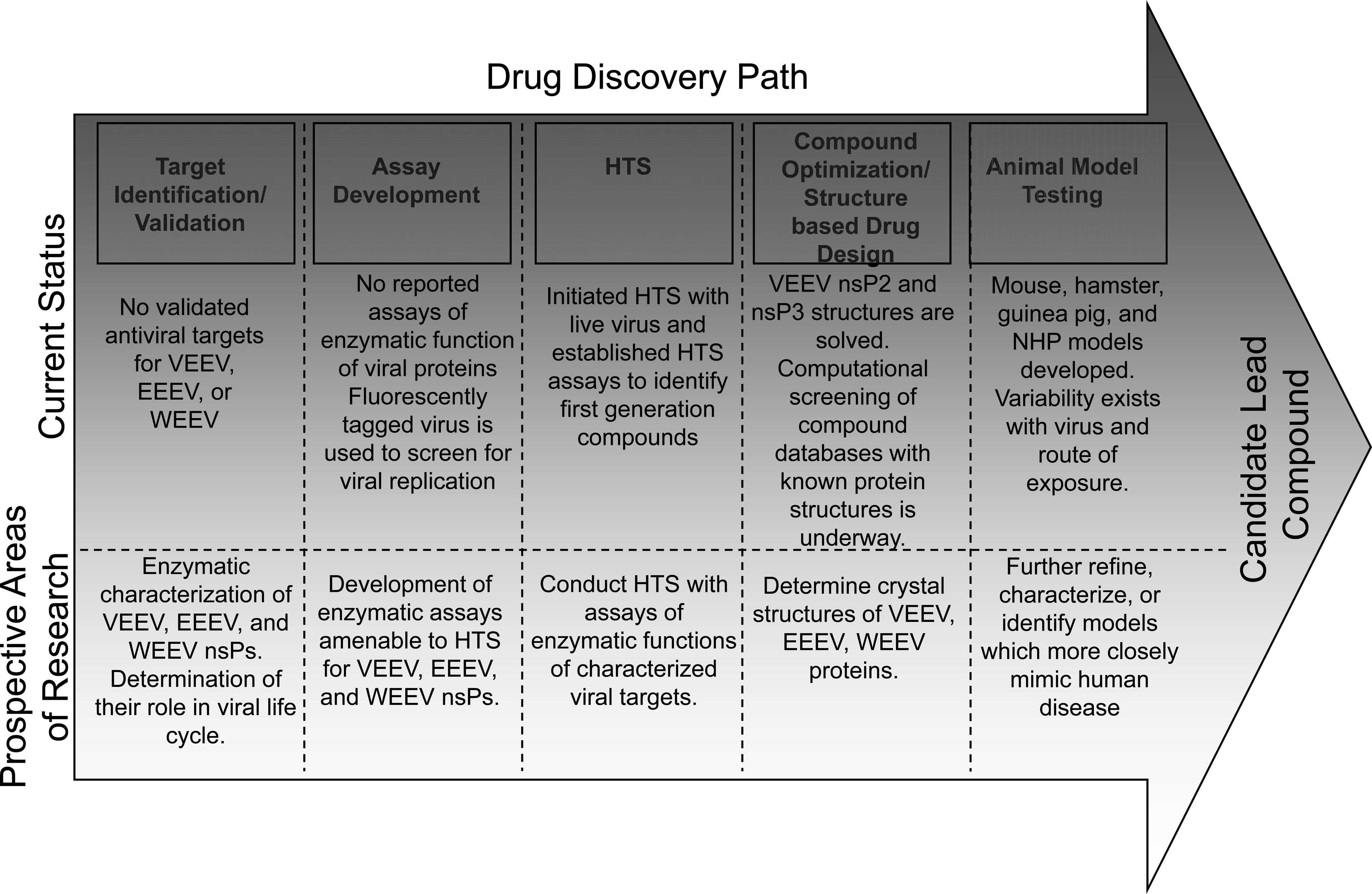
Current status of drug discovery for an alphavirus antiviral therapeutic and prospective areas of research
Basic Research
The development of structure activity relationships of lead compounds is an essential component of drug discovery. As such, structural predictions of target viral proteins need to be elucidated. To date, the only published reports of structural data for New World alphavirus proteins are for VEEV nsP2 and nsP3.48,125 It will be essential to determine the crystal structures of VEEV, EEEV, and WEEV nonstructural proteins and perform structural analysis to identify homologous structural domains. Of the nsPs, nsP2 and nsP4 are more characterized and represent probable targets of antiviral intervention because of similar enzymatic activities targeted in other viruses. Ideally, protein purification protocols will need to be developed to purify native forms of these proteins, as the only structural data generated to date have been with truncated forms of nsP2. Such research represents a high priority for the development of a target-based drug discovery program for VEEV, EEEV, or WEEV.
In addition to structural determination of the nsPs, an elucidation is needed of the contribution of nsPs to the viral life cycle, with a focus on determining enzymatic activities, interactions with host cellular proteins, and contributions to viral replication and pathogenesis. No enzymatic function in terms of viral replication has been experimentally determined for VEEV, EEEV, or WEEV nsPs. Thus, it will be essential to experimentally verify if the enzymatic functions and role in the viral life cycle that have been determined for the SFV and SINV nsPs are conserved in VEEV, EEEV, and WEEV. Since these functions are likely conserved in VEEV, EEEV, and WEEV, studies that confirm function simultaneously across viral species will be the most expedient route to addressing this research gap. These data will be critical in determining if the nsPs are viable antiviral targets.
Viral entry into the CNS represents the penultimate step to severe clinical illness. Various studies have provided potential mechanistic explanations of viral entry into the CNS, but the exact mechanisms remain unclear. In the model systems examined, there appear to be differences in CNS entry between VEEV and EEEV.113,118 An understanding of the differences in viral pathogenesis as it relates to CNS entry will be essential in targeting therapies that are capable of preventing CNS pathology against VEEV, EEEV, and WEEV infection. Additionally, there is little available data on the mechanisms of CNS entry for VEEV, EEEV, or WEEV following an aerosol exposure, particularly in NHPs. Data from small animal model challenge studies suggest that the route of exposure is an important factor in determining the frequency of progression to neurologic illness. Aerosol challenge data in NHPs is much more limited, and it is unclear if the route of exposure in NHPs is a factor in the development of neurologic illness. Since the murine aerosol model may not entirely be reflective of the disease seen in the limited number of human aerosol infections, it is unknown if the murine model will be of use in determining mechanisms of CNS entry. While an understanding of the mechanisms of CNS entry and an elucidation of the key differences in routes of exposure and pathogenesis will reveal important aspects of VEEV, EEEV, and WEEV biology, these studies are not immediate priorities for therapeutic development.
The host cell signaling pathways involved in VEEV, EEEV, or WEEV pathogenesis remain largely uncharacterized. An understanding of these pathways will provide information on the molecular mechanisms of pathogenesis and may reveal novel, host-derived therapeutic targets. Due to their eukaryotic origin, these targets would be less prone to the development of drug resistance. Additionally, a determination of a common cellular pathway exploited between both New World and Old World alphaviruses would further define the phylogenetic relationship and evolutionary origin of this family of viruses. While defining the host cellular pathways essential for viral replication would facilitate the development of novel host-targeted therapeutics, such classes of antiviral drugs represent a far-term goal and should be considered a lower research priority. However, applied drug discovery efforts using high content imaging assays can be utilized to screen drug or siRNA libraries to identify host proteins required for virus replication.
Applied Research
Because of the paucity of information regarding the biochemical activities and mechanistic contributions of the nsPs of VEEV, EEEV, and WEEV, high-throughput screening against specific viral proteins cannot be conducted to identify candidate antiviral compounds. Thus, near-term drug discovery efforts must employ established live virus HTS assays to initiate drug screening efforts for VEEV, EEEV, and WEEV. Established screening platforms that use biochemical assays (eg, capsid assembly) and have demonstrated proof-of-concept HTS capabilities could also be employed to diversify screening efforts. Results for these studies will identify initial compounds with in vitro antiviral activity and represent potential immediate effort for the identification of novel viral and host-targeted therapeutic compounds.
As a component of near-term efforts, computational screening of existing VEEV protein structures should be employed. These efforts are low cost, as they do not require the expense of reagents and personnel required for the screening of large compound libraries. As biochemical assays amenable to HTS are developed for the VEEV, EEEV, and WEEV nsPs, computational modeling will become an integral and complementary component of the drug screening process. This will allow for targeted prediction in candidate molecule improvement and will greatly aid in the optimization of compounds through medicinal chemistry.
Although the first series of VEEV, EEEV, or WEEV candidate therapeutics will possess antiviral activity, little will be known about their ability to prevent illness when given at various time points postexposure. Therefore, it will be critical to determine the temporal parameters of therapeutic administration. While the rationale for these experiments is readily apparent to anyone developing antiviral drugs, these data will be critical in developing a concept of operations for military use. For example, candidate compounds with narrow therapeutic windows for administration will be of little value to forward-deployed military personnel. As such, data from these studies will provide invaluable criteria for the down selection of initial drug candidates.
Once the biochemical and enzymatic properties of the nonstructural proteins are elucidated, HTS assays should be developed to perform compound library screens on specific protein targets. Screening of protein targets possesses significant advantages over live virus screens, since compounds are identified to have activity against a known target, thus providing information regarding mechanism of action. Further, compounds identified in protein-based screens can be optimized in a rational fashion based on known structural data. The HTS assays will need to be highly reproducible, use affordable reagents, and be conducted in minimal reactions volumes. Upon development, these assays will be able to be coupled with structural data and computational modeling in order to conduct compound screening and analysis in BSL-2–level containment. Overcoming the need for high-level biosafety containment would represent a significant increase in capability in the study of VEEV.
At present, there is no small animal model that is entirely representative of infection in humans. There are variances in route of infection, progression of illness, and pathology between VEEV, EEEV, and WEEV infection in small animals. Therefore, exploratory studies should be conducted to identify whether alternative small animal models exist that more accurately reflect disease in humans. Such an animal model would be an invaluable tool to achieving licensure of a VEEV, EEEV, or WEEV drug product.
The interaction of alphaviruses in NHP models is even less characterized compared to small animal models. There is a lack of uniformity of lethality in NHP models, which is dependent on the virus and route of exposure used. An extensive characterization of these models should be considered a high priority. Such studies could aid in improving the overall uniformity of the animal model and may identify a model that is most representative of human infection. As with small animal model development, the establishment and characterization of a reproducible NHP or large animal model will be critical for regulatory approval of a VEEV, EEEV, or WEEV drug product.
Conclusion
The development of an alphavirus therapeutic would represent a significant improvement in the defensive posture against these viral threat agents. Historically, there has been a minor investment in pharmaceutical-based countermeasures for alphaviruses within the biodefense community. As a result, many essential elements for successful drug discovery are underdeveloped or missing. From a basic research standpoint, very little is understood regarding the molecular mechanisms of pathogenesis for VEEV, EEEV, and WEEV. While a limited number of studies conducted in model systems like SINV and SFV have provided some insight into the mechanisms of pathogenesis and host response, the proportion of data that will be applicable to VEEV, EEEV, and WEEV is unknown. A continued and robust basic research investment will address these gaps and will provide additional information on identified therapeutic targets and/or reveal novel host-directed targets for antiviral therapy.
In terms of countermeasure development, there are many technical questions, research tools, and model systems that will need to be addressed and developed to allow for a reasonable chance of successful drug development. Upon the identification of compound hits in an HTS, it is standard practice to use structural models to develop a structure activity relationship to optimize the compound's activity. At present, the only published crystal structures for these viruses are the VEEV nsP2 and nsP3 proteins.48,125 Given the sequence identity of VEEV, EEEV, and WEEV proteins (approximately 70%), it is unknown how structurally conserved candidate therapeutic targets will be across this viral family.
Biochemical assays amenable to HTS are another essential tool for drug development. These assays allow for the rapid and efficient screening of large compound libraries against protein targets and are the foundation of many drug discovery efforts. The enzymatic functions of viral proteins of SINV and SFV have been described, but these activities have not been described for the VEEV, EEEV, and WEEV viral proteins. While it is likely that these functions are conserved, experimental validation will be required before their selection as a drug target. Further, enzymatic assays will need to be developed to facilitate HTS of compound libraries. Thus, there is a need to determine the biochemical properties of the various VEEV, EEEV, and WEEV nsPs in order to facilitate the development of reproducible assays for drug screening.
Animal models that depict the natural history and pathology of infection in humans are essential to FDA licensure of medical countermeasures under the Animal Rule. 109 While there are several small animal models for VEEV, EEEV, and WEEV infection that have been described, none are fully representative of the clinical course of infection in humans. Thus, a continued research investment will be needed to either identify additional, more representative small animal models or to further characterize existing models to enhance the body of data. Current NHP models suffer from similar deficiencies. The variability in NHP response to VEEV, EEEV, or WEEV challenge will make the determination of correlates of drug efficacy problematic. The identification of additional NHP species that are more uniform in response to VEEV, EEEV, or WEEV challenge will aid in the preclinical evaluation of a lead candidate therapeutic.
This report describes the current state of knowledge regarding the encephalitic alphaviruses VEEV, EEEV, and WEEV and highlights specific research areas critical to the development of medical therapeutics for these agents. Through an analysis of these gaps, a research strategy can be formulated to allow for the greatest probability of success. It is our hope that by communicating these gaps we are able to engage a wider community of researchers to address these areas of scientific discovery.