




Abstract
The National Institute of Allergy and Infectious Diseases (NIAID) Radiation/Nuclear Medical Countermeasures Development Program has developed an integrated approach to providing the resources and expertise required for the research, discovery, and development of radiation/nuclear medical countermeasures (MCMs). These resources and services lower the opportunity costs and reduce the barriers to entry for companies interested in working in this area and accelerate translational progress by providing goal-oriented stewardship of promising projects. In many ways, the radiation countermeasures program functions as a “virtual pharmaceutical firm,” coordinating the early and mid-stage development of a wide array of radiation/nuclear MCMs. This commentary describes the radiation countermeasures program and discusses a novel business model that has facilitated product development partnerships between the federal government and academic investigators and biopharmaceutical companies.
Recognizing these challenges, the NIAID Radiation/Nuclear Medical Countermeasures Development Program (hereinafter called the radiation countermeasures program) has developed an integrated approach to MCM research and product development. Working in close partnership with academic partners and industry, the radiation countermeasures program contributes critical resources, services, and expertise to the discovery and development of radiation/nuclear countermeasures. The objectives are to lower the opportunity costs and reduce the barriers to entry for companies interested in working in this area and to accelerate translational progress toward a mature product with an improved chance of FDA approval by providing goal-oriented stewardship of promising projects. In many ways, the radiation countermeasures program functions as a “virtual pharmaceutical firm,” coordinating the early and mid-stage development of a wide array of radiation/nuclear MCMs.
The NIAID Radiation Countermeasures Program
The mission of the radiation countermeasures program is to sponsor the research and early development of new MCMs to mitigate or treat damage caused by unintentional radiation exposure. A combination of grants and contracts for basic research, translational research, and product development has been designed to facilitate this objective. The radiation countermeasures program's budget has been between $45 and $50 million annually since the program began in 2005.3,4 The flagship grant program consists of the Centers for Medical Countermeasures against Radiation (CMCRs). 5 The centers are located at 7 academic research universities and serve as the early-stage research and discovery engine for the program. The CMCRs have dedicated funding reserved for large projects as well as small pilot projects that allow scientists to test innovative ideas and build proof-of-concept data for high-risk ventures. The radiation countermeasures program also supports a number of related basic research programs focused on particular aspects of radiation-induced organ damage or radionuclide intoxication that are described in depth elsewhere.4,6,7
To help provide funding opportunities for small businesses, a focused radiation/nuclear MCM small business innovation research (SBIR) grant program was recently initiated with expanded funding limits and timelines. 8 When appropriate, the radiation countermeasures program has guided investigators to other programs at NIH that provide relevant translational resources and services (eg, the NIH Rapid Access to Interventional Development [RAID] program) and facilitated collaborations with the Radiation Research Program at the National Cancer Institute (NCI).9,10 Once a compound that is under development by a CMCR, academic investigator, or company has met certain criteria (explained below), the radiation countermeasures program can use a product development support services contract to conduct further studies at no cost to our partners.
Under the guidance of and in collaboration with NIAID staff, grantees and contractors generate the preclinical and Phase I pipeline that could lead to advanced development, licensure, and procurement of radiation/nuclear MCMs that would be supported by other components of the federal government. For example, the radiation countermeasures program works in close partnership with the Biomedical Advanced Research and Development Authority (BARDA) within the U.S. Department of Health and Human Services (HHS) Office of the Assistant Secretary for Preparedness and Response (ASPR). BARDA supports the advanced development and procurement of MCMs for the Strategic National Stockpile, which, after the initial purchase by BARDA, is managed by the Centers for Disease Control and Prevention (CDC).
The Radiation Countermeasures Program Value Proposition
In the business world, a value proposition is an analysis and review of the benefits, costs, and value of a product or service that an organization can deliver to customers, partners, and other constituent groups. Fundamentally, a value proposition summarizes why a consumer or firm should buy a product, use a service, or establish a strategic alliance. NIAID program managers have consciously attempted to define and articulate the core value proposition that the radiation countermeasures program offers its private sector partners and the U.S. government medical countermeasures enterprise as a whole. The elements of the radiation countermeasures program value proposition are summarized below.
Align Programmatic Goals
The radiation countermeasures program uses several approaches to speed government-sponsored translational research. The first focuses on integrating and aligning our many sponsored investigators with the programmatic goals of the radiation countermeasures program. These goals include developing treatments for acute radiation syndrome (ARS) and the delayed effects of acute radiation exposure (DEARE), developing biodosimetry tools to accurately determine the absorbed dose of radiation a person receives, and developing radionuclide decorporation agents. Our program synchronizes these goals with the rest of the federal government's efforts to develop MCMs through our active participation in PHEMCE, an interagency effort led by BARDA.
Program managers effectively treat all projects funded through grants, contracts, or other mechanisms as collaborative ventures. When appropriate, the radiation countermeasures program has provided strategic advice, suggested alternative avenues of funding, and engaged NIAID regulatory officers for assistance. Additional approaches are described in more detail throughout the rest of this article. Similar tactical and strategic support is provided to biopharmaceutical firms that establish partnership agreements with the radiation countermeasures program. With this approach, the radiation countermeasure program prepares our sponsored investigators for success and maximizes the use of limited resources.
Collaborate with Federal and Industry Partners
In addition to their defined roles explained above, the radiation countermeasures program and BARDA collaborate closely to speed the development process. For example, both participate in “tech watch” meetings with academic or corporate investigators to learn about compounds under development and provide feedback related to government requirements. Both groups assist one another in policy development, program evaluation, and the technical review of new proposals. In several cases, NIAID and BARDA have co-funded research awards.
As these examples illustrate, the radiation countermeasures program and BARDA have built close links on several different levels, which highlights our shared mission. Through these collaborations, BARDA learns about promising products early in the product development pipeline and NIAID learns about BARDA's needs and requirements. These links help to prepare our industry partners for the transition of a project from one federal agency to another. On a relatively limited budget, 9 investigators, groups, or companies that received critical seed funding or other support from the radiation countermeasures program have gone on to receive funding from BARDA for further development of specific products.
Address Regulatory Concerns Proactively
Translational research for MCMs can also be accelerated by addressing regulatory challenges proactively. The FDA's regulations concerning the approval of new drugs or biological products when human efficacy studies are neither ethical nor feasible are known as “the animal rule” (21 CFR 314.600 for drugs; 21 CFR 601.90 for biological products). This path to FDA approval is applicable to MCMs, and it is vitally important that everyone involved in MCM development be aware of and understand these regulations.1,2
Both the FDA and companies trying to license products are learning together how to operate in this comparatively new and challenging framework. Radiation countermeasures program officials frequently communicate with investigators about the animal rule and work collaboratively to anticipate and mitigate regulatory challenges, and the radiation countermeasures program has cosponsored 2 workshops specifically focused on regulatory issues.11,12 The radiation countermeasures program has also supported the development and regulatory review of animal models and protocols to test MCMs. Once FDA has indicated that a given model is suitable in a specific instance, descriptions of the model can be made available, removing the major burden of developing these models and protocols from our corporate partners. In addition, companies can receive, based on priority and available resources, expert regulatory support and guidance from NIAID/NIH Regulatory Officers who have relevant in-depth knowledge and first-hand experience in guiding projects through the appropriate FDA pathways. Several corporate partners of the radiation countermeasures program have received such assistance to help develop their compounds for a radiation indication.
Develop Medical Countermeasures with Multi-use Potential
The NIAID radiation countermeasures program has made developing products with “multi-use” indications a high priority. In this case “multi-use” means that the product is being developed not only for an MCM indication, but also for other clinical indications. There are examples of MCM needs that are more or less amenable to the multi-use concept across the CBRN spectrum. For instance, a broad spectrum antibiotic or a general anti-inflammatory may have many clinical uses, but an antiviral specific to one pathogen or a radionuclide decorporation agent may have no other clinical use except as an MCM.
When possible, developing products that are likely to have multiple indications (and viable commercial markets) facilitates cost sharing with the private sector and can reduce the overall costs to the government. Practical advantages of developing multi-use products are that clinicians will develop familiarity with commercially available products through the everyday practice of medicine and that an extensive human safety database will accumulate in a diverse human population. The latter is an important benefit, since MCMs will likely be administered to similarly diverse populations after a mass casualty event.
For many products, if nothing else, there is a real possibility that compounds that show efficacy for a radiation emergency indication may also help to reduce toxicities associated with radiation therapy and combined radiation and chemotherapy for cancer treatment. To pursue this idea, the radiation countermeasures program and NCI cosponsored a joint workshop in January 2010 to examine how compounds being developed for a radiation injury indication might also be developed for a radiation therapy indication, and NIAID program managers are now working with NCI clinical trials groups to identify candidates for clinical trials.13,14 (A manuscript presenting guidelines for generating the necessary preclinical data to move promising agents into appropriate clinical trials is in preparation.) As a result of this collaboration, NCI sponsored an SBIR contracts program focused on the preclinical and early clinical development of agents for decreasing the toxicity of radiation therapy (with and without chemotherapy) in the fall of 2010. 15
Expand the Market for Radiation Countermeasures
One of the most important features of the radiation countermeasures program is that we have deliberately constructed a program that seeks to develop products with commercial markets as radiation countermeasures. Our strong preference is to work with companies that are aiming at commercial markets; our value proposition is to simultaneously seek a biodefense indication. This is a critical enabling feature of our business model. Our collaborations with NCI, described above, serve as one example of how this model can be applied.
The bases for these efforts are twofold. First, countermeasures with multi-use potential provide authorities with greater flexibility where stockpiling is concerned, making the development, management, and maintenance of stockpiles more affordable and thus, at least in theory, more attractive. Local, state, and international partners who have regarded stockpiling narrow spectrum products such as vaccines and antitoxins as cost-prohibitive because of the associated infrastructure requirements may reach a different conclusion when stockpile development simply means expanding locally available supplies of products in daily clinical rotation. (The willingness of local, state, and international partners to invest in oseltamivir [Tamiflu®] stockpiles as part of their pandemic preparedness efforts is an encouraging precedent in this regard.)
Second, products with efficacy in treating or mitigating radiation injury in an emergency setting are likely to confer similar benefits and may have application in the supportive oncology setting. For products not currently being tested for such indications, demonstrating efficacy in the emergency setting potentially opens up new (and related) commercial markets.
Manage the Government-Industry Partnership Effectively
Typically, the federal government uses a contract mechanism when it wants to acquire services for the direct benefit of the government. This process involves the release of a request for proposal by the government, the submission of detailed technical and business proposals by companies, proposal review, negotiations, and award of a contract. Once the contract is awarded, the contractor is obligated to adhere to its terms and meet all performance and reporting guidelines. Many biopharmaceutical firms find the federal contracting process to be burdensome and slow because of restrictive administrative, accounting, and reporting requirements. The radiation countermeasures program, exploiting the flexibilities afforded by a product development support services contract, has therefore simplified the process of establishing (and terminating) product development partnerships.
In order to reduce the risk and cost to the government, the radiation countermeasures program developed a product development support services contract to support critical product development tasks for specific MCM candidates. The Medical Countermeasures Against Radiological Threats (MCART) consortium was established in 2005 under this NIAID contract to provide support services for product development. These services are provided in kind, at no cost to the private sector partner.
The University of Maryland—Baltimore (UMB) serves as the prime contractor for MCART, a consortium that currently includes 14 subcontractors. The prime contractor has established a broad range of capabilities to perform the required preclinical, nonclinical, manufacturing, and Phase I clinical studies that are necessary for investigational new drug (IND) and new drug application (NDA)/biological license application (BLA) submissions (Figure 1). The contractor can provide proof of concept studies in multiple species, dose/schedule optimization studies, good laboratory practice (GLP) pivotal efficacy studies, GLP toxicology and safety pharmacology studies, pharmacokinetics and pharmacodynamics studies, current good manufacturing practice (cGMP) manufacturing support, stability studies, Phase I human clinical safety and pharmacokinetic studies, and regulatory support. Through the contractor, the radiation countermeasures program partners with a company and performs developmental studies while providing the necessary radiobiology, regulatory support, and animal model expertise. Under this arrangement, the company's expenditure of time and resources is minimized, and opportunity costs in pursuing the biodefense indication are greatly reduced. As mentioned previously, developing and validating animal models alone takes a major burden off companies with candidate MCMs.
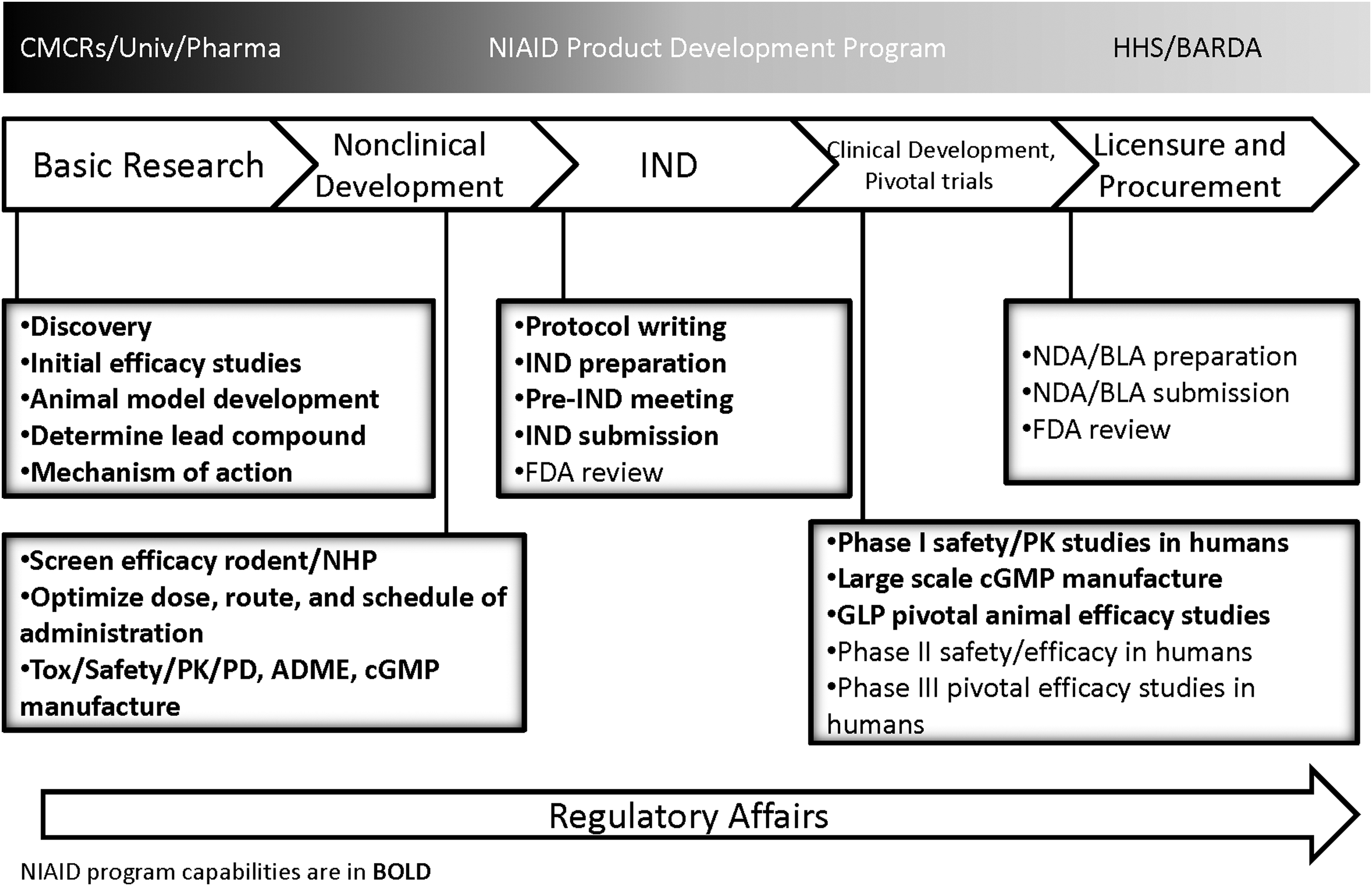
Capabilities available for radiation/nuclear MCM development through a NIAID product development support services contract. Compounds are prioritized based on the existing data set for the indication and the availability of government resources. While Phase I, II, and III trials would be performed as part of a typical drug development effort, products developed for a radiation/nuclear MCM indication would most likely be developed under the “animal rule,” which requires pivotal efficacy trials in animals. Abbreviations: ADME—Absorption, Distribution, Metabolism, and Excretion; cGMP—current good manufacturing practice; GLP—good laboratory practice; IND—investigational new drug application; NHP—nonhuman primate; NDA/BLA—new drug application/biologic license application; PD—pharmacodynamic; PK—pharmacokinetic; Tox—toxicology.
How does a company gain access to the services provided by the product development contractor? After initial contact is made, a product development meeting is set up between company representatives and government program managers from a number of agencies, including NIH, FDA, and BARDA. The presentation is designed to cover a variety of topics, including previously conducted studies with radiation injury, pharmacology/toxicology studies, chemistry, manufacturing and control studies, and other preclinical and clinical data. After the meeting, government program managers meet internally and decide how to prioritize the project and move forward. Pending the quality of the data, the priority, and the availability of funding, a decision is made to go forward and use contractor resources. As stated above, these services are provided without charge to the company. The corporate role is limited to providing the active pharmaceutical ingredient, placebo/vehicle, and knowledge about the drug candidate.
Once the study is completed, a report is written and provided to the company. Research results are evaluated critically and objectively by government experts, the contractor, and industry representatives to determine if additional resources should be allocated for further development. With these significant incentives, a number of companies with products in development for clinical application have partnered with the radiation countermeasures program to pursue biodefense applications for these same products. Many of these companies have been able to do so because the absolute investment of company resources to pursue the biodefense indication is low.
The flexibility provided under the product development support services contract allows the business relationship between industry and the radiation countermeasures program to be managed without a cooperative research and development agreement (CRADA) or contract, which greatly increases the speed with which partnerships can be established. Instead, most relationships can be governed under a confidentiality disclosure agreement (CDA), material transfer agreement (MTA), and modified clinical trial agreement (CTA). The product development support services contract is subject to a “Determination of Exceptional Circumstances” (DEC) that protects the company's prospective intellectual property position. It has been NIAID's experience that providers of candidate compounds and diagnostics, particularly in the commercial sector, are reluctant to submit their proprietary products and data to a program where there could be a risk that government contractors may obtain rights to new inventions relating to the provider's proprietary products. The DEC offers assurance to collaborators that they can submit their proprietary products for evaluation and testing without the fear that NIAID's contractor would obtain title to a new invention relating to the product. Essentially, the company has rights to any new intellectual property that is developed or invented during the evaluation process.
The radiation countermeasures program sponsors a number of efforts to address the government's need to develop radiation MCMs. Considering the breadth of the pipeline we have developed and the number of products that have transitioned to BARDA on a modest budget allocation, we believe this model creates real cost savings. The simplified arrangements governing activities under the product development contract reduce the transaction costs of working with the government and save significant amounts of time when compared to traditional contracting under the Federal Acquisition Regulations. In several instances we have been introduced to a new company, signed the appropriate documents, conducted efficacy confirmation studies, and returned final study reports in 9 to 12 months. This compares favorably with the 18 to 24 months it typically takes to draft, solicit, negotiate, and award a government contract (all of which is before the performance of any work).
Since the relationship between the government and a company is limited, both sides minimize risk in case of product failure. The contractor operates on a work assignment basis, which means NIAID program managers request work from the contractor according to the needs and requirements of the specific compound under evaluation. The contractor then prepares a detailed response outline of how they plan to complete the work. After approval, a work assignment authorizes the contractor to perform the assigned tasks. Additional work is planned depending on study results. By having individual work assignments for discrete projects, products can be inserted or removed from evaluation based on study results. This arrangement assures that resources and funds are focused only on successful drug candidates.
The flexibility of the product development support services contract is a critically important part of our program and allows us to employ the “fail fast, fail cheap” concept espoused by many drug companies. A particular compound is usually tested as a part of an individual work assignment within the overall product development contract. This arrangement gives the radiation countermeasures program and corporate partner the ability to troubleshoot and move forward in a stepwise fashion. This compares favorably to a contract between the government and a sponsor, in which case the sponsor is obligated to complete all milestone-related work defined by the contract. For the radiation countermeasures program, a promising research program advances by moving promptly to the next battery of development activities, while a failed project ends by closing the relevant work assignment. Since there is no formal contractual relationship between the government and the company, there is no need to cancel or modify a contract.
Examples of Progress
The radiation countermeasures program exists for one reason—to promote the development of radiation countermeasures—and in this regard it has progressed admirably. Currently funded efforts range from high-throughput screens of molecule libraries to definitive efficacy evaluations of lead molecules in rigorously controlled animal studies.
The CMCR at the University of California—Los Angeles (UCLA) has developed a high-throughput, small-molecule in vitro screening program to identify molecules demonstrating radioprotectant effects and to date has tested more than 100,000 compounds, identifying 26 for further evaluation and in vivo testing. Seven of these compounds appear to have promising effects when administered up to 24 hours postirradiation. Across the CMCR program, more than 120 other compounds, in various stages of development, have been evaluated in models of hematopoietic, gastrointestinal, lung, skin, kidney, cardiovascular, or central nervous system injury. Of these, more than 10 compounds are licensed for other indications, while another dozen compounds are in late clinical development for other indications. Collectively, the CMCRs have produced some 225 publications, filed for 24 patents, and supported 126 pilot projects.
More than 50 other medical countermeasures are being tested and characterized under non-CMCR grants, contracts, and interagency agreements supported by the radiation countermeasure program. Among these are agents to treat or mitigate radiation combined with burns, wounds, or other injury; gastrointestinal acute radiation syndrome; radiation-induced thrombocytopenia, lung, and skin injury; novel decorporating agents; and oral formulations of diethylenetriamine pentaacetic acid (DTPA), an FDA-approved chelating agent that currently is available only in an intravenous or inhalation formulation.
Additionally, the radiation countermeasures program has met with some 125 companies in the 5 years of its existence and screened almost 20 compounds in rodent models of hematopoietic acute radiation syndrome, 8 compounds for gastrointestinal acute radiation syndrome, and 4 compounds for efficacy in decorporating americium-241. Nine investigators, groups, or companies that received critical seed funding or other support from the radiation countermeasures program have gone on to receive funding from BARDA for further development of specific products. One example of a project that has transitioned involves investigators at the Columbia University CMCR who have developed a completely automated, modular, ultra-high-throughput biodosimetry workstation, which they call the Rapid Automated Biodosimetry Tool or RABIT. The RABIT automates 2 well-established assays that have been shown to be highly specific at the radiation doses of interest, and it will provide accurate dose estimation for people receiving whole-body doses of 0.75 to 8 gray. The RABIT breadboard prototype has achieved a throughput of ∼6,000 samples per day and is designed to potentially accommodate as many as 30,000 samples per day. This throughput represents an improvement of several orders of magnitude over the current gold standard biodosimetry technique, cytogenetic analysis.
Finally, the product development contractor has completed a nonpivotal good laboratory practice–compliant study of granulocyte colony stimulating factor (G-CSF; Neupogen®) in rhesus macaques that demonstrated a significant survival benefit in animals treated with G-CSF and medical management (ie, fluids, antibiotics, nutrition, and blood products) as compared with animals receiving medical management alone. 16 The contractor is poised to begin further studies with G-CSF (Neupogen®) to determine whether it retains efficacy when initiation of therapy is delayed until 48 hours after irradiation and with pegylated G-CSF (Neulasta®) to assess efficacy when administered 24 hours postirradiation. The contractor has also completed several developmental studies of thrombopoietic agents in canines and is mapping out pathways for further work on these agents.
Despite this progress, much work remains. While potassium iodide, calcium and zinc DTPA, and Prussian blue have been FDA-approved for radionuclide decorporation, there are no FDA-approved products for the treatment of ARS.
Conclusion
In summary, the radiation countermeasures program at NIAID incorporates a number of capabilities that make it attractive for private industry to partner with the federal government for MCM development. By integrating our product portfolio and engaging partners in an intensive collaborative environment, the radiation countermeasures program helps companies by providing a good return on investment, addressing regulatory challenges proactively, expanding the market for these products, and limiting contract administrative burdens. From a government perspective, this model decreases costs and risks, accelerates and simplifies MCM development, and will provide BARDA with a pipeline of candidate MCMs for advanced development activities, licensure, and procurement. We believe this model serves as a positive example of how government and industry can work together to develop MCMs and may serve as a model for other medical products whose development has been impeded by real or perceived market failures.