




Abstract
In this annual update and analysis of federal biodefense spending, formerly called “Billions for Biodefense,” the authors report the budgeted levels of spending for FY2012. The article also includes an updated assessment of the proportion of biodefense funding provided for programs that address multiple public health, healthcare, national security, and international security issues in addition to biodefense.
Since 2001, the United States government has spent substantial resources on preparing the nation against a bioterrorist attack. Earlier articles in this series have analyzed civilian biodefense funding by the federal government for fiscal years (FY) 2001 through proposed funding for FY2011. This article updates those figures with budgeted amounts for FY2012, specifically analyzing the budgets and allocations for biodefense at the Departments of Health and Human Services, Defense, Homeland Security, Agriculture, Commerce, and State; the Environmental Protection Agency; and the National Science Foundation. This article also includes an updated assessment of the proportion of biodefense funding provided for programs that address multiple scientific, public health, healthcare, national security, and international security issues in addition to biodefense. The FY2012 federal budget for civilian biodefense totals $6.42 billion. Of that total, $5.78 billion (90%) is budgeted for programs that have both biodefense and nonbiodefense goals and applications, and $637.6 million (10%) is budgeted for programs that have objectives solely related to biodefense.
U.S. Government Civilian Biodefense Funding, FY2001-FY2012 (in $millions)
The Department of Homeland Security (DHS) was created in FY2003.
DHS was unable to provide complete data; accordingly, some items are missing. See Table 4.
DHS FY2004, FY2005, and FY2009 budgets include one-time advanced appropriations for Project BioShield of $890 million, $2.5 billion, and $2.2 billion, respectively.
FY2001-FY2002 numbers not available due to budget methods used by USDA.

Civilian Biodefense Budget by Agency, FY2012 (in $millions). Color images available online at www.liebertonline.com/bsp
Article Assumptions and Methods
➣
➣
➣
➣
A majority of the programs included in this $6.42 billion FY2012 biodefense budget have both biodefense and nonbiodefense goals and applications. These programs are intended to address a range of scientific, public health, healthcare, national security, and international security issues in addition to biodefense. Programs with both biodefense and nonbiodefense goals and applications include those that fund basic scientific research in infectious disease pathogenesis and immunology, programs to improve planning and operations related to public health preparedness, and programs to improve preparedness and response for a range of other disasters. 8
This analysis shows that approximately 90% ($5.78 billion) of the $6.42 billion budgeted for biodefense in FY2012 is intended not only to improve biodefense, but also to address a range of scientific, public health, healthcare, national security, and international security issues. In contrast, 10% ($637.6 million) of the FY2012 biodefense budget would go to programs that have objectives solely related to biodefense (Table 2, Figure 2). Over the course of the 12 fiscal years included in this analysis, $55.27 billion of the $66.91 billion total in biodefense funding has been dedicated to programs with both biodefense and nonbiodefense goals and applications, while $11.63 billion has gone to programs with objectives solely related to biodefense (Table 2, Figure 2).
Strictly Biodefense Funding (Excluding Programs with Goals Beyond Biodefense), FY2001-FY2012 (in $millions)
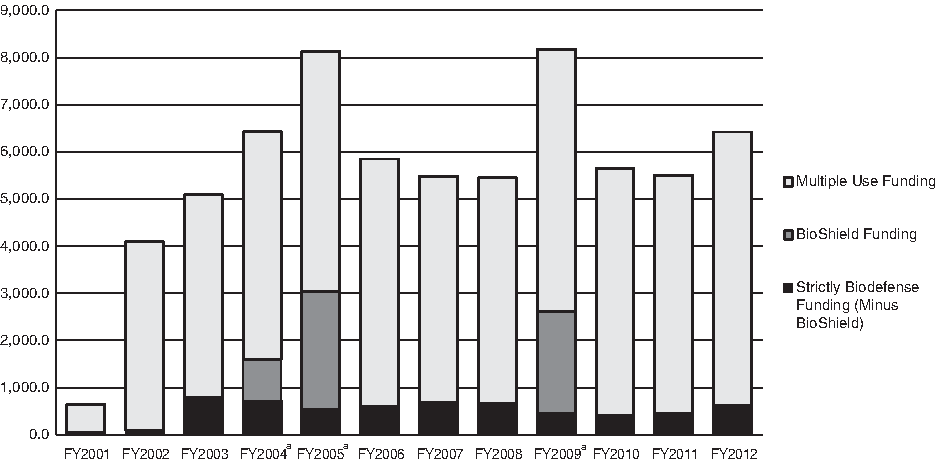
Civilian Biodefense Funding by Fiscal Year, FY2001-FY2012 (in $millions)
Funding Trends
Based on analyses from previous biodefense funding articles1-7 and updated numbers for this year's article, it appears that biodefense would receive an increase in funding in FY2012. However, this proposed increase is especially uncertain because of the current fiscal climate of reduced spending and Congress's emphasis on streamlining and eliminating programs. In the FY2012 budget, federal agencies have consolidated and combined a number of programs under larger budget line item headings (eg, combining biodefense with chemical defense), which has made it more difficult to ascertain funding amounts for specific biodefense activities. As a result, budgets for consolidated and combined programs have been included in their entirety, likely resulting in an overestimation of the biodefense budget for FY2012 (Table 1, Figure 2).
Also for FY2012, federal agencies were generally less transparent in their accounting for, and analysis of, biodefense programs. Historically, the Department of Health and Human Services (HHS) and the Department of Homeland Security (DHS) have provided budgets that most clearly account for biodefense programs and funding, while other agency budgets have been less transparent and have required extensive review and personal contacts with agency representatives to determine biodefense funding amounts. However, for FY2012, HHS and DHS budgets no longer list individual programs in the manner they have been listed in past years, making an assessment of the biodefense elements of even DHS and HHS budgets subject to more uncertainty.
Available FY2011 Biodefense Appropriations Information
Department of Defense and Full-Year
Continuing Appropriations Act, 2011 (P.L. 112-10)
Department of Health and Human Services (HHS)
➣ Centers for Disease Control and Prevention (CDC)
Strategic National Stockpile: $523.5 million ($72.5 million decrease from FY2010)
➣ National Institutes of Health (NIH)
There will be no transfer from the BioShield Special Reserve Fund (SRF) to the NIAID Biodefense Research program.
➣ Public Health and Social Services Emergency Fund (PHSSEF)
$676.2 million will be appropriated to PHSSEF (including biodefense and nonbiodefense programs). This amount is $200 million less than the biodefense portion of PHSSEF alone in FY2010.
➣ Biomedical Advanced Research and Development Authority (BARDA)
BARDA will be funded at $415 million. All funding will be transferred from the BioShield SRF.
➣ Food and Drug Administration
$170 million from PHSSEF influenza appropriations for 2010 (P.L. 111-117) can be used for research to advance regulatory science for medical countermeasures against CBRN threats.
Department of Homeland Security (DHS)
➣ Science and Technology (S&T)
$40 million will be available for the National Bio and Agro-Defense Facility construction, contingent upon a DHS risk assessment.
➣ Federal Emergency Management Agency (FEMA)
$35 million for the Metropolitan Medical Response System (MMRS)
How Does BioShield Funding Work?
➣ BioShield funds were originally appropriated to a Special Reserve Fund (SRF) in FY2004.
➣ Under the Department of Homeland Security Appropriations Act of 2004, the BioShield SRF received an appropriation in the amount of $5.6 billion. Of that amount, $885 million and $2.507 billion were allocated under the DHS budget in FY2004 and FY2005, respectively, for use in FY2004-FY2008. The remainder of the appropriation ($2.175 billion) was then allocated to BioShield in FY2009 for use in FY2009-FY2013.
➣ Although BioShield funds were allocated to DHS, the funds have been used for countermeasures activities in DHS and HHS over multiple years.
➣ BioShield funding allocated in a specific year does not accurately reflect the amount of money spent by the BioShield program in that year. BioShield money has been spent by both DHS and HHS in each year since FY2004 (see Figure 5).
➣ The Consolidated Appropriations Act of 2010 authorized the transfer of the remaining balance of the BioShield SRF out of DHS and into an HHS account for “biodefense countermeasures.” This balance remains available until September 30, 2013.
In addition, appropriations amounts for FY2011 are uncertain given the long congressional debate over budget reductions. The final full-year Continuing Appropriations language for FY2011 (P.L. 112-10) 9 was passed by Congress in April, after federal budgets had been released. The text of the final FY2011 appropriations law does not provide sufficient detail to update all of the biodefense funding estimates for this article, so Tables 1 through 10 reflect the FY2011 funding estimates from federal agency budget documents. However, the limited amount of specific biodefense funding information that could be extracted from the text of P.L. 112-10 is included in the sidebar (at left). 9 Next year's analysis will more accurately reflect FY2011 biodefense funding amounts.
Methods, Sources, and Assumptions
This year's analysis employed methods and sources similar to those used in previous articles in this series. Sources for the FY2012 analysis include agency “Budgets in Brief,” agency budget justifications, and personal contact with agency representatives to obtain and track civilian biodefense funding. A full, detailed description of methods, sources, and assumptions can be found in previous articles in this series.1-7
In addition to the analysis of biodefense funding by federal agency, this article includes an updated assessment of the proportion of civilian biodefense funding, from FY2001 through FY2012, that has been dedicated to programs with objectives solely related to biodefense, compared to the amount provided for programs with both biodefense and nonbiodefense goals and applications. For the purpose of this analysis, a program with objectives solely related to biodefense is defined as:
A program that focuses entirely on prevention, preparedness, and/or mitigation of bioterrorism's effects on civilians.
Some specific examples of programs with solely biodefense goals include the DHS BioWatch program for biological agent early detection, HHS smallpox and anthrax vaccine research, and DoD cooperative biological threat reduction programs to engage former bioweapons scientists in new biological research activities.
A program with both biodefense and nonbiodefense goals is defined as:
A program that serves one or more purposes beyond biodefense: At least one major element of the program is specifically related to improving biodefense. However, the program also has objectives related to advancing other areas of science, public health, healthcare, national security, or international security.
Examples of programs with both biodefense and nonbiodefense goals include the HHS Hospital Preparedness Program (HPP), which helps to improve healthcare surge capacity around the country for multiple hazards including bioterrorism; the National Institute of Allergy and Infectious Diseases' (NIAID) Biodefense Research Program, which, in addition to funding preclinical and clinical research toward biodefense countermeasures, funds basic infectious disease pathogenesis and immunology research with implications for a multitude of other diseases; and the DHS Regional Catastrophic Event Planning grants, which are used to plan for bioterrorism and other potentially catastrophic events such as nuclear scenarios and major natural disasters (Table 2, Figure 2).10,11
Civilian Biodefense Funding by Federal Agency
Department of Health and Human Services
For FY2012, the HHS budget for biodefense programs is $4.48 billion. This amount represents a proposed increase in funding of 16%, or $626.6 million, over FY2011 estimated funding levels (Table 3). The majority of funds requested for HHS in FY2012 are allocated to programs at the U.S. Centers for Disease Control and Prevention (CDC), the National Institutes of Health (NIH), and the Office of the Assistant Secretary for Preparedness and Response (ASPR) (Figure 3). 10
Department of Health and Human Services Civilian Biodefense Funding, FY2001-FY2012 (in $millions)
In an effort to consolidate CDC preparedness programs, the 2012 budget includes the Surveillance Initiative programs under the heading of CDC Preparedness and Response Capability.
The SNS was located in the HHS Office of the Secretary for FY2001-FY2003 and FY2005-FY2007. In FY2004, it was located in the Department of Homeland Security. It is now a CDC function.
According to the FY2011 HHS Budget in Brief, the CDC Preparedness and Response Capability now encompassess the Laboratory Reponse Network line item, in addition to the Select Agent Program and other research and surveillance.
HRSA bioterrorism and hospital preparedness programs were moved to the ASPR Office in 2006.
The Office of Public Health and Emergency Preparedness became the Office of the Assistant Secretary for Emergency Preparedness and Response (ASPR) in 2006.
The National Disaster Medical System was moved from the Department of Homeland Security to the Department of Health and Human Services ASPR Office effective January 2007.
BARDA and Strategic Investor are currently being funded from BioShield Special Reserve Fund (SRF) balances. This funding replaces prior funding under the Advanced Research and Development and Bioshield Management line items.
Some HHS biodefense funds are specifically requested through the Public Health Social Services Emergency Fund (PHSSEF). Placing funds in the PHSSEF enables them to be appropriated in one place and then allocated to targeted biodefense activities.
Sources: HHS FY2012 Budget in Brief: http://www.hhs.gov/about/FY2012budget/fy2012bib.pdf
NIH, NIAID FY2012 Budget: http://www.niaid.nih.gov/about/whoWeAre/budget/Documents/fy2012cj.pdf, Pg. NIAID 10
FDA FY2012 Congressional Budget Justification: http://www.fda.gov/downloads/AboutFDA/ReportsManualsForms/Reports/BudgetReports/UCM243370.pdf, Pg. 503
General Departmental Management FY2012 Budget Justification: http://www.hhs.gov/about/FY2012budget/gdm_cj_fy2012.pdf, Pg. 135
The NIH FY2012 budget for biodefense includes a proposed $335 million increase in funding over FY2011 levels for the Biodefense Research Program administered through NIAID, but this amount is consistent with the NIAID Biodefense Research funding for FY2010. The FY2012 budget also proposes a total of $655 million for the SNS, to replace expiring products, support BioShield acquisitions, and fill gaps in countermeasures inventory.10,12
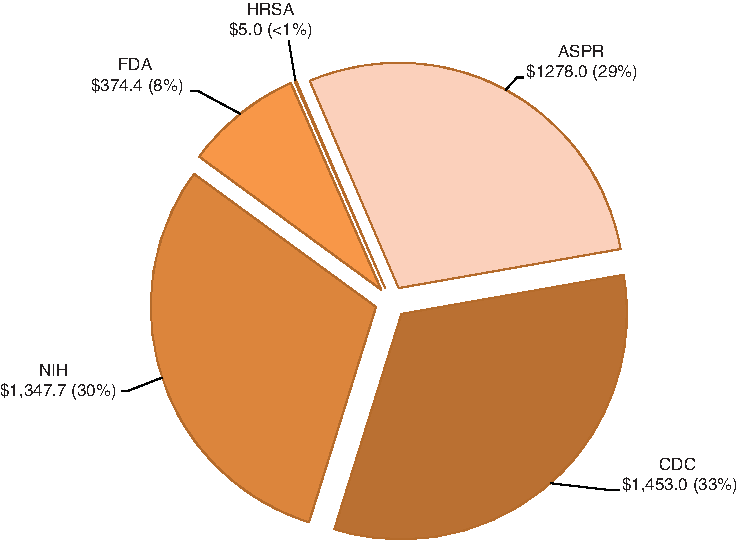
HHS Civilian Biodefense Budget, FY2012 (in $millions). Color images available online at www.liebertonline.com/bsp
The FY2012 budget also requests an increase in funding for programs located in ASPR. This increase in funding is the result of reallocation of existing BioShield Special Reserve Funds (SRF), rather than new funding. The Biomedical Research and Development Authority (BARDA) is budgeted to receive $655 million in BioShield funds. The budget also includes $100 million in funding allocated from the BioShield SRF to establish a strategic investment corporation that would function as a public-private venture capital fund for the development of new countermeasures products (Figure 4). 10
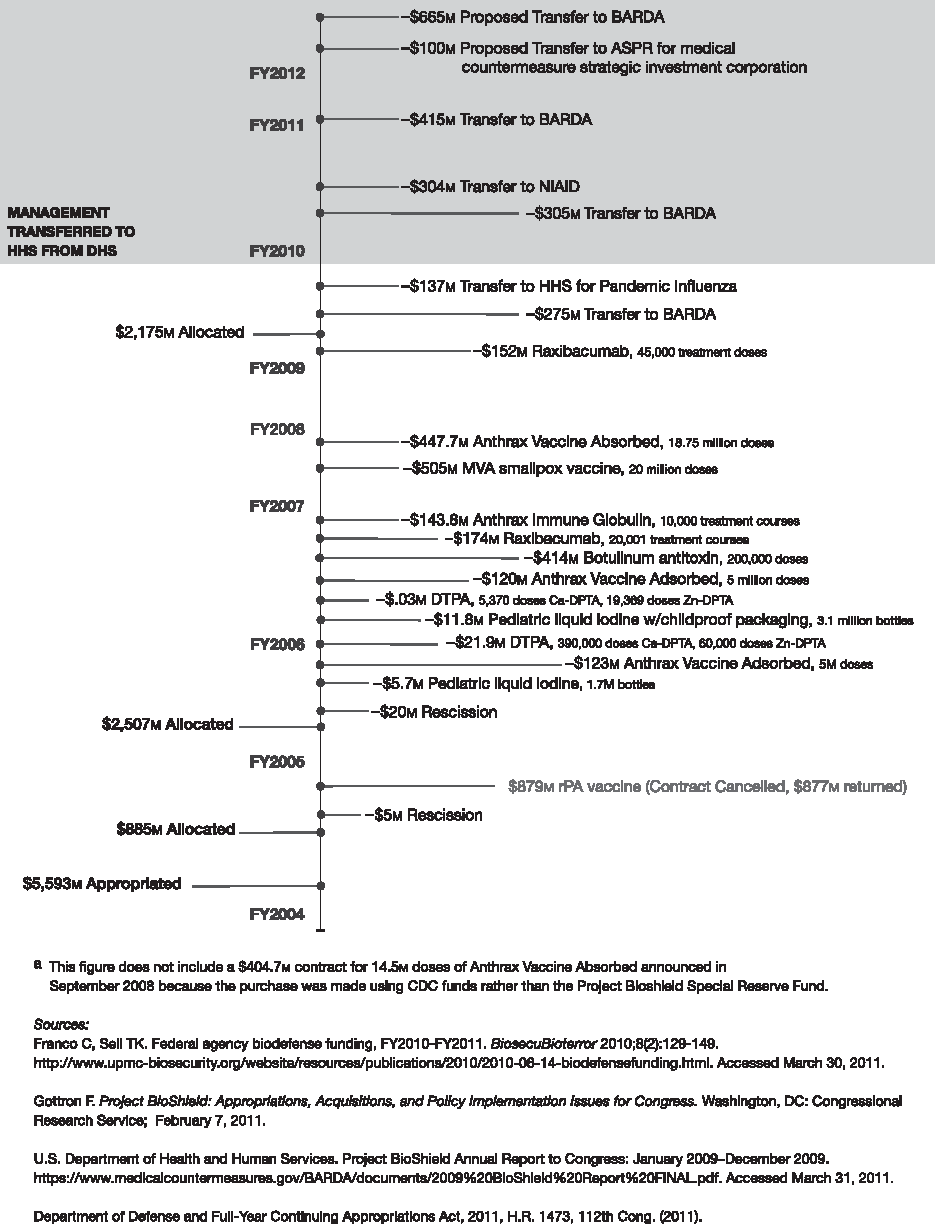
BioShield Funding and Expenditures
In the CDC budget, funding for the BioSurveillance Initiative (including BioSense) is not available for analysis because it has been folded into CDC Preparedness and Response budget line item. However, despite having incorporated additional programs into this area, CDC Preparedness and Response Capability would be reduced by $19 million or 11%.10,13
Two programs in HHS that affect state and local preparedness would see decreases in funding. Funding for State and Local Preparedness and Response Capability, which includes the Public Health Emergency Preparedness (PHEP) cooperative agreement grants to states, would be reduced by $110 million, or 14%, from FY2011 to FY2012.10,13 The Hospital Preparedness (HPP) grant program would be reduced by $42 million, or 10%, from FY2011 to FY2012. From their peak funding period in the early 2000s, the State and Local Preparedness and Response Capability and the HPP grant program have seen decreases in funding of 31% and 27%, respectively.
Department of Defense
The FY2012 DoD biodefense budget of $1.025 billion represents a proposed increase of $251.5 million, or 33%, above FY2011 estimated funds for DoD civilian biodefense activities (Table 4). For the purposes of this analysis, DoD civilian biodefense includes programs to prevent biological terrorism; programs to respond to domestic disasters, including bioterrorism; and programs that are coordinated with other federal agencies for the purpose of research and development of biodefense countermeasures and technologies. DoD biodefense activities with civilian applications in this FY2012 budget include the Army National Guard WMD Civil Support Teams, Cooperative Biological Engagement at the Defense Threat Reduction Agency (DTRA), the Biological Warfare Defense Program at the Defense Advanced Research Projects Agency (DARPA), and the Medical Biological Defense program under the Chemical and Biological Defense Program (CBDP) heading.14-18
Department of Defense Civilian Biodefense Funding, FY2001-FY2012 (in $millions)
Of the Chemical and Biological Defense Program, only Medical Biological Defense has been included in totals for FY2011 and years past. Medical Biological Defense is primarily countermeasures-research oriented, whereas the remainder of the Chemical and Biological Defense Program either is focused on chemical defense or has strictly military applications.
Sources: FY2012 Department of the Army Budget Estimates: http://asafm.army.mil/Documents/OfficeDocuments/Budget/BudgetMaterials/FY12/milpers//ngpa.pdf pg. 62;
DoD FY2012 Operations and Maintenance CTR http://comptroller.defense.gov/defbudget/fy2012/budget_justification/pdfs/01_Operation_and_Maintenance/O_M_VOL_1_PARTS/O_M_VOL_1_BASE_PARTS/0134_CTR_OP-5_FY_2012.pdf. Pg. CTR 951;
DoD FY2012 Chemical and Biological Defense Program Budget Justification: http://comptroller.defense.gov/defbudget/fy2012/budget_justification/pdfs/03_RDT_and_E/CBDP.pdf;
DoD FY2012 DARPA RDTE budget: http://comptroller.defense.gov/defbudget/fy2012/budget_justification/pdfs/03_RDT_and_E/DARPA.pdf. Pg. 1-109.
PGS Preliminary Analysis: FY2012 Budget Request for DOD Cooperative Threat Reduction Program: http://www.partnershipforglobalsecurity.org/PDFFrameset.asp?PDF=preliminary_ctr_analysis.pdf;
The Medical Biological Defense program represents a majority of DoD's investment in biodefense activities with civilian applications. For FY2012, Medical Biological Defense is budgeted to receive $680.3 million, an increase of $228.2 million above FY2011 estimates. Projects funded under Medical Biological Defense include basic research of vaccines, diagnostics, and therapeutic drugs against biological threat agents; applied research of vaccines, diagnostics, and therapeutic drugs against biological threat agents; advanced technology development of vaccines, diagnostics, and therapeutics; advanced component development and prototypes for development and manufacturing of medical countermeasures; development and demonstration of rapid response capabilities, from pathogen identification to medical countermeasure delivery; and a new category, Operational Systems Development (OSD), for upgrades and modernization of information systems, medical systems, and detection instrumentation for biological threats. 14 Increases for Medical Biological Defense would be applied to the program areas of applied research, advanced technology development, and system development and demonstration. 14
For FY2012, DTRA has consolidated its biodefense programs under a new heading, Cooperative Biological Engagement (CBE) (formerly Cooperative Threat Reduction), which encompasses the project areas of biological safety and security, Cooperative Biological Research (CBR), and disease surveillance. The CBE program is budgeted to receive an increase in funding of $90.4 million, or 53%, for a total of $259.5 million for FY2012.15,16 This program aims to “counter the threat posed by pathogens (as delineated in the U.S. Select Agent List), related materials and expertise, and other emerging infectious disease risks.” 15
DARPA's Biological Warfare Defense program, which focuses on technologies for biological pathogen detection, prevention, treatment, and remediation, and works jointly with other government agencies to fund programs supporting new approaches to biological warfare defense, would receive a slight decrease in funds of $2.3 million, for a total of $30.4 million for FY2012. 17
Finally, the Army National Guard's WMD Civil Support Teams (WMD-CST) would receive a budget reduction of $24.9 million for CBDP-funded equipment and capabilities, for a FY2012 funding request of $54.9 million for WMD-CST funding for training and equipment. 18
Department of Homeland Security
The DHS budget request for FY2012 totals $511.4 million for civilian biodefense programs, a proposed 5% increase of $24.3 million above FY2011 estimated levels (Table 5). The DHS FY2012 budget request would reduce funding for Regional Catastrophic Event Planning from $35 million to $8.5 million and eliminate funding for the Medical Surge Grant Program (formerly the Metropolitan Medical Response System [MMRS]).10,19 However, a trend has emerged over past issues of this report of the Medical Surge Grant Program in the DHS budget being eliminated, followed by Congress subsequently restoring its funding.
Department of Homeland Security Civilian Biodefense Funding, FY2003-FY2012 (in $millions)
Formerly the Preparedness Directorate (P.L. 109-295 and changes pursuant to section 872 of the Homeland Security Act, 2002).
NDMS was transferred to the HHS Office of the Assistant Secretary for Preparedness and Response (ASPR) effective January 1, 2007.
The Strategic National Stockpile was transferred to HHS (CDC).
Of the $5.6 billion BioShield special reserve fund (appropriated in FY2004), an amount not to exceed $3.4 billion was allotted for FY2004-FY2008 for the program. The remaining approximately $2.2 billion of the fund was allocated in the FY2009 budget for FY2009-FY2013.
Funds appropriated for BioShield in years prior will be used in the current year.
BioWatch was formerly located within the Science and Technology Directorate and had been part of the Biological Countermeasures line item through FY2006 (P.L. 109-295 and changes pursuant to section 872 of the Homeland Security Act, 2002).
The FY2007 number for BioWatch is an estimate only. DHS could not confirm the validity of this number.
The FY2009 DHS budget broke down the Laboratory Facilities line item into operations and construction for various facilities for the first time. Attempts were made to obtain numbers for previous fiscal years. NBACC operations began in 2008 (therefore, prior numbers are not available), and numbers for Plum Island Construction and Operations prior to FY2008 were not provided by DHS.
Sources: DHS FY2012 Budget in Brief http://www.dhs.gov/xlibrary/assets/budget-bib-fy2012.pdf
DHS Budget Justification FY2012 http://www.dhs.gov/xlibrary/assets/dhs-congressional-budget-justification-fy2012.pdf
The requested budget for the BioWatch program, in the Office of Health Affairs, is $115.2 million, a proposed increase of 29%, or $25.7 million, above the FY2011 estimate. The FY2012 proposed increase for BioWatch would fund activities to continue “Gen-3 development, which is expected to significantly reduce the time between a release of a biothreat agent and confirmation of that release by BioWatch technology.” 10 (p8)
Under the DHS Science and Technology Directorate (S&T), the budget includes $150 million for the construction of the National Bio and Agro-Defense Facility (NBAF), which will study foreign animal and emerging and zoonotic diseases that threaten agriculture and public health. Also in the S&T budget, funding for research thrust areas has altered. In place of the Biological Countermeasures and Agricultural Thrust areas, funding for biodefense would now be included in the CBRNE Defense Research and Development Thrust area. All other DHS biodefense program funding budgeted for FY2012 remains at or near FY2011 estimated levels (Table 5).10,19
Department of Agriculture
The FY2012 USDA budget requests a total of $106.0 million for its biodefense-related programs. This is an increase of $16.0 million above the FY2011 preliminary CR estimate, but it is a decrease of nearly $150 million from the amount requested in last year's budget ($252.0 million) (Table 6). 20
Department of Agriculture Civilian Biodefense Funding, FY2001-FY2012 (in $millions)
USDA Press and Budget offices were unable to provide numbers for these years.
USDA FY2010 budget did not include any line items specifically for Food and Agricultural Defense; the FY2011 budget continues with the FY2010 revised line items.
Sources: USDA FY2012 Budget Summary and Annual Performance Plan http://www.obpa.usda.gov/budsum/FY12budsum.pdf.
The USDA proposes funding for biodefense-related activities under the Animal and Plant Health Inspection Service (APHIS), the Food Safety and Inspection Service (FSIS), and the National Institute of Food and Agriculture (NIFA). In addition, the budget indicates that $4 million is budgeted for homeland security initiatives in the USDA, “to provide a coordinated national effort to protect American agriculture and rural communities from intentional harm.” 20 (p12)
In this FY2012 budget, there is no longer line item funding for animal and plant health monitoring and surveillance activities under APHIS. Instead, USDA has organized its budget by commodity (eg, avian, cattle, swine, cotton, tree, and wood health). This makes it difficult to determine which funds are going toward disease surveillance and which are being directed toward other plant and animal health initiatives with no biodefense applications. Thus, as compared to previous years, biosurveillance funding at USDA cannot be accounted for in the FY2012 budget.
In FY2012, $20 million in funding is directed toward emergency management, including $18 million for emergency preparedness and response, and $2 million for a contingency fund to be used in responding to an unforeseen outbreak. Other significant amounts of funding are requested for the APHIS Veterinary Diagnostics program ($33 million); the FSIS Public Health Data Communication Infrastructure System ($39 million), for improved communication and investigation in response to outbreaks; and the Regional Diagnostics Network ($10 million). 20
Environmental Protection Agency
For FY2012, the EPA budget for civilian biodefense is $103.2 million, a decrease of 33%, or $50.2 million, below FY2011 estimated funds (Table 7). The budget proposes decreases to all 4 biodefense-related programs under the homeland security heading including, Science and Technology, Environmental Program and Management, Buildings and Facilities, and the Hazardous Substance Superfund. This reduction in funding would affect EPA research activities related to biological preparedness and response, biological decontamination and remediation, laboratory preparedness and response, and critical infrastructure protection. 21
Environmental Protection Agency Civilian Biodefense Funding, FY2001-FY2012 (in $millions)
Numbers for additional years are included in other line items, such as Clean Land.
Due to EPA reorganization, these activities fell under new headings beginning in FY2003.
This bill includes a number of relevant line items, but a precise breakdown that accounts for all $175 million could not be found.
Sources: EPA FY 2012 Budget in Brief: http://www.epa.gov/planandbudget/annualplan/FY_2012_Budget_In_Brief.pdf. Pp. 77-89.
Department of Commerce
The FY2012 civilian biodefense budget for Commerce totals $111.2 million, a proposed 11% increase of $10.9 million above the FY2011 estimate (Table 8). The Commerce biodefense budget is comprised solely of the Bureau of Industry and Security's (BIS) program on export controls. This number represents an overestimation of the Commerce biodefense budget, as an unspecified portion of these monies is used for biodefense. 22
Department of Commerce Civilian Biodefense Funding, FY2001-FY2012 (in $millions)
Sources: Bureau of Industry and Security FY2012 Budget http://www.osec.doc.gov/bmi/budget/FY12BIB/BIS.pdf.
Department of State
For FY2012, the Department of State budget requests biodefense funding of $74.4 million, a reduction of $0.8 million, for 3 civilian biodefense programs: the Bureau of Arms Control, Verification, and Compliance's Office of Chemical and Biological Weapons Affairs; the Bureau of International Security and Nonproliferation's (ISN) program on Global Threat Reduction; and the ISN program on Missile, Biological, and Chemical Nonproliferation (Table 9). 23
Department of State Civilian Biodefense Funding, FY2001-FY2012 (in $millions)
The Chem/Bio Worldwide Security Upgrades line item was folded into the Physical Security/Protective Equipment Worldwide Security Upgrades. Therefore, specific numbers for Chem/Bio are no longer available.
The BioRedirection program was subsumed under the Nonproliferation of WMD Expertise item in 2005.
Information on funding for this office is not available from the Department of State prior to FY2006.
Nonproliferation of WMD Expertise was renamed the Global Threat Reduction Program beginning in FY2008.
The Biosecurity Engagement Program (BEP) budgets could not be confirmed by the State Department, so they were not included in this analysis.
Sources: U.S. Department of State FY2012 Congressional Budget Justification: http://www.state.gov/documents/organization/156215.pdf, Pg. 139, 150;
U.S. Department of State FY2012 Function 150 and Other International Programs: http://www.state.gov/documents/organization/156214.pdf, Pg. 163
For FY2012, the Bureau of Arms Control, Verification, and Compliance's Office of Biological Affairs has been expanded to include chemical weapons threats. This program is budgeted at $2.6 million, the same amount as estimated for FY2011. 23 (p151)
In this budget, the ISN program on Chemical and Biological Weapons Threat Reduction has been changed to include the missile threat and to focus on nonproliferation rather than threat reduction. This program would receive $2.8 million in FY2012, $0.2 million more than is estimated for FY2011. 23 (p139) The Department of State notes in its budget documents that this office “manages U.S. Government engagement … [on] export controls … and develops related nonproliferation analysis and recommendations for improved approaches on complex, sensitive, and controversial missile, chemical, and biological nonproliferation-related issues worldwide.” 23 (p135)
The Global Threat Reduction (GTR) program under ISN would receive $69 million for activities “aimed at reducing the threat of terrorist or state acquisition of WMD materials and expertise.” 24 (p163) GTR includes activities on redirection of biological weapons scientists and biological and chemical laboratory security upgrades.
National Science Foundation
The NSF FY2012 budget proposes flat funding of $15 million for its civilian biodefense program. In the FY2012 budget, biodefense funding is solely directed to Microbial Genomics, Analysis, and Modeling in the NSF BIO Directorate, which has received the same level of funding since FY2003 (Table 10). 25
National Science Foundation Civilian Biodefense Funding, FY2001-FY2012 (in $millions)
Sources: NSF FY2012 Homeland Security Activities Budget Request: http://www.nsf.gov/about/budget/fy2012/pdf/09_fy2012.pdf.
Conclusion
The President's FY2012 budget requests $6.42 billion for civilian biodefense, a proposed increase of 16%, or $878.1 million, above the previous year's estimates. The majority of the “biodefense” programs included in the FY2012 budget are intended not only to improve biodefense, but also to improve preparedness and response more broadly. 8 This year's article provides an updated assessment of the programs in the biodefense budget that have both biodefense and nonbiodefense goals and applications, including in the areas of science, public health preparedness, and disaster response. Of the FY2012 $6.42 billion budget for civilian biodefense, $5.78 billion (90%) is budgeted for programs with both biodefense and nonbiodefense goals and applications, and $637.9 million (10%) is budgeted for programs that have program objectives solely related to biodefense (Figure 2).
HHS continues to receive the majority of federal biodefense funding (70%), followed by DoD (16%), DHS (8%), USDA (1.5%), EPA (1.5%), Commerce (1.5%), State (1.5%), and NSF (<1%). Five of the 8 agencies included in this budget analysis would receive increases to their biodefense budgets in FY2012, with EPA and State receiving funding cuts, and NSF receiving flat funding (Figure 3).
It should be noted that there are some important uncertainties in this year's biodefense funding analysis: (1) Estimated biodefense appropriations amounts for FY2011 are especially uncertain given the long Congressional debate over budget reductions. The final full-year Continuing Appropriations language for FY2011 (P.L. 112-10) does not provide sufficient detail to update the FY2011 biodefense funding estimates for this article. (2) For FY2012, federal agencies have consolidated many biodefense programs under larger budget line item headings (eg, chemical and biological defense) that do not specify funding amounts for biodefense activities. As a result, budgets for consolidated and combined programs have been included in their entirety, likely resulting in an overestimation of the biodefense budget for FY2012.
Footnotes
Acknowledgments
The authors would like to acknowledge Ari Schuler as the original author of the “Billions for Biodefense” series. Mr. Schuler developed this concept and was the first to identify the civilian biodefense programs on which this analysis is based. Tracking biodefense funding is a difficult process that evolves each year. The authors encourage readers to submit any updates or additional information that they feel should be included in future reports in this series.