




Abstract
Decontaminating civilian facilities or large urban areas following an attack with Bacillus anthracis poses daunting challenges because of the lack of resources and proven technologies. Nevertheless, lessons learned from the 2001 cleanups together with advances derived from recent research have improved our understanding of what is required for effective decontamination. This article reviews current decontamination technologies appropriate for use in outdoor environments, on material surfaces, within large enclosed spaces, in water, and on waste contaminated with aerosolized B. anthracis spores.
This article reviews current decontamination technologies appropriate for use in outdoor environments, on material surfaces, within large enclosed spaces, in water, and on waste contaminated with aerosolized B. anthracis spores.
After the September 11 attacks on the World Trade Center, cases of inhalational anthrax began to appear in Florida, Washington, DC, and New York, and suspected or confirmed B. anthracis contamination was reported in at least 7 U.S. states. Despite a massive effort to identify, treat, and track approximately 10,000 potentially exposed individuals, 5 deaths occurred among those receiving postsymptomatic treatment. 2 Expensive and unprecedented programs were mounted to decontaminate and refurbish contaminated facilities.
The attacks underlined the importance of interagency coordination at the national level—the Federal Bureau of Investigation (FBI), the Centers for Disease Control and Prevention (CDC), the Environmental Protection Agency (EPA), and state and local public health departments all played major roles—as well as the need for establishing clearance goals that had never before been codified. Whereas public sector cleanup was largely driven by politics, in the private sector, cleanup efforts were often decided by economics. The EPA was immediately called in to manage cleanup at the Hart Senate Office Building, with remediation of office buildings on Capitol Hill alone costing about $28 million. The 3 most important lessons from the cleanup experiences were that (1) fumigation is usually necessary for indoor releases involving significant amounts of B. anthracis spores; (2) remediation (including fumigation) is complex, time-consuming, and costly; and (3) preparedness and planning are critical to improving the quality and timeliness of future cleanups. The combined medical and decontamination response resulted in total costs approaching $1 billion.
This article describes decontamination technologies most appropriate for use within civilian facilities and across wide urban areas that have been contaminated with aerosolized B. anthracis spores. Recommendations draw from lessons learned following cleanup of Washington, DC, facilities and those at other locations,4–6 as well as conclusions published by the EPA and co-investigators2,10–18 and its National Response Team, 7 and research funded by the EPA and the Department of Homeland Security (DHS).8,9,19
Preliminary Considerations
Any large civilian facility or urban area contains a broad range of structures and items that might need to be decontaminated after a B. anthracis attack. Decisions regarding whether or not to decontaminate would be made by a unified command in view of site- and incident-specific considerations, including the possible use of monitored natural attenuation in areas deemed less critical than others. The environmental unit in the unified command, likely with input from subject-matter experts comprising a technical working group, would develop decontamination choices and strategies.
Before a decontamination strategy can be planned in detail, however, a host of considerations must be evaluated by members of the unified command, with stakeholder input. They include, but are not limited to:
• The identity and characteristics of the biological agent itself, its environmental persistence, its ability to aerosolize, the mode of delivery (release), and the nature of spread; • Boundaries (sometimes called exclusion zones) that restrict and control access to contaminated areas (often called hot zones); • Results of environmental sampling, including extent and magnitude of contamination; • Epidemiologic evidence (human disease cases) and what that evidence shows; • Health risks posed by the agent and its susceptibility to medical countermeasures, balancing risk mitigation through reducing exposure versus large-scale prophylaxis programs; • Clearance goals and clearance criteria to meet the goals; • Nature of the sites and items to be decontaminated; • Prioritization of facilities, areas, and infrastructure from the results of characterization and according to possible national security considerations; • Projected timelines to complete decontamination, if performed; • Public perception, such as acceptance of proposed decontamination technologies; and • Quantities of estimated waste and suitable staging and storage areas for waste.
It is essential to understand not simply whether viable spores are present in a given location, but whether decontamination is necessary by evaluating actual health risks to the public, including susceptible populations, such as people who are immunocompromised. Once such a determination has been made and before decontamination strategies are selected, an overriding consideration is to define the goal for deciding whether decontamination is successful—in other words: What is an acceptable level of residual B. anthracis spores (if any) based on risk assessment?20–23
Decision makers cannot refer to established risk-based clearance goals for biological agents because they do not exist, so it may be advantageous to rely on precedents. For B. anthracis cleanups to date, decontamination was not considered successful until there was no growth of B. anthracis spores from any clearance environmental sample taken. 3 In 2005, the National Academy of Sciences concluded that there is currently no scientific basis for establishing amounts that can be safely left behind. 24 In particular, dose-response relations for specific biological warfare agents such as B. anthracis are not sufficient to understand infectivity with confidence. Furthermore, insufficient information is available on which to base clearance goals for residual biological agents after decontaminating a facility. Thus, no growth of B. anthracis spores on any clearance environmental sample will likely continue to be used as the indicator that decontamination of surfaces—at least indoors—is successful. Because of uncertainties and difficulties in establishing infectious doses for most biological pathogens, a structured, quantitative risk characterization may not be possible. Nevertheless, a qualitative risk characterization should be provided to decision makers, because it is instrumental in helping them to determine clearance goals and a decontamination strategy. Such risk characterization should consider both the risk of exposure and risk mitigation through prophylaxis programs.
Outdoor environments pose even greater problems for clearance, as discussed below. In the end, remediation must be defensible to regulatory agencies, stakeholders, and the public. It is important to anticipate the issues of concern and to educate all relevant parties about the decontamination technologies selected and the criteria and clearance methods to be used.
Developing a Decontamination Strategy
Figure 1 summarizes the major activities associated with the decontamination phase.25,26 A key point that must be understood by planners at the outset is that no single decontamination technology or strategy available to date is effective on every type of material and in every situation. Because few decontamination technologies have been developed for wide-area application, and even fewer have been demonstrated for that purpose, selecting an appropriate technology should focus on identified best decontamination practices while taking into account the characteristics of the contaminant and site-specific environmental parameters that govern the effectiveness of various approaches, along with cost-benefit considerations. Decision makers must evaluate decontamination options in the context of applicable regulatory requirements or possible waivers and according to the technical and logistical requirements of each decontamination process.
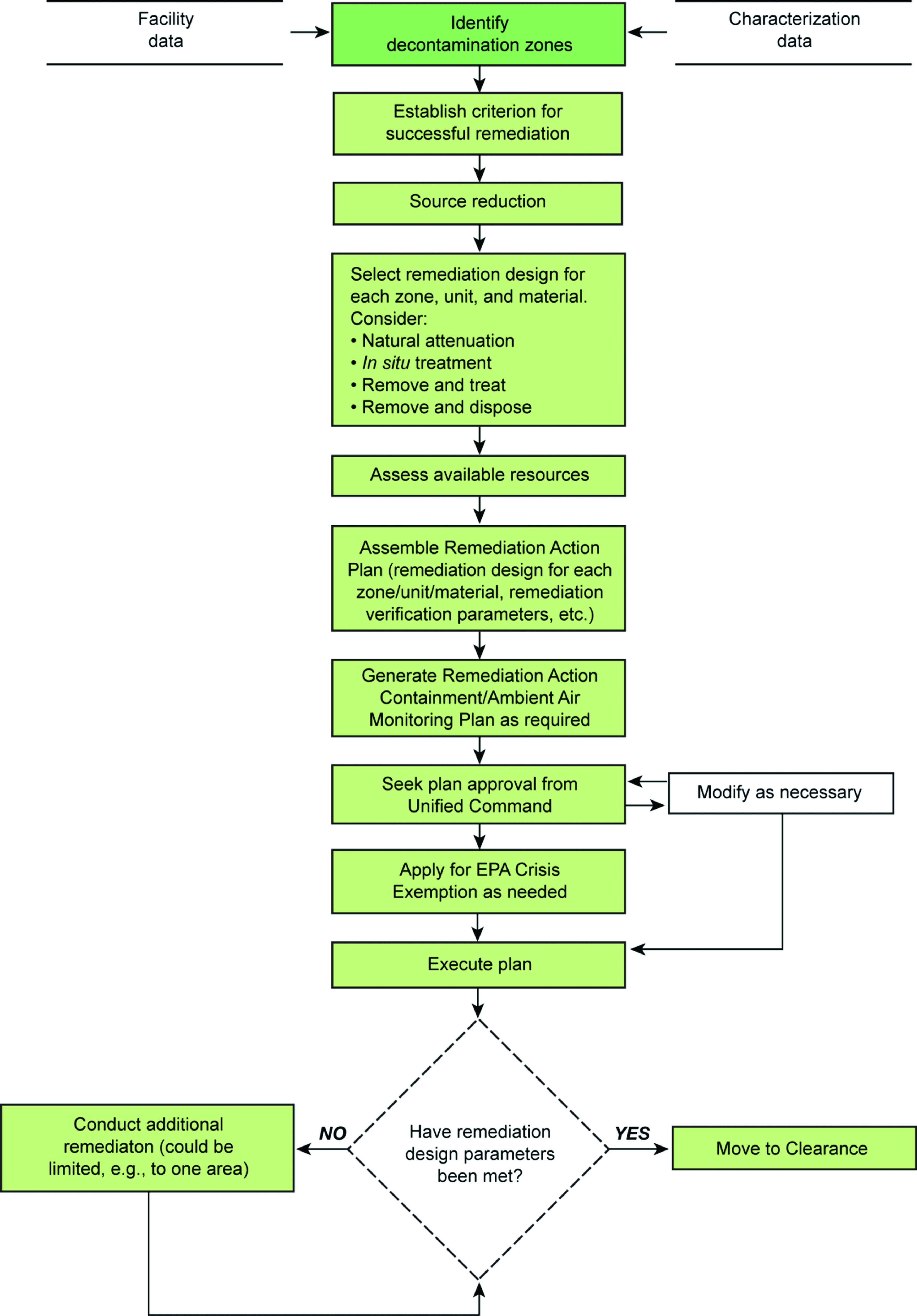
Major Activities During the Decontamination Phase (modified after references 21 and 22). Color images available online at www.liebertonline.com/bsp
A key recommendation is to conduct any necessary outdoor decontamination first, before decontaminating indoor facilities in a hot zone, to prevent recontamination of indoor areas from resuspended or tracked spores, but only after prophylaxis and evacuation of potentially exposed populations. Decontamination is also constrained by local prioritization decisions that can be politically influenced and informed by public and stakeholder concerns. Thus, if critical infrastructure or facilities are high on the priority list for reopening, their decontamination may be required before that of outdoor areas.
Decontamination-related decisions can have a major impact on waste disposal costs and can result in legal and regulatory challenges at the time that disposal of waste takes place. Without adequate waste disposal arrangements, the resumption of normal operations or habitation will almost certainly be delayed. Details on waste treatment and disposal from past B. anthracis cleanups can be found in the literature. 6 The EPA has yet to classify waste contaminated with B. anthracis, another consideration that could delay waste disposal.
Information about the areas and types of materials requiring decontamination will have been determined after environmental sampling and analysis are completed during characterization. With such information in hand, specific decontamination planning activities can begin. This effort has historically culminated in the preparation of an incident-specific Remediation Action Plan (RAP), which is a formal document (more than one might be needed for a wide-area incident) used to guide operations by describing all the actions required to remove, reduce, or eliminate contaminants at a site or throughout an area. The RAP is approved by the unified command, coordinating with appropriate state, local, and federal authorities before implementation by designated decontamination contractor(s) and trained decontamination personnel overseen by the operations section of the unified command.
Decontamination might commence with source reduction, which is the process of removing certain items or materials from a contaminated site for further treatment and reuse or disposal, and cleaning the remaining site structures and surfaces before the main decontamination activity begins. For highly contaminated indoor facilities, source reduction has generally included physical cleaning or chemical pretreatments of the surfaces of materials that remain onsite and of the interior structure. 6 Source reduction might be minimized or even eliminated, depending on the decontamination strategies implemented. If fumigation were chosen for an indoor facility, then sealing the building to prevent a release of fumigant might also be required to address public health, worker safety, or environmental concerns. Any existing isolation that might have been initiated during first response or characterization needs to be reviewed for adequacy if fumigation with gaseous or vaporous decontamination reagents is to be used.
Selecting Decontamination Technologies
Physical decontamination either inactivates a biological agent through physical means, such as heat or radiation, or removes the agent, such as by rinsing with soap and water. Biological or chemical decontamination inactivates a biological agent through the use of antimicrobial disinfectants or sterilants. The choice of decontamination technologies 27 depends on the type of agent released, the nature and extent of contamination, and other site-specific parameters identified during characterization sampling and analysis. Other criteria that drive the selection of decontamination technologies for civilian applications include the availability of a given decontamination technology, safety issues including toxicity and byproducts, efficacy, materials compatibility, cost, time for procurement and setup, environmental concerns, acceptability to regulators and stakeholders, and waste generation. Planners should check with the EPA about the possible need for obtaining Federal Insecticide, Fungicide, and Rodenticide Act (FIFRA) exemptions for the use of unregistered pesticides at particular sites.
Preparation for decontamination includes establishing the necessary infrastructure, organizing and staging engineered decontamination processes, ensuring safe working conditions, and preventing the further spread of contamination or fumigant if used, as mentioned above. If a biological agent release is extensive, restoring a complex facility or large area will most likely require the use of multiple contractors for different aspects of cleanup. A variety of contractors now have experience in remediating facilities that have been contaminated with B. anthracis spores. Experience in outdoor remediation is much more limited.
Large-Scale Decontamination of Outdoor Surfaces
Wide-area contamination involving B. anthracis spores is one of the most difficult decontamination challenges to address with confidence. The only large-scale experiences to date have been at Gruinard Island and Sverdlovsk (now Ekaterinburg) in the former Soviet Union. 28 At Gruinard Island, formaldehyde solution diluted in seawater was sprayed over the entire island, and heavily contaminated topsoil was removed. 29 Forty years after initial contamination, the island was identified as safe. Information on the Sverdlovsk release from a military microbiological facility (Compound 19) is limited, but reports suggest that wash-down activities, top soil burial, and application of chloramine occurred. 28 Other information on the effectiveness of decontaminants used in outdoor environments is sometimes conflicting. For example, the disinfectant VirkonS® (Antec™ International) is used in the agricultural industry and in healthcare settings, but publications on its efficacy are contradictory,30,31 and it has not been reported to be effective by the EPA in laboratory testing against B. anthracis spores. 32
Most decontamination reagents have either not been tested outdoors or have not been tested sufficiently to prove their efficacy, although testing on some common outdoor materials (eg, wood, soil, concrete, asphalt) has been reported.12,18,33,34 Effectiveness outdoors depends on the outdoor matrix, environmental conditions, and B. anthracis concentration. Among other variables that must be considered are the effectiveness of any strategy or reagent on outdoor porous versus nonporous surfaces, surface permeability, surface orientation, whether required contact times can be achieved, and the potentially large organic loading expected in soils. Application of surface fixatives or binders, or physical removal, have the advantage of inhibiting resuspension and cross-contamination while allowing additional time for thorough decontamination. Strategies previously used for alpha radioactive contamination, such as spraying oil or paint suspensions to bind the material to fixed surfaces, 35 might also prove effective for reducing resuspension of spores, but such strategies are untested for biological contamination. As with all mitigation measures, the effectiveness of containment should be evaluated before actions are taken to ensure that an approach does not worsen the situation.
The EPA uses strategies that combine natural attenuation with long-term environmental monitoring for sites where soil and groundwater are contaminated by organic chemicals or radioactive tritium. However, the approach has not yet been applied to biological contamination. Monitored natural attenuation (allowing time for natural degradation processes along with periodic sampling and analysis) might be adequate for some biological agents, but it will not eliminate risks to humans from highly persistent, spore-forming pathogens, such as B. anthracis, especially for indoor releases where spores can remain viable for long periods.36–39 However, for areas where decontamination is not feasible, such as large areas of soils and vegetation, monitored natural attenuation might be considered as an option, so long as spores are exposed to direct sunlight. 15 This approach should be used only where reaerosolization and the potential for human and wildlife exposure to spores are relatively low. Where outdoor decontamination is necessary, some recommendations can be made on the basis of the research that is available and our best understanding of technologies at hand. Because none of the suggested approaches have been comprehensively validated, outdoor pilot-scale testing is strongly recommended before larger-scale application. If a wide-area attack were to occur today, the strategies for consideration are as described below.
Option 1 for Evaluation
Wash all contaminated buildings and surfaces with a liquid decontaminant using firefighting equipment and specialized aircraft that can distribute reagents in large quantities. Bleach solution (pH-amended) is a widely available and low-cost disinfectant, but bleach is not effective in soil. 12 The EPA recently approved 2 liquid peroxyacetic acid with hydrogen peroxide solutions as sterilants on precleaned, hard, nonporous surfaces. Other peroxygen compounds have been shown to be effective in laboratory studies on small samples. 33 Potential reagents that might be effective are listed in Table 1. 18 Reaerosolization of spores is a concern when spraying surfaces, especially with high-pressure washers, and collection of runoff needs to be evaluated with input from regulatory agencies.
Outdoor Decontamination Technology Options for Consideration a
For details and additional references, see reference 43. Efficacy of listed options can be affected by concentration, contact time, number of applications, material type, temperature, and other factors. Past crisis exemption does not prove efficacy.
Mixed efficacy of Decon (MDF-200) is reported against wild-type B. subtilis spores. 42
Option 2 for Evaluation
Wash building exteriors and street surfaces first using a mild surfactant in water to mobilize and concentrate spores on the ground; then decontaminate the liquid runoff and ground using a decontaminant. Available liquid decontamination agents are identified in Table 1. As with Option 1, ensure that washing improves the situation more than it spreads contamination. Little information is available on liquid application conditions that would effectively wash spores off buildings while minimizing reaerosolization, and ad hoc approaches could make the situation worse. Surfactants and their effectiveness have not been tested for such application and would need evaluation. Decontamination on some ground surfaces (eg, soil) might be more challenging than on building surfaces. The extent of decontamination required for ground surfaces remains to be determined.
Option 3 for Evaluation
Spray an inexpensive nutrient solution or germinant to initiate desporulation.44,45 Once the agent is in vegetative form, any of the chemicals shown in Table 1 for wide-area outdoor use could be used for decontamination, presumably at reduced concentrations. The efficacy of promoting desporulation has not been demonstrated on any scale and would require careful onsite validation before wide-area application. This option would only be as effective as the germinating agent, and germination agents have not been shown to approach a 6-log germination potential (comparable to a standard for sporicides). As with decontamination efficacy, a germination efficacy of 99% (2 log), for example, would be considered ineffective when dealing with a population of B. anthracis spores.
The safety of drinking water following an attack should be assessed. Reports show that treatment of spore-contaminated water with high doses of chlorine has a limited (2 log) ability to kill spores.46,47 Flocculation and sedimentation followed by sterile filtration yields better (>3 log) performance. 48 A recent study assessed the potential for sodium hypochlorite and 5% hydrogen peroxide to effectively sterilize drinking water (>6 log reduction) with a 10-minute exposure time. 49 Point-of-use decontamination techniques, such as membrane filtration 50 or boiling in a covered vessel for at least 10 minutes, 51 should be considered.
Smaller-Scale Surface Applications
Tables 2 and 3 identify 5 decontamination options for treating contaminated indoor surfaces or for small-scale applications on outdoor surfaces. Many interiors contain similar materials that can be divided into porous versus nonporous surfaces for which a given reagent may be most efficacious. Indoor surface decontamination techniques can also be selected to address surface hotspots or broad surfaces, such as floors and walls. Because most surface reagents can be corrosive to certain materials, it is important to consider material compatibility issues as well as safety and costs.
Key Characteristics of Surface Decontamination Options
Key Characteristics of Surface Decontamination Options
The surface decontamination categories identified in Tables 2 and 3 include 3 sporicides used to decontaminate surfaces after the 2001 attacks. They are pH-amended bleach, aqueous chlorine dioxide, and hydrogen peroxide/peroxyacetic acid. Two types of hydrogen peroxide/peroxyacetic acid reagents have been registered under FIFRA since 2009 specifically to decontaminate B. anthracis spores on precleaned, hard, nonporous surfaces (Peridox and Steriplex Ultra). Two reagent categories are sodium dichloroisocyanurate and hydrogen peroxide, which have been shown to be effective in research for decontaminating B. anthracis spores on outdoor surfaces. Calcium hypochlorite has been used extensively for disinfection in sanitation and water treatment, but such uses do not necessarily imply efficacy in inactivating B. anthracis spores. The EPA continues to perform research to determine the efficacy of a variety of surface-decontamination reagents for B. anthracis spores on building materials,10–18,33 including low-cost, low-toxicity reagents that might be found in a household kitchen.
Gaseous or Vaporized Reagents for Indoor Areas
Table 4 identifies 4 options for fumigating large, open indoor areas. Gaseous chlorine dioxide (ClO2) and vapor-phase hydrogen peroxide (VPHP) were used to decontaminate entire facilities following the 2001 anthrax attacks. Paraformaldehyde was used to fumigate essential items at 2 facilities. Methyl bromide was shown to be effective in field research performed after the attacks. 2
Key Characteristics of Fumigation Decontamination Options a
Efficacy of fumigant options can be affected by concentration, contact time, number of applications, material type(s), temperature, relative humidity, and other factors.
For gaseous ClO2 fumigation, Sabre Technical Services (www.sabretechservices.com) is currently the only vendor capable of fumigating the interiors of large buildings and has previously fumigated 4 anthrax-contaminated facilities. ClorDiSys (www.clordisys.com) generates ClO2 by a different method and has fumigated the interiors of smaller buildings, but not for B. anthracis spores. The ClorDiSys method has been tested against B. anthracis, and efficacy was not significantly different from that for Sabre in glovebox tests. 59 Sabre performed mold removal using ClO2 in post-Katrina New Orleans, and within a 2-year period decontaminated “hundreds of structures from homes to businesses to government buildings.” 74 Those activities appear to be the closest examples available of mass facility decontamination in an urban environment using gaseous fumigation. BioQuell (www.bioquell.com/us) and Steris (www.steris.com) are the 2 main vendors for VPHP indoor decontamination technology, which has limited penetration into porous surfaces. 2 Of the current VPHP vendors, only Steris previously fumigated buildings with B. anthracis contamination after the 2001 attacks.
Research on the decontamination efficacy of methyl bromide against biological agents 75 is ongoing by the EPA and others. For example, investigators have reported that a methyl bromide minimum effective dose of 80 mg/L was lethal to 107 spores of B. anthracis (10 different strains: ATCC 10, ATCC 937, ATCC 4728, ATCC 9660, ATCC 11966, ATCC 14187, AMES-1-RIID, AMES-RIID, ANR-1, and STERNE) on glass slides after a 48-hr exposure at 37°C. 66 Other research was conducted as a field trial within a 30,000-ft 3 structure. 67 Filter paper coupons containing 106 spores of 1 of 3 species, Geobacillus stearothermophilus, B. atrophaeus, and B. thuringiensis, and stainless-steel coupons with spores of B. atrophaeus were placed in 50 locations in the structure. After fumigation with 312 mg/L of methyl bromide for 48 hr at 35.5°C (mean RH=76%), only 1 location (a sealed refrigerator) contained viable spores of B. atrophaeus on a single coupon. All electronic equipment and material fumigated at the same time functioned afterwards and showed no tangible collateral effects.
In a more recent study, 68 24 indoor materials were exposed to methyl bromide for 16 hr at concentrations ranging from 100 to 2500 ppm in 48-L, electropolished, stainless-steel chambers. Methyl bromide concentrations were measured during and after disinfection. Interactions with materials were reported as “small,” with nearly complete and rapid desorption. An upcoming EPA report on systematic investigations by that agency will contain more data on methyl bromide efficacy.
The relatively few vendors able to perform onsite decontamination might constrain scheduling and limit indoor fumigation if many facilities were contaminated. Given long remediation timelines, some building owners might opt to do decontamination themselves (not necessarily adhering to strict regulations), or they might vacate the area, resulting in slower economic and social recovery. If decontamination teams were supplied with additional equipment and trained technicians, the timeframe could be reduced. Although the stockpile is limited and additional production would require exemptions, a considerable number of fumigation contractors have the capability to apply methyl bromide, which would increase fumigation capabilities if that technology were employed. Planners and responders also now have the advantage of lessons learned from the indoor decontaminations performed during 2001.4,5
Equipment and Personal Items
Potential incompatibility with candidate decontamination reagents is a concern especially for sensitive electronic equipment or components, such as computers, fiber optics, and transformers; valuable items, such as documents, artwork, and money; and personal belongings. In some cases, decision makers could consider using gas or vapor technologies, such as VPHP, but chamber-based approaches were used at offsite facilities to treat some essential items after the 2001 attacks. Table 5 identifies the options for chamber treatment.
Key Characteristics of Chamber-Based Decontamination Options a
Ethylene oxide (EtO) sterilizes items through an alkalization reaction, destroying an organism's ability to reproduce. Because a residue remains after processing, items must undergo aeration. With the exception of glass and metal, EtO can penetrate most materials to an effective level of sterilization,76,77 although stacks of paper must not be tightly packed.
Irradiation sterilization techniques include exposure to high-energy electrons from particle accelerators or high-energy electromagnetic radiation in the form of an e-beam, x rays, or gamma rays. Given a sufficient absorbed dose, all organisms, including spores of B. anthracis, are rendered unable to reproduce as a result of DNA damage. Irradiation can destroy magnetic media, such as film or videotape, and it tends to be expensive. Gamma irradiation was used following the 2001 attacks to decontaminate mail and other documents. 78
If chamber-based technologies were selected following a wide-area incident, it might become necessary to qualify materials to avoid overloading offsite decontamination facilities. It has been recommended that criteria be developed for identifying essential versus nonessential items; however, the process must be balanced with 5th Amendment rights that prevent government agencies from taking personal property—contamination notwithstanding—without appraisal, compensation, or replacement in kind. 79
Decontaminating and Minimizing Solid Waste or Wastewater
Enormous amounts of waste would be generated during remediation of B. anthracis spores, some that might be decontaminated and some that might not be prior to transport for disposal. Throughout remediation, waste management activities must be authorized or exempted by federal, state, and local regulatory agencies. Requirements can include environmental, public health, worker safety, and many other mandates. Waste disposal options for B. anthracis–contaminated wastes are limited but include the possibilities of incineration, commercial autoclaving, commercial gamma irradiation, and disposal in landfills. In the event of large-scale decontamination, facilities might be unwilling to accept waste without verification of sterilization. Therefore, waste must be minimized, and it would be best to decontaminate items such as furniture and carpets as part of building fumigations when possible. There might be no alternative to disposal for contaminated food and perishables. Inexpensive and abundant chemical oxidizers are the most appropriate technologies to decontaminate waste items. Items can be placed in a bath of decontaminant, such as amended bleach, long enough to kill all B. anthracis spores. Contact times on the order of 60 minutes should suffice. Verification of a successful sterilization process should be agreed upon in advance with agencies and facilities approving the disposal. The EPA has developed a suite of tools to assist in waste and debris management during disasters, including biological terrorist events. 80
Preventing contaminated wastewater from running off into uncontaminated areas is another important consideration. Depending on destination, wastewater from decontamination technologies is regulated by Clean Water Act pretreatment requirements specified in 33 USCA 1317, 40 CFR 403, and any state and local publicly owned treatment works pretreatment requirements. Any contaminated surface runoff or wastewater discharge would require permitting or waivers from National Pollution Discharge Elimination System (NPDES) program authorities. Water retention systems can be decontaminated with calcium hypochlorite, sodium hypochlorite, chloramines, or chlorine dioxide. The use of liquid chlorine in contact settling tanks has been recommended. Alternatives that meet U.S. regulatory standards—as with all other treatment strategies—need to be evaluated on a smaller scale before wide-area implementation. The EPA is preparing guidance for treatment of water following a contamination incident. 81
Water Resources and Drinking Water Systems
In the event of B. anthracis contamination of outdoor water resources, no treatment is currently recommended because it is expected that spores would eventually flocculate and mix into sludge solids. Furthermore, in situ, large-scale treatment would have an ecological impact. If a monitored water resource does not return to an acceptable condition, options to be evaluated include continued water treatment by conventional disinfection, increasing the level of disinfection, or issuing end-of-pipe treatment devices. 9
Studies by the EPA43,82 show that greater concentrations of free chlorine and monochloroamine than are normally used in drinking water treatment will be required to kill spores associated with copper, iron, and PVC surfaces, which tend to deplete available oxidant. Preliminary research indicates that a greater than 10-fold increase from current treatment practices may be effective as a starting point. Thus, if potable water systems were contaminated, decontamination could be performed using chlorination at ∼10 times the standard treatment level, followed by sampling to verify treatment efficacy. Sodium hypochlorite (2%), sodium dicholor-s-triazinetrione dihydrate (Dichlor) (2%), and hydrogen peroxide (5%) have also been demonstrated to sterilize water samples containing surrogates for B. anthracis spores. 49 Point-of-use filters, reverse osmosis, membrane filtration, and ultraviolet treatment are also recommended.
Decontamination of People
The CDC has published interim guidelines for personal decontamination of workers after an autonomous detection system (ADS) signal indicates the presence of B. anthracis. For example, workers present at the area of the signal device are advised to evacuate immediately, remove potentially contaminated outer garments at the site, wash exposed skin with mild soap and copious warm water, and to use replacement outer garments and shoes. 83
Conclusions
Following the distribution of B. anthracis letters in the U.S. during 2001, remediation actions required months and even years to complete, reflecting the lack of advance preparation and new learning curves associated with cleanup. Decontaminating a civilian facility or large urban area following a B. anthracis attack will continue to pose daunting challenges, because gaps in sufficiency (lack of resources) and proficiency (lack of technologies) remain. Nevertheless, the lessons learned from past cleanups together with advances derived from recent research have improved our understanding of what is required for effective decontamination. New resources are available to support remediation planning and execution following a biological attack, but preplanning is perhaps the most important way to expedite remediation, reduce costs, and shorten the time to reopen facilities.
No single decontamination technology or strategy currently available will be effective in every situation. Furthermore, because of the different characteristics needed for an ideal decontamination technology, no single formulation is likely to become an all-purpose approach in the foreseeable future. Thus, an optimized strategy for a complex facility or urban area will likely employ a range of decontamination technologies according to site- and incident-specific contamination conditions; item, facility, or area characteristics and requirements; and the nature of the decontamination technology to be applied. Decisions about selecting an appropriate technology should focus on identified best decontamination practices while factoring in the cost-benefit and risk-benefit of site-specific parameters along with the effectiveness of a given candidate decontamination approach to the extent it is known.
Footnotes
Acknowledgments
This work was supported by the Department of Homeland Security through the Interagency Biological Restoration Demonstration (IBRD) project. The authors thank Dorothy Canter, Jeff Kempter, Erica Canzler, and Shawn Ryan for their comments on earlier versions of the tables.