




Abstract

The annual biodefense funding analysis focuses primarily on the presidential budget for the next fiscal year because it provides an indication of potential funding levels for biodefense programs. However, in reality, the President's budget is only a guideline indicating the administration's priorities. Congressional funding does not automatically follow the President's budget request. In fact, Congress rarely funds programs at exactly the same level requested by the President.
Given the complicated federal budget and appropriations process, we decided to further characterize the change in select biodefense program funding levels from the President's budgets to congressional appropriations each year. For many programs these changes are significant. In some cases Congress has reduced program funding in comparison to the President's budget, while in other cases Congress has restored funding to programs that were proposed to be reduced or eliminated by the President.
This article offers an analysis of how funding amounts proposed in the presidential budget each year differ from actual funds appropriated by Congress for the same fiscal years. The analysis highlights funding level changes in a number of selected civilian biodefense programs.
The Budgeting and Appropriations Process
The federal budget and appropriations process consists of 3 parts: the President's budget request, congressional budget resolutions, and appropriations.
Each year, the President is required by law to submit a budget request to Congress for the next fiscal year, which runs from October 1 through September 30. Typically, the President's budget request is submitted in early February for the fiscal year that begins the following October.
After the President submits a budget, the House and Senate work to create their own (nonbinding) budget resolutions to guide the appropriations process. The House and Senate must then reconcile their 2 budgets and produce a conference report.
Next, Congress begins the process of appropriating funding for the next fiscal year. Appropriations committees in the House and Senate draft and pass appropriations bills that go to the full House and Senate and are then reconciled between the 2 chambers and signed into law by the President. 1 If a final appropriations bill has not been signed into law by the end of September, Congress passes a continuing resolution (CR) authorizing funding at the current level until final appropriations legislation is passed. In each year since 1999, most federal agencies have operated under a CR for some period of time. 2
Methods
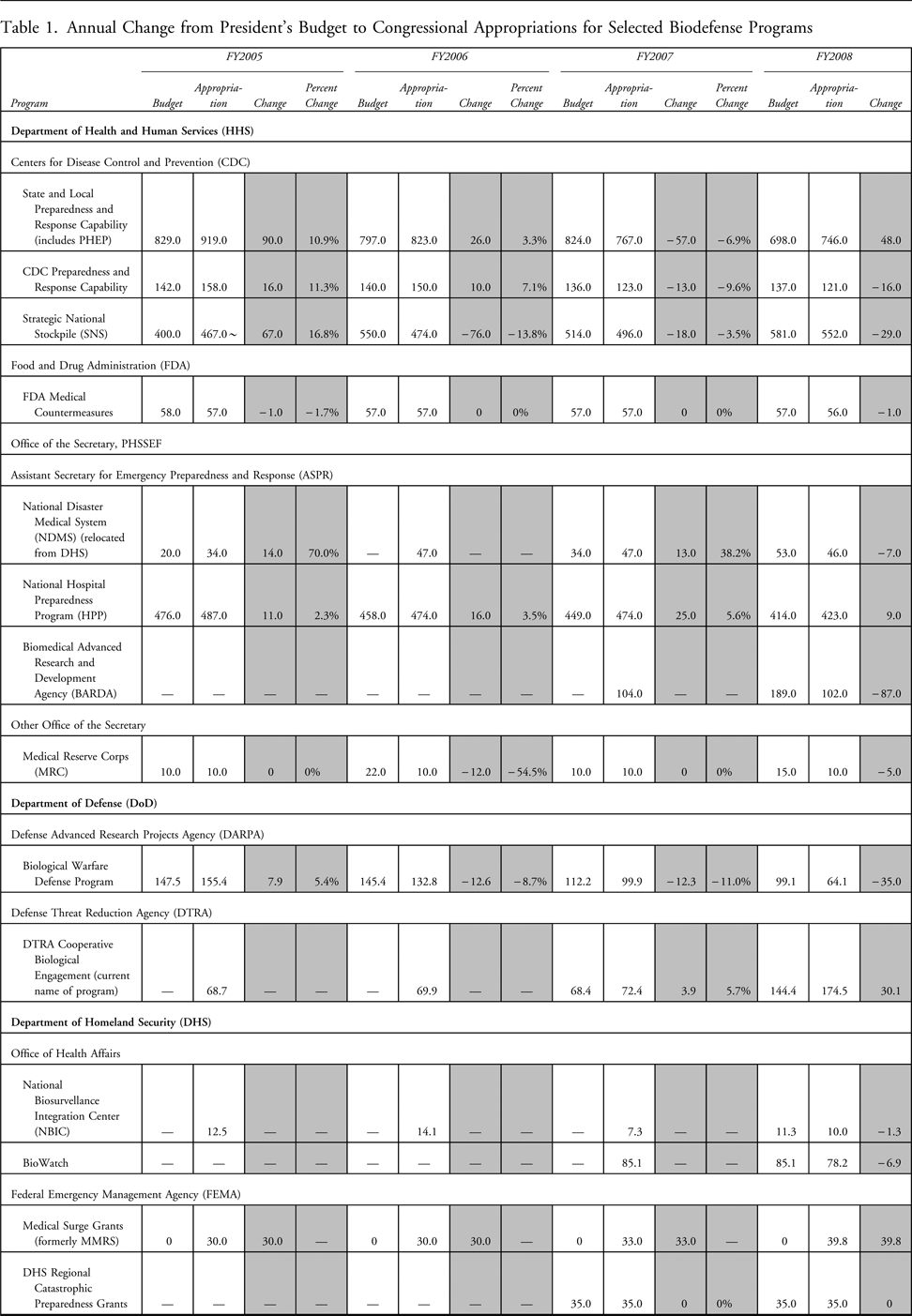
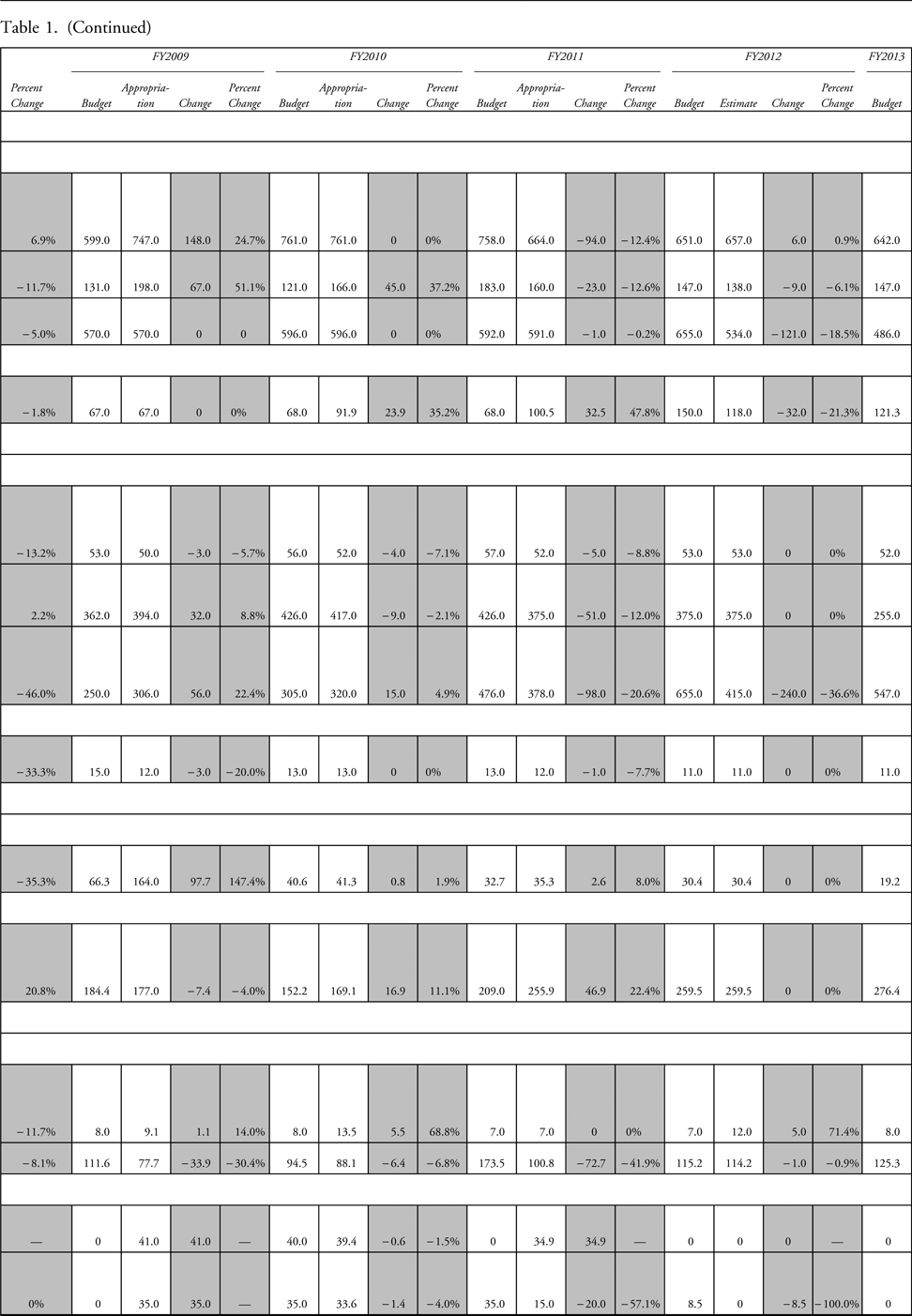
Funding levels for this analysis were determined by examining articles in the biodefense funding series published here in previous years.1–9 We selected 14 biodefense programs based on their central role in civilian biodefense and the availability of consistent funding data from FY2005 to FY2012. For each selected biodefense program, we identified the President's budget and the appropriations level in each fiscal year from FY2005 to FY2012. Finally, for each fiscal year, we calculated the change in funding levels from budget to appropriations (Table 1).
Findings
Trends
From FY2005 to FY2012, the difference between congressional appropriations and presidential budget requests for selected biodefense programs overall has varied. In some years, average funding across the 14 selected programs has nearly matched requests. In others, Congress has increased funding or reduced funding significantly. In particular, recent years have seen a significant reduction in appropriated funding compared to the President's budget. For instance, in FY2011 there was an average reduction of nearly $18 million and for FY2012 nearly $29 million from the President's budget (Figure 1).
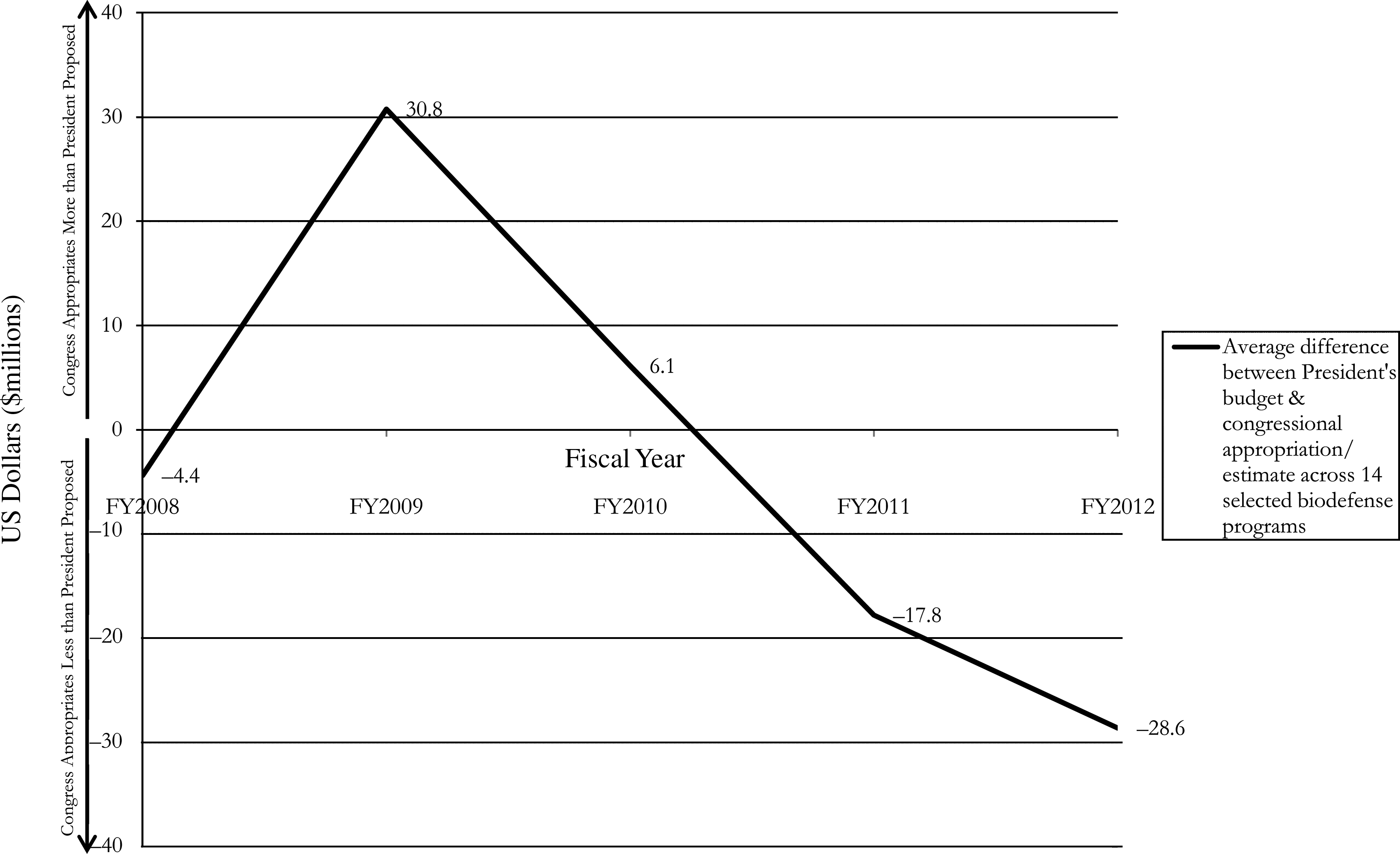
Average Change per Year of Budgeted vs. Appropriated/Estimated Funds, FY2008-FY2012
When analyzed by program, the differences between congressional appropriations and the President's budget requests for individual biodefense programs also vary. Programs that have seen the greatest congressional funding reduction on average since FY2008 from the President's budget include the Centers for Disease Control and Prevention's (CDC) Strategic National Stockpile program (SNS) (−$30.2 million on average), the Department of Health and Human Services' (HHS) Biomedical Advanced Research and Development Authority (BARDA) (−$70.8 million on average), and the Department of Homeland Security's (DHS) BioWatch program (−$24.2 million on average). Additionally, some programs may maintain relatively steady funding levels over several fiscal years but, in this analysis, show a reduction from presidential budget requests because proposed increases in funding have been unfulfilled.
Other programs have had significant average increases in funding by Congress when compared to the President's budgets. These include the Department of Defense's (DoD) Defense Threat Reduction Agency (DTRA) program on Cooperative Biological Engagement (+$17.3 million on average) and DHS's Medical Surge Grants (formerly MMRS) (+$23.0 million on average). Additionally, although overall funding has been reduced for CDC's Public Health Emergency Preparedness (PHEP) cooperative agreement program by 30% over the past 10 years, the average change between the President's budget and congressional appropriations has been positive (+$21.6 million on average from FY2008 to FY2012) (Figure 2).

Average Change per Program Budgeted vs. Appropriated/Estimated Funds, FY2008-FY2012
Individual Program Analysis
Some biodefense programs have clearly been given more support by either the Administration or Congress.
Medical Surge Grants
Funding for the DHS Medical Surge Grants provides an interesting case study of preservation by Congress. Since FY2005, the President has routinely zeroed out the budget of these grants and has requested funding for this program in only 1 year (FY2010). However, in each year's appropriations, Congress has persistently restored funding to this program at levels between $30 and $41 million until FY2012 (Figure 3).
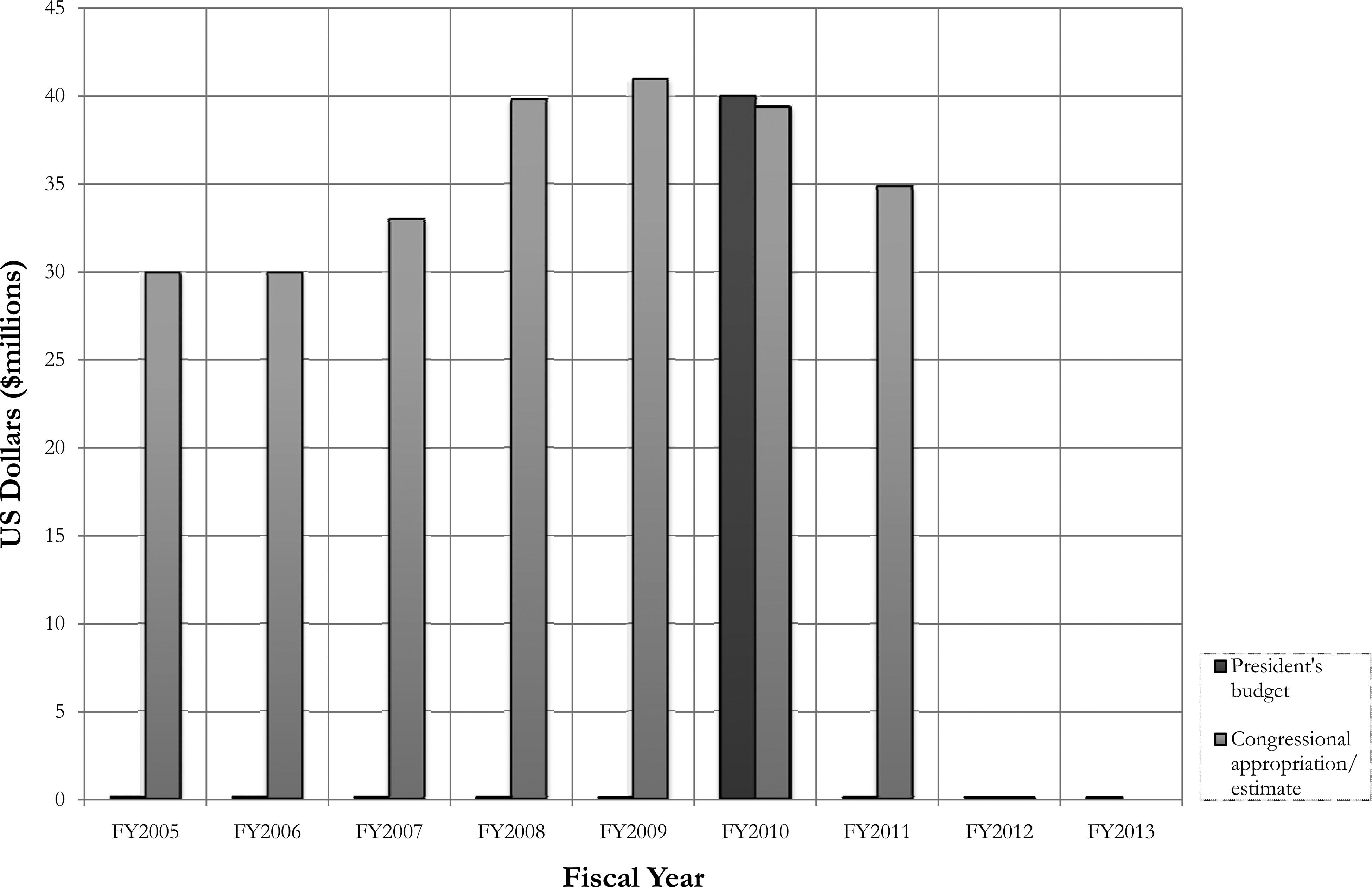
MMRS Comparison of Presidents' Budgets and Congressional Appropriations/Estimates
BARDA
BARDA has had a greater champion in the Administration than it has in Congress. In 3 of the past 5 years, Congress has funded BARDA at lower than requested levels, and proposed funding for BARDA has been reduced in appropriations by $70.8 million on average over the past 5 years. In FY2012, the President proposed a budget for BARDA of $665 million, which Congress reduced by 37% to the estimated appropriation of $415 million.
Additionally, since FY2009 BARDA has been funded with money already appropriated to another program—the BioShield Special Reserve Fund (SRF)—thus depleting the program fund, which is intended to be used to purchase medical countermeasures and not for countermeasure development under BARDA (Figure 4).
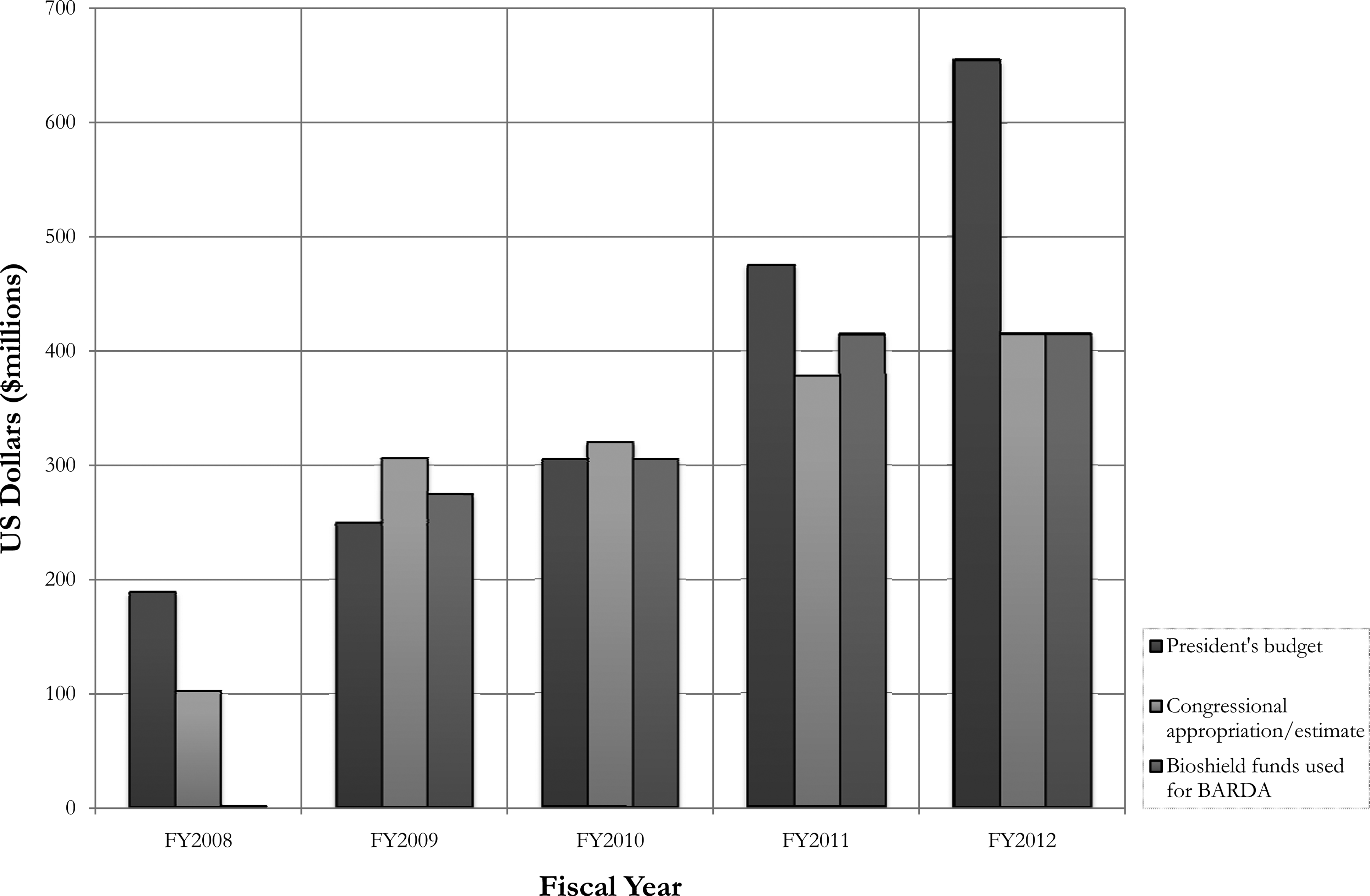
Comparison of Presidents' Budgets, Congressional Appropriations/Estimates, and Level of Bioshield Support for BARDA
Conclusions
The change between the presidential budget request and final congressional appropriation reflects differing priorities between the Administration and Congress. Although considerable attention is paid to the presidential budget request each year, appropriations made by Congress should have equal attention. This process is complex; public information on program funding is incomplete, and exact levels of funding for many biodefense programs is often difficult to determine until estimated amounts are included in the next year's budget request. It is clear from this analysis that some biodefense programs enjoy more support from Congress than others. In general, however, congressional funding for selected biodefense programs in recent years is lower than presidential requests. We hope that this analysis sheds light on the priorities of Congress and the Administration for these biodefense programs.