




Abstract

The US government is undertaking important and necessary efforts to prevent nuclear terrorism. However, should prevention fail, the nation must also be prepared to manage the consequences of a nuclear event. Rapid response, citizen preparedness, readiness to handle medical needs, and other incident management programs could save tens or hundreds of thousands of lives if a nuclear event were to occur.
Methods
To better understand the resources being committed to managing the consequences of nuclear terrorism, the Center for Biosecurity of UPMC sought to determine the level of funding allocated for programs in this mission area. We used a previous analysis completed by Schwartz and Choubey of the Carnegie Endowment to identify many relevant programs. 4 Additional programs were identified through careful search of budget materials from the Departments of Health and Human Services, Defense, Homeland Security, and Energy and the Environmental Protection Agency.5–16
Programs were included in the analysis if nuclear consequence management was incorporated into their program descriptions, titles, or missions. Programs focusing on “all-hazards” preparedness and response were not included in this analysis unless the proportion of funding for nuclear-related activities could be determined.
Findings
Collectively, the fiscal year (FY) 2012 appropriation for US nuclear consequence management programs totals $741.2 million (Table 1). This amounts to slightly over 1% of the estimated $52 billion total US nuclear weapons–related funding, including nuclear stockpile programs (as estimated in 2009) (Figure 1). 4 Funding for nuclear consequence management has remained essentially flat since FY2008, when it was estimated to be $700 million. 4
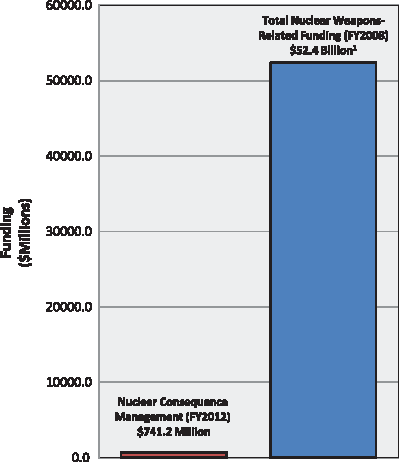
Funding for Nuclear Consequence Management vs. Total Nuclear Weapons-Related Funding. 4 Color images available online at www.liebertonline.com/bsp
Nuclear Consequence Management (in $millions)
FY2012 funding level is an estimate only.
Funding information was not available in FY2013 budgets; FY2012 amounts are from the FY2012 budget.
Conclusions
In 2010, President Obama observed, “Two decades after the end of the Cold War, we face a cruel irony of history—the risk of a nuclear confrontation between nations has gone down, but the risk of nuclear attack has gone up.” 17 Yet, this analysis shows that since FY2008, funding levels for nuclear response have not appreciably increased, despite this risk.
While prevention of a nuclear attack is of vital importance, the consequences of failing to prevent an attack are so large that the country must prepare to respond. We find that the funding and resources that have been dedicated to managing the consequences of a nuclear attack do not match the severity of the threat as indicated by government leaders and independent analysts.
If Congress and the administration are truly concerned about nuclear terrorism in this country, they should reassess the amount of support dedicated to saving lives in the event of a nuclear detonation.