




Abstract
Several quick tests for identifying botulinum toxins (BoNTs) are commercially available, but generally these tests have not been evaluated by independent laboratories. This study presents data on the evaluation of a number of commercial tests and demonstrates the use of cosmetic preparations of BoNT A and B as positive controls. For reference we used an in-house ELISA procedure. The cosmetic toxins, Botox® and Neurobloc®, were found to be useful—that is, they had a sufficiently high toxin content to be used in test evaluation studies. Some commercial kits based on columns (ABICAP®) or lateral flow technology were tested for their detection limits. The ABICAP column system was found to be a useful alternative to an in-house ELISA method. In general, the lateral flow–based test systems evaluated here were not able to detect BoNT, and a large proportion of the tests showed construction failures. In conclusion, this study showed that cosmetic BoNT products have enough toxin content to be used as convenient and accessible means of testing commercially available quick tests. The lateral flow tests used in this study were not satisfactory, while the ABICAP system was found to be a good alternative to an ELISA.
Several quick tests for identifying botulinum toxins (BoNTs) are commercially available, but generally these tests have not been evaluated by independent laboratories. This study presents data on the evaluation of a number of commercial tests and demonstrates the use of cosmetic preparations of BoNT A and B as positive controls. It showed that cosmetic BoNT products have enough toxin content to be used as convenient and accessible means of testing commercially available quick tests.
B
Many different methods based on both immunoassays and PCR-based detection systems have been developed and evaluated in food and public health laboratories to help detect toxins in food and diagnose toxin poisoning in patients. 8 Detection kits have also been developed and are commercially available for the detection of different toxins in suspicious samples. 9 A general overview of biotoxin assays can be found in a report from the Department of Homeland Security (DHS). 9 However, the report presents only the various technologies but does not evaluate the performance of commercially available tests.
The purpose of our study is to present results from our use of well-defined and prescription-accessible botulinum toxins in cosmetic preparations for testing and evaluating the performance of different commercial kits.
Materials and Methods
Reagents
Botulinum toxins (BoNTs) A and B from Calbiochem diluted in phosphate-buffered saline (PBS: 82 mM NaCl, 43 mM Na2HPO4, 9.8 mM KH2PO4) were used as reference toxin solutions and are referred to as in-house toxins. Four pharmaceutical-grade botulinum toxins described by Jimenez-Shahed 10 were used as test substances. Representing BoNT A toxins, Botox (BoNT A, 10 ng/ml), Dysport® (BoNT A, 8.7 ng/ml), and Xeomin (BoNT A, 1.2 ng/ml) were used in the study. Representing BoNT B, Myobloc®/Neurobloc® (BoNT B, 27.5 ng/ml) was used.
Three different toxoids from Senova (www.diavita.de) were also used in the study: toxoid A (toxoid, 104 00 008), toxoid B (toxoid, 104 00 013), and toxoid E (Bot.E Toxoid 322). The toxoids are supplied as pellets of 2.5 ng.
Assays
For reference, an in-house ELISA procedure with a starting dilution of 1 μg/ml of toxins (Calbiochem) of BoNT A and 0.1 μg/ml BoNT B (2-fold dilution curves) was used. The ELISA used precoated streptavidin plates (Thermo), which were coated with 100 μl biotinylated rabbit antibotulinum toxin (Diagnostica, SSI, Denmark) 1:100 in carbonated buffer and incubated overnight at 40°C. After incubation the plates were washed 3 times with alkaline phosphatase (AP) washing buffer (0.15 M NaCl, 8 mM Tris-HCl, 2 mM Tris-base, 0.05% Tween 20, pH 7.4) and blocked using 10 mM ethanolamine (100 μl per well) for 1 hour at room temperature. The plates were then washed again 3 times with AP washing buffer. The standard toxins were diluted with incubation buffer (0.04 M Tris-HCl, 0.01 M Tris-base, 0.15 M NaCl, 0.05% Tween 20, amidoblack, pH 7.5) +0.2% bovine serum albumin (BSA) for a final concentration of 0.1 μg/ml, after which the standards were diluted 2-fold in wells A1 and 2 to G1 and 2. H1 and 2 were blanks without toxin. The plates were incubated for 1 hour at room temperature on a shaking table and were then washed 3 times in AP buffer. The plates were then incubated with rabbit antitoxin antibody in a dilution of 1:250 with incubation buffer +0.2 % BSA.
Following a new washing, conjugated antirabbit IgG-AP diluted 1:2,000 in incubation buffer +0.2 % BSA was added, and the plates were incubated for 1 hour at room temperature on a shaker. After washing 3 times with AP washing buffer, the assays were developed for enzyme activity using 1 AP-substrate tablet/5 ml of substrate buffers. After 30 min incubation, the plates were read at 405 nm using the 650 nm absorbance as reference.
For testing the toxin concentration, 1 μg/ml of toxins (Calbiochem) of BoNT A and 0.1 μg/ml BoNT B, with known concentration, was used to generate a standard curve consisting of 8 calibrators for A (1,000, 500, 250, 125, 62.5, 31.2, 15.6, and 0 ng/ml) and 8 for B (100, 50, 25, 12.5, 6.25, 3.12, 1.5, and 0 ng/ml). The 4 commercially available toxins were diluted 1:1 for A (Botox®, Dysport®, and Xeomin®) and 1:5 for B (Myobloc®/Neurobloc). The diluted standard and samples were added in duplicates into the appropriate wells. The absorbance value of each well was compared, and the concentrations for all samples were calculated, using the 8-point standard curve and multiplied with the dilution factor to obtain the result in ng/ml.
Commercial Test Kits
Several commercial test kits for detecting botulinum toxins were tested. The commercial ABICAP multilayer test kit contains 24 columns in a 3-filter arrangement and all reagents to perform quantitative tests. ABICAP specific for BoNT A, B, or E was evaluated. The ABICAP test can be read visually or by using a Photometer (DiaVita), which will provide an OD-value.11,12 In the present study, the tests were read visually.
The test has previously been described by Attrée et al 11 and is also called an immunoaffinity column (IAC) assay. (Further information on the ABICAP® Test Kits [DiaVita] can be found at www.diavita.de/germanneu//images/stories/Downloads/BroschEnglischInternet.pdf.) Four different test kits based on the lateral flow technique were also tested. All 4 tests are described by Baird et al. 9
The BADD Botulinum Toxin test is a lateral flow test designed to detect botulinum A or botulinum B. Further information can be found on the company's homepage (BADD [Biowarfare Agent Detection Devices], ADVNT Biotechnologies, www.advnt.org/products/biowarfare/baddbox/, Instruction sheet and homepage).
The Pro Strips Rapid Screening System Multi-Agent BioWarfare Threat Detection Kit is described by the company instruction as a 1-device, 1-sample multiple threat recognition kit. Pro Strips is intended for detecting anthrax, ricin toxin, botulinum toxin, Y. pestis (plague), and SEB (Staphylococcal enterotoxin B). For further information, see the Pro Strips™ (ADVNT Biotechnologies) homepage (www.advnt.org/products/biowarfare/prostrips/).
The ENVI Assay System is an immunochromatographic rapid test. As described in the company instruction, the kit contains disposable rapid tests for screening environmental samples for anthrax, ricin toxin, SEB, smallpox, and botulinum toxin. For further information, see ENVI Assay System and ChemPro Reader Module (Environics Oy) (www.swanenviron.com/securitytec.html).
The RAID DX kit contains a RAID 8 test and a RAID TOX test. The RAID 8 test detects anthrax, ricin toxin, botulinum toxin, SEB, plague, brucella, tularemia, and orthopox, while the RAID TOX (Cat. #R-450) detects ricin toxin, botulinum toxin, and SEB and has a positive and a negative control. For further information, see Alexeter Technologies, LLC© (www.alexeter.com/biow/index.asp).
Results
Specificity of the Toxin Assays
Figure 1 shows the data from the in-house ELISA. The in-house ELISA was able to detect the cosmetic toxins Botox, Dysport, and Myobloc®/Neurobloc®. In the ELISA for botulinum A toxin (Figure 1A), the Botox and Dysport preparations were only detectable just above the limit of detection. Xeomen was not detectable. Testing Neurobloc in the ELISA for botulinum toxin B (Figure 1B) showed a concentration of 144.5 ng/ml compared to the official concentration of 27.5 ng/ml. The toxin Myobloc®/Neurobloc® B showed a relatively high cross-reaction (5.5 ng/ml) in the ELISA test for botulinum A (data not shown). Also, the toxoids A and B from Senova showed a good response in the ELISA (Figure 1).
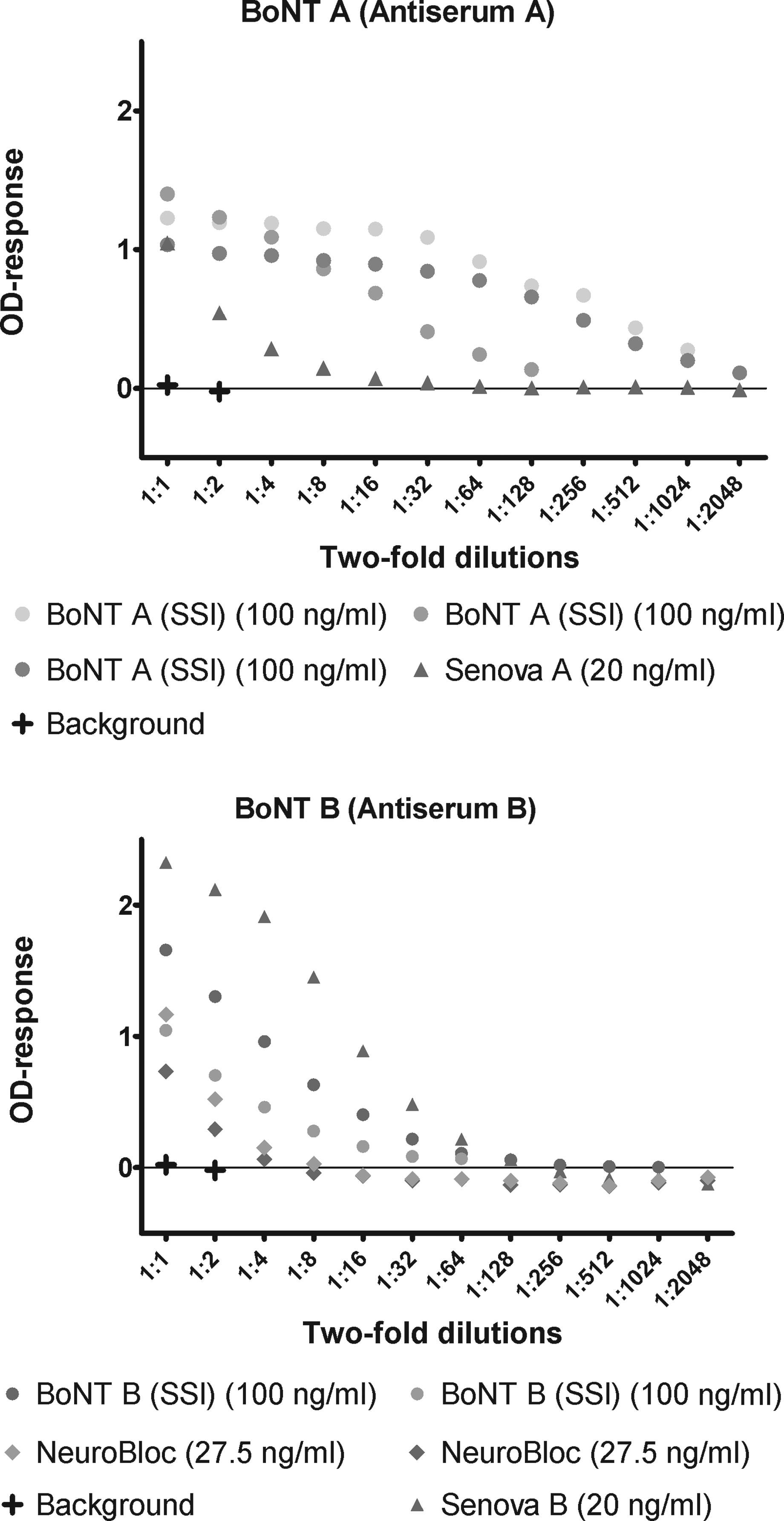
Testing Cosmetic Toxin (NeuroBloc), 2 Toxoids (Senova A and B) and Our In-house Toxins (BoNT A and B). The toxins were all tested using our in-house ELISA. The starting solution has been noted for each toxin. The toxins were 2-fold diluted. The 3 cosmetic toxins Botox, Dysport, and Xeomin have not been included in that they show a response around the cut-off limit.
ABICAP Column System
The ABICAP A was able to detect the cosmetic Botox (BoNT A), the toxoid A, and the in-house toxins although at different concentrations (Figure 2). The ABICAP A also detected Neurobloc (BoNT B), with a reaction similar to the reaction in the in-house ELISA, and, furthermore, the E toxoids yielded a positive response.
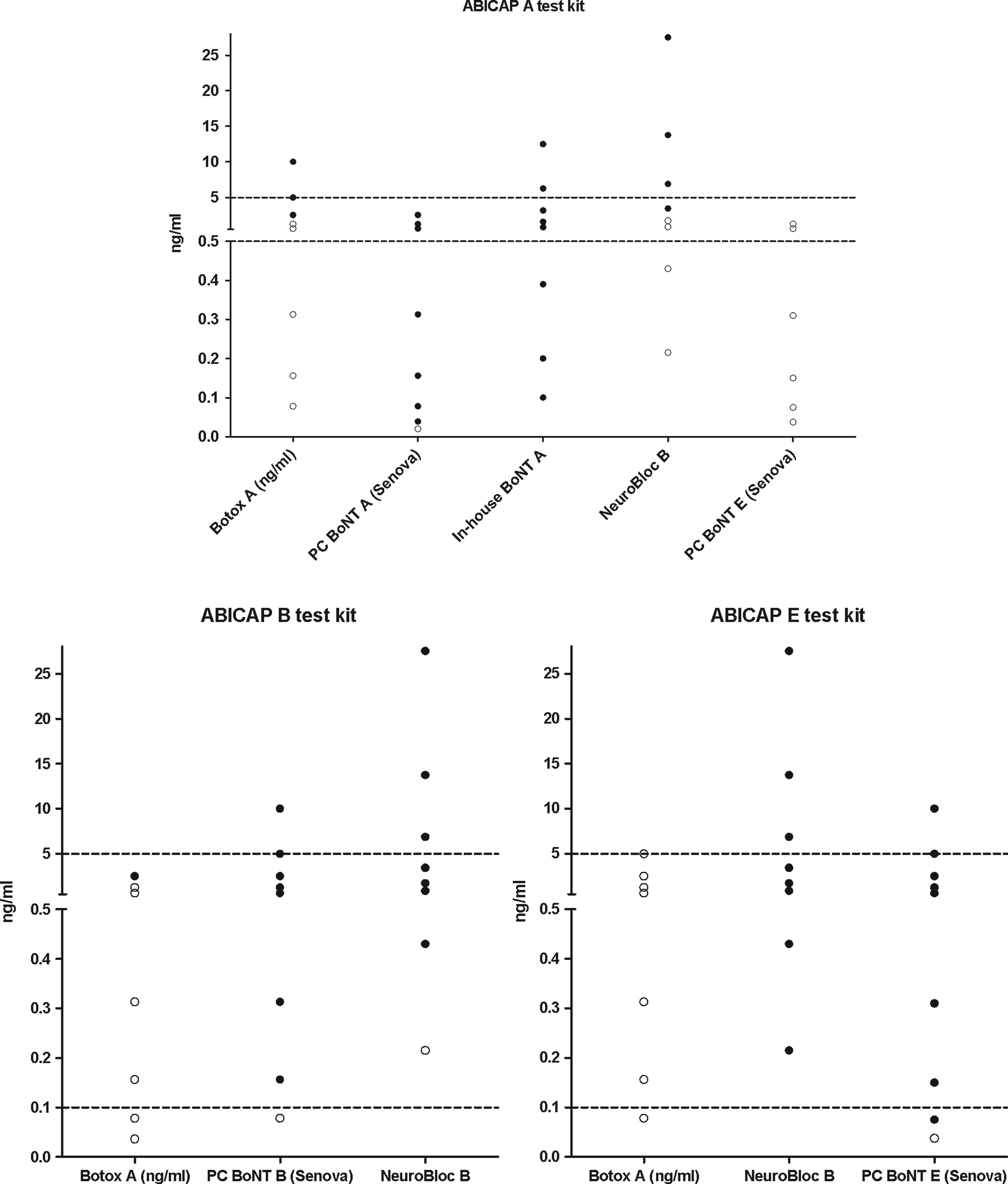
The Response of Assays to Individual Toxin Preparations. Concentrations are the known concentrations of toxins and toxin dilutions based on the information of the manufacturers. Transparent symbols represent negative responses (ie, absent signals in the test kit). Black symbols signify positive responses. The upper detection limits (uDL) and lower detection limit (lDL) for each ABICAP system are presented by dotted lines. Within this interval, the concentration of the test sample may be measured using a photometer.
ABICAP B was tested against Botox (BoNT A), Neurobloc (BoNT B), and the Senova B toxoid. The ABICAP B was not tested against Cabiochem toxin BoNT B. The ABICAP B showed a very similar response against both Neurobloc (BoNT B) and the Senova B toxoid. A weak cross-reaction against Botox (toxin A) was also observed.
The ABICAP E assay was tested with toxoid E with a positive result. Also, Neurobloc and Botox were tested; while Botox showed no response, Neurobloc (ie, toxin B) showed a strong cross-reaction exceeding the signal for E toxoid.
The ABICAP system has in this study been read visually, but a photometer can be used to provide an OD-value. Figure 2 presents the lower and upper detection limits for the ABICAP system, where the photometer is able to measure the amount of toxin in the sample; for ABICAP A, the upper detection limit (uDL) is 5 ng/ml and the lower detection limit (lDL) is 0.5 ng/ml. This is the interval within which the toxin concentration in a sample can be measured from the OD-value. Signals above the uDL will have to be diluted before the photometer will be able to give an exact toxin concentration in the sample. A cut-off limit for visual reading was not provided with the ABICAP test; however, all positive responses in this study for ABICAP A, B, and E started below the uDL and proceeded above the limit (Figure 2).
Using PBS as a negative control in the ABICAP resulted in a nonspecific reaction, but the provided sample buffer from ABICAP used as a negative sample gave a negative response as required.
First-Responder Lateral-Flow Kits
The BADD, Pro Strips, ENVI, and the RAID DX were tested using in-house toxins, cosmetic toxins, or toxoids (Table 1).
Several of the assays showed malfunctions in that adding drops to the sample wells did not result in a sample flow that was able to reach all test windows, even when drops continued to be added to the sample wells.
ENVI Assay (Environics Oy). One of 2 tests with in-house BoNT A 10,000 ng/ml showed a positive response.
A follow-up 1:50 dilution is evaluated on the RAID test kits.
The BADD A test was tested against both Botox A (100 ng/ml) and Calbiochem BoNT A (50 ng/ml) with a negative result, although the detection limit of BADD A is 33 ng/ml according to the manufacturer. The BADD B test was tested against both 500 ng/ml and 10,000 ng/ml of in-house BoNT B with a negative response, although the detection limit of BADD B is 500 ng/ml according to the manufacturer.
The Pro Strips test was tested with Calbiochem BoNT A (50 ng/ml and 10,000 ng/ml), Botox (100 ng/ml), and Calbiochem BoNT B (10,000 ng/ml), all with negative responses. The detection limit of Pro Strips is stated to be 33 ng/ml for toxin A and 500 ng/ml for toxin B. Several of the assays showed malfunctions in that adding drops to the sample wells did not result in a sample flow that was able to reach all test windows, even when drops continued to be added to the sample wells. The ENVI Assay System was tested against Calbiochem BoNT A (10,000 ng/ml), Botox (100 ng/ml), and NeuroBloc (27.5 ng/ml), all with a negative response. Retesting the ENVI Assay System with the Calbiochem BoNT A toxin (10.000 ng/ml) this time showed a positive response. However, the detection limit of the ENVI Assay System is stated to be 10 ng/ml.
The RAID 8 and RAID TOX tests were each tested with NeuroBloc (27.5 ng/ml and 13.75 ng/ml) with a negative response. Furthermore, several of the RAID 8 kits showed malfunction, in that adding drops to the sample wells did not result in a sample flow that was able to reach all test windows, even when drops continued to be added to the sample wells. The detection limit of the RAID 8 test is stated to be 30 ng/ml. Because of reappearing malfunction and general lack of response with the RAID 8 and RAID TOX tests, we decided not to proceed with the testing of these kits.
Discussion
In many emergency situations there are no sophisticated laboratory facilities available close by for handling toxins, and therefore the easy-to-use first responder assays are attractive when encountering suspected biotoxin materials.4,13 Setting up the gold standard method—that is, mouse LD50 tests—is often not an option because of the animal, antibody, and facility requirements needed for such tests.11,13 The use of rapid diagnostic tests such as lateral flow tests therefore holds promise for first responders. However, many of the simple field tests have not been scientifically evaluated, so end users need to test and evaluate the quality of such kits before using them.
In this study, we tested and used cosmetic toxins available by medical prescription for BoNT A and B and compared them to botulinum toxins. The advantage of using these toxins is that they are well-defined, positive toxin controllers and available as medical drugs. 10 Thus, a laboratory does not need to culture the C. botulinum bacterium to obtain the BoNT by secretion, 11 a task that can be problematic when no sophisticated laboratory is available. The disadvantage of using the cosmetic toxins is the cost associated with the evaluation of the field kits. Here, Botox was selected as the preferred A toxin because it is the cheapest product with the highest concentration of toxin of the 3 tested BoNT A toxins. It is a lyophilized powder that is reconstituted in liquid. By changing the volume of the solution, the toxin concentration may be adjusted to the desired level. For botulinum toxin B, to our knowledge, NeuroBloc is the only pharmaceutical grade product available. However, the low solution of NeuroBloc of 27.5 ng/ml makes it less useful for situations requiring higher concentrations. We also found that in further evaluating our in-house ELISA, we now have well-defined positive control toxins for both botulinum toxin A and B, which can be used in the future evaluation of the in-house ELISA.
The ABICAP procedure is a column-based immunoaffinity test that has been described and evaluated in several studies with good results.11,14 The study by Attrée et al 11 tested the method against BoNT A and found that the ABICAP assay is one of the most rapid and sensitive immunoassays for the detection of BoNT A. In another study, the ABICAP system was used for detecting Yersinia pestis and found to be a simple and specific test. 14 The ABICAP system, however, was found to be very complex as a first responder test. It requires multiple pipetting steps, and the whole test procedure takes around 40 minutes. However, the system is sensitive, and we conclude that it may be used as an alternative to a conventional ELISA, especially as a screening method.
The 4 first responder assays tested in this study are all based on lateral flow systems. 9 The typical limits of detection of lateral flow tests for BoNT are stated to range from 5 to 50 ng/mL (500-5,000 MLD50/mL). 15 According to Baird et al, 9 only the BADD assay has been scientifically evaluated before,13,16 and there are no peer-reviewed studies for the 3 other assays (ProStrips, RAID, and ENVI). Two studies described test results using BADD for the detection of BoNT A 13 and Bacillus anthracis spores. 16 In the study by Gessler et al, 13 a detection limit for the BADD assay using purified BoNT A of 100 ng/ml was reported in contrast to the detection level of 33 ng/ml specified by the manufacturer.
In the present study, we were not able to obtain a positive response for any of the tested toxins and concentrations in this assay. Of the 3 other lateral flow tests, we were able to achieve a positive response only with the ENVI assay using a concentration of 10,000 ng/ml of the Calbiochem BoNT A toxin (1,000 times above the stated detection limit). Despite the fact that we are using different manufactured toxins with a concentration high above the specified detection limits of the assays, positive responses were observed only for 1 test. Furthermore, several assays repeatedly showed functional failures in that the sample flows with the toxins were not able to consistently reach all test windows in the assays. Because of the poor results of the 4 lateral flow tests in detecting BoNT A and B toxins in our laboratory, we did not evaluate the assays further (eg, with spiked samples).
In conclusion, the ABICAP system is a specific, sensitive, and simple method, which has been evaluated in several studies with good results. However, the ABICAP system was not found to be suitable for first responders, in that the handling procedure was too complicated for our purpose. It was therefore not tested further with spiked samples. However, as a temporary alternative method to an ELISA, it did it seem suitable. The system may be read either visually or by a photometer 11 (www.senova.de). This assay is recommended for laboratories in the build-up phase as a basic assay. The 4 tested lateral flow assays were not found applicable for first responders due to several observed functional failures and lack of positive responses against toxins above the stated detection limits. Commercial cosmetic toxins represent a convenient and well-controlled, albeit costly, alternative to obtaining botulinum toxins from chemical companies or from a laboratory's own bacterial cultures. Instead of requiring each laboratory to evaluate every commercially available test system, the field would be much facilitated by the development of a DHS standardized test and evaluation of biological threat agent detectors (globalbiodefense.com). However, until such a resource has been developed, individual laboratories still need to evaluate tests locally.