




Abstract
The terrorist attacks of September 11 and the anthrax mailings a month later prompted a sweeping response by the federal government to improve the preparedness of the US to meet the potential threat posed by a terrorist using a biological agent. This response transcended traditional interagency boundaries, creating new opportunities while producing unique fiscal and leadership challenges. The National Interagency Confederation for Biological Research has made significant progress over the past 12 years because of its ability to adapt to the need for interagency cooperation and overcome many of these challenges. As construction of the National Interagency Biodefense Campus at Fort Detrick nears completion, the US has the capability to pursue a unique whole-of-government approach to the development of medical measures to counter the threat of bioterrorism. In addition to the high-level support of many in the federal government, the key success factors for this effort have been (1) a critical mass of leaders with the right leadership characteristics, (2) development of a compelling vision and accompanying narrative understood and articulated by all partnering organizations, and (3) recognition of the need for a partnership office to do the important communication and collaboration work in the organization to synchronize the information available to all the partners. The major barrier to interagency cooperative efforts of this kind is the inability to comingle funds from different appropriations.
The response to the 2001 attacks transcended traditional interagency boundaries, creating new opportunities while producing unique fiscal and leadership challenges. The National Interagency Confederation for Biological Research has made significant progress over the past 12 years because of its ability to adapt to the need for interagency cooperation and overcome many of these challenges. Key success factors include a critical mass of leaders with the right leadership characteristics, a compelling vision and accompanying narrative understood and articulated by all partners, and a central office to synchronize the information available to all the partners. The major barrier has been the inability to comingle funds from different appropriations.
T
Before 2001, US government efforts to produce medical countermeasures against biological weapons centered on the Department of Defense (DoD), and DoD scientists appropriately focused their efforts on protecting an expeditionary military: healthy personnel facing a known or suspected threat. Specialized high-containment research laboratory space and expertise to ensure the safe study of lethal agents was therefore extremely limited. The critical need for a whole-of-government effort to address bioterrorism more comprehensively led to the formation of a unique organization, the National Interagency Confederation for Biological Research (NICBR), and a substantial investment in research infrastructure, culminating in the National Interagency Biodefense Campus (NIBC) located at Fort Detrick, in Frederick, Maryland.
This article captures the critical developments of the evolution of the NICBR and the NIBC since their inception and is offered primarily as a descriptive narrative. However, the principles developed over the past 12 years in this effort may be applicable to other complex interagency cooperative efforts, especially when major investments are required. At a minimum, the lessons learned should not be lost.
Early Development
Table 1 is a timeline of the development of the NICBR and the NIBC. While the events of September and October 2001 precipitated the formation of the NICBR and the outpouring of commitments necessary to construct the NIBC, the NICBR was conceived well before those events. Senior military health leaders and civilian health leaders in the Department of Health and Human Services (HHS) recognized the growing threat attendant to biologic weapons and the need for a broader research base to develop countermeasures. Specifically, the need to do laboratory research to better assess potential threats was evident to many, as was the need for research on measures to treat, not just prevent, disease caused by exposure. Meeting these expanded research needs mandated a broadening of the research base and the involvement of scientists and clinicians in HHS as well as DoD. Furthermore, as the research effort spread to involve more laboratories, more agencies, more scientists, and more clinicians, the need for collaboration and coordination measures to optimize cooperation and avoid redundancy was also evident.
National Interagency Confederation for Biological Research Timeline
Enlarging the research effort necessitated the construction of facilities designed and engineered specifically for research with dangerous pathogens. Existing facilities at the US Army Medical Research Institute for Infectious Diseases (USAMRIID) needed to be expanded, while extending the work into new areas required facilities built de novo. Construction of high-containment research facilities is expensive, and the requirements necessary to protect the workforce, the environment, and the surrounding community while conducting the research are exacting.
The National Institute of Allergy and Infectious Diseases (NIAID) of the National Institutes of Health (NIH) created a unique research facility modeled after a hospital, complete with advanced imaging capabilities. A key decision made early in the planning process was to locate NIAID's laboratory, the Integrated Research Facility (IRF), at Fort Detrick, Maryland, where DoD biodefense work was already centered and plant pathogen work by the US Department of Agriculture (USDA) was well established. The NIH already had a significant presence at Fort Detrick in the National Cancer Institute (NCI). The expertise required for operating containment laboratories and the understanding of the unique security and support requirements already existed at Fort Detrick.
While funding for a laboratory to characterize the potential offensive threats to the US was requested by the Army, this mission was eventually assigned to the newly created Department of Homeland Security (DHS), and funding for the National Biodefense Analysis and Countermeasures Center (NBACC) was provided to that agency. DHS and NBACC also received the mission assignment of forensic analysis support to law enforcement organizations including the FBI, a need illuminated during the investigations of the anthrax letters. The decision to place NBACC at Fort Detrick followed the same lines of reasoning as placement of the IRF. Senior military and civilian government leaders further directed the planning effort to focus on putting all the biodefense laboratories, USAMRIID, NBACC, and IRF, in the same area of Fort Detrick, creating a campus arrangement both to facilitate scientific exchange and to provide the greatest opportunity for sharing common support services required by the various laboratories. All newly constructed laboratory facilities included dedicated space for high-containment laboratory operations. Conceptually, the NIBC was complete by the end of 2003.
Compelling Narrative
The entry of additional agencies into the biodefense research space created the requirement for an organization to effect communication, coordination, and collaboration among the agencies while resolving conflicts and preventing redundancy. Planning for this organization, the NICBR, took place in parallel with the concept development and planning for the NIBC. On April 22, 2003, the NICBR constitution was signed by the Army, NIAID, and NCI. As the largest single organization resident at Fort Detrick, NCI would be substantially affected by the ongoing development of the NIBC and, even though its cancer-fighting mission space did not overlap greatly with the other partners, NCI support and scientific collaboration have been critical for progress of the effort. DHS and USDA joined the NICBR near the end of 2003. The Centers for Disease Control and Prevention (CDC) became an NICBR partner in 2005.
The NICBR constitution codified a 3-tiered governance structure (Figure 1). Every charter member, regardless of size, has voting representation at all 3 levels. The top tier or board of directors includes the Surgeon General of the Army; the directors of CDC, NIAID, and NCI; the director of research and development of the Science and Technology Directorate of DHS; and the administrator of the Agricultural Research Service of USDA. The middle tier of governance, the executive steering committee, includes the commanding general of Fort Detrick and flag level representatives of all partners. The third or operational tier of governance, termed the Fort Detrick Interagency Coordinating Council (FDICC), includes the commander of Fort Detrick Garrison and the resident leads for each of the member organizations. While the Army is the host for the NICBR and the NIBC, there is no designated lead agency or lead organization. There is no one in the organizational structure or governance model designated as the executive director. The NICBR survived because of, or in spite of, the fact that it is driven by a unanimous consensus-driven leadership model. No member organization has the authority to make a decision for any other member.
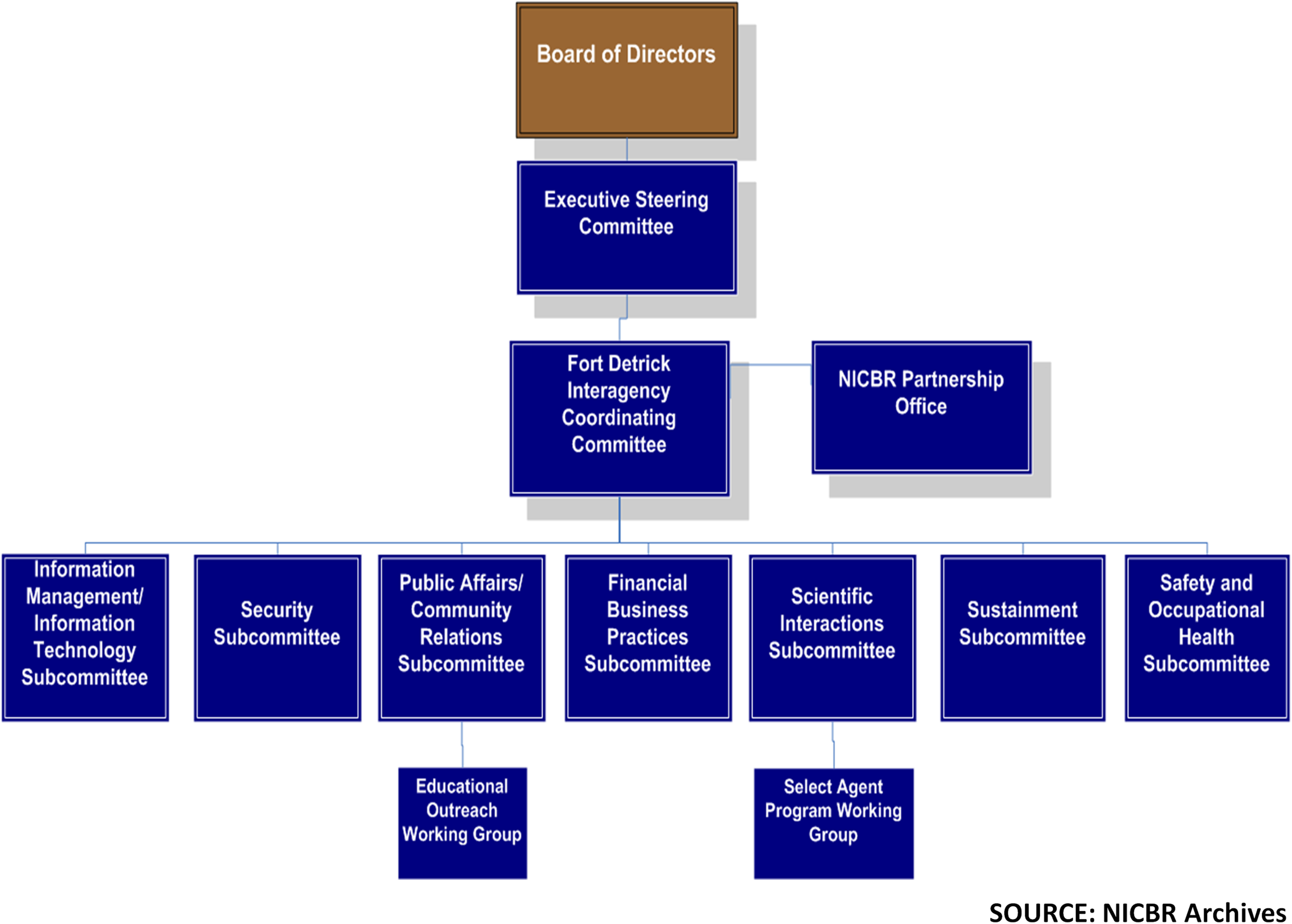
National Interagency Confederation for Biological Research Governance Structure (Color graphics available online at www.liebertonline.com/bsp)
Once agreements were reached on the campus arrangement and the governing documents, attention focused on funding, planning, and constructing the individual laboratories as well as providing for the infrastructure necessary to support the new laboratories. Even with high-level support from both legislative and executive branches of the federal government, securing the funding necessary for 3 large containment laboratories required extraordinary effort. A compelling narrative emerged. Each NICBR partner had to understand and be able to articulate the unique mission space of all partners. Partners with new construction requirements became mutually supportive. Partners without new construction requirements understood the narrative and were extremely valuable in helping to articulate the need for 3 new laboratories.
Another key element of the narrative was the emphasis placed on the campus arrangement. While each agency had a unique scientific mission, the support requirements—security, logistical support, and utilities for the laboratories—overlapped greatly. Articulating how the campus arrangement afforded the greatest opportunity for efficiencies in the provision of support services while simultaneously providing the environment most conducive to scientific research was key to securing funding.
Infrastructure Challenges
Separate congressional appropriations for each of the 3 major laboratories provided funding for building the individual research facilities but not the infrastructure enhancements needed to support the new construction. The authorizing legislation for the new laboratories specified that construction would take place at Fort Detrick but never mentioned the word campus. The necessary space was evident. However, extant utility, transportation, communications, and security infrastructure was not sufficient. If early planners operating under significant time constraints were to be faulted, it would be for failing to fully provide for the large investment in infrastructure needed to develop the NIBC. The Deputy's Advisory Working Group of the DoD approved a substantial amount of DoD money in 2009 to support infrastructure development but also constrained use of the additional money for the DoD portion of the infrastructure costs. In accordance with law governing expenditure of funds by federal agencies, other partners did not have budgetary authority for infrastructure outside their laboratories. What constituted DoD portions of the costs remained open to much interpretation and has resulted in the frequent need for discussion and negotiation. The fact that NIBC construction is nearing completion and none of the obstacles has proven insurmountable is a testament to the skill in conflict resolution of many individuals.
The most problematic infrastructure investment involved the provision of electrical power, steam for heat, and chilled water to the laboratories. The existing commercial power grid supplied adequate power but could not achieve the exacting standards for reliability and stability needed to operate the extraordinarily sophisticated equipment in the new laboratories. A new central utility plant was necessary, and the plant had to be brought on line quickly in order to support the construction of the laboratories. Without money earmarked for infrastructure development, the Army determined the best available option to be a public-private partnership. In what is termed an “enhanced-use-lease” (EUL) arrangement, private companies raised venture capital and constructed the central utility plant on Fort Detrick land in exchange for lease payments. The enhanced-use-lease provided the utilities on time to meet construction timelines. The power conditioned by the central utility plant is free from perturbations. However, utilities supplied in this manner and to these standards are expensive, and the cost of utilities has been a point of friction among the partners. Engagement of outside consultants to assess utility charges mitigated the friction significantly. However, the cost of utilities remains a significant issue with partner organizations. These costs have a negative impact on the amount of money available to conduct science. More thorough planning for infrastructure development might have prevented the central utility plant from becoming an issue.
Advent of the Partnership Office
The construction effort reached a peak during the years 2007 to 2009. Construction of the first phase of the central utility plant was completed. Construction of the NBACC was completed during this period, and the construction of the IRF neared completion as well. Construction of a new Navy lab was begun in July 2009, and groundbreaking for the first phase of the Army's new USAMRIID took place in the fall of 2009.
However, progress in construction was not matched by progress in the organizational development of the NICBR. In spite of the participants' unwavering commitment to the success of the NICBR, working together proved to be difficult. Unique organizational cultures became an issue as were differing business processes among the partners. The 3-tiered governance model was insufficient to meet the rapidly evolving needs of the campus. Everyone involved in NICBR governance had full-time jobs elsewhere in their home agencies, and no individual in any of the partnering organizations had standing up the NICBR and making it successful as their main responsibility. After some preliminary discussions among the partners, a decision was made at the executive steering committee level to establish the NICBR Partnership Office (NPO). Member organizations contributed either full-time or part-time senior-level staff to the partnership office as they were able. Partnership office staff members were selected based specifically on the basis of their networking skills and commitment to NIBC and NICBR success.
Establishing the partnership office solved a number of problems. Its staff rapidly developed a sense of ownership for progress in organizational development of the NICBR. A sense of the importance of teamwork permeated their efforts. Communication throughout the partnering organizations rapidly improved. The partnership office staff exchanged information constantly and ended compartmentalization of information. Information needed by all partners was provided to them for analysis and consideration as soon as it was available. Before the partnership office was established, inadvertent withholding of information occurred all too often and had inhibited the development of trust among the partners.
The second important contribution of the partnership office was the provision of a capable staff to the governance structure. The board of directors, executive steering committee, and interagency coordinating council now had full-time professionals to collect information and analyze issues between meetings. These activities freed members of the governing bodies to deliberate and make decisions. The partnership office did not govern but quickly became a key enabler for effective governance. Meticulous records of meetings and scrupulously maintained records of issues that required action were important adjuncts to the deliberations of the governing groups. The partnership office staff carefully prepared their governance representatives for important meetings and decision points. Governance meetings became more productive; decisions were made and problems were solved.
In 2011 all 3 governing bodies—the interagency coordinating council, executive steering committee, and board of directors—ratified a strategic plan, a rarity among complex interagency organizations. Based on the shared core values of trust and teamwork, the plan recognized that a loose confederation did not achieve the founding goals of the NICBR or the NIBC. The vision of the NICBR became synergistic biological research and development focused on the nation's most important scientific challenges and threats, capitalizing on the efficiencies of co-location and the opportunities to advance effectiveness with frequent opportunities to communicate and collaborate under the NICBR umbrella.
Additional Partners
The Base Realignment and Closure (BRAC) Act of 2005 added a new laboratory to the NIBC. The law required the Navy to relocate its biodefense-related operations to Fort Detrick from the national capitol region. The NICBR constitution was amended, and the Navy became a partner, with representation at all 3 layers of governance. The Navy's laboratory was built and key personnel moved before BRAC deadlines.
Other partners, the US Food and Drug Administration (FDA) and the Army's Installation Management Command (IMCOM), have been added more recently. The FDA's Office of Counterterrorism and Emerging Threats (OCET) medical countermeasure mission is closely aligned with the NICBR mission and adds complementary core capabilities to foster the development and approval of safe and effective medical products to counter national security biothreats. The NICBR constitution has been amended to accommodate differing levels of membership. Details of the reasoning for having different types of members are beyond the scope of this article; suffice it to say that for an organization bound by the requirement for unanimous agreement, becoming overly inclusive is a potential hazard (Figure 2).
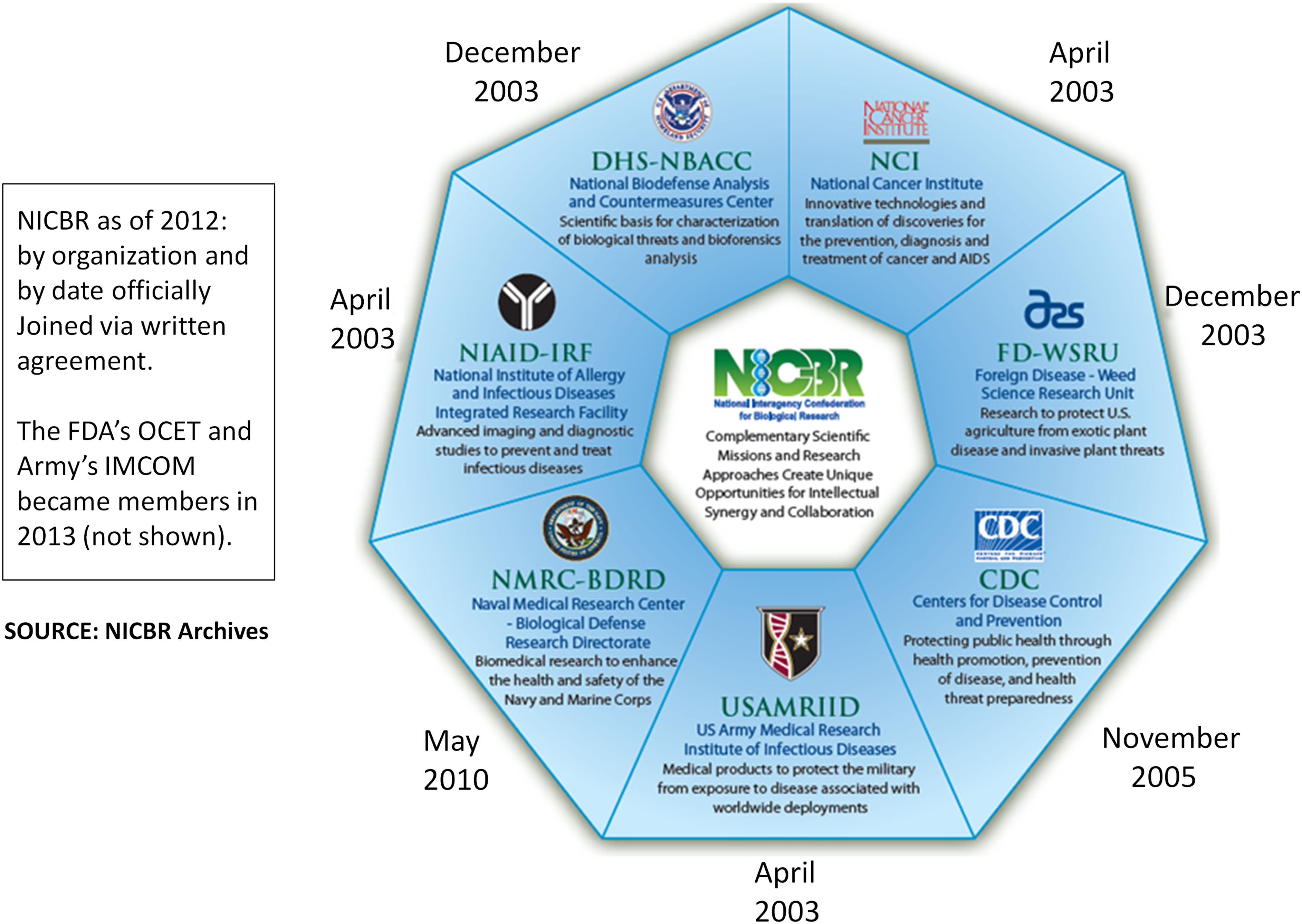
NICBR: Distinct but Complementary Missions (Color graphics available online at www.liebertonline.com/bsp)
Leadership
Any discussion of the evolution of the NICBR to its current state is incomplete without considering the leadership attributes required for a venture like the NICBR to succeed. We have alluded to the fact that no one person is ever completely in charge of the NICBR. We have intentionally avoided the mention of any leaders involved in this effort by name. Any list would be necessarily arbitrary, incomplete, and probably even inaccurate. After interviews with 20 principals involved in the different stages of developing the NIBC and the NICBR, we concluded that progress with this endeavor went far beyond a small group of visionary leaders and that a large number of influential people with a common vision were essential to the effort.
While it may not be possible to identify all the leaders important to the development of the NIBC and the NICBR, it is possible to describe the leadership attributes most important to progress. Leaders needed to possess substantial credibility in their own agency. This credibility extended to their superiors, who had to trust the leader's judgment to deal with the unrehearsed and novel leadership challenges of the interagency environment. Successful leaders in this environment had to have the trust and confidence of their subordinates as well. However, the most distinctive feature of successful leaders in the interagency environment was the ability to establish credibility across the different partnering organizations and agencies. The willingness to see issues from the perspective of each partnering organization rather than only their own was of inestimable value.
The meta-leadership model developed by Marcus and Dorn at Harvard's Kennedy School of Government well describes the leaders needed in the interagency environment. 2 First developed from observations of interagency operations in response to natural and man-made disasters, the model is used to train leaders for emergency preparedness. The meta-leadership model emphasizes the need to lead up and down one's own chain of supervision as well as across partnering organizations with their own unique cultures and processes. The concepts of critical mass, consistency, and organizational memory are all apropos. Especially critical is a shared vision among key leaders of what constitutes success and strict adherence to a set of shared values—in the case of the NICBR, a commitment to building trust among the partners. Progress in the evolution of the NICBR has been most pronounced when partnering organizations and agencies have maintained a critical mass of meta-leaders in the 3 layers of governance and the associated subcommittees and working groups.
Issues
The single greatest obstruction in an interagency cooperative effort is the inability to combine federal funds from different lines of appropriation in order to make capital investments. At the dawn of the NICBR, and while construction planning for the NIBC was in its infancy, Congress questioned the need for separate laboratories in lieu of a single laboratory that the separate agencies would share. However, the statutory proscription against co-mingling funds across appropriations prevented DoD from using its construction dollars to build permanent space for DHS or HHS and vice versa. The statutes allow rental arrangements based on available space and the reimbursable provision of services by one agency for another. However, one agency cannot use its appropriated funds to build space specifically for a sister agency. Sensitivity about these provisions of appropriations law extends well into the decision-making organizational culture of the Congress. At least a portion of the design, construction, and construction management costs of separate laboratories could have been avoided if Congress had provided some limited ability to combine funds for major interagency undertakings like the NIBC.
The inability to combine funds for construction was problematic throughout the development of the infrastructure for the new laboratories. The best example is the central utility plant. No single agency could have secured the major funding needed to build the central utility plant and have it operational in time to meet the construction constraints. The amount of money involved was too large. However, if each agency could have contributed to the total cost based on square footage of planned construction or some other objective parameter, the central utility plant could have been constructed without requiring a public-private partnership. The option of paying for infrastructure with appropriated construction funds in lieu of many years of paying the high overhead for utilities from science budgets is recommended by the NICBR partners.
The inability to combine funds for capital investment also inhibited the full development of the campus. Initial plans called for the construction of spaces designed to foster collaboration and scientific exchange, one of the main purposes of arranging the laboratories to form a campus. Compared to the expense of laboratories, spaces for meeting rooms and conference rooms are inexpensive to build. The NICBR partners were willing to contribute to the construction of these areas. However, no agency could or should shoulder the financial and operations burden single-handedly.
Conclusion
The NICBR and NIBC chronicles are far from complete. The IRF and NBACC are only now becoming operational. The new USAMRIID will not be completed and operational until at least 2016. Maturation of the NIBC and the NICBR are elements of a strategic plan, one that centralizes much of the effort to combat bioterrorism at the federal level. The fruits of that plan are yet to be fully realized. It remains to be seen whether the development of public infrastructure will pay the expected dividends and yield a more coordinated and effective effort to combat the threat of bioterrorism. However, given the gaps in capabilities and capacities assessed after the attacks of September 11, and despite imperfect coordination of separate agency investments as we have discussed, the co-location and synchronization of this very large interagency effort conserved a portion of the total investment needed. Will scientists from DoD, DHS, HHS, and USDA, working together, be able to develop medical countermeasures in time to mitigate or, in the best of all worlds, prevent a biological attack on US citizens at home or troops abroad? Will the infrastructure be fully used as the nation's fiscal issues significantly affect the amount of money available to invest in science? Will the example of this large interagency effort serve as a catalyst for similar efforts to address some of the nation's toughest problems, such as clean energy, cybersecurity, obesity, and brain disorders? Or will the challenges that impede interagency collaboration and teamwork, specifically the inability to combine federal money from different appropriations, be too much of an obstacle? These questions remain to be answered.
Footnotes
Acknowledgments
The views expressed are those of the authors and do not necessarily reflect those of the Department of Defense, the US Army, or the Uniformed Services University of the Health Sciences. The authors express their sincere appreciation to all individuals involved in the foundation and evolution of the NICBR and the NIBC who gave freely of their time in interviews. This project would not have been completed without their participation.