




Abstract
During the past decade, a number of journals have implemented dual-use policies in order to analyze whether the papers submitted for publication could raise concern because of the potential for misuse of their content. In this context, an analysis was performed on Latin American scientific journals to examine whether they apply formal written dual-use review policies and whether they inform their authors and reviewers about potentially sensitive issues in this area, as other international journals do. Peer-reviewed life sciences journals indexed in Latindex from Brazil, Mexico, Argentina, and Chile were analyzed. The Guide for Authors and the Instructions to Referees of 216 journals included in the Latindex catalogue (which means that they meet the best quality standards of the Latindex system) were screened for biosecurity-related information using the keywords biosecurity, biological weapons, and dual-use research of concern. Results showed that the screened publications had a total lack of dual-use review policies, even though some of them pointed out ethical behaviors to be followed related to authorship, plagiarism, simultaneous submission, research results misappropriation, ethical principles for medical research involving human subjects, guiding principles for the care and use of animals in research, research standard violations, and reviewer bias, among others.
A number of journals have implemented dual-use policies to analyze whether the papers submitted for publication could raise concern because of the potential for misuse of their content. Here the authors analyzed peer-reviewed life sciences journals from Brazil, Mexico, Argentina, and Chile to see whether they apply formal written dual-use review policies and whether they inform their authors and reviewers about potentially sensitive issues in this area. Results showed that none of the screened publications had dual-use review policies.
T
Over the past several years, and especially following the terrorist events of September 11, 2001, and the subsequent attacks using the US Postal Service, there have been increasing calls to consider the possibility that research activities and published articles could be subverted for malevolent purposes because of their dual-use characteristics.
Several papers that could be considered as publications of concern because of the risk they may pose to society if the results were to be used for malevolent purposes have been published in prominent biomedical research journals. Examples include a description of a method for enhancing the virulence of a mousepox virus, which could be applied to human viruses; 2 a demonstration of how to reconstruct a human polio virus using mail-order supplies; 3 research on how to enhance the virulence of a benign human smallpox virus (Variola vaccinia) used to vaccinate people against a more deadly form of the virus (Variola major); 4 a mathematical model estimating how much botulinum toxin would be needed to infect the US milk supply and how many people would be killed; 5 the complete genetic sequence of the 1918 pandemic influenza virus; 6 the publications that showed how to make the highly pathogenic avian influenza H5N1 virus transmissible by aerosol among ferrets;7,8 and the redaction of a paper about Clostridium botulinum toxin that is not neutralized by existing antitoxins. 9
In 2003, a group of editors and security experts convened by the US National Academy of Sciences met to discuss the role of journals and editors. Concerns were raised about the potential abuse of published information with regard to safety and security issues raised by papers submitted for publication. The result of this meeting was a joint Statement on Scientific Publication and Security signed by a group of journal editors and authors, which was published in the journals Science, Proceedings of the National Academy of Sciences, and Nature. 1 This statement emphasized the importance of spreading science, but at the same time, it took into account that some information could be misused and would generate a potential risk if it were published.
As a consequence, journal editors discussed the importance of an international consensus on how to identify dual-use research issues. Some believed that the “Fink Report” 10 definitions were a good starting point and a tool for establishing the basis for what was later developed by the National Science Advisory Board for Biosecurity (NSABB) as criteria for identifying “dual-use research of concern.” 11
In subsequent years, new policy statements on dual-use research (DUR) and dual-use research of concern (DURC) were developed by various groups, including the American Society for Microbiology, which “affirms the long-standing position of the Society that microbiologists will work for the proper and beneficent application of science and will call to the attention of the public or the appropriate authorities misuses of microbiology or of information derived from microbiology.” 12 Another example is the statement from the National Research Council Canada, which states in its Publishing Policy: Editorial and Ethical Responsibilities that “any paper or monograph submitted for publication that raises concern because of the potential misuse of methods, technologies or agents reported for nefarious purposes may be subject to editorial review to determine the risks and benefits to the scientific community and the public at large, that may result from the publication. The Editor will take a final decision concerning publication.” 13 The World Association of Medical Editors (WAME) affirms that “editors should take into account whether studies are ethical and whether their publication might cause harm to readers or to the public interest.” 14
As mentioned above, some journals have implemented dual-use review policies, but there is still a long road ahead. An article by van Aken and Hunger showed the results of a survey of 28 major life science journals, including English-language publishers (the vast majority) and Russian and Chinese journals. 15 This study noted, “Few of the English-language publishers and none of the Russian and Chinese publishers surveyed implement formal biosecurity policies or inform their authors and reviewers about potentially sensitive issues in this area.” 15 (p61)
As it is unclear to what extent Latin American scientific journals apply formal dual-use review policies, we analyzed life science journals of this region, and results are presented below.
Methods
In order to determine which Latin American countries had the most scientific output, a search was performed using SJR SCImago Journal & Country Rank for life science journals. The first 4 countries were Brazil, Mexico, Argentina, and Chile (Table 1).
Documents and H-index indicators of Brazil, Mexico, Argentina, and Chile, where the ranking parameters considered categorizing the searched journal performance were: Region: Latin America, Subject Area: all, Year: 2012.
Total documents: output of the selected period. All types of documents are considered, including citable and noncitable documents.
H Index expresses the journal's number of articles (h) that have received at least n citations. It quantifies both journal scientific productivity and scientific impact, and it is also applicable to scientists, countries, etc.
Source: SCImago. (2007) SJR-SCImago Journal & Country Rank. http://www.scimagojr.com.
Life sciences journals with peer review indexed in Latindex from these 4 countries were considered in conducting this analysis. The areas taken into account included agronomic sciences, biology, biochemistry, biotechnology, medical science and epidemiology, pharmacology, physiology, genetics, infectology, immunology, and microbiology. These 216 journals, which are included in the Latindex catalogue (this means that they meet the best quality standards of the Latindex system), are listed in Appendix 1. The Guide for Authors and Instructions to Referees from all these journals were screened for biosecurity-related information using the keywords biosecurity, biological weapons, and dual-use research of concern in Spanish, English, and Portuguese.
In order to show in detail the 5 most representative life science journals published in each of these 4 countries, we used SJR-SCImago Journal & Country Rank, the Latindex catalogue, and the JCR impact factor obtained in the Scientific Electronic Library Online (SciELO). The journals were selected based on their importance to the scientific community as reflected by their impact factor (Table 2). As can be observed in this table, the impact factors are not as high as those of journals published in Europe or the United States, but they are the 5 highest-ranking journals that publish original research results in Latin American countries.
ISSN=International Standard Serial Number for print journal (p) or electronic journal (e).
SJR=SCImago Journal Rank indicator (selected year 2012).
H Index=number of journal articles (h) that have received at least n citations over the whole period.
Total Documents (2012)=the total number of articles published by each journal during 2012.
Impact Factor from the Journal Citation Report (JCR), obtained from the Scientific Electronic Library Online (SciELO), for print (p) or electronic (e) journal. Impact factors are calculated based on a 2-year period (eg, 2012 impact factor is based on citations in 2010 and 2011).
Latindex: online information system for scientific journals from Latin America, the Caribbean, Spain, and Portugal. The Latindex catalogue includes titles that had passed an evaluation based on 33 international criteria of editorial quality for print journals (p) and 36 for electronic journals (e), previously checked and agreed by the Latindex system.
Editorial Issues Addressed: Some journals refer to general guidelines that include ethical standards but contain no reference to biosecurity issues:
ICMJE=International Committee of Medical Journals Editors; Recommendations for the Conduct, Reporting, Editing and Publication of Scholarly Work in Medical Journals.
WHO=World Health Organization, International Standards for Clinical Trial Registries.
WMA=World Medical Association Declaration of Helsinki: Ethical Principles for Medical Research Involving Human Subjects.
SSRI=Singapore Statement on Research Integrity.
IBC=Institutional biosafety or ethics committees.
APS=American Physiological Society, Guiding Principles for the Care and Use of Vertebrate Animals in Research and Training.
Scientific International Collaboration
Scientific international collaboration is a very important issue to analyze in the context of scientific publications; Figure 1 shows the percentages of documents that were produced by Brazil, Mexico, Argentina, and Chile in partnership with 1 or more countries. As can be seen, a high percentage of scientific work performed is done in collaboration with scientists who may work in countries that are more regulated than are Latin American countries.
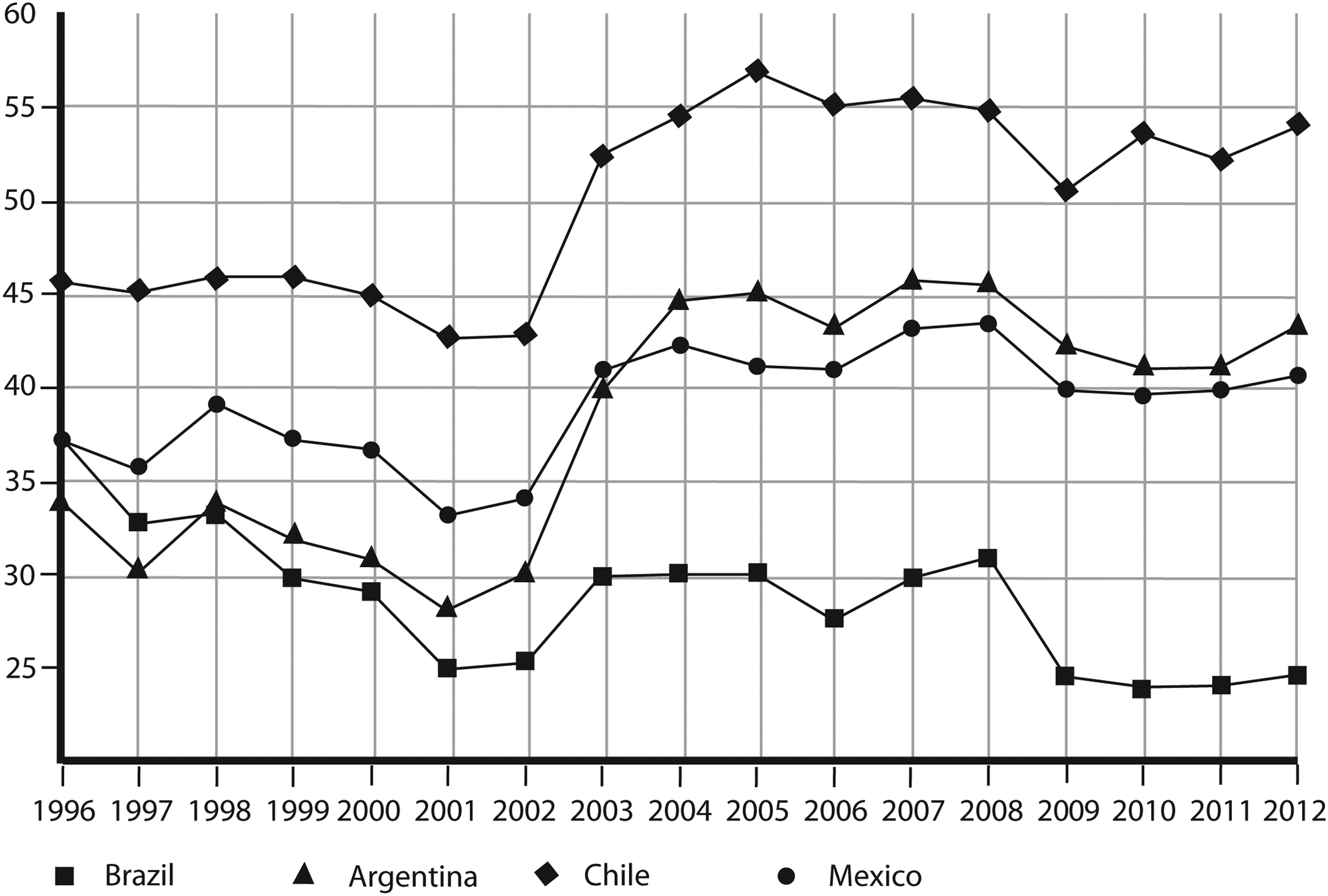
Percentage of documents written in collaboration between 2 or more countries (Source: SCImage Research Group. http://www.scimagojr.com [accessed March 3, 2014])
Findings
None of the 216 Latin American journals that were screened for biosecurity-related information has any written policy related to this topic. The journals did not consider any dual-use policy in their guidelines for publishing scientific papers, even though some of them addressed ethical concerns—for example, some follow the Vancouver rules for authorship, 16 which are the foremost international ethical standards for scientific publications. Others include ethical standards for human and animal experimentation but contain no reference to dual-use concern issues.
The Brazilian journal Memórias do Instituto Oswaldo Cruz, regarding ethical policies, refers to the Singapore statement, which, in its section 14 related to societal considerations, says, “Researchers and research institutions should recognize that they have an ethical obligation to weigh societal benefits against risks inherent in their work.” 17 This could be considered the closest to a dual-use policy without an explicit mention of it.
Increasing Awareness of Dual-Use Issues
The findings observed in Latin American journals reflect what is usually found in editorial boards of scientific journals in other regions of the world. These results might reveal, among other factors, a relatively low awareness of the potential risks of dual-use research among publishers and reviewers of scientific Latin American journals.
Resnik and colleagues reported the results of a survey conducted on high-impact life science journals to evaluate the application of dual-use policies by their editors. 18 The results showed that, in addition to lack of awareness, there were other explanations given by editors for not applying dual-use policies in their journals. The reasons given included that editors might be aware of these issues but they did not consider them to be relevant, or that they had not taken the time to develop these policies, or that editors thought that these kinds of policies were an inappropriate restriction on freedom of inquiry and the dissemination of knowledge.
The various reasons, including lack of awareness, that life science journal editors do not apply dual-use policies in their journals might reflect a need for an effective and feasible mechanism to oversee scientific information that has potential public health benefits but poses a significant risk for misuse if broadly disseminated. 19
Education and International Collaboration
Part of the reason for a lack of awareness among life scientists and, in consequence, among scientific journal editors might be the fact that biosecurity and dual-use issues are rarely covered by university courses. To overcome this situation, we need a harmonized approach, with a broad reach to all of the scientific community, and in particular to publishers and reviewers, to explain what DUR and DURC mean, what the threats are, and what should be their roles as responsible communicators to the scientific community and to society.
In addition, the international community should be involved in finding mechanisms to minimize the risk of misuse of science, while paying particular attention to international scientific collaboration. According to the Proceedings from Bridging Science and Security for Biological Research: International Science and Security, 20 and using co-authorships as a measure of international partnerships, the percentage of scientific articles co-authored by international partners has doubled since 1997. International partnership was also observed among Latin American scientists, who often collaborate with colleagues from more developed countries, generating the need to face challenges of jurisdiction and governance, culture, scientific infrastructure, and export control policies, which are unfamiliar to many Latin American scientists.
Involvement in Shaping Policies
Government, international organizations, and nongovernment organizations need to be involved in shaping policies. The development of programs of outreach, education, and training in dual-use research, as well as information about policies governing publication, communication, and dissemination of dual-use research of concern, involve the scientific community in ensuring that their research activities are carried out in compliance with fundamental ethical principles. All these actions might constitute a way forward to effectively implement a culture of responsibility among scientists in Latin American countries, ensuring the promotion and observance of best practices in academia, industry, and government.
This outreach could be conducted in several ways. For example, at the national level, this process could be organized by life science societies and associations, which are important sources of guidance for scientists on the ethical standards to be applied to their disciplines. In some Latin American countries, government agencies can also help to organize the outreach process to reach not only scientists and academics, but also politicians, media, and science writers.
Although awareness and education represent a basic pillar in this process, some guidelines and oversight would be needed to achieve specific results. International organizations, such as the World Health Organization, 21 could establish global guidelines for disseminating DUR and DURC research, so that editors can agree on ways to make author instructions more uniform, including agreeing on a consistent definition of DURC, with a checklist for reviewers to streamline the process. One a way to achieve this goal could be through regional activities focused on the potential risk posed by DUR and DURC in Latin American scientific publications.
Moreover, in the Biological and Toxin Weapons Convention (BTWC), which was the first multilateral disarmament treaty banning an entire category of weapons, the term biosecurity arose for the first time in 2003 and has continued to evolve since then. 22 It is worth mentioning that, because of the international community's concern about biosecurity policies, during the Seventh Review Conference, held in 2011, it was decided that this subject would become one of the 3 standing agenda items to be addressed annually during the 2012-2015 intercessional program. 23 Topics already discussed include, among others, measures for strengthening national biological risk management; voluntary codes of conduct and other measures to encourage responsible conduct by scientists, academia, and industry; and education and awareness-raising about risks and benefits of life sciences and biotechnology. 24 In this way the BTWC has created a neutral platform, accessible to 170 states, which allows a multilateral dialogue about such issues as biosecurity and DURC policies and facilitates discussion among scientists and policymakers from different areas of the world, representing diverse environments, and with particular perceptions of biorisks.
Other nongovernment organizations, such as the International Federation of Biosafety Associations (IFBA), could play an active part in proposing guidelines with international scientific participation in order to discuss dual-use journal policies in the global community.
It is important to consider the role of national biosafety and biosecurity associations in the region, such as the Biosafety and Biosecurity Subcommission, which belongs to the Argentinean Microbiology Association (AAM); the Biosafety Mexican Association (AMEXBIO); and the Brazilian Biosafety Association (ANBio). These associations have an important supporting role to play in educating on topics such as biorisk management, dual-use research, and codes of conduct through common outreach activities in their respective countries. These actions could include interactive online courses; the creation of regional networks among scientists that enable a more proactive role in this type of policy discussion; raising the awareness of journal editors, reviewers, and publishers regarding implementation of dual-use policies and procedures; and the development of regional biosecurity guidelines that are informed by the sharing of common cultures and lifestyles. All these initiatives should enhance the ethical responsibility of communicating scientific information and diminish the risk that could endanger public health, agriculture, plants, animals, the environment, or materiel.
Conclusions
While we consider that this study reveals worrying results, we are not surprised by them. The findings suggest that we need to work harder in our scientific communities to increase awareness related to the new risks and threats.
Identification and consideration of DURC throughout the research process should be done before the submission of manuscripts for publication. If this is not done because identifying DURC is a task with which many scientists have no experience, then the editors of scientific journals will be the last step in the review process before the dissemination of information. 19 Identifying DURC is subjective, and it is sometimes difficult for even the most knowledgeable scientists and editors. 25
International engagement is critical for reducing the risk of misusing biological research, given that science is globally distributed and has an effect on and relevance for members of every society. Although treaties, conventions, and dialogue between national governments and among international agencies are valuable, any meaningful progress will require strong relationships built on existing interactions of mutual trust and respect between individual scientists worldwide. 26
It is important to consider that even though freedom and openness are traditionally recognized as the central values governing the regulation of life science publication, there exists global risk that threatens the world. This is an area in which scientific journal editors, including Latin American ones, could contribute to mitigating and being effective safeguards against the misuse of legitimate research.
Footnotes
Acknowledgments
We would like to thank Dr. David Franz for his support and comments on this manuscript.
Appendix 1. List of the 216 Journals Screened for Mention of Biosecurity Issues in Guidelines for Authors and Reviewers
Note: For each journal, the instructions for authors and for reviewers that were available on the website were screened for biosecurity issues using key words biosecurity, biological weapons, and dual use research of concern. For every journal, relevant documents aimed at instructing authors were identified, but we cannot rule out the possibility that additional documents may have been overlooked, despite the utmost scrutiny and the use of search engines.
A Revista Eletrônica de Farmacia (Brazil)
A Unoesc & Ciência. ACBS (Brazil)
Acta Bioquímica Clínica Latinoamericana (Argentina)
Acta botânica brasílica (Brazil)
Acta botánica mexicana (Mexico)
Acta científica. Biologia e saúde (Brazil)
Acta Gastroenterológica Latinoamericana (Argentina)
Acta Scientiae (Brazil)
Acta Scientiae Medica (Brazil)
Acta Scientiarum. Agronomy (Brazil)
Acta veterinaria Brazilica (Brazil)
Agriscientia (Argentina)
Agro@mbiente (Brazil)
Agro-ciencia (Chile)
Agrociencia (Mexico)
Agronomia (Brazil)
Agro Sur (Chile)
Alergia Pediátrica (Mexico)
Anais da Academia Brazileira de Ciências (Brazil)
Anais da Academia Pernambucana de Ciência Agronômica (Brazil)
Analecta veterinaria (Argentina)
Anales de la Escuela Nacional de Ciencias Biológicas (Mexico)
ARBS. Annual Review of Biomedical Sciences (Brazil)
Archives of Medical Research (Mexico)
Archivos de Alergia e Inmunología Clínica (Argentina)
Archivos de biología y medicina experimentales (Brazil)
Archivos de medicina veterinaria (Chile)
Archivos de salud de Sinaloa (Mexico)
Arquivo Brazileiro de medicina veterinária e zootecnia (Brazil)
Arquivos de biologia e tecnología (Brazil)
Arquivos de Ciências Veterinárias e Zoologia da Universidade (Brazil)
Arquivos do Instituto Biológico (Brazil)
Avances en ciencias veterinarias (Chile)
Avances en investigación agropecuaria (Mexico)
BAG. Journal of Basic and Applied Genetics (Argentina)
BIOCELL (Argentina)
Biociencia (Chile)
Biociências (Maceió/Porto Alegre) (Brazil)
Biocyt (Mexico)
Bioéthikos (Brazil)
Bio Farma: Revista Técnico Científica de Farmácia, Bioquímica e Análises Clínicas e Toxicológicas (Brazil)
Biological Research (Chile)
Bioquimia (Mexico)
Bioquímica y patología clínica (Argentina)
Bioscience Journal (Brazil)
Biotecnia (Hermosillo, Son.) (Mexico)
Biotecnia (Mexico)
Boletim de Medicina Veterinária (Brazil)
Boletín Micológico (Brazil)
Boletín Sociedad Argentina de Botánica (Argentina)
Bragantia (Brazil)
Brazilian Archives of Biology and Technology (Brazil)
Brazilian Journal of Biology (Brazil)
Brazilian Journal of Genetics (Brazil); Gene Conserve (Brazil)
Brazilian Journal of Infectious Diseases (BJID) (Brazil)
Brazilian Journal of Medical and Biological Research (Brazil)
Brazilian Journal of Microbiology (Brazil)
Brazilian Journal of Plant Physiology (Brazil)
Brazilian Journal of Veterinary Research and Animal Science (Brazil)
Chilean Journal of Agricultural Research (Chile)
Ciencia (Mexico, D.F.) (Mexico)
Ciência Animal Brazileira (Brazil)
Ciência e agrotecnologia (Brazil)
Ciência e Cultura (Campinas) (Brazil)
Ciência, Cuidado e Saúde (Brazil)
Ciência & Educação (Brazil)
Ciencia e investigación agraria (Chile)
Ciência e Natura (Brazil)
Ciência florestal (Brazil)
Ciencia forestal en Mexico (Mexico)
Ciência rural (Brazil)
Ciências & Cognição (Brazil)
Clínica Veterinária (Brazil)
Comunicata Scientiae (Brazil)
Crop Breeding and Applied Biotechnology (Brazil)
Cuadernos del CEAGRO (Argentina)
Darwiniana (Argentina)
DOMINGUEZIA (Argentina)
El Boletín Latinoamericano y del Caribe de Plantas Medicinales y Aromáticas (México)
El Hornero (Argentina)
Electronic Journal of Biotechnology (Chile)
Enfermedades infecciosas y microbiología (Mexico)
Engenharia Agrícola (Brazil)
Engenharia na Agricultura (Brazil)
Epidemiologia e Serviços de Saúde (Brazil)
Evidência : Biotecnologia e Alimentos (Brazil)
FABICIB (Revista de la Facultad de Bioquímica y Ciencias Biológicas) (Argentina)
FAVE. Sección Ciencias Agrarias (Argentina)
FAVE. Sección Ciencias Veterinarias (Argentina)
Floresta (Brazil)
Genetics and Molecular Biology (Brazil)
Genetics and Molecular Research (Brazil)
Genetics and Molecular Research (GMR) (Brazil)
Horticultura Brazileira (Brazil)
Horticultura mexicana (Mexico)
Idesia (Chile)
Jornal Brazileiro de Patologia e Medicina Laboratorial (Brazil)
Jornal Brazileiro de Pneumologia (Brazil)
Journal of Biotechnology and Biodiversity (Brazil)
LABORAT-acta (Mexico)
Latin American Journal of Pharmacy (Argentina)
Medicina (Buenos Aires) (Argentina)
Medicina Interna de México (Mexico)
Medicina Universitaria (Mexico)
Medicina y Sociedad (Argentina)
Memórias do Instituto Oswaldo Cruz (Brazil)
Micología Aplicada Internacional (Mexico)
Miscelánea. Fundación Miguel Lillo (Argentina)
Nacameh (Mexico)
Nacional de Cuyo (Argentina)
Perspectivas Médicas (Brazil)
Pesquisa Agropecuária Brazileira (Brazil)
Pesquisa Agropecuária Tropical (Brazil)
Pesquisa Veterinária Brazileira (Brazil)
Planta Dañina (Brazil)
Quebracho (Argentina)
RCA. Revista científica agropecuaria (Argentina)
REB. Revista de educación bioquímica (Mexico)
RECIIS : Revista Eletrônica de Comunicação, Informação & Inovação em Saúde (Brazil)
Recursos rurais (Brazil)
Respyn. Revista salud pública y nutrición (Mexico)
Revista Acadêmica: Ciências Agrárias e Ambientais (Brazil)
Revista Americana de Medicina Respiratoria (Argentina)
Revista AMMVEPE (Mexico)
Revista Argentina de educación médica (RAEM) (Argentina)
Revista Argentina de Microbiología (Argentina)
Revista biomédica (Mexico)
Revista Brazileira de Biociências (Brazil)
Revista Brazileira de Botânica (Brazil)
Revista Brazileira de Ciências Agrárias (Brazil)
Revista Brazileira de Ciências Farmacêuticas/Brazilian Journal of Pharmaceutical Sciences (Brazil)
Revista Brazileira de Educação Médica (Brazil)
Revista Brazileira de Epidemiologia (Brazil)
Revista Brazileira de Farmacognosia (Brazil)
Revista Brazileira de Fisiologia Vegetal (Brazil)
Revista Brazileira de Fruticultura (Brazil)
Revista Brazileira de Saúde e Produção Animal (Brazil)
Revista Caatinga (Brazil)
Revista Ceres (Brazil)
Revista Chapingo. Serie ciencias forestales y del ambiente (Mexico)
Revista Chapingo. Serie horticultura (Mexico); Revista Ciência Agronômica (Brazil)
Revista Chilena de Enfermedades Respiratorias (Chile)
Revista Chilena de Infectología (Chile)
Revista Ciencia y Salud (Chile)
Revista científica de medicina veterinária. Pequenos animais e animais de estimação (Brazil)
Revista da Associação Médica Brazileira (Brazil)
Revista da Biologia (Brazil)
Revista da Faculda de de Zootecnia, Veterinária e Agronomia FZVA (Brazil)
Revista de Biologia e Saúde da UNISEP (Brazil)
Revista de ciencias agrarias y tecnología de los alimentos (Argentina)
Revista de Ciências da Vida (Brazil)
Revista de Ciencia y Tecnología (ReCyT) (Argentina)
Revista de Ciências Médicas e Biológicas (Brazil)
Revista de Educación en Biología (Argentina)
Revista de enfermedades infecciosas en pediatría (Mexico)
Revista de la Asociación Médica de Bahía Blanca (Argentina)
Revista de la Facultad de Agronomía (Buenos Aires) (Argentina)
Revista de la Facultad de Agronomía (La Plata) (Argentina)
Revista de la Facultad de Ciencias Agrarias. Universidad
Revista de la Facultad de Medicina de la UNAM (Mexico)
Revista de la Sociedade Brazileira de Medicina Tropical (Brazil)
Revista de medicina veterinaria (Argentina)
Revista de Microbiologia (Brazil)
Revista de Salud Pública (Argentina)
Revista de Sanidad Militar (México)
Revista de Saúde Pública (Brazil)
Revista del CIZAS (Argentina)
Revista del Instituto Nacional de Enfermedades Respiratórias (Mexico)
Revista do Hospital das Clínicas (Faculdade de Medicina da Universidade de São Paulo) (Brazil)
Revista do Instituto de Medicina Tropical de São Paulo (Brazil)
Revista Eletrônica de Agronomia (Brazil)
Revista especializada en ciencias químico-biológicas (Mexico)
Revista fitotecnia mexicana (Mexico)
Revista Gastroenterología Latinoamericana (Chile)
Revista HCPA (Brazil)
Revista interdisciplinaria de estudios agrarios (Argentina)
Revista latinoamericana de microbiología (Mexico)
Revista Médica de Chile (Chile)
Revista médica del Hospital General de México (Mexico)
Revista Médica de Rosario (Argentina); Revista de Patologia Clínica (Mexico)
Revista mexicana de ciencias agrícolas (Mexico)
Revista mexicana de ciencias farmacéuticas (Mexico)
Revista mexicana de fitopatología (Mexico)
Revista mexicana de ingeniería biomédica (Mexico)
Revista Mexicana de Micología (Mexico)
Revista Pilquen. Sección Agronomía (Argentina)
Revista Saúde (Brazil)
Revista Saúde, ética & Justiça (Brazil)
Revista Scientia Agraria Paranaenses (Brazil)
Revista Scientia Rural (Brazil)
Revista Taurus (Argentina)
Revista veterinaria (Argentina)
RIA. Revista de investigaciones agropecuarias (Argentina)
SaBios : revista de saúde e biología (Brazil)
Salud(i)ciencia (Argentina)
Salud Colectiva (Argentina)
Saúde & Ambiente em Revista (Brazil)
Salusvita (Brazil)
Saúde em revista (Brazil)
Saúde e Pesquisa (Brazil)
Scientia agrícola (Brazil)
Scientia Medica (Brazil)
Simiente (Chile)
Técnica pecuaria en Mexico (Mexico)
Tempus – Actas de Saúde Coletiva (Brazil)
Universitas Ciências da Saúde (Brazil)
Unoesc & Ciencia (Brazil)
Varia Scientia Agrárias (Brazil)
Vertientes (Mexico)
Veterinária em foco (Brazil)
Veterinaria Mexico (Mexico)
Veterinária Notícias (Brazil)
Vittalle (Brazil)