




Abstract
In 2011, President Obama addressed the United Nations General Assembly and urged the global community to come together to prevent, detect, and fight every kind of biological danger, whether a pandemic, terrorist threat, or treatable disease. Over the past decade, the United States and key international partners have addressed these dangers through a variety of programs and strategies aimed at developing and enhancing countries' capacity to rapidly detect, assess, report, and respond to acute biological threats. Despite our collective efforts, however, an increasingly interconnected world presents heightened opportunities for human, animal, and zoonotic diseases to emerge and spread globally. Further, the technical capabilities required to develop biological agents into a weapon are relatively low. The launch of the Global Health Security Agenda (GHSA) provides an opportunity for the international community to enhance the linkages between the health and security sectors, accelerating global efforts to prevent avoidable epidemics and bioterrorism, detect threats early, and respond rapidly and effectively to biological threats. The US Department of Defense (DoD) plays a key role in achieving GHSA objectives through its force health protection, threat reduction, and biodefense efforts at home and abroad. This article focuses on GHSA activities conducted in the DoD Office of the Assistant Secretary of Defense for Nuclear, Chemical, and Biological Defense.
The launch of the GHSA provides an opportunity for the international community to enhance the linkages between the health and security sectors, accelerating global efforts to prevent avoidable epidemics and bioterrorism, detect threats early, and respond rapidly and effectively to biological threats. The US Department of Defense (DoD) plays a key role in achieving these objectives through its force health protection, threat reduction, and biodefense efforts at home and abroad.
R
Biological threats differ significantly from nuclear threats, in which fissile material is tightly controlled and technical barriers for weapon design and development are high. The biological agents that could be used as the basis for a biological weapon occur naturally and are globally available. Widespread diffusion of information has made the knowledge and equipment necessary to misuse biological agents widely available, and the technical capabilities required to develop these agents into a weapon are relatively low. Furthermore, the revolution in the life sciences, while critical for public health, industrial applications, and the development of life-saving therapeutics and vaccines, have fundamentally altered the biological threat environment. As enabling technologies continue to proliferate, threat reduction programs have continued to foster a culture of safe, responsible conduct of life sciences research. Efforts have also been made to enhance physical containment of dangerous biological agent stocks, implement pathogen inventory controls, and build surveillance capabilities to detect and identify outbreaks in real time.
Bridging the Health-Security Divide
Addressing biological threats requires cooperation between the health and security communities, which have traditionally worked independently, using different approaches. The understanding of the relationship between global health and national security has grown and evolved over time, leading to increased engagement between these sectors. Collaboration and mutual support between the security community and animal health and public health services is critical for prevention and response to biological threats that occur naturally, accidentally, or are caused by a terrorist or a state deploying a bioweapon. 1
The Global Health Security Agenda
The recently announced Global Health Security Agenda (GHSA) 2 is a coordinated international effort to better link the health and security sectors and collectively work toward a world safe and secure from infectious disease threats. The GHSA will galvanize countries and international organizations around a long-term agenda to strengthen international collaboration, confidence, and capacities in reducing shared biological threats.
The GHSA prioritizes 3 goals: (1) preventing avoidable epidemics; (2) detecting biological threats early; and (3) responding rapidly and effectively to biological events of international concern. This multisectoral international effort leverages capabilities and resources from both the health and security sectors to enhance our collective capacity for countering biological threats, whether caused naturally, accidentally, or deliberately.
Prevent Avoidable Epidemics
Although it is unrealistic to expect that every disease outbreak can be avoided, strong preparedness efforts can help prevent many epidemics. Actions such as increasing surveillance and early detection of antimicrobial resistant microorganisms and zoonotic diseases, establishing effective immunization programs to prevent outbreaks of vaccine-preventable diseases, and improving national biosafety and biosecurity systems will improve preparedness and help enable the international community to reduce the likelihood of outbreaks, regardless of origin.
Detect Threats Early
The ability to recognize an emerging biological event is critical to effectively respond to the event and mitigate the impact. Improving global biosurveillance and reporting networks, strengthening sample and reagent sharing frameworks, building accurate laboratory diagnostic capabilities, and deploying a highly trained biosurveillance workforce can strengthen global capacity to detect, characterize, and report emerging biological threats as early as possible. This will result in greater global awareness of emerging threats so that appropriate action can be taken.
Respond Rapidly and Effectively
While many significant outbreaks can be prevented through improved surveillance and early detection, these efforts alone are not the solution to the biological threat. A global network of emergency operations centers that enables a multisectoral response to biological incidents and improved global access to both medical and nonmedical countermeasures during health emergencies are essential to ensure that decision makers have the necessary information and tools to enable a swift, effective response to outbreaks that do occur.
DoD Activities Support the GHSA
The Department of Defense (DoD) has a long-standing commitment to countering biological threats specifically focused on protecting force health, countering weapons of mass destruction, building partner capacity, and encouraging technological innovation. 3 These programs contribute to the GHSA's objectives by strengthening national biosafety and biosecurity systems, expanding diagnostic availability, improving detection and surveillance capability, and increasing availability of medical countermeasures for both the US and international partners. DoD's strategic guidance is aligned with the GHSA, allowing existing investments to be leveraged in support of enhanced global capacities. Given the DoD's depth of expertise and numerous programs focused on biological threats, the department is well positioned to enable a new era of health-security collaboration that improves international capacity to prevent, detect, and respond to outbreaks of infectious disease, regardless of origin.
In the Office of the Assistant Secretary of Defense for Nuclear, Chemical, and Biological Defense (NCB), efforts that support the GHSA are centered in 2 main programs, the Cooperative Biological Engagement Program (CBEP) and the Chemical and Biological Defense Program (CBDP) (Figure 1).
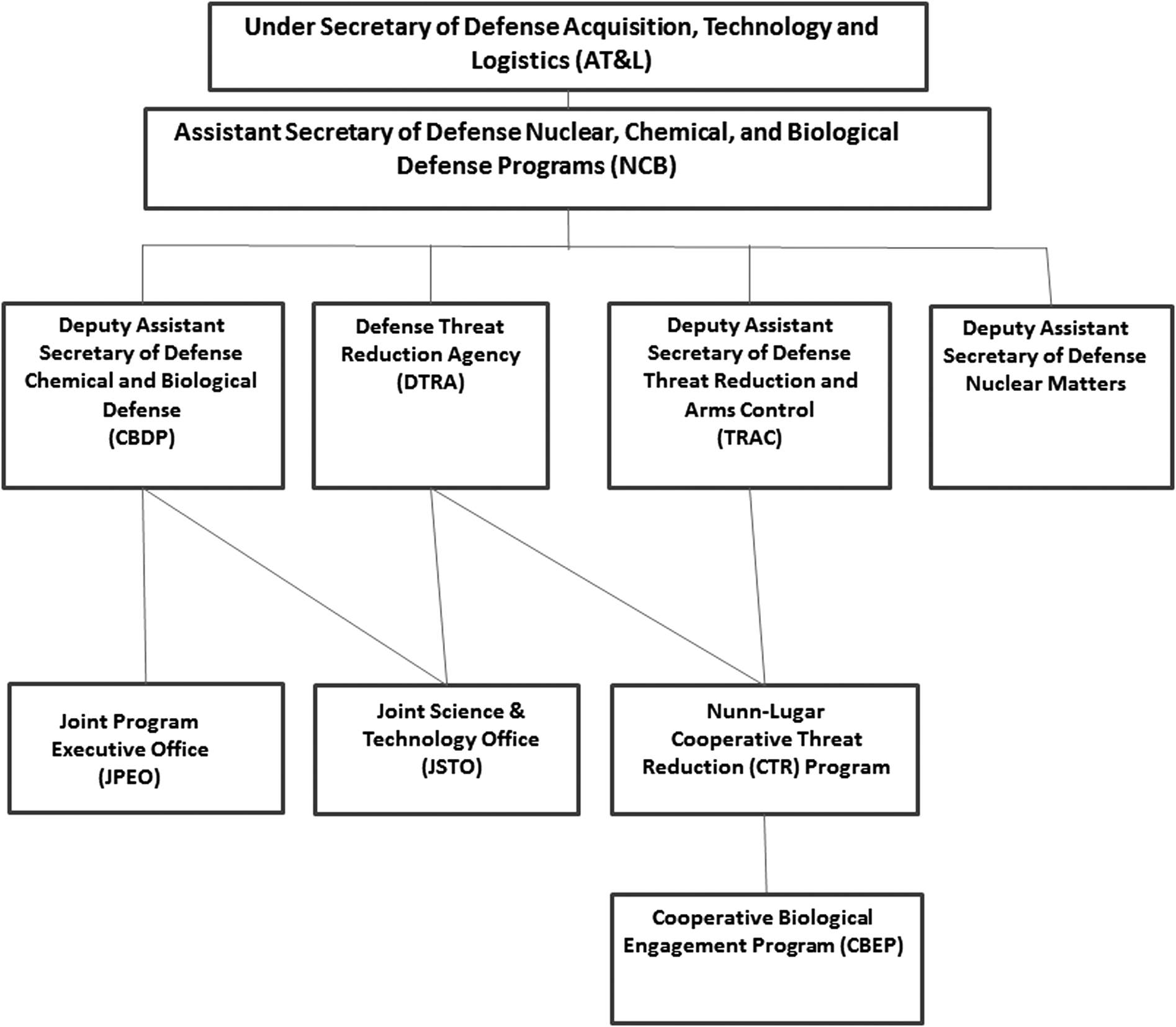
DoD Offices Contributing to Global Health Security
For over a decade, CBEP has partnered with countries across the world to reduce biological threats. The program was initiated in 1998 to address the threat posed by the vestiges of the offensive biological weapons program left vulnerable following the collapse of the Soviet Union.
4
To limit access to these deadly biological weapons, CBEP dismantled production plants and secured the biological agents that had been collected and enhanced by the Soviet program in Russia and the countries bordering Russia. CBEP also helped integrate the scientists working on the Soviet biological weapons program into a culture of safe and responsible life sciences research. Since that time, the CBEP mission and geographic footprint have evolved to address the ever-changing biological threat. CBEP currently works with partner countries in Africa, South and Southeast Asia, and the Middle East, in addition to the former Soviet Union, to secure and consolidate repositories of dangerous pathogens; improve disease detection capability through developing laboratory capabilities and promotion of safe, responsible research; and link disease detection capabilities to response. These activities help reduce the threat that dangerous pathogens pose to US national security and our service members' health; furthermore, these priorities align with the goals of the GHSA (Figure 2).
• Prevent: CBEP's biosecurity experts work with partner countries to identify, consolidate, and secure pathogen collections and diseases of security concern to prevent the sale, theft, diversion, or accidental release of such pathogens and diseases. • Detect: CBEP's global health experts build partner capacity to rapidly and accurately survey, detect, and confirm biological outbreaks of pathogens of security concern. Through these efforts, CBEP also improves overall biological surveillance capabilities in partner countries. • Respond: CBEP's biosurveillance experts help partner countries create linkages between disease surveillance, reporting systems, and response and promote multisectoral engagement in outbreak response.
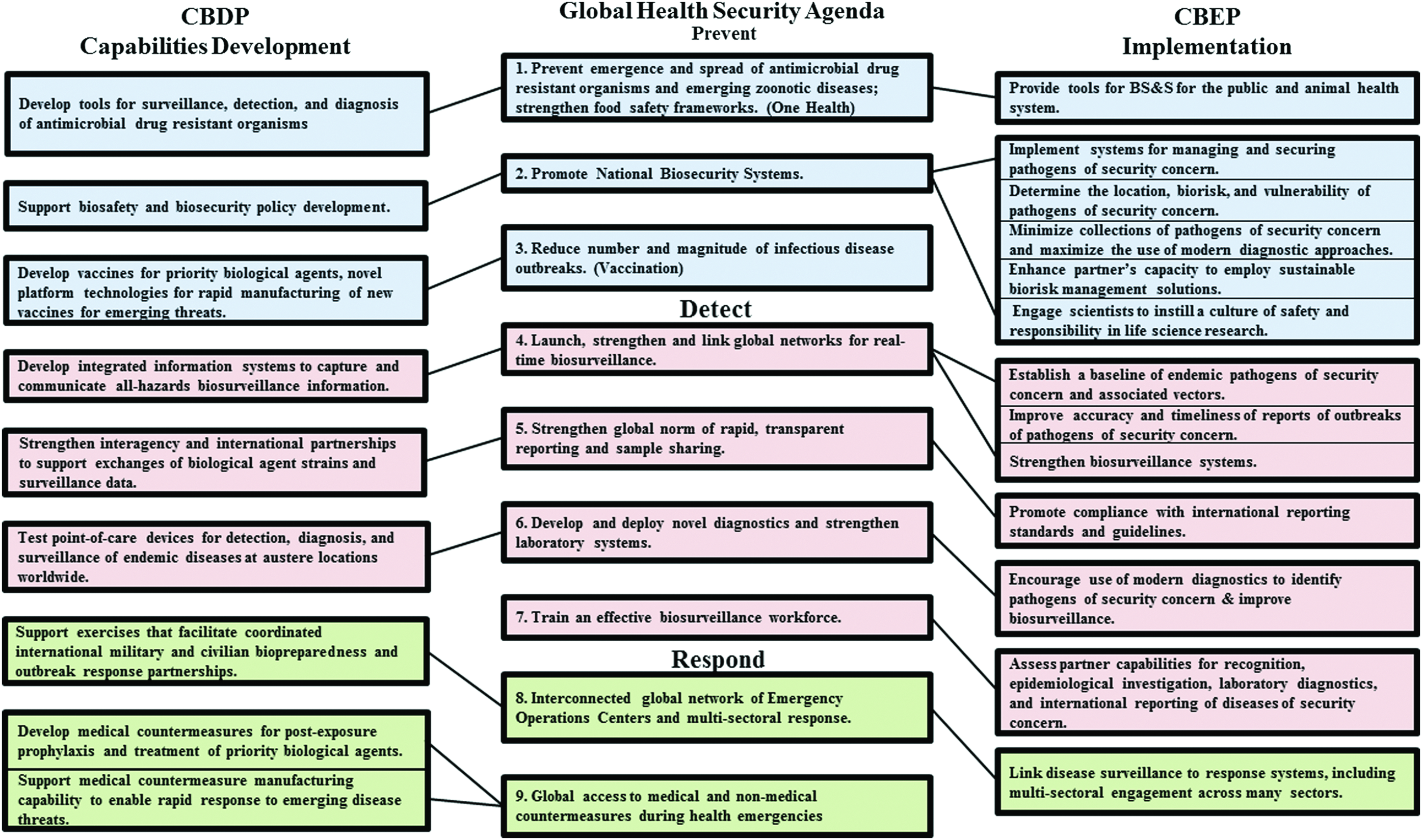
NCB Efforts that Contribute to Global Health Security Agenda Objectives (Color graphics available online at www.liebertonline.com/bsp)
In 2013, the DoD's Defense Threat Reduction Agency (DTRA) built on a long-standing cooperative relationship with the Centers for Disease Control and Prevention (CDC) to partner on pilot projects in Vietnam and Uganda. These projects aimed to measurably improve global health security capabilities to mitigate the effects of biological threats from any cause. 5 Under this interagency partnership, DTRA and CDC improved efficiency of both organizations' programs in partner countries, established a common understanding of partner country's global health security needs, and facilitated access to a broad array of subject matter expertise. Working together, the DoD and CDC established emergency operations centers, strengthened laboratory capability, and enhanced information technology systems that support health communication and response. These sustainable capabilities tangibly improve partner countries' capacity to prevent, detect, and respond to biological threats. They also demonstrate the importance of common frameworks and models that can be standardized, shared, and adapted across countries. Because of the success of these projects, the DoD and CDC have continued these collaborative efforts and expanded them to 10 additional countries in 2014: Ethiopia, Kenya, Georgia, Kazakhstan, Philippines, Thailand, Jordan, South Africa, Tanzania, and India.
The CBDP, the second NCB program that supports the GHSA, was established to provide state-of-the-art defense capabilities to allow US military forces to operate and successfully complete missions in chemical and biological warfare environments. These efforts not only provide technologies that help protect DoD's warfighters, but also benefit our partners in preventing, detecting, and responding to outbreaks of biological agents. CBDP conducts science and technology (S&T) research, advanced development, and fielding of technologies that enable the prevention, detection, and response to chemical and biological threats affecting human health. Research and development activities in the CBDP have resulted in Food and Drug Administration (FDA)–cleared diagnostics for anthrax, plague, tularemia, Q fever, and influenza A/B and A subtyping. Additionally, CBDP has provided the FDA with information on multiple diagnostic assays currently being developed for low-probability, high-consequence pathogens, such as Zaire ebolavirus, to more rapidly enable the FDA to issue an emergency use authorization (EUA) for these assays in the case of a declared emergency. These advances represent a critical capability for the nation's biopreparedness.
Currently, CBDP is working to improve diagnostic capabilities for use in low-resource environments, which will help enable earlier treatment and disease containment. These efforts not only provide technologies that help protect the warfighter and the national security of the United States, but may also benefit global partners in responding to infectious disease outbreaks. CBDP has several medical countermeasures in the developmental pipeline that, if cleared by the FDA, will enable vaccination against or treatment of infectious diseases, both viral and bacterial. Additionally, the program is funding the development of improved electronic surveillance tools that will assist in improved situational awareness and early detection of infectious disease outbreaks, whether naturally occurring or man-made. While these efforts are designed to ensure that US forces are protected from biological threats, they can also provide benefit to international partners and civilian populations. Multiple CBDP activities align with GHSA objectives (Figure 2).
• Prevent: CBDP's subject matter experts are developing tools to enable the detection of antimicrobial drug resistant organisms, prophylaxis for priority biological agents, and biosecurity policies that can support international biosecurity efforts.
• Detect: CBDP's biosurveillance experts are developing an integrated suite of information systems and advanced analytics to capture and communicate all-hazard biosurveillance information and point-of-care and laboratory-based diagnostics to support a global network of laboratory capabilities for the detection of biological threats.
• Respond: CBDP's medical countermeasure and response experts support exercises to facilitate a coordinated whole-of-government approach (military and civilian) to biopreparedness and outbreak response partnerships and develop medical countermeasures for postexposure prophylaxis and treatment of priority biological agents, including manufacturing capabilities and regulatory improvements to enable rapid response to emerging disease threats in a crisis.
While not the focus of this article, it is important to note the work done in this arena by the DoD Office of the Assistant Secretary of Defense for Health Affairs. Under this office, the Armed Forces Health Surveillance Center-Global Emerging Infections Surveillance and Response System (AFHSC-GEIS) funds and implements a global program that supports and contributes to force health protection in US forces, while providing robust second-order benefits to the global public health community and thereby to global health security. AFHSC-GEIS efforts that positively affect the achievement of global health security are focused along 3 lines of effort: direct and indirect support to the combatant commands in their areas of operations, partner capacity building, and specific infectious disease surveillance–related projects. Additionally, the DoD supports 5 Army and Navy overseas research laboratories, located in Kenya, Thailand, Egypt, Peru, and Singapore. The mission of these overseas laboratories is to investigate diseases relevant to military interests, which are often of strong interest in the local public health community and necessitate strong, enduring local and regional partnerships.
Recommendations
Although NCB efforts to support the GHSA objectives are robust, several issues may hamper achievement of these goals. Several of these issues and recommendations for improvements are described below.
•
Embassy support, particularly from individuals with the ability to work across health and security agencies and with international partners, is critical for successful planning and implementation of global health security projects in partner countries. However, some embassies are concerned with the lack of capacity and experience in their workforce to support additional global health security projects. Providing health security personnel with this type of multisectoral experience would provide embassies the appropriate expertise required to successfully implement global health security projects.
•
To overcome these issues, where possible, programs should build capabilities that support overall global health security rather than building disease-specific capabilities, while also focusing on securing existing repositories of pathogens of security concern. Prioritizing activities that help the partner nations meet international obligations, such as implementing the WHO IHR (2005), is not only an important measure of success but also provides greater sustainability to ongoing GHSA activities. The National Academy of Sciences (NAS) report on threat reduction programs clearly articulates this recommendation: “Programs are more effective and have a higher likelihood of being sustained if they are developed in partnership with the engaged country, are tailored to the region, and are seen as beneficial to both partners.” 4 The GHSA launch provides an opportunity to develop a standard set of materials describing how DoD GHSA engagements benefit both the US government, by increasing international biosecurity, and our international partners, by improving local health system infrastructure.
•
DoD GHSA programs should recognize that progress in the life sciences has fundamentally altered the risks and should not focus exclusively on the physical approach of guns, gates, and guards previously espoused by US programs. Cooperative biological research can lead to enhanced security at international laboratories. In the course of their interactions with foreign scientists, US researchers have the opportunity to better understand biological risks in other countries and propagate best practices for safe, secure pathogen collection, transport, destruction, and laboratory storage. These best practices can then be institutionalized at laboratories and other facilities abroad. This increased security is vital to US interests in areas of political instability with weak scientific infrastructure as these precautionary techniques can prevent both deliberate and accidental misuse. In addition, collaborative research efforts can also lead to improved public and veterinary health, which can facilitate increased stability in developing nations. Effective capacity building that is intimately linked with a change in the research culture will remain sustainable after direct DoD support ends.
Conclusion
The challenges posed by biological pathogens are real and immediate. No single country or organization can achieve global health security alone. It is a shared responsibility. Countering biological threats requires flexible and agile responses from capable partners, as well as “whole-of-government” and “whole-of-international-community” solutions. By working in partnership with other nations, multilateral organizations, and civil society, DoD can make further progress toward the ultimate goal of the GHSA—a world safe and secure from global health threats posed by infectious diseases, regardless of their origin.
Footnotes
Acknowledgments
We would like to thank Jennifer Smith, Leila Heintzelman, Julia Dooher, Maureen Bartee, Brett Forshey, and Jennifer Crossman for their critical review of this manuscript.