




Abstract
Photochemistry is a powerful synthetic tool resulting in the construction of unique substances. Remarkably, photochemistry has been relatively underexplored in the cannabinoid area and represents a valuable opportunity for further discovery.
Photochemistry involves the study of how radiant energy (usually ultraviolet [UV]) affects chemical changes and it predates the emergence of life on Earth. In fact, photochemistry was likely the process that gradually modified the primitive methane containing atmosphere of our planet to one more suited to higher life forms. 1 However, the first experimental study of photochemistry only began with Joseph Priestley and his 1790 observations of sunlight's effect on nitric acid vapors. 2 Recognition of photochemistry's development and importance as an advanced science has now resulted in >200,000 peer-reviewed publications and several Nobel Prizes in Chemistry. 3
Compounds isolated from Nature (natural products) constitute a large and important segment of organic chemistry (compound classification) space. 4 Although photochemical reactions have long been employed to synthetically construct natural products, 5 the photochemistry of natural products themselves has been relatively underexplored 6 with far <1% of natural products publications involving any photochemistry according to the SciFinder® chemistry database. This deficit has been especially true for the extensive portfolio of Cannabis natural products collectively known as cannabinoids (phytocannabinoids). 7
Despite numerous articles that have focused on the optimization of Cannabis illumination to study plant growth, morphology, and enhanced cannabinoid yield,8,9 there have been relatively few studies that have experimentally examined the detailed outcome of cannabinoid photochemistry with full product characterization. These scattered reports are now briefly summarized here. In 1968, Crombie and Mechoulam demonstrated the photochemical conversion of cannabichromene to cannabicyclol in ∼45% yield by a [2+2] cycloaddition reaction. 10 Shani and Mechoulam later discovered that UV irradiation of cannabidiolic acid in cyclohexane with oxygen gave cannabielsoic acid A as product.11,12 Although both light and oxygen were found to be essential for this transformation, it appeared that singlet oxygen ( 1 O2) was not involved.
Mechoulam was also the first to systematically explore the photochemistry of cannabidiol (CBD) in various solvents, discovering that the product outcome was very solvent dependent. Using cyclohexane as the photochemical reaction medium, several compounds were obtained from CBD, including delta-9-tetrahydrocannabinol (THC) in ∼13% yield. 13 Acknowledging that the “first definitive work” in cannabinoid photochemistry was that of Mechoulam, Cross and coworkers corroborated Mechoulam's conversion of CBD to THC with their slightly increased (16%) THC photochemical yield. 14
In 1975, Turnbull reported that the photolysis of cannabinol largely caused ether ring cleavage, affording cannabinodiol (CBND). 15 This interesting result was later verified by investigators in the Netherlands, employing total synthesis for the structure proof of CBND. 16 Importantly, Merli and colleagues have just published the most comprehensive description to date of CBD photochemistry. 17 Although not a purely photochemical investigation, the singlet oxygen photooxygenation of THC and several related cannabinoids has also recently appeared. 18
For many natural product classes, detailed exploration of their photochemistry has been relatively overlooked. Clearly, this is also the case for cannabinoids, whose few definitive photochemistry articles easily fit into the space of a few paragraphs as noted earlier. However, there are some exceptions to this circumstance among certain natural products, including the flavonoid family. In contrast to the rather limited group of cannabinoid photochemical publications, flavonoid photochemistry abounds with numerous conclusive studies. 19 Interestingly, some of these very photochemistry investigations have also involved members of the diverse flavonoids present in Cannabis. 20 In particular, the Cannabis flavonoid quercetin has been prominent in scores of photochemical articles, including a recent one highlighting its photoprotective effect against UV B radiation skin damage. 21
Further examination of cannabinoid photochemistry clearly presents some potentially valuable opportunities. It is possible that novel cannabinoid photochemical derivatives will be discovered with unique biological activity or improved physical properties. Systematic cannabinoid photochemistry inquiry may also provide new insight into the mechanisms for minor cannabinoid formation in the Cannabis trichome. With the light sensitivity of some cannabinoids well documented, it is possible that future photochemistry studies could produce recommendations for improved cannabinoid storage conditions.
Finally, increased experience with cannabinoid photochemistry might facilitate cannabinoid entry into other growing technical areas. A dramatic example of such an opportunity is photodynamic therapy (PDT), the use of a photosensitized drug for medical applications such as oncology. PDT is an increasingly powerful therapeutic modality, especially for skin cancer. PDT publications now number in the many thousands each year with their growth accelerating as seen in Figure 1. Interestingly, natural products are beginning to play a role in PDT 22 and the first several articles employing CBD in PDT have just appeared.23–25
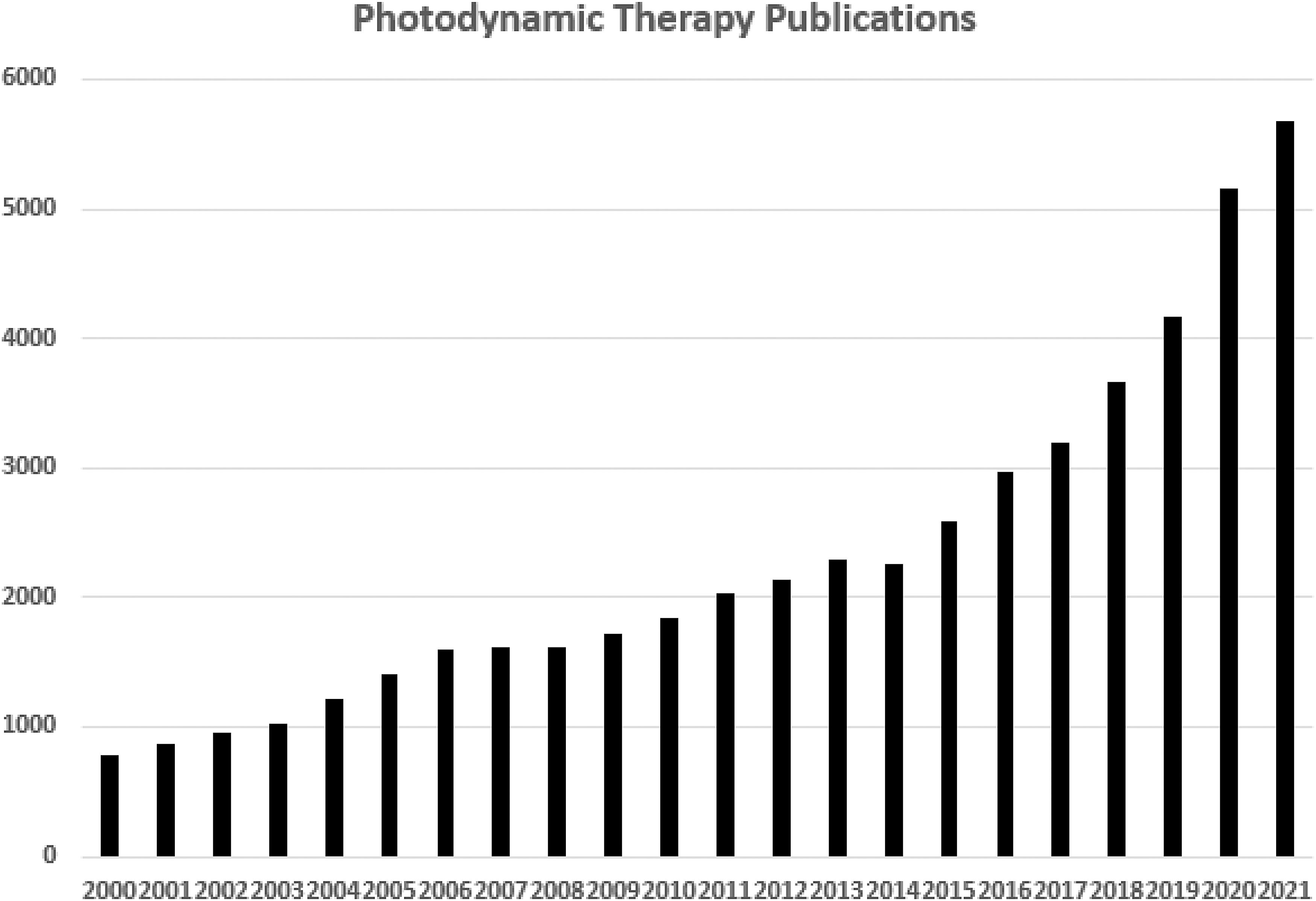
Growth of photodynamic therapy publications.
The intriguing organic chemistry of Cannabis constituents has been an exciting technical journey for more than a century. Very likely, an expanded exploration of cannabinoid photochemistry has the potential for even more remarkable discovery and practical application.
Footnotes
Author Disclosure Statement
No competing financial interests exist.
Funding Information
No funding was received for this article.