




Abstract
Background:
The legal cannabis landscape has greatly outpaced scientific knowledge. Many popular cannabis claims, such as cultivar (colloquially referred to as strain) classification and terpene content producing different subjective effects, are unsubstantiated. This study examined, for the first time, whether cultivar classification (sativa/indica) and terpene content (caryophyllene, limonene, myrcene, pinene, and terpinolene) were associated with subjective cannabis effects (i.e., pain levels, low-arousal [“indica-like”] effects, high-arousal [“sativa-like”] effects, and negative effects).
Methods:
Regular cannabis users (n=101) took part in a 2-week long ecological momentary assessment study in which they responded to questions about their cannabis use, stated their preference for sativa versus indica, and reported their in-the-moment subjective effects within 30 min of smoking cannabis. Cultivars were coded for sativa versus indica classification and primary terpene content using Leafly, a popular search engine. Linear mixed-effect models then examined subjective response by sativa/indica and primary terpene. Covariates included demographics (age, sex, race, income), cannabis use (medical use, cannabis use frequency, stated preference for sativa/indica, global expected cannabis effects), morning pain ratings, and specific smoked cannabis occasions (hour of day, minutes since use, context, number of hits, and tetrahydrocannabinol).
Results:
The majority of participants (78.3%) had a preference for either sativa or indica and reported reasons for their preference that aligned with industry claims. After controlling for covariates, findings revealed that cultivars classified as indica dominant were associated with greater low-arousal (e.g., sluggish, slow) effects relative to the unweighted mean of all cannabis cultivars (b = 0.44, SE=0.16, p=0.01). Cultivars with primary caryophyllene were associated with greater pain ratings (b = 0.53, SE=0.24, p=0.03) and negative effects (b = 0.22, SE=0.08, p=0.01) relative to the mean of all other terpene types. Cultivars with primary pinene were associated with less negative effects (b = −0.35, SE=0.18, p=0.04).
Conclusions:
Cultivars classified as indica dominant were associated with greater low-arousal effects in models that accounted for both within- and between-person variation, despite the scientific challenges distinguishing between sativa and indica. Preliminary findings also suggest terpenes may play a role in subjective effects. These results emphasize the need for further research, particularly controlled lab studies.
Introduction
Cannabis legalization has given rise to a quickly expanding industry that has outpaced the scientific knowledge of cannabis.1,2 The diverse products customers purchase, as well as their marketed effects, are rarely supported by research. 3 This is concerning because individuals use dispensaries to guide their decision making about their cannabis use. 4 Research examining popular claims is warranted.
One salient claim is that there are two distinct classifications of cannabis—Sativa and Indica—which elicit unique effects.4–6 Sativas are thought to increase energy, sociability, and creativity, whereas indicas are thought to decrease anxiety, increase sleepiness, and reduce pain.6–8 Perceptions of this dichotomy are strong.4,9–11 One study found that over half the cannabis users surveyed felt confident in their ability to differentiate between sativas and indicas. 4 There is also evidence that consumers buy products based on sativa/indica labels.3,11,12
Despite strong perceptions, there is limited research on whether subjective response actually differs based on cultivars (colloquially referred to as cannabis strains), such as indica and sativa. Two studies examined symptom reduction using the Releaf App, which allows individuals to record changes in their medical symptoms (e.g., anxiety, depression, pain) while using cannabis.13,14 The first study found indica-labeled products were associated with increased symptom relief. 13 However the second study, which focused on fatigue, did not find significant differences between sativas and indicas. 14
Of note, the lack of attention to differentiating effects of indicas and sativas may be owing in part to the fact that the scientific community has shown the classification of sativas and indicas to be untenable.15,16 Although sativas and indicas may have historically distinct botanical taxonomies, much of cannabis today is a mix/hybrid of both indica and sativa.15–19 Studies examining the genetic structure of cannabis, as well as the tetrahydrocannabinol (THC) and cannabidiol (CBD) concentrations of cannabis, have found that cultivars classified as indica and sativa are strikingly similar to one another.5,20–24 Nevertheless, the cannabis plant contains 400+ compounds that can differ widely across cultivars. 25 As many of these chemical constituents are understudied, it is conceivable that some compounds might differ between cultivars and influence cannabis effects.
One popular theory for purported differences in effects between cultivars involves terpenes, another abundant cannabis compound.26,27 Terpenes are naturally occurring and are known to produce the taste and smell of cannabis.26,28,29 There are 100+ identified terpenes.25,30 The most abundant are limonene, myrcene, pinene, linalool, terpinolene, and caryophyllene.5,30 Like THC and CBD, terpene concentrations can vary widely across cultivars.5,30 There is also evidence that terpenes may differ between sativas and indicas, although the specificity of this remains questionable.5,31 Of note, there is select animal research showing terpenes produce different effects.27,30–36 For example, pinene and myrcene have been found to produce antidepressant and sedative effects in rodents.34,37,38 Whether or not terpenes found in cannabis elicit different subjective responses in humans remain speculative.
Taken together, individuals perceive that different products produce different effects. 4 However, research has not rigorously examined variation in cultivar effects.21,22, There is equivocal evidence that terpenes may differ between sativas and indicas, 5 and there is preliminary animal research showing terpenes may elicit unique acute effects.32,33 The lack of scientific attention to this topic makes it difficult to determine if these robust claims are driven by expectancies or actual effects.
This study used ecological momentary assessment (EMA) to examine subjective response to smoked flower (the most common way of using cannabis 39 ) by sativa/indica classification and terpenes. The repeated nature of EMAs allows for a rigorous within-person test of differences in subjective effects of various cultivars across time. This study had four aims. First, we characterized whether and for what reason individuals stated a preference for sativas versus indicas. We hypothesized the majority of our sample would have a preference and would state reasons aligned with cultural vernacular. Second, we examined whether primary terpene content differed by sativa and indica. Given mixed research on this topic, no hypotheses were made. Third, we tested whether pain ratings, negative effects, low-arousal (indica-like) effects, and high-arousal (sativa-like) effects differed between sativa and indica.
Consistent with scientific agreement,15,16 we hypothesized no differences in subjective effects. Finally, we tested whether subjective effects differed across occasions when cultivars were primary in limonene, myrcene, pinene, terpinolene, and caryophyllene. These analyses were exploratory. To control for person-level and day-level factors associated with subjective effects, we included demographics, cannabis use patterns/characteristics, stated preference for sativa/indica, expectancy effects, and morning pain ratings (for pain analyses) as covariates.
Methods
Participants
Cannabis users were recruited in-person and online to participate in a 2-week EMA. Participants were eligible if they provided informed consent, resided in Arizona, legally able to purchase cannabis, and reported at least weekly flower and edible use. Participants were excluded if they self-reported (1) a serious mental health condition or substance use disorder (SUD), (2) ongoing or seeking treatment for SUD, (3) past 4-week medication change, or (4) not having a reliable smart phone with internet. There were 101 individuals who completed the 2-week long EMA study. Table 1 provides the demographic characteristics. Participants were compensated based on level of participation ($50 Amazon Gift Card for their full participation [80%+ compliance rate]). The University IRB approved study procedures.
Sample Characteristics
Household income scored as 1=less than $25K, 2=$25K to $50K, 3=$50K to $100K, 4=$100K to $200K, 5=greater than $200K. Frequency of use scored as 1=don't use, 2=less than once per year, 3=once per year, 4=once every 3–6 months, 5=once every 2 months, 6=once every month, 7=2–3 times per month, 8=once a week, 9=twice a week, 10=3–4 times a week, 11=5–6 times a week, 12=once a day, 13=more than once a day. Length of time using scored as 1=less than 1 month, 2=1–3 months, 3=3–6 months, 4=6–9 months, 5=9–12 months, 6=1–2 years, 7=2–3 years, 8=3–5 years, 9=5–10 years, 10=10–15 years, 11=15+ years.
SD, standard deviation.
Procedures
Eligible individuals first completed a baseline survey via Qualtrics. They then completed an online video appointment to confirm state of residence via photo ID, download the EMA app (TigerAware 40 ), and receive instructions. For the following 2-weeks, individuals initiated a 5-min survey when they finished smoking flower or having an edible for the first time on any given day. Participants were asked to complete their report within 30 min based on when the peak effects of smoked cannabis occur.41,42 Participants then completed two follow-up assessments 90 and 180 min after the initial report and randomly scheduled survey prompts sent throughout the day. Given edibles have a delayed effect, only the initial smoked cannabis report and morning surveys (sent between 8:00 and 11:59 a.m. to measure pain ratings) were used.
Measures
Cannabis use patterns
At baseline, participants reported their current frequency of cannabis use on a scale of 1=never to 12=more than once a day. 43 Participants also indicated percent of the time (0–100%) they used cannabis for medical versus recreational purposes.
Cannabis preference
At baseline, participants were asked “Do you prefer indicas or sativas?” with response options of “sativas,” “indicas,” “I don't have a preference,” and “I don't know what these are.” Participants explained their preference using free responses. Four research team members then individually coded each response into specific reasons for preference (90.82% agreement across coders) and subsequently met to resolve discrepancies.
Smoked flower occasion
After their first cannabis use of the day, participants indicated the time they finished smoking, % THC, number of hits, cannabis cultivar, and whether they were alone or with others.
Subjective effects
Participants responded on the extent to which they expected to feel (at baseline for global expectancies) and were currently feeling (during each EMA report) a series of 17 subjective effects (Anticipated Effects of Cannabis Scale [AECS] 44 ) rated on a scale of 0=Not at all to 10=Extremely. We used the low-arousal negative effects scale (sluggish, drowsy, out of it, slow, lazy; α=0.84) as a proxy for indica-like effects and the high-arousal negative effects scale (paranoid, panicked, fearful, anxious, suspicious, like heart is racing; α=0.71) as a proxy for negative effects.
Given that the overall positive effects scale (excited, heightened senses, sociable, creative, wise, and in tune with nature) included both low-arousal and high-arousal effects, we removed “wise” and “in tune with nature” and added “outgoing” and “confident” (two items from the original AECS factor analysis 41 ), to create a high-arousal positive effects scale as a proxy for sativa-like effects. This new high-arousal effects scale had good internal consistency (α=0.87) that was comparable with the items on the original scale (α=0.85). Scale items were averaged for each subscale. Finally, participants responded to one item about current level of pain on a 0=Not at all to 10=Extremely scale.
Morning report
Each morning, participants responded to the level of pain they were currently feeling on a scale of 1=None to 5=Extreme.
Cultivar and terpene classification
To identify cultivar classification and terpene content, we used Leafly, a popular cannabis search engine that uses independent labs to verify cultivar information. 7 Of the 775 cannabis use occasions, 71.23% indicated the cultivar of the cannabis used. Of those occasions (n=552), 78.3% were able to be classified as sativa dominant (27.1%), indica dominant (32.2%), or hybrid (40.7%; a 50/50 mix). The 432 occasions that were included in the final analyses on subjective response by cultivar classification included 72.3% participants. The 21.7% occasions not classified by Leafly were considered missing data and excluded.
Of the 552 occasions with reported cultivar name, 71.2% had terpene information provided by Leafly. The 393 occasions that were included in the final analyses on subjective effects by terpene content included 65.3% participants. The 28.8% occasions that did not have terpene information were considered missing data and excluded from analyses. Leafly lists one primary and two secondary terpenes for each cultivar and there were eight different terpenes reported across smoking occasions (i.e., caryophyllene, myrcene, limonene, pinene, linalool, terpinolene, humulene, and ocimene). For this study, only the primary terpene was included in analyses. Given the limited number of occasions (i.e., ≤1) in which ocimene, linalool, and humulene were the primary terpene, they were excluded from analyses.
Statistical analyses
Chi-square tests were conducted to examine whether individuals with a sativa/indica preference differed in their reasons for stated preference as well as whether dominant terpenes differed between cultivars classified as sativa dominant, hybrid, and indica dominant. We then examined whether subjective effects differed by classification and terpenes. Intraclass correlations indicated the variance between individuals was between 53.6% and 68.6% for all subjective effects, suggesting that linear mixed models were appropriate. 45 All analyses were conducted in SAS (Version 9.4) PROC MIXED to test whether subjective response differed by cultivar classification and terpene content. Maximum likelihood estimation was used and models were run with degrees of freedom set to Satterthwaite given the small sample size. 46
Given the categorical nature of both cultivar classification and primary terpenes, we used effect coding, which allowed for comparison of sativa and indica and each terpene to the unweighted mean of all groups. As this coding scheme requires one group to be constant, we considered cultivars classified as hybrids to be constant as well as cultivars with primary myrcene to be constant. To additionally compare myrcene to the mean of groups, a second model was run using caryophyllene as the constant. All models were first run without covariates, and subsequently with covariates including age, sex (0=male, 1=female), race (0=not White, 1=White), overall frequency of cannabis use, sativa/indica preference (0=no preference, 1=preference), expectancy effects (for negative effects, low-arousal effects, and high-arousal effects), morning pain (for pain), minutes since last smoking session, hour of day in military time (e.g., 1:15 p.m. was coded as “13”*) context (0=alone, 1=with others), number of hits taken, and THC concentration.
Before analyses, variables were examined for normality assumptions. Variables not normally distributed were winsorized by transforming outliers (1.11% of all cases) to the closest value within the distribution of ±3 SD from the mean. 47 Continuous level one predictors (i.e., age, overall frequency of cannabis use, expected subjective effects) were group-mean centered to account for between-person associations. Continuous level two predictors (i.e., morning pain, time elapsed before report, hour of day, number of hits, and THC content) were person-mean centered to examine within-person associations. 48
Results
Compliance
There were 775 smoked flower occasions over the 14-day study period, with each participant completing an average of 7.25 (SD=4.57) reports. There was an estimated 0.84 (SD=1.48) missed smoked cannabis reports per participant, as computed by individuals retrospectively reporting they had smoked flower the prior day without actually completing a cannabis report that day. This suggests that 87.29% of smoked cannabis use occasions were captured across the study period. The compliance rate was 89.51% for morning reports.
Sativa versus indica preference
Of the 101 participants, 43.6% preferred indicas, 34.7% preferred sativas, 20.8% did not have a preference, and 0.9% had never heard of sativa/indica. Table 2 provides reasons why individuals preferred indicas, sativas, or had no preference. Chi-square tests found that those who preferred indicas were more likely to give reasons including improving sleep [χ2(1)=11.26, p<0.001], reducing physical pain [χ2(1)=6.42, p=0.01], reducing anxiety [χ2(1)=6.42, p=0.01], and increasing relaxation [χ2(1)=15.96, p<0.001]. Those who preferred sativas were more likely to give reasons including increasing energy [χ2(1)=34.07, p<0.001], improving mood [χ2(1)=6.71, p=0.01], increasing focus [χ2(1)=9.69, p=0.002], and not impairing productivity [χ2(1)=6.73, p=0.01]. Of those who reported no preference, 47.6% used both sativa and indica depending on the reason for using cannabis (e.g., “I like Sativa for the AM and Indica for the PM”), 42.9% did not feel a difference between cultivars, and 9.5% preferred hybrids.
Reasons for Preference
Bold text indicate significant findings at p < 0.05.
Totals do not add to 100% as many participants indicated more than one reason for their preference. Some quotes had some unnecessary words removed for visual clarity (e.g., “I experience anxiety and indicas tend to take edge off and help me relax” was changed to “I experience anxiety. Indicas tend to take edge off and help me relax”).
Cultivar characteristics
Figure 1 provides the concentration of primary terpenes by cannabis classified as sativa dominant, indica dominant, or hybrid. Chi-square tests showed that sativa-dominant cultivars were more likely to have terpinolene relative to indica-dominant or hybrid cultivars [χ2(1)=7.98, p=0.01].
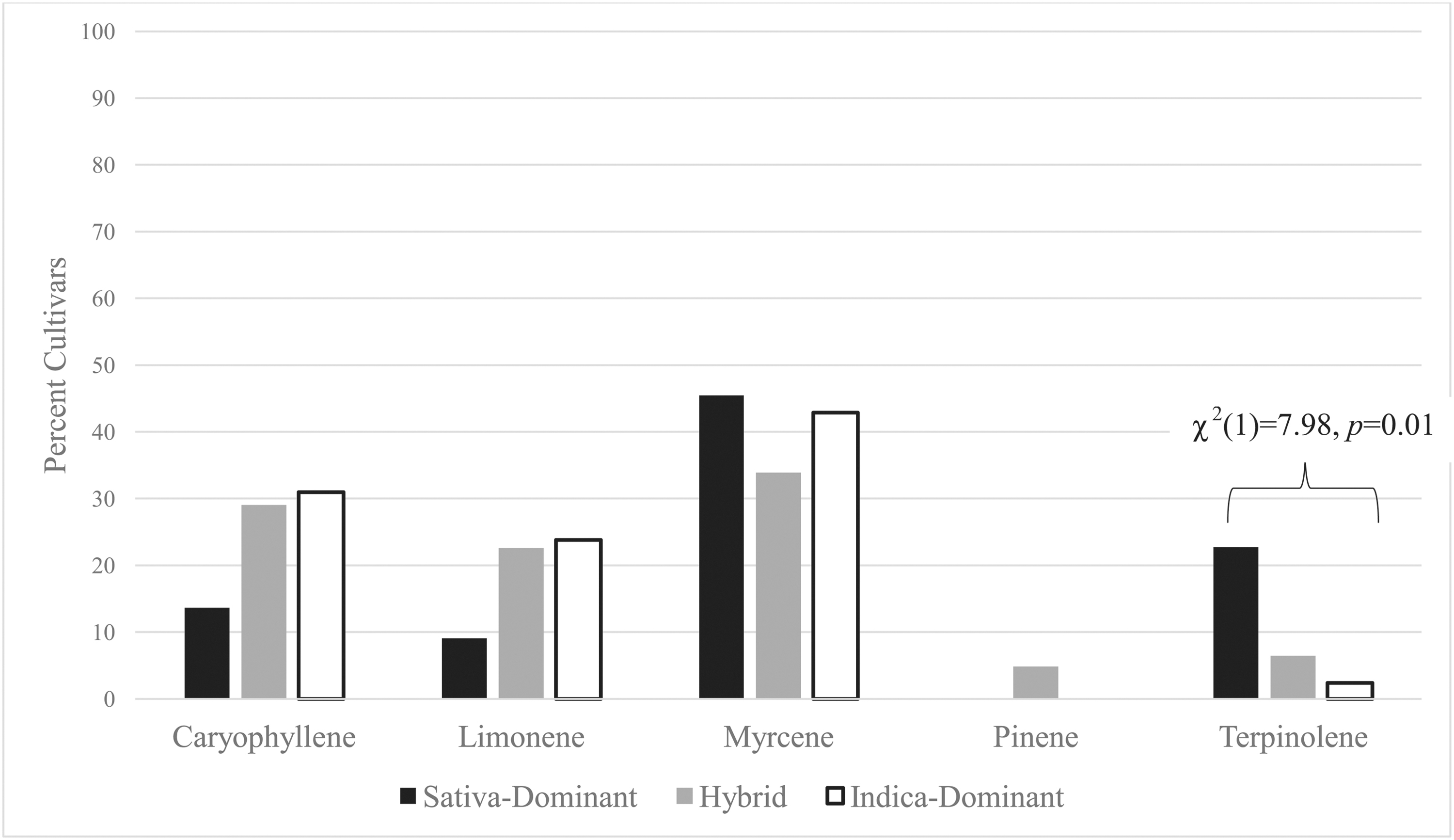
Frequency of primary terpenes in cultivars. χ2(1)=7.98, p=0.01. No terpenes significantly differed across cultivar classification other than terpinolene.
Subjective response by sativa/indica classification
Initial results without covariates found that cultivars classified as indica were associated with greater low-arousal effects (b = 0.28, SE=0.10, p=0.01, CI=0.08 to 0.47) relative to the mean of all cultivars. This finding remained significant with the inclusion of all covariates. Table 3 provides estimates for full model.
Subjective Response By Cultivar Classification
Bold text indicate significant findings at p < 0.05.
Sex coded as 0=male, 1=female. Race coded as 0=Not White, 1=White. Context coded as 0=alone, 1=with others. Effect coding was used to compare sativa cultivars and indica cultivars to the mean of all groups.
CI, confidence interval; SE, standard error; THC, tetrahydrocannabinol.
Subject response by terpenes
Models without covariates found that cultivars with primary caryophyllene were associated with greater pain ratings (b = 0.49, SE=0.21, p=0.02, CI=0.08 to 0.90) and greater negative effects (b = 0.22, SE=0.07, p=0.004, CI=0.07 to 0.37) relative to the mean of all primary terpenes. Pinene was associated with lesser negative effects (b = −0.37, SE=0.17, p=0.03, CI=−0.71 to −0.03) relative to the mean of all terpenes. Models were similar after including covariates. Table 4 provides estimates for the full model.
Subjective Response By Primary Terpenes
Bold text indicate significant findings at p < 0.05.
Sex coded as 0=male, 1=female. Race coded as 0=Not White, 1=White. Context coded as 0=alone, 1=with others. Effect coding was used to compare each terpene with the mean of all groups. Because Myrcene was considered the contrast group in the first model, a second model was run to examine whether myrcene differed from the mean of all groups.
Table provides estimates for myrcene from second model. All other estimates in this second model were unchanged from first.
Discussion
This study was the first test of whether cultivar classification and terpenes are associated with subjective cannabis effects. Consistent with hypotheses, the majority of participants reported a preference for sativa or indica. Individuals who preferred indicas (43.6%) reported using for health and relaxation purposes. Individuals who preferred sativas (34.7%) reported using for increased mood and energy. These findings extend knowledge that cannabis users hold robust perceptions that cultivars classified as sativa and indica produce different effects. 4
When examining whether classification was associated with subjective response, indica was associated with greater low-arousal effects relative to all cultivars. This finding is in-line with industry claims and consumer perceptions4,5 but is inconsistent with current scientific understanding that sativas and indicas do not represent distinct groups.15,16
One possibility is that these low-arousal effects were expectancy based. Indeed, our study did find that expected effects were a robust predictor of subjective response. However, cultivar differences remained after controlling for between-person differences in cultivar preference and expected effects as well as within-person deviations from typical patterns of use (e.g., sativa/indica cultivar). Nevertheless, lab studies are needed to disentangle pharmacologically based from acute expectancy-based subjective effects. It should also be noted that participants reported preference for indicas to reduce pain and sativas for high-arousal effects, but such relations were not found during naturally occurring cannabis use episodes. These discrepancies highlight the need for continued research.
Analyses examining differences in primary terpenes across cultivar classification found only one difference; Sativas were more likely to have terpinolene than indicas or hybrids. The limited distinctions of terpenes by cultivar classification underscore minimal overall differences between sativas and indicas.15,16,21,22 Moreover, ∼40% of cultivars reported in our sample were considered hybrid, suggesting that sativa/indica classifications do not apply for many cannabis products. If sativa/indica continue to be used and examined, it is imperative to determine the extent to which they are distinct from one another.
This study found that pinene was associated with lesser negative effects relative to the average negative effect score for all terpene groups. This finding is somewhat consistent with select animal research showing pinene is associated with reduced oxidative stress and agitation.37,49 We also found that caryophyllene was associated with greater pain ratings and negative effects relative to other primary terpenes, inconsistent with preliminary animal models suggesting that caryophyllene may have analgesic properties.50,51 These findings provide initial evidence that some terpenes may play a role in subjective response to cannabis, even when accounting for within-person fluctuations in cannabis products, subjective response, and morning pain ratings and between-person confounding variables (e.g., if those with higher pain select cannabis products with more caryophyllene relative to individuals with less pain).
Although this study yielded novel findings, there are several limitations to be considered. First, our sample size was small. However, prior research has used sample sizes comparable with or smaller than this study.52–54 Second, EMA studies are helpful for examining behavior in the real-world but are unable to disentangle pharmacological from expectancy effects. Third, we used data from Leafly and were unable to verify cultivar/terpene classification. It is currently unclear what makes a cultivar sativa or indica.
Fourth, identical cultivar names can differ in chemical composition depending on the grower, which provides further complexity in identifying what people are actually using. 55 Relatedly, we were unable to ascertain whether sativa/indica labels on Leafly were consistent with the packaging label purchased by the participant, which may have impacted expected effects of cannabis use. Fifth, we examined primary terpenes, but there are several terpenes within one cultivar that may influence effects. Finally, results were based on individuals using cannabis daily, on average. Findings may differ with individuals who use cannabis at different rates.
Despite limitations, this study provided the first test of subjective response by cultivar classification and terpene content. Disseminating accurate information to cannabis consumers is of public health importance as many claims in the industry are unsubstantiated. These findings highlight the need for continued education in the community, given the overall lack of education and scientific training across fields (e.g., dispensary staff, medical doctors).56,57
Footnotes
Authors' Contributions
S.A.O. conceived of study, led data collection, data analysis, and wrote the first article draft. J.T.W. and W.R.C. assisted with study conception and data analysis. R.V.S., G.M.K., and M.P.F. assisted with data collection and tables/figures. All authors revised, edited, and approved the article.
Author Disclosure Statement
No competing financial interests exist.
Funding Information
This work was partially supported by the Arizona State University Graduate and Professional Student Association's Jumpstart Grant Program and the Arizona State University Sharon Manne Research Award.