




Abstract
Background:
The popularity of delta-8 tetrahydrocannabinol (THC) and cannabidiol (CBD) products has seen a sharp increase in use during recent years. Despite the rise in use of these minor cannabinoids, there are little to no pre-clinical behavioral data on their effects, with most pre-clinical cannabis research focusing on the behavioral effects of delta-9 THC. The current experiments aimed to characterize the behavioral effects of delta-8 THC, CBD, and mixtures of these two drugs using a whole-body vapor exposure route of administration in male rats.
Methods:
Rats were exposed to vapor that contained different concentrations of delta-8 THC, CBD, or CBD/delta-8 THC mixtures during 10 min of exposure. Following 10 min of vapor exposure, locomotor behavior was monitored, or the warm-water tail withdrawal assay was conducted to measure the acute analgesic effects of the vapor exposure.
Results:
CBD and CBD/delta-8 THC mixtures resulted in a significant increase in locomotion across the entire session. Although delta-8 THC alone had no significant effect on locomotion across the session, the 10 mg concentration of delta-8 THC had a hyperlocomotion effect in the first 30 min of the session followed by a hypolocomotor effect later in the session. In the tail withdrawal assay, a 3/1 mixture of CBD/delta-8 THC resulted in an immediate analgesic effect compared to vehicle vapor. Finally, immediately following vapor exposure, all drugs had a hypothermic effect on body temperature compared to vehicle.
Conclusion:
This experiment is the first to characterize the behavioral effects of vaporized delta-8 THC, CBD, and CBD/delta-8 THC in male rats. While data were generally congruent with previous research investigating delta-9 THC, future studies should explore abuse liability and validate plasma blood concentrations of these drugs following administration through whole-body vapor exposure.
Introduction
Cannabis remains the most widely used illicit drug in the United States, which is derived from the Cannabis indica and Cannabis sativa plants. 1 According to a recent report in 2020, 209 million people 15–64 years of age used cannabis in the past year. 2 Historically, individuals used cannabis that is primarily composed of either delta-9 tetrahydrocannabinol (THC) and/or cannabidiol (CBD). 3 However, cannabinoid products recently became tremendously diverse in their composition, route of administration, and formulation. 3
Passed by the U.S. Congress in 2018, the Agricultural Improvement Act (i.e., the Farm Bill) indicated that Cannabis plants comprised <0.3% delta-9 THC and its by-products were no longer listed on the Schedule of Controlled Substances. 4 This legislation led to the rapid proliferation of the industrial hemp market, in which novel classes of minor cannabinoids emerged. Simultaneously, cannabis use through vaporization more than doubled among high school students from 2017 to 2020. 2 As hemp-derived minor cannabinoids are now perceived as “legal weed,” interest and accessibility to minor cannabinoids continue to escalate. 4
Delta-8 THC is a minor cannabinoid that is a chemical isomer of delta-9 THC and is present in most cannabis plants at low concentrations.5,6 Due to its altered chemical structure, delta-8 THC has been reported to produce psychoactive effects analogous to, but generally less potent than delta-9 THC. 3 Psychoactive effects of delta-8 THC use include feelings of euphoria, visual and time distortion, relaxation, and difficulty in thinking and speaking, and can produce a dream-like state. 6
Given the passage of the Farm Bill, many cannabis sellers and consumers consider hemp-derived delta-8 THC as “legal,” leading to it being used as a substitute for delta-9 THC in states where access to delta-9 THC is restricted. 7 In recent studies, which surveyed delta-8 THC users, users reported seeking delta-8 THC as a replacement for delta-9 THC because it is perceived as legal, less potent, and can be purchased at a lower cost.6,8 While there is a significant amount of data that have investigated the behavioral effects of delta-9 THC, there is a necessity for more experimental research that looks at the behavioral and physiological effects induced by the increasingly popular delta-8 THC.
This experiment is aimed at determining behavioral effects of vaporized delta-8 THC, CBD, and mixtures of these two drugs in male rats. In recent years, pre-clinical research investigating the effects of delta-9 THC has validated vaporized cannabinoid models using rats. 9 This is an important experimental development as it more closely models how humans tend to use THC products. 9 The pulmonary route tends to have a higher abuse liability and is more likely to lead to a cannabis use disorder compared to other routes of administration. 10 Recent studies have shown that rats exposed to delta-9 THC vapor tend to show hypothermia, hypolocomotor, and antinociception effects,11–14 and lower concentrations of vaporized delta-9 THC have displayed hyperlocomotion effects early in the session.15,16
Also, research indicates that CBD mixed with delta-9 THC alters the metabolism of delta-9 THC, resulting in elevated brain and blood levels, 17 and alters the hypothermic and locomotor effects of delta-9 THC. 11 These pre-clinical data on the interaction of delta-9 THC and CBD are supported by human data, which found that CBD in combination with delta-9 THC resulted in a greater intoxicating effect of delta-9 THC. 18 Given these data, it is not surprising that many delta-8 THC products also report having a percentage of CBD in them.
While previous research characterized the behavioral effects of vaporized delta-9 THC, there are limited pre-clinical studies looking at the behavioral effects of delta-8 THC and no data looking at the combined effects of CBD with delta-8 THC. Previous pre-clinical research found that systemic injections of delta-8 THC produce a delta-9 THC-like profile of effects in the tetrad battery.19–21
The recent study by Vanegas et al., found that i.p. injections of delta-8 THC also substituted for the discriminative stimulus effects of delta-9 THC in mice, indicating similar subjective effects between the two drugs. 19 The aim of these studies was to test the behavioral effects of delta-8 THC, CBD, and combinations of the two drugs using a whole-body vapor exposure or vaporized route of administration. We were interested in establishing a behaviorally active concentration range for vaporized delta-8 THC, CBD, and mixtures of the two drugs using a locomotor assay. Once we established behaviorally active concentrations using our vaporization procedures, we then tested for antinociception and hypothermic effects of these compounds and mixtures.
Methods
Animals
Twenty-four male Sprague Dawley rats (Envigo, Indianapolis, IN, USA) were received at ∼51 days of age. Twelve rats were used in the locomotor study and later participated in the tail-withdrawal test with CBD and CBD/delta-8 THC mixture. The other 12 animals participated in a previous pilot study, where they were exposed to delta-8 THC and vehicle by vaporization. Upon arrival, all rats were pair-housed in sterile plastic shoebox cages with bedding and one enrichment toy, which was switched once a week during bedding change. Rats were housed in a 12-h reversed-light/dark cycle and had unlimited access to food and water. All procedures were approved by the Creighton University Institutional Animal Care and Use Committee and conformed to the NIH Guide for the Care and Use of Laboratory Animals. 22
Apparatuses
Vaporization chamber
Drug administration occurred in a vaporization chamber that consisted of a 10 L polypropylene container with an air-tight lid (22.23×33.66×23.50 cm, SKU10058862; Container Store, Omaha, NE, USA) connected to a Volcano Medic 2 vaporizer using a whip attachment to allow vapor to be pumped into the chamber (Ref No. 01 01M; Storz and Bickel, Tuttlingen, Germany) (Fig. 1). The vaporizers were temperature controlled and dosing capsules (Ref No. 09 33M; Storz and Bickel) were loaded with drug and placed into the vaporizers to heat the drug to 210°C before administration.

Image of the vaporization chamber, while rat is exposed to vaporized delta-8 tetrahydrocannabinol.
Locomotor chambers
Rats were tested in custom-made 12 in circular locomotor chambers for locomotor activity (for more details see Adams et al. 23 ). A camera was positioned above the chambers to digitally record each session so footage could be analyzed for distance traveled using ANY-maze computer software (Stoelting Co., Wood Dale, IL, USA).
Procedures
Vaporization procedure
Once a rat was closed into the chamber, the air pump on the vaporizer was activated in 10-sec intervals, with 2-min pump off intervals and a total of 50 sec of vapor introduction throughout the 10-min exposure. The 50 sec of vapor introduction completely vaporizes 300 μL of either drug or vehicle [propylene glycol (PG)] during the 10-min exposure. Concentration of drug in the locomotor assay was achieved by within-subject design, where each rat received each drug and each concentration of drug once.
All rats in the locomotor study were administered the different concentrations of drug in the following order: delta-8 THC, CBD, and CBD/delta-8 THC mixtures. Concentrations of each drug were administered in random order with 3 days between each administration. The concentrations tested for each drug were as follows: delta-8 THC, 0 or PG, 10, 20, and 40 mg/300 μL; CBD, 30, 60, and 120 mg/300 μL; CBD/delta-8 THC mixtures, 20 mg/60 mg, 20 mg/20 mg, and 60 mg/20 mg/300 μL. Following drug administration, the rats were transferred directly to the locomotor chambers or to the warm water tail-withdrawal station. The concentrations tested for CBD and the CBD/delta-8 THC mixtures were based off of previous publications.11,24
Locomotor procedure
Rats were placed in the locomotor chambers for 2 h. While in the locomotor chamber, behavior was monitored using a digital video camera mounted above the chambers. Following the sessions, the animals were returned to the colony room and placed into their home cages.
Warm water tail-withdrawal procedure
Following completion of the locomotor concentration curves or the pilot study, rats were broken up into four groups to be tested for antinociceptive effects of PG-0 mg/300 μL, delta-8 THC 20 mg/300 μL, CBD 60 mg/300 μL, or a CBD/delta-8 THC mixture 60 mg/20 mg/300 μL using the tail withdrawal assay. These doses were determined based on the results from the locomotor concentration curves. The animals were exposed to vaporized drug as previously described and tail withdrawal latencies were determined at 0, 30, and 60 min post-vapor exposure. The rats' tails were inserted first into a 50°C water bath followed by a 55°C water bath. The 55°C water bath is used as a control measure for general sedative effects. 25 A stopwatch was used to measure in seconds how long the rats kept 5 cm of their tails submerged. Following the tail dips, rectal temperatures were measured using a temperature probe.
Data analysis
Distance traveled in meters was the significant dependent variable in locomotor studies. The total session locomotor concentration curves were each analyzed using a one-way repeated measure ANOVA with concentration as the within-subject factor. Given that concentration was a within-subject variable and animals were repeatedly exposed to the locomotor procedure, a two-way repeated measures ANOVA was conducted on the delta-8 THC concentration curve to determine if there was an exposure or ordering effect. Order (1st, 2nd, 3rd, and 4th locomotor exposure) and concentration were both within-subject factors.
This analysis revealed there was no significant effect of exposure or ordering on delta-8 THC locomotor effects, so this analysis was not conducted moving forward. The within-session locomotor effects were analyzed using a two-way repeated measures ANOVA, with time and concentration as within-subject factors. The significant dependent variables from the warm water tail-withdrawal assay were tail-withdrawal latencies in seconds and rectal body temperatures. These curves were each analyzed using a mixed-factor ANOVA, with time as a within-subject factor and drug as a between-subject factor. Post-hoc comparisons were conducted using Tukey's HSD. For tests of significance, an alpha of p≤0.05 was used.
Drugs
Hemp-derived delta-8 THC distillate (3CHI, Carmel, IN, USA) and CBD isolate powder (3CHI) were purchased in bulk from 3CHI online website. Upon arrival, both delta-8 THC and CBD were analyzed using 1 H nuclear magnetic resonance spectroscopy (400 MHz Bruker Ascend, CDCl3 solvent). Both delta-8 THC 26 and CBD27,28 spectra were identical to those reported in previously published literature, each had >98% purity.
To mix different concentrations of delta-8 THC, first the distillate was heated in a 120°C water bath. Amounts of drug were then weighed and mixed with our vehicle PG to reach a concentration in mg of the drug per 300 μL of PG. CBD isolate was weighed and mixed with PG to reach a concentration in mg of the drug per 300 μL of PG. All drugs were covered in aluminum foil and maintained at room temperature. Before each vaporization session, 300 μL of drug was pipetted in the dosing capsule.
Results
Detla-8 THC locomotor effects
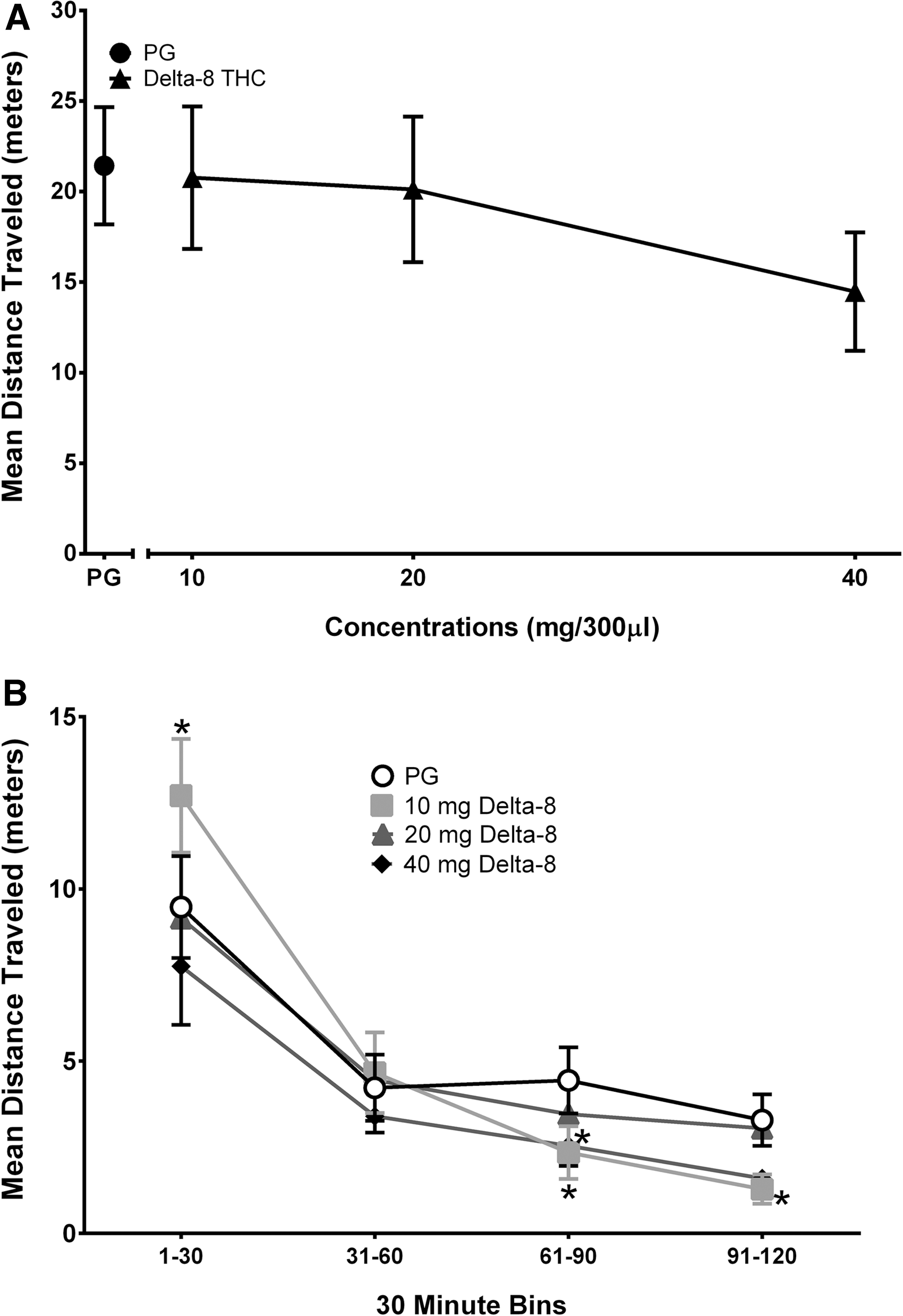
A one-way repeated measures ANOVA revealed that delta-8 THC resulted in nonsignificant effects on distance traveled across the entire session [F(3,47)=1.207, p=0.32; Fig. 2A]. The within-session analysis revealed a significant main effect of time [F(3,33)=22.94, p≤0.0001] and a significant interaction of time by concentration of delta-8 THC [F(9,99)=3.44, p=0.001]. Post-hoc comparisons indicated that the 10 mg concentration of delta-8 THC resulted in a significant hyperlocomotor effect compared to PG during the first 30 min of the session followed by a significant hypolocomotor effect during the latter portion of the session (Fig. 2B). Also, the 40 mg concentration resulted in a significant hypolocomotor effect also during the 61–90-min bin and a nonsignificant trend (p=0.07) toward hypolocomotor during the 91–120-min bin compared to PG (Fig. 2B).
CBD locomotor effects
A one-way repeated measures ANOVA revealed that CBD resulted in a significant effect on distance traveled across the entire session [F(3,47)=4.13, p=0.02; Fig. 3A]. Post-hoc comparisons revealed that both 60 and 120 mg concentrations resulted in significant increases in locomotor behavior compared to PG. The 120 mg concentration resulted in a significant increase in locomotion compared to the 30 mg concentration. The within-session analysis revealed significant main effects of time [F(3,33)=33.83, p≤0.0001] and concentration [F(3,33)=2.91, p≤0.05] and a significant interaction of time×concentration of CBD [F(9,99)=3.01, p<0.005]. Post-hoc comparisons indicated that all three active concentrations of CBD resulted in a significant hyperlocomotor effect compared to PG during the first 30 min of the session, but the 30 mg concentration did not result in hyperlocomotor throughout the session when compared to PG (Fig. 3B).

CBD/delta-8 mixtures locomotor effects
A one-way repeated measures ANOVA revealed that CBD/delta-8 THC mixtures resulted in a significant effect on distance traveled across the entire session [F(3,47)=5.75, p=0.006; Fig. 4A]. Post-hoc comparisons revealed that there were significant increases in locomotor behavior compared to PG vapor following exposure to the 60 mg/20 mg mixture and the 20 mg/20 mg mixture, but not the 20 mg/60 mg mixture. Post-hoc comparisons of the 60 mg/20 mg and 20 mg/20 mg mixtures indicate they had a larger increase in locomotor behavior compared to 20 mg of delta-8 THC alone.
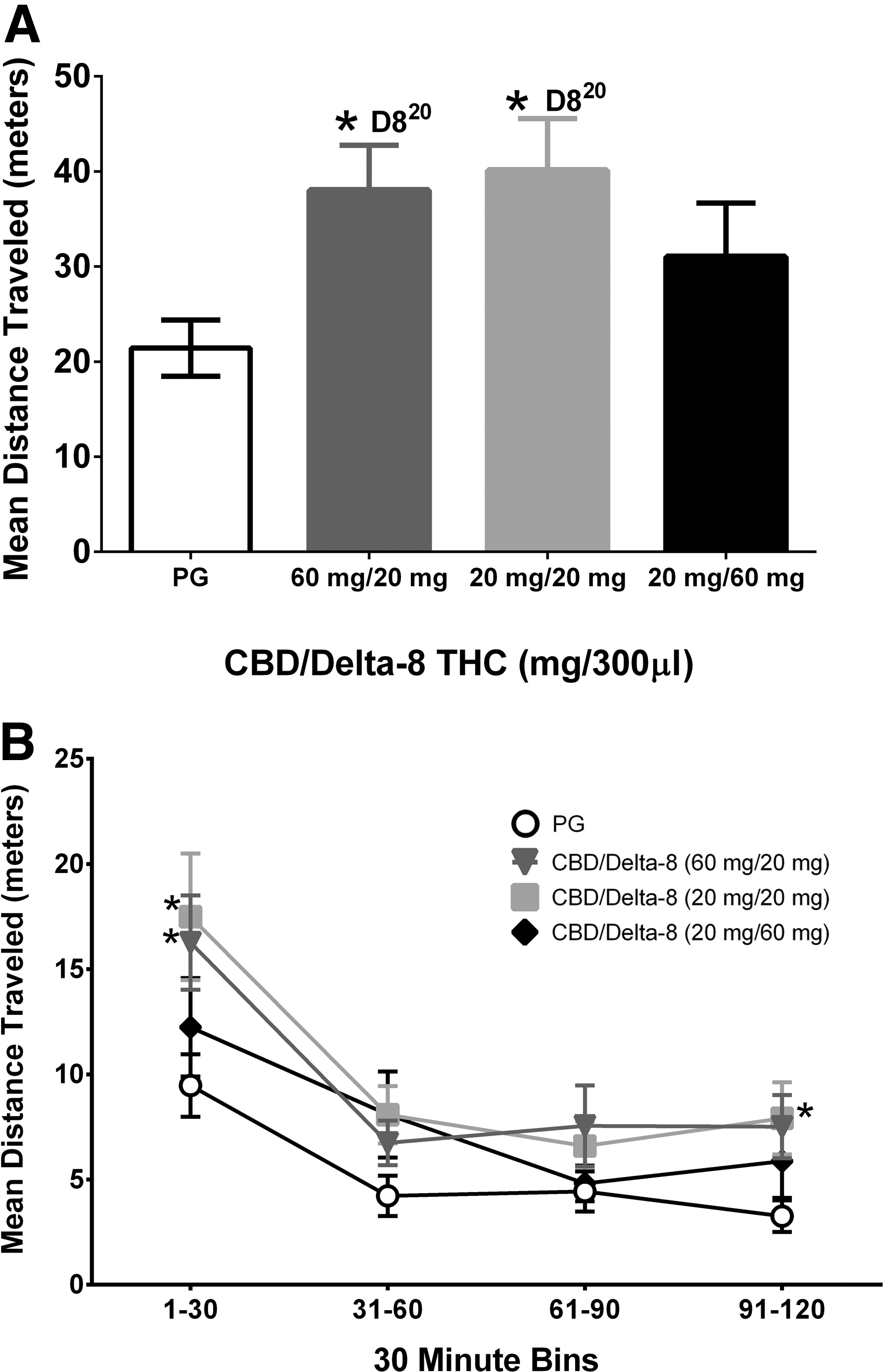
Within-session analysis revealed significant main effects of time [F(3,33)=26.63, p≤0.0001] and mixture [F(3,33)=5.76, p≤0.01], but not a significant interaction of time×mixture [F(9,99)=1.09, p=0.38]. Despite the lack of a significant interaction, Figure 4B indicates that both the 60 mg/20 mg and 20 mg/20 mg mixtures had a hyperlocomotion effect in the first 30 min compared to PG and tended to be higher through the entire session.
Antinociceptive and thermal effects of delta-8 THC, CBD, and mixtures
Analysis of tail withdrawal latencies in the 50°C water bath revealed only a main effect of drug [F(3,19)=2.94, p≤0.05; Fig. 5A]. There was a trend toward an interaction of time×drug, but it failed to reach significance. Post-hoc comparisons indicated that the main effect of drug was driven by the 60 mg/20 mg mixture resulting in a significant increase in tail withdrawal latencies compared to PG.
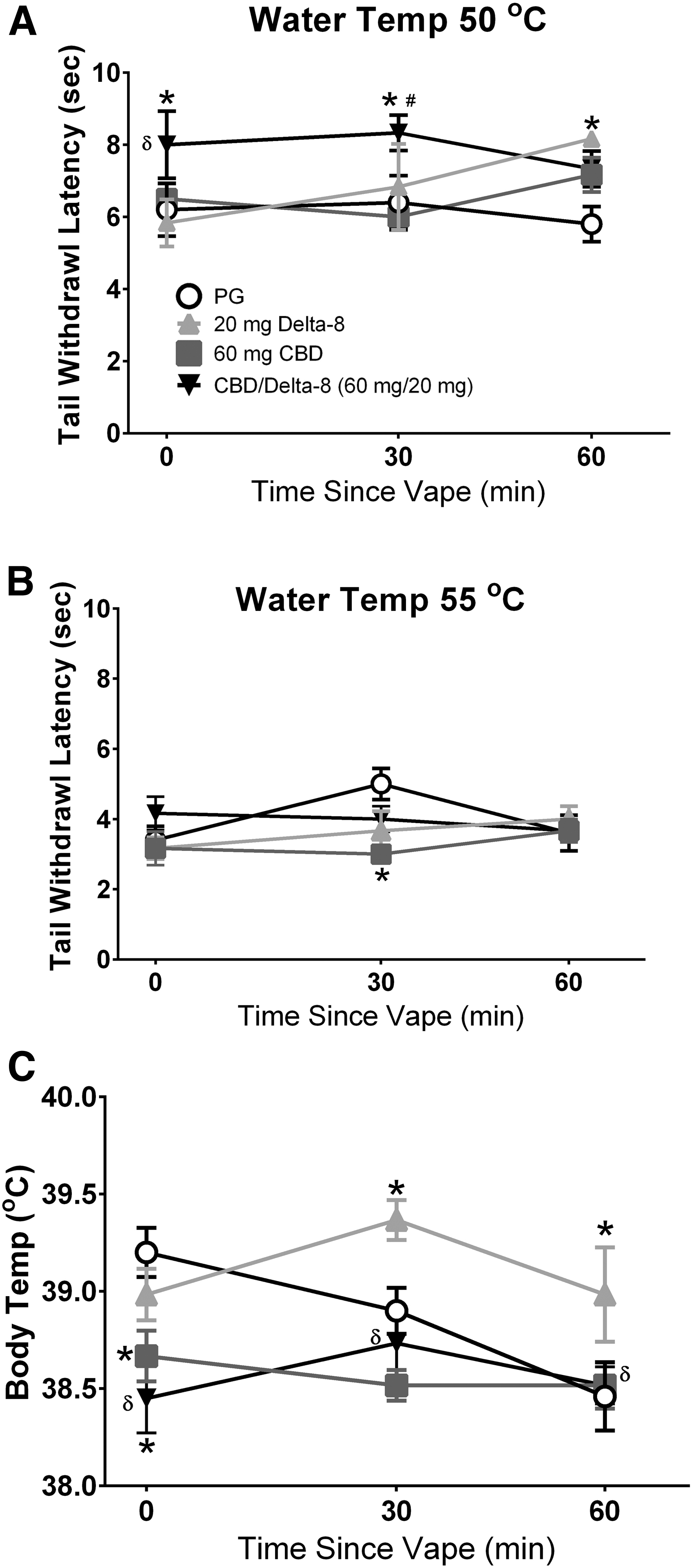
We also found that the 60 mg/20 mg mixture also increased withdrawal latencies relative to 20 mg of delta-8 THC and 60 mg CBD alone; the effect of the 60 mg/20 mg mixture was most pronounced in the first 30 min following vapor exposure. Delta-8 THC alone was also significantly higher than PG alone, but not until 60 min post-vapor exposure. A two-way mixed factor ANOVA on tail withdrawal latencies in the control 55°C water bath revealed only a significant interaction of drug×time [F(6,38)=2.82, p≤0.05; Fig. 5B]. Post-hoc analysis reveals the effect was driven by the 60 mg CBD concentration being significantly lower than PG at the 30-min time point.
In terms of thermal effects of vaporized cannabinoids, the analysis revealed significant main effects of time [F(2,38)=6.59, p≤0.005] and drug [F(3,19)=5.05, p≤0.01] and a significant interaction of time×drug [F(6,38)=3.95, p<0.005; Fig. 5C].
Post-hoc analysis revealed that immediately following vapor exposure, all drugs had a hypothermic effect compared to PG with 60 mg of CBD and the 60 mg/20 mg mixture being significantly lower than PG. The 60 mg/20 mg mixture resulted in a hypothermic effect compared to 20 mg of delta-8 THC alone at all time points. Surprisingly, the 20 mg concentration of delta-8 THC resulted in a hyperthermic effect compared to PG at the 30 and 60 min post-vapor exposure time points. This apparent hyperthermic effect was driven by the fact that the PG group did have a significant time-dependent decrease in body temperature from the 0- to 60-min time point.
Discussion
Vaporized delta-8 THC resulted in a moderate, but significant increase in locomotion at the beginning of the session and a significant decrease later in the session, particularly with the 10 mg concentration. Higher concentrations only decreased locomotion later in the session. The 20 mg concentration of delta-8 THC tested for analgesic effects caused a significant increase in tail withdrawal latencies 60 min post-vapor exposure. Surprisingly, this concentration resulted in a hyperthermic effect relative to PG at 30 and 60 min post-vapor exposure.
CBD resulted in a concentration-dependent increase in locomotion, with the moderate and high concentrations increasing locomotion across the entire session. CBD alone had no significant analgesic effect and resulted in a hypothermic effect immediately following vapor exposure. When CBD and delta-8 THC were combined in a 60 mg/20 mg or a 20 mg/20 mg mixture, locomotion increased. These hyperlocomotive effects were larger than those seen by both drugs alone at similar concentrations. Following the 60 mg/20 mg mixture, there was a rapid onset of a significant analgesic effect and hypothermic effect.
The trend of a decrease in locomotion caused by the 40 mg concentration of delta-8 THC is generally congruent with previous studies that found vaporized delta-9 THC decreases locomotor behavior.11,13,29 When the locomotor session was broken down within session, we observed that the low concentration of delta-8 THC resulted in a significant increase in locomotion early in the session. This finding is also congruent with previous vaporized delta-9 THC studies.15–17,29
Furthermore, the significant antinociceptive effects of delta-8 THC compared to PG also align with studies conducted on vaporized delta-9 THC,11,12,30 although this study's antinociceptive effects were not as robust and had a delayed onset relative to those previously reported with delta-9 THC. These differences might be related to the lower potency of delta-8 THC versus delta-9 THC 31 or due to differences in vaporization procedures. Another explanation for the less robust antinociceptive effects seen in this study could be since these animals had multiple exposures to delta-8 THC and CBD before the tail withdrawal test, there could have been some tolerance to the drug effects. A recent study looking at the effects of repeated injections of delta-8 THC in mice found that antinociceptive effects in a tail withdrawal assay were significantly lower than delta-9 THC and the mice developed tolerance to the effects of delta-8 THC after repeated injections. 19
One area of inconsistency relative to previous work with vaporized delta-9 THC versus this study is the lack of a clear hypothermic effect caused by delta-8 THC. The one concentration test of vaporized delta-8 THC resulted in an immediate, but small nonsignificant hypothermic effect followed by a hyperthermic effect inconsistent with previous vaporized delta-9 THC studies.11,12,30 This was, in part, due to the PG group showing a significant decrease in body temperature across time, while the delta-8 THC group did not have a significant change in body temperature across time. Although this lack of hypothermic effects could be due to the rats having previous delta-8 THC and CBD exposure, the recent study by Vanegas et al 19 found a relatively mild hypothermic effect in mice given injections of delta-8 THC and the mice displayed tolerance to this effect with repeated injections.
Despite the lack of a clear hypothermic effect of delta-8 THC, our study found that the 60 mg CBD concentration had a significant hypothermic effect consistent with prior studies, even using a different strain of rats.11,24 Javadi-Paydar et al 24 found that vapor exposure to CBD had a nonsignificant impact on tail withdrawal latencies, which is consistent with data derived from this study. Previous work investigating the locomotor effects of CBD alone are mixed, with previous studies looking at vaporized CBD finding no effect of a lower concentration of CBD, 11 Although, higher concentrations of CBD have been shown to result in significant hypolocomotor effects early in the session compared to vehicle. 24
A study with a similar vaporization setup to that used in this study found a hypolocomotor effect of a 20 mg concentration of CBD alone when vaporized, no effect with injection, and a hyperlocomotor effect when given orally. 17 Other studies using an injection route of administration found CBD had either no significant effect on locomotor behavior32,33 or a hyperlocomotor effect. 34 While our locomotor effects are consistent with Britch et al's 34 findings, they are inconsistent with the previous vaporization studies. This may be due to differences in concentration tested, vaporization procedures (group vs. single vaporization exposure), or how locomotor activity was monitored (activity counts with a radiotelemetry system vs. tracking distance traveled).
Currently, the studies published that discuss the effects of vaporized CBD and delta-9 THC mixtures on the behavioral tetrad are limited. One study 11 found there was an additive hypothermic effect of a 4/1 CBD/delta-9 mixture, which is consistent with the additive hypothermic effects of a 60 mg/20 mg CBD/delta-8 mixture in this study. Although neither the previous study 11 nor Hlozek et al's 17 study found any additive effect on activity rates of CBD/delta-9 THC mixtures, this study found two mixtures caused additive effects on increasing locomotor activity. Javadi-Paydar et al 24 observed that inhalation of CBD/delta-9 mixtures had no effect on tail withdrawal, which contrasts with this study as the 60 mg/20 mg mixture resulted in a rapid and significant onset of analgesic effect in the tail withdrawal assay immediately post-vaporization.
These discrepancies could be due to differences in the THC drugs tested or differences in the vaporization procedure. When the CBD and delta-9 THC combinations have been tested by the injection route, CBD tends to enhance the behavioral effects of delta-9 THC. For instance, injections of CBD have been shown to enhance the hypothermic and/or hypolocomotor effects of delta-9 THC when given simultaneously.32,33,35,36 The additive effects of mixtures of CBD/delta-8 THC may be a result of CBD altering the metabolism of THC, as CBD is known to inhibit the cytochrome P450 family of liver enzymes that metabolize THC.34,37 As such, THC levels could be heightened in the blood, resulting in increased behavioral effects.
Besides a metabolic mechanism, CBD has been shown to increase CB1R levels in the hippocampus and hypothalamus when administered in combination with delta-9 THC. 32 Given the connections between the hippocampus and midbrain structures in mediating behavioral effects,38,39 it is possible that the combinations of CBD and delta-8 THC used in this study altered the modulating signal coming in from the hippocampus to midbrain structures. It is also possible that CBD is heightening levels of endogenous cannabinoids through inhibition of anandamide amidase 40 or reuptake of anandamide, 41 leading to an enhancement of delta-8 THC effects.
To our knowledge, this experiment is the first to investigate the behavioral effects of delta-8 THC and mixtures with CBD using a whole-body vapor exposure route of administration. This experiment illustrated that behavioral active effects of delta-8 THC, CBD, and mixtures of the two drugs could be achieved using a whole-body exposure route of administration. While the observed behavioral effects from this study were generally consistent with previous vaporized delta-9 THC research, there are procedural differences and limitations that make direct comparisons with previous delta-9 literature difficult.
For instance, this study tested limited concentrations in the tail withdrawal and body temperature assays; it is possible that a concentration-dependent alteration in these measures could occur if multiple concentrations were tested. Regardless of the limitations, this study is the first to characterize the behavioral effects of vaporized delta-8 THC in a rodent model. Gathering pre-clinical data on delta-8 THC is crucial, given its rising popularity. Future studies in our laboratory are aimed at investigating the abuse liability of delta-8 THC and mixtures with CBD using a conditioned place preference design. Finally, while we attempted to mimic a vaporization procedure that has shown validated levels of delta-9 THC in plasma and the brain, 17 our laboratory will be working on validating plasma blood concentrations of drugs using our current vaporization procedures.
Footnotes
Acknowledgments
We would like to thank both Dr. James Fletcher for analyzing our drug samples for purity and Dr. Vanessa Minervini for the training and use of the warm water bath tail withdrawal assay. We would also like to thank Storz and Bickel, Inc., for the generous donations of the Volcano vaporizers and supplies. We also would like to thank Claire Shinners, Keegan Kalkman, Giorgio Bacchin, Abbie Molson, Miles Eckrich, and Haydn Fitzgerald for their assistance in the collection of data presented in the article.
Author Disclosure Statement
The authors have no conflict of interest to disclose.
Funding Information
We would like to thank the Creighton University Faculty Research Fund for the generous funding, which allowed for the completion of this project.