




Abstract
Background:
Exploring the morphological traits of historical Cannabis populations from the Maghreb can provide invaluable information about the characteristics of the Maghreb Landrace Kif and contribute to the preservation of this vulnerable Cannabis resource.
Aim:
The purpose of the present study was to analyze the morphological characteristics of Cannabis specimens collected before worldwide introgressive hybridization and summarize the morphological traits of the Maghreb Landrace Kif.
Discussion:
Despite the limited number of specimens collected in the Maghreb, this study identified distinct types of Cannabis in the herbaria, including the Maghreb Landrace Kif, European hemp, and potentially East Asian hemp. By examining the morphological traits of kif specimens and reviewing the relevant literature, the study identifies the morphological traits that tend to characterize Maghreb Landrace Kif. Morphologically, Kif is different from drug-type Cannabis indica (“Sativa” and “Indica”). It resembles European hemp Cannabis sativa, but has female inflorescence characteristics that allow it to be distinguished from the latter, even when the growing conditions are optimal. These are the density of pistillate inflorescences (perigonal bract-to-leaf index), and the capitate stalked glandular trichomes cover density on the perigonal bracts.
Conclusion:
The characteristics of pistillate inflorescences identified in this study can be used to distinguish and select plants before phytochemical and genetic analysis, thus facilitating the identification of the Maghreb Landrace Kif.
Introduction
Cannabis (local name: Kif, Tekrouri, or Zatia) has been present in the Maghreb for centuries, but its cultivation is fairly recent, dating back to the early 19th century. The plant was mainly cultivated in the Rif mountains of Morocco and throughout northern Algeria and Tunisia.1,2 Kif was also present in the Maghreb oases of Algeria and Tunisia 1 and in the Moroccan regions of Fez, Marrakech, and Tafilalet.1,3 Currently, cultivation is massively condensed in northern Morocco.
In the formal botanical taxonomy of the genus Cannabis, Cannabis sativa and Cannabis indica are considered two subspecies 4 (C. sativa subsp. sativa and C. sativa subsp. indica). Each subspecies includes both wild and domesticated varieties. 4 Molecular studies support this subdivision.5–7 Carl Linnaeus first published the binomial name and described C. sativa in his seminal Species Plantarum of 1753 as having loose inflorescences and perigonal bracts with relatively sparse capitate stalked glandular trichomes (CSGTs). Linnaeus herbarium specimen morphology is consistent with a northern European fiber-type Landrace.8,9 In 1785 Lamarck described and named C. indica Lam., meaning “Cannabis from India.” Schultes et al. 10 departed from the original taxonomic concept of Lamarck and narrowly assigned C. indica to plants from Afghanistan. This led to the vernacular taxonomy “Indica” and “Sativa.” 11 Lamarck C. indica corresponds to “Sativa,” and Afghani C. indica corresponds to “Indica.”
Hillig 12 divided C. indica into two biotypes that have a distinct morphology and geographical provenance: narrow-leaf-drug (NLD) “Sativa” from South Asia and broad-leaf-drug “Indica” from Central Asia. McPartland and Small 13 in an extensive study, including morphological analysis of 1100 herbarium specimens, have identified several features distinguishing “Sativa” and “Indica.” They assigned taxonomic names to these taxa, respectively, C. sativa subsp. indica var. indica and C. sativa subsp. indica var. afghanica. However, most Cannabis strains encountered today are hybrids of “Sativa” and “Indica.” This widespread hybridization has significantly reduced their differences, endangering the original landrace ancestors, indica and afghanica. 14
Although the origin of Cannabis in the Maghreb is uncertain, one of the supported theories is that it was first introduced to Numidia by the Phoenicians and spread to the rest of the Maghreb by the Carthaginians.1,15 It is very likely that the Cannabis plant present at this time was C. sativa (hemp), used as a source of textiles and as an edible plant. 1 The C. indica plant from India would later be spread, for its psychoactive effects, to the Maghreb through Egypt by successive Arab invasions (9th to 12th centuries). 16
In the Maghreb, the Kif is mainly used as a drug crop, but the plant also produces a lot of fibers and seeds. Morphologically, the Kif plant has been described as resembling the nonpsychoactive northern hemp of Europe17,18 and has even been confused with it, as stated by Guyon, 19 who assigned Kif to C. sativa. In the formal taxonomic classification, the Landrace Kif was named α Kif and ranked as less than variety.4,20 Indeed, De Candolle 20 synonyms C. indica with C. sativa and acknowledged one species, C. sativa, with four groups (α, Kif; β, Vulgaris; γ, Pedemontana; δ, Chinensis). De Candolle defined the α group (C. sativa L. var kif Augustin de Candolle) as the southern hemp with a strong psychoactive effect, which corresponds to the Kif plants described in Bone (Algeria) by Dukerley. 18 According to Small and Cronquist, 4 De Candolle's α Kif group belongs to C. indica.
Ethnobotanists Clarke and Merlin 17 postulated that the Maghreb Cannabis Landrace is a hybrid between “Sativa” (NLD) and European hemp C. sativa and named it C. indica var. Mediterranean, and McPartland and Small, 13 when analyzing historical Cannabis herbarium specimens, noted that those originating from the Maghreb are of intermediate phenotype suggesting hybridization between European and Asian Cannabis.
Compared to European hemp, Kif plants mature earlier and are described as shorter plants, rarely exceeding 2 m in height, weakly branched or unbranched, shorter internodes, compact stem apex, pistillate inflorescence denser, leafier, and perigonal bracts rich in CSGTs.3,18,21
This study aims to analyze the morphological traits of historical Cannabis from the Maghreb and to provide a morphological description of the original Maghreb Landrace Kif. Herbarium specimens collected before the worldwide introgressive hybridization were examined morphologically and compared with data from previous studies.
Materials and Methods
Plant material
The plant material is from the herbarium collections of the Muséum National d'Histoire Naturelle (MNHN) of Rabat (RAB), the MNHN of Paris (P), the Montpellier University (MPU), the Royal Botanic Garden of Edinburgh (E), and the Botanic Garden of Meise (BR). A total of 21 cultivated and noncultivated specimens (Table 1; Algeria n=13; Morocco n=7; North Africa n=1) collected between 1834 and 1988 were examined. RAB and P specimens were examined in herbaria, while MPU, E, and BR specimens were examined from digitized images of the Global Biodiversity Information Facility or Réseau national des collections naturalistes databases or from the catalog of the Royal Botanic Garden Edinburgh.
List of the Studied Herbarium Cannabis Specimens from the Maghreb
C, cultivated; NC, noncultivated.
Morphological parameters were measured using a ruler and Photoshop 23.1.0 software. Leaf characteristics were measured as illustrated by Anderson 22 (Fig. 1). Leaf parameters measured on larger leaves, whenever possible, included the number of leaflets per leaf, length of the central leaflet (L), width of the central leaflet (W), and distance from the base of the central leaflet to the widest point (WP). The quotients L/W and WP/L are measures of central leaflet shape. The leaflet shape was lanceolate (the widest part is below the midpoint) or oblanceolate (the widest part is above the midpoint). A leaflet with a WP/L >0.5 is oblanceolate. The number of measurements performed for each specimen ranges from 0 to 3 depending on the preservation and accessibility of the central leaflet for measurement.
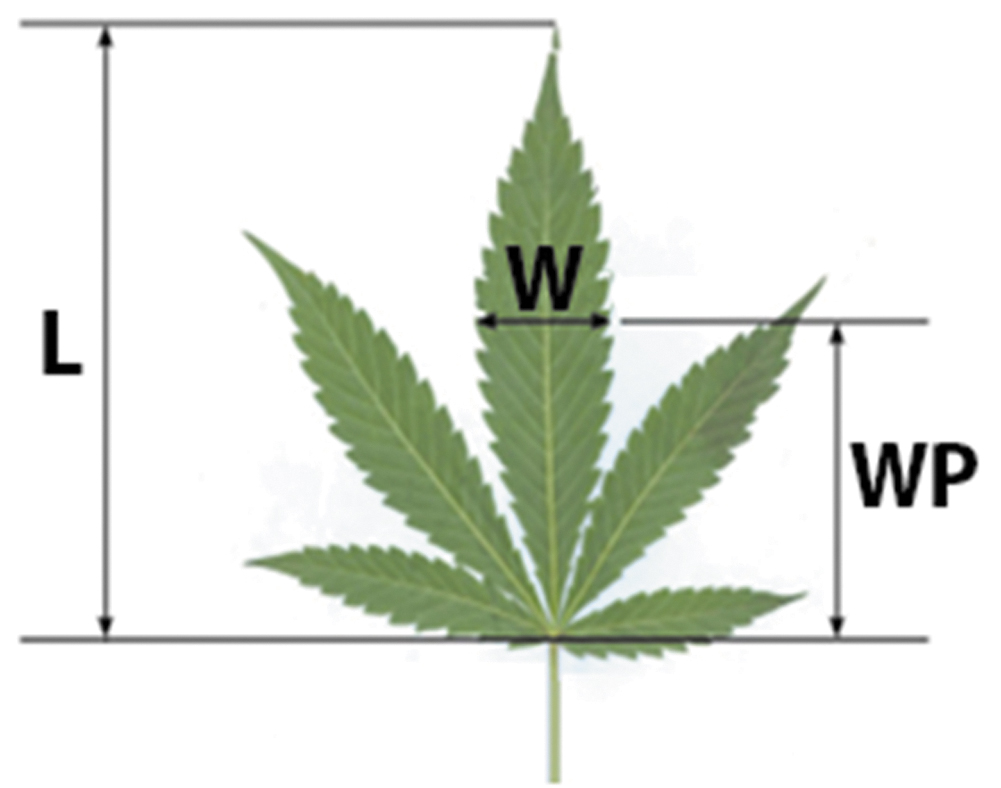
Leaf of Cannabis showing measurements made on central leaflet. L, length of the central leaflet; W, width of the central leaflet; WP, distance from the base of the central leaflet to the widest point.
Inflorescence density was qualitatively assessed using the “perigonal bract-to-leaf index.” Inflorescences with a low index have a predominance of leaf material and short internode length. The density of CSGTs was qualitatively assessed on the perigonal bracts of specimens from visited herbaria as reported by McPartland and Small. 13
Results
Morphological Maghreb specimens' analysis
The morphological characters of the 21 Maghreb herbarium specimens analyzed from five herbaria are presented in Tables 2 and 3 with respect to the main distinctive characters (branching habitus, leaves, leaflets, and female flowers). Maghreb specimens vary in morphology according to their origin.
Characteristics of herbarium Cannabis specimens from the Maghreb
CSGTs, capitate stalked glandular trichomes.
Leaf Characteristics of Herbarium Cannabis Specimens from the Maghreb
L was estimated accounting for the missing tip.
L, length of the central leaflet; W, width of the central leaflet; WP, distance from the base of the central leaflet to the widest point.
Specimens from Algeria
Noncultivated specimens
Four of the five Algerian specimens (n=2–5) are annotated as corresponding to the psychoactive Cannabis: C. indica or kif and were collected in inhospitable environments. They consist of entire plants of small size (fit on a herbarium sheet) and show differences in branching and leaves. One staminate specimen has a menorah-shaped habitus similar to Central Asian Landraces, while two others, one staminate and one pistillate, branched at an acute angle. There are also differences in petiole length; one specimen presents biserrate margins.
The specimen (n=1) collected in Bone consists of a pistillate inflorescence with flower clusters much closer together, particularly toward the top of the inflorescence, low perigonal bract-to-leaf index, and perigonal bracts moderately covered with CSGTs. This inflorescence resembles the Kif.
Cultivated specimens
The Algerian specimens (n=6–13) are from different growing conditions, running from arid to indoor controlled Common Garden Experiment (CGE), and seeds from different origins were used:
(1) One specimen consists of three immature plants from Souf oasis, small and stunted, long rooted; leaves 5 leaflets, broad and oblanceolate leaflets.
(2) One specimen of two immature plants collected in Adrar, the aridest zone of the Algerian Sahara. Plants are small and stunted; long roots; larger leaves 5 leaflets, central leaflet somewhat long and broad.
(3) Four specimens collected in 1850 for the French herbariums (P, Société des Lettres de L'Aveyron [SLA]) are from Cannabis grown at the French colonial Union Agricole of Sig, from seeds of the Orient. The two (P) specimens exhibited similar morphology. The plants are of the same size; largest leaves 7 leaflets; central leaflet long and broad; inflorescence of the more mature specimen appears somewhat compact and leafy. The (SLA) maturing pistillate plant branched near ground level; largest leaves 5 leaflets; central leaflet long, broad, and oblanceolate in shape.
(4) One unbranched mature pistillate specimen was collected by Dukerley in Bone and consists of an entire plant with a compact stem apex. Larger leaves have 5–7 leaflets, long petiole; central leaflet is long and narrow; inflorescence is small and compact, with flower clusters much closer together, especially toward the top of the inflorescence, low perigonal bract-to-leaf index.
(5) One monoecious specimen from CGE cultivated seeds (seeds from Sahara) and annotated as kif. The specimen consists of three upper parts of the plant, presumably due to the significant height of the plant; largest leaves 7 leaflets; central leaflet long, narrow, and oblanceolate in shape; inflorescence loose, high perigonal bract-to-leaf index. In addition, the perigonal bracts have almost cystolith trichomes and rare CSGTs, indicating that this inflorescence is not consistent with that of a psychoactive plant.
Specimens from Morocco
Noncultivated specimens
The specimens from Morocco (n=14–17) were collected in unusual environments (rubble, roadside, or city). The morphological analysis distinguished differences in leaves, leaflets, and pistillate inflorescences. Regarding leaves' characteristics, one of the four specimens has leaves with overlapping leaflets edges and larger leaves with broader central leaflets. The other specimens show leaves leaflets edges with gaps and larger leaves with central leaflets less broad. Pistillate inflorescence analysis distinguished two different inflorescences: (1) One pistillate specimen has an elongated and somewhat diffuse inflorescence, with relatively a high perigonal bract-to-leaf index; it resembles the inflorescence structure of a South Asian Landrace C. indica. Lam. (2) One mature pistillate specimen has a compact inflorescence, low perigonal bract-to-leaf index, and perigonal bracts moderately covered with CSGTs. This inflorescence resembles Dukerley's specimen.
Cultivated specimens
Morphological analysis of Moroccan specimens (n=18–20) showed significant differences in the pistillate inflorescences between northern and southern specimens. The two specimens (n=18 and 19), collected in 1875, from the same locality in southwestern Morocco, show differences in plant height, branching, and leaves. But they have compact and leafy inflorescences. The specimen (n=18) is tall and has a thick branched stalk; larger leaves 7 leaflets, long petiole; central leaflet long and narrow. Specimen (n=19) is short with a thin, unbranched stalk; larger leaves 7 leaflets, long petiole; central leaflet long and relatively broad. The inflorescences of both specimens are elongated and compact, with compact cymes much closer together, especially toward the top of the inflorescence, a low perigonal bract-to-leaf index, and the perigonal bracts densely covered with CSGTs. These inflorescences' morphology resembles that of Kif.
The specimen (n=20) collected in Ketama, the historical Kif growing area of northern Morocco, presents an unbranched thin stalk; larger leaves 7 leaflets, long petiole; central leaflet long, narrow, acuminate, but oblanceolate in shape; inflorescence elongated and somewhat compact, with cymes much closer together, especially toward the top of the inflorescence, and low perigonal bract-to-leaf index.
Morphological characteristics of Cannabis Landrace (Kif)
To explore and summarize the characteristics of the Maghreb Cannabis Landrace, we examine seven herbaria specimens (n=1, 6, 14, 18, 19, 20, and 21) that have morphological traits of Kif (Fig. 2). In addition, we included data from previously published studies for comparison and for parameters that are not available from herbarium specimens (e.g., plant height).
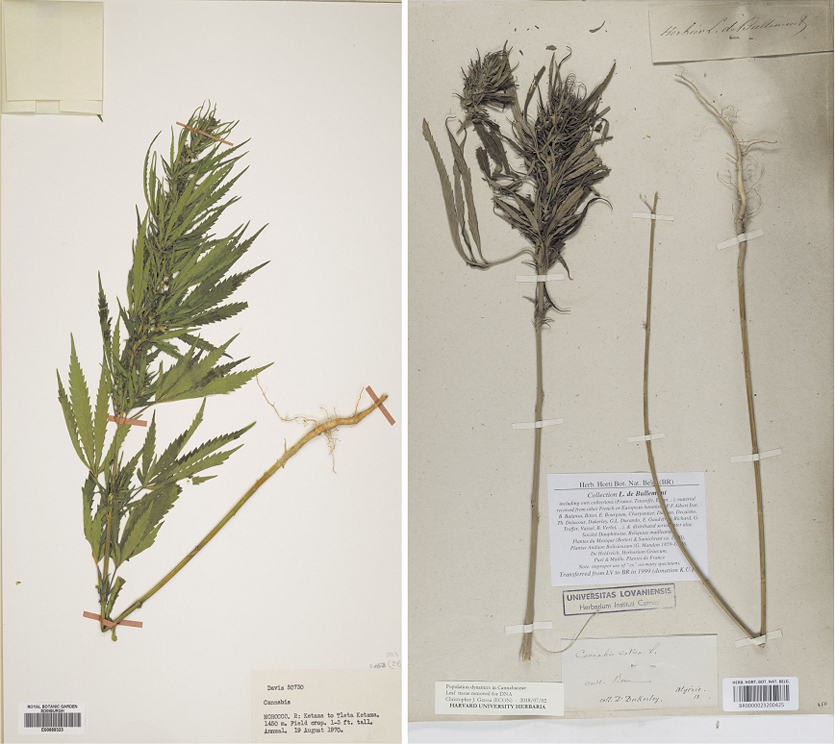
Two specimens of Maghreb Cannabis. On the left, a specimen of Ketama (Morocco) reprinted with permission from the Herbarium of the Royal Botanic Garden Edinburgh (E) (https://data.rbge.org.uk/herb/E00669323). Copyright 2018, Herbarium of the Royal Botanic Garden Edinburgh (E). On the right, Dukerly's specimen of Bone (Algeria) reprinted with permission from the Meise Botanic Garden (BR) (https://www.botanicalcollections.be/specimen/BR0000023200425). Copyright Meise Botanic Garden (BR).
As presented in Table 2, the majority of specimens seem to belong to those in the collection that have the greatest heights, and the taller specimen is 87 cm. Entire plant specimens are mostly unbranched. The leaves' characteristics presented in Table 3 show leaves palmately compound, medium green color for the most preserved specimens, and leaflet edges with gaps. Larger leaves have often 7 leaflets and long petioles. Central leaflets are long, narrow, or relatively broad, acuminate, and margins coarsely serrate. Inflorescences are compact (or relatively compact for one Moroccan specimen), with flower clusters much closer together, especially toward the top of the inflorescence, low perigonal bract-to-leaf index, and perigonal bracts densely or moderately covered with CSGTs. Table 4 summarizes the characteristics that tend to distinguish the Maghreb Kif Landrace.
Characteristics of the Maghreb Kif Landrace
Discussion
In the Maghreb, the psychoactive Cannabis of Indian origin was “Sativa” (NLD)1,17 that, according to the current taxonomical treatment, corresponds to C. sativa subsp. indica var. indica. However, it is probably extinct, and the historical Kif Landrace is more likely to be derived from crosses between the European narrow-leaf-hemp and the original Maghreb NLD.13,17
In this study, 21 herbarium specimens were explored. Morphological traits were analyzed, and compared, where possible, to the morphology of Kif plants described by Dukerley 18 or to representative type specimens of C. sativa subsp. sativa (European hemp) and C. sativa subsp. indica (“Sativa” and “Indica” in the historical sense). We found many variations in Maghreb specimens' morphology, and mature female specimens were essential for comparison.
Almost all the specimens are from Algeria and Morocco, and none is available from Tunisia. The Kif plant was described in Tunisia by De Candolle, 20 and its cultivation was widespread.1,20 Note that only a few specimens have been collected in the Maghreb. Indeed, the African coastal Mediterranean region has been neglected by taxonomists, despite the presence of a morphologically divergent population that is culturally and geographically isolated and relatively accessible for study. 23
Whatever the origin of the specimens, those collected outside cultivation have mostly occurred in unusual locations (city, rubble, or wasteland) and would escape from gardens or crops, or from smoked Cannabis seeds. Indeed, the general absence of wild Cannabis populations in the Maghreb has been reported by Clarke and Merlin. 23
A majority of specimens are young (maturing or in vegetative forms) or male plants and, consequently, less useful for comparison. But the morphology of two staminate specimens shared traits with plants of the Central Asian Landraces 13 : menorah-shaped habitus (n=5) and overlapping margin leaves (n=8). Mature female specimens showed two different inflorescences. The specimen from Morocco has an elongated and somewhat diffuse inflorescence resembling the South Asian Landrace C. sativa subsp. indica and does not match Maghreb Kif. However, a link with the original Maghreb NLD should not be excluded. The other two specimens, one from Morocco and the other from Algeria, have compact leafy inflorescences that resemble those of Kif. The Algerian specimen matches the Kif plant since it comes from the locality of Bone, where Dukerley 18 was the first to describe the Kif plants.
For cultivated specimens, there are differences between plants from Algeria and Morocco. The Moroccan specimens are all of indigenous origin and have a morphology compatible with Kif.3,18,21 However, the specimen from Ketama, the traditional area for Kif cultivation in northern Morocco, has a less dense inflorescence than the two specimens from southern Morocco. The Ketama's specimen inflorescence is more consistent with Clarke's (1989) 21 description of Kif grown in the northern Rif mountains. In Morocco, Kif was cultivated in the north and in the south, and three main strains, geographically named Ktami, Zerouali, and Gunaoui, were widely cultivated: 3 Ktami in the North and Zerouali, and Gunaoui in the southern Atlas region and the Moroccan Sahara. 24 Charnot 3 reported that these strains would have differences in their inflorescence structure and plant habit compared to European hemp, but provided no description.
In Algeria, the specimens are of various origins: Cannabis cultivated in Bone, in the desert areas of Adrar or the oasis of Souf, from orient seeds in Sig and from Sahara seeds indoors CGE in Alger.
The specimen from Bone corresponds to the Kif plant and should be annotated as such, since it is collected by Dukerley, 18 who was the first to describe the Kif plants in Bone. All plants from Sahara are in vegetative forms and are probably of native origin since Kif was reported to have been cultivated in the Algerian oases since the 17th century. 1
The plants from the Sig locality were collected in 1850 by two different French herbaria (Paris and Aveyron) and consist of plants with relatively large leaflets. Because specimens are derived from Cannabis grown by the “Union Agricole du Sig,” founded in 1945 by French settlers when they created the Algerian commune of Saint-Denis du Sig, it may correspond to Cannabis used for fiber, not for drugs. Indeed, at that time in Algeria, East Asian (Chinese) hemp, like European hemp, was cultivated for textile fiber destined for France. 25 Unlike European hemp C. sativa subsp. sativa, the botanical classification of East Asian hemp is unclear, since it can be assigned to C. indica or C. sativa.8,26
The specimen from Alger is monoecious, with central leaflets long and narrow; high perigonal bract-to-leaf index, and rare CSGTs on perigonal bracts. Based on the characteristics of this specimen, Cannabis grown from seeds of Sahara may correspond to the nonpsychoactive C. sativa. Therefore, the Algiers specimen was incorrectly annotated as psychoactive Kif. It should also be noted that the origin of the seeds is not always certain.18,27
The study of herbaria specimens having morphological traits of Kif and data from previously published studies3,18,21 made it possible to summarize the traits that tend to characterize Maghreb Kif Landrace (Table 4). Even if Kif plants are morphologically resembling hemp of Europe plants, they have characteristics that allow them to be distinguished. However, when growing on richer soils, apart from female inflorescence and the appearance of the stem apex of the plant, the Kif distinguishing characters can sometimes be confused with those of European hemp. 18
Conclusions
The morphological study of the historical Cannabis from the Maghreb, before global introgressive hybridization, has enabled description of the region's Cannabis plants and identifying key morphological traits of the Kif plant. Combined with its phytochemical profile and genetic characteristics, these traits can aid in the plant's identification and facilitate the identification of areas to be protected as a heritage for conservation and sampling for developing cannabidiol-rich medicinal strains to meet the needs of the nonpsychoactive medicine industry. However, further research is required to explore the phytochemical and genetic characteristics of the Kif plant, as these aspects remain poorly understood. 28
Footnotes
Acknowledgments
The authors thank the curators of the herbaria for access to the specimens, in particular Professor Corinne Sarthou, the scientific manager of the collections of the Herbarium of the National Museum of Natural History (P), for hosting and critically reviewing this article. The authors thank the Botanical Garden of Meise (BR) and the Herbarium of the Royal Botanical Garden of Edinburgh (E) for permission to use photos of the specimens.
Authors' Contributions
F.B. and M.F. designed this study. F.B. and O.B. produced the data. F.B. analyzed the data and wrote the article. J.E.O. contributed to the final version of the article. M.F. acquired the funding. All authors read and approved this article.
Author Disclosure Statement
The authors have no conflict of interest.
Funding Information
This study was supported by the region of Tangier-Tetouan-Al Hoceima, through the Project on Medical and Therapeutic use of Cannabis in the Northern Region of Morocco.