




Abstract
Introduction:
The use of medical Cannabis remains unregulated in several countries due to the scarcity of clinical studies with high scientific evidence that establish safety and efficacy of Cannabis products. This study aimed to comprehensively analyze how knowledge has been created in this field, as well as perform a bibliographic mapping to identify knowledge gaps, and investigate key authors and journals that have significantly contributed to advancing our understanding of Cannabis.
Method:
The study protocol was registered in the International Prospective Register of Systematic Review (CRD42020223084). A systematic search was conducted in the Cochrane Central Register of Controlled Trials, Lilacs, Google Scholar, PubMed, SciELO, Scopus, and Web of Science databases. The bibliographic analysis and mapping were registered using the VOSviewer, Sci2tool, CiteSpace, and PoP software.
Results:
The systematic search identified 27,597 records, with 17,020 duplicates, resulting in a total of 10,577 articles included. The authors who published the most were Marilyn Ann Huestis (n=108) and Sagnik Bhattacharyya (n=71), while Elisaldo A. Carlini and Raphael Mechoulam published 8 and 22 articles, respectively. The journals Drug and Alcohol Dependence (n=297), Psychopharmacology (n=159) and Addictive Behaviors (n=150) were the ones that published the most on Cannabis. The journals suggest that the articles are correlated with the adverse and toxicological effects of recreational Cannabis use; however, most articles focus on medical Cannabis. The peak of publications was in 2021 (n=1,481). The countries that published the most were the United States (n=9,735), while Brazil occupied the 11th position (n=422). Most publications were carried out in “Pharmacology and Pharmacy” (11.31%), followed by “Psychiatry” (7.66%) and “Medicine” (5.80%). The areas of “Neurosciences” (1.59%), “Biochemistry,” “Genetics,” and “Molecular Biology” (0.79%) were little explored.
Conclusion:
This study captured the characteristics of publications about Cannabis and clinical studies in the scientific literature, yielding >10,000 articles, representing a large literature review, to date. Therefore, the most productive countries included the United States, the United Kingdom, and Canada, while the most productive authors were Marilyn Ann Huestis and Sagnik Bhattacharyya, with a peak of publications in 2021. Finally, the most chosen journals were Drug and Alcohol Dependence and Psychopharmacology.
Introduction
Cannabis sativa
Historically, C. sativa was commonly used as a medicine in the 18th, 19th, and 20th centuries, and it was readily available in pharmacopeia and pharmaceutical catalogs. For instance, in Brazil, Indian Cannabis Cigarettes were recommended for asthma and insomnia. 5 The pharmacological effects of the plant are associated with various compounds, primarily cannabinoids, with notable emphasis on cannabidiol (CBD) and delta-9-tetrahydrocannabinol (Δ 9 -THC). 6 Cannabinoids have demonstrated the ability to suppress immune activation and the production of inflammatory cytokines, suggesting their potential in modulating excessive inflammation. Consequently, some authors have postulated the utilization of C. sativa extracts for the treatment of Coronavirus Disease 2019 (COVID-19).7,8
Early research on C. sativa recognized its benefits and application for medicinal purposes but also warned about possible risks associated with indiscriminate use, such as aggressiveness and even murder. It is important to note that these studies were conducted in accordance with the prevailing moral notions of the time, often emphasizing side effects that were inconsistent with its psychoactive capacity. 9 Consequently, such biased research contributed to the social stigmatization of marijuana and Cannabis-derived products. In Brazil, for example, as early as 1920, there was a concern among influential social groups about the spread of the so-called “drug,” which led to its characterization of the marginalized population. Subsequently, the process of criminalizing marijuana and its derivatives began. 10
However, there has been a recent tendency toward expanding discussions on the legalization and decriminalization of psychoactive substances. In the case of marijuana and C. sativa resin, the World Health Organization decided in 2020 to reclassify them to a level of substances considered less dangerous. 11
These deliberative actions, along with legislative reviews in various countries and a less prohibitive stance, have stimulated academic research as the need for scientific evidence to guide discussions on the topic arises. This is mainly due to the limited number of clinical studies and high-quality research that demonstrate the safety and efficacy of using these compounds. Filling these knowledge gaps is essential to inform evidence-based decision-making in health care and public policy, and to address concerns related to illegality, drug trafficking, and dependence associated with Cannabis use. 12
Several reviews have been published on Cannabis use, activities, and other aspects, but few employed the bibliometric approach.13,14 The application of a bibliometric analysis can facilitate an understanding of the field, including research trends, influential publications, and key authors. In other words, a bibliometric analysis is a research method that involves the statistical evaluation of scientific publications to identify the characteristics and determine the impact of the published literature in a specific academic discipline.15,16
To date, only a small number of bibliometric analyses on the topic of C. sativa and cannabinoid research have been conducted. Liu et al 13 performed a bibliometric analysis of research on Cannabis published between 1940 and 2019, capturing the characteristics of 1,167 publications that met criteria. They found that historical development could be divided into chemistry, pharmacology, and molecular biology. Another bibliometric analysis captured the characteristics of six decades of research on the plant, totaling 1,284 publications that met eligibility. This number does not reflect the entirety of the literature on Cannabis and cannabinoids, as it sought to capture research carried out at the intersection of Cannabis and just a few topics, the following six topics: biochemistry, biology, forensic genetics, genetics, molecular markers, and traceability. 14
Other studies have focused on more specific subsets of publications: Yeung et al 17 conducted a comprehensive review of the top 100 highly cited studies pertaining to Cannabis. In a separate study, Treister-Goltzman et al 18 identified specific trends in publications related to medicinal Cannabis. The authors observed a significant surge in the volume of publications on this topic over the past two decades, with a substantial portion originating from the United States. In addition, three bibliometric analyses were undertaken to characterize a collection of publications centered around substance use and addiction, all of which encompassed studies involving Cannabis.19–21
In this sense, in this systematic review, our objective is to develop a comprehensive database for future clinical reviews and conduct a bibliometric evaluation of the available literature on C. sativa and cannabinoids. This provides insights into research trends over time, identifies knowledge gaps, and guides future studies to enhance our understanding of the field.
Materials and Methods
The primary research question guiding this study was, “Is the use of derivatives of C. sativa effective and safe for therapeutic use?” To address this question and construct the database, we conducted a systematic review and bibliometric analysis following the recommendations outlined in the Preferred Reporting Items for Systematic Reviews and Meta-Analysis (PRISMA). 22 The protocol for this review was registered in the International Prospective Register of Systematic Review (www.crd.york.ac.uk/PROSPERO, protocol number CRD42020223084). 23
Literature search
A comprehensive search for relevant studies was conducted in the following databases: Cochrane Central Register of Controlled Trials (CENTRAL), Google Scholar, Lilacs, PubMed, SciELO, Scopus, and Web of Science (WoS). We employed various combinations of keywords: Cannabis, cannabidiol, tetrahydrocannabinol, cannabinol, cannabinoids, Cannabis sativa, clinical trial, and/or clinical study, to identify the use of C. sativa or cannabinoids in individual through clinical studies. The search was conducted from July 29, 2020, to August 5, 2020. The last search was on January 1, 2023. Supplementary Table S1 provides a detailed description of the search criteria.
Selection of studies
Studies involving the use of CBD or Δ
9
-THC were selected based on the Population, Intervention, Comparison, Outcome, and study design strategy:
Population: Individuals of both sexes, with or without age restrictions, who were either healthy or had specific diseases: Intervention: Use of CBD or Δ
9
-THC; Comparison: Before and after the intervention and/or comparison with placebo; Outcome: Assessment of the intervention's effect on various endpoints, patient well-being, or adverse events; Study type: Clinical trials.
For studies involving the use of the plant and their extracts, as well as other cannabinoids, all types of study (in vitro, animal or human) were considered. Review articles, editorials, letters to the editor, case reports, case series, regulatory aspects, comments, news, abstracts published in conference proceedings or scientific journals, results of dissertations or theses, and articles that were unavailable in full-text despite contact with the authors were excluded. Articles published in Spanish, English, and Portuguese were considered eligible.
Eligibility criteria
Duplicate studies were excluded using reference managers (Mendeley® and JabRef). The remaining citations were imported into the Rayyan Systematic Review platform 24 for the inclusion or exclusion process based on the predefined criteria.
The eligibility process consisted of two stages. In the first stage, two independent researchers (L.M.S., B.C.A., or A.C.G.A.) reviewed all nonduplicated articles and excluded those that were deemed irrelevant based on the title and abstract. Any discrepancies were resolved through consensus, involving a third researcher (B.J.M.-S. or J.M.D.-A.). In the second stage, the articles included in the first stage were read in full by two researchers (B.C.A. and A.C.G.A.) to assess their eligibility. Any discrepancies were resolved by a third investigator (B.J.M.-S. or J.M.D.-A.). The level of agreement between the reviewers was evaluated using the Kappa test. 25 The database of included articles has been deposited in Mendeley Data (https://doi.org/10.17632/8c8h2ny54v.1).
Data extraction
The articles that met the inclusion criteria were thoroughly read, and relevant data were extracted to address the research question. The extracted information included author details, publication year, study location, composition of extracts, objective of the study, findings, and limitations. In addition, bibliometric data were collected, including the number of publications (in total and per year), authors details, journals, publications types, articles per journal, document type, publication countries, journals with the highest publication volume, Journal Citation Indicator category of journals, and the most prolific authors.
All publications authored by an individual were included, regardless of the authorship order. Trends associated with this subset of publications were identified and presented. Data organization and analysis were performed using Microsoft Excel®. Bibliometric networks were constructed and visualized using VOSviewer software (version 1.6.19). 26
Bibliometric analysis
Cooccurrence analysis of keywords
A cooccurrence analysis of all data was performed to identify the most common author keywords used in abstract, title, and/or keywords across the publications. This analysis aimed to map promising areas of study in cannabinoid research and explore their intersectionality with other topics and fields. The bibliometric network was constructed and visualized using the VOSviewer tool.
Coauthorship analysis
A coauthorship analysis of the authors who published the most volume of research on Cannabis was conducted to determine patterns of collaborations between authors and research teams. The bibliometric network was constructed and visualized using the VOSviewer software.
Results and Discussion
The initial searches identified 27,597 records and yielded 10,582 articles included in bibliometric analysis. Spanning a period of 72 years (1950–2022), the publications in this field exhibited diverse characteristics. Specifically, review articles accounted for 25.52% of the publications, while >29% represented nonclinical studies. Comparatively, only 13.83% were categorized as clinical studies, and 4.84% were designated as protocols for clinical studies. Notably, a minority of <1% consisted of case reports, pilot studies, and in vitro studies. Subsequently, a meticulous assessment of titles and/or abstracts (n=9,403) was undertaken, leading to the inclusion of 1,179 articles in the final database (Supplementary Fig. S1). The selection was based on the predefined criteria established earlier, ensuring the database's comprehensiveness and relevance for further analysis and research.
Interestingly, one of the main reasons for exclusion was the presence of articles that did not involve the use of Cannabis, which accounted for 23% of the excluded publications. Upon closer examination, a significant portion of the publications did not directly address the medicinal use of Cannabis and instead focused on recreational use, often in combination with other substances of abuse, such as alcohol. Moreover, some articles did not mention the use of Cannabis at all, even in the recreational context.
The analyzed publications spanned from 1955 to 2022. Figure 1 shows the annual publication number from this range of year, and revealing a notable surge above the exponential trend line in the last decade. This observation suggests a correlation between the increasing legalization of C. sativa in various countries and the growing public support for its legalization, both of which appear to be linked to a higher volume of studies conducted. While C. sativa remains illegal in many nations, certain individual components have been purified, tested, and approved by regulatory agencies, such as the Food and Drug Administration (FDA), or similar bodies, for medicinal use. This has paved the way for renewed growth in research efforts. 26
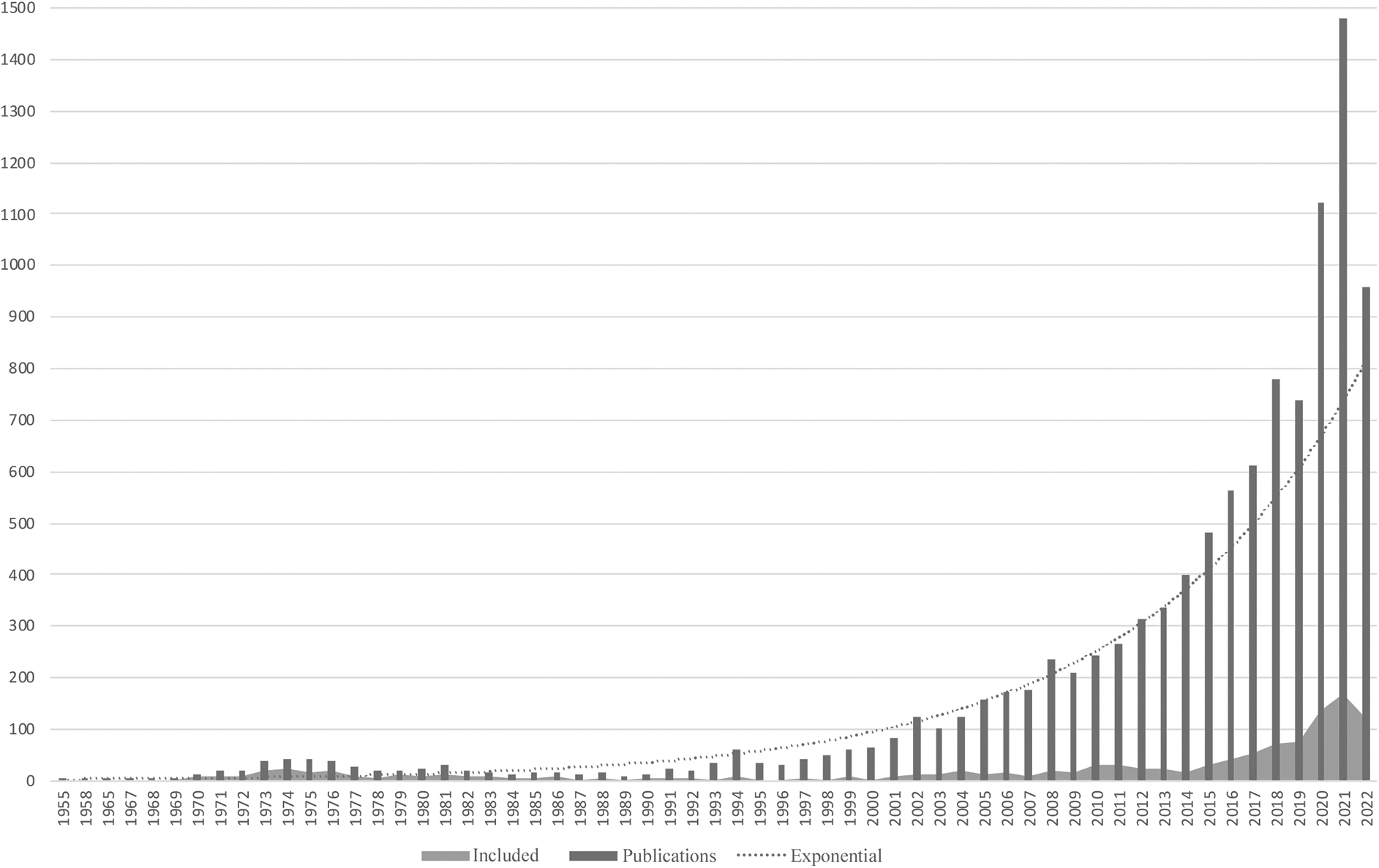
Number of Cannabis and cannabinoid publications per year from 1955 to 2022.
Conversely, despite the slow initiation of medicinal use of C. sativa in Western cultures, more than 100 studies had been published in Europe and the United States by 1970. 27 In 1961, following the United Nation's Single Convention on Narcotic Drugs, several countries, including Brazil, the United States, Europe, and the United Kingdom, introduced legislation reclassifying C. sativa and its derivatives as controlled substances. Thus, from that period, the use of C. sativa was considered illegal, regardless of whether it was used for recreational or medicinal purposes. 28 This shift led to fluctuations and challenges in the publication rate, attributed both to legal restrictions and the difficulty in replicating study effects among individuals. 27
Starting from the 2000s, several nations, including Israel, Canada, the Netherlands, the United States, the United Kingdom, and Australia, have enacted legalization measures for the utilization of C. sativa for medical objectives. 27 In Australia, beginning in 2016, the regulation of medicinal Cannabis prescription to patients by their medical practitioners has fallen under the jurisdiction of the Therapeutic Goods Administration. Evidently, the demand for medicinal C. sativa is on an upward trajectory, substantiated by the noteworthy surge in Special Access Scheme-category B approvals, escalating from a modest 146 applications in June 2018 to an impressive 13,666 by September 2021. Analogously, this same trend is observable in Brazil, where import authorizations escalated from 850 in 2015 to an impressive 15,862 by 2020. 29
The early 2000s marked a significant surge in scientific publications attributed to the elucidation of the endocannabinoid system by scientific inquiry. This breakthrough provided insights into cannabinoid receptors and associated enzymes, consequently galvanizing the scientific community to focus its efforts on exploring the clinical and therapeutic potential of cannabinoids.
In addition to the widespread dissemination of successful case studies, another pivotal development that emerged in the early 2000s was the advent of Open Access. This movement served as a solution to enhance the accessibility of knowledge, particularly emanating from public research institutions. Within the Brazilian context, the implementation of the Coordenação de Aperfeiçoamento de Pessoal de Nível Superior (CAPES) Periodicals Portal played a pivotal role, aiming to foster and enhance the nation's scientific output. 30
Furthermore, the last 3 years under scrutiny (2020–2022) have demonstrated a pronounced growth, with particular emphasis on the year 2021, which saw the publication of >1,400 articles. This notable upswing in scientific output can be attributed to the global pandemic induced by the COVID-19. 31 The enforced isolation and interruption of laboratory research led quarantined researchers to publish their planned and pending articles, as well as those previously set aside. These observations are further substantiated by the peak in the number of published reviews during the same period (364 in 2020 compared with 184 in 2019), resulting in a cumulative total of 1,112 articles published, encompassing 41.2% of all reviews published throughout the entire period (Supplementary Table S1).
Our bibliometric analysis has underscored the critical significance of meticulous database selection in cannabinoid-related scientific research, with PubMed and WoS emerging as the most representative platforms in terms of total publication count. Between 2000 and 2022, a remarkable surge in the annual count of scientific publications centered around C. sativa was evident within PubMed, soaring from 620 to 2,388, reflecting a 4.5-fold increase.
Similarly, publications centered on medicinal C. sativa experienced a nine-fold rise, ascending from 82 to 742. Within the WoS, a 10-fold escalation was observed in publications focused on medicinal C. sativa, escalating from 28 to 296 studies. These data indicate a consistent and steady trend of escalating publication volume in this domain over time. Notably, the most substantial growth in publications concerning medicinal C. sativa transpired between 2015 and 2022 (Fig. 2), a facet worth emphasizing.

Annual number of publications related to Cannabis, categorized as Medicinal, Substance of Abuse, or Not Applicable.
In 2017, the analysis of publications related to medicinal C. sativa revealed that the majority of studies consisted of original research (66.7%), while reviews, commentaries, editorials, committee position statements, guidelines, and case reports accounted for 33.8%. Despite the consensus that we possess more knowledge about the effects resulting from recreational use rather than medicinal use, our bibliometric analysis did not validate this assumption.
We observed that until 2006, there was no significant difference in the quantity of publications related to each type of use. However, from 2007 onward, there was a progressive increase in studies evaluating the recreational use of C. sativa. This rise might be attributed to a heightened scientific and medical concern regarding indiscriminate usage and global legalization efforts. Conversely, a noteworthy surge in studies focused on the medicinal use of Cannabis began in 2013, with a considerable escalation in 2017. This marked increase established a discernible trend and prevalence of studies centered around medicinal use.
These findings underscore the imperative of adopting a strategic approach in the pursuit of scientific insights concerning cannabinoids. Making the appropriate choice of databases, such as PubMed and WoS, has facilitated access to an extensive array of clinical and scientific studies pertaining to the therapeutic utilization of cannabinoids. Nonetheless, it is of paramount importance to underscore that there remains a significant gap in specific information concerning the toxicology and pharmacology of cannabinoids within these databases. Hence, it is imperative for further research to be conducted in this domain to bridge this knowledge deficit.
Our bibliometric analysis portrays a surge in research endeavors, accompanied by an escalation in the number of journals that have contributed to this subject matter. A total of 2,264 journals have featured at least one publication on this topic (Supplementary Table S1). Among the top 10 contributors, Drug and Alcohol Dependence (3.37%), ClinicalTrials.gov (2.69%), Addictive Behaviors (1.69%), Psychopharmacology (1.63%), Journal of Substance Abuse Treatment (1.29%), Cannabis and Cannabinoid Research (1.02%), Neuropharmacology (0.98%), Frontiers in Psychiatry (0.97%), Schizophrenia Research (0.97%), and PLoS One (0.93%). Intriguingly, the top 10 contributors encompass just 15.56% of the total publications. Moreover, <50% of the publications fall within the top 100 journals, with >1,000 journals having only one publication on the subject.
The leading journal boasts 357 articles disseminated across 35 editions spanning the years 1980 to 2022, with a thematic focus on “Substance Abuse/Psychiatry” (3.89%). This prominent position can be rationalized by the frequent association between alcohol consumption and the use of other substances such as C. sativa. It is worth highlighting that numerous studies published in this journal have employed marijuana abuse as a reference point, thus justifying the substantial volume of articles within Drug and Alcohol Dependence. Following suit, ClinicalTrials.gov has maintained an 18-year sequence dedicated to Cannabis under the domain of “Pharmacology and Pharmacy” (11.31%) from 2005 to 2022, amassing a total of 285 records of clinical studies on the platform.
The ongoing annual stream of publications is likely attributed to the heightened research focus in this field around 2005, coupled with the emergence of new evidence regarding medical C. sativa and the evolution of studies throughout the 2010s. In the third position, the Addictive Behaviors journal has published 24 editions featuring 179 studies on C. sativa between 1980 and 2022, predominantly centered on “Clinical Psychology/Substance Abuse” (4.21%). The prevalence of publications during the 1990s and around 2005 suggests an emphasis on C. sativa as a substance of abuse.
While Drug and Alcohol Dependence leads in terms of publication count, it is crucial to highlight that this journal accounts for <5% of the overall total of Cannabis-related studies. This observation prompts us to contemplate the valuable contributions of other journals mentioned in the ranking, each with its distinctive thematic focus and sphere of influence. The diversity of these journals and specialized areas mirrors the intricate and extensive nature of Cannabis research, encompassing clinical, pharmacological, psychological, and societal dimensions.
Further notable journals within the ranking include Psychopharmacology, with 40 editions published between 1976 and 2022, spanning the domains of “Neurosciences/Pharmacology and Pharmacy/Psychiatry” (2.74%); the Journal of Substance Abuse Treatment, featuring 26 editions on C. sativa between 1988 and 2022 in the sphere of “Clinical Psychology/Substance Abuse” (4.21%); Cannabis and Cannabinoid Research, with eight editions spanning from 2005 to 2022, focused on “Pharmacology and Pharmacy” (11.31%); and Neuropsychopharmacology, with 24 editions between 1992 and 2022, encompassing “Neurosciences/Pharmacology and Pharmacy/Psychiatry” (2.74%).
Noteworthy mentions also go to Frontiers in Psychiatry and Schizophrenia Research, with 12 and 21 editions, respectively, in their domains of “Psychiatry” (7.66%). Finally, the PLoS One journal, within the domain of “Multidisciplinary Sciences” (1.75%), consecutively published 13 editions between 2010 and 2022, featuring 98 articles on C. sativa. This array of thematic approaches, found across diverse journals, enriches the scientific comprehension of C. sativa, furnishing a comprehensive insight into its effects, therapeutic applications, and potential risks.
On the contrary, there were 707 distinct WoS categories identified. The top 10 areas offer an alternate insight into the subjects covered by the published articles.
The foremost category is “Pharmacology and Pharmacy” (11.31%), followed by “Psychiatry” (7.66%), “General and Internal Medicine” (5.80%), “Substance Abuse” (4.63%), “Clinical Psychology/Substance Abuse” (4.21%), “Substance Abuse/Psychiatry” (3.89%), “Clinical Neurology” (2.79%), “Neurosciences/Pharmacology and Pharmacy/Psychiatry” (2.74%), “Clinical Neurology/Neurosciences/Pharmacology and Pharmacy/Psychiatry” (1.87%), and “Multidisciplinary Sciences” (1.75%), collectively encompassing ∼47% of all publications. Interestingly, contrary to expectations, the journal domains primarily pertain to general pharmacology and effects on the central nervous system. The “Substance Abuse” field ranks only fourth (4.63%). Impressively, >300 categories contain only a single publication.
In contrast, the fields of “Neurosciences” (7.4%), “Biochemistry,” “Genetics,” and “Molecular Biology” (2.9%) have been relatively underexplored. This observation might be correlated with historical records revealing the longstanding and prominent role of C. sativa in medicine, which continues to evolve progressively. Furthermore, the growing acknowledgment of therapeutic utility by the scientific community and government has fostered increased accessibility and the development of products, including synthetic cannabinoids like Δ 9 -THC in the form of Dronabinol (Marinol®) and Nabilone (Cesamet®) for medicinal purposes.
Moreover, in November 1995, the American Journal of Public Health, the world's oldest and largest organization of health care professionals, issued a resolution advocating for legislation to enhance accessibility for research on medicinal C. sativa as a novel plant-based drug capable of medication production. 32 Consistent with earlier surveys on Cannabis literature, the majority of publications concentrate on biological and medicinal sciences rather than plant sciences.14,18 Supporting our findings, Ng and Chang 15 observed a substantial number of publications in the “Medicine” field (57%), followed by “Pharmacology,” “Toxicology,” and “Pharmaceutical Sciences” (27%), as well as “Biochemistry,” “Genetics,” and “Molecular Biology” (19.55%).
In this study, our analysis revealed that the United Kingdom and Canada lag slightly behind the United States, as the second and third major contributor. Surprisingly, Italy ranked sixth. In contrast to our expectations, the leading university is King's College London, with Harvard University and the University of Toronto following suit. According to Yeung et al., 17 Italy's significant contribution to C. sativa and cannabinoids research stands out even when compared with its research in other related fields, such as ethnopharmacology, nutraceuticals, natural products in cancer studies, and neurosciences.
In fact, historical pollen records suggest that central Italy has engaged in C. sativa cultivation for over 2,000 years. 33 The prevalence of C. sativa and its lengthy cultivation history in Italy might contribute to the substantial Italian involvement in Cannabis-related research. While Italy's prominence could also be linked to political, regulatory, or funding factors, a comprehensive analysis of these claims is beyond the scope of this study. The collected articles featured a total of 44,385 unique authors. On average, each author produced 0.24 publications. Notably, collaborative teamwork was the predominant approach, with a significantly smaller number of authors publishing as sole contributors (Fig. 3). Despite the considerable number of researchers in this field, a noteworthy observation is that 35,527 authors published only once, while 226 authors contributed to ∼10 articles.
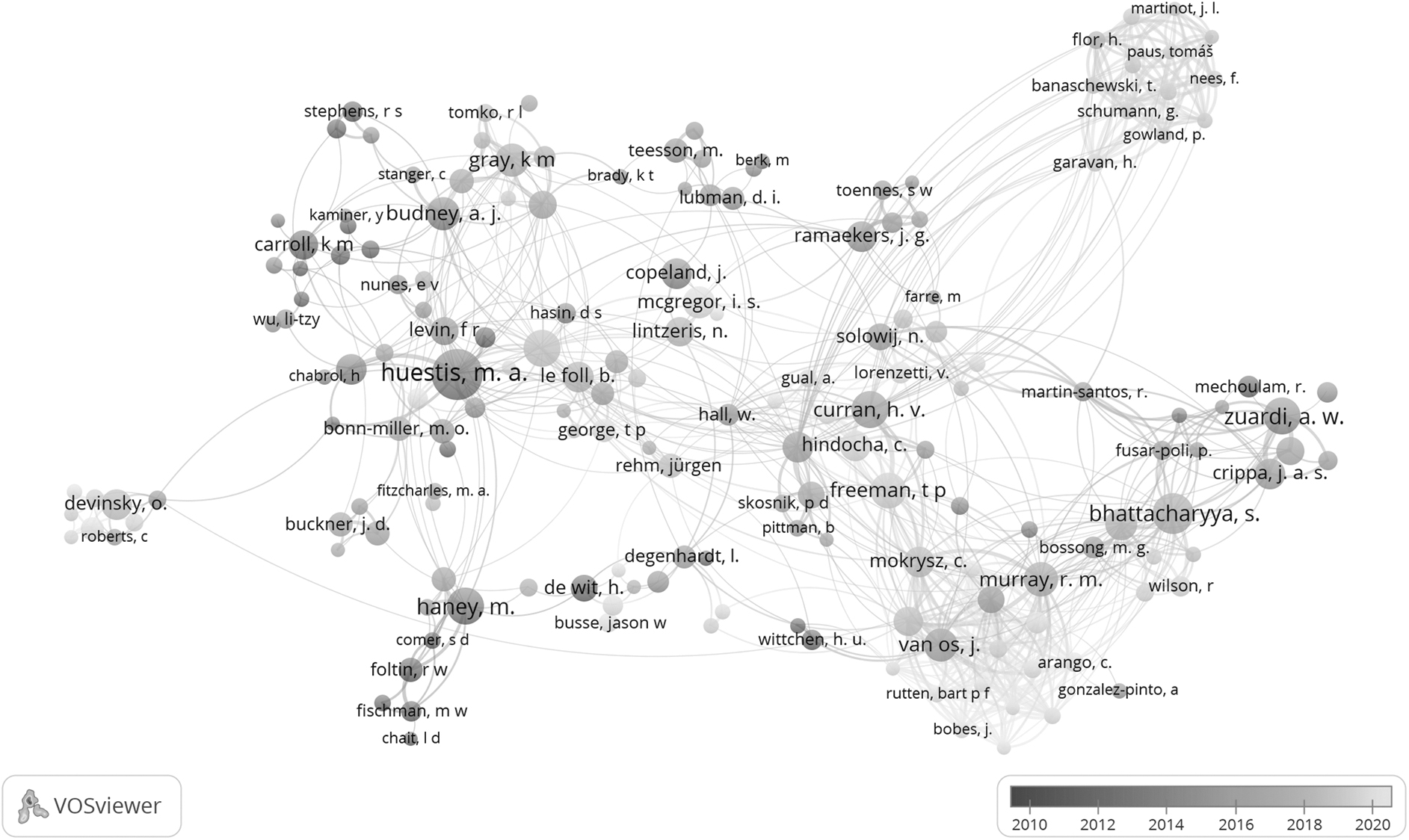
The collaboration network among the authors over a 1950–2022. The most frequently prolific authors appear as larger nodes with larger text. The VOSviewer software was used to generate this analysis.
The most prolific authors including Marilyn Ann Huestis (n=108), Sagnik Bhattacharyya (n=71) and Antonio Waldo Zuardi (n=63), as indicated in Table 1. Marilyn Ann Huestis (n=108) is an American researcher specializing in the effects of illicit drugs on the body. Her publications encompass the toxicology and analysis of cannabinoids as substances of abuse. One of her recent works delves into a combination of toxicological tests assessing the influence of marijuana on driving. 34 Sagnik Bhattacharyya (n=71), an Indian psychiatrist, focuses on neurobiological aspects, as well as psychotic and substance abuse disorders, particularly related to Cannabis.
The Major Contributors to the Cannabis and Cannabinoids Publications
% accum, percent acumulated; WoS: Web of Science.
Antonio Waldo Zuardi (n=63), a Brazilian researcher, has been studying the therapeutic potentials of marijuana derivatives. The global study “Trends in cannabis and cannabidiol research from 1940 to 2019” published in Current Pharmaceutical Biotechnology journal, analyzed the performance of countries, institutions, authors, and journals in Cannabis research using parameters such as total production, global citation score, and the h-index. Antonio Waldo Zuardi ranks among the top 10 researchers globally in terms of publications. 13
Despite being considered pioneers in C. sativa research, Elisaldo A. Carlini, a Brazilian researcher, and Raphael Mechoulam, a Bulgarian researcher, have contributed 8 and 22 articles, respectively, among the found articles. They have made significant contributions in the field of pharmacology and synthesis of cannabinoids, with both being acknowledged as pioneers in C. sativa research within their respective areas. Their research showcased how CBD, when combined with patient medication, aided in the control of epileptic seizures.
Consequently, the scientific representation of C. sativa research receives enhanced recognition in alignment with research groups, authors, and the social context in which they operate. Marilyn Ann Huestis, an American researcher, stands as the author with the highest number of publications (n=108), within the context of countries with the highest publication rates, where the United States (n=9,735) leads. In countries such as Brazil, where scientific studies on C. sativa began relatively late, the lower number of publications is justified by various factors, primarily including legalization, legislation, and research support.
These factors hinder access to technologies, materials, resources, and research references. Nevertheless, researchers such as Elisaldo A. Carlini Universidade Federal de São Paulo/Brasil have made significant contributions, exemplified by his publication, 35 a double-blind, randomized study involving a small sample of eight patients. This study demonstrated the beneficial effects of CBD on seizure control, opening doors for further research in the country. 35 In our survey, Brazil ranked 11th (n=422) among countries with the highest number of published articles on C. sativa.
A total of 14,125 author-suggested keywords were extracted from all publications, which underwent a screening process to eliminate duplicates, resulting in 10,964 distinct keywords after data cleaning. Among these, 607 words were utilized ∼20 times, and 125 had occurred ∼100 times. In Figure 4, the network of keywords is presented by both decades and the overall period. Within the top 10 frequently used author-suggested keywords, we find terms such as humans, Cannabis, male, female, adult, adolescent, clinical studies, randomized controlled trial, substance-related disorders, and cannabinoids. The bubble map reveals that articles discussing analgesia and anxiety in clinical human studies appear more frequently than in animal experiments. Furthermore, terms such as side effects, marijuana abuse, risk factors, association with other drugs, and smoking exhibit a notable frequency.
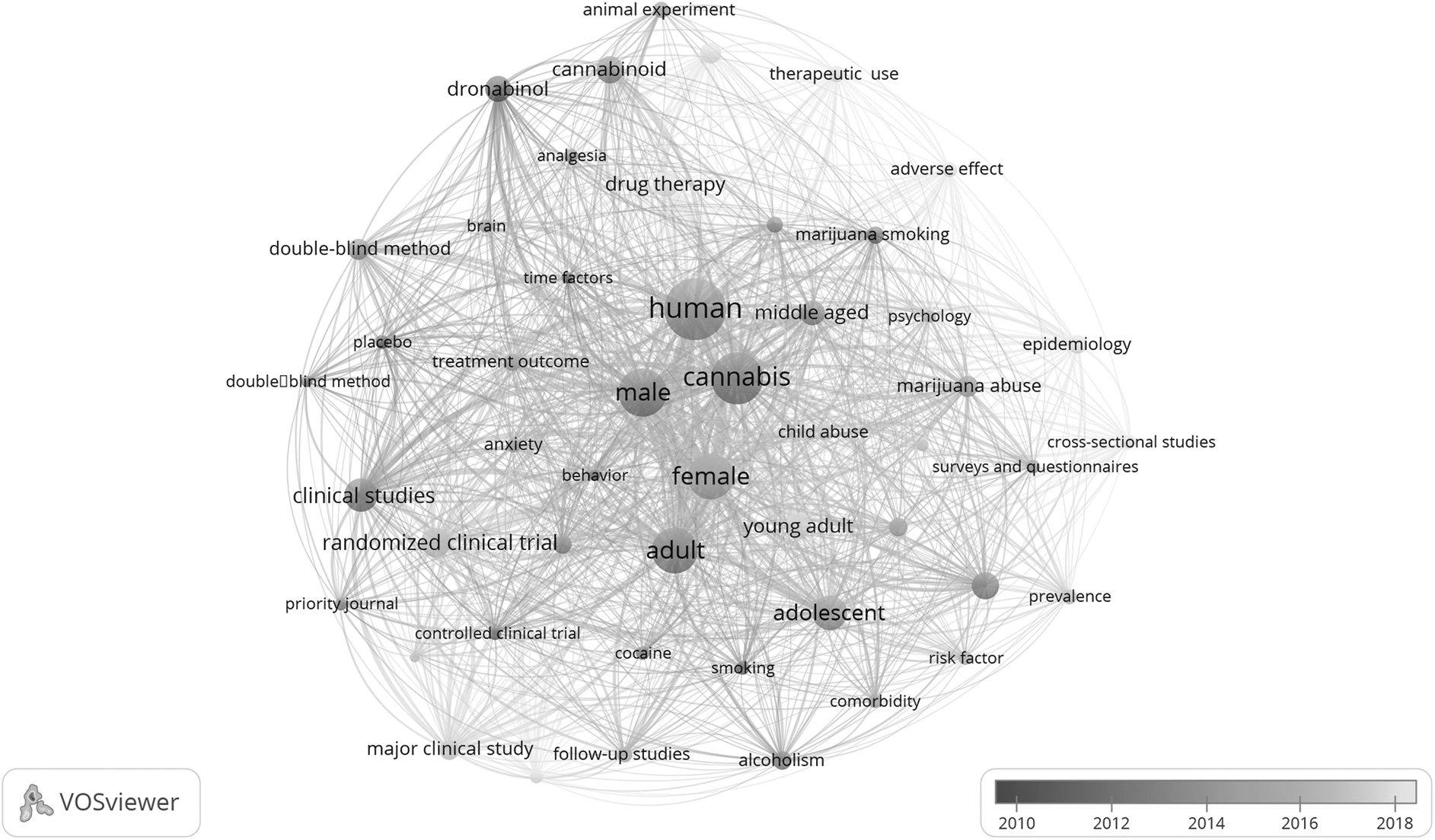
Cooccurrence analysis of the most frequent author keywords. The most frequently used keywords appear as larger nodes with larger text. Each cluster of highly related keywords is displayed using a different color to facilitate categorization. Bibliometric web was generated using the VOSviewer software.
A total of 133,295 terms were identified in the title and abstracts, with 4,688 terms occurring ∼10 times and 489 terms appearing ∼100 times (Supplementary Figs. S2 and S3). When considering only the titles, there were 19,059 terms used, with 594 terms appearing ∼10 times, and 53 terms occurring ∼100 times. Upon closer examination of the dataset, several noteworthy terms emerged frequently in titles, such as cannabidiol, tetrahydrocannabinol, efficacy, and safety. In addition, correlations between effects and cannabinoids were prominent, alongside investigations into risks and associations with psychoses. The presence of systematic reviews and meta-analyses in the bubble map is also notable.
Yeung et al 17 demonstrated that articles containing the term analgesia received more citations than those related to weight loss. Moreover, Δ 9 -THC, which also possesses analgesic effects, 36 garnered a substantial number of citations. The authors also highlighted that rodent models were frequently employed, along with concepts such as “Long-Term Potentiation,” “Depolarization-Induced Suppression of Excitation,” and “Food Intake.” Long-term potentiation is a crucial mechanism underlying learning and memory. 37 Rat studies indicated that long-term cannabinoid treatment might impair reference and working memory performance, and disrupt long-term potentiation in the hippocampus. 38 In addition, endocannabinoids could play a role in modulating anxiety and fear conditioning through long-term potentiation. 17
Regarding food intake, the endocannabinoid system in the hypothalamus can conditionally activate CB1 receptors to maintain and regulate food intake in conjunction with leptin. 39 Clinical trial results showed that the CB1 receptor blocker, rimonabant, combined with a hypocaloric diet, led to a significant reduction in body weight and cardiovascular disease risk. However, this inhibitor was withdrawn from assessment due to mood fluctuations and suicidal tendencies.40,41 Moreover, Yeung et al 17 observed that the CB1 receptor was a frequently researched focus, with frequent recurrence of keywords such as CB1, cannabinoid receptors, and anandamide, the latter being a famous agonist known from an article with a high citation count.17,42
Landscape of C. sativa and cannabinoids
More than two decades have passed since significant legal and social policy changes concerning the use of C. sativa for medical and other purposes took place. 43 Presently, ∼30 countries around the world have legalized medical C. sativa or derivative products for specific uses. These countries include the United States, Australia, Brazil, Argentina, Canada, Chile, Mexico, Uruguay, various European Union nations, and others. However, several countries maintain stringent guidelines regulating the medical use of pharmaceutical products derived from C. sativa. Notably, nations such as the Netherlands, Norway, and Germany are pioneers in the ongoing legalization of C. sativa, providing legalized access to meet the medical needs of patients with specific conditions. In countries, such as Spain and France, the use of certain derived drugs for specific ailments is permitted. 17
On the contrary, only Canada and Uruguay have legalized the sale and recreational consumption of C. sativa. In the United States, 14 states have more restrictive laws that limit Δ 9 -THC content, while 10 states and the District of Columbia have legalized recreational C. sativa use. In the United States, the medication containing CBD, Epidiolex, was recently FDA approved as the first prescribed drug available for treating rare diseases, such as Dravet syndrome. 44 In addition, approved medications such as Marinol, Syndros, and Cesamet consist of synthetic cannabinoids with structures resembling Δ 9 -THC. 44 All the latter medications are indicated for treating nausea and vomiting resulting from cancer chemotherapy.
According to Ng and Chang, 15 an increase in open-access publications has been observed since 1980, with 2010 marking a decade with a notably high percentage of open-access versus subscription articles (48.92%). Between 1960 and 2010, there was a rise in publications in areas such as immunology and microbiology, neuroscience, nursing, psychology, and social sciences. Multiple journals consistently ranked in the top 10 for publishing the literature on C. sativa and cannabinoids across various decades. For instance, Drug and Alcohol Dependence, Psychopharmacology, and the British Journal of Pharmacology remained top publishers from 1980 to 2019.
Publications related to C. sativa and cannabinoids were related with a diverse range of topics, including mental health disorders, diseases, and the use of other substances. In the cluster of mental health topics, publications often included keywords such as psychosis, depression, schizophrenia, and anxiety. Within the realm of disease, research explored the intersection of C. sativa with chronic conditions such as multiple sclerosis and cancer. In addition, publications were written at the crossroads of cannabinoids use and other substances, evident in the cluster of substance-related keywords, including terms such as alcohol and tobacco.15,17
C. sativa is a topic of interest when examining the emergence and treatment of mental health conditions, as highlighted by the prevalence of author keywords. Previous systematic reviews, including Crippa et al., 45 and Walsh et al., 46 have investigated the potential of cannabinoids as an anxiolytic agent and its utilization among individuals dealing with anxiety. These reviews have indicated that recent studies support the application of cannabinoids as an anxiolytic treatment for individuals facing anxiety-related conditions, while also highlighting the need for further research to elucidate the specific mechanisms underlying Cannabis-induced anxiety relief.15,45,46
While certain studies propose a positive link between anxiety and C. sativa use, other research suggests that this connection could be influenced by underlying factors affecting anxiety vulnerability or nonmedical C. sativa consumption.15,46 Systematic reviews and meta-analyses consistently establish a relationship between C. sativa usage and psychosis or related mental health conditions characterized by psychotic symptoms.15,46 Further longitudinal research is stressed by Johnson et al 47 to explore the enduring effects of C. sativa use on psychosis. The impact of C. sativa consumption on brain development and susceptibility to psychosis has been studied. Meta-analyses indicate an earlier onset of psychotic symptoms among Cannabis users than nonusers, a trend supported by elevated susceptibility in individuals genetically predisposed to psychosis.15,17
Several researchers are investigating the potential of Cannabis to manage pain associated with chronic conditions. Belendiuk et al 48 reviewed Cannabis's use for cancer and multiple sclerosis treatment, revealing conflicting results on cannabinoids' efficacy in alleviating cancer treatment symptoms. Some studies suggest tumor growth reduction with cannabinoid-derived drugs, while others indicate increased tumor growth due to immune system suppression. These inconsistencies suggest insufficient evidence to define Cannabis and cannabinoids' potential in cancer treatment.15,48
Strengths and limitations
This bibliometric study exhibited several notable strengths. First, it encompassed the characteristics of 10,575 publications across 2,694 journals, cataloged from six distinct databases (WoS, Scopus, Lilacs, SciELO, PubMed, and CENTRAL), marking the most extensive bibliometric analysis on this subject, to date. Employing a systematic review and adhering to established guidelines like PRISMA, the study's robust methodology bolstered the validity and dependability of its findings. By amassing data from a multitude of reputable databases, the analysis ensured the inclusion of a diverse range of literature. Spanning over 72 years, the study provided a longitudinal vista of trends and advancements in C. sativa research, facilitating the detection of historical shifts and nascent trends. The comprehensive scrutiny of author-suggested keywords further facilitated the identification of recurring themes and subjects within the literature.
However, certain limitations should be acknowledged. While the study's omission of manual result tracking is a common practice for bibliometric analyses encompassing numerous publications, it comes with inherent drawbacks related to practicality and efficiency. Furthermore, due to the nature of article retrieval and database amalgamation, citation counts for individual articles were forfeited, precluding the execution of cocitation and network analyses. Relying exclusively on published articles could introduce publication bias, potentially skewing findings by favoring the publication of positive results and sidelining inconclusive or negative outcomes. The study's focus on English-language publications might engender bias toward English-speaking regions, inadvertently neglecting valuable insights into other languages.
The process of data cleansing and keyword extraction carries the potential for errors or the inadvertent omission of pertinent terms, thus influencing result accuracy. The establishment of inclusion and exclusion criteria introduces an element of subjectivity and possible bias. The study's reliance on accessible bibliographic data could lead to gaps or incomplete information within the analysis. Given the diverse array of publication types encompassed—including reviews, clinical studies, and nonclinical studies—the potential for heterogeneity is heightened, potentially impacting overall analyses.
Conclusion
Our bibliometric analysis provides insights into C. sativa research, highlighting growing interest in its therapeutic potential and acknowledging research challenges. While progress has been made, ongoing investigation into safety, efficacy, and long-term effects is crucial. This overview supports evidence-based decisions, protocol refinement, and future research planning.
Our analysis reveals research growth, with the United States, the United Kingdom, and Canada as major contributors. Influential authors include Marilyn Ann Huestis, Sagnik Bhattacharyya, and Antonio Waldo Zuardi. Research focuses on clinical studies, emphasizing therapeutic potentials, adverse effects, and mental health connections. Keyword analysis underscores multidisciplinary research spanning pharmacology, psychiatry, neuroscience, and clinical psychology.
Overall, this study informs future research and policy considerations, highlighting unexplored areas and the need to address knowledge gaps. It lays the foundation for advancing medical science through Cannabis-based interventions as our understanding deepens.
Footnotes
Acknowledgments
The authors thank the Federal University of São João del Rei for the infrastructure, incentive, and collaboration. They thank A. Elbakyan Sci-Hub for their collaboration.
Author Disclosure Statement
The authors have no conflicts of interest to disclose.
Funding Information
This study was financed in part by the Coordenação de Aperfeiçoamento de Pessoal de Nível Superior—Brasil (CAPES)—Finance Code 001.

Abbreviations Used
References
Supplementary Material
Please find the following supplemental material available below.
For Open Access articles published under a Creative Commons License, all supplemental material carries the same license as the article it is associated with.
For non-Open Access articles published, all supplemental material carries a non-exclusive license, and permission requests for re-use of supplemental material or any part of supplemental material shall be sent directly to the copyright owner as specified in the copyright notice associated with the article.
