




Abstract
Background:
Although the majority of cannabinoid research has focused on delta-9-tetrahydrocannabinol (Δ9-THC) and cannabidiol (CBD), there is increasing interest in the therapeutic effects of other phytocannabinoid compounds (i.e., minor cannabinoids), as there is little known about their effects or interaction with CBD. The current study objective was to determine the concentrations of 15 minor cannabinoids in unregulated, over-the-counter CBD products.
Methods:
A cross-section sample of 80 local and national brands of hemp-derived oil products was purchased both online and in local retail outlets in central Kentucky. Epidiolex® was included as a regulated control. Samples from each product were extracted by solvent extraction and quantified by liquid-chromatography tandem mass-spectrometry. The targeted cannabinoids were: cannabidiolic acid (CBDA), cannabidivarin (CBDV), cannabidivarinic acid, Δ9-tetrahydrocannabivarin, Δ9-tetrahydrocannabivarinic acid, Δ9-tetrahydrocannabinolic acid-A, Δ8-tetrahydrocannabinol (Δ8-THC), cannabigerol (CBG), cannabigerolic acid, cannabinol (CBN), cannabinolic acid, cannabicyclol (CBL), cannabicyclolic acid, cannabichromene (CBC) and cannabichromenic acid.
Results:
Among the unregulated products included in this analysis, the most frequently detected minor cannabinoids were CBDV (100% of samples tested), CBG (77%), CBC (72%), CBN (67%), CBL (67%), and CBDA (51%). Δ8-THC was not detected in any of the products tested. Concentrations of these cannabinoids varied widely from trace concentrations to several mg/mL (e.g., CBDA: 0.006–12.258 mg/mL).
Conclusions:
These data indicate CBD products often contain minor cannabinoids, although the array and concentrations of these cannabinoids vary widely across products. The concentrations of these minor cannabinoids are largely absent from product labels, leaving consumers uninformed about product contents.
Introduction
Despite high levels of public interest in the therapeutic effects of cannabidiol (CBD) and the widespread availability of products, the CBD product market remains largely unregulated. There are known issues with CBD product consistency, purity, and label claims, with several studies demonstrating inaccurate labeling of CBD and Δ9-THC concentrations.1–3 In addition, most products do not state the presence of other cannabinoids or their concentrations on their labels (and this information is not common on the publicly available certificates of analysis). However, there are dozens of cannabinoids (aside from CBD and Δ9-THC) that are present in the cannabis plant in rather low concentrations and are generally referred to as the “minor cannabinoids” (e.g., cannabichromene [CBC], cannabinol [CBN], cannabigerol [CBG])—many of which are now being sold as individual products (e.g., CBG isolate) with unsubstantiated health claims. Relatively little is known about the full complement of phytocannabinoid constituents present in CBD products, and it is unclear the degree to which they may contribute to the side effects or therapeutic effects of CBD products.
While previous studies have reported a limited number of cannabinoids/minor cannabinoids in CBD products,4,5 the present study details the concentrations of 15 minor cannabinoids. The current study includes tandem liquid chromatography mass spectrometry (LC–MS/MS) determinations of 15 minor cannabinoids: cannabidiolic acid (CBDA), cannabidivarin (CBDV), cannabidivarinic acid (CBDVA), tetrahydrocannabivarin (THCV), Δ9-tetrahydrocannabivarinic acid (THCVA), Δ9-tetrahydrocannabinolic acid-A (THCA-A), Δ8-tetrahydrocannabinol (Δ8-THC), CBG, cannabigerolic acid (CBGA), CBN, cannabinolic acid (CBNA), cannabicyclol (CBL), cannabicyclolic acid (CBLA), CBC, and cannabichromenic acid (CBCA). These cannabinoids can occur in end products via: (1) plant expression in the source plant (i.e., hemp or cannabis plant genetics), (2) by-product of manufacturing process, (3) natural breakdown of the cannabinoids from time and/or exposure to the elements, or (4) product additives (i.e., chemicals not original to the source plant that are added during product production).
Thus, the purpose of the present study was to analyze 80 commercially available CBD products to determine (1) the concentration of minor cannabinoids in each product, and (2) compare these profiles to the FDA-approved product, Epidiolex as a regulated-product control.
Method
Product selection
The goal in the selection of hemp-derived oil products was to acquire products from local and national brands readily available to consumers in central Kentucky. Eighty unregulated hemp-derived CBD oil products representing 51 different brands were purchased from 21 online and 9 local (brick and mortar) retailer sources between April 2 and May 9, 2021. Epidiolex® (the FDA-approved CBD product) was also obtained (UK Investigational Drug Service Pharmacy) to serve as a regulated control. Products were randomly assigned a study identifier to blind researchers to product identification. All products were tested immediately after opening and before stated expiration dates.
Reagents and standards
Certified reference materials were purchased from suppliers with ISO17025 and ISO17034 accreditation. CBDV, THCV, CBG, CBN, Δ8-THC, CBL, CBC, CBDVA, CBDA, THCVA, CBGA, THCA-A, and CBCA were purchased from Cayman Chemical (Ann Arbor, MI, USA); CBNA and CBLA from Cerilliant Corporation (Round Rock, TX, USA). For the preparation of quality control samples, CBDV, THCV, CBG, CBN, Δ8-THC, CBL, CBC, CBDVA, CBDA, THCVA, CBGA, THCA-A, CBLA, and CBCA were purchased from Dr Ehrenstorfer (LGC Standards, Manchester, NH, USA) while CBNA was obtained from Cerilliant Corporation. Cannabidiol-d9, cannabigerol-d9, Δ9-tetrahydrocannabinol-d9, and cannabichromene-d9 were sourced from Cayman Chemical. 11-nor-9-carboxy-tetrahydrocannabinol-d3 and Δ9-tetrahydrocannabinolic acid-d3 were purchased from Cerilliant Corporation. Reagents and solvents (LC/MS grade) for use during the extraction and analysis were purchased from Fisher Scientific (Hampton, NH, USA). Extra virgin olive oil, which was used as an analyte-free matrix was obtained from a local grocery retailer (Kroger, Cincinnati, OH, USA).
We have previously reported sample preparation methodology (see1,2).
Instrumentation
Analysis of samples was carried out via LC–MS/MS using a Thermo Accela 1250 quaternary LC system coupled with a Triple Stage Quadrupole (TSQ) Vantage mass spectrometer (Waltham, MA, USA). Separations were carried out using a reversed phase (C8) Kinetex® analytical column (2.1 − 100 mm, 2.6 μm) purchased from Phenomenex (Torrance, CA, USA). A gradient solvent program using mobile phases of 0.1% formic acid in water (A) and in acetonitrile (B) was employed. Briefly, from a starting composition of 50% B, the percentage of organic mobile phase (i.e., B) was increased over 10 min and then an organic flush was used to remove residual matrix components before returning to the solvent starting composition. The solvent flow rate was 500 μL/min, and the total analytical run time was 14.25 min.
The mass spectrometer was equipped with an electrospray ionization source operated in positive and negative ion modes using selective reaction monitoring. Monitored transitions for analytes and internal standard are listed in Table 1.
Selective Reaction Monitoring (SRM) Transitions
Analyte/Internal Standard is the Compound Monitored. The Precursor Ion is the Positively (Neutral Compounds) or Negatively (Acid Compounds) Charged Ion Selected in Q1. The Product Ion is the Charged Ion Product Resulting from Fragmentation of the Precursor Ion Selected in Q3. The Quantifier Ion Response Ratio is Used to Determine Concentration. The Mass to Charge Ratio (m/z) Shows the Ion Mass Selected in Q1 and Q3 Respectively.
quantifier ion.
Data analysis
Descriptive statistics were used to summarize the concentration and frequency of detection of each of the minor cannabinoids. Pearson correlation was used to determine correlations between concentrations of each cannabinoid; significance was set at p < 0.05.
Results
Method validation and performance
Across all three groups no interferences were detected for any of the target analytes or internal standards. In addition, the target analytes and internal standards were identified, correctly demonstrating that the developed method is selective for the target analytes and internal standards. Recovery ranged from 87% to 100%, and potential minor matrix effects. Quality control samples were included in each batch with six replicates at each of four concentrations across the range to verify control of the assay. The relative standard deviation across all concentrations ranged from 3.6% to 12.7%, and the mean relative error was within 5% of the nominal concentration.
Minor cannabinoid concentrations
The concentration of 15 minor cannabinoid compounds was determined in 80 commercially available products as well as Epidiolex® (we have previously reported the THC and CBD concentrations of these products—see1,2). Table 2 displays the range of concentrations detected (mg/mL) and frequency of detection (percent of products containing the cannabinoid) for these compounds. As shown in Table 2 and as illustrated in Figure 1 (a–b), minor cannabinoid concentrations varied greatly from 0.005 mg/mL to 12.258 mg/mL. The most commonly detected minor cannabinoid was CBDV, which was detected in all samples tested (range: 0.019–0.809 mg/mL). Other commonly detected minor cannabinoids (i.e., detected in more than 60% of samples) included: CBG (76% of samples; range: 0.006–2.233 mg/mL); CBC (73% of samples; range: 0.006–3.330 mg/mL), CBL (68% of samples; range: 0.006–0.322 mg/mL); and CBN (68% of samples; range: 0.007–1.190 mg/mL). CBDA was detected in approximately half the samples tested (51%); although it displayed the highest concentration range (up to 12.258 mg/mL), this high concentration was only detected in one sample and was not representative of the sample array (e.g., one other sample contained 5.469 mg/mL, two samples contained >1 mg/mL and all others were 0.7 mg/mL and lower). Δ8-THC was not detected in any of the products tested.
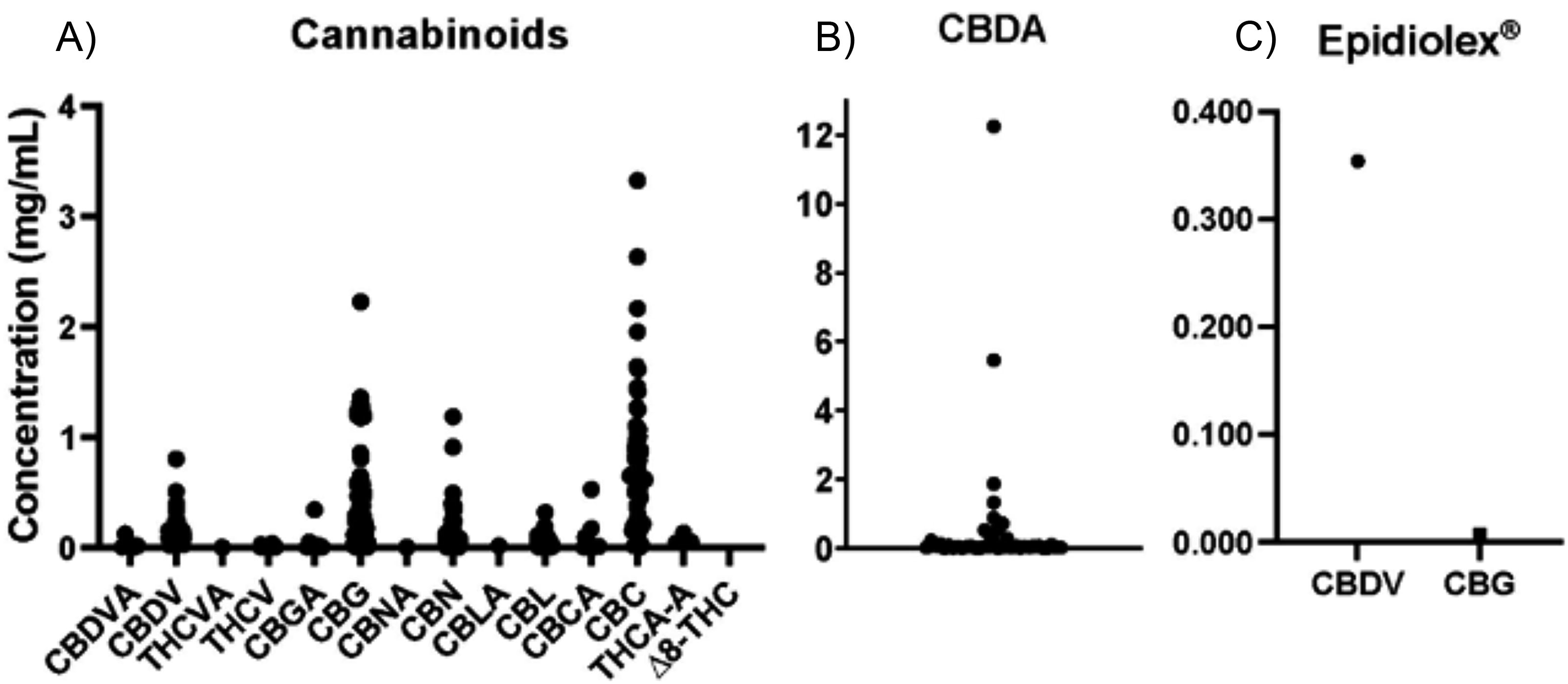
The first panel
Concentrations of Minor Cannabinoids in Unregulated Products (n = 80) and the FDA-Regulated Product Epidiolex®
Concentrations of 15 Minor Cannabinoids Assessed in 80 Unregulated CBD Products and the Prescription Medication Epidiolex®. For the Unregulated Products, the following Are Presented: mean and Median Concentrations (mg/mL; Mean/Median of 9 Aliquot Samples from Each of the 80 Products), the Range Detected across All Products (mg/mL) and the Percentage of Samples Containing the Minor Cannabinoid. For the FDA-Regulated Product, Two Minor Cannabinoids Were Detected; the Mean Concentration (ng/mL; Mean of 9 Aliquot Samples of the Source Product) and the Standard Error of the Mean (SEM, ng/mL) Are Presented.
Minor cannabinoid content of the FDA-approved cannabidiol product Epidiolex was minimal (see Figure 1c; concentrations [±SEM] reported in Table 2b). Only two minor cannabinoids were detected in this product at low concentrations: CBDV (0.354 ± 0.003 mg/mL) and CBG (0.007 ± < 0.001 mg/mL).
The correlation array of cannabinoids concentrations is presented in Table 3. Higher concentrations of CBD were associated with higher concentrations of an array of minor cannabinoids: CBDV, CBG, CBL, and CBC (Table 3). Other significant correlations that included more than half of the samples (e.g., two minor cannabinoids that were detected in ≥40 samples): (1) CBDV was associated with CBG, CBL, and CBC; (2) CBG was associated with of CBN, CBL, and CBC; and (3) CBL was associated with CBC (see Table 3 for outcomes and statistics).
Correlations of Minor Cannabinoids Detected in Unregulated CBD Products (n = 80)
Pearson Correlations Were Used to Detect Correlations between Minor Cannabinoid Concentrations in the Analyzed Products. The Table above Presents the Pearson’s Correlation Coefficient (r), the p-value of the Comparison (p) and the Number of Samples Included in the Analysis (n). Significant p values (p < 0.05) Are Emphasized with Both Italic Text and an Asterisk.
Discussion
The current study analyzed 80 samples of CBD oil preparations sold online and in stores, along with and the FDA-approved product Epidiolex®, to determine concentrations of minor cannabinoids using LC/MS/MS. The results of this study indicated that six minor cannabinoids were present in over half of the over-the-counter/unregulated products tested. These cannabinoids included: CBDV (present in 100% of samples tested), CBG (76%), CBC (73%), CBN (68%), CBL (68%), and CBDA (51%) (Table 1). Similar to other studies, CBDV, CBG, and CBC were the most commonly observed minor cannabinoids in the array of products tested, and the concentrations varied greatly.4–7 Despite the recent public interest and surge in Δ8-THC product availability, none of the CBD samples tested contained Δ8-THC. In comparison, Epidiolex contained only two minor cannabinoids: CBDV and CBG (Table 2). Notably, the unregulated products did not list the presence of any minor cannabinoids on the label, leaving the consumer unaware of the specific cannabinoids that are present or their relative concentrations.
Each CBD product contained a different array/concentration of minor cannabinoids with little consistency (aside from the presence of CBDV) across products. Given this variability and lack of information provided by manufacturers, consumers, and practitioners are unable to understand the contents of these products. There is little research in humans to determine the pharmacokinetic or pharmacodynamic effects of the minor cannabinoids, and it is unclear if any of these compounds may alter the effects of CBD or produce any effects on their own. Nearly all products contained relatively low concentrations of the minor cannabinoids, suggesting a low likelihood of profound drug effects or drug interactions, but more research needs to be conducted to make this determination.
Overall, there is increasing interest in the medical and therapeutic effects of the minor cannabinoids, and they are currently being evaluated for a wide range of indications, including antinociceptive (e.g., CBDV, 8 CBDA 9 ), anti-inflammatory (e.g., CBC, THCV, CBN 10 ), antibacterial (e.g., CBG, 11 CBDV 12 ), antiviral (e.g., CBGA, CBDA 13 ), anticancer cell proliferation (e.g., CBG, 14 CBN 15 ), antiemesis (e.g., CBDA 16 ), antiepileptic (e.g., small human trial with CBDV 17 ; CBC, 18 CBG 19 ), insomnia (e.g., CBN 20 ), autism spectrum disorder (e.g., CBDV 21 ), and as a possible biomarker for recent cannabis use (e.g., CBG 22 ).
Overall, little to no data is currently available on how the minor cannabinoids found in widely available CBD products may contribute to CBD’s therapeutic effects or side effects. However, manufacturers should clearly state the contents of cannabinoid products (specific cannabinoids present, concentrations of each) on the product label to better inform consumers and practitioners about the risks and benefits of each product.
Footnotes
Acknowledgments
This study was supported by the UK Cannabis Center (Kentucky State Appropriation, KRS164.983); S.B. was supported by National Institute on Drug Abuse grants (R01DA054347, R01DA045700).
Authors’ Contributions
E.J.: Conceptualization, methodology, validation, formal analysis, investigation, resources, data curation, writing—original draft, visualization, project administration. M.K.: Conceptualization, methodology, writing—review and editing, project administration. P.N.: Formal analysis and writing—review and editing. S.B.: Investigation, resources, writing—original draft, writing—review and editing, visualization, project administration, supervision, funding acquisition.
Author Disclosure Statement
S.B. has previously served as a scientific consultant to Canopy Growth Corporation unrelated to the present work. The other authors have no conflicts to declare.
Funding Information
This study was supported by the UK Cannabis Center (Kentucky State Appropriation,