







Abstract
Background:
Hemp and cannabidiol (CBD) products are now widely available for purchase in the United States and in many international jurisdictions. However, these products are largely unregulated (with very few exceptions) and are widely available without restriction. This has created a market in which low-quality and contaminated products are commonplace. The aim of the current study was to analyze the cannabinoid content of 56 selected CBD gummy products.
Methods:
Gummy-based CBD products from national brands, available for purchase online, were obtained. Liquid chromatography-tandem mass spectrometry (LC-MS/MS) was used for cannabinoid analysis. Key outcome measures included: (1) concentration of CBD in each product, (2) accuracy of the product labeling regarding CBD concentration, and (3) concentration of Δ9-tetrahydrocannabinol (Δ9-THC) and other cannabinoids of interest (e.g., cannabidivarin and cannabinol) in each product. An exploratory analysis assessed within-product consistency of CBD and THC concentrations (e.g., variation in cannabinoid content from gummy to gummy within a single bottle).
Results:
The products contained a mean of 21.38 (±11.16) mg CBD per gummy (range: 5.70 − 59.99 mg). In total, 70% of the gummies contained CBD in a concentration that differed by >10% of the dose listed on the packaging. In total, 39% of the products contained Δ9-THC and concentrations were highly variable (range: 0.019–0.88 mg Δ9-THC/gummy); 9 products (16% of products tested) contained >0.4 mg Δ9-THC per gummy. Within-product analysis (n = 10 products) revealed high variability across gummies (coefficient of variation for CBD: 2.1 − 27.1%; Δ9-THC: 3.1 − 23.5%).
Conclusions:
As several studies have demonstrated, unregulated CBD product packaging is not an accurate indication of the product constituents. This study further confirms that CBD products do not have reliable CBD concentrations—both relative to the dose listed on the label and among individual gummies within the same bottle. These products also frequently contain Δ9-THC (and occasionally Δ8-THC), often unbeknownst to the consumer. The results of this study support the growing body of literature suggesting the necessity of CBD product regulation to ensure customer health and safety.
Introduction
Consumer interest in the (purported) therapeutic benefits of cannabidiol (CBD) products has greatly increased over the past few years. Since CBD was removed from the Controlled Substance Act with the passage of the Agricultural Improvement Act of 2018, 1 the availability of these products and the variety of formulations have exponentially increased. It is estimated that more than 50% of CBD consumers use these products to manage medical conditions including the management of pain and anxiety.2–4
According to a 2021 U.S. CBD Consumer Report, 2 the product types most used by consumers are liquid preparations (i.e., oils/drops/tinctures) followed by gummies, vapes, edibles, and topicals. Given the prevalent use of gummies across the nutritional supplement industries, this result is not surprising. For CBD products, gummies and other edibles offer a convenient and discreet option, 5 ostensibly an option that does not need to be measured out to obtain the correct dose.
Presently, only one highly purified, plant-based CBD medication, Epidiolex® has been approved by the Food and Drug Administration (FDA) for the treatment of three forms of epilepsy—Lennox-Gastaut, Dravet syndrome, and epilepsy associated with tuberous sclerosis.6,7 Since the FDA concluded that their existing framework for regulating dietary supplements and food additives is not amenable to CBD products, these products are regulated under the Food, Drug, and Cosmetic Act. 8 However, there remains a regulatory ambiguity for CBD products, as there is no federally regulated standard for label accuracy or cannabinoid content. This issue has been highlighted by several studies which demonstrate the continued concern with the manufacturing quality of CBD products, particularly regarding the accuracy of CBD concentrations compared with label claims, as well as the risk of unintended exposure to Δ9-tetrahydrocannabinol (Δ9-THC).9–15 However, only a limited number of product analyses have included the assessment of gummy formulations.10,14 In one study, the researchers determined that 55% of CBD gummy products tested contained ≥20% variation in CBD (i.e., either 20% more CBD, or 20% less CBD) than the dose stated on the product label. 10 Similarly, a separate study (using a more conservative ≥10% range of variability) reported that 74% of the CBD gummy products tested contained CBD amounts that were inconsistent (greater than or equal to ±10%) with the label information. 14 In addition to CBD dose inaccuracy, one study 10 also observed a CBD fruit gummy product with a total Δ9-THC content of 1.0 mg per serving.
Generally, gummy products are a hydrocolloid-based network that holds a sugar syrup with a relatively high moisture content. The most common hydrocolloid stabilizers are gelatin, starch, or pectin. Hydrocolloid selection greatly influences how a product is manufactured as well as the properties of the finished product. 16 Adding to the complexity of CBD gummy products is that phytocannabinoids are chemically hydrophobic, while the gummy matrix is hydrophilic—this contrast presents a challenge in achieving a stable and effective product. Aside from quality issues, gummy products are sweet, colorful, highly palatable confectionary/candy-like products—this remains concerning as these products are being consumed by children, where unintended exposure can result in serious medical emergencies. 17
The present study was designed to (1) assess the cannabinoid constituents of CBD gummy products (including CBD, Δ9-THC and 15 other phytocannabinoid compounds) using ISO17025-accredited methods, (2) describe the accuracy of the CBD concentration listed on the label (e.g., dose accuracy), and (3) evaluate within-product consistency of CBD and Δ9-THC concentrations (i.e., testing multiple gummies within the same product lot).
Materials and Methods
Product selection
Internet searches (keywords: CBD gummy, CBD edibles, hemp gummy, cannabidiol gummy, gummy, edibles) were conducted between December 14, 2022, and January 6, 2023, to identify CBD and hemp gummy products available for online retail purchase. Products with marketing or label claims for cannabinoids other than CBD, as well as any products marketed for cannabis/marijuana, were excluded. Only products from the United States were included in this study. Although the selection of products may not fully represent the available products across the industry, the design is intended to represent the typical consumer experience for online shopping of CBD gummy products in the United States.
Reagents and standards
Reference materials used for the preparation of calibrator samples and quality control samples were purchased from different suppliers. Both Δ9-THC and CBD reference materials for calibrator samples were purchased from Cayman Chemical (Ann Arbor, MI, USA), along with Δ9-THC-d9 and CBD-d9, which were used as internal standards. For the preparation of quality control samples, Δ9-THC reference material was purchased from Cerilliant Corporation (Round Rock, TX, USA) while CBD reference material was purchased from LGC Standards (Manchester, NH, USA). To facilitate qualitative identification, a quality control sample was prepared using reference material purchased from Cayman Chemical (tetrahydrocannabinolic acid-A [THCA-A], cannabidivarin [CBDV], tetrahydrocannabivarin [THCV], cannabigerol [CBG], cannabinol [CBN], and Δ8-THC), Cerilliant Corporation (CBDA), and LGC Standards (cannabidivarinic acid [CBDVA], tetrahydrocannabivarinic acid [THCVA], cannabigerolic acid [CBGA], cannabinolic acid [CBNA], cannabichromenic acid [CBCA], cannabicyclolic acid [CBLA], cannabicyclol [CBL], and cannabichromene [CBC]). Stable labeled analogs of cannabinoid compounds were purchased from Cayman Chemical (CBD-d9, CBG-d9, and Δ9-THC-d9) and Cerilliant Corporation (11-nor-9-carboxy-THC-d3) were used as internal standards. Reagents and solvents (liquid chromatography-tandem mass spectrometry [LC-MS/MS] grade) for use during extraction and analysis were purchased from Fisher Scientific. Haribo® Goldbears® were used as the negative control matrix and were purchased from a local grocery store (Kroger, Cincinnati, OH, USA).
Sample preparation
Six gummies from each product were weighed to determine the average gummy weight. Then, a representative sample of each product was processed through a cryomill to generate a homogeneous sample. For each product, 12 replicates of 50 ± 0.5 mg were weighed out from the homogenized sample into appropriately labeled tubes. Each tube then received 10 µL of internal standard for an added concentration of 0.020 mg/mL and 2.500 mL of (40:60) acetonitrile:water mixture. The samples were then capped, tumbled for 20 min, sonicated for 40 min, and centrifuged for 20 min at 20°C. Once the analyst confirmed that all samples had been completely dissolved, a 50 µL aliquot of the supernatant was transferred to an autosampler vial and diluted with solvent and water to a final volume of 1 mL forming a sample with an appropriate concentration range and composition (nominally 50:50 acetonitrile:water v:v) for analysis. The vials were then capped and briefly vortex-mixed before being analyzed by LC-MS/MS.
Prior to analysis for the manufacturer consistency study, 12 gummies were selected from a single lot for each product included in the study. Each of the 12 gummies was weighed, then processed by cryomill to generate a homogeneous sample. For each gummy, six aliquots of 50 ± 0.5 mg were weighed out and extracted for analysis as described above.
Instrumentation
Sample analysis was carried out via LC-MS/MS using a Thermo Scientific™ Vanquish™ HPLC system coupled with a TSQ Quantis™ mass spectrometer (Waltham, MA, USA). Separations were carried out using a reversed-phase (C8) Kinetex® analytical column (2.1 × 100 mm, 2.6 µm) purchased from Phenomenex® (Torrance, CA, USA). A gradient solvent program was employed using mobile phases of 0.1% formic acid in water (A) and in acetonitrile (B). Briefly, starting with a composition of 50% B, the percentage of organic mobile phase (i.e., B) was increased over 10 min to 65% B, followed by a 1-min organic flush at 98% B employed to remove residual matrix components before returning to the initial solvent composition. The solvent flow rate was 500 µL/min, and the total analytical run time was 14.25 min. Through the use of reference material, the method was demonstrated to separate all analytes through a combination of chromatography and mass spectrometry. 18
The mass spectrometer was equipped with an electrospray ionization source, operated in positive ion mode using selective reaction monitoring. Monitored transitions for CBD, Δ9-THC, other minor cannabinoids, and internal standards have been previously reported, but analyte transitions are shown in Table 1.12,13,15,17 Neutral compounds, those lacking a carboxylic acid group, were monitored with positive ionization, while acidic compounds, those containing a carboxylic acid group, were monitored using negative ionization.
Selective Reaction Monitoring Transitions for Targeted Analytes
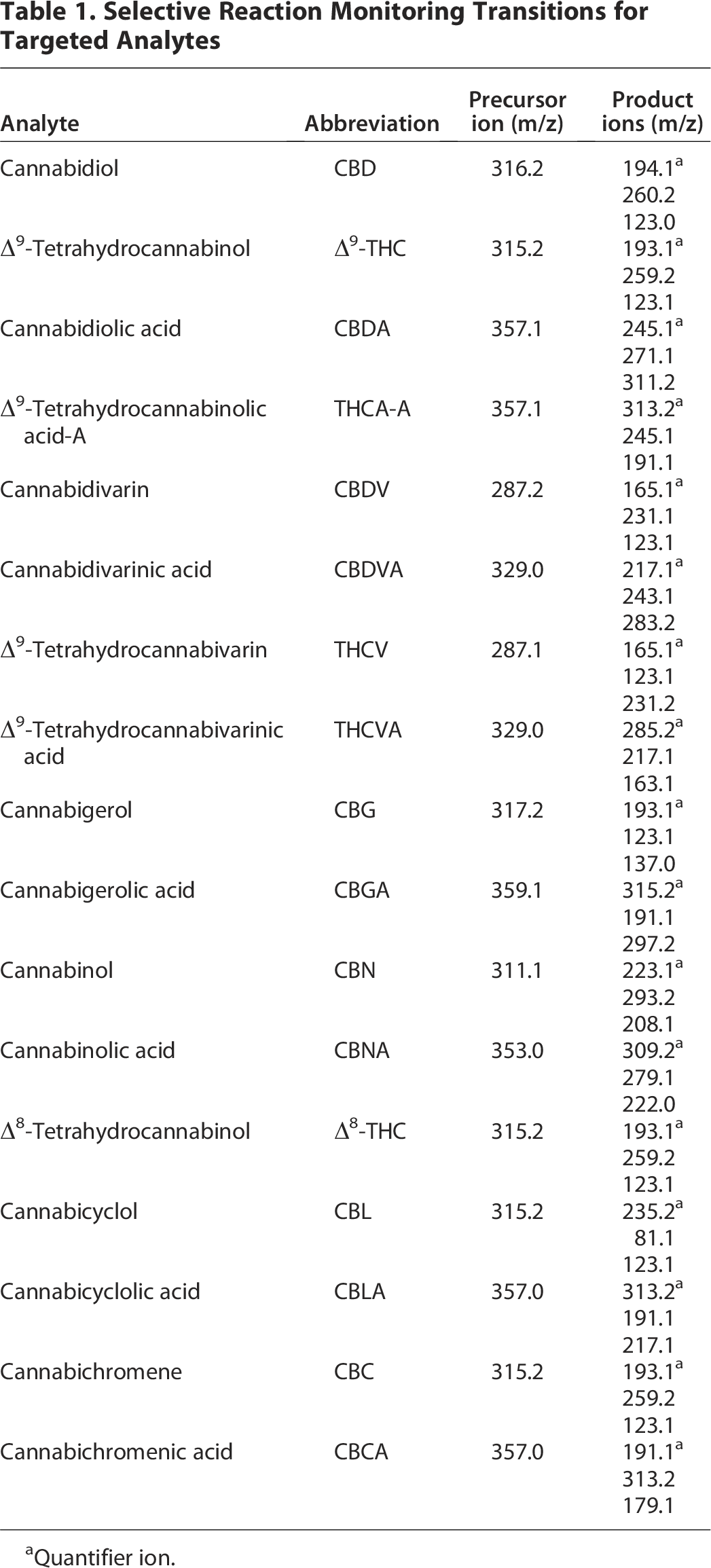
Quantifier ion.
Results
Method performance
Across all batches, no interferences were detected for any of the target analytes or internal standards. Additionally, the target analytes and internal standards were correctly identified compared with the reference standard analyzed with each batch based on retention time, m/z, and confirming ion ratios. Confirming ion ratio criteria were: 10% absolute difference for an ion ratio <25%; 25% relative difference for ion ratios 25−50%, and 15% absolute difference for ion ratios >50%. Proper identification demonstrated that the developed method was selective for the target analytes and internal standards. Recovery was determined to range from 84% to 96%, and potential matrix effects were minor. Calibration curves were prepared to determine CBD and Δ9-THC concentrations across a range of 0.2−30 mg/g for CBD and 0.005−1.000 mg/g for Δ9-THC. The lowest calibrator sample was set as the lower limit of quantification, and any sample with a concentration above the calibration range was subjected to dilution and reanalyzed. Quality control samples were included in each batch with 12 replicates at each of three concentrations across the range to verify control of the assay. The relative standard deviation across all concentrations ranged from 1.8% to 6.5%, and the mean relative error was within 11% of the nominal concentration.
Cannabinoid assays
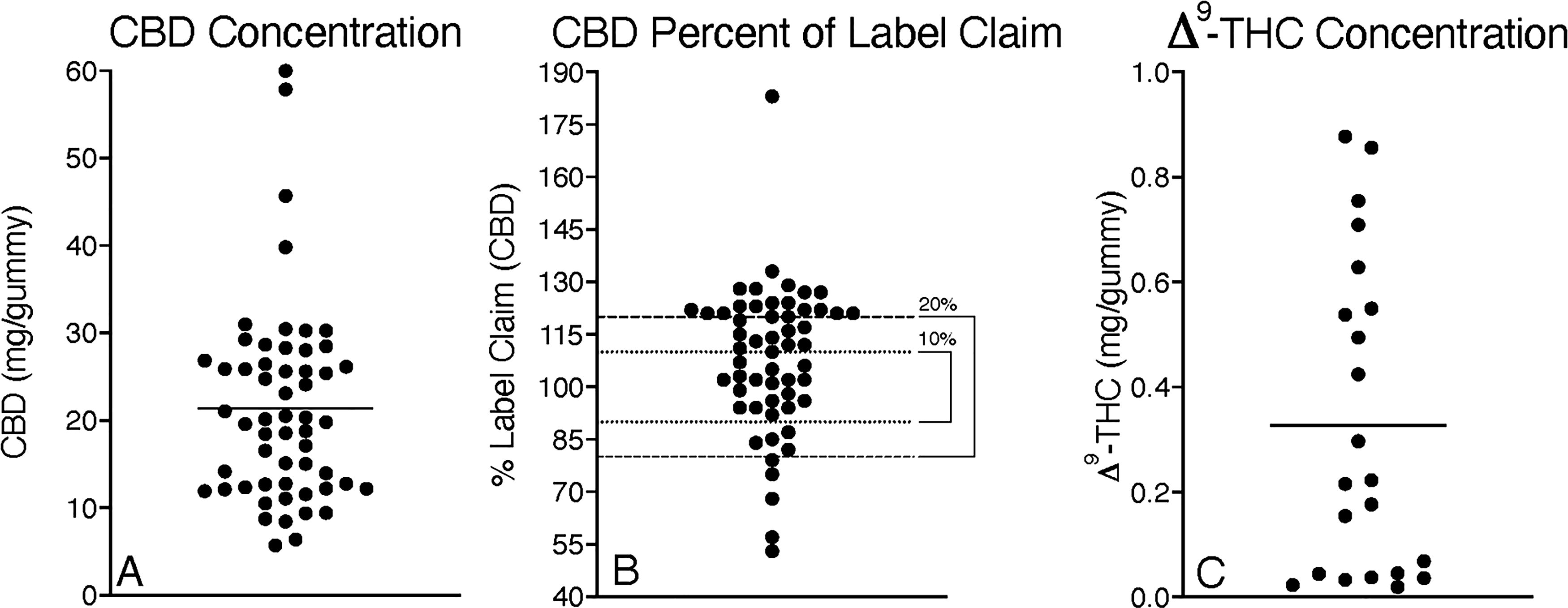
Figure 1A displays the CBD concentration detected in each gummy across the 56 products. The mean concentration was 21.38 (±11.16) mg CBD per gummy; however, a wide range of concentrations was detected across products (5.70 − 59.99 mg CBD per gummy; Table 2). When comparing the detected concentration to the label claim (i.e., mg of CBD/gummy as listed on the package label), only 17 products were within ±10% of the label claim (dotted lines, Fig. 1B; Table 2). An additional 15 products fell within ±20% deviation from the label claim (dashed lines, Fig. 1B; Table 2). Of the 24 products that were >20% outside of the label claim, most contained more CBD than stated (19 products contained more, only 5 products contained less; Table 2). Of the products containing >120% CBD, most were between 121% and 133% of the label claim; however, one outlier contained 183% more CBD than reported on the bottle.
CBD Concentration: Label Information and Results of LC-MS/MS Analysis
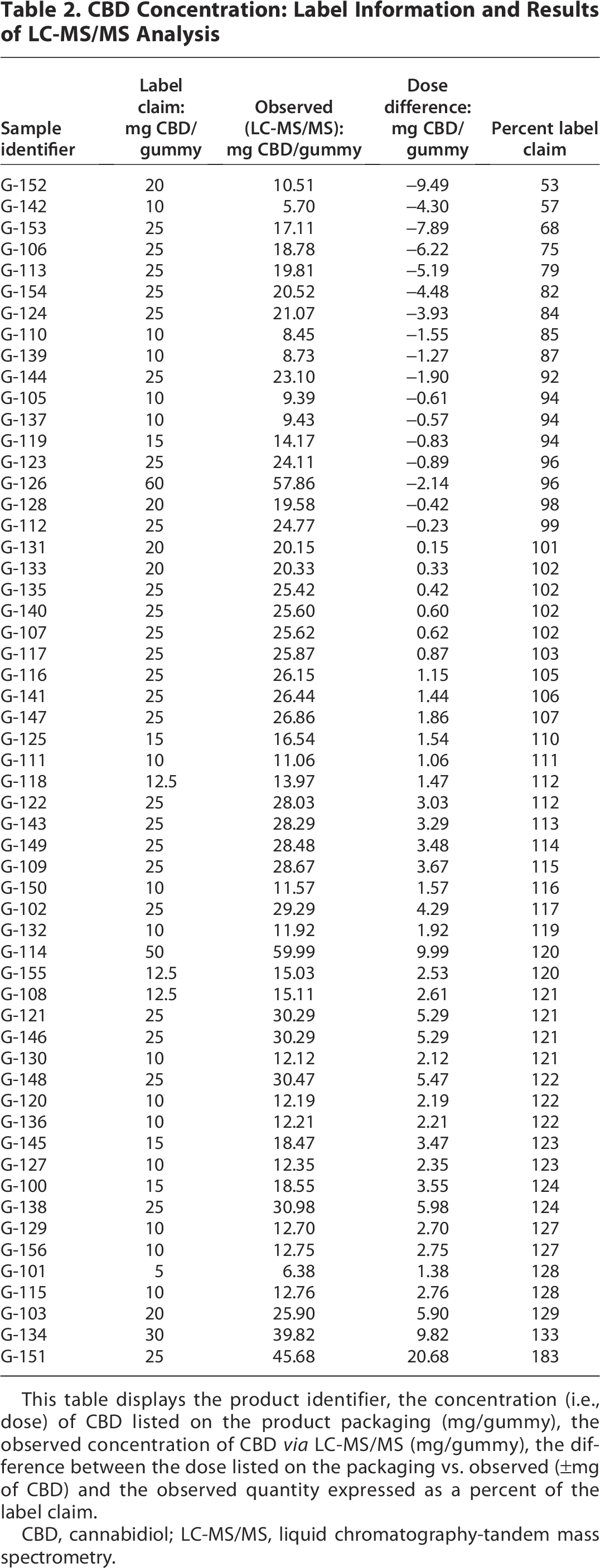
This table displays the product identifier, the concentration (i.e., dose) of CBD listed on the product packaging (mg/gummy), the observed concentration of CBD via LC-MS/MS (mg/gummy), the difference between the dose listed on the packaging vs. observed (±mg of CBD) and the observed quantity expressed as a percent of the label claim.
CBD, cannabidiol; LC-MS/MS, liquid chromatography-tandem mass spectrometry.
Concentrations of Δ9-THC Detected in CBD Gummy Products

Of the 56 products tested, 22 products contained detectable concentrations of Δ9-THC (i.e., above the limit of quantitation for Δ9-THC). The concentrations of Δ9-THC detected are displayed (expressed as mg of Δ9-THC per gummy), from the lowest to the highest concentration detected.
CBD, cannabidiol; THC, tetrahydrocannabinol.
When the gummy products were assessed for Δ9-THC contamination, 22 products (39% of those tested) had detectable Δ9-THC concentrations (i.e., above the LOQ). As displayed in Figure 1C (see also Table 3), eight samples contained relatively low concentrations (range: 0.019–0.068 mg Δ9-THC/gummy). However, the remaining 14 samples contained moderate-to-high concentrations (0.15–0.88 mg Δ9-THC/gummy), with 9 of these products (16% of products tested) containing > 0.4 mg Δ9-THC per gummy.
Minor cannabinoids were also assessed (see Table 4; concentrations were not assessed, but detection status is reported). The most frequently detected cannabinoids were cannabidivarin (CBDV) (100% products), CBG (75%), CBN (59%), and CBC (50%). Notably, Δ8-THC was detected in only 5% of products.
Frequency of Minor Cannabinoids Detected in CBD Gummy Products (n = 56)

This table displays the 10 minor cannabinoids that were detected in the analysis of 56 unregulated CBD gummy products. The frequency at which each minor cannabinoid was detected is displayed (i.e., the percent of the 56 products included in the analysis). A total of 15 minor cannabinoids were assessed; however, CBDVA, THCVA, CBNA, CBLA, and THCA-A were not detected in any of the products.
CBC, cannabichromene; CBCA, cannabichromenic acid; CBD, cannabidiol; CBDA, cannabidiolic acid; CBDV, cannabidivarin; CBG, cannabigerol; CBGA, cannabigerolic acid; CBL, cannabicyclol; CBLA, cannabicyclolic acid; CBN, cannabinol; CBNA, cannabinolic acid; THCA-A, tetrahydrocannabinolic acid-A; THCV, tetrahydrocannabivarin; THCVA, tetrahydrocannabivarinic acid; THC, tetrahydrocannabinol.
The results of the exploratory assessment of within-product consistency (i.e., variation from gummy to gummy within the same bottle) examined 12 gummies per package and a total of 10 products (see Table 5). CBD concentrations were quite variable across individual product gummies, with variability ranging from 2.1% to 27.1% (coefficient of variation). A similar pattern was observed with Δ9-THC, with 3.1−23.5% variation within products. The product with the greatest gummy-to-gummy variability contained 5.54–15.98 mg of CBD per gummy and 0.037–0.153 mg of Δ9-THC per gummy.
Within-Product Assessment: Variability of Cannabinoid Concentrations Within the Same Package
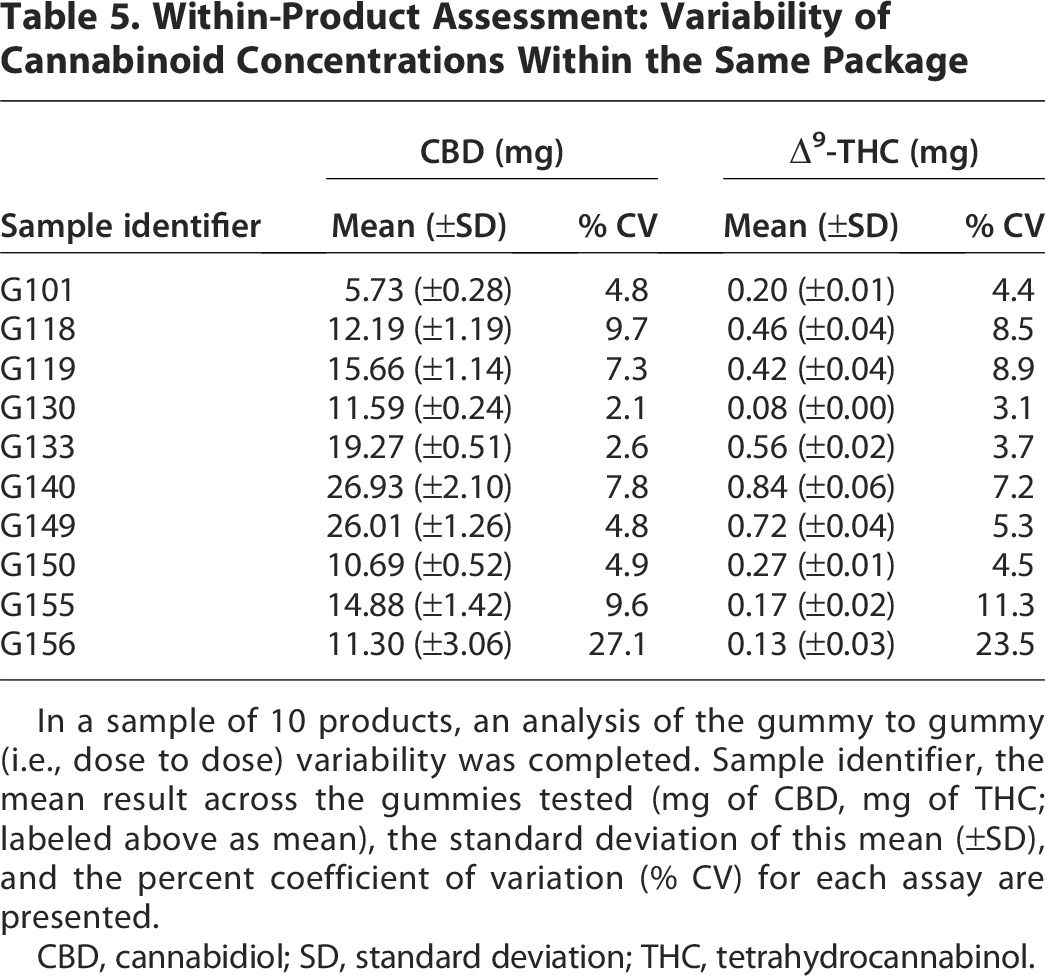
In a sample of 10 products, an analysis of the gummy to gummy (i.e., dose to dose) variability was completed. Sample identifier, the mean result across the gummies tested (mg of CBD, mg of THC; labeled above as mean), the standard deviation of this mean (±SD), and the percent coefficient of variation (% CV) for each assay are presented.
CBD, cannabidiol; SD, standard deviation; THC, tetrahydrocannabinol.
Discussion
In the current study, 56 CBD gummy products were purchased from online retailers and analyzed for CBD content (with comparison to label claim), Δ9-THC content, as well as the presence of 15 minor cannabinoids. Additionally, an exploratory assessment was conducted (n = 10 products) to assess gummy-to-gummy variability within the same package. The primary findings from this study indicate, similar to previous reports analyzing other CBD formulations (e.g., liquid, topical), gummy products are subject to (1) dose mislabeling, with 70% and 43% of the products falling >10% and >20% outside of the label claim, respectively; (2) Δ9-THC contamination, such that 39% of products tested contained Δ9-THC (range: 0.019–0.88 mg Δ9-THC/gummy); and (3) within-product variability (e.g., dose to dose variability) in regard to both CBD (range: 2.1−27.1%) and Δ9-THC (range: 3.1−23.5%). This study joins several others demonstrating CBD quality control issues including CBD content, labeling accuracy, and unintended exposure to Δ9-THC.9–15,19,20
In reference to CBD dose accuracy (e.g., concentration detected compared with concentration listed on the product packaging), this study demonstrated a discrepancy that ranged from −9.5 mg CBD to +20.7 mg CBD per gummy. This represents a significant degree of variation, particularly when marketed doses are within this range of error (e.g., 5–20 mg CBD/gummy doses are commonplace). This degree of variability could result in a doubled dose or only a small fraction of the anticipated dose, with both scenarios having the possibility to produce negative health outcomes. The current study also determined that 5/56 products tested did not list a suggested serving size on the package, and 38/56 products did not indicate a maximum number of suggested servings per day. Consumers have increasingly sought out CBD products for purported health benefits, either as a specific therapy for a medical condition or general health and well-being.2,3 Considering that most people take CBD products without medical guidance, consumers rely heavily on product label information when making decisions on product choice and dosing 3 ; however, this study and several others have demonstrated that this is (unfortunately) a problematic approach. High doses of CBD taken in combination with other medications and/or dietary supplements present the risk of dose-dependent drug−drug interactions as well as hepatocellular injury/toxicity. 21
Gummy product manufacturing is a complex process influenced by numerous factors, including moisture, temperature, sugar content, and choice of hydrocolloid stabilizer. For CBD products, this complexity is further amplified by the hydrophobic nature of cannabinoid compounds being blended into a hydrophilic gummy matrix. Recognizing these issues, an exploratory study was conducted to assess the gummy-to-gummy variability within the same package. The maximum coefficient of variation observed—27.1% for CBD content and 23.5% for Δ9-THC content—further demonstrates the risks for consumers taking these products as the gummies within the same package of the same product could be significantly different in cannabinoid content.
In the current study, there was a wide range of Δ9-THC detected. Rather shockingly, none of the product labels indicated that (1) there was a possibility that the product could contain Δ9-THC, (2) the dose of Δ9-THC contained in the product, or (3) warnings that this product could cause impairment or a positive drug test. This means consumers of these products were not informed they were consuming Δ9-THC, despite it being a U.S. DEA Schedule I drug. The regulatory ambiguity within the CBD product industry clearly leaves consumers at risk for unintended exposure to Δ9-THC. If product regulation does not address this issue, it is crucial that we educate consumers so they are aware that CBD products may contain Δ9-THC, even if it is not indicated on the labeling, and this exposure could lead to intoxication or impairment. One case study showed that consumers often assume CBD products are safe based on the labeling, leading to the consumption of several gummies. 22 For instance, if a consumer takes three gummies of a product containing 0.88 mg of Δ9-THC per gummy (the highest concentration determined for a product in this study), they would be unknowingly exposed to 2.6 mg of Δ9-THC—an amount comparable to the starting dose (2.5 mg) for dronabinol, an FDA-approved, prescription pharmaceutical form of Δ9-THC. 23 In addition to safety concerns, consumers should also be aware that this type of unintentional Δ9-THC consumption could result in testing positive for Δ9-THC on a drug test and is virtually indistinguishable from actual cannabis consumption, which has wide ranging impacts, including drug testing in the context of employment requirements, impaired driving cases, the criminal justice system, and sport doping. The urinary thresholds for THC-COOH (an inactive metabolite of Δ9-THC) are 50 ng/mL for immunoassay tests and often 15 ng/mL for confirmation by gas chromatography-mass spectrometry. 24 Some studies have suggested that a positive drug test result can occur with Δ9-THC doses of less than 0.4 mg per day.25–28 In the current study, nine products (16% of samples tested) exceeded this 0.4 mg Δ9-THC limit in one gummy. This somewhat reckless lack of quality control has wide ranging consequences. Active-duty military personnel and veterans are also subject to drug testing, and the Department of Defense has explicitly prohibited service members and civilian contractors from using hemp-derived products based on the potential for Δ9-THC contamination. 29 However, the risk for unintentional Δ9-THC consumption is especially concerning for children, as CBD gummy products appear very similar to other candy products that are marketed to children (e.g., gummy bears, gummy rings). For example, one case report describes a 4-year-old child consuming CBD gummies (quantity unknown), resulting in a THC-COOH urinary concentration >14,286 ng/mL (along with serious medical sequelae). 17 This case further highlights the safety concerns and the need for clear regulations of CBD products.
Despite the relaxation of cannabis policies for various sporting bodies within the United States, the World Anti-Doping Agency (WADA) prohibits “all natural and synthetic cannabinoids” in competition. The examples provided in the regulations appear to suggest that only THC-like chemicals are prohibited: (1) cannabis (hashish, marijuana) and cannabis products, (2) natural and synthetic tetrahydrocannabinols (THCs), (3) synthetic cannabinoids that mimic the effects of THC, and (4) the explicit exclusion of CBD.30,31 However, it is possible that any minor cannabinoid/phytocannabinoid (outside of THC, CBD) is included in this category, as the only confirmed exception is CBD, but it is unknown if WADA is specifically testing for these compounds. There is no high-quality research available to determine the effects of most of the minor cannabinoids in terms of abuse potential, impact on sport performance, interactions with THC or CBD, or if they produce any effects on their own, as there is very little known about pharmacokinetic or pharmacodynamic effects of these compounds. The current study, along with others, has demonstrated that minor cannabinoid compounds are prevalent CBD products readily available over the counter to consumers, despite little to no evidence of their presence declared on the product label.9,10,14,15
Conclusions
These data join several other studies in demonstrating the need for regulatory control and additional caution and education regarding the consumption of CBD products. These data suggest that the potential harms of poor product quality could lead to (1) inaccurate CBD doses being consumed (either higher or lower than intended), and (2) the risk of unintentional Δ9-THC exposure (with implications ranging from impairment, drug testing repercussions, and health risks for children). In addition to respectfully advocating for additional regulatory control and quality assurance, we would also encourage additional education for both health care providers and CBD consumers for increased awareness of these harms and to help promote public safety.
Footnotes
Author Disclosure Statement
No competing financial interests exist.
Funding Information
Completion of this article was supported by the UK Cannabis Center (Kentucky State Appropriation, KRS164.983); S.B. was supported by National Institute on Drug Abuse grants (R01DA054347, R01DA045700).