




Abstract
Background:
Over the last decade, there has been a significant increase in the production of multiple tetrahydrocannabidiol (THC) related products via the acid catalysis of cannabidiol (CBD). The widespread availability of CBD and the unregulated or poorly regulated nature of its use have flooded the market with THC-containing products of unverifiable provenance and frequently contaminated by trace metals and residual solvents. Under non-optimized, poorly controlled, or harsh reaction conditions, these acid-catalyzed transformations yield multiple cannabinoids including Δ9-THC and Δ8-THC, along with numerous side products. These side products are rarely identified or quantified accurately, and their safety and pharmacology remain largely unknown.
Aims:
This review aims to present an up-to-date understanding of one of the fundamental transformations in cannabinoid chemistry: the cyclization of CBD to THC. This knowledge will facilitate the development of safer, cleaner, more affordable, and accessible cannabinoid products while guiding medical practitioners and regulators.
Materials and Methods:
We conducted a literature review of studies published over the last 5–6 years on the interconversion of CBD to THC. Our review focused on the following key aspects: (1) advances in understanding reaction mechanisms and optimizing desirable reaction outcomes; (2) development of new catalysts, including “green chemistry” approaches such as solid-supported acids; and (3) implementation of fit-for-purpose analytical methods to better characterize reaction outcomes and reassess the accuracy of cannabis and hemp product labeling.
Results:
Provided strict quality controls of materials, reaction conditions, and related isolation techniques, the latest research of the acid-catalyzed CBD cyclization shows that it is feasible to access products with elevated and consistently high quality, enriched with either CBD or THC fractions, in a cost-effective manner. Among a spectrum of possible products, easy access to low-potency THC compositions may be particularly relevant for serving the needs of medical patients consuming cannabis and hemp-derived cannabinoids including dose titration as well as to supporting safe and responsible use in recreational markets now saturated with overly potent products.
Introduction
The acid-catalyzed conversion of cannabidiol (CBD) to tetrahydrocannabidiol (THC) is a well-known intramolecular terpene cyclization in the annals of cannabinoid chemistry. This reaction was first discovered by Adams in the earliest publications in the field going back to the 1940s. 1 Subsequent work conducted in the 1960s with major contributions from Mecholaum et al.2,3 established that a primary reaction product is Δ9-THC, an isomer that can undergo a facile isomerization in situ to the thermodynamically more stable Δ8-THC via a double bond shift (Scheme 1, path A). Δ9-THC is a major psychoactive constituent of the Cannabis sativa L. plant, whereas Δ8-THC occurs naturally only in trace amounts (or in aged cannabis samples) and has milder yet pronounced Central Nervous System effects through a common mechanism of binding to the CB1 cannabinoid receptors. 4

Reaction mechanisms of the acid-catalyzed cyclization of CBD.
CBD-to-THC transformations were largely overlooked as having any practical implications until the late 2010s when a resurging interest in Δ8-THC was prompted by a large supply of inexpensive (<$500/kg) hemp-derived CBD isolates including abundant crystalline materials with claimed purity >99%. In parallel, the loopholes in the latest, 2018, version of the Farm Bill in the United States 5 de facto legalized hemp-derived cannabinoids as food additives as long as they don’t contain Δ9-THC above a 0.3% threshold level, a definition that excluded Δ8-THC from the calculations.
At present, the poorly regulated U.S. market for Δ8-THC products exceeds $1 billion, accompanied by growing anxiety among consumers, medical professionals, and regulators, including the Food and Drug Administration (FDA), regarding product quality, lack of analytical standards, potential contaminants, and overall safety.6,7 Despite existing barriers to expanding the fundamental exploration of cannabinoids—due to the federal regulation of Δ9-THC as a Schedule 1 compound, still limited academic research, and the shroud of secrecy surrounding the industry practices—the last 5–6 years have yielded significant information addressing knowledge gaps around Δ8-THC and related THC isomers formed from CBD.
Driven by more sophisticated and integrated analytical techniques, and supported by a growing number of commercially available standard reference cannabinoids, foundational reactions have been revisited to achieve a better understanding of mass balances, optimal reaction conditions, and the identities and quantitation of side products. These methodologies have also been successfully applied to screen marketed products, revealing multiple discrepancies in label claims. This review significantly expands our perspective and understanding of the field since it was last reviewed by Golombek et al. 8
Major Reaction Pathways
Our literature analysis will be anchored in key reaction mechanisms and the selection of reaction conditions that lead to the preferential formation of either Δ8-THC or Δ9-THC as the desired outcomes. The scope and accurate detection of side products have been major limitations in the utility of the CBD-to-THC conversion for products in the consumer market. Thus, the evolution and challenges of newer analytical techniques will be reviewed, leading to recommendations for best practices that should be considered for adoption by the industry.
Specific processes behind hemp-derived products remain mostly undisclosed. However, recent investigations that rigorously analyzed a multitude of Δ8-THC products available in the marketplace9–13 have revealed an emerging, comprehensive, and converging picture of side products and reaction profiles, consistent with well-controlled laboratory experiments. In some instances, we will re-quote key publications—first in the context of the main reaction pathways, and then to highlight the profiles of side reactions and related analytical tools.
A unified view of the main processes involved in the acid-catalyzed conversion of CBD to THC can be rationalized through the formation of three different carbocation intermediates (Scheme 1): (1) exocyclic C(8)+, responsible for the main reaction pathway yielding Δ9-THC (A); (2) endocyclic C(1)+, leading to iso-THC derivatives (B); and (3) endocyclic C(4)+, prompting a benzofuran cyclization, accompanied by epimerization at the C(4) carbon and the formation of the (−)-cis-Δ9-THC side product (C).
While the possible formation of iso-THC products has been firmly established for a long time, 14 the reaction pathway (C) was, until recently, underappreciated in the literature. Under harsher reaction conditions, subsequent secondary rearrangements—such as those involving a migration of the double bond and additional cyclizations—may produce complementary reaction products, for example, a ubiquitous Δ8-THC (from Δ9-THC) in the main reaction pathway and well-recognized Δ4(8)-iso-THC (from Δ8-iso-THC). Concurrently, hydration reactions of different carbocations could also give rise to minor amounts of hydroxylated derivatives of both THC and iso-THC, along with a double-cyclization leading to cannabicyclol and further rearrangement of the minute amounts of (−)-cis-Δ9-THC.
It is feasible to posit that many commercial Δ8-THC products arise from harsher reaction conditions intended to minimize the ratio of Δ9-THC below 0.3% thus producing a panel of side products. Still, as we will see, a list of such products is finite, and a comprehensive picture of all the reaction products is now in view.
Progression of Inquiries
In addition to its direct involvement in the current production of Δ8-THC, interest in CBD cyclization over the years has stemmed from various aspirations. The ease with which CBD is converted to THC in a reaction flask led Adams 15 to propose that it could possibly be a main biosynthetic pathway to THC in plants. However, it turned out that this was not the case as the formation of THC and CBD occurs via different enzymatic cyclizations of cannabigerol in its carboxylated forms. Thus, the cyclization of CBD to THC had no impact on the subsequent development of distinct hemp plant lineages, fine-tuned by genetic engineering to overproduce either CBD or THC. Decades later, the same notion sparked a heated debate about the possibility of such a conversion occurring in vivo in connection to human consumption of CBD, though there is still no supporting collective evidence. 8 Finally, with the increased use of CBD, multiple studies have focused on the shelf stability of CBD and its associated photo- and thermal degradation (including pyrolysis), revealing a range of ancillary cyclization pathways and products.16–18 For example, CBD is shelf-stable when protected from light and moisture. However, if not properly stored, it forms a THC fraction, presumably due to an acidic environment and atmospheric carbon dioxide, which could further lead to a ubiquitous terminal oxidation product stemming from aromatization of the cycloxene ring, resulting in the formation of cannabinol (CBN).
One of the first instructional and widely quoted protocols for the conversion of CBD to THC, along with more definitive assignments of the main and side reaction products, was reported by Mechoulam et al.19,20 Protic acid-catalyzed conversion using p-toluenesulfonic acid in refluxed toluene produced Δ8-THC with 79–85% yields (over 15–120 min), whereas a Lewis acid catalysis by BF3·Et2O in methylene chloride at 0°C gave predominantly Δ9-THC in 67% yield and Δ8-iso-THC (27%) as a major side product (Scheme 1). This observation gave rise to an early hypothesis about the stabilization of Δ9-THC against isomerization in the presence of Lewis acids. However, this conjecture has not been confirmed in modern studies. In the meantime, with no available CBD source, the following years, up until the 2020s, saw only occasional spikes of interest, primarily traced to scattered patent disclosures, for example, looking into zinc salts 21 and aluminum alkoxides catalysts. 22
Modern Investigations
In a more systematic approach, the CBD-to-THC cyclization reactions have been revisited and further scrutinized in several studies (reported in the last 5 years) that examined a wide range of solvents, temperatures, reaction times, and catalysts.12,23–26 Following a chronological sequence of publications, the screening of protic acids conducted by Marzullo et al. 23 found that camphorsulfonic acid was a superior catalyst for producing Δ9-THC, albeit in moderate yields (61%), without converting to Δ8-THC or forming side products. The reaction required a prolonged time of 96 h in toluene at ambient temperature and left significant amounts of unreacted CBD (38%). In contrast, the use of elevated temperatures and different solvents resulted in the generation of significant amounts of the more thermodynamically stable Δ8-THC. High yields of Δ9-THC (81%) were also obtained in toluene at ambient temperature (over 48 h) using p-toluenesulfonic acid, but this was accompanied by small amounts of Δ8-THC (11%).
Lewis acids In(OTf)3 and trimethylsilyl trifluoromethanesulfonate (TMSOTf) performed better than BF3·Et2O in terms of yields, yet predominantly formed Δ8-THC. This study represented a significant step forward in achieving a full reaction mass balance and a more definitive characterization of the reaction side products. It revealed, in some instances, further isomerization of Δ8-iso-THC to Δ4(8)-iso-THC via migration of the exocyclic double bond (Scheme 1, path B). Such insights were achieved through a combination of flash column chromatography isolation of the reaction products and the analysis of the crude reaction mixtures by quantitative nuclear magnetic resonance (qNMR) spectroscopy. High-performance liquid chromatography (HPLC) used in this work provided only partial information due to poor separation of the iso-THC isomers from the main reaction products.
In a different study, 27 three main mineral acids—sulfuric, hydrochloric, and acetic acid in aqueous alcohols—showed detectable quantities of Δ9-THC along with alkoxylated derivatives, but with poor yields and multiple untraceable side products. Further advances in decoding the reaction outcome were achieved by Huang et al., 12 who revisited a subset of mostly protic reagents/catalysts and reaction conditions previously studied 23 (typically at ambient temperature and over tens of hours). This important investigation used authentic samples of Δ8-iso-THC and Δ4(8)-iso-THC, along with a combination of gas chromatography (GC), qNMR, and HPLC. Improved peak separation was accomplished using silver-impregnated silica columns, a methodology successfully adopted from challenging lipid analyses. Most of the reported analytical data included direct quantification of all five main analytes (CBD, Δ9-THC, Δ8-THC, Δ8-iso-THC, and Δ4(8)-iso-THC), cross-referenced using two orthogonal techniques: GC–mass spectrometry (GC-MS) and Ag(I)-HPLC. A careful interrogation of the trace impurities with short retention times in the HPLC runs also revealed several hydrated species derived from both THC (giving 9α-hydroxyhexahydrocannabinol along with its 9β-enantiomer) and iso-THC (producing 8-hydroxy-iso-tetrahydrocannabinol). Ultimately, the developed analytical methodology was deployed for the analysis of commercially available Δ8-THC-enriched gummies, showing the presence of both unaccounted-for Δ8-iso-THC and Δ4(8)-iso-THC. This also led to corrections in Δ8-THC levels due to deficiencies in the HPLC methods typically used in the industry, along with related peak overlaps. The same conclusions regarding inaccurate product labels were reached in more recent, larger studies of commercial Δ8-THC products by Meehan-Atrash 10 and, more recently, by ElSohly et al. 11 The latest published analysis of commercial Δ8-THC products by the latter group,24 using GC-MS and a variety of validated methods relying on standard reference compounds, showed not only more dominant Δ8-iso-THC and Δ4(8)-iso-THC fractions but also products of advanced reactivity, such as further iso-cyclization of Δ8-cis-THC (path B) and ring migration of the double bond in Δ4(8)-iso-THC to Δ4-iso-THC. Additional concurrent side product fingerprints involving hydroxylation and epoxidation are most likely indicative of harsher reaction conditions, longer reaction times, and exposure to oxygen and water.
In an exemplary investigation 26 with multiple cross-references to practical utility, CBD-to-THC conversion has been set up as an efficient flow-through continuing process (achieving grams per hour output). Although the choice of solvent as methylene chloride is commercially unattractive due to the increasing effort to reduce the usage of chlorinated solvents, the process optimization achieved very high yields (>90% conversion), along with an exquisite selectivity for the formation of either Δ8-THC (using TMSOTf) or Δ9-THC (with AlCl3) and minimal formation of the iso-THCs side products (1–3%).
Catalysis by solid-supported catalysts
Using solid-supported catalysts is an appealing strategy in natural product synthesis because it can reduce production costs, provide recycling options, offer better control over potential contaminations in the final products, and allow for the use of alternative solvents.28,29 These benefits are being highlighted by concerned scientists as vital to ensuring the quality of cannabis and hemp products and the safety of consumers.6,7
Common mineral acids such as sulfuric acid, alkylperfluorosulfonic acids, and sulfonic acid derivatives are available in three commercially produced solid-supported forms: SiO2-supported alkylsulfonic acids, 30 SiO2-supported perfluorinated Nafion-H, 31 and Amberlyst-15 ion-exchange resin (a polystyrene-divinylbenzene copolymer covalently bound to benzenesulfonic acid, in the H+-form) 32 that is a member of the larger family of commercially available products, many of which are widely used in processes such as water purification. However, when systematically tested in CH2Cl2, all three catalysts alongside Lewis acid solid-supported Polyvinylpyrrolidone supported boron trifluoride showed unremarkable results in terms of yield and selectivity in CBD cyclization, with no benefits over soluble acids. 26 This suggests that the choice of solvent conditions or solid support may not have been optimal. Solid-supported catalysts remain an area of active research to produce catalysts with reduced leaching and fouling, adjusted porosity, and surface area of the support matrix. 33
Before the studies mentioned above, one of the authors of the present review was the first to report the use of acidic solid-supported catalysts including zeolites for the CBD-to-THC conversion.34,35 Zeolites are a unique class of industrially used aluminosilicate solid catalysts that, in their acidic form, offer both Brønsted and Lewis acid functionalities through alumina and silica oxide moieties, respectively. 36 Zeolites are available on a large scale at low cost and come in a variety of Si/Al ratios, allowing for fine-tuning of desired reactivity. Additionally, zeolites have 3D cage structures of varying dimensions (typically in the 8–14 Å range), which can better fit the reactants within their cavities, enhancing selectivity.
These reports,34,35 identified several zeolites that exhibited excellent reactivity in the CBD-to-THC cyclization, demonstrating up to a 5:1 selectivity for Δ9-THC versus Δ8-THC when the conversion was kept at 50–60%. The ratio shifted to 3:1 as the reaction progressed to 80% completion. 33 More importantly, it was discovered that these reactions could proceed in CBD melts without solvent at modest temperatures (100–120°C) in just 10–15 min. C-Click Life Sciences, a product development company, holds the intellectual property licensing rights to commercialize acid-enriched solid catalysts for CBD-to-THC conversion, including zeolites. 35 Compared with other acid catalysts, zeolites can be easily separated from the reaction mixture by simple filtration, eliminating the need for work-up processes and avoiding catalyst-related leaching or contamination. This makes it feasible to produce a whole range of products with different THC potencies (in combination with CBD) via a cost-efficient, streamlined process. This approach is particularly suitable for titration studies in patient populations and for integration into simple personal-use devices.
Can CBD be converted to THC in vivo?
The possibility of in vivo THC formation as a result of human CBD consumption has been reviewed by Golombek et al. 8 However, there is no published literature on the metabolism of CBD in the context of the FDA approval of Epidiolex (in 2018) that reports detectable THC levels. The controversy surrounding this issue stems from some model studies using simulated gastrointestinal fluids, which showed the formation of THC in a biologically relevant acidic environment. Meanwhile, multiple human clinical trials (reviewed by Ujváry and Hanuš 37 ) have firmly established that the key metabolite of CBD is 7-OH-CBD, which is further converted into 7-COOH-CBD and related terminal glucuronides via the enzymatic activities of 3A4 Isoform of CYP450 and 2C19 Isoform of CYP450. The recognition that no pharmacodynamically relevant levels of THC are produced is supported by the very mild side effects observed with Epidiolex, an oil-based intraoral CBD formulation approved for treating Dravet syndrome in pediatric populations. At the recommended dose levels of up to 20 mg/(kg·day), no psychomimetic or dissociative side effects were reported, as detailed in the drug insert.
A recent computational study by Bujis 38 compared the reaction rates of CBD conversion in aqueous sodium dodecyl sulfate (SDS) with and without HCl. The study concluded that the formation of sodium dodecyl sulfonic acid in situ acts as a key accelerator for the conversion in hydrophobic micelles, a process that otherwise occurs very slowly. One key factor hindering CBD cyclization may also be its extremely poor aqueous solubility (<0.1 µg/mL). This solubility issue can be improved by using cyclodextrin complexation and other solubility enhancers.39–41 Among these enhancers, SDS is the most powerful detergent, increasing CBD solubility by nearly three orders of magnitude, up to over 0.1 mg/mL, which may enable more efficient homogeneous catalysis. Other water-based cannabinoid formation reactions and rearrangements could be significantly influenced by the presence of SDS. 42 A recent study by Hart et al. 43 concluded that CBD-to-THC conversion is an unlikely cause of failed drug tests in people consuming CBD-only products.
Analytical development
The fundamentals of cannabinoid analysis have been primarily developed to understand the constituents of the cannabis plant and the staple of current commercial testing remains HPLC, 44 whereas GC, an initial go-to method for analysis of cannabis, was considered inferior to HPLC due to its more destructive nature related to acidic cannabinoids such as cannabidiolic acid and tetrahydrocannabinolic acid. 45 In general, derivatization techniques help to overcome stability problems and a GC-FID method is currently the official method established by the European Commission for the analysis of cannabis. 46 Over time, the related HPLC methods for cannabis evolved from following a handful of compounds to current protocols including concurrent quantification of up to 20 cannabinoids in one sample, and became equally applicable to hemp and hemp-derived products with no adjustments. An expansion of the analytes panel was very much driven by the fascination with “minor” cannabinoids and enigmatic “entourage effects” proposed by the early research and describing perceived synergistic healing effects of natural mixtures as compared with individual cannabinoids. 47 Isocratic methods based, for example, on the acetonitrile/water mixtures (e.g., 70:30) modified with formic or other acids using C18 reverse-phase columns, became common and more frequently chosen in the commercial labs over the gradient methods.44,48 Apparently, switching to ultra-performance liquid chromatography (UPLC) and using smaller, <2 micron particle size columns provides a better peak resolution and separation than 5 micron stationary phases and reduces the run time to less than 10 min. 44 However, widespread adoption of high-pressure UPLC setups may face challenges, including the need to maintain particulate-free samples, limited column lifespans, and ensuring unobstructed mobile phase flow lines for reliable operation. These issues become particularly significant when analyzing a diverse range of samples, such as plant materials, extracts, and edibles.
For some key analytes such as Δ8-THC, HPLC analysis poses significant challenges due to (1) poor peak separation and (2) the identical molecular weights of structural isomers, which exhibit very similar fragmentation patterns in MS. 49 Despite potential HPLC method adjustments to improve separation of Δ8-THC and Δ9-THC, 50 the retention time difference between these compounds is typically only a few tens of seconds, with baseline separation typically unachievable in serial testing (Figs. 1 and 2). 51 Furthermore, commercial laboratories are seldom in a position to provide fit-for-purpose methods tailored for hemp-derived cannabinoids, instead relying on adaptations of the methods designed for cannabis.
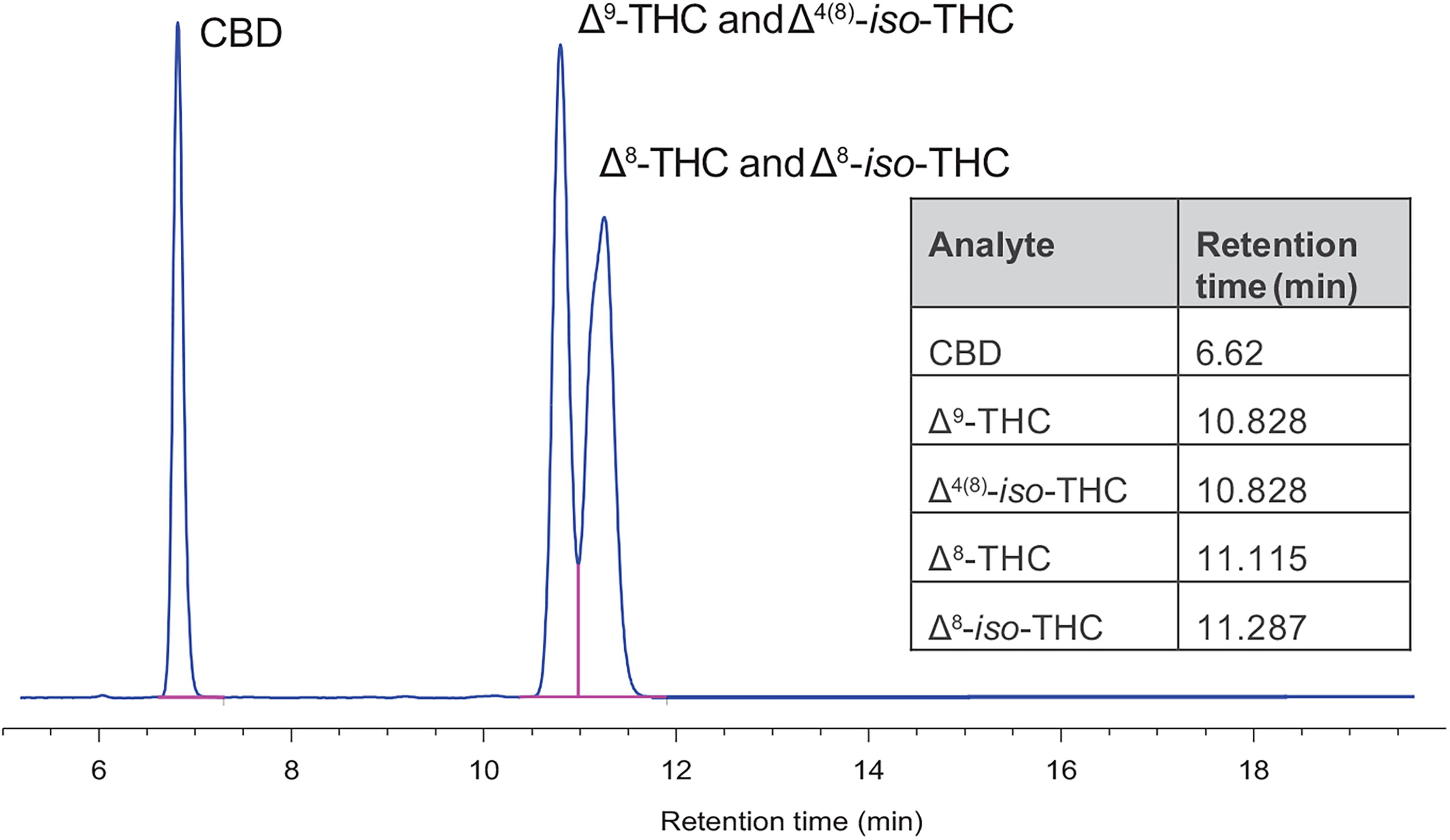
HPLC chromatogram of the mixture of the THC and iso-THC standards using the typical method for cannabis analysis (reproduced from Cayman Chemical, MI materials 51 ). Co-injection of CBD, Δ9-THC, Δ4(8)-iso-THC, Δ8-THC, and Δ8-iso-THC. Agilent 1100 Series HPLC with Gemini C18 column (250 × 4.6 mm, 5 µm), 20:80 H2O:acetonitrile (ACN), 0.1% AcOH mobile phase,1 mL/min flow rate, T = 40°C, 228 nm. CBD, cannabidiol; HPLC, high-performance liquid chromatography; THC, tetrahydrocannabidiol.
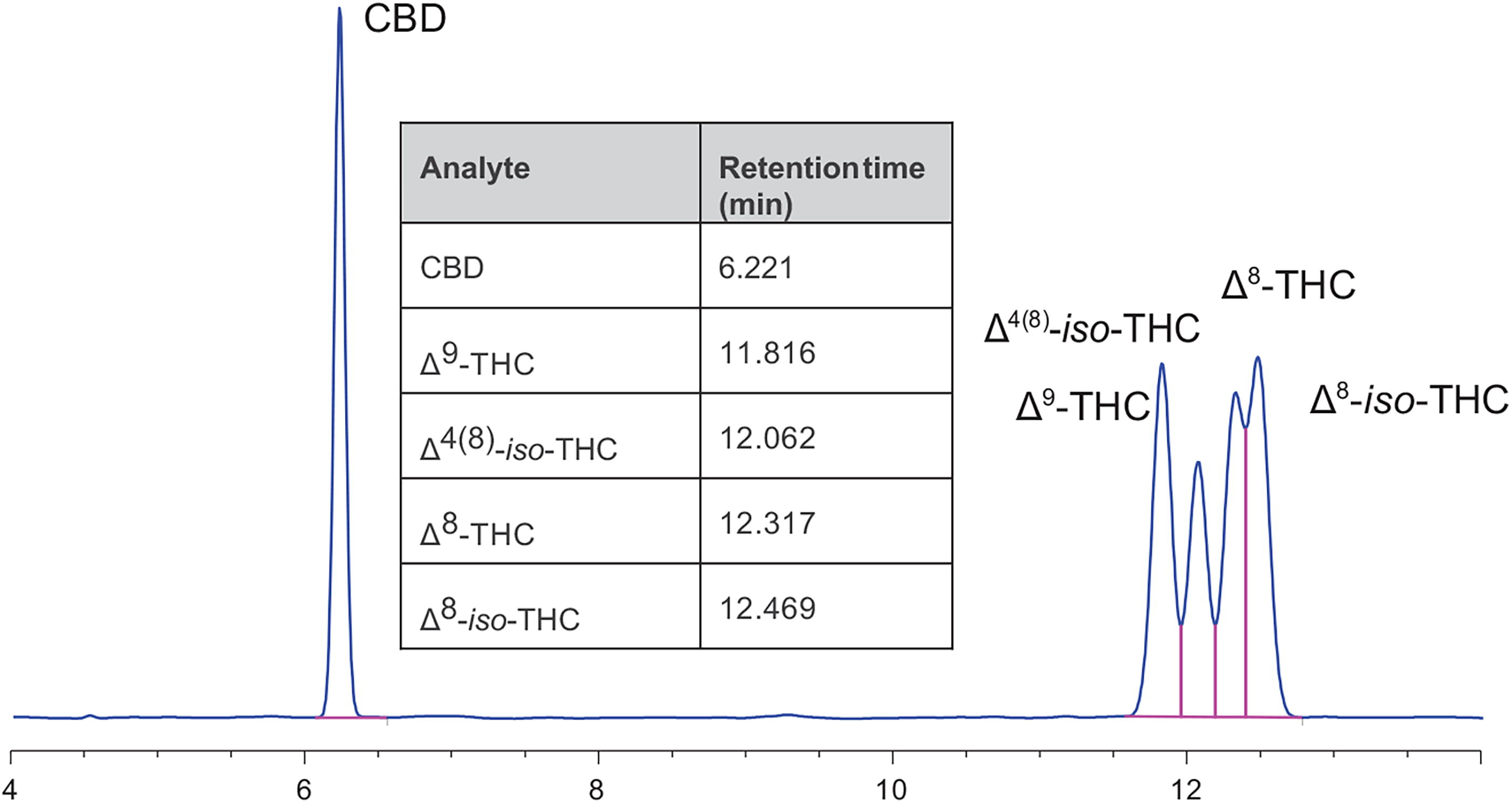
Optimized HPLC chromatogram of the mixture of the THC and iso-THC standards using the optimized method for cannabis analysis (reproduced from Cayman Chemical, MI materials 51 ). Co-injection of CBD, Δ9-THC, Δ4(8)-iso-THC, Δ8-THC, and Δ8-iso-THC. Agilent 1100 HPLC with Raptor ARC-C18 column (150 × 4.6 mm, 2.7 µm), 30:70 H2O:ACN, 0.1% AcOH mobile phase, 1 mL/min flow rate, T = 40°C, 228 nm. CBD, cannabidiol; HPLC, high-performance liquid chromatography; THC, tetrahydrocannabidiol.
An additional complex issue arises from the co-elution of iso-THC isomers with the main Δ8-THC and Δ9-THC peaks, making them inseparable by HPLC.51,52 The presence of these iso-THCs in hemp-derived cannabinoid mixtures has been conclusively confirmed through characteristic Nuclear Magnetic Resonance signatures and used for semi-quantitative analysis.53,54 However, the detection of iso-THCs by HPLC has remained elusive for a long time, as reference standards only recently became available (e.g., from Cayman Chemicals). A streamlined path to reliable quantification of the CBD-to-THC conversion panel is now emerging with the reintroduction of GC-FID, 25 and GC-MS spectroscopy,51,55 optimized for fit-for-purpose objectives (Fig. 3). In these improved GC methods, most main and side products yield well-separated peaks, and their identities have been established using a wide array of reference standards, either commercially available or synthetically produced. Widespread adoption of these appropriate methods faces minimal technical barriers, as most commercial cannabis analytical labs are already equipped with GC instruments (commonly used for terpene analysis). So, the remaining hurdles primarily involve regulatory adoption, standardization, and oversight.

GC chromatogram of the mixture of the THC and iso-THC standards (CBD, Δ9-THC, Δ4(8)-iso-THC, Δ8-THC, and Δ8-iso-THC) in the GC-MS method optimized for the analysis of the hemp-derived products (reproduced from Cayman Chemical, MI materials 51 obtained in collaboration with KCA Labs, KY 64 ). Agilent 8890 GC, 5977B MS detector, Restek Rtx-5MS capillary column (30 m × 320 μm × 0.5 μm). Injector T = 300°C, oven T programmed to start at 50°C and increase 40°C/min to 210°C, hold 20 min, then increase 40°C/min to 300°C and hold 8.75 min. Run time 35 min. The injection mode was set to split with a ratio of 60:1. Helium carrier gas at 2 mL/min. GC, gas chromatography; THC, tetrahydrocannabidiol.
An integrated use of different analytical methods played a key role in revealing the operation of pathway C (Scheme 1) in the catalytic conversion of CBD. It is illustrated by the discovery of tetrahydrodibenzofuran scaffolds in 27 commercial Δ8-THC samples of vaping liquids. 9 The structure of the compound was unambiguously identified by qNMR as (5aR,9aS)-5a-isopropyl-8-methyl-3-pentyl-5a,6,7,9a-tetrahydrodibenzo[b,d]furan-1-ol (iso-THCBF) and present in quantities up to 1.7% along with 2–13% of concomitant Δ4(8)-iso-THC. In addition, iso-THCBF has been isolated in small quantities by ElSohly et al. 25 during preparatory HPLC fractionation of CBD-to-THC conversion reactions catalyzed by p-Toluenesulfonic Acid. However, there are currently no reported synthetic procedures or commercially available analytical standards for iso-THCBF. Closely related reduced analogs of dibenzofurans have been reported by Arnone et al., 56 who observed furan cyclization in condensation reactions of olivetol and orcinol with piperitol, pulegol, and isopiperitenol. Their unequivocal structural assignments were confirmed via acid-catalyzed ring closure of 6’-isopropyl-3′,4-dimethyl-1’,2’,3′,4’-tetrahydro-[1,1’-biphenyl]-2,6-diol, which positions the endocyclic double bond for furan ring formation. Another related class of furanoid compounds, known as cannabielsoins, can be generated either enzymatically by Cytochrome C450 (CYPs) in vivo or through thermal degradation of CBD at high temperatures in an oxygenated environment though the furan ring closure in this case occurs via an endocyclic C(2) carbon of CBD. This process is often accompanied by methyl group oxidation to alcohol and partial or full aromatization of the cyclohexene ring. 57
Pathway C acidic cyclization of CBD and the formation of cis-THC align with growing evidence of the natural occurrence of cis-cannabinoid motif stemming from racemization at the carbon atom bonded to the isoprene moiety. Several publications have recently reported highly stereoselective and efficient synthetic methods to produce cis-THC.58,59 Conversely, the migration of THC’s double bond to Δ10-THC and Δ6a,10a-THC occurs predominantly under strongly basic conditions, 60 and the products elute at longer retention times, avoiding interference in HPLC analyses of Δ9-THC and Δ8-THC. Small amounts of Δ10-THC could form in acidic conditions, albeit in harsher reactions, for example, by prolonged reflux of CBD in ethanol with hydrochloric acid, a reaction that also prompts recyclization of CBD to cannabichromene (CBC). 61
The untapped potential of chiral HPLC for analyzing complex cannabinoid mixtures offers opportunities to uncover previously undetected stereoisomers.62–64 However, scaling this technique for mass analysis is challenging due to its reliance on 100% organic mobile phases rather than reverse-phase conditions, necessitating specialized HPLC setups.
Progressive service providers are now offering diverse methodologies tailored to specific cannabinoid panels. For example, KCA Laboratories (Nicholasville, KY) has developed an exemplary GC-MS method capable of quantifying over 20 analytes from hemp-derived products and doesn’t require the detection of acidic cannabinoids (Table 1). 65 These analytes may be grouped as follows based on their origin: (1) non-carboxylated canonical cannabinoids (could be reliably quantified using orthogonal HPLC methodologies); (2) key products of acidic CBD cyclization, including Δ8-THC, Δ9-THC, and iso-THCs; (3) Δ10-THC derivatives from base-promoted cyclization or minor products of acidic conditions; (4) oxidation and cyclization byproducts from stressed conversions; and (5) a panel of canonical varinic (3-substituted propyl homologs) cannabinoids similar in scope to the (1) panel. Additionally, KCA Laboratories has added derivatization with BSTFA (N,O-bis[trimethylsilyl]trifluoroacetamide) followed by GC-MS analysis to increase the versatility of its offerings. It now quantifies acidic cannabinoids with neutral cannabinoids by GC-MS because the TMS derivatives of the acidic cannabinoids are stable and do not undergo decarboxylation.
A Panel of Analytes in GC-MS Analysis of the Hemp-Derived Cannabinoids (KCA Labs, KY)
GC‐MS, gas chromatography–mass spectrometry; THC, tetrahydrocannabidiol.
Furthermore, numerous oxidation products and cis-stereochemistry cannabinoid scaffolds fit well into GC-MS and GC-FID analyses, showcasing the method’s versatility when applied to hemp-derived products.
Therapeutic Potential of the CBD + THC Combination Products
A well-controlled CBD-to-THC conversion offers another significant application: the generation of CBD + THC combination products with varying strengths and component ratios. The current abundance of such products has been driven by various factors. Initially, the combination products were conceptualized based on an empirically optimized 1:1 “golden ratio” of CBD to THC, aimed at maximizing medical benefits while minimizing side effects. 66 This concept then evolved into a broader spectrum of blends, particularly those with a more dominant CBD composition (ranging from 1:1 to as much as 20:1), and later into low-THC potency products (up to 50:1) and micro-dosing products 67 (containing less than 0.3% Δ9-THC, enabling wider product circulation). These products are increasingly being adopted in more strictly regulated European hemp and cannabis markets, such as Germany, where they offer one of the few viable treatment options for patients.68,69
It is hypothesized that the proper selection of CBD + THC ratios can be fine-tuned for different disorders, the main ones being pain, anxiety, and insomnia, often using a titration dosing paradigm, 70 and possibly mitigating the adverse effects of Δ9-THC. 71 This view is gaining traction among medical practitioners, who serve an estimated 3.8 million medical cannabis patients in the United States (as of 2022), 72 and among a large portion of the growing consumer base seeking cannabinoids for medicinal purposes on their own (more than a quarter of all users in the United States).
While CBD + THC combination products are available through the cultivation of hemp and cannabis, this approach is often less efficient compared with conversion methods due to natural variability in plant strains, the use of isolates from multiple strains, and potential contamination issues (e.g., solvents, mold, heavy metals, and herbicides).
As discussed in prior sections, the importance of proper analytical controls becomes even more critical for products with low-THC potency, which are gaining popularity in micro-dosing applications and dose titration protocols.70,73 For such applications, targeting medium-to-low conversion ratios in CBD-to-THC cyclization in mild reaction conditions should lead to improved purity and minimization of side products as compared with reactions run to completion (i.e., full consumption of CBD).
Concluding Remarks
The results of recent investigations point clearly toward better process controls and best practices for accessing both Δ8-THC and Δ9-THC from CBD via acid-catalyzed cyclization, producing CBD + THC combination products, and prompting a reevaluation of CBD’s role as a potential natural source for other cannabinoids. 74 The blueprint for moving forward in harnessing abundant and inexpensive CBD stock may lie within more stringent approaches commonly adopted in pharmaceutical development. This would involve introducing precise reaction controls, establishing proper (orthogonal) analytical methods, considering the adoption of separate assay and purity methods common in pharma development, and conducting full structural characterization and quantification of side products to ensure the safety of the final product. For instance, it would be highly beneficial to conduct safety and toxicology assessments of the two iso-THC isomers, which are major products of an alternative cyclization pathway. Expanded use of GC chromatography will likely help detect iso-THCs in various products and improve the label information. The exploration of CBD-to-THC conversion also underscores the significance of cis-THC products—both naturally occurring and those formed through acidic epimerization—and highlights the need for closer attention to the complex stereochemistry of cannabinoids. It is astonishing that no significant clinical trials have yet been sponsored for Δ8-THC.
With the upcoming renewal of the 2018 Farm Bill, it is crucial that scientific research stays ahead of regulatory changes, ensuring more informed decisions and safer consumption of both recreational and therapeutically valuable products. The new upcoming 2024 version of the U.S. Farm Bill 75 will likely, and justifiably, set significant limitations on Δ8-THC products by expanding the 0.3% THC residual threshold in CBD to include any THC isomers. The Bill’s new definition of industrial hemp also aims to prevent the use of CBD as a precursor for other cannabinoids. However, this review serves as a reminder that these “other cannabinoids” are only one well-studied chemical reaction away, adding meaningfully to the fascinating kaleidoscope of potentially useful natural and plant-derived molecules and their easy transformations.
Footnotes
Authors’ Contributions
A.N. conceptualized a framework of the review, established a structure of the presented material, collected key references, and led the drafting and editing process. M.P. contributed to the overall edits to optimize an integrated narrative and sections of the manuscript about medical relevance. The authors are grateful to Ksenia Garcia for help in producing high quality images.
Author Disclosure Statement
Both authors are stakeholders in C-Click Life Sciences, Inc., San Diego, CA, the company incorporated to commercialize the processes and devices for solid-supported catalytic conversion of CBD to THC.
Funding Information
No funding was received for this article.