




Abstract
Objective:
The purpose of this study was to determine the efficacy and safety of omega-3 fatty acids for children with autistic spectrum disorder (ASD).
Methods:
This was an open-label pilot study. Ten children aged 4–7 years old with ASD according to the Diagnostic and Statistical Manual of Mental Disorders, 4th edition (DSM-IV), were given 1 gram daily of omega-3 fatty acids for 12 weeks. The main outcome measure used was the Autism Treatment Evaluation Checklist (ATEC). These data were collected between July, 2006, and June, 2007.
Results:
Of the 9 subjects who completed the study, 8 showed improvement of about 33% on the Autism Treatment Evaluation Checklist (ATEC). None worsened and no side effects were reported.
Conclusions:
Omega-3 fatty acids appear to be safe and might be helpful for children suffering from ASD. Further study is needed with a larger number of children in a double-blind design and with various doses of omega-3 fatty acids.
Introduction
Methods
The study was approved by the Ben Gurion University Helsinki Committee (Institutional Review Board), and parents of the children signed written informed consent. All children were diagnosed with autism spectrum disorder according to the Diagnostic and Statistical Manual of Mental Disorders, 4th edition (DSM-IV) (American Psychiatric Association 1994) and rated for severity according to the Childhood Autism Rating Scale (CARS) (Stella et al. 1999). All children received a severity rating of at least moderate according to CARS at baseline. The children were diagnosed and evaluated by a board-certified child psychiatrist (G.M.) on entrance to the study, at week 6, and at the end of the study at week 12. During interim weeks, the children were rated by a trained clinical rater (Y.B.), a senior medical student, under the supervision of the child psychiatrist (G.M.). Omega-3 fatty acids were administered as two daily 500-mg capsules that contained 190 mg of eicosapentanoic acid and 90 mg of docosahexaenoic acid per 500-mg capsule. The dose chosen was on the basis of our previous findings of positive improvement in children with major depression treated with omega-3 fatty acids (Nemets et al. 2006).
At the beginning of the study, at 6 weeks, and at 12 weeks, each subject was evaluated by CARS, Clinical Global Impressions (CGI), and Children's Psychiatric Rating Scale (CPRS) (Overall and Campbell 1988). For the first 6 weeks, there was a weekly evaluation of every subject using the Autism Treatment Evaluation Checklist (ATEC) (Rimland and Edelson 1999), CGI, and CPRS. At the end of the 6-week period of study and after 12 weeks, we evaluated the children using CARS, CGI, CPRS, and ATEC. These data were collected between July, 2006, and June, 2007.
The CPRS was chosen on the basis of previous studies in autism psychopharmacology (Masi et al. 2003; Findling et al. 2004; Gagliano et al. 2004). ATEC was chosen on the basis of previous studies that showed it to be sensitive to change with other treatments of autism (Jarusiewicz 2002; Lonsdale et al. 2002; Klaveness and Bigam 2005).
Results
One subject dropped out after two sessions because his family moved from the area. Eight of the 9 subjects that completed the study period showed improvement. In these 8 subjects, the improvement from baseline to 12 weeks averaged 33% according to ATEC (Fig. 1). Most of the improvement was in the first 6 weeks. The CGI, CPRS, and CARS showed the same trend. One child did not respond at all; none worsened. One subject stopped taking the omega-3 fatty acids after 6 weeks, and his clinical state deteriorated; after renewing treatment, he improved again.
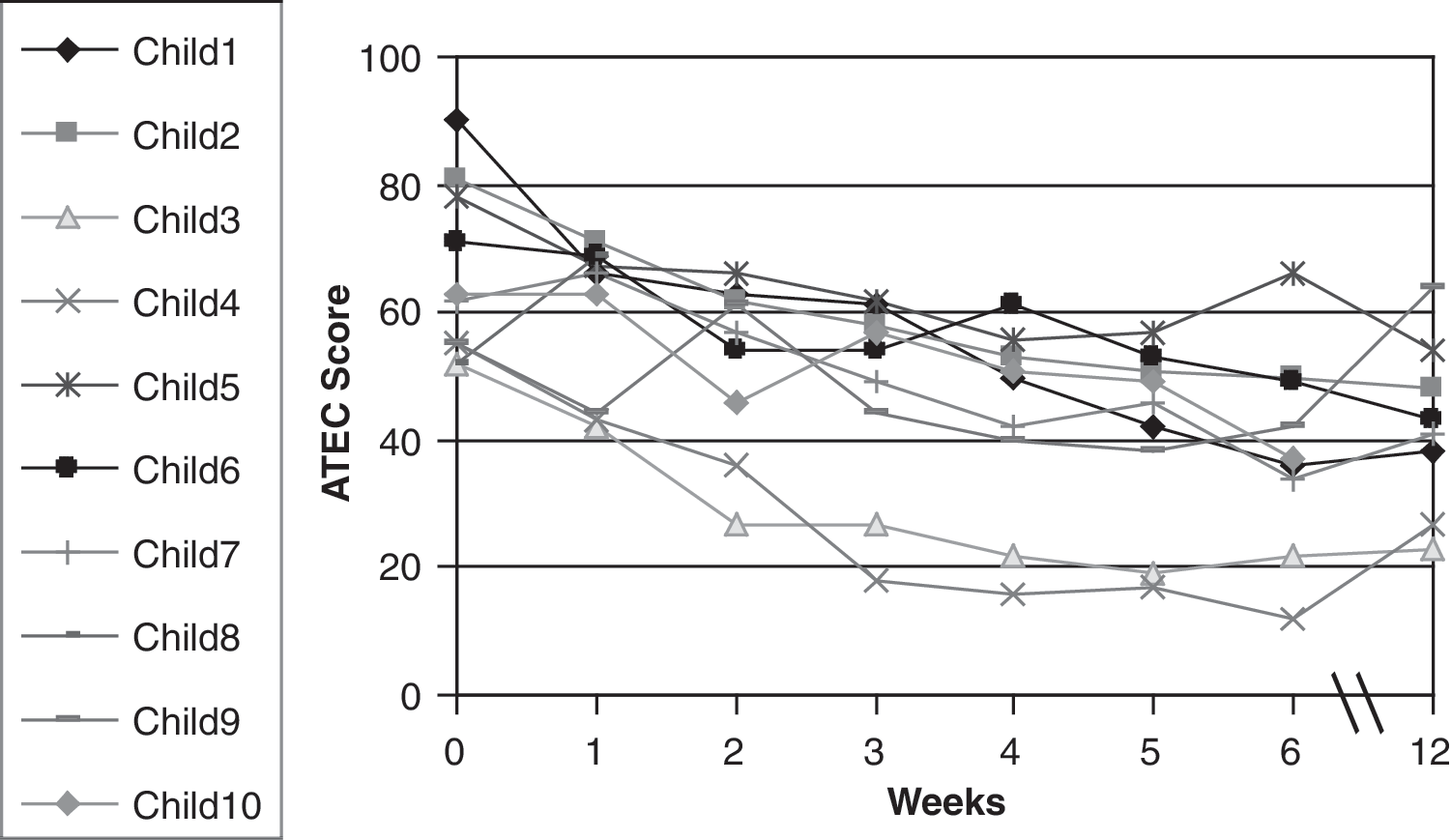
Autism Treatment Evaluation Checklist.
Discussion
These results confirm those of Amminger et al. (2006). Because fatty acid dietary intake is different in different countries and cultures, it is especially important to replicate findings related to omega-3 fatty acid treatments in countries with different diets. Some of the improvement we noted occurred in the autistic core symptoms, such as sociability and speech. There was no specific parameter in which the children improved, but rather there was a general improvement in all of the autistic symptoms.
These encouraging results require study of different doses of omega-3 fatty acids. Some previous studies have used doses of up to 10 grams a day in adults (Stoll et al. 1999), but others (Peet and Horrobin 2002) have suggested that the dose–response curve may show decreased response at higher doses. It would also be important to study time course because the effect over months and years might show tolerance or, on the other hand, increasing effectiveness. A recent study by Salem et al. (2001) showed effects of omega-3 fatty acids in rats on brain function and development, making the clinical findings described above biologically plausible. Given that omega-3 fatty acids are nonpatentable and pharmaceutical company funding is unlikely, it is critical that investigator-initiated studies be conducted for these compounds.
Footnotes
Disclosures
G. Meiri, Y. Bichovsky, and R.H. Belmaker have no conflicts of interest or financial ties to report.