




Abstract

Here, we present the case of a 7-year-old boy with PDD-not otherwise specified (NOS) and chronic diurnal bruxism treated with buspirone. To our knowledge, this is the first case of a developmentally disabled patient with diurnal bruxism that remitted after treatment with an anxiolytic.
Case Report
AA was a 7-year-old boy with previously diagnosed PDD-NOS and moderate mental retardation. Accompanied by his parent, he presented with the chief complaint of significant bruxism, predominantly diurnal but also nocturnal. His constant bruxism had led to his teeth being ground flush to his gums (Fig. 1). During the initial evaluation, he was grinding his teeth. When asked to stop, he was able to do so, only to resume the grinding soon thereafter.
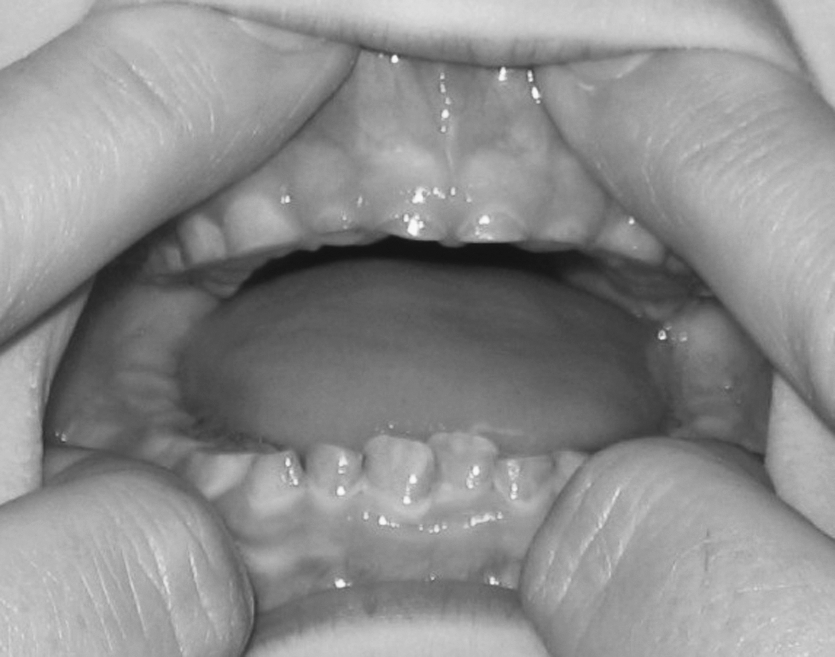
Oral damage secondary to bruxism in a 7-year-old boy with pervasive developmental disorder-not otherwise specified.
In addition to the diagnoses of bruxism and PDD-NOS, this patient had a complicated medical history after a premature birth at 26 weeks. He was born THC-positive and developed necrotizing enterocolitis shortly thereafter. AA has an unspecified metabolic disorder, chronic lung disease, asthma, gastroesophageal reflux disease (GERD), short gut syndrome, and liver cirrhosis with associated portal hypertension with esophageal and colonic varices. He receives most of his nutrition through a gastrostomy tube and has endured multiple surgeries due to his many concurrent medical conditions. On presentation, AA was on propranolol, lansoprazole, fluticasone, phytonadione, codeine sulfate, cetirizine, montelukast, and albuterol, along with vitamin K injections. He had had no previous psychiatric evaluations and had never been on a psychotropic medication or partaken in behavioral therapy. He did not suffer from any craniofacial anomalies.
With the belief that his social, communication, and medical difficulties were causing him significant distress and leading to his bruxism, it was deemed most appropriate to start an anxiolytic targeting bruxism. AA was started on buspirone 2.5 mg daily for 1 week, which was then increased to 2.5 mg twice daily thereafter. Buspirone was chosen because of its limited side effect profile and concerns about side effects associated with selective serotonin reuptake inhibitor (SSRI) use in youth with PDDs, such as behavioral activation (King et al. 2009). After 2 weeks of treatment, the patient's parent called noting little-to-no improvement in his bruxism. The dosage was then increased to 5 mg twice daily. This increased dosage improved AA's symptoms for only a short while. After 2 months, the buspirone dose was increased to 5 mg three times daily, as AA's parent noted that AA had resumed grinding his teeth in the afternoon. Once on 5 mg three times daily, the patient's parent noted that his bruxism had stopped throughout the day and night. At this time, his Clinical Global Impressions-Improvement (CGI-I) Scale score was 1, “very much improved.” (Guy, 1976) (Scores range from 1=“very much improved” to 4=“unchanged” to 7=“very much worse.”)
Several months after buspirone initiation, AA's parent called, noting that he had been staying up late in the evening and waking up during the early morning hours on his current dose of buspirone. His parent said that these changes had commenced 2–3 weeks after the last dosage increase. His parent also noted daytime sleepiness. At this time, AA was started on melatonin 3 mg at bedtime that was subsequently increased after several weeks to 6 mg to treat insomnia that was believed to be secondary to buspirone. Melatonin was ineffective in treating his insomnia and was replaced with trazodone 25 mg and later 75 mg at bedtime.
At follow-up 9 months after buspirone initiation, AA's bruxism remained improved, but afternoon teeth grinding had recurred, resulting in a CGI-I score at this time of 3, “minimally improved.” At this time, buspirone was increased to 7.5 mg three times a days, resulting within weeks in the cessation of bruxism and the return of a CGI-I score of 1. Due to continued daytime sedation and nighttime awakenings, an attempt was made to reduce the buspirone dose to 5 mg thrice daily. This reduction resulted in a return of teeth grinding and resultant dose increase back to the most effective dose of 7.5 mg thrice a day. At this point in his treatment, AA had four permanent teeth.
Over the course of 1 year of treatment with buspirone, AA's bruxism significantly improved. Buspirone use was associated with sleep disturbance and daytime sedation that only partially improved with trazodone. AA remained on trazodone. Trazodone use was associated with a reduction in nighttime awakenings, but some awakenings persisted with this medication.
Discussion
It is currently unclear as to why patients with developmental disabilities frequently exhibit bruxism. Some contend that bruxism is due to an anatomical abnormality, such as malocclusion or dental trauma. In these cases, it has been found that dental-based therapies have been most effective (Muthu and Prathibha 2008; Lang et al. 2009). Prosthodontics and dental surgery have been used with some success. However, many studies have found that using intraoral appliances in patients with developmental disabilities is difficult, given that such patients tend to lack the capacity to understand the need for compliance with such devices and are unable to tolerate the device in their mouths. Medical techniques have also been tried. One study found that an injection of botulinum toxin-A into the masseter of a patient with autism was successful in reducing the patient's bruxism for a period of 60 days (Monroy and da Fonseca 2006).
Another potential etiology for bruxism in children with developmental disabilities is psychological. Advocates of this view believe that bruxism in these children is reinforced by operant contingencies and that treatment will be most effective if behaviorally based (Lang et al. 2009). These studies have utilized cueing procedures at the onset of bruxing and the delivery of an aversive stimulus (Bebko and Lennox 1988; Barnoy et al. 2009). Music therapy has also been tried, but with little success (Lang et al. 2009).
Although some medications have been associated with bruxism, it is unlikely that this patient's symptoms were iatrogenic, as none of his medications has been associated with bruxism. Propranolol has, in fact, been shown to decrease bruxism (Amir et al. 1997). Studies have also found an association between bruxism and GERD. AA developed GERD early in his life. Although one study focused on adults with nocturnal bruxism as opposed to children with diurnal bruxism such as AA, it was found that esophageal acidification induced rhythmic movements of the masseter muscle and, thereby, bruxism (Ohmure et al. 2011). Children with GERD may thus be more likely to develop bruxism themselves.
Yet another possible etiology of bruxism is related to anxiety that results from stress (Glaros and Rao 1977; Lang et al. 2009). Children with PDDs tend to avoid social contact, have difficulty communicating, and often exhibit self-injurious behaviors. These symptoms may be among the factors that lead to wear on the teeth via bruxism (DeMattei et al. 2007). At present, though, no treatments have been devised to treat the stress or reduce the anxiety in the developmentally disabled population. It was our belief that the bruxism in our patient was related to anxiety about his multitude of medical, communication, and social difficulties. With that in mind, we determined that a trial of buspirone, an anxiolytic, would be the best course of treatment. Buspirone is known to have a high affinity for serotonin (5-HT1A) receptors and moderate affinity for dopamine (D2) receptors. In contrast to benzodiazepine anxiolytics, buspirone is known for having less of a sedating effect (Bristol-Myers Squibb Co. 2010). Despite this fact, treatment-associated sedation and sleep disturbance were noted in our case.
In healthy adults, bruxism is primarily nocturnal. Buspirone use has been described in several reports in healthy adults with bruxism. Several case reports detail the effects that buspirone has in reducing bruxism in this population (Ellison and Stanziani 1993; Bostwick and Jaffee 1999; Ranjan et al. 2006). Many of these studies dealt with patients who developed bruxism after treatment with an SSRI. These authors posit that bruxism follows SSRI treatment, because these drugs increase extrapyramidal serotonin levels, thus leading to a decrease in dopamine levels. The cell bodies of serotonergic neurons synapse with the cell bodies of dopaminergic neurons in the ventral tegmental area of the midbrain (Bostwick and Jaffee 1999). When dopamine levels fall, centrally mediated movements become less controlled, and, thus, bruxism, a movement of the teeth, may occur. When buspirone is given to these patients, it is thought to act as an agonist at the D2 receptors and counteract the SSRI-suppressed dopamine levels. Additionally, buspirone acts as a partial agonist at postsynaptic 5-HT1A receptors and competes with serotonin for binding sites. Therefore, it reduces serotonergic activity, leading to increased dopaminergic activity. With this hypothesis in mind, if patients with developmental delay are found to have reduced dopamine or enhanced serotonin function, then treatment with buspirone would likely aid in the treatment of their bruxism. It is likely that dopamine dysregulation plays a role in the mechanism of bruxism (Amir et al. 1997).
In conclusion, this case shows that buspirone was effective in eliminating the symptoms of bruxism in a child with PDD-NOS. To our knowledge, this is the first case of a child with a PDD whose bruxism remitted after treatment with buspirone. Whether the etiology is wholly stress or anxiety-related or related to neurochemical dysregulation remains to be seen. However, the significant improvement observed in this case suggests that buspirone should be considered in other cases of bruxism and comorbid developmental disability. The only side effects noted during the trial were daytime sedation and nighttime awakenings. The present case suggests that the impact of buspirone on bruxism in youth with developmental disorders should be further investigated. Additional attempts should be made to investigate the effects of benzodiazapine anxiolytics on children with concurrent developmental disorders and bruxism.
Footnotes
Disclosures
Danielle K. Orsagh-Yentis has no conflicts of interest or financial ties to disclose. Logan K. Wink has no conflicts of interest or financial ties to disclose. Craig A. Erickson is a current or past consultant to F. Hoffman-La Roche, Ltd. and Novartis. He has received grant support from F. Hoffman-La Roche, Ltd., Novartis, Bristol-Myers Squibb Co., and Seaside Therapeutics. Christopher J. McDougle is a member of the Speakers Bureau for Bristol-Myers Squibb Co. Kimberly A. Stigler receives research grant support from Forest Pharmaceuticals and from Bristol-Myers Squibb Co.