




Abstract

To the Editor:
Not all adverse events occurring with oral olanzapine were also reported for OLAI, probably because the latter has only recently been introduced. In particular, skin reactions have been associated with administration of olanzapine, such as hyperpigmentation (Jhirwal et al. 2004), exanthemata or rashes (Christen et al. 2006), vasculitis (Duggal et al. 2005; Papaioannides et al. 2006), xanthomatose or lichenoid eruptions (Chang et al. 2003; Sinnott and Mazzone 2006) various dermatitides (Rashid et al. 2007; Lowney et al. 2010), and hypersensitivity syndromes (Raz et al. 2001; Benito-Leòn et al. 2005; Prevost et al. 2011), but not with OLAI (Chue and Chue 2012).
Juvenile idiopathic arthritis (JIA) designates a group of chronic arthropathies, which constitute the most common rheumatic group of conditions in children. JIA is not a disease proper, but rather an exclusion diagnosis that applies to any arthritis of unknown cause (such as infectious, oncologic, or other rheumatic etiologies) persisting for >6 weeks with an onset before age 16 (Huang 2012).
We report on a patient affected by JIA who developed an extensive skin rash after switching from oral olanzapine to OLAI.
Case Report
A 17-year-old Caucasian male was admitted to the emergency psychiatric unit in July 2011, presenting with mystic delusions, increased self-esteem, auditory and visual hallucinations, decreased sleep (3–4 hours/night), disorganized speech resulting from loosening of associations, and psychomotor agitation. His history was negative for psychiatric disorders and substance abuse. He had been affected by human leukocyte antigen (HLA)-B27 positive JIA with sacroiliitis since the age of 14, which was treated with intramuscular methotrexate, 7.5 mg/week; oral folic acid, 5 mg/day; oral sulfasalazine, 1.5 mg/day; and subcutaneous etanercept, 50 mg/week. He was currently free from rheumatic symptoms. He reported no allergic reactions to drugs or other substances. We diagnosed American Psychiatric Association, Diagnostic and Statistical Manual of Mental Disorders, 4th ed., Text Revision (DSM-IV-TR) (American Psychiatric Association 2000) schizophreniform disorder and treated him with oral 15 mg/day olanzapine (increasing it to 20 mg/day after 5 days), intravenous desmethyldiazepam, 2 mg/day, and intravenous promazine, 50 mg/day.
On admission, routine laboratory tests showed no abnormalities. Two days later, serum glutamic oxaloacetic transaminase (SGOT) was 193 U/L (reference values [r.v.], 15–46), lactate dehydrogenase (LDH) was 749 U/L (r.v., 313–618), creatine kinase (CK) was 4146 U/L (r.v., 55–170), conjugated bilirubin (direct) was 0.44 mg/dL (r.v., 0.00-0.40), and total bilirubin was 1.04 mg/dL (r.v., 0.2–1.40). These values gradually returned to the normal range within 1 week.
After 21 days of treatment, his psychotic symptoms had improved, and the acute phase had remitted. We switched from oral olanzapine to OLAI at a dosage of 300 mg every 3 weeks, and discharged the patient from the acute ward, referring him to our outpatient facility. He started regular attendance of his follow-up schedule 1 week later.
Eight days after the first OLAI administration, a rash spreading from the shoulder and rapidly extending over the entire dorsal trunk occurred (see Fig. 1). The skin eruption was not associated with fever, itch, or other clinical symptoms, and routine laboratory tests were normal, except SGOT (84 U/L) and serum glutamic pyruvic transaminase (SGPT) (129 U/L). We immediately administered 4 mg intramuscular betamethasone and 4 mg oral chlorphenamine. During the following 12 hours, the rash gradually disappeared, leaving no residual damage. Transaminase values returned to normal within 1 week. Three months from the first injection no other adverse events occurred, and treatment continued. The patient's diagnosis had converted to schizophrenia by that time. The side effect obtained a score of 7 on the Naranjo Adverse Drug Reaction (ADR) Probability Scale (Naranjo et al. 1981), compatible with a probable association with the drug. The patient signed free, informed consent for treatments received and for the publication of his case.
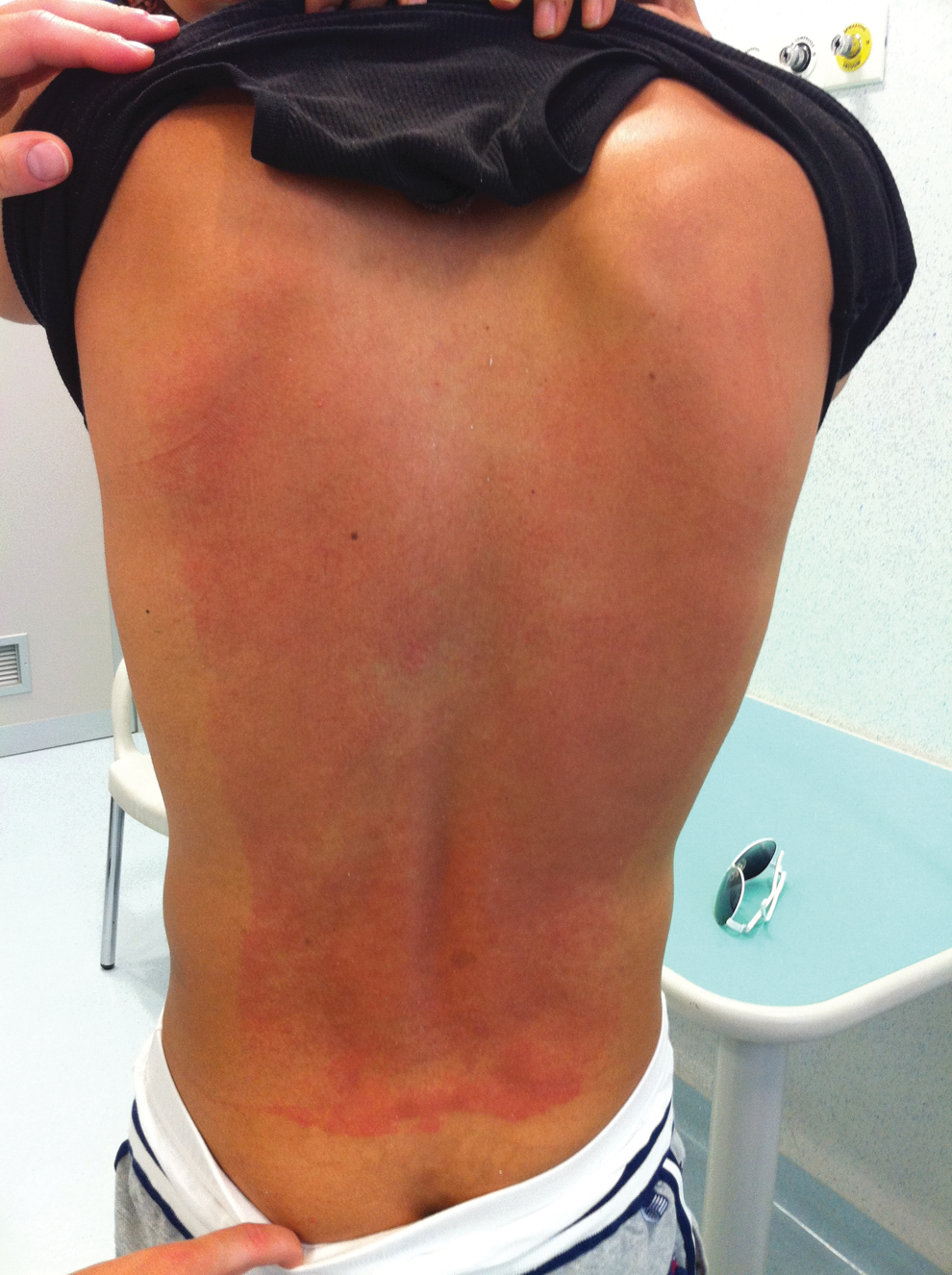
Rash involving the entire dorsal aspect of patient's trunk 8 days following first dose of olanzapine (OLAI). A color version of this figure is in the online article at
Discussion
Rash is common in JIA, but differently from the one we observed after switching the patient from oral olanzapine to OLAI, it is light pink, measles-like, associated with fever, and immediately subsiding (it abates after minutes or hours) (Espada et al. 2009). Our patient's rash was red and homogeneous, completely covering the back, unrelated to underlying arthritis, and needing 18–20 hours of steroid treatment to subside. The state of remission of arthritis, the type of rash presentation and duration, the absence of medication and food allergies, and the score on the Naranjo scale supported the possible iatrogenic origin of the rash.
Despite the wide diffusion of long-acting antipsychotics, few cutaneous effects have been reported with such formulations, that is, an anaphylactoid reaction with paliperidone palmitate after switching from risperidone (Perry et al. 2012), and an erythematous rash with long-acting risperidone after switching from its oral formulation (Reeves et al. 2005). Our case shares with these reports the lack of side effects during oral intake and the development of skin reaction some time after switching to the long-acting formulation.
This is the first erythematous reaction to OLAI not confined to the site of injection. We cannot specify the culprit of the rash reaction we observed in our patient, but we consider it unlikely that palmitate or other excipients were involved. As it was a delayed reaction, we cannot rule out a late reaction to oral olanzapine. The rash was impressive, but relatively benign and promptly responding to steroid treatment, with little systemic involvement, and probable mild, transient liver discomfort. We recommend close observation of patients with autoimmune disorders needing long-acting antipsychotics, including olanzapine, and the immediate use of steroid drugs to control the rash.
Footnotes
Acknowledgments
We gratefully acknowledge the contribution of the librarians of the School of Medicine and Psychology of Sapienza University, Mimma Ariano, Felicia Proietti and Tiziana Mattei, for the identification of relevant literature.
Disclosures
For the past 3 years, Paolo Girardi has received research support from Lilly and Janssen; participated in Advisory Boards for Lilly, Organon, Pfizer, and Schering; and received honoraria from Lilly and Organon. No other author of this article has relevant affiliations or financial involvement with any organization or entity with a financial interest in, or financial conflict with, the subject matter or materials discussed in the article. This includes employment, consultancies, honoraria, stock ownership or options, expert testimony, grants or patents received or pending, or royalties. No writing assistance was utilized in the production of this manuscript.