




Abstract

To The Editor:
Variations in D1 polymorphism rs4532 are associated with ADHD (Bobb et al. 2005) and predict side effects to medication for schizophrenia (Potkin et al. 2003; Lai et al. 2011), although in the latter studies the effects may relate to excess dopamine at the D1 receptor. In both cases, there are good reasons to suggest that D1 receptor genetics may predict side-effects from stimulant medication for ADHD.
We tested the relationship of stimulant side effects to common variations in DA receptor genes using 90 Caucasian children (79.2% males) who met formal criteria for American Psychiatric Association, Diagnostic and Statistical Manual of Mental Disorders, 4th ed. (DSM-IV) diagnosis of ADHD (American Psychiatric Association 1994); were 4–14 years of age (mean=8.85 years; SD=2.32); had no major neurological/physical illness; had an intelligence quotient (IQ) >70; were using stimulant medication; and were not using another psychoactive medication (full demographic and diagnostic data and medication use available from Dr. Levy). Ethics approval and fully informed consent was from the University of New South Wales.
Participants gave blood (52.5%) or saliva (or both for a smaller reliability check sample) via Oragene saliva collection kits (
Medication doses were standardized to a standard Ritalin (IR) dose of 10 mg by the following formula: Dexamphetamine 5mg=Ritalin IR 10mg; Ritalin (modified release) 10mg=Ritalin IR 5mg b.i.d.; Concerta 18mg=Ritalin IR 5mg t.i.d.
We reduced the 16 side effects items to factors using principal components analysis. Both parallel analysis and Velicer's minimum average partial (MAP) test indicated that there were three nonrandom factors; therefore, we generated a three factor solution using Varimax rotation with Kaiser normalization. Factor loadings are available from Dr. Levy. The three factors, nausea, withdrawal (social), and irritability, accounted for only 48.2% of variance, six items failed to load, and one (emotional) cross-loaded on two factors. The factors aligned well, however, with our clinical and theoretical expectations. We first checked if level of side effects correlated with any demographic or dosage variables that might confound results. None of the side effects measures correlated with level of stimulant dose indexed as a raw dosage, standardized across medication variants, or after dividing by age or weight. Using other potential confounders, there were no significant correlations for nausea; however, both appearing rigid and “Zombie”-like and irritability correlated positively with age (r=0.23 and 0.27, p<0.05 respectively). The relationship of the polymorphisms to side effects was tested using multivariate analyses of covariance (MANCOVAs) in which side effect levels were the dependent variables, and allelic status was the independent variable (coded 0=minor; 1=heterozygote; 2=major homozygote; National Center for Biotechnology Information [NCBI] dbSNP build 79/137). Age, dose/weight, and IQ were all used as covariates.
Mean severities of nausea, withdrawal and irritability side effects split by children's status on each allele type are shown in Figure 1. A significant effect of allele status was found for rs4532, the DRD1 receptor polymorphism using Bonferroni correction, F(6,134)=5.73, p<0.001. Univariate follow-up tests showed that the SNP effect was significant for withdrawal, F(2,68)=15.99, p<0.001, with a nominally significant trend for nausea, F(2,68)=3.95, p=0.02. As can be seen in Figure 1, the minor homozygote CC was associated with more severe side effects than either the heterozygote CT or the major homozygote TT.
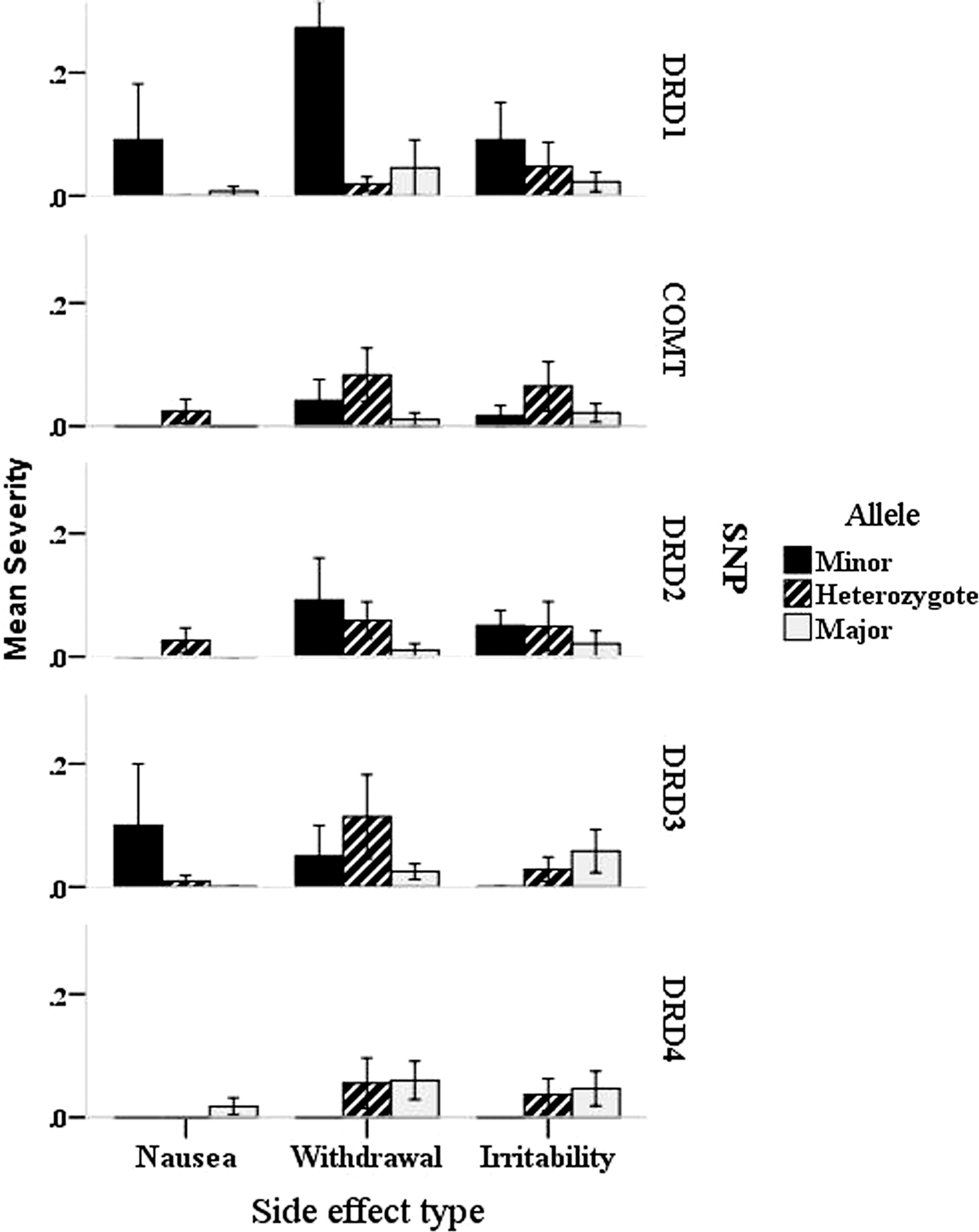
Mean side-effects severity for nausea, withdrawal, and irritability for minor, heterozygous, and major alleles of DRD1, COMT, DRD2, DRD3, and DRD4 single nucleotide polymorphisms. Error bars show the standard error of the mean.
As methylphenidate and dexamphetamine have distinct pharmacological effects, we re-analyzed the data for the methylphenidate group alone (there were insufficient numbers to look at dexamphetamine alone). We also removed those receiving any secondary medication. The significant effect of the D1 receptor minor allele remained significant for withdrawal, F(2,49)=8.271, p<0.001, and borderline for nausea, F(2,49)=2.689, p=0.08.
To our knowledge, the present data are the first to demonstrate that D1 allelic status (rs4532) predicts side-effects from stimulant medication for ADHD. Previous research has shown that the minor allele of rs4532 is more common in ADHD probands (Bobb et al., 2005), and predicts response and side effects to drug treatment in schizophrenia, albeit associated with the DA antagonistic action of antipsychotics rather than the agonistic action of stimulants (Potkin et al., 2003; Lai et al., 2011). SNP rs4532 is located in the 5’ untranslated region (UTR) of exon one of the DRD1 gene, and whereas its functional relevance is unclear, it may affect DRD1 expression (Huang et al., 2008). For example, Potkin et al. (2003) found that treatment and brain regional metabolic responses to clozapine were significantly associated with rs4532 genotypes.
This research supports the value of research into the pharmacogenetics of individual differences in medication side-effects. On the basis of these initial data, we hypothesize that dopamine D1 receptor systems has value in predicting side effects to stimulant medication for ADHD. Further research with larger numbers and dose ranges should provide validation of these initial findings.
Disclosures
No competing financial interests exist.