




Abstract
Objectives:
In recent years antipsychotics have been increasingly used in the population of children and adolescents. The objective of this article is to profile the use of antipsychotic medications in a pediatric population in Poland based on data from the Pomeranian region (Northern Poland).
Methods:
The study was based on National Health Fund data about prescription drug reimbursement between 2008 and 2012. A patient database was created using ID to analyze specific patterns and information about individuals using antipsychotics. Percentage population indicators were calculated using official demographic reports.
Results:
An increased number of overall prescriptions was observed since 2008, with a subsequent decline to its lowest number in 2012. The population with at least one antipsychotic-filled prescription per year has grown in the same time. The annual rate has increased from 0.26% to 0.31% of the general population between 0 and 17 years of age in the Pomeranian region. We observed an increasing number of females and the 0- to 4-year-old receiving antipsychotic prescriptions. The population share of prescribed first-generation antipsychotics exceeded the share of second-generation antipsychotics (SGAs). The use of SGAs increased from 38% to 44% of all prescriptions, during the observation period. The most frequently prescribed drugs were Risperidone (26.7%) and Chlorprothixene (21.7%).
Conclusions:
The study revealed that the prescribing patterns of antipsychotics increased in the Polish pediatric population and concerned more patients from the youngest group. The high prevalence of such early exposure to antipsychotics should focus more attention on drug safety in this population.
Introduction
A
Pharmacoepidemiological studies have shown the increase in frequency of antipsychotic prescribing in children and adolescent groups in many countries (Prathamesh et al. 2010). There is also serious concern that the number of antipsychotics prescribed in recent years has risen in Poland as well (Wladysiuk et al. 2011). The growing interest of such analysis is also caused by undetermined epidemiological data on the Polish burden of psychiatric disorders in pediatric groups. This article attempts to assess the situation of the prescription of antipsychotics in Poland. The main aims of this study are to: Evaluate the general trends of antipsychotic prescriptions in the pediatric population Assess the prevalence of antipsychotic usage by age and sex groups Investigate share of particular drugs in the antipsychotics drug market
Methods
Prescription rules in Poland
People covered under general health insurance are entitled to free healthcare services and drug reimbursement within the territory of Poland. Over 93% of Polish citizens are entitled to drug prescription and health service reimbursement (Zagozdzon et al. 2016). The National Health Fund (NFZ) is the sole public payer in Poland. Pharmaceuticals are classified into (simplified) categories: prescription drugs (which can be reimbursed by the NFZ); drugs used exclusively in hospital treatment under direct medical supervision; and over-the-counter (OTC) nonprescription drugs. The Ministry of Health decides on drug and medical device reimbursement, including whether cost sharing is applied and its extent. Reimbursed drugs are available to all insured persons at the following costs: free of charge, at a flat fee, for 50% of the price, and for 30% of the price. The decision is issued depending on the drug's effectiveness (World Health Organization 2017). Medications are reimbursed only if prescribed for specific conditions contained in the Reimbursement Act. According to the latest NFZ policy, SGAs were reimbursed only in the group of patients suffering from schizophrenia, bipolar affective disorder, Huntington's disease, and dementia. FGAs were reimbursed for individuals with a vast array of psychiatric conditions (for many FGAs diagnoses F00-F99 from ICD-10 are covered by reimbursement). Physicians can also prescribe drugs fully covered by the patient and thus not restricted by official indications lists—these drugs are not recorded in the NFZ reimbursement list and therefore were not included in the studied database.
Study design
The study was based on the prescription drug reimbursement data from the Pomeranian branch of the National Health Fund (NFZ) in the period between January 1, 2008 and December 31, 2012. Data from an earlier publication were reanalyzed (Zagozdzon et al. 2016). The study population included all individuals having at least one agent-prescribed antipsychotic reimbursed, and 0–17 years of age on the day of prescription. The date of first prescription was considered to be the time of the patient entering the study. Data were from the Pomeranian Branch (Northern Poland) of the NFZ. The nation-wide data availability in Poland is still limited due to diversity of computer systems and different interpretations of legal regulations among NFZ branches. We eventually obtained an anonymized database that consisted of every reimbursed prescription for an antipsychotic drug—N05 category by ATC—during the period 2008–2012. The data included patients' ID, age, sex, prescribed drug name, drug form, and prescribed dose. The database of all prescriptions was assessed while analyzing the prescription data. The database was again rearranged by patients' ID to analyze specific patterns of antipsychotic use. First, general prescribing trends and the number of unique patients were summarized. Population indicators were calculated using official demographic reports from the General Statistical Office (Główny Urząd Statystyczny 2016). Then, in patient-centered analysis, the individual data were analyzed and grouped by sex and prescribed antipsychotics' generation (FGAs or SGAs). The last step was the drug-centered approach to look closely for share of particular agent-prescribing patterns.
Statistical analysis
Data were collected and arranged using Microsoft Excel (Microsoft, Redmond).
Statistical analysis was calculated using Statistica 10.0 package (StatSoft, Tulsa). The study data do not fit a normal (Gaussian) distribution, so nonparametric statistical tests were used (two-tailed tests: Mann–Whitney U and Kruskal–Wallis tests). Medians and quartiles were chosen to present the detailed quantities.
The statistical significance cutoff was set as p < 0.05 for all analyses. Ethical approval was not required because this study involved only an anonymized database without any personal data and it did not put anyone at risk.
Results
General trends
In 2008, treatment with antipsychotics (at least one prescription filled) concerned 0.26% (N = 1203) of the 0- to 17-year-old population in the Pomeranian region. This figure increased during subsequent years: 2009—0.27% (N = 1207); 2010—0.29% (N = 1086); for 2011 (N = 1428) and 2012 (N = 1383)—both 0.31%. Figure 1A represents a 2008 and 2012 comparison of the percentage of the population with at least one antipsychotic prescription by age. The population percentage was highest in the 10- to 17-year-old group, and the greatest increase in antipsychotic usage was noted in the 0- to 4-year-old group between the beginning and the end of the studied period (from 0.01% to 0.21% for females and from 0.02% to 0.26% for males). The share of prescribed FGAs was greater than SGAs in nearly all ages, and this disproportion was even more significantly marked among older children (Fig. 1B).
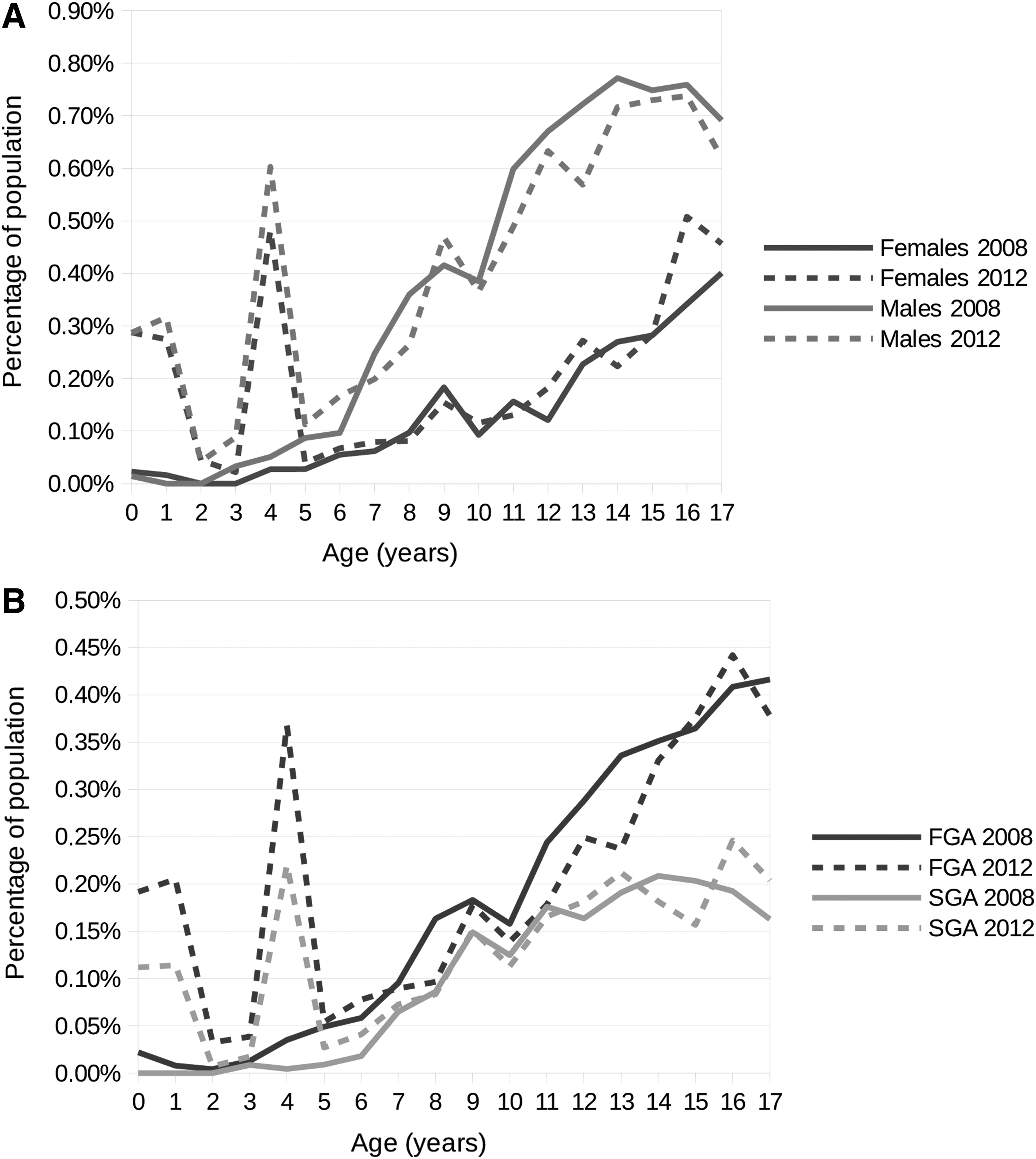
The comparison of 2008 and 2012 percentage of pediatric population (0–17 years of age) with one or more filled prescriptions for an antipsychotic drug by age and sex
The constant rise in the number of prescriptions was observed since 2008; it was highest in 2011, with 5159 prescriptions (mainly due to the rise in SGA use). In 2012, a subsequent decline to the lowest score of analyzed period was observed (4555 prescriptions). Generally, the number of FGA prescriptions exceeds SGAs; however, an increase in the frequency of SGA prescription was observed from 2008 (38%) to 2012 (41%–44%). Unique user trends were clearer; in 2008 and 2009 there were around 1203 patients receiving at least one antipsychotic prescription, whereas in 2011 and 2012 the number rose to around 1428 and 1383, respectively (Fig. 2). Males had more prescriptions than females. Although the majority of patients were male, their number remains fairly stable during the analyzed period (from 898 to 937). The greater rise was observed in female patients (from 305 to 446). The number of prescriptions per patient started from the level of 4.21 and peaked at about 4.75 in 2010, followed by a decline to 3.30 in 2012.
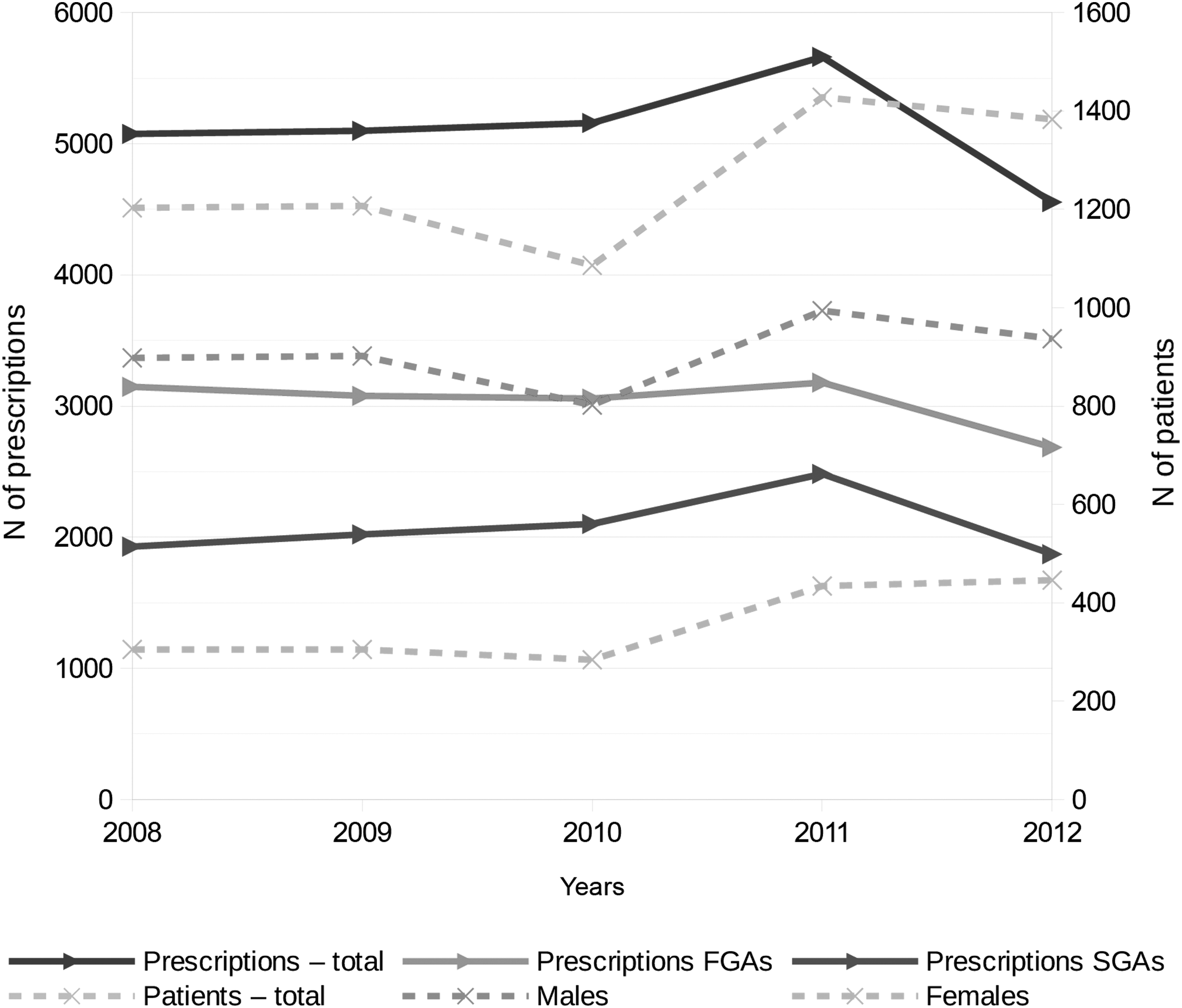
Trends of antipsychotic drug prescription volumes and patients with at least one filled prescription in the 2008–2012 period, Pomeranian region (Northern Poland). FGAs, first-generation antipsychotics; SGAs, second-generation antipsychotics.
Patients
The total population with at least one antipsychotic prescription filled during 2008–2012 included 4101 patients. The majority of subjects were male (68.6%). The median age of all analyzed patients having antipsychotics prescribed was 12 years. FGAs were more often prescribed in younger age (Q25 for age = 6 years). In both groups the lower 25% age groups of women were significantly younger than those of men. FGAs were significantly more often prescribed in injectable form than SGAs (Table 1). Clozapine prescriptions (347, 1.3% of the total) were excluded from this generalized summary.
p < 0.05.
p < 0.01.
FGAs, first-generation antipsychotics; Q, quartiles; SGAs, second-generation antipsychotics.
Antipsychotic agents
Risperidone among SGAs and Chlorprothixene among FGAs were the most frequently prescribed medications (26.7% and 21.7% of overall prescriptions, respectively). However, the decreasing share of total prescriptions for both substances was also observed. The greatest increase in prescriptions was observed in Aripiprazole (1028% increase, compared with 2008 as a baseline). Haloperidol and Chlorpromazine were used mostly in injectable form (Table 2).
g, gram; i.m., intramuscular (injectable) form.
Discussion
In Poland, the use of antipsychotics in the pediatric group has constantly increased between 2008 and 2012. The most significant increase was observed within the youngest age group (0–4 years). Our data also suggest a clear trend of increasing total number of patients receiving antipsychotic prescriptions, but a declining number of prescriptions per patient. This may give an insight into a potential change in the general pattern of use of antipsychotics—the drugs were prescribed more widely, but probably for a shorter period of time. In our study, most of the antipsychotic users were male. Typical median age for FGA prescription was lower than for SGAs. Clozapine prescriptions were excluded from summary, because of its unique role in treatment and pharmacological characteristics (Vauquelin et al. 2012). The most commonly prescribed antipsychotics were Risperidone and Chlorprothixene.
Because our study investigated only the Pomeranian region of Poland, it is unclear if our results also mimic the situation in the rest of the country. At the time of preparing this article, we do not have information of similar analysis conducted in any other region of Poland among the pediatric population. The Pomeranian region does not differ significantly from Poland overall in terms of access to psychiatrists and mental health facilities for this age population, so we hypothesize that the situation in that region mirrors the situation in Poland overall.
Many antipsychotics are used in the pediatric population, and this trend is increasing in many European and North American countries (Harrison et al. 2012). Bachmann et al. (2014) identified 13 recent studies on antipsychotic prescriptions for children and adolescents held since 2000. The majority of them reported an increase in the overall antipsychotics' usage. In Canada, rising usage, particularly of SGAs, was reported (1.9/1000 in 1999 to 7.4/1000 in 2008) (Alessi-severini et al. 2012). The total number of prescriptions increased, despite little change in registered treatment indications (Alessi-severini et al. 2012). In the United States, prescriptions in children increased from 8.6 per 1000 in 1995–1996 to 39.4 per 1000 in 2001–2002 (Cooper et al. 2006). Olfson et al. (2015) investigated the rising trend of neuroleptic prescriptions in the U.S. population under 24 years of age between 2006 and 2010. Males were more likely to use antipsychotics than females, especially during childhood and adolescence. Of note, the prescription trend increased, but not for children 12 years of age or younger. In 2008, the population with one or more antipsychotic prescription filled ranged from 0.2% for young children (3–5 years) to 1.2% for adolescents (13–18 years) (Sultan et al. 2018).
In the U.S. report “Off-Label Use of Atypical Antipsychotics” for the period 2003–2004, antipsychotics were prescribed in only 1% of overall mental health visits by children and adolescents, with most (99%) of these visits involving prescribing of atypicals. Male children/adolescents were more likely than females to be prescribed atypical antipsychotics. Risperidone was the atypical most commonly prescribed to children (Maher et al. 2012).
Mainly stable trends were observed in Europe (apart from Germany) (Bachmann et al. 2014). In a German study concerning outpatient prescription drug trends (2004–2011), Schröder et al. (2017) found a rising trend of antipsychotic prescriptions, whereas FGA prescriptions tended to decline. During the study period, the prevalence of antipsychotic prescriptions ranged between 2.0 and 2.6 per 1000 patients. The most popular drug in 2011 was Risperidone, accounting for nearly 54% of all prescriptions. Conversely, in France, the overall antipsychotic usage trend remains stable because of a decreasing trend for FGAs and rising trend for SGAs (from 2.7/1000 in 2006 to 3.4/1000 in 2013) (Verdoux et al. 2015). No change in antipsychotic prevalence was also reported in an Italian study (Clavenna et al. 2011).
Many potential hypotheses were introduced to explain the rising prescription trends in pediatric populations. According to Harrison et al. (2012), these include: greater acceptance of pharmaceutical usage, limited access to other mental health treatment options (for instance psychotherapy), demand for quick and affordable solutions to mental health issues, etc. There is great concern about the potential long-term effect of such early antipsychotic exposure, which needs to be closely investigated in future studies (Goff et al. 2017; Sultan et al. 2018). Another issue could be related to the specialty of the prescribing physician. In the United States, almost one-third of prescriptions were issued by nonpsychiatrists (Cooper et al. 2006; Sultan et al. 2018). In Canada, more than 70% of antipsychotics for children and adolescents were ordered by general practitioners (Alessi-severini et al. 2012). This situation suggests that the solution to the problem is beyond the psychiatrist's control. There are no such data regarding the Polish healthcare situation, but taking into consideration the shortage of pediatric psychiatrists, the problem may also be significant (OECD 2014).
Despite not including diagnosis, some extrapolations could be made using results from similar studies on that matter. The most common diagnosis in numerous studies/countries was attention-deficit/hyperactivity disorder (ADHD) (Bachmann et al. 2014; Burcu et al. 2014; Olfson et al. 2015; Schröder et al. 2017). The higher prevalence of boys in analyzed cohorts can be attributed to their greater chance of developing ADHD (Schröder et al. 2017). The most prescribed drug in our analysis—Risperidone—was also the most prevalent antipsychotic in the mentioned studies. It is widely used for ADHD treatment (Burcu et al. 2014).
The main strength of our report is the database size, representing real-world trends in antipsychotic drug usage. All of FGAs and SGAs in Poland are available only with valid prescription, mostly reimbursed, so we assume that we included the majority of drugs prescribed in the analyzed period.
Limitations
Several limitations of the study must be acknowledged. Because the data of drugs used during the course of hospitalization are not available, our results illustrate mainly the outpatients' drug patterns. Due to the secondary character of reimbursement data, a potential selection bias could occur in some cases (e.g., issued but not purchased prescriptions, errors in patient's age data, etc.) Also, drugs that are fully covered by patients and not reimbursed by the NFZ (as specified above) were not recorded in the database. An additional limitation was the lack of information on particular diagnoses, which could hide selection bias (e.g., antipsychotics prescribed for nonpsychiatric diseases). Because our dataset was based only on prescriptions, we had no access to any source of health records, and diagnoses were not given. There are no data about adherence to the prescribed drugs and its real use. Therefore, the presented findings should be interpreted cautiously.
Conclusions
There is a clear increasing trend of greater exposure to antipsychotics in the pediatric population in Poland, which is particularly visible within the youngest age group of 0–4 years. The frequency of SGA prescriptions has increased since 2008, but the most commonly used group are FGAs. The majority of study patients were male and their median age was 12 years. The most frequently prescribed drugs were Risperidone and Chlorprothixene.
Clinical Significance
Limited evidence is available for antipsychotics' safety in the pediatric population. The physician should be aware of legal and medical aspects of off-label prescribing. There is also a need for healthcare authorities to set detailed treatment guidelines for the pediatric population.
Footnotes
Disclosures
No competing financial interests exist.