




Abstract
Background:
Social media use is now a central aspect of adolescent life and development. Little is known about the clinical implications of social media use in children and adolescents presenting in acute crisis for psychiatric admission. This study sought to compare the potential effects of social media use among middle and high school students on outcomes of psychiatric morbidity. It was hypothesized that among social media users, high school students would have greater psychiatric morbidity compared with middle school students.
Methods:
The research team extracted clinical and demographic data from adolescents (aged 12–17 years) presenting for acute psychiatric admission who also had documented social media use (N = 56). Educational status, middle school (n = 21) versus high school (n = 35), was examined as an independent variable. Psychotropic medication use, self-injurious behavior, suicide risk, and suicidal ideation were examined as dependent variables in logistic regression models.
Results:
High school students using social media had significantly greater predicted odds of psychotropic medication use and self-injurious behavior compared with students in middle school who used social media. High school students using social media had greater, although not statistically significant, predicted odds of suicide risk and suicidal ideation compared with middle school students using social media.
Conclusions:
Social media use is likely an important factor to consider in psychiatric evaluations. The present findings suggest that social media use in high school students is associated with greater psychiatric morbidity compared with middle school students. Further research could illuminate the developmental lines of social media use and age-specific risks.
Introduction
Social media use is a central aspect of adolescent life and development (Reid Chassiakos et al. 2016; Carson et al. 2018; Shafi et al. 2018). Broadly defined, social media refers to electronic forms of communication where users can network, share content, and create identities within communities via online platforms such as Instagram (Kaplan and Haenlein 2010). Prior studies estimate that the majority of youth own a smart phone—a cell phone which functions similar to a computer with Internet access and download capabilities in addition to voice communication (Smith 2018). Approximately half of these youth feel that they may have a smart phone addiction (O'Reilly et al. 2018; Sussman et al. 2018). Social media platforms are indisputably evolving human communication and neurodevelopment (Cookingham and Ryan 2015; Hamm et al. 2015; Meshi et al. 2015).
Youth commonly use these social media portals for affiliation, viral identity formation (digitally curated self-disclosure and character presentation), and peer networks (Kaplan and Haenlein 2010; Bailin et al. 2014; Oberst et al. 2017). The progression of social media use and behaviors during development has substantially outpaced related research and understanding of the implications on psychiatric morbidity (Carson et al. 2018; Shafi et al. 2018; Nesi et al. 2019). There are stark knowledge gaps regarding social media use and its effect in the context of the clinical practice of child and adolescent psychiatry. For example, little is known about how social media use impacts psychiatric morbidity, clinical outcomes, pharmacological interventions, and the potential differential effects across stages of development (Meshi et al. 2015; Carson et al. 2018; Odgers 2018).
It is well recognized that the transition between middle and high school is associated with neurobiological, cognitive, social, and educational changes that impact self-esteem, mood, and development (Wigfield et al. 2005; Fischer et al. 2019). The manner in which development influences social media use is largely unknown. Social media use may have associations with depression, risk-taking behaviors, poor sleep quality, and suicidality (Cash et al. 2013; Sueki 2015; McDougall et al. 2016; Sampasa-Kanyinga et al. 2018). Notably, there is a dearth of research examining the variable effects of social media use during development.
One recent study surveyed over 5000 students (aged 11–20 years) to ascertain if social media use impacted sleep duration. The majority of respondents had suboptimal sleep duration and 73.4% reported using social media. Social media users had greater odds of decreased sleep time in a dose-dependent manner compared with those youth who did not report using social media. However, these findings were not examined in an age-dependent manner (Sampasa-Kanyinga et al. 2018). Nighttime-specific social media use is predictive of poor sleep quality, which can impact depression and anxiety severity (Woods and Scott 2016). A follow-up study examined cross-sectional survey data in over 10,000 youth. School status (middle vs. high school) moderated the relationship between social media use and academic connectedness. In this sample, social media use of less than 2 hours per day had a positive association with school connectedness in high school students. Conversely, social media use of more than 2 hours per day had a negative association with school association in middle school students. More than 2 hours of daily social media use had a negative association with academic performance in middle and high school students (Sampasa-Kanyinga et al. 2019). Similar findings regarding how social media use impacts psychiatric treatment and suicidality among middle and high school students are lacking (Shafi et al. 2018; Nesi et al. 2019).
The current study was motivated by the clinical observation that child and adolescent patients presenting for acute psychiatric hospitalization increasingly endorse social media use in their presenting histories. Experts have recently emphasized that social media habits should be incorporated in standard psychiatric interviews and histories (Bailin et al. 2014; Carson et al. 2018; Shafi et al. 2018; Nesi et al. 2019). However, this recommendation has not been widely adopted and specific tactics for assessment are ill-defined. This cross-sectional study sought to examine differences in self-injurious behavior, suicidality, and psychotropic medication use between middle school and high school students who endorsed social media use during an acute admission to a psychiatric inpatient unit. It was hypothesized that social media use would have greater associations with self-injurious behavior, suicidality, and psychotropic medication in high school students compared with middle school students.
Methods
Participants
The sample (N = 56) included all youth aged 12–17 years who were admitted to an 18-bed inpatient psychiatric unit at the Mayo Clinic in 2015 who also reported social media use during the intake process. The data were extracted retrospectively from the electronic health record. The Advanced Cohort Explorer platform was used to identify inpatients with documented social media use in the medical record (N = 56). Search terms included “Facebook, SnapChat, Twitter, and Social Media.” Demographics, Patient Health Questionnaire (PHQ-9) (Richardson et al. 2014), Suicide Status Form-II (SSF-II) (Romanowicz et al. 2013), the presence of self-injurious behavior, pharmacological treatments on admission, and additional clinical variables were collected by members of the study team (R.M.A.S., A.L.N., and L.S.). Two board-certified child and adolescent psychiatrists (M.R. and P.E.C.) oversaw data collection and consensus review of any inconsistencies in abstraction. The research study had Mayo Clinic Institutional Review Board approval before any data collection or analyses.
Dependent variables
The primary dependent variables were measured at the time of admission and included self-injurious behavior, suicidal ideation, and suicide risk. A secondary dependent variable was the documented use of psychotropic medication (antidepressants, antipsychotics, mood stabilizers, or stimulants) at the time of admission (yes/no). Self-injurious behavior was operationalized as a binary outcome—present (yes) versus absent (no). Suicidal ideation was measured using the single suicidal ideation item (Item 9) on the self-report PHQ-9. The PHQ Item 9 (“thoughts that you would be better off dead or of hurting yourself”) was treated as an ordinal scale that ranged from 0 (“not at all”) to 3 (“nearly every day”). A score of 0 indicated that the participant did not endorse suicidal ideation at the time of admission, and higher PHQ Item 9 subscale scores reflected a greater intensity of suicidal ideation. Suicide risk was measured using the single suicide risk item (Section A, Item 6) on the self-report SSF-II. The SSF suicide risk item (“rate overall risk of suicide”) was treated, for the purpose of this study, as an ordinal scale that ranged from 1 (“extremely low risk”) to 5 (“extremely high risk”). A score of 1 indicated that the participant did not endorse a risk of “killing one self,” and higher SSF Item 6 subscale scores reflected a greater risk of suicide (Romanowicz et al. 2013).
Independent variable and covariates
The independent variable was educational grade of the patients. Educational grade was operationalized as high school (n = 35) or middle school (n = 21). The covariates, which were selected a priori, included sex, number of previous hospitalizations for mental health (range: 1–7), Child Protection Report filed in Minnesota for abuse/neglect within past 3 years at time of admission (yes/no), depression severity (measured via PHQ; included in the self-injurious behavior model) or formal diagnosis of depression at time of admission (yes/no; included in the suicidality models), and use of psychotropic medication (yes/no). We note that psychotropic medication use was only included as a covariate in the models for self-injurious behavior and suicidality. These variables were included as covariates in the models to bolster precision in the evaluation of the main effect of educational grade on the outcomes.
Multiple imputation for missing values
Missing values, observed only for the PHQ and SSF and occurred in no more than about 7% of the sample, were imputed. Missing values (with an assumed arbitrary missing pattern) for the classification variables and for the continuous variables were imputed via 500 burn-in iterations (samples) using Fully Conditional Specification along with the discriminant method (for the classification variables) and the predictive mean matching method (for continuous variables) of the PROC MI procedures in SAS software, version 9.4 (van Buuren 2007).
Statistical analyses
Demographic and clinical characteristics for the sample of 56 youth were described using the sample mean and standard deviation for continuous variables and the frequency and percentage for categorical variables. Differences among high school and middle school students were examined with two-independent sample t-test with the Satterthwaite method for unequal variances (for continuous variables) and Fisher's exact test (for categorical variables).
Multiple binary logistic regression, with penalized maximum likelihood estimation along with Firth's bias correction, was implemented to estimate the odds of the patient using psychotropic medication and engaging in self-injurious behavior, respectively, given high school status versus middle school status, while controlling for the aforementioned covariates. Finally, ordinal logistic regression was performed to investigate the effect of educational grade status (high school vs. middle school) on suicide risk and suicidal ideation, respectively, while controlling for the aforementioned covariates. The cumulative probabilities were modeled over the higher ordered suicidal ideation and suicide risk scale scores (more suicidal ideation and greater suicide risk). Adjusted odds ratios (ORs) along with the 95% confidence interval (CI) were reported.
Statistical analyses were carried out using SAS software, version 9.4 (SAS Institute, Inc., Cary, NC). The level of significance was set at α = 0.05 (two-tailed), and we implemented the false discovery rate (FDR) procedure to control false positives over the multiple tests (Benjamini and Hochberg 1995).
Results
Participant characteristics
Of the 56 youth who were identified as social media users, 82.14% were females, 69.64% were non-Hispanic White, and the mean age of the patient was 14.64 ± 1.49 years. About 82% of the youth had a history of self-injurious behavior, 42.86% had a history of being bullied, 60.50% had a diagnosis of depression at the time of admission, and 53.57% were taking psychotropic medication upon admission. The mean PHQ total score at time of admission was 13.82 ± 7.45. According to the PHQ Item 9 and the SSF, 23.21% and 35.71% reported having no suicidal ideation and extremely low suicide risk, respectively, at the time of admission. The mean number of previous hospitalizations for mental health was 2.08 ± 1.50 (range: 1–7). Demographic and clinical characteristics of the sample of 56 youth in the current study are shown in Tables 1 and 2.
Demographic and Clinical Characteristics of the Overall Sample of Youth with Documented Social Media Use
History of abuse or neglect = child protection report filed in Minnesota for abuse/neglect within past 3 years at time of admission; depression status = formal diagnosis of depression at time of admission; hospitalizations = number of previous hospitalizations for mental health.
M, sample mean; SD, standard deviation; PHQ, Patient Health Questionnaire; SSF, Suicide Status Form.
Demographic and Clinical Characteristics of High School Versus Middle School Youth with Documented Social Media Use
p-Value (two-tailed) associated with the test of group differences (high school vs. middle school) on each characteristic.
History of abuse or neglect = child protection report filed in Minnesota for abuse/neglect within past 3 years at time of admission; hospitalizations = number of previous hospitalizations for mental health; depression status = formal diagnosis of depression at time of admission.
M, sample mean; SD, standard deviation; FDR, false discovery rate; PHQ, Patient Health Questionnaire; SSF, Suicide Status Form.
Psychotropic medication, self-injurious behavior, suicide risk, and suicidal ideation
The multiple binary logistic regression revealed that youth (social media users) who were in high school had significantly greater predicted odds of psychotropic medication use (OR = 5.073, 95% CI: 1.344–25.014, p = 0.0262, FDR = 0.0538; area under the curve [AUC] = 0.868; Table 3) and self-injurious behavior (OR = 4.545, 95% CI: 1.324–17.865, p = 0.0269, FDR = 0.0538; AUC = 0.774; Table 3) than youth (social media users) who were in middle school, given fixed values of all other variables in the model. The ordinal logistic regression, although not statistically significant, revealed that youth (social media users) who were in high school had greater predicted odds of increased suicide risk (OR = 1.138, 95% CI: 0.381–3.397, p = 0.8173, FDR = 0.8531; AUC = 0.618; Table 3) and increased suicidal ideation (OR = 1.110, 95% CI: 0.401–3.018, p = 0.8531, FDR = 0.8531; AUC = 0.649; Table 3) than youth (social media users) who were in middle school, given fixed values of all other variables in the model. The logistic regression results are shown in Table 3 and Figure 1.
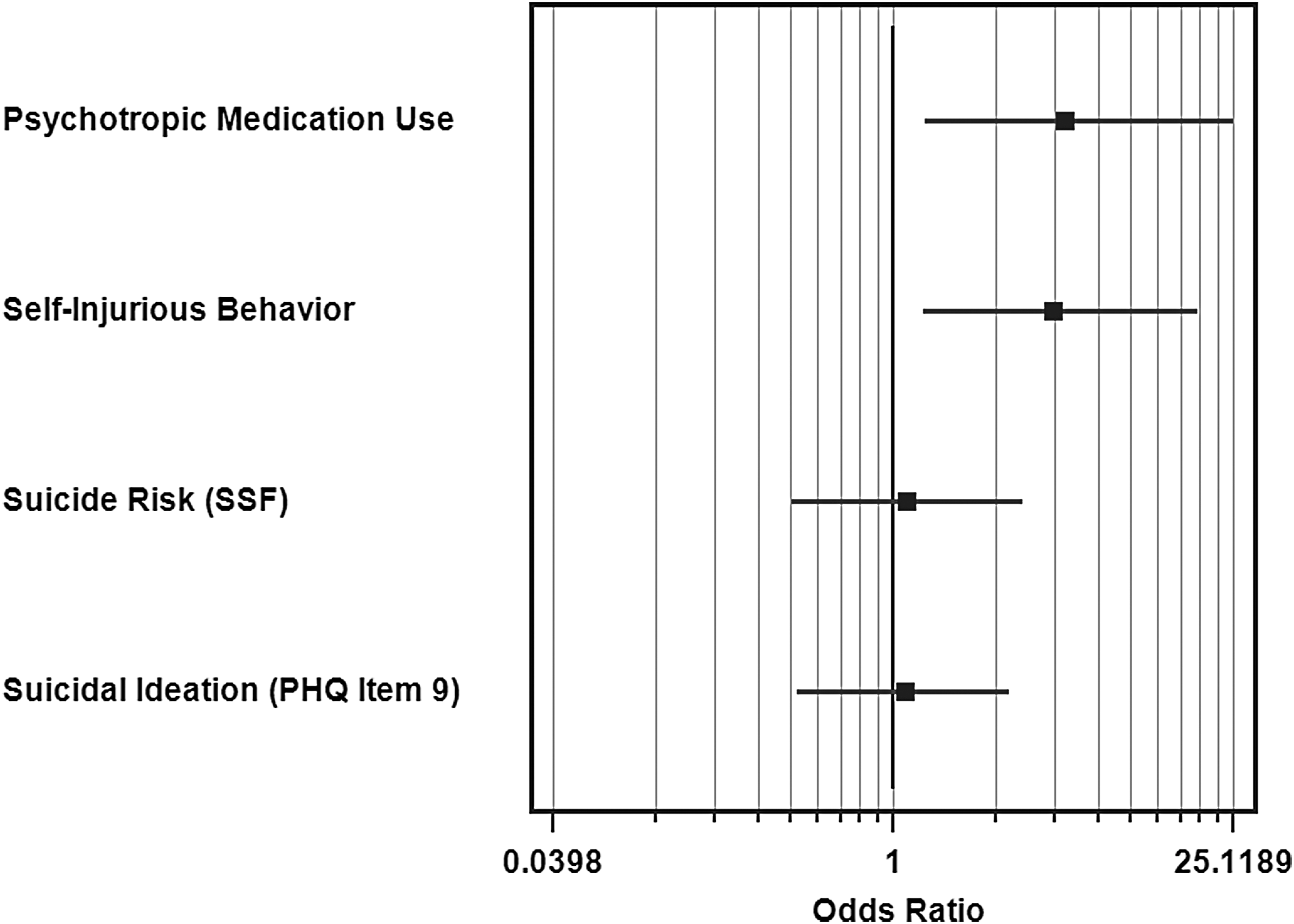
Odds ratios for measures of psychiatric morbidity among high school and middle school psychiatric inpatients endorsing social media use.
Relationship Between Educational Grade Status and Psychotropic Medication Use, Self-Injurious Behavior, and Suicidal Ideation Among Inpatient Sample of Social Media Users
A separate binary logistic regression was implemented to estimate the odds of the patient using psychotropic medication and engaging in self-injurious behavior, respectively, given educational grade status. A separate ordinal logistic regression model was performed to investigate the effect of educational grade status on suicide risk and suicidal ideation, respectively. Odds ratios were adjusted for the covariates. An estimated odds ratio >1 indicated greater predicted odds of psychotropic medication use, self-injurious behavior, suicide risk, and suicidal ideation among social media users who were in high school versus middle school. N = 56.
95% CI = confidence interval for odds ratios; FDR, false discovery rate; AUC, area under the curve; PHQ, Patient Health Questionnaire; SSF, Suicide Status Form.
Discussion
This is one of the first studies to examine the impact of social media use among middle school and high school psychiatric patients presenting for an acute hospitalization. Youth with reported social media use in high school were more likely to have existing prescriptions for psychotropic medications (antidepressants, antipsychotics, mood stabilizers, or stimulants) than middle school students. High school student social media users were also more likely to have self-injurious behaviors than middle school students reporting social media use. High school students reporting social media use had greater suicide risk and suicidality compared with middle school students reporting social media use, but these associations were not statistically significant. These preliminary findings lay a foundation for further work to inform the child and adolescent psychiatry community in understanding and assessment practices related to social media use in children and adolescents. Social media use in different age groups could signify different risk profiles or variable effects on psychiatric status.
Broadly, the present results further underscore that social media use in adolescents with severe psychiatric disturbances is likely a core concern that is still poorly understood by child and adolescent psychiatrists (Berryman et al. 2018; Shafi et al. 2018; de Vries et al. 2019). Recently, Nesi et al. (2019) surveyed a sample of psychiatrically hospitalized adolescents on social media use and found that many adolescents reported positive aspects to social media use such as rapid support from friends and distraction. However, a small, but alarming, percentage endorsed viewing content that facilitated self-injurious behavior or suicidality (Nesi et al. 2019). The findings of Nesi et al. (2019) contribute to the paucity of such literature, but their study did not address the potential differences in age groups or aspects relevant to psychopharmacology.
Prior work examining the interface of social media and the practice of psychopharmacology is limited (Mota Pereira 2014; Sarker et al. 2016; Abbe and Falissard 2017). One recent intriguing study examined the idea of augmenting pharmacotherapy with social media utilized as a positive intervention for treatment-resistant major depressive disorder (MDD). Sixty patients with treatment-resistant MDD and standard antidepressant regimens were randomized to a group with a psychiatrist Facebook friend, Facebook group with no psychiatrist friend, or a control group. Participants in the group with a psychiatrist Facebook friend could readily interact with the psychiatrist. Participants in the Facebook groups had superior response and remission rates compared with the control group. The Facebook group with the psychiatrist friend had superior results (Mota Pereira 2014). Notwithstanding complex pragmatic and ethical barriers, this work also illustrates the untapped potential of social media for child and adolescent psychiatry practice. Social media use in youth will most likely continue to evolve at a rapid pace. At present, child and adolescent psychiatrists are ill-equipped to navigate this viral landscape. There are unacceptable knowledge gaps regarding the assessment of social media use in the context of psychiatry evaluations and the potential for harnessing social media platforms therapeutically (Bailey et al. 2018; Odgers 2018).
Machine learning and natural language processing methodologies provide tangible prospects for the systematic study and use of social media in psychiatric practice. Examples include digital phenotyping and patient-centered symptom monitoring with passive data collection (Onnela and Rauch 2016). Other recent efforts have used Twitter posts to identify early signs and patterns of prescription medication abuse (Sarker et al. 2016). Monitoring online social networks or online health communities could also provide valuable data to refine the practice of psychopharmacology (Abbe and Falissard 2017).
The present findings suggest that high school students endorsing social media use have a greater associated psychiatric morbidity compared with middle school students. However, these associations do not imply causality and generate many more questions. High school students may have greater morbidity as a consequence of greater illness duration. However, future research could examine the developmental lines of social media use in youth (Odgers 2018; Shah et al. 2019). Recent qualitative work proposes various motivations for social media use in adolescents (Throuvala et al. 2019). Motivations and patterns of use are most likely fluid across development. For example, middle school students may be more likely to use social media for deepening peer group attachments and support compared with high school students (Throuvala et al. 2019). Other factors should be considered in the future research. For example, high school social media users may have less parental supervision and may use more toxic forms of social media compared with middle school students.
This study has limitations to consider carefully. The study was retrospective and had a small sample size. Social media use was characterized based on the review of the electronic health record and what the admitting clinician had documented. In the present study, it was not possible to quantify the dose of social media use (high or low use) or identify the presence of cyberbullying. While the study methodology was vulnerable to potential bias, documented social media use in the electronic medical record may denote clinical significance. While psychotropic medication use was recorded based on objective information, it was not possible to ascertain adherence to the medication. Furthermore, psychotropic medication use included a wide range of medications that could not be examined individually due to small numbers in respective group. With these limitations in mind, these preliminary results provide a framework for further research in this area.
Conclusions
To summarize, this study examined social media use among middle and high school students in the midst of an acute psychiatric crisis. High school students had greater predicted odds of psychotropic medication use and self-injurious behavior.
Clinical Significance
The present findings provide more evidence to suggest that social media use is a central and underexamined aspect of development in child and adolescent psychiatric practice. Clinician curiosity with regard to how adolescents use and present themselves online has the potential to add value to a psychiatric and safety assessment. Social media use should be routinely assessed during the course of psychiatric consultations and follow-up appointments. Future work could further explicate the differential patterns of social media use and impact across age groups, examine the moderating effects on biopsychosocial development, and inform clinicians on how to use social media to optimize psychopharmacological treatments.
Footnotes
Authors' Contributions
R.M.A.S., P.A.N., M.R., A.L.N., L.S., and P.E.C. contributed to the design of the study and interpretation of data. R.M.A.S., A.L.N., L.S., and P.E.C. acquired the data. P.A.N. completed statistical analyses. R.M.A.S., P.A.N., M.R., A.L.N., L.S., and P.E.C. assisted with the interpretation of statistical analyses. R.M.A.S., P.A.N., M.R., A.L.N., L.S., and P.E.C. drafted, revised, critically reviewed, and approved the final submitted draft of the article. R.M.A., P.A.N., and P.E.C. had full access to all the data in the study. P.E.C. takes responsibility for the integrity of the data and the data analysis.
Disclosures
Dr. P.E.C. receives research support from the NIH. Dr. P.E.C. has received research grant support from Pfizer, Inc.; equipment support from Neuronetics, Inc.; and received supplies and genotyping services from Assurex Health, Inc., for investigator-initiated studies. He is the primary investigator for a multicenter study funded by Neuronetics, Inc., and a site primary investigator for a study funded by NeoSync, Inc. Dr. P.E.C. serves as a paid consultant for Procter and Gamble Company. The other authors have no disclosures or potential conflicts of interest to declare.