




Abstract

Li et al. (2019) reported data that they claim “showed that the lower the placebo response rate, the greater the efficacy difference between antidepressants and placebo” in clinical trials of antidepressants in children and adolescents. However, their claim can be entirely explained as a known statistical artifact. Because of regression toward the mean, difference scores are very highly correlated with the scores on which they are based (Hilgard 1981). As an example, consider the artificial data shown in Figure 1, in which hypothetical low, medium, and high drug and placebo response rates are graphed. In this data set, the correlation between the two response rates is zero. However, the correlation between placebo response rates and the drug–placebo difference is −0.71. The drug–placebo difference is 10% (favoring drug) for studies with a low placebo response rate, 0% for studies with medium placebo response rates, and −10% (favoring placebo) for studies with high placebo response rates, but this apparent association is entirely spurious, because there is no relation between drug and placebo response rates in the data on which it was based. The high correlation between a difference score and one of the scores from which the difference is calculated is not unique to data sets such as the one in the figure. Even stronger correlations can be found consistently by randomly entering numbers for drug and placebo. The coefficient reported by Li et al. (−0.58) is smaller than that generated by unrelated symmetrically distributed random data (−0.71). Indeed the 0.71 correlation can be obtained using any two sets of symmetrically distributed numbers (e.g., when both sets of numbers are normally distributed). Thus, the data reported by Li et al. cannot be interpreted as an indication of a genuine association between placebo response rates and drug–placebo differences. It may simply represent a statistical artifact.
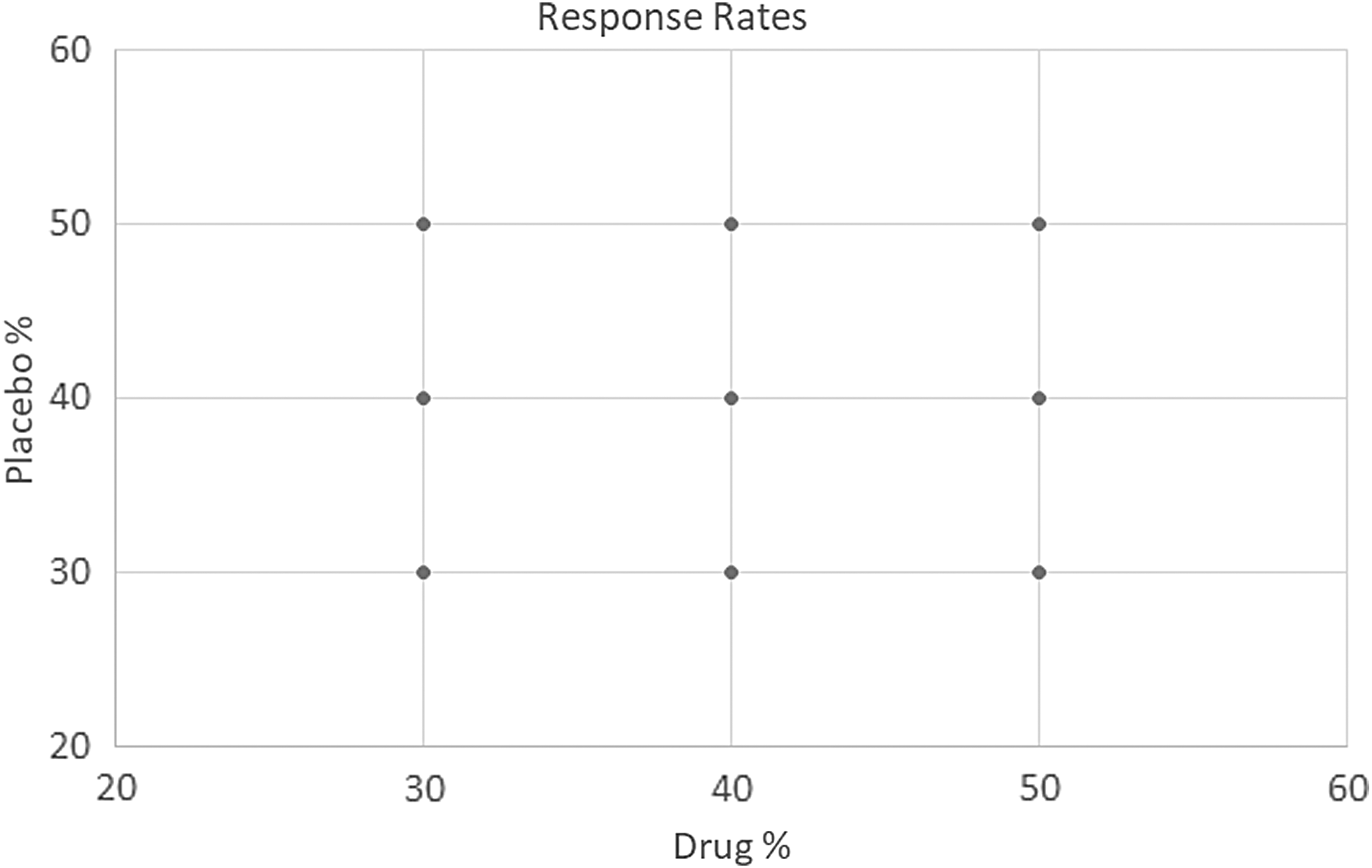
Correlation plot of artificial data with a zero correlation between placebo and drug response rates.
Disclosures
No competing financial interests exist.