




Abstract
Background and Objective:
The purpose of this study was to determine what side effects were most associated with medication nonadherence as reported by adolescents and young adults with attention-deficit/hyperactivity disorder (ADHD).
Methods:
A combination of multiple linear regression and chi-square automatic interaction detection techniques were utilized in analyzing the survey data responses of 157 adolescents and young adults with ADHD.
Results:
The mean number of side effects reported was M = 10.33 side effects with 77% of the sample reporting at least one side effect. In aggregate, the number or severity of side effects were not significantly associated with medication nonadherence. Rather, it was the severity of particular side effects, upset stomach and vomiting, which were significantly associated with medication nonadherence.
Conclusions:
Health care providers should utilize this information as an indicator that medication nonadherence will be an issue when these side effects are present.
Introduction
Charach et al (2008) found that parents frequently describe concerns about side effects while considering the benefits of medication. Indeed, Emilsson et al (2017) found that side effects were one of the most common reasons associated medication nonadherence. In their review of the literature, Kamimura-Nishimura et al (2019) found that adverse or side effects of medication for attention-deficit/hyperactivity disorder (ADHD) can negatively impact the adherence to medication such that side effects have been a commonly cited reason. Toomey et al (2012) found that parents who discontinued medication for ADHD were more likely to report side effects, often within a year of their initial prescription.
In regard to information regarding side effects, Sleath et al (2017) reported that one in six parents wished their health care providers provided more information about side effects of ADHD medication. This lack of information may be why Toomey et al (2012) found that medication side effects (62% of the sample) to be the most common reason given for medication nonadherence and eventual discontinuation. Charach and Fernandez (2013) also found that adverse effects were frequently reported as being associated with the discontinuation of medication. As such, Scholle et al (2021) note that health care providers should optimize avoiding adverse effects as well as preparing patients and their families adequately.
While the literature has indicated that side effects in aggregate are associated with medication nonadherence, limited research has disaggregated these side effects or only examined certain side effects. The purpose of this study was to determine what side effects were most associated with medication nonadherence as reported by adolescents and young adults with ADHD. To achieve this purpose, we addressed two research questions. First, what was the number of side effects reported and were these or their severity associated with medication nonadherence? Second, what side effects individually were most associated with medication nonadherence?
Methods
Sample
The sample consisted of 157 adolescents and young adults with self-reported ADHD. Approximately 69% (n = 108) identified as female, 14% (n = 22) identified as male, 7% (n = 11) identified as nonbinary, and 10% (n = 16) chose not to identify a sex or gender. With respect to race, ∼73% (n = 115) identified as White, 2% (n = 3) as African American, 6% (n = 9) as Asian, and finally 19% (n = 30) chose not to identify as any race. As for ethnicity, ∼11% (n = 17) identified as Hispanic or Latinx. Table 1 presents these percentages along with frequencies for the demographic characteristics. The average age was 20.47 years (SD = 2.44).
Sample Characteristics
Measures
This survey was administered through the CHADD (Children and Adults with Attention-Deficit/Hyperactivity Disorder, 2020) website, where individuals <18 years assented to participate and individuals >18 years consented to participate. The degree of medication adherence was measured along a 7-point scale responding to the question, “do you take your medication as prescribed?” Approximately 10% (n = 16) reported never missing it, 23% (n = 37) reported taking medication almost all the time, 22% (n = 35) reported taking it most of the time, 31% (n = 49) reported taking it sometimes, 6% (n = 9) not taking it most of the time, 1% (n = 2) reported taking it almost never, and 6% (n = 9) reported taking it never.
A total of 35 different adverse events were represented. Participants also responded as to side effects or adverse events as well as severity of the following: decreased appetite, sore throat, skin rashes, dry skin, dry eyes, taste in mouth, nasal congestion, blood pressure, excessive talking, picking skin, biting nails, mood swings, depression, worry/anxiety, socially withdrawn, anger, weight loss, weight gain, upset stomach, vomiting, nausea, thirsty, constipation, waking up early, dizziness, palpitations, chest pains, tremors, easily agitated, difficulty urinating, sleepiness, difficulty sleeping, tiredness, headaches, and diarrhea.
Analyses
To answer the first research question, we conducted a multiple linear regression with the number of side effects reported and their severity predicting medication nonadherence as the basic model without examining individual side effects as predictors. Model fit was evaluated through R 2, where values of 0.03, 0.09, and 0.25 or larger may be viewed as small, medium, and large, respectively (Gravetter et al, 2020). Bayesian Information Criterion (BIC) and Akaike/Deviance Information Criterion (AIC) values were also reported as measures of fit with lower values indicating better comparative model fit relative to each other in the first versus second research questions variance inflation factor values <10 and tolerance values >0.10 indicate a lack of multicollinearity.
To answer the second research question as to what side effects individually were most associated with medication nonadherence, Chi-square Automatic Interaction Detection (CHAID) analyses were utilized through SPSS (v. 28.0). CHAID analyses examined individual side effects and the relationship among these individual side effects as associated with medication nonadherence. As a data mining technique, CHAID analyses provides a data-driven approach that splits “nodes” or aggregated categories of responses according to F values with corresponding levels of statistical significance (Giri and Paul, 2020). Values of Cohen's d were considered as small being at 0.20 or less, medium being between 0.20 and 0.80, and large being >0.80 (Cohen, 1988). This study was approved by the committee for the protection of human subjects at the University of Alabama.
Results
The mean number of side effects reported was M = 10.33 side effects (SD = 14.38) with 77% of the sample reporting at least one side effect. For the first research question, the model did not fit the data especially well with an r 2 value of 0.03. In addition, model fit revealed a BIC value of 645.12 and an AIC value of 512.19 that was achieved without examining any individual side effects as predictors in the model for the first research question. Neither the number of side effects, β = 0.24, p = 0.05, nor the severity of side effects was associated with medication nonadherence, β = 0.12, p = 0.34. Side effects or their severity in aggregate were not significantly with medication nonadherence. For the second research question, model fit was better with a lower BIC (489.07) and AIC (475.26) values, in which this second model for the second research question included individual side effects as predictors.
Although not for comparative purposes, the second model revealed an r-squared value of 0.08. Results in Figure 1 revealed that the side effect of upset stomach was significantly associated with medication nonadherence, F(1, 155) = 6.51, p = 0.035, d = 0.76. This side effect or node was split into two groups of participants reporting “mild to not at all” versus “moderate to severe” (or greater than mild) for symptoms of upset stomach. Among those participants who reported “moderate to severe” symptoms of upset stomach, these participants more likely to report the side effect of vomiting as well. The side effect of vomiting was significantly associated with medication adherence, F(1, 141) = 4.64, p = 0.033, d = 1.18.
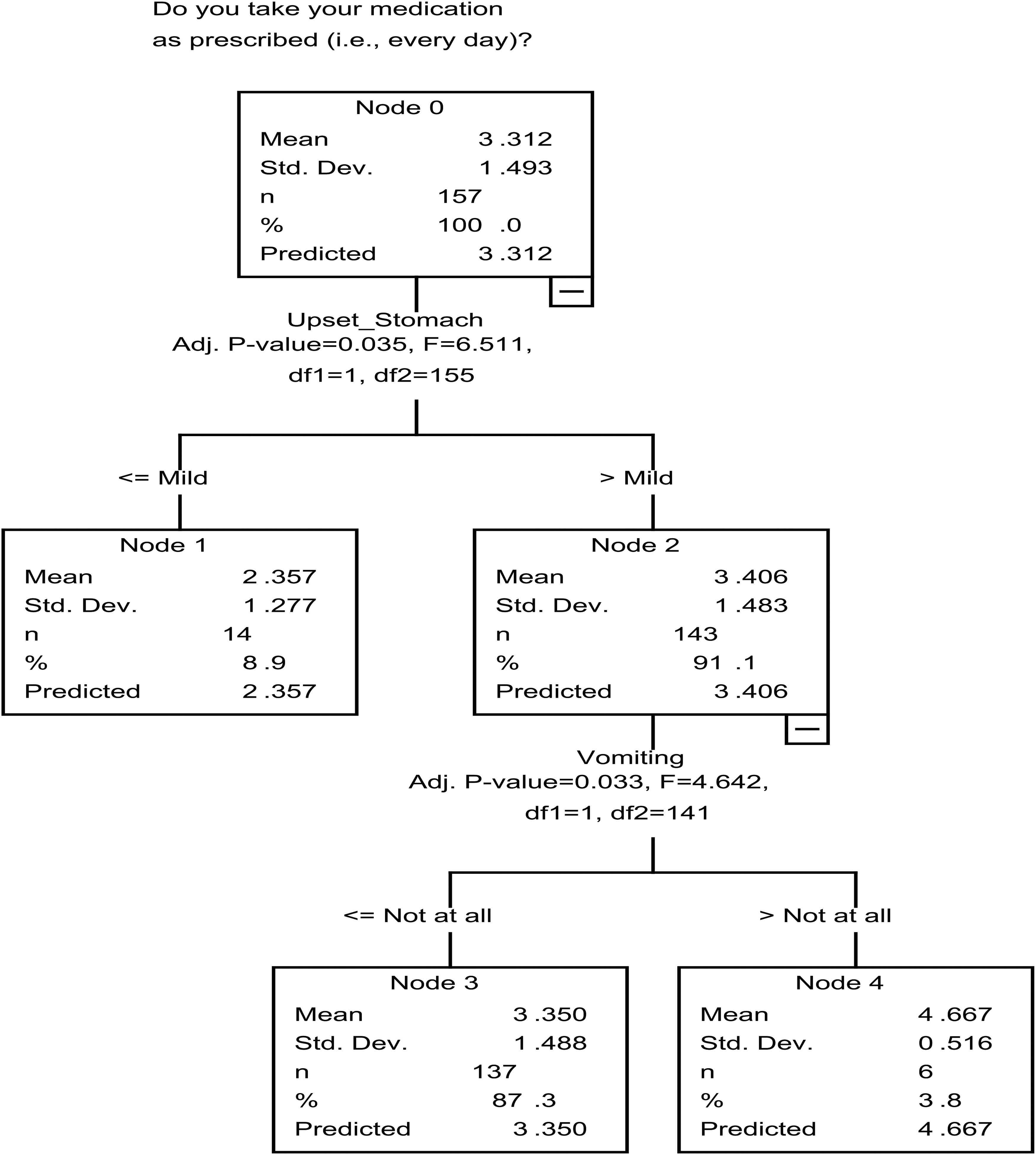
Decision tree for adverse or side effects of ADHD medication. ADHD, attention-deficit/hyperactivity disorder.
Discussion
The results of this study indicate consistent results with respect to a high percentage of participants with ADHD reporting have at least one side effect at 77% of the sample. Toomey et al (2012) found that at least one side effect was reported by 71% of all participants with ADHD. Results of this study suggest that upset stomach and vomiting were the two side effects that were statistically significant in predicting medication nonadherence. However, Kamimuma-Nishimura et al (2019) found that weight/appetite issues, sleep difficulties, and increased aggressive/irritability were most associated with medication nonadherence. Toomey et al (2012) instead suggested that psychological side effects such as mood changes, irritability, and depression were the most important side effects in predicting medication nonadherence. Thus, the literature appears to be mixed with regard to which particular side effects being most associated with medication nonadherence.
Conclusions
This study was distinct in two ways to previous research: (1) there was a comprehensive list of 35 possible side effects with an “Other” option and (2) these side effects were patient reported rather than parent or guardian reported. This is important as Sleath et al (2017) has noted that health care provider communication with parents of children with ADHD has been found to be suboptimal and rarely ask about side or adverse effects. A comprehensive list of possible side effects is also important so that participants do not have to rely on the free recall of side effects at the time of the study without prompting of suggested possible side effects.
Clinical Significance
Chacko et al (2010) found that adherence to medication generally decreases when side effects are persistent or severe enough. In addition, Khoza et al (2011) suggested that intermittent adherence to ADHD medications may increase the overall side effect burden as individuals taking medications will have to readjust to side effects all over again. Health care providers should consider the results of this study in optimizing the use of medication with minimal adverse effects (Chacko et al, 2010).
Chacko et al (2010) have argued that minimizing adverse events can be equally as important as symptom reduction in achieving longer-term adherence. For instance, if an individual reports an upset stomach that this side effect should signal to health care providers as a serious enough to consider changing medications as this side effect has been associated with medication nonadherence. In addition, the side effect of having an upset stomach is in turn associated with vomiting, which is also associated with medication nonadherence. Health care providers can also assess for gastrointestinal sensitivities that may lead to an upset stomach or vomiting.
Footnotes
Authors' Contributions
Conceptualization, methodology, formal analysis, and writing—original draft by L.B.-B. Writing—revising and editing, and resources by C.K.
Disclosures
No competing financial interests exist.