




Abstract
Despite policy emphasis on early identification, many children with Autism are diagnosed late, with some being diagnosed as late as adolescence. The objective of this study was to examine the demographics and clinical characteristics of school-age children and adolescents initially diagnosed with Autism age 7 and older, in an urban, university-affiliated multidisciplinary center that evaluates/treats youth with developmental disabilities. A chart review of all school-age children and adolescents referred for evaluation to determine if the child has developmental disabilities from January 2019 to May 2023 was performed. Of all children evaluated in that period (n = 825), 164 (19.8%) were diagnosed with Autism, 123 (75%) had a previous diagnosis, and 41 (25%) were newly diagnosed with Autism. Patients newly diagnosed with Autism age ≥7 were more likely to be diagnosed with Language Disorder (100% vs. 82%, p = 0.001) and Anxiety Disorder (27% vs. 13%, p = 0.04), be prescribed with an antidepressant (10% vs. 1%, p = 0.03), and less likely to be diagnosed with Intellectual Disabilities (13% vs. 34%, p = 0.001) than those who had a previous diagnosis of Autism, with no other differences in demographics or developmental diagnosis between the groups. Of the 136 patients referred for evaluation with a previous diagnosis of Autism, 13 (9.5%) did not meet the criteria for Autism any longer after multidisciplinary evaluations but continued to present developmental disorders, including Language Disorder (100%), attention-deficit/hyperactivity disorder (46%), and Speech Sound Disorder (38%). Of the 87 families who were concerned about Autism (without a previous diagnosis), 32 (36.8%) confirmed the diagnosis of Autism, 9 (1.5%) patients were newly diagnosed with Autism, and there were no parental concerns. In conclusion, in this ethnically diverse group of school-age children and adolescents with developmental disabilities, 25% received an initial diagnosis of Autism after age 7. Similar to previous reports, children who received a later diagnosis were more likely to present a language impairment, anxiety, and higher cognitive skills. Longitudinal studies, in ethnically diverse populations, are necessary to understand the trajectory and clinical profile of Autism.
Despite policy emphasis on early identification, many children with Autism Spectrum Disorder are diagnosed late, with some being diagnosed as late as adolescence (Hyman et al., 2020). However, evidence on what determines the timing of Autism Spectrum Disorder diagnosis, including children diagnosed in adolescence, is lacking. Understanding these determinants can inform the development of effective strategies to improve earlier identification of Autism Spectrum Disorder.
The objective of this study was to examine the demographics and clinical characteristics of school-age children and adolescents initially diagnosed with Autism at age 7 and older, in an urban, university-affiliated multidisciplinary center that evaluates/treats youth with developmental disabilities. A chart review of all school-age children (7 and older) and adolescents referred for evaluation to determine if the child has developmental disabilities from January 2019 to May 2023 was performed.
Data included: demographics, previous diagnosis of Autism, parental concerns, developmental and mental health diagnoses besides Autism, and the use of psychopharmacology to treat co-morbid conditions before evaluation in our Center. Statistics included descriptive data and chi-square. This study was approved by the Albert Einstein College of the Medicine Institutional Review Board.
Of all the children evaluated in that period (n = 825), 136 (16.4%) had a previous diagnosis of Autism (Fig. 1), whereas 87 (10.5%) did not have a previous diagnosis of Autism but the family had concerns about it; 602 (72.9%) did not have a previous diagnosis of Autism and there were no parental concerns. Of the 825, 164 (19.8%) were diagnosed with Autism, 123 (75%) had a previous diagnosis, and 41 (25%) were newly diagnosed with Autism.
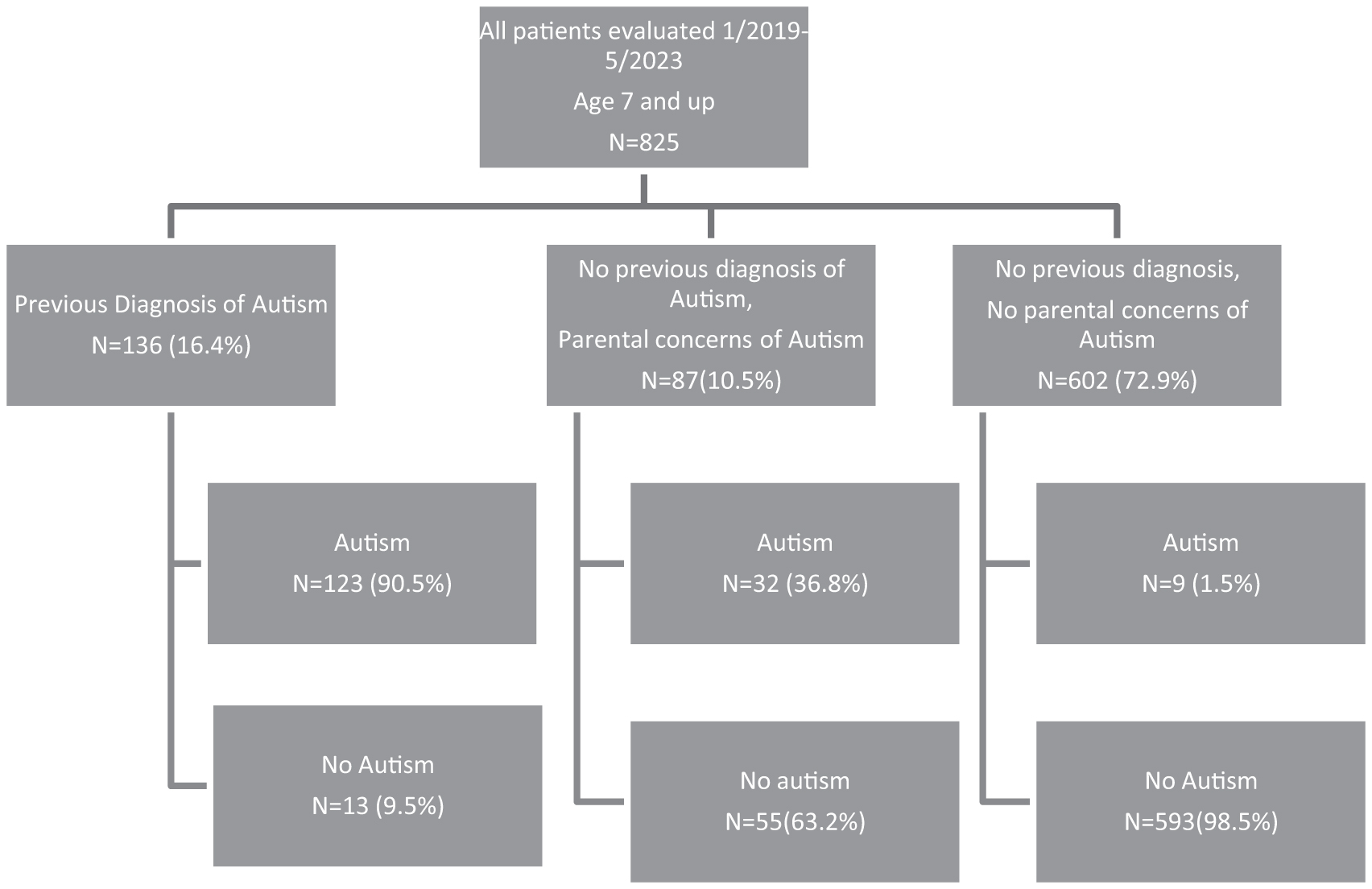
Trajectory of all patients evaluated from January 2019 to May 2023.
Patients newly diagnosed with Autism age ≥7 were more likely to be diagnosed with an Anxiety Disorder (27% vs. 13%, p = 0.04) and be prescribed selective serotonin reuptake inhibitors (10% vs. 1%, p = 0.03); developmentally, they were more likely to present with a Language Disorder (100% vs. 82%, p = 0.001) and less likely to be diagnosed with Intellectual Disabilities (13% vs. 34%, p = 0.001) than those who had a previous diagnosis of Autism (Table 1). There were no other differences in demographics or developmental diagnoses between the groups.
Demographics, Developmental and Psychiatric Diagnoses of Patients Age ≥7 Diagnosed with Autism (N = 164), By History of Previous Diagnosis of Autism
Bold values denote statistical significance at the p < 0.05 level.
Statistical analysis: aChi-square, bIndependent t-test, and cMann–Whitney U test.
Diagnoses based on the DSM-5 (American Psychiatric Association, 2013).
Use of psychopharmacology to treat co-morbid conditions before being referred to our center.
Included: Amphetamine and Dextroamphetamine, Lisdexamfetamine, and Methylphenidate.
Included: Aripiprazole and Risperidone.
Included: Clonidine and Guanfacine.
Included: Sertraline, Fluoxetine, and Escitalopram.
ADHD, attention-deficit/hyperactivity disorder; DSM-5, Diagnostic and Statistical Manual of Mental Disorders, 5th Edition; SSRIs, selective serotonin reuptake inhibitors.
Of the 136 patients referred for evaluation with a previous diagnosis of Autism, 13 (9.5%) did not meet the criteria for Autism any longer after multidisciplinary evaluations but continued to present developmental disorders, including Language Disorder (100%), attention-deficit/hyperactivity disorder (46%), and Speech Sound Disorder (38%). Of the 87 families who were concerned about Autism (without a previous diagnosis), 32 (36.8%) confirmed the diagnosis of Autism; 9 (1.5%) patients were newly diagnosed with Autism, and there were no parental concerns.
In conclusion, in this ethnically diverse group of school-age children and adolescents with developmental disabilities, 25% received an initial diagnosis of Autism at age 7 or older. Similar to previous reports (Loubersac et al., 2023), children who received a later diagnosis were more likely to present a language impairment, anxiety, and higher cognitive skills.
Limitations of this report include the retrospective nature, yet it represents the extent of yearly evaluations conducted in an urban developmental center. Longitudinal studies, in ethnically diverse populations, are necessary to understand the trajectory and clinical profile of Autism.
Footnotes
Author Disclosure Statement
No competing financial interests exist.