




Abstract
Various Arg-Gly-Asp (RGD) derivatives have been labeled with various radioisotopes for targeting αvβ3 integrin, which is expressed during angiogenesis in tumor. In this study, 2-(4′-isothiocyanatobenzyl)-1,4,7-triazacyclononane-1,4,7-triacetic acid (NOTA-SCN) and its c(RGDyK) conjugate (NOTA-SCN-c(RGDyK)) were labeled with 177Lu, which is a near ideal radionuclide for treating tumors because it emits therapeutic beta particles and gamma rays for monitoring. 177Lu (250 MBq) was labeled with 50 μg NOTA-SCN-c(RGDyK) quantitatively. The specific activity of 177Lu-NOTA-SCN-c(RGDyK) was 1.44 × 10⁵ Ci/mol. Biodistribution study was performed in Balb/c mice xenografted with CT-26 (mouse colon cancer) cells. The highest uptake was found in kidneys (7.56% ± 0.71% ID/g at 1 hour), and tumor uptake was 1.70% ± 0.33% ID/g at 1 hour postinjection. Moderate tumor-to-blood (2.36 ± 0.29) and tumor-to-muscle (2.06 ± 0.40) ratios were observed. This study shows that 177Lu-NOTA-SCN-c(RGDyK) is a potential therapeutic agent for angiogenic tumors, but special care is required to prevent kidney toxicity.
Introduction
Angiogenesis is required for tumor proliferation and metastasis, 1 and the integrins, which are composed of α and β subunits, participate in this process via cell–cell and cell–matrix interactions. 2 In particular, αvβ3 integrin is found where cell–cell and cell–matrix interactions occur and is highly expressed on osteoclasts, inflammatory cells, angiogenic cells, and tumor cells. Further, peptides with the arginine-glycine-aspartic acid (RGD) amino acid sequence strongly bind to αvβ3 integrin, 3 and many studies, in which αvβ3 integrin was targeted using RGD derivatives, have reported that these derivatives inhibit angiogenesis. 4 It has been also reported that anti-αvβ3 integrin monoclonal antibodies inhibit angiogenesis without affecting pre-existing blood vessels. 5 –7 Further, αvβ3 integrin is viewed as a promising candidate for tumor imaging and therapy, because its expression is highly specific. Accordingly, many radiolabeled RGD derivatives have been devised to target αvβ3 integrin, for example, the interaction between 125I-labeled c(RGDyK) and αvβ3 integrin has been used to target angiogenesis. 8 However, the high gut activity of 125I-labeled c(RGDyK) caused by hepatobiliary excretion is problematic. Several other radiolabeled RGD derivatives have been reported to improve pharmacokinetics and tumor affinities. 9 Dimerized and multimerized derivatives have been developed to improve tumor accumulation and pharmacokinetics. Although these derivatives showed increased affinity for αvβ3 integrin, uptakes in nontargeted organs such as kidney and liver also increased. 10 –13
Beta emitters, especially 131I, are used therapeutically, 14,15 and 90Y- and 111In-labeled RGD peptides have shown potential for therapy and imaging, respectively. 16 177Lu is known to be a promising radionuclide for therapeutic applications because it has suitable nuclear physical properties (T 1/2 = 6.73 days, E β(max) = 0.49 MeV, E γ = 208 keV [11%]) 17 and is amenable to large-scale production. In particular, it has the advantages of a wide distribution without significant decay loss due to a relatively long half-life, has adequate specific activity, and can be generated at excellent radionuclidic purities. Further, 177Lu-labeled EDTMP and DOTMP showed potential for the palliation of bone metastases. 18
In the present study, a c(RGDyK) derivative conjugated with a bifunctional chelating agent isothiocyanatobenzyl-1,4,7-triazacyclononane-1,4,7-triacetic acid (SCN-Bn-NOTA) was labeled with 177Lu (Fig. 1). 19 NOTA is a nine-membered cyclic compound and forms stable neutral complexes with metallic radionuclides, such as gallium and indium. In particular, gallium-NOTA complex is highly stable (k = 1031) because the small ionic radius of Ga(III) (62 pm) matches that of the NOTA chelate cage. Further, Ga(III) has been used for radiolabeling various biomolecules. 20,21 However, NOTA has not been previously labeled with 177Lu because lutetium has relatively large ionic radius.
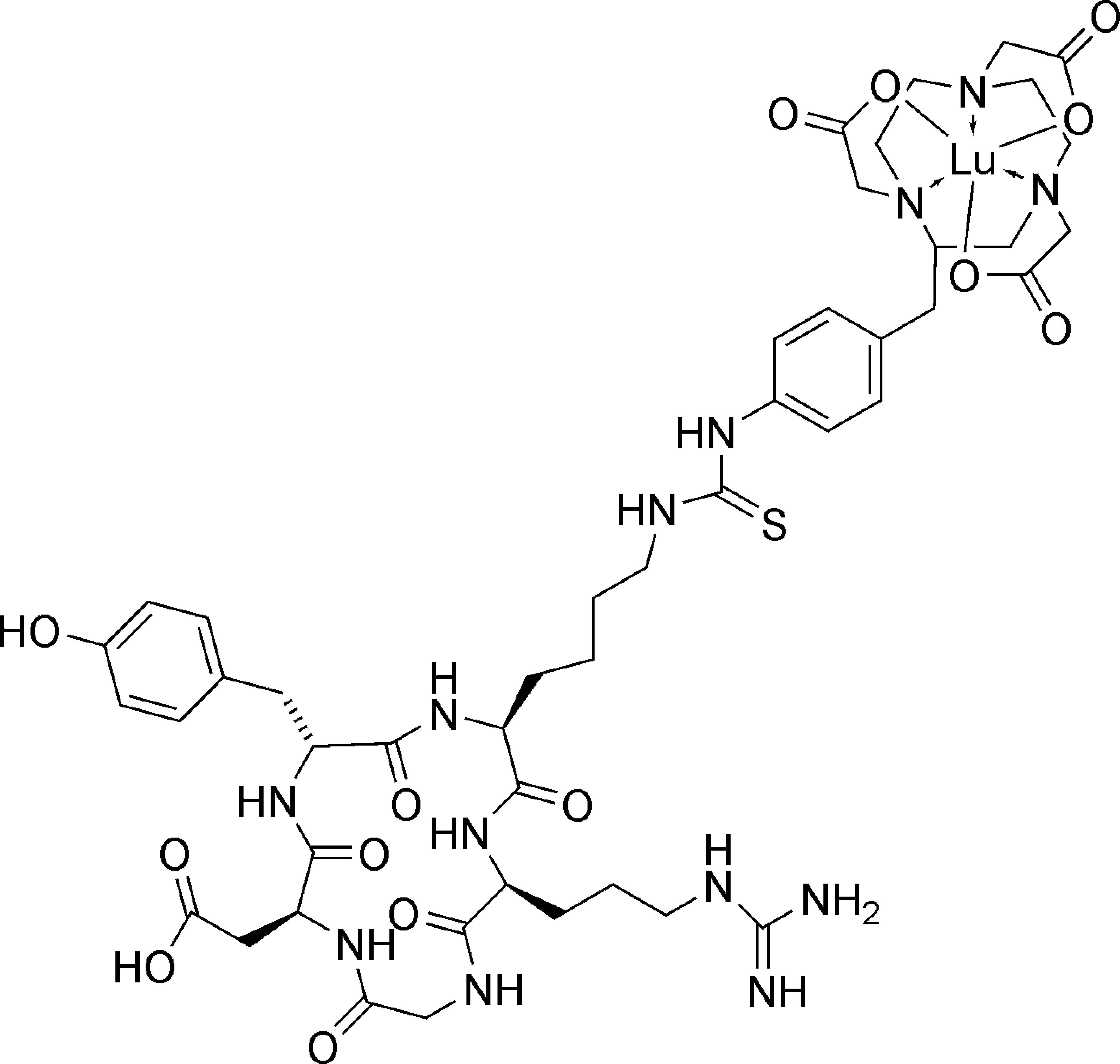
Chemical structure of 177Lu-NOTA-RGD. RGD, arginine-glycine-aspartic acid.
In the present study, NOTA-c(RGDyK) was labeled with 177Lu and its biodistribution was investigated in tumor-xenografted mice.
Materials and Methods
Synthesis of NOTA-RGD
4′-SCN-Bn-NOTA and c(RGDyK) were purchased from Futurechem. All other reagents and solvents were purchased from Sigma-Aldrich.
NOTA-RGD was synthesized as previously described. 19 In brief, 4′-SCN-Bn-NOTA (660 nmol, 0.3 mg) was added to c(RGDy)K (600 nmol, 0.37 mg) in 0.1 M sodium carbonate buffer (pH 9.5) and allowed to react for 20 hours at room temperature in the dark. NOTA-RGD peptides were then purified by high-performance liquid chromatography (HPLC; Agilent 1100 series) using an XTerra preparative column RP18 (10 × 250 mm; Waters) with 0%–100% ethanol gradient in 0.01% trifluoroacetic acid from 0 to 30 minutes at a flow rate of 3 mL/minute (retention time of NOTA-RGD was 13.2 minutes).
Labeling with 177Lu
177Lu (250 MBq; Perkin-Elmer) was added to a solution of 50 μg NOTA-SCN-c(RGDyK) and 1.0 mg selenomethionine in 300 μL sodium acetate buffer (pH 5.5, 0.4 M) and heated at 90°C for 35 minutes. Labeling efficiencies were checked by instant thin layer chromatography-silica gel (ITLC-SG; Pall Co.) using 0.1 M citric acid as eluant (R f values of 177Lu-NOTA-RGD and free 177Lu were 1.0 and 0.0, respectively) or by Whatman No. 1 paper (Kent) using 50% ethanol as eluant (R f values of 177Lu-NOTA-RGD and free 177Lu were 0.0 and 1.0, respectively). And labeling efficiencies were confirmed by HPLC (XTerra preparative column RP18; 250 nm; 100%–30% of 10 mM HCl gradient, 0%–70% MeCN gradient for 20 minutes). The retention time of 177Lu-NOTA-RGD in this system was 18.5 minutes. The radioactivity and the optical density at 240 nm of the peak fraction containing 177Lu-NOTA-RGD were measured, and specific activity was calculated.
Stability of 177Lu-NOTA-RGD
The stability of 177 Lu-NOTA-RGD was checked at room temperature over 1 week. Radiochemical purity for stability testing was checked by ITLC-SG and paper chromatography as described above.
Biodistribution study in mice with a colon cancer xenograft
The biodistribution study was performed at Seoul National University Hospital, which has full Association for the Assessment and Accreditation of Laboratory Animal Care International (2007) accreditation.
The mouse colon cancer cell line CT-26 was grown in DMEM medium containing 10% fetal bovine serum and harvested with trypsin. Cells were washed with 10 mL of phosphate-buffered saline. Each male Balb/C mouse was injected subcutaneously (s.c.) with 2 × 10⁵ CT-26 cells in right shoulder. Fourteen (14) days postinjection, 177Lu-NOTA-RGD (0.37 MBq/0.1 mL) was injected intravenously via a tail vein. Mice were sacrificed by cervical dislocation at 10 minutes, 1 hour, 4 hours, 12 hours, 24 hours, and 48 hours postinjection; thigh muscles, blood, and other organs were excised immediately, weighed, and counted using a Cobra II γ-scintillation counter (Packard Canberra Co.). Results were expressed as percentages of injected dose per gram of tissue (% ID/g).
Results
Radiolabeling
The 177Lu-NOTA-RGD produced was analyzed by ITLC-SG, paper chromatography, and HPLC. For these analyses, ITLC-SG plates and Whatman No. 1 paper were eluted with 0.1 M citric acid and 50% ethanol, respectively. When ITLC-SG plates were eluted with 0.1 M citric acid, free 177Lu moved with the solvent front and 177Lu-NOTA-RGD remained at the origin, but when Whatman No. 1 paper plates were eluted with 50% ethanol, free 177Lu remained at the origin and 177Lu-NOTA-RGD moved with the solvent front. The labeling efficiency was over 99% and almost no free 177Lu was found.
177Lu-NOTA-RGD had a longer retention time (18.5 minutes) than unlabeled NOTA-RGD by preparative HPLC (Fig. 2). The specific activity of 177Lu-NOTA-RGD was 5.33 GBq/μmol, and labeled 177Lu-NOTA-RGD was found to be stable for more than 24 hours at room temperature by HPLC (Fig. 3).
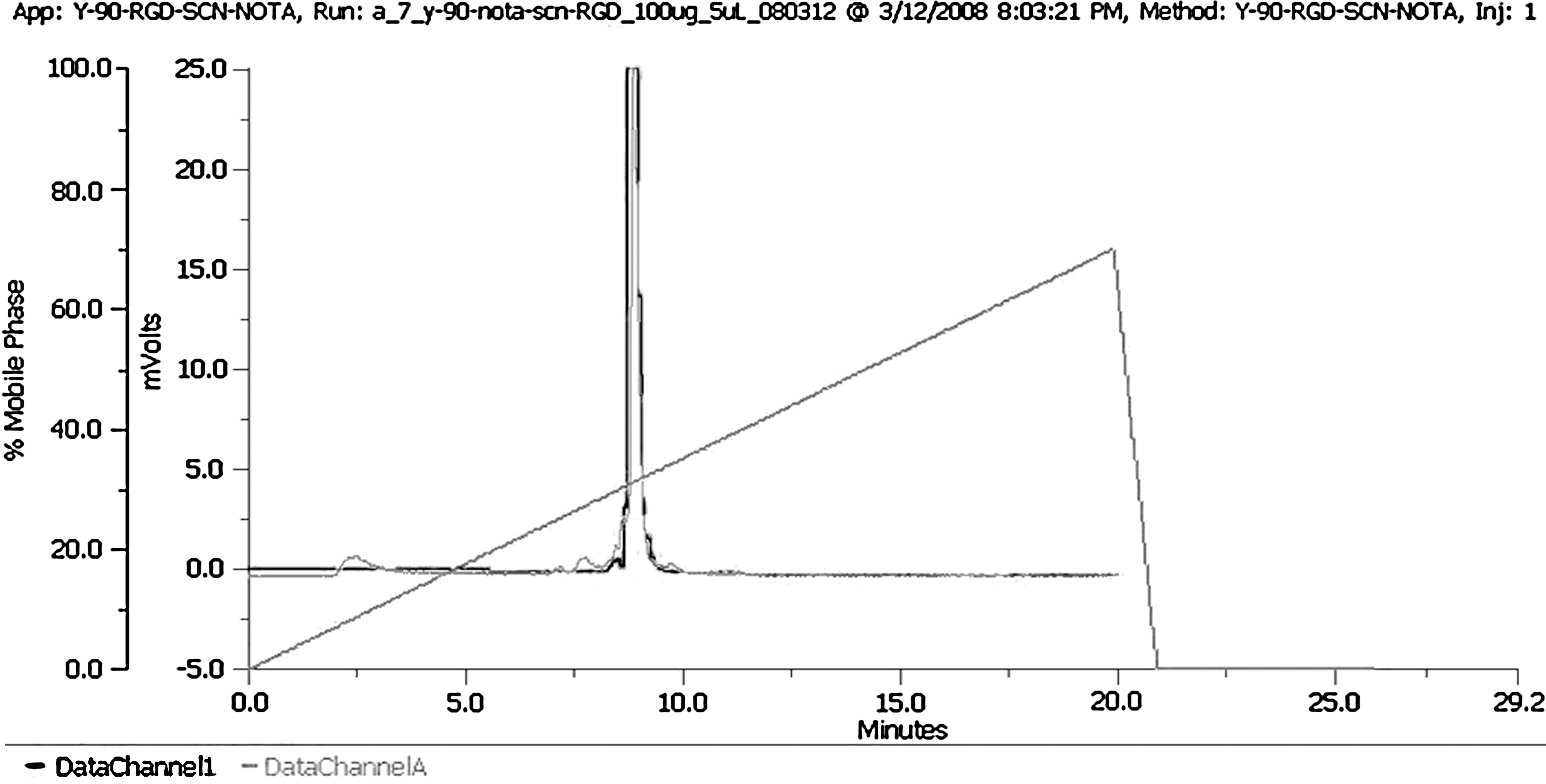
High-performance liquid chromatography profiles of 177Lu-NOTA-RGD. Zero percent to 70% MeCN gradient from 0 to 20 minutes in 10 nM HCl. High purity of radiolabeled product was demonstrated.

Stability of 177Lu-NOTA-RGD at room temperature for 7 days. Stabilities were checked by instant thin layer chromatography-silica gel and Whatman paper, using 0.1 M citric acid and 50% ethanol as eluants, respectively.
Biodistribution in tumor xenograft model
The biodistribution of 177Lu-NOTA-RGD was investigated in a mouse colon cancer CT-26–bearing Balb/C mice model at 14th day post-transplantation (Fig. 4). Levels of 177Lu-NOTA-RGD uptake in the kidneys (7.56% ± 0.71% ID/g at 1 hour) were high, suggesting that most was excreted via the kidneys. Although tumor uptake was not high (1.70% ± 0.33% ID/g at 1 hour), tumor-to-blood (2.36 ± 0.29 at 1 hour) and tumor-to-muscle ratios (2.06 ± 0.40 at 1 hour) were high and increased with time (Table 1). Bone uptakes were similar to those of other organs, such as liver, spleen, stomach, and intestine, and decreased with time, which indicates that 177Lu-NOTA-RGD is sufficiently stable in vivo.
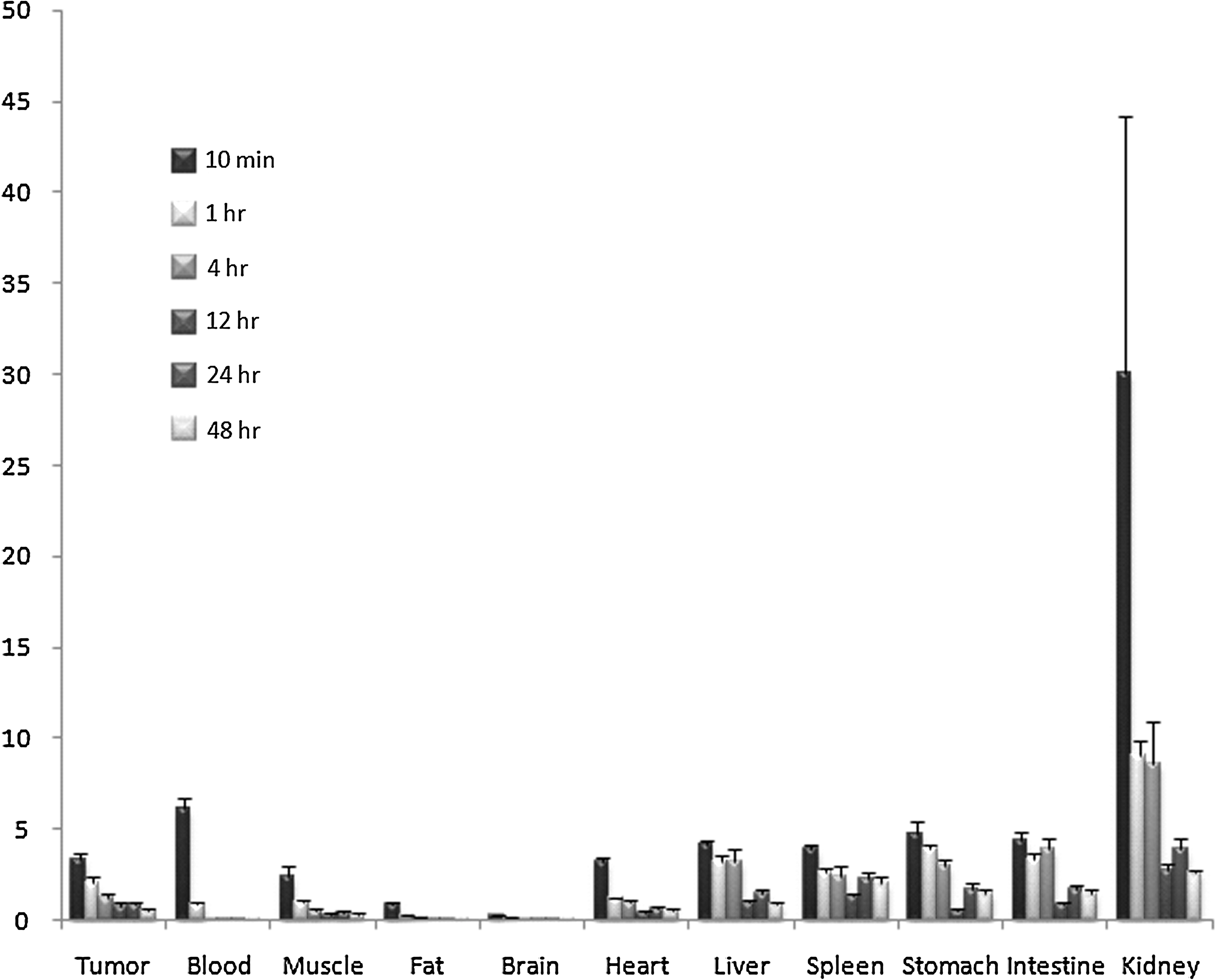
Biodistribution of 177Lu-NOTA-RGD in Balb/c mice with a CT-26 tumor after intravenous injection through tail vein.
Discussion
In this study, a conjugate of NOTA and RGD derivatives was designed for diagnostic and therapeutic applications and investigated as a potential ligand for 177Lu labeling. This type of derivative was chosen because RGD peptides specifically target the αvβ3 integrin expressed in tumors. In terms of preparation, c(RGDyK) and SCN-Bn-NOTA were conjugated by thiourea bond formation. This process leaves all carboxyl residues of NOTA intact and available for complex formation with 177Lu.
The NOTA-c(RGDyK) conjugate was purified by HPLC and then labeled with 177Lu at 90°C for 35 minutes. Free 177Lu remained at the origin by paper chromatography when eluted with 50% ethanol and moved with the solvent front when eluted with a 0.1 M citric acid solution on ITLC-SG.
Like 131I, 188Re, 166Ho, and 90Y, 177Lu is a promising therapeutic β-emitter and has adequate nuclear physical properties (T 1/2 = 6.73 days, E β(max) = 0.49 MeV, E γ = 208 keV [11%]) for therapeutic applications. 177Lu could be a viable alternative for 131I (T 1/2 = 8.02 days, E β(max) = 0.606 MeV, E γ = 364 keV [81%]) for therapeutic applications and has an advantage of a relatively low energy (208 keV) and low abundance (11%) of major γ emission. In addition, 177Lu can be produced in large scale with good radionuclidic purity and adequate specific activity.
188Re (T 1/2 = 17 hours, E β(max) = 2.21 MeV, E γ = 155 keV [15%]) and 90Y (T 1/2 = 64 hours, E β(max) = 2.18 MeV) have been reported to be attractive radionuclides for cancer therapy, because they have favorable nuclear decay characteristics and can be produced from generators installed in hospitals. However, the availability of 188W/188Re generator is limited, because it is produced by a double neutron capture reaction, and only few reactors worldwide can provide the high thermal neutron fluxes (>5 × 10¹⁴ n/cm2/s) required to produce 188W in the quantities required for the preparation of 188W/188Re generator. 22 –2490Y is also obtained from a generator, but radionuclidic contamination by 90Sr (T 1/2 = 28.3 years) is problematic, and thus, the generator is not available commercially. 25
DOTA has been used as a bifunctional chelating agent for labeling peptides with lanthanide radionuclides, such as 177Lu, because of its ability to form highly stable chelates. 26 However, in the present study, it was found that NOTA also forms a stable chelate with 177Lu. Although NOTA has been previously reported to form a stable chelate with 68Ga, 27 this is the first report of the successful labeling of an RGD derivative with 177Lu.
The biodistribution model used in this study was a CT-26 (mouse colon carcinoma)-xenografted mouse model, and it was found that 177Lu-NOTA-RGD was well taken up by tumors. Hydrophilicity and hydrophobicity are important determinants of renal excretion and hepatobiliary excretion. In the present study, high renal excretion and low hepatobiliary excretion were attributed to the hydrophilic nature of 177Lu-NOTA residues. 177Lu-NOTA-RGD shows high kidney uptake, and thus, it is probably cleared rapidly through kidneys. However, kidney uptake might be the dose-limiting factor for radionuclide therapy using 177Lu-NOTA-RGD, and thus, 177Lu-NOTA-RGD doses should be considered carefully to prevent kidney toxicity.
Conclusions
A NOTA-RGD conjugate was synthesized, labeled with 177Lu, and its in vitro stability and in vivo biodistribution were investigated in tumor-bearing mice. 177Lu has a considerable potential as a therapeutic radionuclide because of its suitable decay properties. 177Lu-NOTA-RGD complex was prepared with excellent radiochemical purity and was found to have excellent in vitro stability. This biodistribution study in Balb/C mice showed high uptakes in kidneys and high tumor/blood ratios. These findings indicate that 177Lu-NOTA-RGD might be a potential therapeutic agent for angiogenic tumors. However, caution must be exercised to prevent kidney toxicity.
Footnotes
Acknowledgments
This work was supported by an NRF of Korea grant (R0A-2008-000-20116-0) and the Converging Research Program (2010K001055) funded by the Ministry of Education, Science and Technology.
Disclosure Statement
No competing financial interests exist.