




Abstract
Skeletal uptake of β−-emitting radionuclides may be used for bone pain palliation or myeloablation. The physical characteristics of the β− particles required for the two conditions are, however, different, that is, higher energies are favorable for destruction of bone marrow. In this study, the labeling conditions of ethylene diamine tetramethylene phosphonic acid (EDTMP) with three rare earth metals (90Y, 166Ho, and 177Lu) having β− particles of diverse physical characteristics were optimized, and their animal biodistributions were studied and compared with 153Sm-EDTMP. All the four radiometals (X = 90Y, 166Ho, 177Lu, and 153Sm) were produced from n,γ reactions of their respective precursors (89Y, 165Ho, 176Lu, and 152Sm). They were labeled with EDTMP at varying degrees of pH and molar ratios, and labeling yields were determined by paper chromatography at each data point. The complexes with optimal labeling yields and their chloride forms (XCl3) were then studied for biodistributions in 66 Sprague–Dawley male rats at 30 minutes, 2 hours, and 24 hours after injection. All the radiopharmaceuticals gave ∼98% complex yields at pH 8. At optimum pH level, good labeling was achieved at X:EDTMP molar ratios of 1:5, 1:8, and 1:20 for 90Y, 166Ho, and 177Lu complexes, respectively. 177Lu-EDTMP showed the best biodistribution results among all the complexes, with a total skeletal uptake of 70.2% ± 2.4% at 24 hours (153Sm-EDTMP = 59.1% ± 2.6%). 90Y-EDTMP had skeletal accumulation significantly higher than 166Ho-EDTMP (45.5% ± 2.9% and 27.4% ± 3.6%, respectively). Blood activity of all the agents disappeared promptly through the kidneys. This study demonstrates higher localization of 177Lu-EDTMP in skeleton than 153Sm-EDTMP and shows that the localization of 90Y-EDTMP is better among the high-energy radiometals studied.
Introduction
Therapeutic bone-seeking radiopharmaceuticals emitting β− particles are either used for bone pain palliation therapy in metastatic skeletal disease or proposed for bone marrow ablation in hematological malignancies, such as multiple myeloma. β− particles of low energies are recommended for bone pain, whereas those with higher energies are used for bone marrow ablation. 1 Ethylene diamine tetramethylene phosphonic acid (EDTMP) is an active bone seeker that is taken up by the bone matrix. Labeled with a lanthanoid, that is, 153Sm, it is frequently used as a bone seeker, primarily for bone pain palliation therapy, and is also evaluated for bone marrow ablation. 2 –4153Sm has beta energy of a medium range (E β(max) = 808 keV, maximum soft-tissue range: 3.1 mm, T½ = 47 hours). Because of this it has an untoward effect of myelosuppression, a major dose-limiting factor. 5,6 On the other hand, when used alone its beta energy falls short in efficiency for bone marrow ablation. 7
Several other lanthanoids have β− particle energies that may be more suitable for the aforementioned clinical situations. 166Ho (E β(max) = 1855 keV, maximum soft-tissue range: 8.7 mm, T½ = 27 hours), 177Lu (E β(max) = 498 keV, maximum soft-tissue range: 2.0 mm, T½ = 161 hours), and 90Y (E β(max) = 2280 keV, maximum soft-tissue range: 11.9 mm, T½ = 64 hours) are few of them that are under evaluation. 8 –10 The present study's authors have recently produced these isotopes at Isotope Production Division, PINSTECH, Islamabad. This study was done to label them with EDTMP while optimizing various labeling parameters and to perform and compare their animal biodistributions with ionic forms of the respective radiometals and 153Sm-EDTMP. The experiments on animals were conducted with prior approval of the ethics committee of the Pakistan Institute of Engineering and Applied Sciences (PIEAS), Islamabad, and according to appropriate guidelines to conduct experiments on laboratory animals.
Materials and Methods
Preparation of labeled EDTMP
Radioisotopes (X = 90Y, 166Ho, 177Lu, and 153Sm) were produced locally by n,γ reactions from stable oxides of their precursors (89Y2O3, 165Ho2O3, 176Lu2O3, and 152Sm2O3) obtained from International Hospital Supply Corp., New York, using previously published procedures. 11 Known quantities of the targets were sealed in quartz ampoules and cold-welded into aluminum cans. The irradiations were carried out inside the core of the 10 MW swimming pool type nuclear reactor Pakistan Research Reactor-I for up to 12 hours at a neutron flux of ∼1.0 × 1014 cm2 s−1. The irradiated material was dissolved in 5 M hydrochloric acid and evaporated to dryness and the residue was dissolved in distilled water to obtain radionuclide solutions in their chloride forms (XCl3). Radionuclide purity was assured by HPGe gamma spectrometry.
EDTMP was dissolved in distilled water and labeling was done separately for different radiometals by adding their respective chloride solutions to it. Labeling conditions of metal-to-ligand molar ratio (X:EDTMP) and pH of the reaction mixture were optimized to achieve maximum complexation yield. Reaction mixture volumes were ∼2 mL and all the studies were performed at room temperature (22°C ± 2°C). The pH levels of the resulting solutions were adjusted with 1 M HCl or 1 M NaOH and were incubated for 30 minutes before examining the labeling yields.
Paper chromatography
The radiolabeling yields of complexes were determined by ascending paper chromatography. Five microliters of the test solution was spotted at 2 cm from bottom end of Whatman 3 MM chromatography paper strips (14 × 2 cm). The strips were developed in pyridine/ethanol/water (1:2:4) and then dried. Activity was measured using either 1 cm cut-sections of the strip separately in a well counter or, alternatively, the whole strip by a 2π scanner (Berthold). Labeled complex moved with the solvent front (R f = 9–10), while ionic form remained at the point of spotting (R f = 0). The labeling yields of solutions were determined for various pH levels and molar ratios. The solutions to be used in animals were first adjusted to pH 7 and were made sterile by using a Millipore filter prior to injection.
Labeling yields of all the complexes under study were evaluated at various pH levels (n = 3 at each level), keeping high X:EDTMP molar ratios (1:12 for 90Y and 166Ho; and 1:30 for 177Lu). Labeling percentage was also analyzed after changing X:EDTMP molar ratio from 1:1 to 1:12 for 90Y and 166Ho and from 1:5 to 1:30 for 177Lu (n = 3 at each point), keeping pH at optimal level. Labeling yields of the complexes prepared at optimal parameters were also studied after 1 week to evaluate the stability.
Biodistribution study
The biodistribution study of ionic radionuclides and labeled complex was performed in Sprague–Dawley male rats having weight ranging from 175 to 200 g. Rats were anesthetized in a covered jar containing cotton swab dipped in ether followed by injection of 200 μL of the complex into the tail veins and housed separately for a certain period. They were then killed with an overdose of anesthesia. Three dissections were done at 30 minutes, 2 hours, and 24 hours for each radiopharmaceutical and its free ionic radionuclide (only 2 and 24 hours in case of 153Sm). One (1) milliliter of blood was drawn from the heart and weighed immediately after sacrificing the animal. Rat was then weighed and subsequently dissected taking special care to separate the blood and urine on the kill papers. The tissue washing and the urine from the cages was also collected separately. The required organs were taken out for the calculations of percentage of activity per organ (%ID/g). The larger organs such as liver and intestines were weighed and then a small weighed portion was taken for the purpose of counting and adjusted for whole organ. Femur was taken as representative bone for skeletal uptake and total skeletal uptake was estimated 25 times the %ID of femur. 12 Counting was done in Ludlum™ Model 261 spectrometer using γ photons of energies with respective to radionuclide or, alternatively, using bremsstrahlung for 90Y.
A total of 66 animals were sacrificed, 3 each for EDTMP labeled with 90Y, 166Ho, and 177Lu and their ionic forms at each time point of 30 minutes, 2 hours, and 24 hours and for the study of the biodistribution of 153Sm-EDTMP and free ionic 153Sm for comparison at 2 and 24 hours.
Scintigraphic studies
Scintigraphic studies at Department of Medical Sciences (PIEAS) were also done on Sprague–Dawley male rats to visually evaluate the distribution of EDTMP labeled with 166Ho and 177Lu for comparison with 153Sm. The animal was anesthetized by intramuscular injection of 100 mg diazepam as the initial dose. The additional amounts were given later to retain the effect of anesthesia. Approximately 25 MBq of radiopharmaceutical was injected into the tail vein and imaging was done under Siemens Integrated ORBITER Camera System interfaced with high-resolution parallel-hole collimator. Twenty-percent energy windows were set at 103 and 81 keV for 153Sm and 166Ho, respectively. For 177Lu, the setting of dual energy windows at 113 and 208 keV was used to attain adequate count rate. Ten (10)-minute static image of whole body was acquired on 64 × 64 matrix at 2 hours after the injection. All the radiopharmaceuticals were studied in separate animals.
Results
Production and labeling
Twelve (12) hours of irradiation of Sm2O3, Y2O3, Ho2O3, and Lu2O3 produced ∼3700, 160, 5920, and 925 MBq/mg activities of 153Sm, 90Y, 166Ho, and 177Lu, respectively. No other gamma-emitting radionuclide was detected by gamma spectrometry in all productions.
Nearly 98% of labeling yields could be achieved with all radioisotopes at pH 8 (Fig. 1), with only a minimal change at higher pH levels. However, at pH levels below 7, the yield was significantly low (Fig. 2A).
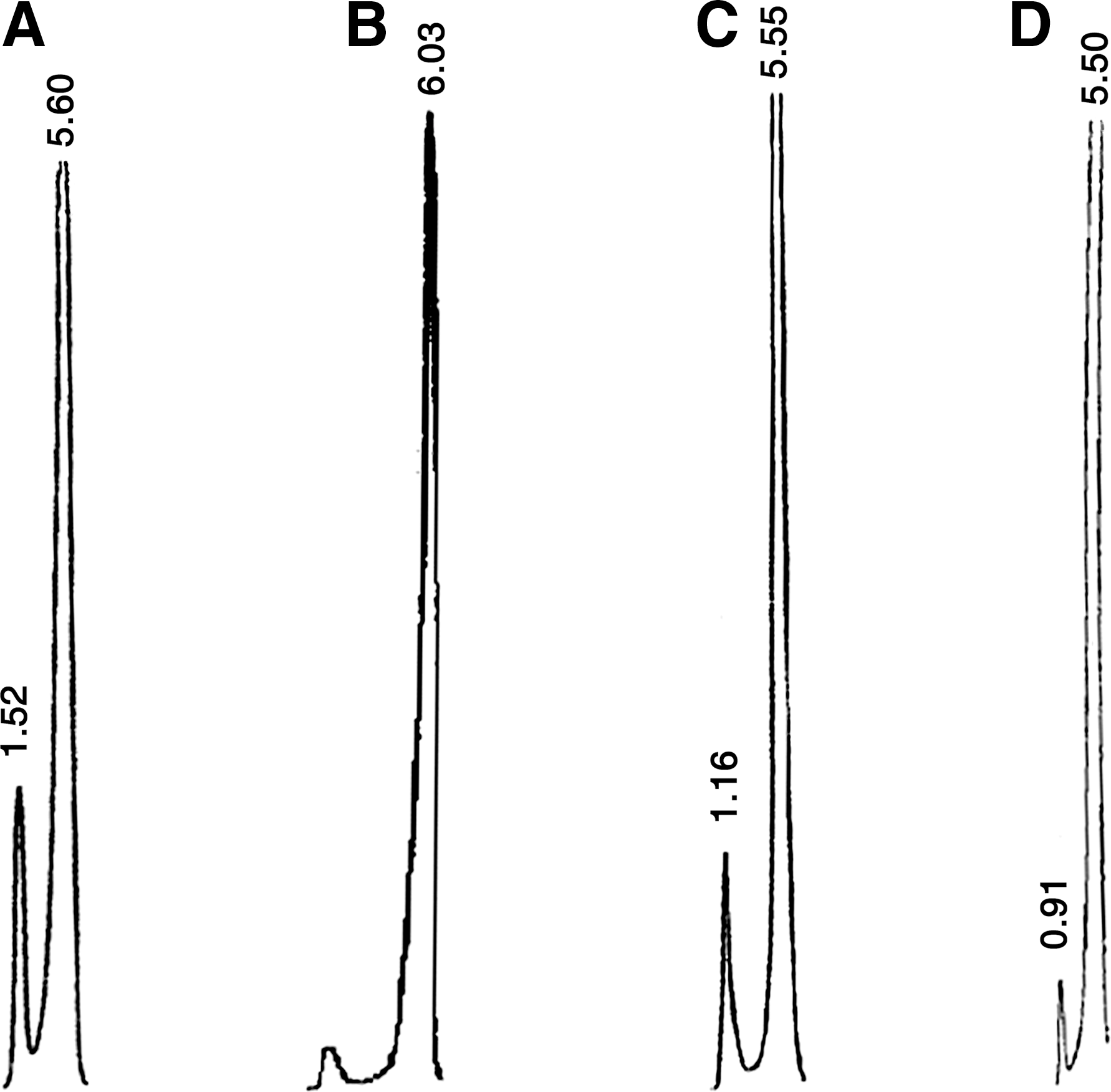
Paper chromatography scans of 90Y-EDTMP
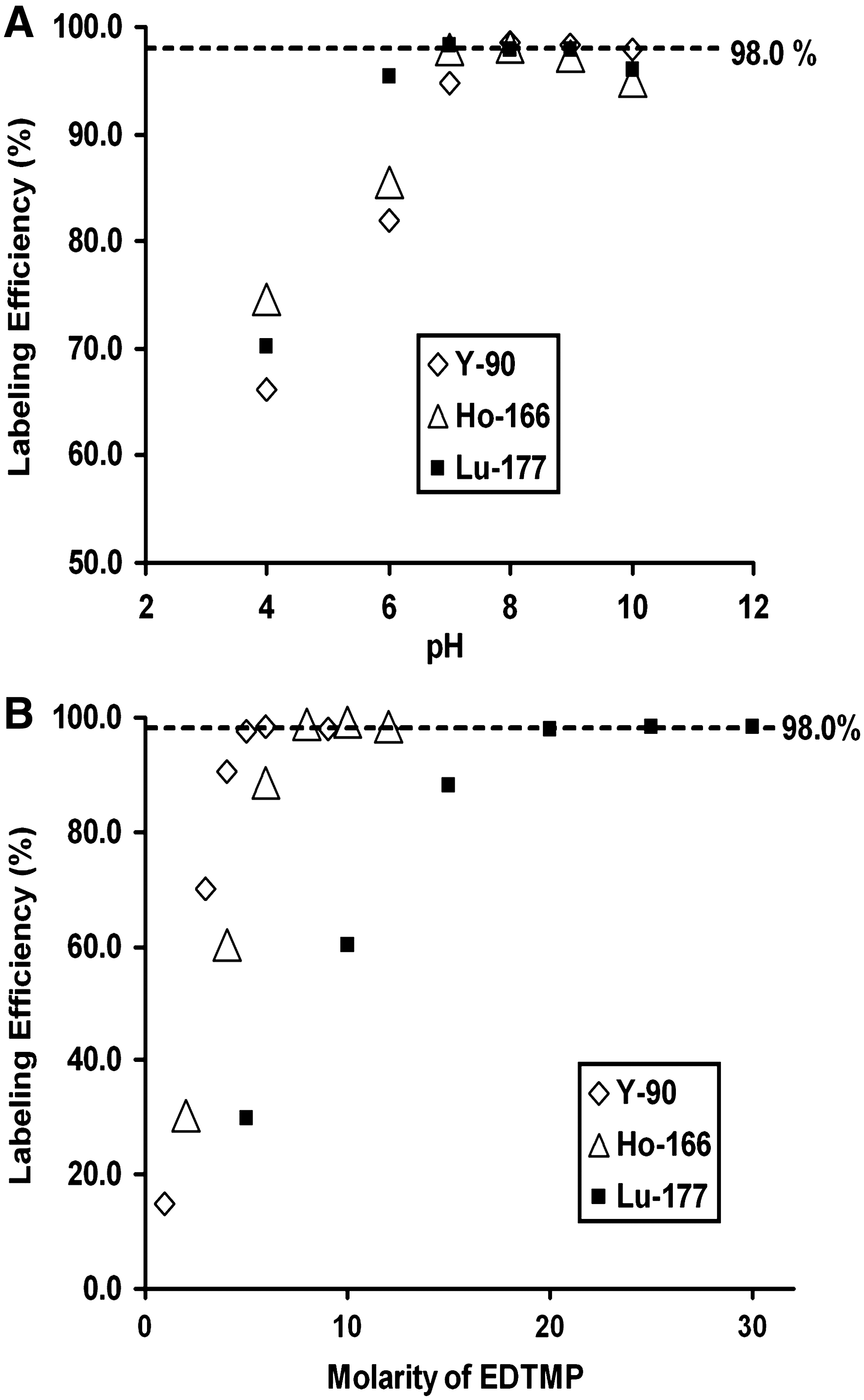
Variation in labeling yields of different complexes with change in pH
Keeping optimum pH level, that is, pH 8, good labeling yield (97.7% ± 1.3%) was possible at a molar ratio of 1:5 in case of 90Y-EDTMP. Above this ratio the labeling remained >98% (Fig. 2B). The labeling efficiency of 166Ho-EDTMP reached 98.8% ± 0.3% with a molar ratio of 1:8 or above. However, 177Lu could be labeled efficiently at 1:20 onward (98.1% ± 0.4% at 1:20). All the complexes remained adequately stable after 7 days (>95%).
For 153Sm-EDTMP, a labeling efficiency of >99% could be achieved after 30 minutes of incubation at room temperature. The complex remained stable even after 7 days (98%).
Biodistribution studies
Complexes prepared at optimum labeling parameters and giving labeling yields of ∼98% as mentioned in the above section were used for biodistribution studies. There was a significant difference in the distributions of labeled EDTMP and their respective free ionic forms (Table 1). The ionic forms mainly accumulated in the liver with low skeletal and renal uptake. Free 153Sm ions showed the highest hepatic uptake, whereas free lutetium was the lowest among all the free ions (8.29% ± 0.72% and 0.47% ± 0.34%, respectively, at 24 hours after injection). Uptake in the lung at 24 hours postinjection was also highest for 153Sm ions (6.83% ± 0.62%), and 166Ho ions showed the highest renal accumulation. No significant uptake of the free ions was seen in the femur, with 153Sm being the highest (0.36% ± 0.03% at 24 hours).
n = 3 for each radiopharmaceutical and its free ionic form.
EDTMP, ethylene diamine tetramethylene phosphonic acid.
177Lu-EDTMP showed the high percentage of uptake in the femur among all the labeled radiopharmaceuticals, increasing from 2.71% ± 0.32% at 30 minutes to 6.76% ± 0.63% at 24 hours in femur. It was twice as high as 153Sm-EDTMP at 24 hours. 90Y-EDTMP demonstrated femur accumulation similar to 177Lu-EDTMP at 30 minutes (2.71% ± 0.16%), but remained almost steady in 2- and 24-hour samples. 166Ho-EDTMP gave the minimum femur uptake in all complexes (a maximum of 1.20% ± 0.06% at 2 hours).
Total skeletal uptake was estimated from percentage of femur uptake (Fig. 3). 177Lu-EDTMP had highest bone uptake reaching 70.2% ± 2.4% at 24 hours. 166Ho-EDTMP uptake in the skeleton was the lowest of all, that is, 15.6% ± 1.7% at 30 minutes to a maximum of 36.1% ± 2.1% at 2 hours after injection. Peak activity for 90Y-EDTMP was also found at 2 hours (56.9% ± 2.8%).
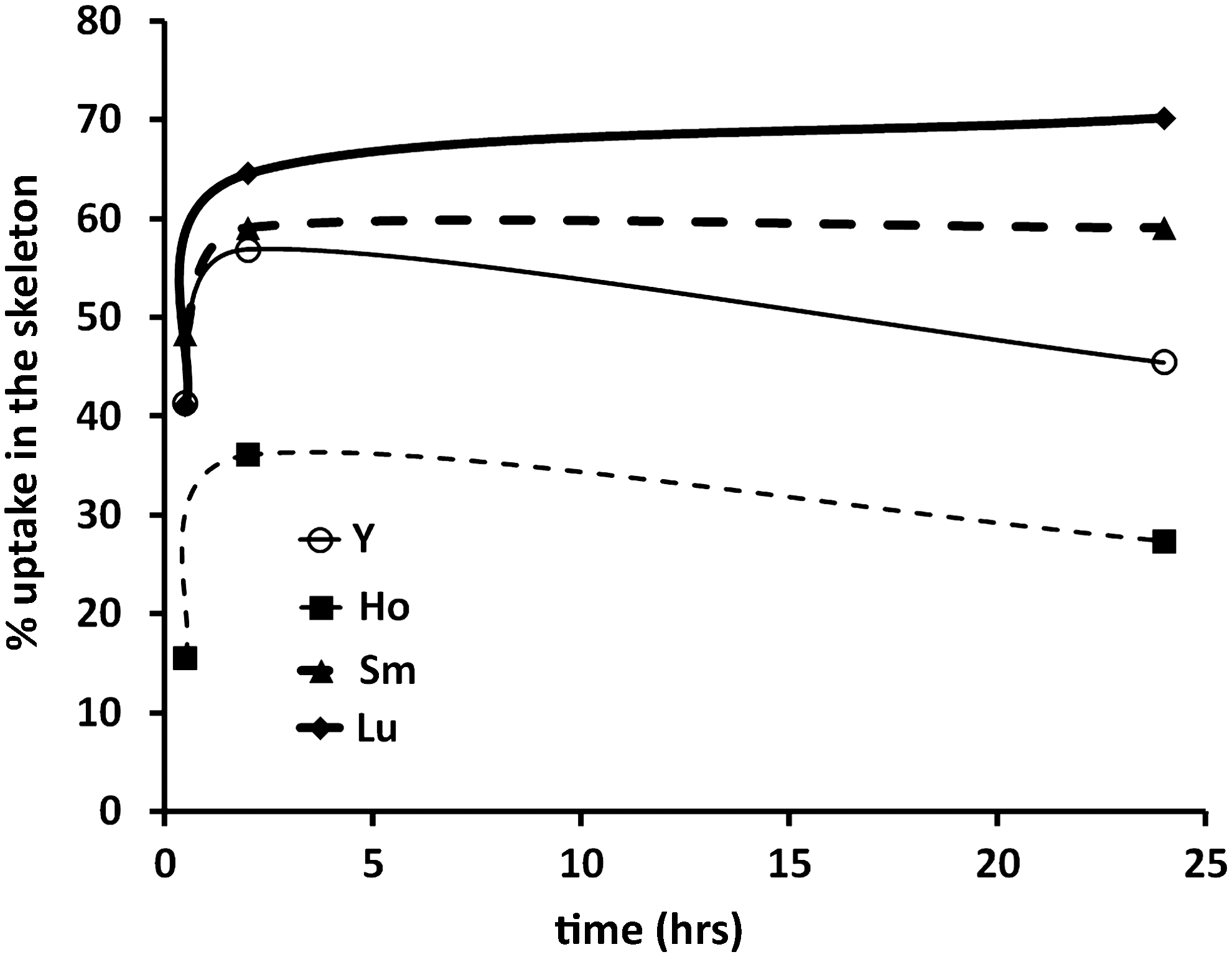
Comparison of total skeletal uptake of EDTMP complexes with 90Y, 166Ho, 177Lu, and 153Sm in Sprague–Dawley male rats sacrificed at different times. n = 3 at each time point.
A significant pool of renal activity was seen in all the labeled compounds, with 166Ho-EDTMP being the highest. In 24 hours the activities in all the other organs were minimal for all the radiopharmaceuticals.
Scintigraphic studies
Sprague–Dawley rats were also imaged under a gamma camera at 2 hours after tail injections of 153Sm-, 166Ho-, or 177Lu-labeled EDTMP. The images (Fig. 4) demonstrated selective uptake in the skeleton and accumulation in the urinary system, findings which were in accordance with the biodistribution results.
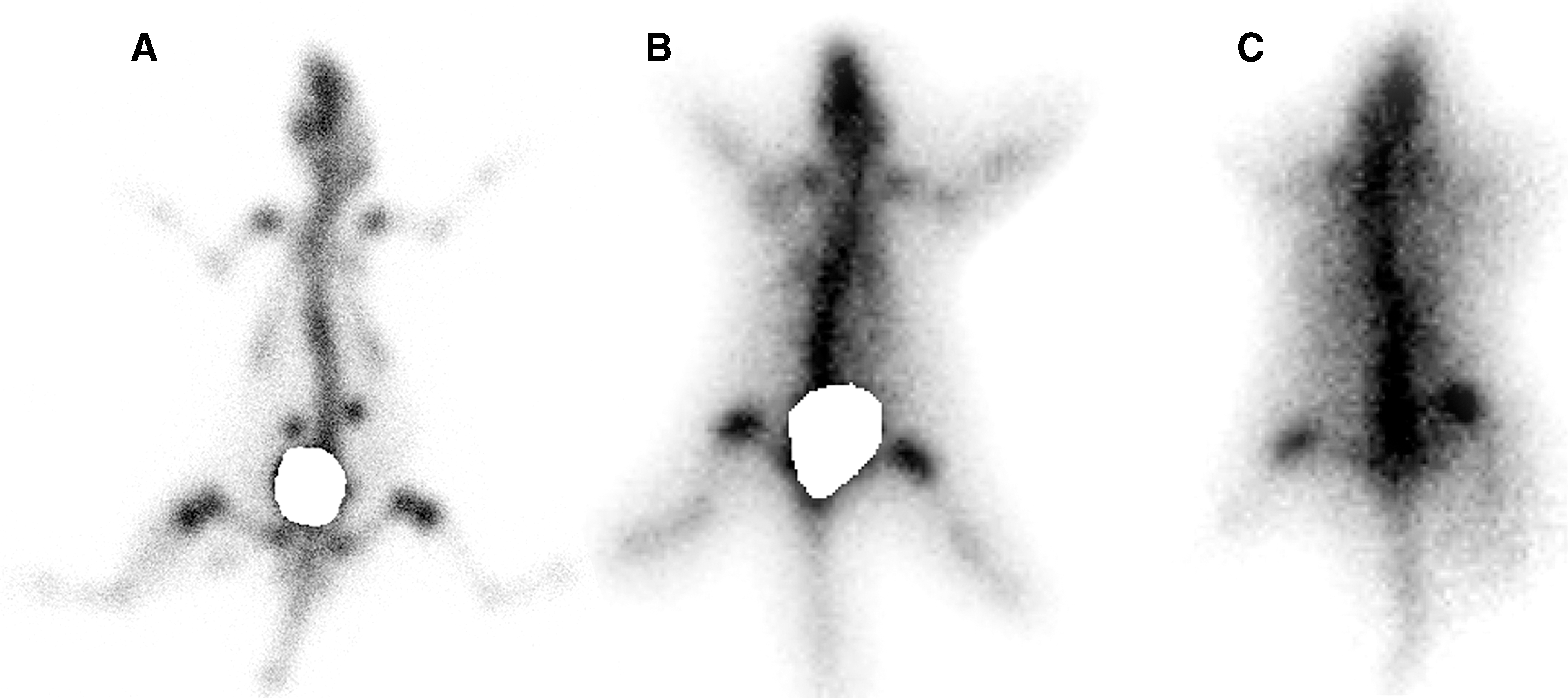
Scintigraphic images of Sprague–Dawley male rats at 2 hours after intravenous injections of 153Sm-EDTMP
Discussion
EDTMP labeled with a lanthanoid 153Sm is used clinically for metastatic bone pain and is anticipated for use in bone marrow ablation, but its β− energy and range of the particles are not ideal for both indications. 1,5 –7 There are several other β−-emitting lanthanoids that are being evaluated for this purpose. They include 166Ho and 177Lu and the chemically similar 90Y. 8 –10 In the present study, parameters for labeling of EDTMP with these radiometals were optimized and their animal biodistributions were determined, comparing with 153Sm-EDTMP. The latter was prepared in the authors' department and was of standards similar to that in the study by Goeckeler et al. 12 (%ID/g in femur 3.80 ± 0.31 and 3.720 ± 0.259, respectively).
166Ho, which has a long range of β− particles (E β(max) = 1855 keV, maximum soft-tissue range: 8.7 mm), was considered for bone marrow ablation before marrow transplantation. It was labeled with EDTMP efficiently at pH 7 and 8 (≥98% at both pH levels) but dropped slightly at higher pH (Fig. 2A). A research group in South Africa also achieved >97% labeling efficiency at similar pH levels. 8 In contrast, Appelbaum et al. 13 showed 99.7% labeling efficiency at a higher pH level (pH 10.2). They applied ion exchange technique to assess the yield, whereas the South African and the present studies used paper chromatography. In the present study, 166Ho was efficiently labeled with EDTMP at a molar concentration of 1:8, whereas only 80% labeling was reported at 1:250 by Ernestová et al. 14
166Ho-EDTMP gave the lowest bone uptake among all the radiopharmaceuticals studied (maximum at 2 hours, i.e., 1.20% ± 0.06%ID/g of femur and 36.1% ± 2.1%ID in whole skeleton). This could be explained by excessive removal of the complex from blood via kidneys (nine times higher than 153Sm-EDTMP at 2 hours). Excretion of 166HoCl3 was also significantly high when compared with other ions. Variation of in vivo distribution of 166Ho-EDTMP from 153Sm-EDTMP has also been observed in previous studies, with its uptake in bone being inferior to the latter as seen in canine and baboon models. 8,13,15
In the present study, 177Lu was efficiently labeled with EDTMP at a pH suitable for intravenous use (98.3% ± 0.4% at pH 7), which is consistent with a preliminary work of Chakraborty et al. 9 In the present study, efficient labeling of 177Lu could only be possible with higher ligand concentrations compared with other metals studied (98.5% ± 0.4% at a metal:ligand ratio of 1:20 or above). Chakraborty et al. 16 in another study, however, produced 98.1% ± 0.5% 177Lu-EDTMP at 1:5 ratio possibly because of slight variation in the method of labeling.
177Lu-EDTMP prepared in this study showed highest bone uptake compared with other three metals when tagged to EDTMP. At 24 hours after injection, its total skeletal uptake was 70.2% ± 2.4%ID, whereas that of 90Y-, 166Ho-, and 153Sm-labeled EDTMP was 45.5% ± 2.9%ID, 27.4% ± 3.6%ID, and 59.1% ± 2.6%ID, respectively. Significantly lower uptake in rats (46.25% ± 3.48%ID) has been reported by Chakraborty et al. 16 Garnuszek et al. 17 found femur uptake similar to the present study (5.32% ± 0.55%ID/g and 5.10% ± 0.32%ID/g, respectively).
The appearance of distribution of 177Lu-EDTMP on the scintigraphic images of rats was consistent with direct measurements of biolocalization after animal sacrifice (Fig. 4C). There was, however, a higher level of noise seen in177Lu-EDTMP compared with 153Sm-EDTMP because of registration of scattered photons of higher energies. Similarly, the scattered events of 1379 keV photons of 166Ho-EDTMP distorted its image, which was recorded at 81 keV.
Yttrium is a nonlanthanoid rare earth metal that possesses chemical properties similar to lanthanoids. In this study, 90Y-EDTMP was prepared with a high labeling yield (98.4% ± 0.3%) at pH 8, which remained almost steady at higher pH levels (Fig. 2A). At higher acidic contents (pH 7 and less), the efficiency of labeling sharply declined.
As expected, while analyzing the biodistribution results it was found that 90YCl3 primarily accumulated in the liver, findings which were also observed with all other free ions. In contrast, however, the free ionic 90Y activity in lungs was significantly low when compared with other chlorides. Its uptake in bone was minimal (a maximum of 0.11% ± 0.01%ID/g at 2 hours), but when tagged with EDTMP the accumulation in femur was 74 times higher at 24 hours. Total uptake of 90Y-EDTMP in the skeleton was 56.9% ± 2.8%ID at 2 hours, which was parallel to 153Sm-EDTMP (59.1% ± 4.6%ID) (Fig. 3). de Witt et al. 18 using computer simulations predicted the localization of 90Y-EDTMP in bone similar to 153Sm-EDTMP, which was demonstrated by the present study's experiments in rats.
Bone uptake of a beta-emitting radiopharmaceutical gives a radiation dose to the malignant lesions of the skeleton and also at the same time to the bone marrow. Later, an untoward effect is caused, which may be reduced by using β− particles of lower E max and hence lesser penetration. 1 In the present study, 177Lu-EDTMP has shown biolocalization similar to 153Sm-EDTMP. However, it earns a better place than the latter because of the shorter soft-tissue range of its β− particles when bone marrow toxicity is considered. Further, because of its half-life nearly four times than that of the latter agent, reinjections may be required after longer durations, reducing the overall cost. Further studies in human volunteers and patients are underway in the authors' institute.
On the other hand, limited success has been reported using 153Sm-EDTMP for bone marrow ablation without support of a chemotherapeutic agent. 19,2090Y and 166Ho have been proposed in literature for this purpose, 8,10 and as they have higher particle penetration they could be better choices. In the present study, however, 90Y-EDTMP showed favorable skeletal localization compared with 166Ho-EDTMP. Later, it was found inadequate for producing bone marrow ablation in dog models. 13
Conclusions
This study demonstrates a convenient and efficient labeling of EDTMP with 90Y, 166Ho, and 177Lu similar to 153Sm-EDTMP, with slight dissimilarities in optimum labeling conditions. There is considerable variation in the skeletal accumulation of the four agents, which is in the following sequence: 177Lu-EDTMP > 153Sm-EDTMP > 90Y-EDTMP > 166Ho-EDTMP. It is recommended that 177Lu-EDTMP is a better choice for bone pain palliation therapy, and 90Y-EDTMP should be further evaluated for bone marrow ablation.
Footnotes
Acknowledgments
The authors thank Mohammad Yousuf Kakakhel, Shabana Saeed, and Tariq Majeed of the Department of Medical Sciences of PIEAS for their valuable technical assistance to accomplish this project. The authors also appreciate the technical staff of IPD, PINSTECH and DMS, PIEAS, for their selfless help in performing the animal studies. Support from Khurshid Ahmed and Nadeem Khalid is also appreciated. Tremendous help also came from Sallahud-Din, Khalid, Samina Roohi, and Ibrar Haider of Isotope Production Division of PINSTECH. This study was financially supported by PINSTECH and PIEAS.
Disclosure Statement
No competing financial interests exist regarding this publication.