




Abstract
Purpose:
177Lu (T 1/2 = 6.73 days, E β(max) = 0.497 MeV, E γ = 113 KeV [6.4%] and 208 KeV [11%])-labeled DOTA-TATE, a somatostatin analog, is presently being considered a promising agent for the treatment of patients suffering from inoperable neuroendocrine tumors, which overexpress somatostatin receptors. The objective of the present work was to develop an optimized protocol for the preparation of therapeutic dose of 177Lu-DOTA-TATE with as high as achievable specific activity at the time of its administration, taking into account the variable specific activity of 177Lu available during the preparation of the agent.
Methods:
177Lu labeling of DOTA-TATE was carried out using a precalculated amount of DOTA-TATE based on the available specific activity of 177Lu at the time of preparation, keeping a minimum molar ratio of [DOTA-TATE]:[Lu] = 4:1, so that 177Lu-DOTA-TATE could be obtained with highest possible specific activity without compromising its radiochemical purity and stability.
Results:
One hundred (100) batches of 177Lu-DOTA-TATE were prepared following this protocol till date at five different nuclear medicine centers of India, with a radiochemical purity of 98.25% ± 1.1% and specific activity of 32.74–65.49 GBq/μmol (885–1770 mCi/μmol). Till date, 250 patient doses of 177Lu-DOTA-TATE have been dispensed and administered in 150 patients suffering from various types of neuroendocrine-originated tumors.
Conclusions:
The developed method ensures that patient doses of 177Lu-DOTA-TATE could be prepared with highest possible specific activity depending upon the available specific activity of 177Lu at the hospital radiopharmacy.
Introduction
Peptide receptor radionuclide therapy (PRRT) using radiolabeled somatostatin analogs is a novel therapeutic modality for patients with somatostatin receptor-positive tumors. [DOTA0,Tyr3]octreotate (DOTA-TATE) labeled with 177Lu [T 1/2 = 6.73 days, E β(max) = 0.497 MeV, E γ = 113 KeV (6.4%) and 208 KeV (11%)] has emerged as a promising agent for the treatment of patients suffering from inoperable neuroendocrine-originated tumors. 1 –7 One of the challenges involved in carrying out targeted tumor therapy using 177Lu-DOTA-TATE, like any other receptor-specific radiotherapeutic agent, is to prepare the radiolabeled conjugate with adequately high specific activity in order that sufficient activity can be deposited in the cancerous lesions without saturating the limited number of receptors present in the cancerous site. 8 –10 Although no-carrier-added (nca) 177Lu produced by indirect route involving the neutron irradiation of enriched (in 176Yb) Yb2O3 target followed by β− particle emission is ideally suited for obtaining radiolabeled conjugates in very high specific activity, the difficulty involved in the separation of two adjacent members of lanthanides is a major practical drawback. It has been already documented that 177Lu could be produced with adequate specific activity for preparing receptor-specific radioconjugates by direct neutron activation of enriched 176Lu target. 10 –12 However, the specific activity of 177Lu produced by thermal neutron activation of 176Lu available at the hospital radiopharmacy may vary considerably depending on various irradiation parameters, namely, thermal neutron flux, duration of irradiation, power fluctuation, intermediate shutdowns, and also 176Lu enrichment in the target. Another important aspect is the wide range of time required to deliver the radionuclide to the nuclear medicine centers. This is a very important consideration, especially in vast countries such as India, where a large number of nuclear medicine clinics need to be catered using limited radionuclide production facility. As the specific activity of 177Lu available at the time of preparation of the agent may vary considerably, the optimization of the labeling protocol with respect to the amount of peptide, in order that it can be prepared with high radiochemical purity using minimum amount of DOTA-TATE, is very crucial and poses a challenge to the hospital radiopharmacy technicians preparing the therapeutic doses of 177Lu-DOTA-TATE for administration to the patients. On the other hand, the use of lyophilized kits of DOTA-TATE with a fixed amount of conjugate would only work within a well-defined range of specific activity.
The present study describes the optimization of the radiolabeling protocol for the preparation of 177Lu-DOTA-TATE at the hospital radiopharmacy for clinical application in human patients using indigenously produced 177Lu. Rapid and convenient quality control techniques have also been developed to ascertain the suitability of the preparation before human administration. One hundred (100) batches of 177Lu-DOTA-TATE have been prepared using the protocol developed and 250 patient doses have been administered till date at various nuclear medicine centers located in different parts of India with encouraging results.
Materials and Methods
Lutetium oxide (64.3%, 74%, and 82% enriched in 176Lu, spectroscopic grade, >99.99% pure) was obtained from Trace Sciences International, Inc. DOTA-TATE was purchased from PiChem. Gentisic acid (2,5-dihydroxybenzoic acid) was obtained from Aldrich Chemical Company. All other chemicals and solvents used were of AR grade and supplied by reputed local chemical manufacturers. Radionuclidic purity of 177Lu was ascertained by high-resolution gamma ray spectrometry using an HPGe detector (EGG Ortec/Canberra detector) coupled to a 4K multichannel analyzer (MCA) system after radiochemical processing. All other radioactivity measurements were carried out using well-type NaI(Tl) scintillation counter (Electronic Corporation of India Limited) after adjusting the baseline at 150 keV and keeping a window of 100 keV, thereby utilizing the 208 keV gamma photon of 177Lu. Paper chromatography (PC) strips were purchased from Whatman. The high-performance liquid chromatography (HPLC) system (PU 1580) was obtained from Jasco. The elution was monitored by detecting the radioactivity signal using a well-type NaI(Tl) detector coupled with the HPLC system. All the solvents used for HPLC were degassed and filtered prior to use and were of HPLC grade.
Production of 177Lu
177Lu was produced by thermal neutron bombardment on enriched Lu2O3 targets (64.3%, 74%, and 82% in 176Lu) at a neutron flux ranging from 6 × 10¹³ to 1 × 10¹⁴ n/(cm2s) for 21 days at the DHRUVA reactor of Bhabha Atomic Research Centre. The target was subsequently cooled for 24 hours to eliminate the possibility of the presence of 176mLu (T 1/2 = 3.7 hours) as radionuclidic impurity. Radiochemical processing was performed by dissolving the irradiated target in 2 N HCl by gentle warming inside a lead-shielded plant. The resultant solution was evaporated to near-dryness and reconstituted in double-distilled water. The evaporation and reconstitution step was repeated 2–3 times. The amount of 177Lu activity produced and radionuclidic purity of the produced 177Lu were determined following the procedures reported in the literature. 10,11
Calculation for arriving at the optimal protocol for a patient dose
For the preparation of a patient dose of 177Lu-DOTA-TATE with the highest possible specific activity at the time of administration to the patients, it is necessary to calculate the exact amount/volume of each component required for every batch. To achieve this, first the volume of 177LuCl3 required to prepare a particular patient dose (say, 7.40 GBq [200 mCi]) was calculated from the known radioactive concentration of 177LuCl3 after the necessary decay correction. To determine the minimum amount of DOTA-TATE, which will be required to prepare 177Lu-DOTA-TATE with adequate stability postpreparation, it is necessary to ascertain the amount of Lu that will be present in the preparation to yield the required dose. This can be calculated from the known specific activity of 177Lu, taking into account the necessary decay correction. The requirement of DOTA-TATE was subsequently determined considering DOTA-TATE:Lu molar ratio to be 4:1. In earlier studies, it was observed that to obtain 177Lu-DOTA-TATE with adequately high radiochemical purity, maintaining a minimum molar ratio of [DOTA-TATE]:[Lu] = 4:1 is absolutely necessary. 10 Finally, the required volume of 0.1 M ammonium acetate buffer (pH ∼5) was calculated by considering that its volume should be three times the volume equivalent of 177LuCl3 and aqueous DOTA-TATE solution.
Preparation of a patient dose of 177Lu-DOTA-TATE
177Lu-DOTA-TATE suitable for administration to the patients was prepared by adding the required volume of aqueous DOTA-TATE solution (prepared by dissolving DOTA-TATE in high-purity water with a concentration of 1 μg/μL) in the necessary volume of 0.1 M ammonium acetate buffer (pH ∼5) containing 40 mg/mL gentisic acid. The pH of the resultant solution was adjusted to 5, if required, after the addition of required volume of 177LuCl3. Subsequently, the reaction mixture was incubated at 85°C–90°C for 45 minutes. After the quality control studies, the preparation was subjected to Millipore filtration prior to the administration to the patients.
Quality control techniques
Before the preparation is administered to the patients, it is essential to perform the quality control tests to find out the extent of complexation. Quick quality control of 177Lu-DOTA-TATE was performed by paper chromatography using 50% aqueous acetonitrile (v/v) as the eluting solvent. The exact complexation yield of every batch prepared was determined by HPLC using acetonitrile and water mixed with 0.1% trifluoro acetic acid as the mobile phase following the reported gradient elution technique. 10
Stability studies of 177Lu-DOTA-TATE patient dose
The stability of 177Lu-DOTA-TATE patient dose was studied by incubating the preparation at room temperature up to 24 hours and determining its radiochemical purity at different time intervals following the quality control techniques mentioned earlier.
Results
Production of 177Lu
177Lu was obtained with a specific activity range of 740–1480 GBq/mg (20–40 Ci/mg) at 24 hours after end of bombardment (EOB). The variation of specific activity with which 177Lu was obtained was mainly due to the use of Lu targets with different enrichment of 176Lu as well as due to the fluctuation of thermal neutron flux during irradiation and unscheduled shutdown of the reactor. 177mLu was found to be the only radionuclidic impurity present in the processed 177Lu. It was observed that 5.55 kBq (0.15 μCi) of 177mLu was present per 37 MBq (1 mCi) of 177Lu at EOB, which corresponds to 0.015% of the total activity produced, indicating that the radionuclidic purity of 177Lu produced was more than 99.98%.
Optimal protocol for a patient dose
For the preparation of a typical 7.40 GBq (200 mCi) patient dose of 177Lu-DOTA-TATE using 177Lu of specific activity of 925 GBq/mg (25 Ci/mg), the protocol to be used is as follows. It is evident that a 7.40 GBq (200 mCi) preparation will have 8 μg of Lu, which is equivalent to 0.045 μM Lu. Now, as the molar ratio of DOTA-TATE and Lu need to be 4:1 in the preparation, the amount of DOTA-TATE required will be 260 μg (molecular weight of DOTA-TATE is 1436). This implies that 260 μL of the stock solution of DOTA-TATE (1 μg/μL) will be required. Considering that the radioactive concentration of 177Lu at the time of preparation is 37 GBq/mL (1 Ci/mL), 200 μL of 177LuCl3 needs to be added to prepare a 7.40 GBq (200 mCi) patient dose. Therefore, the buffer requirement will be ∼1.4 mL [(260 + 200) × 3 μL = 1380 μL]. Hence, for the actual preparation, 260 μL of DOTA-TATE stock solution is added to 1.4 mL of 0.1 M ammonium acetate buffer containing 56 mg of gentisic acid followed by 200 μL of 177LuCl3. In the final step, the reaction mixture needs to be incubated at 85°C–90°C for 45 minutes after adjusting the pH to ∼5, if necessary.
Table 1 shows the volume/weight of different constituents required for the preparation of 7.40 GBq (200 mCi) patient dose of 177Lu-DOTA-TATE with variable 177Lu specific activity.
Volume of 177Lu is considered as 0.2 mL in all the cases.
Quality control of 177Lu-DOTA-TATE
In PC using 50% aqueous acetonitrile (v/v), it was observed that the activity corresponding to 177Lu-DOTA-TATE moved toward the solvent front (R f = 0.5–0.8), whereas uncomplexed 177Lu remained at the point of spotting (R f = 0–0.1) under identical conditions. Typical PC patterns of 177Lu-DOTA-TATE and 177LuCl3 are shown in Figure 1A and B, respectively. Though paper chromatography was used as a quick quality control measure for deciding the suitability of the preparation for patient application, actual complexation yield was determined by HPLC studies, which were performed subsequently for each batch. Figure 2A and B show the typical HPLC patterns of 177Lu-DOTA-TATE complex after preparation and 7 days postpreparation, respectively. It was observed that 177Lu-DOTA-TATE was obtained in near-quantitative yield following the developed protocol.

Typical paper chromatography patterns of 177Lu-DOTA-TATE

Typical HPLC patterns [CPS versus retention time (min)] of 177Lu-DOTA-TATE complex
Stability studies of 177Lu-DOTA-TATE patient dose
It was observed that the preparation was adequately stable up to 7 days at room temperature as no appreciable reduction of radiochemical purity of the agent was detected.
Discussion
It has been well documented in the literature that the receptor-specific therapeutic agents need to be prepared with highest possible specific activity to achieve maximum therapeutic efficacy. The first step of achieving this is obviously the availability of 177Lu with as high specific activity as practically possible during the preparation of the agent. Though nca 177Lu could be obtained by indirect route involving the neutron irradiation of enriched (in 176Yb) Yb2O3 target followed by β− particle emission, this route is reported to be more cumbersome owing to the requirement of separating two adjacent members of the lanthanide series. Moreover, irradiation of highly enriched 176Yb target, which possesses a poor thermal neutron capture cross-section (2.4 b), is not economical. Therefore, for the present study, the production of 177Lu was envisaged via direct route involving the neutron irradiation of enriched (in 176Lu) Lu2O3 target. It has been well reported that the irradiation time is required to be optimized to produce 177Lu with highest possible specific activity following this route, particularly when the irradiation is carried out in a high-flux reactor or high-flux positions of a medium-flux reactor. 13 It can be shown by theoretical calculation that irradiation for 21 days (each cycle of 7 days) is required to produce 177Lu with maximum possible specific activity when the irradiation is being carried out in the high-flux positions of the reactor (DHRUVA). 11 Hence, for the preparation of the patient dose of 177Lu-DOTA-TATE with highest achievable specific activity, 177Lu was produced by irradiating enriched (in 176Lu) Lu2O3 target for 21 days.
To prepare the radiopharmaceutical with highest possible specific activity at the time of administration to the patients, it is necessary to label minimum amount of DOTA-TATE using 177Lu, without compromising the stability of the agent. It has been observed that when the molar ratios of DOTA-TATE and Lu are taken as 4:1, the 177Lu-DOTA-TATE complex could be obtained with >98% radiochemical purity and adequate stability up to 7 days. 10 Therefore, it was decided that similar molar ratios will be maintained during the preparation of patient doses of 177Lu-DOTA-TATE. However, as the specific activity of 177Lu available during the preparation of patient dose varies considerably, the use of a cold kit, which has a fixed amount of DOTA-TATE, may not always provide the agent with highest possible specific activity. The specific activity of 177Lu varies from batch to batch because of the variation of reactor irradiation conditions such as power fluctuation, intermediate shutdown, etc., as well as because of the use of Lu2O3 target with different enrichment factors. Moreover, in a country like India, which has limited radioisotope production facilities, it requires few hours to 2–3 days before the radionuclide could be delivered at the hospital radiopharmacy for the preparation of radiopharmaceuticals. Therefore, depending upon the proximity of the radiotherapy centers with respect to the reactor site, different centers receive 177Lu with different specific activities even when the 177Lu activity is supplied to all the centers from the same batch. Hence, the use of a cold kit containing a fixed amount of DOTA-TATE is not expected to give the agent with highest possible specific activity. Therefore, there is a need of developing a simple protocol that can be followed at the hospital radiopharmacies so that the agent could be prepared with maximum possible specific activity during the time of administration.
As it is essential to ensure that the agent was prepared with desired radiochemical yield, quality control procedures must be followed before it can be administered to the patients. For this, a quick quality control method has been developed based on simple paper chromatography technique using 50% aqueous acetonitrile (v/v) as the eluting solvent. This procedure provides a fair idea about the suitability of the preparation for human administration and thus can be used as a quick quality control measure. The accurate radiochemical purity of the agent can be subsequently determined by HPLC technique.
The method described in the present article for the preparation of therapeutic doses of 177Lu-DOTA-TATE at the hospital radiopharmacy has been successfully employed at five different major nuclear medicine centers of India. One hundred fifty (150) patients suffering from various types of neuroendocrine tumors have been treated using 177Lu-DOTA-TATE prepared following this method and 250 patient doses have been successfully dispensed till date. Figure 3 shows representative scintigraphic images of patients with neuroendocrine-originated tumors having extensive metastases (A) and with neuroendocrine-originated tumors with lung metastases (B), recorded at 24 hours postadministration of 7.40 GBq (200 mCi) of 177Lu-DOTA-TATE prepared following the developed protocol.
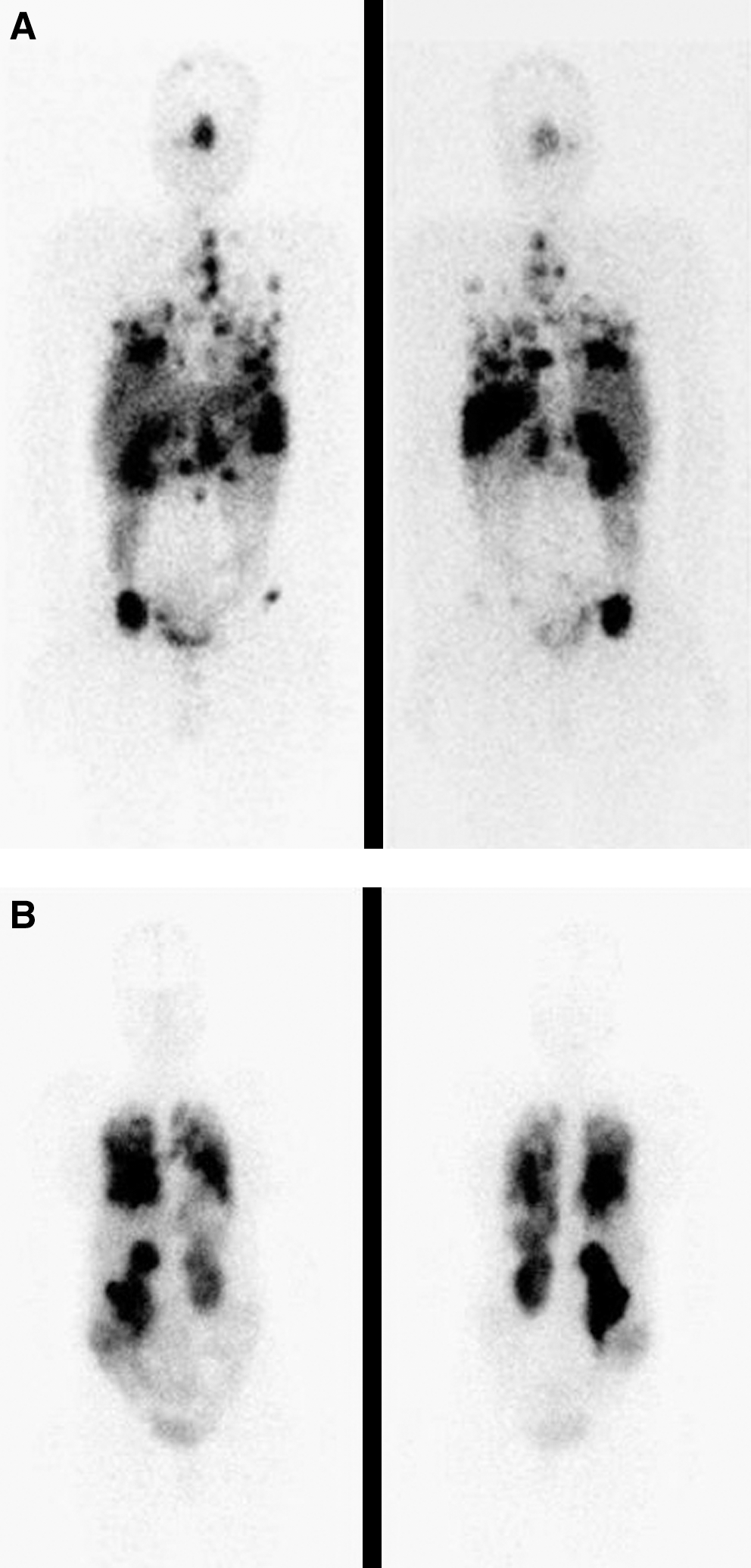
Typical posttherapy whole-body images of patients with neuroendocrine-originated tumors having extensive metastases
Conclusions
A suitable method for the preparation of patient doses of 177Lu-DOTA-TATE, an agent presently being used for targeted therapy of neuroendocrine tumors overexpressing somatostatin receptors, with maximum possible specific activity during its administration to the patients has been developed. The method has the advantage of preparing the agent using the minimum amount of DOTA-TATE depending upon the available specific activity of 177Lu during the time of its preparation, thereby ensuring the preparation of the agent at highest possible specific activity. Suitable, simple and rapid quality control methods were developed for carrying out quick quality control tests of the agent. This method has been successfully employed for the preparation of patient doses of 177Lu-DOTA-TATE at five different major nuclear medicine centers across India and 250 patient doses have been successfully dispensed till date.
Footnotes
Acknowledgments
The authors are grateful to Mr. K.V. Vimalnath Nair for the radiochemical processing of the irradiated Lu targets and Dr. S.V. Thakare and Mr. K.C. Jagadeesan for helping in carrying out the irradiations of Lu target. The authors gratefully acknowledge Dr. V. Venugopal, Director, Radiochemistry and Isotope Group, Bhabha Atomic Research Centre, for his keen interest and constant encouragement.
Disclosure Statement
The authors disclose that there are no financial or other conflicting interests in this work.