




Abstract
Azolyl steroids are known to manifest antiprostate cancer and antiandrogenic activities. These azolyl steroids have been shown to express affinity toward androgen receptors (ARs) overexpressed on LNCaP (human prostate adenocarcinoma) cell line. Hence, suitably derivatized azolyl steroids can be envisaged as potential vectors for targeting overexpression of ARs in prostate cancer. In the present study, testosterone has been derivatized to 17α-azidoandrost-4-ene-3-one using microwave-mediated azidation of the mesylate. Subsequently, a facile one-pot Cu(I)-catalyzed Click reaction was carried out to synthesize 99mTc(CO)3-labeled 17α-triazolylandrost-4-ene-3-one, which was characterized by HPLC. The chemical characterization of 99mTc(CO)3-17α-triazolylandrost-4-ene-3-one was carried out by preparing its corresponding rhenium complex using [NEt4]2[Re(CO)3Br3] precursor. The radiolabeled complex could be prepared in >95% radiochemical yield as determined by HPLC. In vitro studies of 99mTc(CO)3-17α-triazolylandrost-4-ene-3-one complex in LNCaP cell lines overexpressing ARs showed binding of 4.95%±1.2%, with inhibition of 8%±0.9%. In vivo biodistribution studies in male Wistar rats have shown uptake in the prostate to the extent of 0.48%±0.19% injected dose/g at 1 hpi and retention therein till 3 hpi. The present study demonstrates a novel and facile one-pot reaction for preparation of 99mTc-labeled 17α-triazolylandrost-4-ene-3-one complex using Click chemistry. The corresponding Re-analog has been prepared for purpose of comparative characterization with the 99mTc-labeled complex. The radiosynthetic strategy described in this article can be further extended toward preparation of radiolabeled complexes of other triazolyl steroidal derivatives.
Introduction
Prostate cancer is one of the most frequently diagnosed cancers among men. 1,2 Currently used methods for diagnosis of prostate cancer involve invasive procedures, and therefore, patients with prostatic cancer progress to an advanced stage of the disease at the time of diagnosis. 3 –6 To help in early diagnosis and monitoring disease progression, the need for additional means to complement and improve upon the existing approaches is therefore relevant. Noninvasive receptor imaging using radiolabeled molecules can provide an early indication of the disease and help in determining the therapeutic response. Androgen receptors (ARs) are upregulated in prostate cancer cells when compared with normal prostate cells, making them potential biological targets for developing radiotracers for diagnosis and therapy of prostate cancer. 7,8 In search of an ideal AR-based prostatic imaging agent, 8 –13 various androgens have been labeled with several γ-emitting radionuclides, such as 77Br, 82Br, 125I, and 75Se, as well as with the positron emitter 18 F. Because of high cost of production, short half-life of positron (β+)-emitting isotopes, and the need for PET imaging instrumentation, PET has restricted clinical applications. However, the lower cost, easy availability, and longer half-lives of SPECT radioisotopes are the features that contribute toward development of new SPECT-based radiotracers that can be routinely used in hospitals. Technetium-99m is the most suitable SPECT radionuclide for imaging, having ideal nuclear and physical properties (t ½=6 hours, E γ=140 keV).
The major impediments toward the use of radiolabeled androgen-based receptor imaging agents are rapid metabolic cleavage, low receptor binding affinity, and inadequate specific activity. Therefore, the need for a more effective androgen imaging agents still exists. The problem of inadequate specific activity can be circumvented by preparing radiotracers using organometallic technetium tricarbonyl precursor, [99mTc(CO)3(H2O)3]+, which leads to formation of high-specific-activity complexes required for the uptake in low-capacity targets such as ARs. [99mTc(CO)3(H2O)3]+ requires tridentate bifunctional chelating agents (BFCAs) for formation of stable complexes and this has been well studied and evaluated for radiolabeling of various molecules. 14 –18 However, the drawback of these BFCAs is that they require multistep synthesis involving protection of certain groups, which may interfere while incorporation of the targeting molecule. In this respect, it was felt pertinent to explore the versatile click chemistry route in designing a derivative for facile labeling with [99mTc(CO)3(H2O)3]+. 19 –21 The Click reaction, a Cu(I)-catalyzed cycloaddition reaction between a terminal azide and propargyl glycine, leads to formation of a 1,2,3-triazole derivative that provides tridentate coordination via N3 of the triazole ring, which is required for forming stable complex with [Tc(CO)3]+. In Click reaction, the formation of a chelating system in a biologically avid molecule derivatized as an azide and its complexation with 99mTc can be achieved in a single step, making it an attractive strategy to be followed for preparation of Tc(I)-complexes. 22,23
Very few compounds have been labeled with 99mTc for use as androgen-based receptor imaging agents. 24 –27 However, rapid metabolic cleavage, low receptor binding affinity, and inadequate specific activity are the major impediments toward use of these radiolabeled conjugates. Therefore, a need for more effective androgen imaging agents still exists. Ling et al., Njar et al., and Zhu et al. have reported the synthesis of novel 17-imidazolyl, pyrazolyl, and isoxazolyl androstene derivatives as potential agents for the treatment of prostatic cancer. 28 –30 These novel 17-azolyl steroids were found to inhibit P45017α, the key enzyme of androgen biosynthesis. Nnane et al. and Grigoryev et al. have shown that these 17-azolyl steroids manifest antiandrogenic activity in cultures of human prostate cancer cell lines (LNCaP) by preventing the labeled synthetic androgen R1881 from binding to the ARs. 31,32 In the present work, 17-(5′-isoxazolyl)androsta-4,16-dien-3-one (L-39,) 31 and VN/109-1 (Scheme 1) 32 were used as lead compounds, to design and synthesize its 17-triazolylandrost-4-ene-3-one analog labeled with 99mTc, in a one-pot procedure from the precursor 17α-azido-androst-4-ene-3-one, utilizing the novel Click chemistry route for targeting ARs upregulated in prostate cancer.
Materials and Methods
Materials
Carbonyl kit (Isolink® kit) for the synthesis of [99mTc(CO)3(H2O)3]+ precursor was obtained as a gift from Mallinckrodt Medical. All the animal experiments were carried out in compliance with the relevant national laws as approved by the local committee on the conduct and ethics of animal experimentation. LNCaP cells (human prostate adenocarcinoma cell line) were procured from National Centre for Cell Sciences (Pune), the cell repository of India.
General methods
99mTcO4 − was eluted from an in-house 99Mo/99mTc column generator using 0.9% saline. HPLC analyses was performed on a Jasco PU 1580 system and a Jasco 1575 tunable absorption detector and a radiometric detector system having C-18 reversed-phase HiQ Sil (5 μm, 250×4 mm) column. The gradient system consisting of eluting solvents H2O (solvent A) and acetonitrile (solvent B) with 0.1% trifluoroacetic acid was used for HPLC analyses (0–28 minutes, 90% A–10% A; 28–30 minutes, 10% A; 30–32 minutes, 10% A–90% A).
Chemical synthesis
Detailed chemical synthesis, characterization data, and NMR or ESI-MS spectra (Supplementary figures S1–S7) of all newly reported compounds are provided in the Supplementary Data (available online at
Radiochemistry
[99mTc(CO)3(H2O)3]+ precursor
In brief, 99mTcO4 − in 0.9% NaCl from 99Mo/99mTc generator (1 mL, 20–30 mCi) was added to the Isolink kit via syringe. The vial was kept in a boiling water bath for 15 minutes. After cooling the vial to room temperature, 1 N HCl was added to neutralize the solution to pH 7 and decompose any residual boranocarbonate. Radiochemical purity of the precursor was checked by reverse-phase HPLC (Fig. 1A).
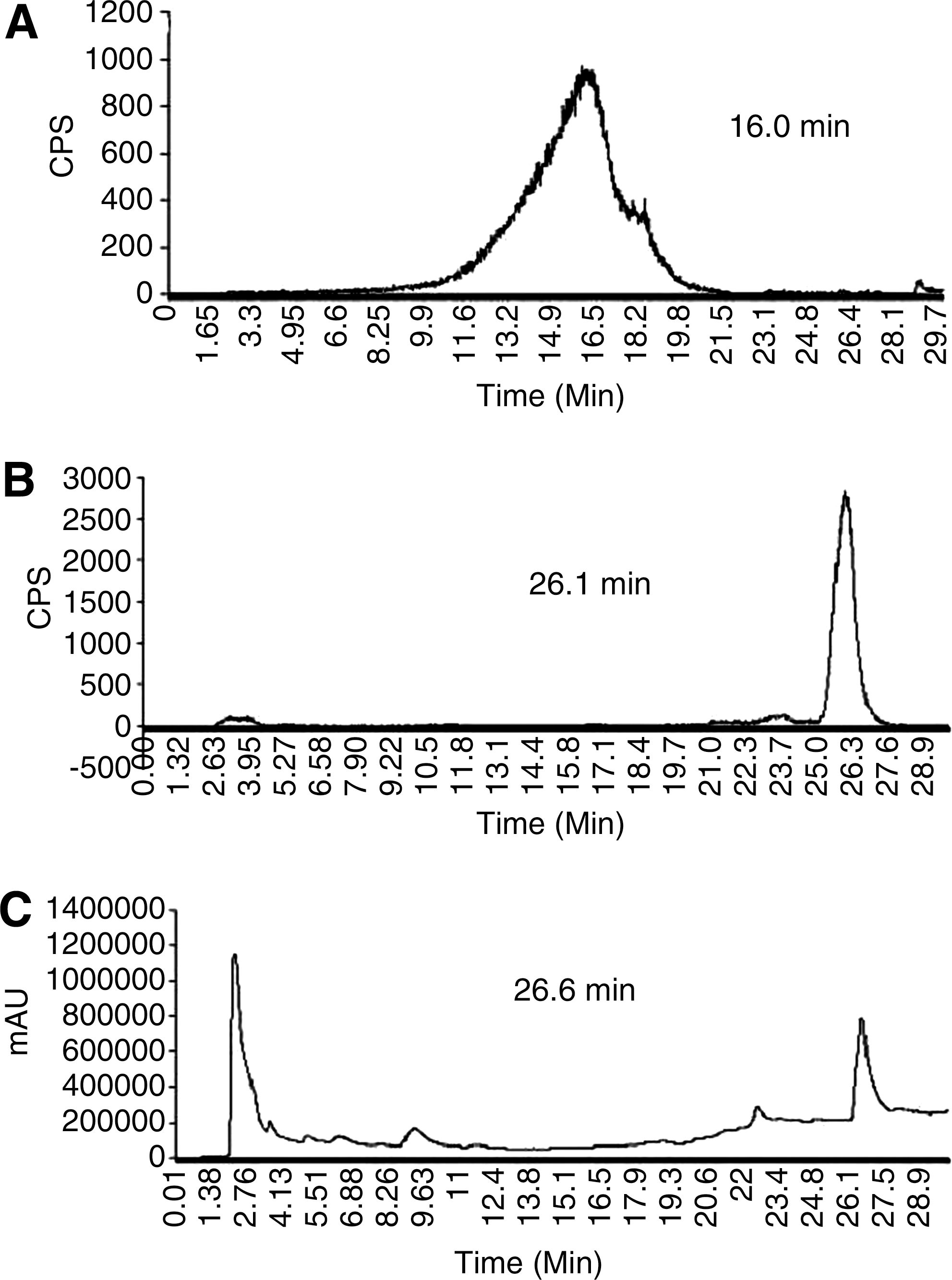
HPLC profile of
99mTc(CO)3-17α-triazolylandrost-4-ene-3-one
(5)
To 0.2 mLsolution (t-butanol/H2O 1:1) of compound
In vitro stability assessment
The stability of 99mTc(CO)3-17α-triazolylandrost-4-ene-3-one (
To study the stability of 99mTc(CO)3-17α-triazolylandrost-4-ene-3-one (
In vitro cell uptake studies
Cell uptake studies were carried out using LNCaP cells (human prostate adenocarcinoma cell line). The cells were maintained at 37°C in humidified 5% carbon dioxide atmosphere in RPMI 1640 medium with 2 mM
Biodistribution studies
The biodistribution studies were carried out according to the relevant national regulation using mature (5–6 weeks old) male Wistar rats weighing between 180 and 200 g. The 99mTc(CO)3-17α-triazolylandrost-4-ene-3-one
Results and Discussion
Synthesis
The structure of
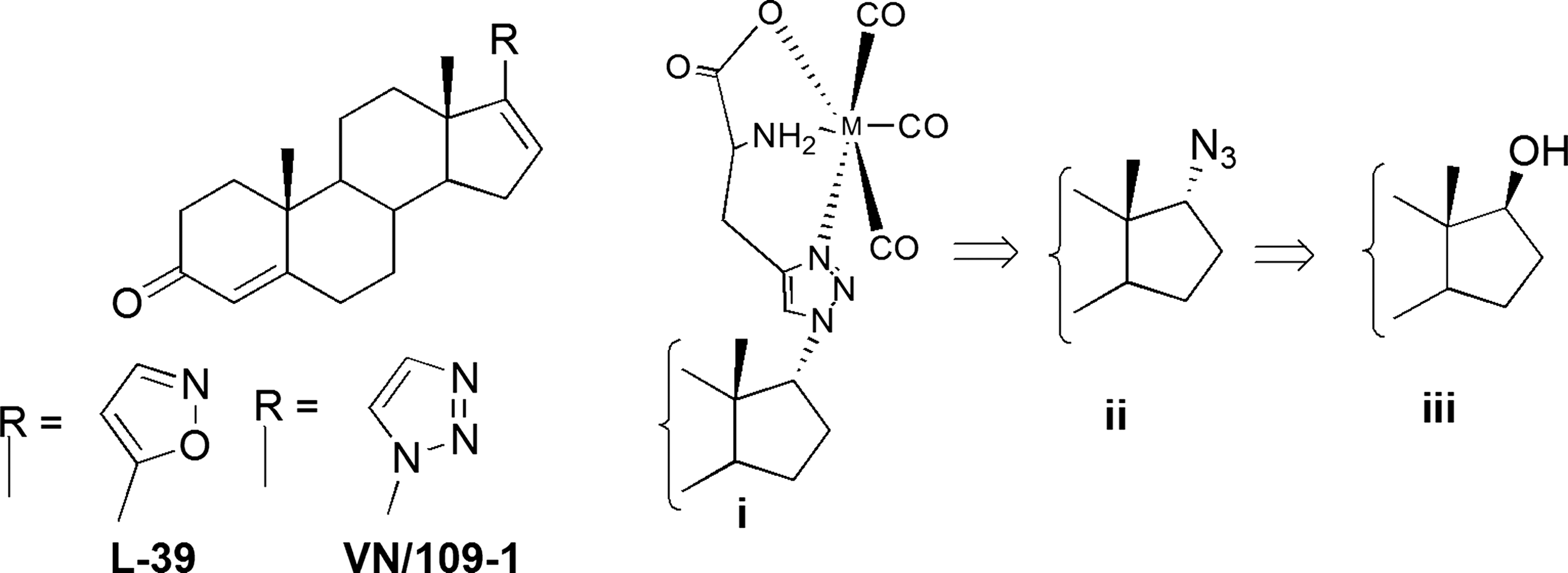
Retrosynthetic analysis of the 99mTc-labeled triazole analog of L-39. M=99mTc, Re.
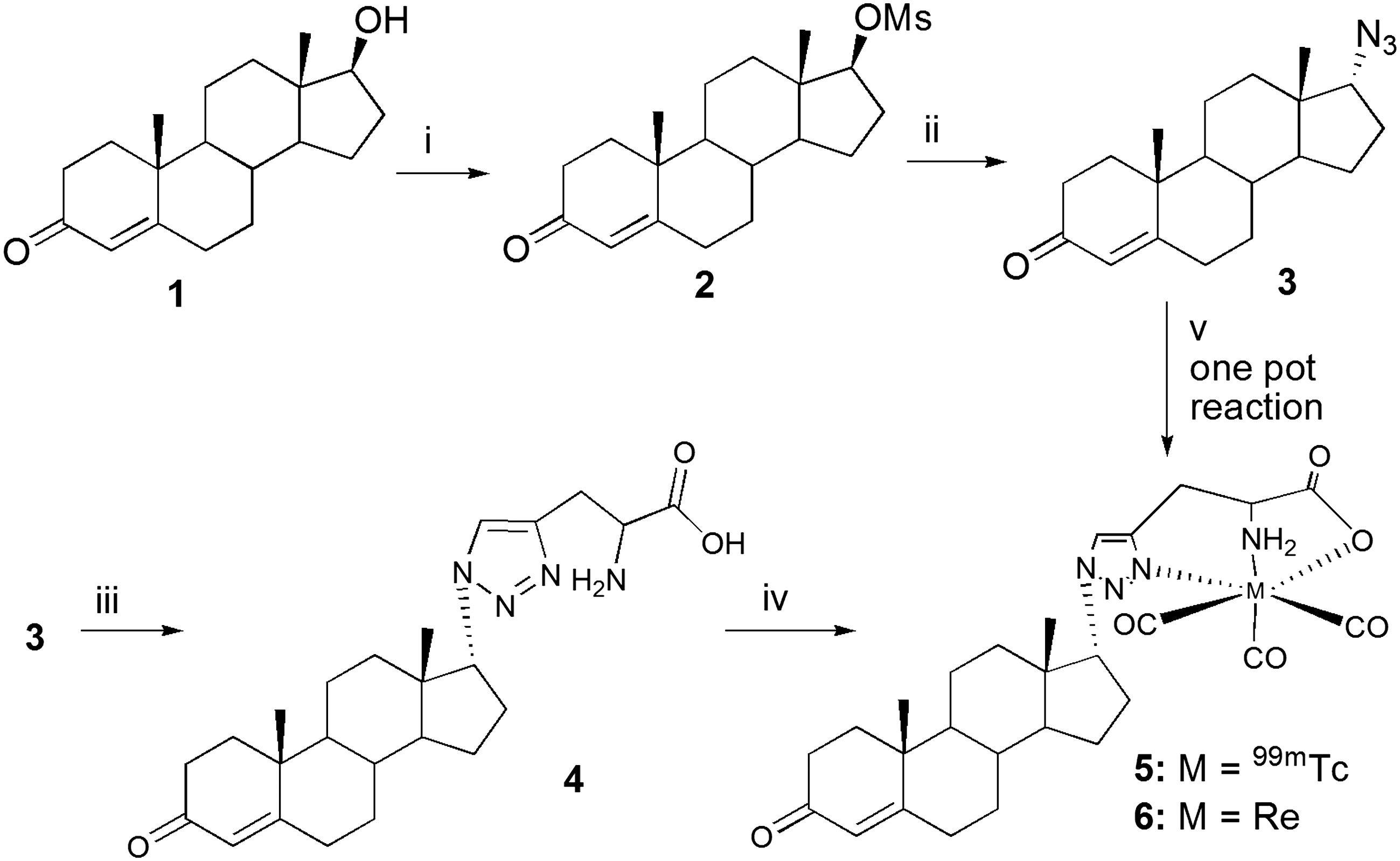
Reagents and conditions. (i) MsCl, Pyridine, 0°C, 30 minutes; (ii) DMSO, NaN3, microwave (350 W), 2 minutes; (iii) Cu (II) acetate, Na-ascorbate, propargylglycine, t-BuOH+H2O (1:1), room temperature, 12 hours; (iv) for
The present synthesis commenced with mesylation of testosterone (
Radiolabeling
Triazole
The 99mTc(CO)3-triazole complex
The lipophilicity of 99mTc(CO)3-17α-triazolylandrost-4-ene-3-one
In vitro stability and cell uptake studies
The affinity of the radiolabeled complex toward ARs has been tested by carrying out in vitro and in vivo studies. In vitro stability of the complex was studied in phosphate-buffered saline at pH 7.0 as well as in serum after 6 hours of incubation at 37°C. The complex was found to be stable even after 6 hours of preparation. In serum stability studies, nearly 50% of the activity was associated with the precipitate obtained after acetonitrile addition, indicating high binding of complex with serum proteins. The acetonitrile fraction was characterized by HPLC, wherein a single peak was observed at the same retention time (26.1 minutes, >95%) as that of the complex, indicating no decomposition of the complex and hence its stability under 37°C incubation.
To assess the kinetic inertness of the complex under physiological condition, the challenge studies were carried out by incubation of the radiolabeled complex with excess of histidine and cysteine. The HPLC pattern of the complex (retention time: 26.1 minutes) remained unaltered with no indication of the appearance of a new peak corresponding to that of either 99mTc(CO)3-histidine or 99mTc(CO)3-cysteine complex. This demonstrates the kinetic inertness of the complex, indicating no transchelation with the ligands, histidine, or cysteine.
To determine the affinity of the 99mTc(CO)3 triazole complex (
In vivo studies
99mTc(CO)3-17α-triazolylandrost-4-ene-3-one
To determine whether the uptake was mediated by AR, a blocking study was carried out by coinjection of 80 μCi of 99mTc(CO)3-17α-triazolylandrost-4-ene-3-one with 25 μg testosterone to saturate the AR. The blocking studies did not show any decrease in the prostate uptake though inhibition was observed in in vitro cell studies. This may be attributed to the difference in physicochemical conditions while carrying out cell uptake studies in vitro and that present in vivo.
At 3 hours postinjection point, uptake by prostate was 0.45±0.08 similar to that at 1 hour postinjection. There was a significant decrease in muscle uptake to 0.02±0.01, thereby significantly increasing the prostate/muscle ratio to 24.22±14.68. Uptake in the blood was 0.06±0.03, causing the prostate/blood ratio to reduce to 8.50±3.25 compared with 1 hour postinjection. In vivo biodistribution studies revealed that 45%–50% of the total injected activity was associated with the carcass. The binding of steroidal hormones to the adipose tissue in rats has been reported. 36 The low activity in blood and liver may be probably attributed to binding of the radioligand to the adipose tissue associated with the carcass.
Conclusion
The testosterone molecule could be successfully derivatized at 17-position to introduce a triazole moiety radiolabeled with 99mTc(CO)3 core via click chemistry route. The radiolabeled complex could be obtained in >95% radiochemical yield as determined by radiochromatogram in HPLC. The retention time in HPLC-UV profile of Re(CO)3-17α-triazolylandrost-4-ene-3-one was similar to that of the radioactive peak of 99mTc(CO)3-17α-triazolylandrost-4-ene-3-one observed in HPLC, thereby confirming the identity of the complex. Preliminary biodistribution studies in normal male Wistar rats have shown favorable uptake in prostate with significantly less uptake in other organs. However, 99mTc(CO)3-17α-triazolylandrost-4-ene-3-one did not show specificity toward ARs in in vivo biodistribution studies, indicating the loss of affinity due to introduction of a chelating group and the lipophilic 99mTc-tricarbonyl core.
Footnotes
Acknowledgments
The authors are thankful to Dr. V. Venugopal, Director, Radiochemistry and Isotope group, and Dr. Meera Venkatesh, Head Radiopharmaceuticals Division, for their constant encouragement and support toward this work. Manish V. Dhyani is thankful to Department of Atomic Energy, Government of India, for the research fellowship.
Disclosure Statement
No competing financial interests exist.
References
Supplementary Material
Please find the following supplemental material available below.
For Open Access articles published under a Creative Commons License, all supplemental material carries the same license as the article it is associated with.
For non-Open Access articles published, all supplemental material carries a non-exclusive license, and permission requests for re-use of supplemental material or any part of supplemental material shall be sent directly to the copyright owner as specified in the copyright notice associated with the article.
