




Abstract
Radioiodine (131I) has been widely used for the treatment of patients with thyroid diseases. However, there is a persisting concern about the induction of second tumor and genetic damage after 131I therapy. The purpose of this study was to investigate the radioprotective effects of Origanum vulgare extract against genotoxicity induced by 131I in human lymphocytes. Whole blood samples from human volunteers were incubated with origanum extract at doses of 12.5, 25, 50 and 100 μg/mL. After 1 hour of incubation, the lymphocytes were incubated with 131I (20 μCi/mL) for 1 hour. The lymphocytes were then cultured with a mitogenic stimulant to evaluate micronucleus formation in cytokinesis-blocked binucleated cells. Incubation of lymphocytes with 131I induced additional genotoxicity and shown by increases in micronuclei (MN) frequency in human lymphocytes. Origanum at three last doses significantly reduced the MN frequency in cultured lymphocytes. The maximum protective effect and the maximum decrease in the frequency of MN were observed at 100 μg/mL of origanum, which caused a reduction of 70% (p<0.0001). Origanum extract also exhibited an excellent and dose-dependent radical-scavenging activity against 1,1-diphenyl-2-picrylhydrazyl-free radicals. This study has important implications for patients undergoing nuclear medicine procedures. The results indicate a protective role for origanum extract against the genetic damage induced by radiopharmaceutical administration.
Introduction
Humans are probably exposed to ionizing irradiation through both external and internal contamination. In internal contamination, radioactive substances accumulate and cause irradiation of critical organs. Ionizing radiation passing through living tissues generates free radicals. Interactions of free radicals with DNA can induce DNA damage leading to mutagenesis and carcinogenesis. 1 One significant source of internal irradiation stems from the use of radiopharmaceuticals in nuclear medicine procedures. Radiopharmaceuticals, which are often used for diagnostic and therapeutic purposes, contain at least one radionuclide and a nonradioactive ligand. 2 Among the therapeutic radionuclides, radioiodine (131I) has been widely used for the last 50 years for the treatment of patients with thyroid diseases like hyperthyroidism to reduce the size of the thyroid gland or with differentiated thyroid cancer to eliminate remnant tumor cells after thyroidectomy. 3 The widespread use of 131I in nuclear medicine is due to its physical and radiochemical properties. It is a β particle (Emax=0.61 MeV and Eavg=0.20 MeV) and gamma ray (E=0.36 MeV) emitter, with a physical half-life of ∼8 days, which accumulates preferably in the thyroid tissue. About 90% of the secondary effects of its radiation are the result of the β particles, whose track length is relatively short (∼0.8 mm) in soft tissue. 4
Most studies have shown no increased mortality due to secondary malignancies in patients receiving 131I therapy for hyperthyroidism, provided that standard radioprotection procedures are fulfilled. 5 However, an increased overall cancer incidence among hyperthyroid patients treated with 131I has been recently reported. 6 Some chromosomal damage to peripheral lymphocytes has been reported in Graves' disease patients treated with 131I. 7 Chromosomal abnormalities can be assessed simply by evaluating the frequency of micronuclei (MN) in dividing cells, an index of either numerical or structural chromosome alterations. 8 Therefore, the yield of MN in peripheral blood lymphocytes can be considered as a real “biological dosimeter” for radiation exposure of patients undergoing radiation therapy. 9 In a recent study, it was demonstrated that the MN frequency of peripheral blood lymphocytes, as well as the formation of CFs in Graves' patients treated by 131I were associated with an impairment of antioxidant defenses, as demonstrated by a significant depletion of vitamin E. 7
The protective capacity of thiol-containing compounds against normal tissue damage from radiation has been recognized for over 40 years. 10 Amifostine, belongs to the class of synthetic thiol compounds, and is a powerful radioprotective agent compared to other agents, but this drug has limited use in clinical practice due to its side effects and toxicity. The search for less toxic radiation protectors has spurred interest in the development of natural compounds. 11 Medicinal plants have potential preventive properties because of chemical constituents, such as phenolic compounds and flavonoids. Flavonoids and phenolic compounds have many biological properties, including hepatoprotective, antibacterial, anticancer, antioxidant, and free-radical scavenging activity. 12 It has been reported that Zataria multiflora has powerful protection effects on DNA damage induced by γ-irradiation on human lymphocytes. 13 The chemical composition of Zataria showed that it has several phenolic compounds, such as thymol, carvacrol, hydroxyl benzoic acid, and cymene. 14,15
The genus Origanum belongs to the family of Labiatae and includes many species that are commonly found as wild plants in the Mediterranean areas, Euro-Siberian, and Irano-Siberian regions. 16,17 Origanum vulgare L. is the only species of the Origanum genus growing wild in Iran. O. vulgare L. is widely spread all over the country, particularly Gilan, Mazandaran, and West Azarbaijan provinces. Recent studies have shown that Oregano displays antioxidant, antifungal, and antibiotic properties. Due to its antioxidant functions; Oregano could become helpful agent in treatment of cancer, heart disease, and high blood pressure. It is also useful as a digestive aid, since it promotes salivation. Used externally, Oregano is successful in treatments of rheumatism, muscle and joint pain, sores, and swellings. Oregano oil can help combat toothache. 18 Results of various studies indicated that the antioxidant effects of oregano might be related to the dominant components, including, carvacrol and thymol, present in its essential oil. 19
Although many studies have evaluated natural products as radioprotective agents in animals and humans, little is known about the effects of radioprotective agents against damage from radiopharmaceuticals. Thus, this study was undertaken to assess the effects of origanum extract against genotoxicity induced by 131I in human peripheral blood lymphocyte using the micronucleus test.
Materials and Methods
Chemicals
The solution of 131I was prepared from AEOI, Tehran, Iran. 1,1-Diphenyl-2-picrylhydrazyl radical (DPPH) was purchased from Sigma Chemicals Co. Butylated hydroxyanisole was purchased from Merck. All chemicals were obtained from Merck and Sigma and were used without further purification.
Plant material
Origanum vulgare L. dried powder of the plant was purchased from the Giah Essence Phyto-Pharmaceutical Co. Aliquots of 200 g of the dried powder of the plant were extracted with 2000 mL of ethanol (75%) for 72 hours. After evaporation of solvent under reduced vacuum at a temperature below 50°C, 25 g of dried powder was obtained.
Measurement of the free-radical-scavenging activity of origanum
The free-radical-scavenging capacity of methanolic extract was determined based on the bleaching of the stable DPPH. 20 Different concentrations of origanum extract (0.0125–0.2 mg/mL) were added, in a volume of 1 mL, to 3 mL of a methanolic solution of DPPH (10 mg/250 mL). After 15 minutes of incubation at room temperature in the dark, the absorbance was recorded at 517 nm. The experiment was performed in triplicate. butylated hydroxytoluene (BHT) was used a standard antioxidant agent. The percentage of scavenged, free radicals was calculated using the following formula: ([Control_Test]/Control)×100.
Blood treatment
The protocol for this study was approved by the National Elites Foundation of Iran, Tehran, Iran. Informed consent was obtained from five healthy, nonsmoking human volunteers, who were all men aged between 25 and 35 years. Seven milliliters of whole blood was collected in heparinized tubes and divided into seven 1-mL tubes. The blood samples were treated with 50 μL of origanum extract solution to give final concentrations of 12.5, 25, 50, or 100 μg/mL and were then incubated for 1 hour at 37°C. Subsequently, 20 μCi of 131I was added to the blood samples, which were then incubated for 1 hour. The positive control tube contained only 20 μCi of 131I, and the control sample received no treatment. Another control group treated with only high concentration of 100 μg/mL origanum to observe the safety of the high concentration on human lymphocyte. After incubation, the samples were washed out thrice to separate 131I from the whole blood. RPMI 1640 medium was added to each tube and the cultures were centrifuged at 1200 rpm for 8 minutes and then the upper (less dense) solution was removed and blood samples were transferred for micronucleus assay.
MN assay
Duplicate 0.5-mL aliquots of each sample were added to 4.5 mL of RPMI 1640 culture medium (Gibco) containing 20% fetal calf serum, 20 μL/mL phytohemagglutinin (Gibco), 50 U/mL penicillin, 50 μg/mL streptomycin and 2 mM glutamine (Sigma). All cultures were incubated at 37°C±1°C in a humidified atmosphere of 5% CO2 and 95% air. Cytochalasin B (final concentration: 6 μL/mL) was added after 44 hours of culture. After 72 hours of incubation, the cells were collected by centrifugation for 8 minutes at 1000 rpm, resuspended in 0.075 M cold potassium chloride, and then immediately treated with a fixative solution (methanol:acetic acid, 6:1) thrice. The fixed cells were dropped onto clean microscopic slides, air-dried and stained with Giemsa solution. All slides were evaluated at 40× magnification to determine the frequency of MN in cytokinesis-blocked binucleated cells with well-preserved cytoplasm. Image of typical binucleated cells with and without a micronucleus are shown in Figure 1. The criteria for scoring MN were a diameter between 1/16th and 1/3rd of the diameter of the main nuclei, a nonrefractile nature, no link to the primary nucleus, and no overlap with the primary nucleus. 21 Additionally, the two main nuclei of the cell had to be completely divided for the cell to be countable as a binucleated cell. In each blood sample group and for each volunteer, 1000 binucleated cells were scored from the treated and control cultures in duplicate to determine the frequency of MN.
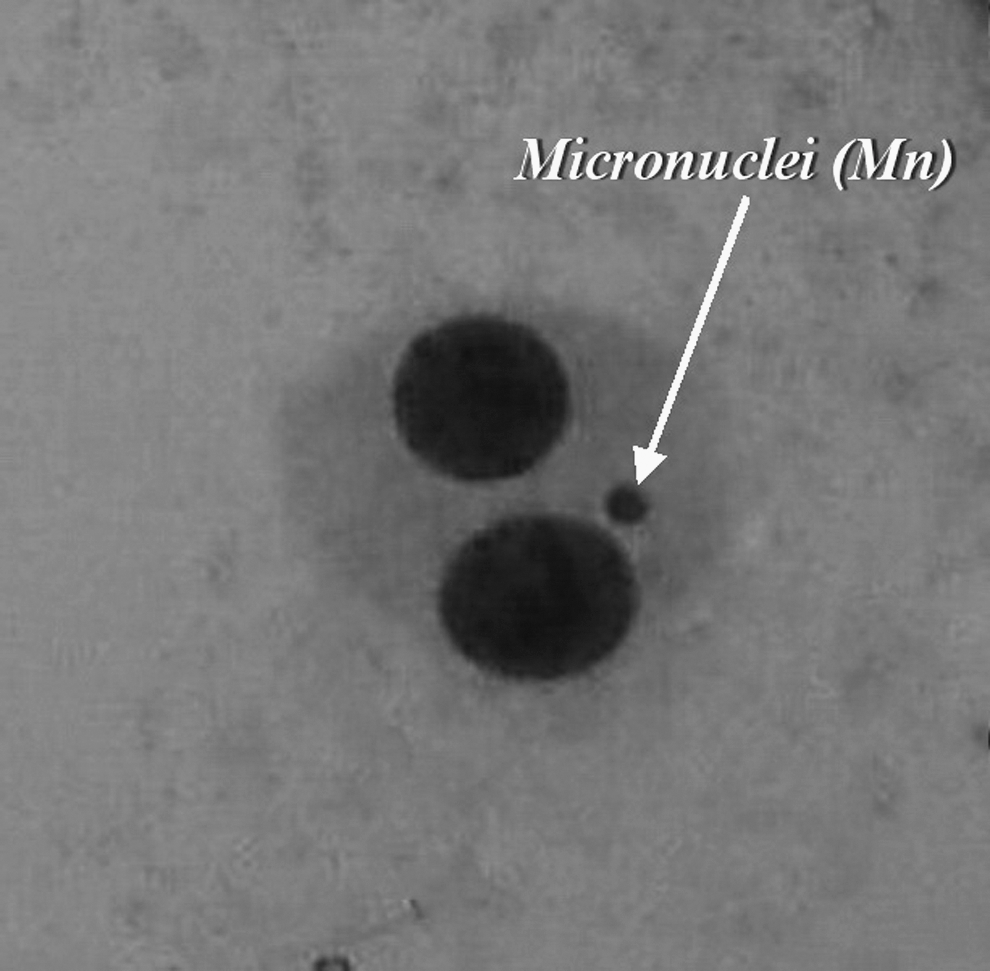
A typical binucleated lymphocyte with micronuclei (Mn).
Statistical analysis
For each volunteer, the number of MN was recorded for each group. The data are presented as the means±standard deviation. The data were analyzed using ANOVA with Tukey's honestly significant difference post hoc test. A p-value of less than 0.05 was considered significant.
Results
Excellent scavenging effect was observed with origanum extract. The scavenging effects of methanolic extracts from origanum on DPPH radicals increased with increasing concentrations; it was 97.47% at 0.2 mg/mL (Fig. 2).
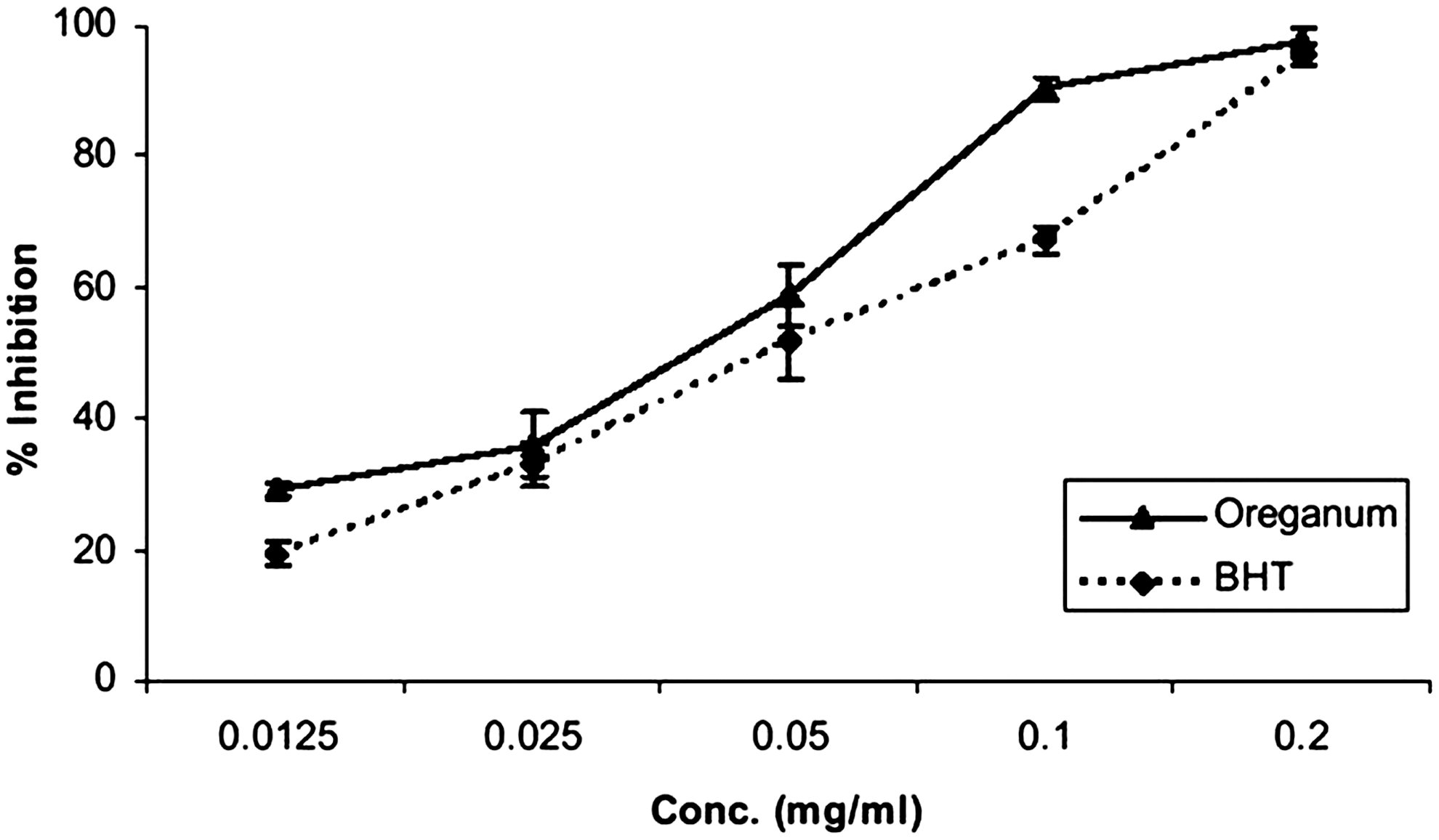
Scavenging effect of different concentrations of Origanum vulgare (▲) and BHT (■) on the 1,1-diphenyl-2-picrylhydrazyl-free radical at 517 nm. BHT, butylated hydroxytoluene.
The data presented in Figure 3 show that there was a significant difference in the percentage of micronucleated binucleated cells between lymphocytes treated with 20 μCi of 131I and the control cells (p<0.0001). The percentage of MN in the lymphocytes of volunteers treated with 131I was 12.46%±1.17%, whereas the percentage in nontreated control lymphocytes was 1.03%±0.2% (Table 1). Origanum extract at last three-doses had a potent protective against the DNA damage induced by 131I. The protective effect of origanum and the reduction of the frequency of MN by origanum increased with increasing concentration. The frequencies of MN in groups of cells that were pretreated with origanum at doses of 12.5, 25, 50, and 100 μg were 10.9%±0.78%, 8.56%±0.8%, 5.6%±0.7%, and 3.73%±0.35%, respectively (Table 1). The results for origanum at last three-doses were significantly better than the result for the 131I sample (Fig. 3). The total micronucleated binucleated cell values were 31%, 55%, and 70% less for the 25, 50, and 100 μg concentrations of origanum extract, respectively, than in controls. The maximum protective effect of origanum, which was observed at 100 μg, strongly prevented the formation of MN induced by 131I and protected human lymphocytes against 131I-induced DNA damage (p<0.0001). In spite, origanum extract did not show any significant protective effect at low concentration of 12.5 μg. Origanum did not also cause any additional genotoxicity at high concentration of 100 μg.
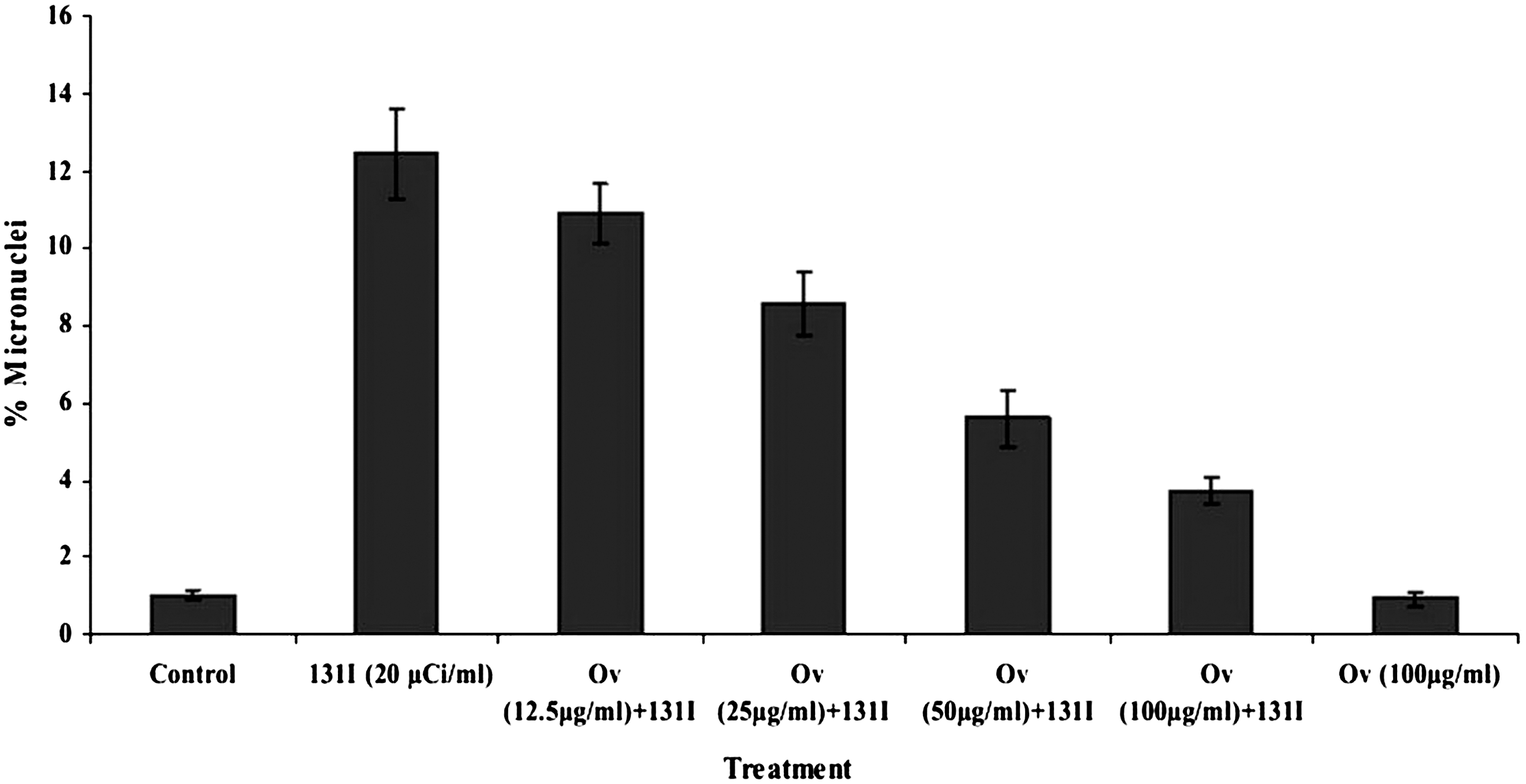
In vitro protection by Origanum vulgare extract (Ov) at different concentrations (12.5, 25, 50, and 100 μg/mL) against genetic damage induced by radioiodine (131I) (20 μCi/mL) in cultured whole blood lymphocyte. The data represent the mean±standard deviation of five human volunteers. p<0.0001: Control sample compared with similarly irradiated lymphocytes from the blood sample treated with 131I. p<0.0001: 131I sample compared to 131I+Ov100. p<0.001: 131I sample compared to 131I+Ov25, 131I+Ov50 samples. p>0.05: 131I sample compared to 131I+Ov12.5. p>0.05: Control sample compared with similar lymphocytes from the blood sample treated with Ov100.
One thousand binucleated cells were examined in each sample.
131I, radioiodine; Ov, Origanum vulgare extract.
Discussion
Measures of genotoxicity have been used to estimate the risk of damage induced by internal irradiation from the radiopharmaceutical. 2 In the last years, the micronucleus assay in human lymphocytes has been extensively used to assess the cytogenetic damage induced by chemicals and radiation. This assay after the improvements introduced by Fenech and Morley 22 appears to be sensitive, simple, and fast enough to detect agents that induce chromosome damage. 23 This method uses cytochalasin B for arresting cytoplasm division, which permits the identification of lymphocytes that have divided once in culture. 22
Up to now, several cytogenetic studies have been performed with patients treated with 131I therapy; they have reported significant increases in chromosome aberrations 23 –25 and MN 26 –29 in thyroid cancer patients after 131I treatment. By using this technique, many scientists have also studied the presence of MN in hyperthyroidism patients, 30 who received 131I therapy. Therefore, there is a persisting concern about the induction of second tumor and genetic damage after 131I therapy, 31,32 as the genotoxic effect of irradiation is indisputable.
Irradiation generates free radicals of oxygen, such as superoxide, peroxide, hydroxyl radicals, and their intermediates, which in turn induce lipid peroxidation of membranes and cell structures. A certain degree of imbalance, known as the “oxidative stress,” may occur between radical-generating and radical-scavenging systems and lead to severe damage in certain critical cell structures, including chromosomes. 24,33 –37 Ionizing radiation generates free radical damage in DNA and induces genotoxic effects and death in the cells. With respect to the potential application of ionizing radiation in medical practices (e.g., radiotherapy and nuclear medicine), the development of effective radiomodifiers is highly desired and also the radioprotectors undoubtedly have an important role for tolerance and increasing the survival rate in patients. 1 However, the study of radioprotective effects in human volunteers is limited by the impossibility of irradiating healthy humans for experimental research; in addition, only in vitro studies, such as the method presented here can be used in clinical practice for the evaluation of the efficacy of safe radioprotective agents in human volunteers. 11 In the present study, Origanum vulgare extract significantly protects against genotoxicity induced by the radioactive 131I in lymphocytes. It is noteworthy that this protective effect was elicited without any adverse modification of origanum extract even at a high dose of 100 μg/mL. In detail, our data confirm that 131I therapy induces a significant genetic damage characterized by the increase of MN in blood lymphocyte.
Although the exact mechanism of radioprotective effect is unknown, free-radical scavenging is apparently responsible for inhibitory effect of herbal extract and natural origin compounds on the clastogenic activity induced by ionizing radiation. 1 Natural compounds, including flavonoids and phenolic compounds may play a role in scavenging free radicals, such as hydroxyl radicals generated by chemical hazardous agents. Increase in the intracellular level of reactive oxygen species, frequently referred to as oxidative stress, represents a potentially toxic insult, which interacts with macromolecules to induce DNA damage. 13 It was reported that the antioxidant effect of aromatic plants is due to the presence of hydroxy groups in their phenolic compounds. Thymol [5-methyl-2-(1-methylethyl) phenol] is an isomer of carvacrol, having the hydroxyl group at a different location on the phenolic ring. It seems that the high antioxidant activity of these compounds is due to the presence of phenolic OH groups which act as hydrogen donors to the peroxy radicals produced during the first step in lipid oxidation; 38 thus, retarding the hydroxy peroxide formation induced by ionizing radiation. The aromatic plant Origanum vulgare may act as a potent radioprotective agent due to its phenolic compounds, such as thymol and carvacrol. These compounds are rich in OH groups and can scavenge free radicals induced by ionizing radiation. Therefore, origanum extract may reduce side effects and genotoxicity induced by 131I with its radical scavenging mechanism.
Several studies have shown that thymol and carvacrol has chemoprotective and radioprotective effects against toxicity and genotoxicity induced by chemical agents and ionizing radiation. 39 –42 The essential oil from O. onites, carvacrol, and thymol showed a protective (antioxidant) effect against cytotoxic effect and membrane damage induced by H2O2 on Hep G2 cells, depending on the concentrations. 43 In another study, the incubation of Hep G2 and Caco-2 cells in the presence of the whole scale of concentrations of carvacrol or thymol led, in both cases, to a significant protection of the cells studied from DNA strand breaks induced by the potent oxidant hydrogen peroxide. 39 Aydin et al. 44 also observed that the phenolic compounds thymol and carvacrol significantly reduced the oxidative damage in human lymphocytes. Carvacrol and thymol had also dose-dependent antiproliferative effects on human uterine carcinoma cells. 45
In our study, origanum extract showed a potent radical-scavenging activity against free radicals by DPPH method, which shows that it, has more antioxidant activity than BHT, a standard antioxidant. As phenolic compounds exert excellent antioxidant activity, thymol and carvacrol are two main compounds for the antioxidant activity of origanum. The main characteristic of antioxidants is an ability to trap free radicals. Highly reactive-free radicals and oxygen species are present in biological systems from a wide variety of sources. The free radicals may oxidize nucleic acids, proteins, lipid, and DNA and can initiate degenerative diseases. Antioxidant compounds, such as phenolic acids, polyphenols, and flavanoids scavenge free radicals, such as peroxide and lipid peroxyl and thus inhibit the oxidative mechanisms that lead to degenerative diseases. 46
Conclusion
In conclusion, we showed that origanum extract protects human lymphocytes against genotoxicity induced by internal irradiation. For all three volunteers, the 131I-treated lymphocytes incubated with origanum showed a reduction in MN frequency as compared to 131I-treated samples without origanum. This finding suggests that origanum acts effectively as a free-radical scavenger as such radioprotection is concentration dependent. Origanum treatment at 100 μg/mL provides maximum leukocyte protection. Since origanum has been used extensively as an additive agent, and with regards to potential radioprotective effect, it may be a useful therapeutic candidate for patients undergoing nuclear medicine procedures.
Footnotes
Acknowledgment
This study was approved and supported by a grant from the National Elites Foundation of Iran, Tehran, Iran. The author wishes to thank Dr. Fariba Johari-Daha for her expert technical assistance in the preparation of 131I from AEOI, Tehran, Iran.
Disclosure Statement
The authors declare that there is no conflict of interest.